
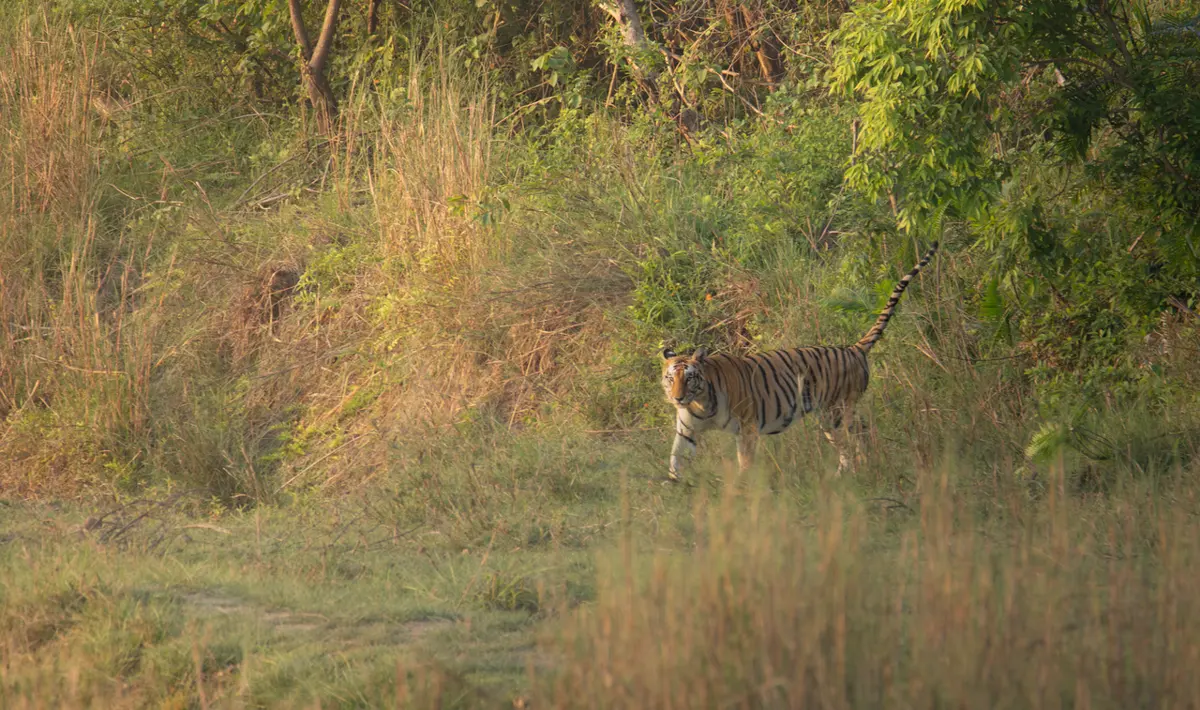
In July 2026, Nepal announced its latest count of wild tigers: 429, up from 355 in 2022, in five national parks of the Tarai: Chitwan (145), Bardiya (112), Parsa (71), Banke (51) and Shuklaphanta (50). A tiger eats only meat. Yet every one of those tigers depends on grass, and on the sunlight that grass catches. Take away the tall grasslands of the Tarai, and the deer go first, then the tigers.
Why does a park with thousands of deer have only a hundred or so tigers? Why can’t a food chain go on for ten or twenty steps? And what happens to the carbon, oxygen and nitrogen in a deer after the tiger has eaten it? This unit answers all three with three ideas: the pyramids that show the levels of an ecosystem, the one-way flow of energy up those levels, and the cycles that carry matter round and round.
4.1 Biological pyramid
What a biological pyramid is
Count every living thing in a field of grass, sort them by trophic level (what level of the food chain they feed at), and draw each level as a bar: the producers at the bottom, the plant-eaters on top of them, the meat-eaters above. In most ecosystems each bar is narrower than the one below it, and the bars stack into a shape like a pyramid.
A biological pyramid (also called an ecological pyramid) is a diagram that shows the number of organisms, their biomass or their energy at each trophic level of a food chain, drawn as bars one above the other, with the producers at the base and the top consumers at the apex.
The British ecologist Charles Elton first drew pyramids of numbers in 1927, in his book Animal Ecology. He had noticed, on Arctic islands and in English woods, that small animals are many and big ones few, and that the animals at the top of a food chain are always the rarest. Pyramids of numbers are still sometimes called Eltonian pyramids after him.
Every pyramid follows three rules:
- The producers are always at the base, the primary consumers (herbivores) on the next bar, then the secondary and tertiary consumers (carnivores and top carnivores).
- Each bar shows one trophic level of one ecosystem, all measured the same way, for the same area (a square meter, a hectare) or the same volume of water.
- Decomposers are not drawn as a bar: they feed on dead matter from every level.
There are three kinds of pyramid, by what is measured: numbers, biomass and energy.
Pyramid of numbers
A pyramid of numbers shows how many individual organisms there are at each trophic level of an ecosystem, in a given area, at a given time.
In a grassland, the producers are small grass plants in huge numbers. A few hundred thousand insects eat them, fewer spiders and insect-eating insects eat those, and a bird or two eat them. Each level has fewer individuals than the one below, so the pyramid is upright. A pond is the same: millions of tiny algae, thousands of water fleas, hundreds of small fish, a few large fish.
But a pyramid of numbers doesn’t always stand the right way up, because it counts a blade of grass and a sal tree as one each.
- In a forest in summer, a few big trees carry a hundred thousand or more caterpillars and other insects, which feed fewer birds. The base is narrow, the middle wide and the top narrow again: a spindle-shaped pyramid, inverted at the base.
- In a parasite chain, each feeder is smaller and more numerous than the one it lives on: one tree, a few dozen birds feeding on its fruit, thousands of lice on the birds. The pyramid of numbers is fully inverted (upside down).
The bars are on a ten-times scale (the key under them), so that 1 bird and 1,500,000 grass plants fit on one screen; the order of the widths, and so the shape, is the same as on an ordinary scale. The numbers for the grassland and the forest are real counts per tenth of a hectare in summer, collected by the American ecologist Eugene Odum (as given in OpenStax Biology 2e). The tree’s numbers are made up, round numbers to show the shape.
Pyramid of biomass
Counting can’t tell a tree from a blade of grass, but weighing can. Biomass is the total mass of living matter at a trophic level, usually as dry mass (with the water dried out) in grams per square meter, g/m².
A pyramid of biomass shows the total biomass of the organisms at each trophic level, in a given area, at a given time.
Weigh the forest instead of counting it, and the inverted pyramid of numbers turns upright: a few trees weigh many tonnes, far more than all the caterpillars on them. On land, pyramids of biomass are almost always upright. So are those of most rivers and lakes with large water plants: at Silver Springs, a clear river in Florida, the plants and algae weighed 809 g/m², the plant-eaters 37, the fish that ate them 11 and the top fish 1.5 (H. T. Odum, 1957).
In some seas and lakes, though, the pyramid of biomass is inverted. In the English Channel the tiny floating algae (phytoplankton) weighed about 4 g/m² and the tiny animals eating them (zooplankton) about 21 g/m². How can 4 g of food feed 21 g of animals? Because a pyramid of biomass is a snapshot at one moment. Phytoplankton live only a few days. They divide so fast, and are eaten so fast, that a small crop at any moment adds up to far more food over a year than the zooplankton weigh. Going Further compares this to a small tea stall: Pyramids of energy and mass.
Pyramid of energy
A snapshot can mislead, so ecologists also measure the flow. A pyramid of energy shows the amount of energy taken in by each trophic level, per unit area, over a period of time, usually in kilojoules per square meter per year (kJ/m² per year).
At Silver Springs the levels took in 87,100, 14,100, 1,600 and 88 kJ per square meter in a year (try A river under Energy in the widget). Each level takes in only part of the energy of the level below, and some of that is lost as heat at every step (4.2). So in every ecosystem, on land or in water, a pyramid of energy is always upright. It can never be inverted.
The three pyramids compared
| Pyramid of numbers | Pyramid of biomass | Pyramid of energy | |
|---|---|---|---|
| What it shows | individuals at each level | dry mass of living matter at each level | energy taken in by each level |
| Unit | number per area | g/m² (dry mass) | kJ/m² per year |
| Time | at one moment | at one moment | over a period (a year) |
| Shape | upright, spindle or inverted | upright, or inverted (some seas and lakes) | always upright |
| Inverted example | a tree with its insects; a parasite chain | phytoplankton and zooplankton | never |
| Weakness | counts a tree and a blade of grass alike | misses how fast a level grows and is eaten | hardest to measure |
The pyramid of energy gives the truest picture of how an ecosystem works, because it shows the flow that everything else depends on. It is also the hardest to make: an ecologist has to measure how much each level eats, grows, breathes out and drops, through a whole year.
A single mango tree carries about 2,000 caterpillars, which are eaten by 20 birds. The pyramid of numbers for this chain is:
Pick an answer to see why.
Which pyramid can be inverted for a sea, and why?
Pick an answer to see why.
4.2 Energy transfer through different trophic levels in an ecosystem
Energy comes in as sunlight
Almost every ecosystem runs on sunlight. Green plants, algae and some bacteria catch light energy in photosynthesis and store it as chemical energy in food. Only a small share of the light falling on them is caught: usually 1–2%, often less. The rest is reflected, passes through, or warms the leaves and the ground.
The energy the producers store is the food for every other level. A producer uses part of it itself, in its own respiration, to stay alive. Only what is left, built into new leaves, stems, roots and seeds, is there for the plant-eaters.
What happens to the energy at each level
Follow 100 kJ of food eaten by a grasshopper in a paddy field. It doesn’t become 100 kJ of grasshopper:
- Not all is digested. Part of the food passes out in the droppings, still holding energy.
- Most of the rest is used up in respiration. The grasshopper burns food to move, fly, keep its cells working and make new ones. That energy ends up as heat, which warms the air and is never used by a living thing again.
- Only a little becomes new body. That is the only energy a frog can get by eating the grasshopper.
And a frog doesn’t eat every grasshopper: some die and are eaten by decomposers instead, and some escape. So at every step only a small share of a level’s energy reaches the next level. The rest leaves as heat, from the level itself or from the decomposers that feed on its dead bodies and droppings.
How the energy is shared inside one animal, the caterpillar’s energy budget, is worked out in Going Further: Where the energy goes.
The ten percent law
In 1942 the American ecologist Raymond Lindeman published the first study of a whole lake (Cedar Bog Lake, in Minnesota, USA) as a flow of energy from level to level. From it came a rule of thumb, later called the ten percent law:
Ten percent law: at each step of a food chain, only about 10% of the energy of one trophic level is passed on and stored in the next; about 90% is lost, mostly as heat.
So if the producers store 10,000 kJ, the primary consumers get about 1,000 kJ, the secondary about 100 kJ and the tertiary about 10 kJ. Written as a formula, the energy at trophic level n (the producers are level 1) is
where is the energy stored by the producers. Going the other way, to put 1 kJ into a top consumer at level 4 the producers must store kJ.
Lindeman’s own story, and how his paper was almost rejected, is in Pyramids of energy and mass.
What the one-way flow means
Energy flows one way. It comes in as light, passes up the levels as food, and leaves as heat. No living thing can turn heat back into food, so energy is never recycled: every ecosystem needs a steady supply of sunlight. (Matter is different: it goes round, as 4.3 shows.)
Three things follow from the ten percent law.
- Food chains are short. After four or five steps so little energy is left that it can’t support another level of animals. Most food chains have three to five trophic levels.
- Top carnivores are few. In the chain grass → chital → tiger, the tiger is at the third trophic level, and tens of thousands of kilograms of grass a year stand behind every tiger. That is why Nepal’s parks hold thousands of deer but only a few hundred tigers, and why a tiger needs a large area. Going Further 6–8 works out how many deer a tiger needs: Energy flows one way.
- Eating lower in the chain feeds more people. A field of maize eaten as maize feeds several times as many people as the same maize fed to chickens that people then eat.
In the chain grass → grasshopper → frog → snake → hawk, the grass stores 50,000 kJ. By the ten percent law, how much energy reaches the hawk?
Pick an answer to see why.
Most of the energy that is not passed from one trophic level to the next:
Pick an answer to see why.
4.3 Biogeochemical cycle
Matter goes round
Energy passes through an ecosystem once. Matter doesn’t. The carbon, oxygen, nitrogen, hydrogen, phosphorus and other elements in a living thing were in the air, water, soil or rocks before, and they go back there when it breathes out, sheds leaves, drops dung or dies. Then other living things take them up again. The same atoms have been going round for billions of years.
A biogeochemical cycle is the circulation of an element (or a compound such as water) between the living parts of an ecosystem (bio) and its non-living parts, air, water, soil and rocks (geo), by chemical and physical processes (chemical).
Each cycle has a reservoir (a large store where the element stays for a long time, such as nitrogen gas in the air or carbon in limestone rock) and an exchange pool (where it is taken up and given back quickly, such as the soil, the living things and the air near them).
The cycles are often sorted into two kinds:
- Gaseous cycles, whose main reservoir is the air (or the sea): the oxygen, carbon and nitrogen cycles. They are fast and balance out quickly.
- Sedimentary cycles, whose main reservoir is the rocks and soil: the phosphorus and sulphur cycles. They are slow; an atom can stay locked in a rock for millions of years.
Decomposers keep every cycle turning: they break dead matter and dung down into simple substances that plants can take up again. How they do it, step by step, is in Grade 9 Optional Science: The steps of decomposition.
Oxygen cycle
Oxygen makes up about 21% of the air by volume, and it is in water, in carbon dioxide, in every food and body, and in most rocks (sand is silicon dioxide). The oxygen cycle is the movement of oxygen between the air, water, living things and rocks.
Oxygen is given to the air almost entirely by photosynthesis, in land plants and in the algae and cyanobacteria of the sea and fresh water:
The oxygen given off comes from the water, which the plant splits using light energy, not from the carbon dioxide. (Written in full, 12 molecules of water are split and 6 are made again, , so every atom of the oxygen gas can come from water.) (American scientists showed this in 1941 by giving algae water made with a rare, heavier kind of oxygen atom: the heavy oxygen came out as the gas.)
Oxygen is taken from the air by:
- Respiration of plants, animals and microbes, which uses oxygen to break down food and gives back carbon dioxide and water: .
- Decay of dead matter by aerobic decomposers, which is respiration too.
- Burning (combustion) of wood, cow-dung cakes, coal, petrol and LPG, for example .
- Rusting of iron, (with water, as hydrated iron oxide), and the weathering of rocks, which slowly lock oxygen into minerals.
Water, too, carries oxygen round. Fish and other water animals breathe oxygen dissolved in water. Respiration and burning make water, and photosynthesis splits it again.
High in the air, 15 to 35 km up, the Sun’s ultraviolet light splits some oxygen molecules into single atoms, which join other oxygen molecules to make ozone, O₃; ozone is split back by ultraviolet light. This ozone layer takes in most of the Sun’s harmful ultraviolet before it reaches the ground.
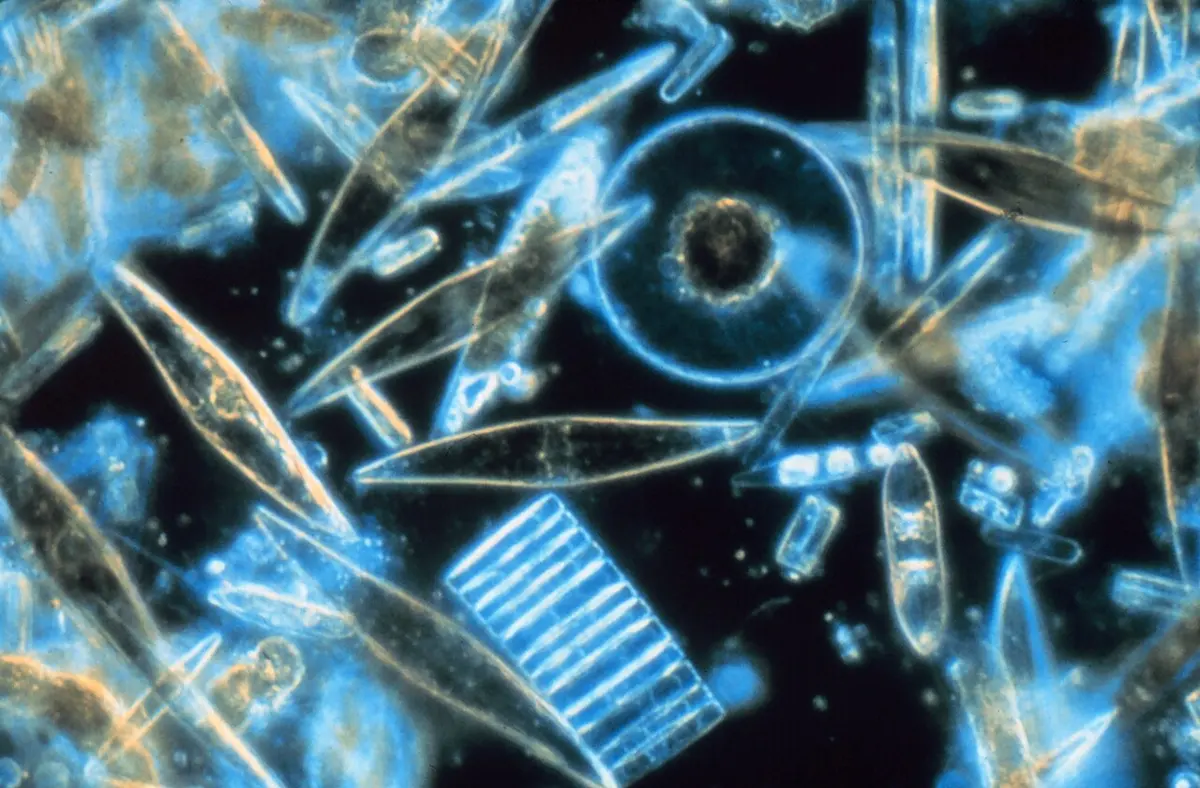
Photosynthesis and respiration are two halves of one loop: each uses what the other makes. On the whole Earth they balance so closely that the air’s oxygen has stayed near 21% for millions of years. About half of all the world’s photosynthesis happens in the sea, in phytoplankton too small to see (Pyramids of energy and mass).
Carbon cycle
Carbon is the element every food and every living thing is built on (Unit 9 of this book is all about its compounds). The carbon cycle is the movement of carbon between the air, living things, the sea, the soil and the rocks.
In the air, carbon is in carbon dioxide, only about 0.04% of it. The steps of the cycle:
- Photosynthesis takes carbon dioxide from the air (and from water) and builds it into sugar, then into every compound of the plant.
- Feeding passes the carbon on: herbivores eat plants, carnivores eat herbivores.
- Respiration by plants, animals and decomposers breaks down food and gives the carbon back to the air as carbon dioxide.
- Decomposition of dead bodies, fallen leaves and dung by bacteria and fungi gives back the carbon that was not eaten.
- Fossil fuels. Some dead matter, buried in mud and rock before it could decay, was turned over millions of years into coal, oil and natural gas. Their carbon stays locked away until they are dug up and burned.
- Burning (combustion) of wood, coal, petrol, diesel and gas gives the carbon back to the air as carbon dioxide.
- The sea takes carbon dioxide in, where it dissolves, and gives it off again. Sea animals build shells of calcium carbonate; their shells pile up on the sea floor and become limestone, which holds the largest store of carbon on Earth.
For thousands of years before about 1800, photosynthesis and the sea took in about as much carbon dioxide as respiration, decay and fires gave out, and the air held about 280 parts per million (ppm). Burning fossil fuels puts back, in a few centuries, carbon that took millions of years to bury, and cutting forests removes some of the photosynthesis. At Mauna Loa in Hawaii, where it has been measured since 1958, the carbon dioxide in the air averaged 427 ppm in 2025 (NOAA). It traps more of the Earth’s heat: The greenhouse effect, in Grade 10 Science.
In the carbon cycle, which process takes carbon out of the air?
Pick an answer to see why.
Nitrogen cycle
Nitrogen is in every protein and in DNA. And the air is 78% nitrogen gas. Yet a wheat plant can starve for nitrogen in a field bathed in it, and so can you. Almost no living thing can use nitrogen gas: its two atoms are held by a triple bond (N≡N), one of the strongest bonds in chemistry. Plants take their nitrogen from the soil instead, as nitrate (NO₃⁻) and ammonium (NH₄⁺) ions, and animals get theirs by eating plants. The nitrogen cycle is the movement of nitrogen between the air, the soil, water and living things, which turns the useless gas into compounds that living things can use, and back again.
It has five steps.
1. Nitrogen fixation
Nitrogen fixation is the change of nitrogen gas from the air into compounds of nitrogen (ammonia, ammonium or nitrate) that plants can use. It happens in three ways.
Biological fixation. Some bacteria and cyanobacteria can break the triple bond, using an enzyme called nitrogenase, and turn nitrogen gas into ammonia:
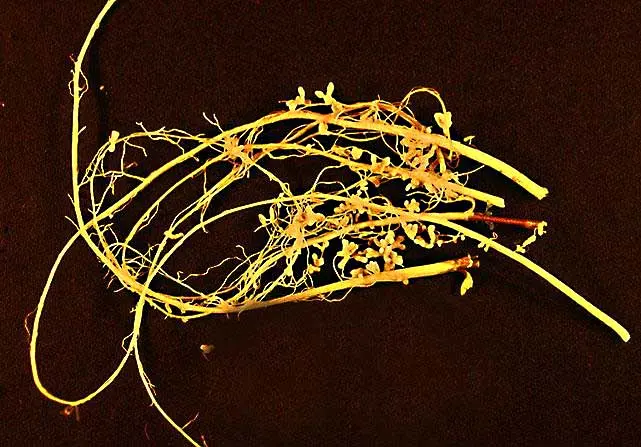
- Rhizobium lives in the root nodules of legumes (beans, peas, lentils, gram, soybean, clover). The plant gives the bacteria sugar and a home; the bacteria give the plant fixed nitrogen. This is symbiosis, which you met in Grade 9 Science.
- Free-living bacteria in the soil, such as Azotobacter (which needs oxygen) and Clostridium (which lives without it), fix nitrogen on their own.
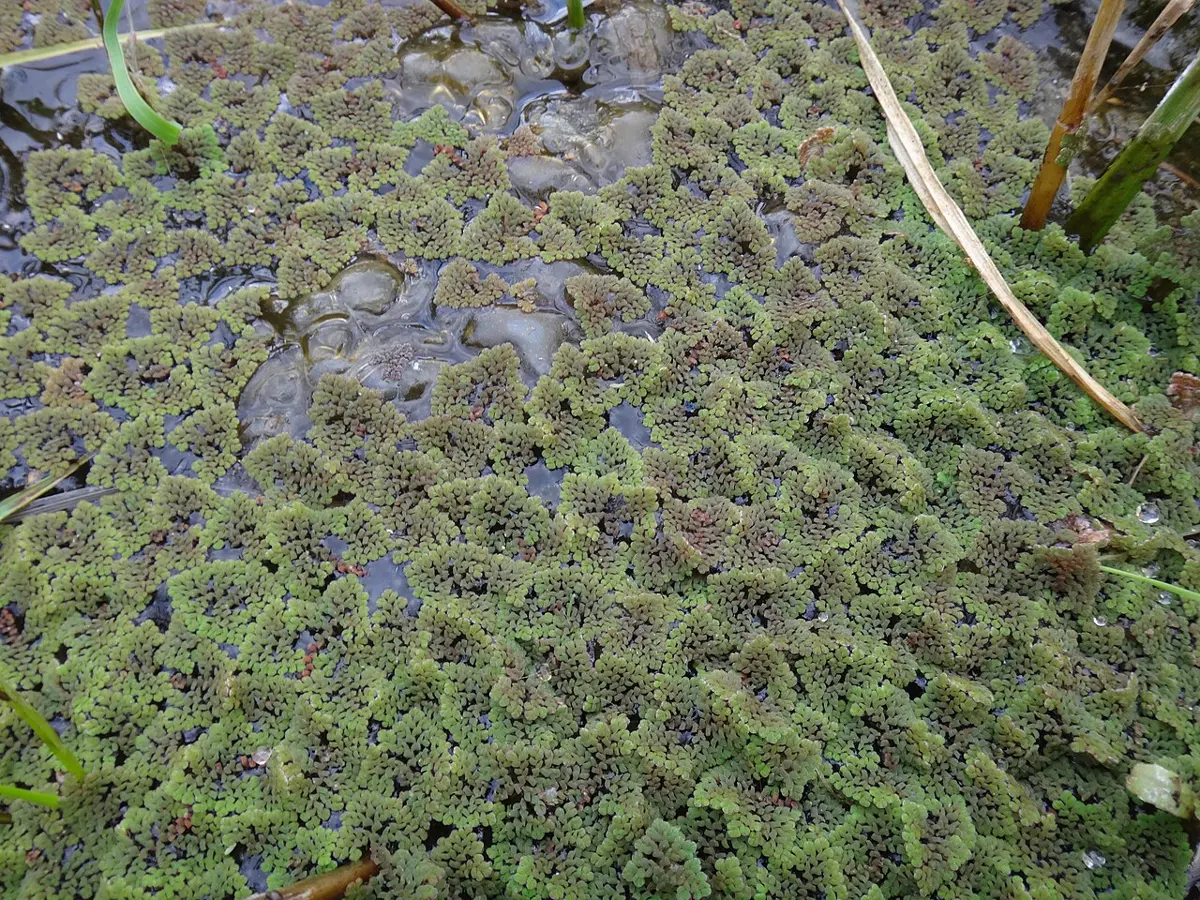
- Cyanobacteria (blue-green algae) such as Nostoc and Anabaena fix nitrogen in water and in wet paddy fields. Anabaena lives inside the leaves of a tiny floating fern, Azolla, which farmers in Asia have grown in rice fields for centuries as a natural fertilizer.
Atmospheric fixation (lightning). The great heat of a lightning flash makes nitrogen and oxygen of the air join. The oxides dissolve in rain as nitric acid and reach the soil as nitrates:
Lightning fixes only a small share of the world’s nitrogen; bacteria and factories fix far more.
Industrial fixation. In the Haber process, nitrogen from the air and hydrogen are made to react over an iron catalyst at about 450 °C and about 200 times the air’s pressure, giving ammonia:
The ammonia is made into fertilizers such as urea, CO(NH₂)₂. The German chemist Fritz Haber won the 1918 Nobel Prize in Chemistry for it (his story).
2. Assimilation
Assimilation is the uptake of nitrate and ammonium by plant roots and their use in making amino acids, proteins, DNA and chlorophyll. Animals get their nitrogen by eating plants, or animals that ate plants: they can’t use nitrate themselves (Where the nitrogen comes from).
3. Ammonification
When plants and animals die, and when animals pass urine and dung, their nitrogen is still locked in proteins and urea. Decomposers (bacteria such as Bacillus, and fungi) break these down and give off ammonia, which forms ammonium ions in the soil. Ammonification is the change of the nitrogen in dead matter, urine and dung into ammonia or ammonium by decomposers. A heap of cow dung smells of ammonia for this reason.
4. Nitrification
Nitrification is the change of ammonium into nitrite and then into nitrate by nitrifying bacteria, in two steps, each done by a different kind of bacterium using oxygen:
- Nitrosomonas turns ammonium into nitrite (NO₂⁻).
- Nitrobacter turns nitrite into nitrate (NO₃⁻).
Both steps need oxygen, so they happen in well-aired soil. The bacteria get their energy from these reactions, and plants get nitrate, the form most of them take up best.
5. Denitrification
In waterlogged, airless soil (a flooded paddy field, a swamp, the mud of a pond), denitrifying bacteria such as Pseudomonas use nitrate in place of oxygen for their respiration and give off nitrogen gas (and a little nitrous oxide, N₂O) to the air. Denitrification is the change of nitrate in the soil back into nitrogen gas by denitrifying bacteria. It closes the cycle, and it is one way a waterlogged field loses its fertilizer.
Some nitrate also washes out of the soil in rainwater into streams, lakes and wells (leaching). Too much nitrate in a pond or lake feeds a thick growth of algae, which use up the water’s oxygen when they die and rot, and fish die.
A farmer in Dang grows lentils after the rice harvest and finds the next rice crop needs less urea. The main reason is:
Pick an answer to see why.
Which bacteria turn nitrite into nitrate?
Pick an answer to see why.
Exercise
1. Choose the correct option
a. Which pyramid is always upright?
Pick an answer to see why.
b. The pyramid of numbers in a parasite food chain (tree → birds → lice) is:
Pick an answer to see why.
c. In a food chain the producers store 8,000 kJ. How much energy reaches the secondary consumers?
Pick an answer to see why.
d. The oxygen given off in photosynthesis comes from:
Pick an answer to see why.
e. The change of ammonium into nitrite and nitrate in the soil is called:
Pick an answer to see why.
f. Which of these is a sedimentary cycle?
Pick an answer to see why.
2. Give reasons
A pyramid of energy can never be inverted.
Hint
Answer
Food chains usually have no more than four or five trophic levels.
Hint
Answer
Energy flows one way in an ecosystem, but matter goes round.
Hint
Answer
Nitrogen is plentiful in the air, yet plants can suffer from nitrogen shortage.
Hint
Answer
3. Differentiate between
Pyramid of biomass and pyramid of energy
Hint
Answer
Nitrogen fixation and nitrification
Hint
Answer
Nitrification and denitrification
Hint
Answer
4. Answer the following questions
Draw an upright and an inverted pyramid of numbers, each with an example.
Hint
Answer
Why is the pyramid of biomass of some seas inverted? Explain how the producers can support a greater mass of consumers.
Hint
Answer
State the ten percent law. Explain, with a labeled diagram, how energy is transferred through the trophic levels of an ecosystem.
Hint
Answer
What is a biogeochemical cycle? Why are such cycles important?
Hint
Answer
Describe the oxygen cycle with a labeled diagram.
Hint
Answer
Describe the carbon cycle with a labeled diagram.
Hint
Answer
Describe the nitrogen cycle with a labeled diagram. Name the bacteria involved in each step.
Hint
Answer
How do human activities change the carbon and nitrogen cycles?
Hint
Answer
5. Numerical problems
In a grassland, the producers take in 15,000 kJ/m² per year and the primary consumers 1,800 kJ/m² per year. Find the percentage of energy transferred. How much energy is lost from the producer level?
Hint
Answer
Basanta says a snake at level 4 of a food chain received 50 kJ, and the primary consumers below it received 20,000 kJ. Is this possible by the ten percent law? Show your working.
Hint
Answer
Lhamu counted the organisms in 1 m² of grassland: 600 grass shoots, 40 grasshoppers, 6 spiders and 1 lizard. (i) Draw the pyramid of numbers using 1 cm for every 50 organisms (draw any level shorter than half a centimeter as half a centimeter). (ii) If the grass stores 9,000 kJ, find the energy at each level by the ten percent law.
Hint
Answer
How many trophic levels can a chain support if the producers store 100,000 kJ and a population needs at least 5 kJ at its level to survive? Use the ten percent law.
Hint
Answer
Printable PDFs
- The unit as a book (A5) 21 pages Answers as an A4 booklet, 6 sheets
- Study notes 2 pages
- Worksheet 6 pages Answer key
- Harder practice questions 3 pages Answer key
Practice every question in the book, and keep track of the ones you miss →
Found a mistake? Please tell us.