
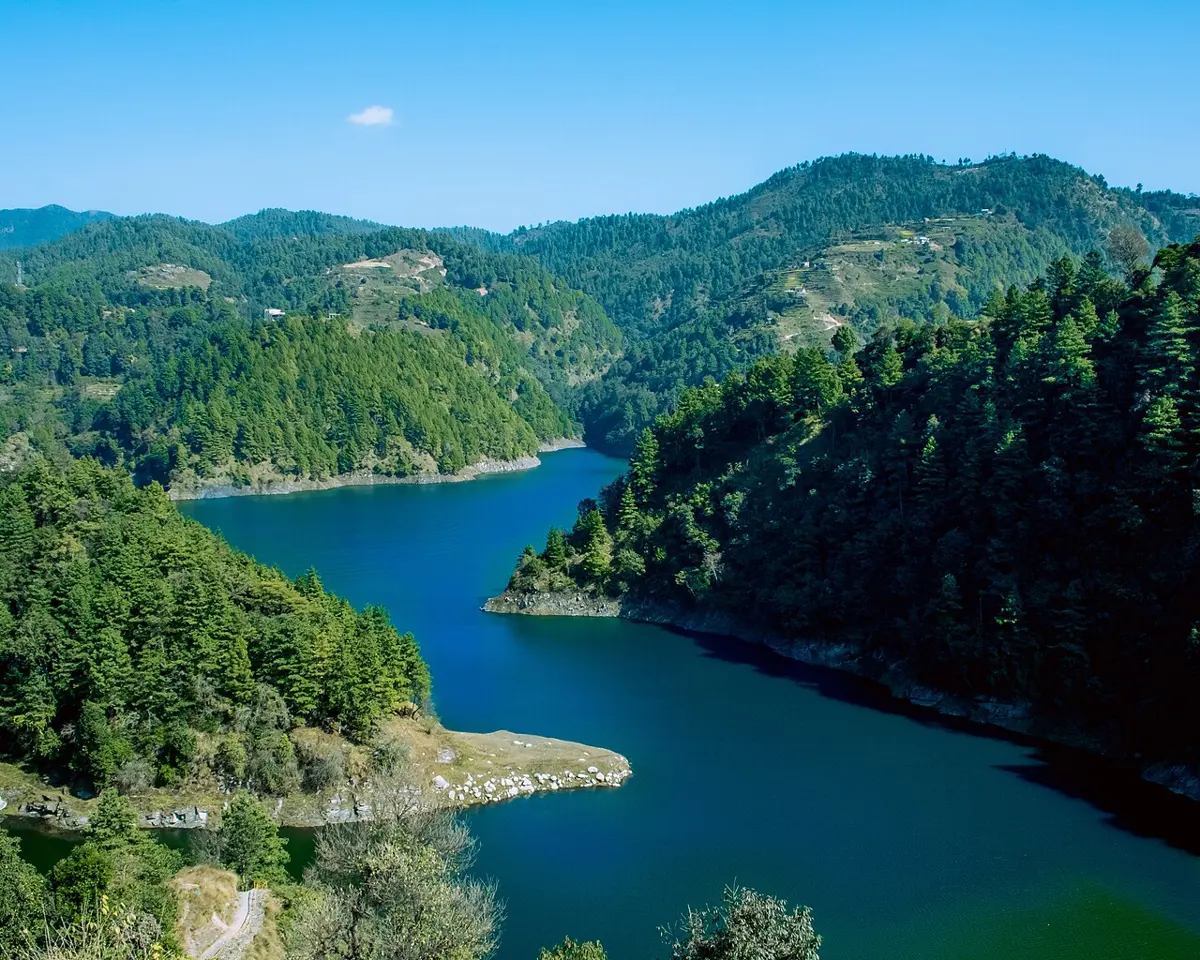
High in the hills south-west of Kathmandu, a dam holds back a long, blue lake: Indra Sarobar, at Kulekhani. Every monsoon, rain fills it. In winter, when Nepal’s rivers run low and people need more electricity, the water is let out through a tunnel and a long pipe down the mountainside to a power station about 550 m below, and the falling water turns the turbines.
The water in the lake isn’t moving. It isn’t hot. It just sits there for months. Yet it holds enough energy to light homes all winter. The same is true of a stone lifted onto a wall: it sits there doing nothing, but push it off and it can crack a tile. The energy you gave it when you lifted it hasn’t gone. So where is it kept? Inside the stone? In this topic you will find a surprising answer, and see that magnets and a rubbed balloon keep energy in the same way.
Energy waiting to be used
You learned in Grade 6 that some energy is stored, ready to be used later. A stretched catapult, a wound-up spring, water held high in a reservoir, a stone lifted up: each has potential energy, energy stored because of its position or its shape. Let go, and the stored energy turns into other forms: the catapult’s stone flies, the water rushes down, the lifted stone falls faster and faster. The energy of motion it gains is kinetic energy (more on that in Why Is Speeding So Dangerous?).
You learned in Grade 8 that energy is the ability to do work Grade 8: Energy in daily life, and that work = force × distance Grade 8: Efficiency. That tells you how the stone got its energy. To lift it, you push up with a force as big as its weight, over the height you lift it. The work you do is not lost. It is stored, and you get it back when the stone falls.
So far, so familiar. But think about the words “because of its position”. Position compared with what? A stone 1 m up in your room has potential energy. Would the same stone have any, floating 1 m from nothing, far out in space? Hold that question.
Which of these has potential energy because of its position?
Pick an answer to see why.
It takes two
Here is the answer to the question: no. A stone floating far out in space, with nothing to fall towards, has nothing to fall to. It has no stored energy to give.
A lifted stone can only fall because the Earth pulls on it, and gravity is a pull between two things. The stone pulls on the Earth too, just as hard (Pushes come in pairs). When you lift the stone, you pull the stone and the Earth apart, against that pull. That is where the work goes.
So the potential energy doesn’t belong to the stone alone. It belongs to the stone and the Earth together. Two or more things that act on each other, taken together, are called a system. The energy is stored in the system because of how its parts are arranged: here, how far apart the stone and the Earth are. Change the arrangement, and the stored energy changes.
Where is it, exactly? Not in the stone, and not in the Earth. Scientists say it is stored in the gravitational field between them, the space around the Earth where things are pulled towards it. You met fields in How Can Something Push Without Touching?: a magnet or a charge fills the space around it with a field, and so does every mass.
A stone is lifted from the ground onto a wall. Where is the extra energy stored?
Pick an answer to see why.
Higher and heavier
Now compare. Which stores more energy: a stone on a low shelf, or the same stone on a high shelf?
The work you do lifting it is its weight × the height. Lift it twice as high, and you push with the same force for twice the distance: twice the work, so twice the energy stored. Three times as high, three times the energy. Near the ground, the stored energy is in proportion to the height.
And a stone twice as heavy, lifted to the same height, needs twice the force: again twice the work, twice the energy stored.
| Same 1 kg packet of rice, put on a shelf… | 0.5 m up | 1 m up | 1.5 m up |
|---|---|---|---|
| Energy stored (compared with the floor) | 4.9 J | 9.8 J | 14.7 J |
| Compared with the lowest shelf | 1 × | 2 × | 3 × |
(A mass of 1 kg weighs 9.8 N on Earth: nearly 10 N. You will meet weight properly in Grade 10: Weight.)
The same is true of a cart on a roller coaster. Wherever the cart is on the track, the energy stored in the cart and the Earth depends only on how high the cart is, not on how it got there or which way the track slopes.
A drawing like the bars in Figure 9.3 is a model: a picture that shows how something works, here how much energy is stored in each arrangement. Scientists use models to explain things and to predict them. You can draw energy bars for any system.
A coconut hangs 4 m up a tree. A mango of the same mass hangs 2 m up. Compared with the mango (and the Earth), the coconut and the Earth store…
Pick an answer to see why.
For the deeper version, with a formula for the energy of height and the ball that swaps it with kinetic energy every bounce, go further still to Where Does the Energy Go When a Ball Bounces? in Going Further 9–12.
Magnets: pull apart, push together
Magnets pull and push each other across a gap too Grade 8: Magnet. So two magnets are a system that can store energy, just like the stone and the Earth.
Take two magnets with the north pole of one facing the south pole of the other. They pull together. To pull them apart, you must do work against that pull. That work is stored, and when you let go, the magnets snap back together: the stored energy becomes kinetic energy, then a click of sound and a tiny bit of heat. For things that pull together, pulling them apart stores energy.
Now turn one magnet round, so that north faces north. They push apart. To push them close together, you must do work against that push. Hold them close and let go: they fly apart. For things that push apart, pushing them together stores energy.
That last sentence of Figure 9.4 is the rule for every system. Left alone, things move towards the arrangement that stores less energy, and the energy they give out becomes motion. A lifted stone falls. Water runs downhill. Magnets that attract snap together. To move them the other way, something has to do work on them.
Two magnets are held with north facing north, a finger’s width apart. You push them closer together. What happens to the energy stored in the pair?
Pick an answer to see why.
Turning a magnet
Arrangement isn’t only distance. It is also which way things face. A compass needle is a small magnet in the Earth’s magnetic field Grade 8: Geomagnetism. Left alone, it points north. Turn it away from north, and the Earth’s field turns it back: so turning it takes work (far too little to feel with your finger, but it is there), and the energy is stored in the needle and the Earth’s field. Let go, and it swings back.
The needle stores the most energy when it is turned right round to point south, and none when it points north. When you let go, the stored energy becomes motion, the needle overshoots, swings back, and the motion turns back into stored energy, again and again. Each swing, a little is lost as heat, rubbing at the pivot and pushing the air, until the needle settles pointing north.
You turn a compass needle 90° away from north, then 160° away from north. When do the needle and the Earth’s field store more energy?
Pick an answer to see why.
Charges: a balloon and your hair
You learned in Grade 7 that rubbing can give things an electric charge. Rubbing a balloon on your hair moves electrons from your hair onto the balloon. The balloon gets a negative charge, and your hair a positive one. Unlike charges pull together (Two kinds of charge), so your hair reaches up towards the balloon.
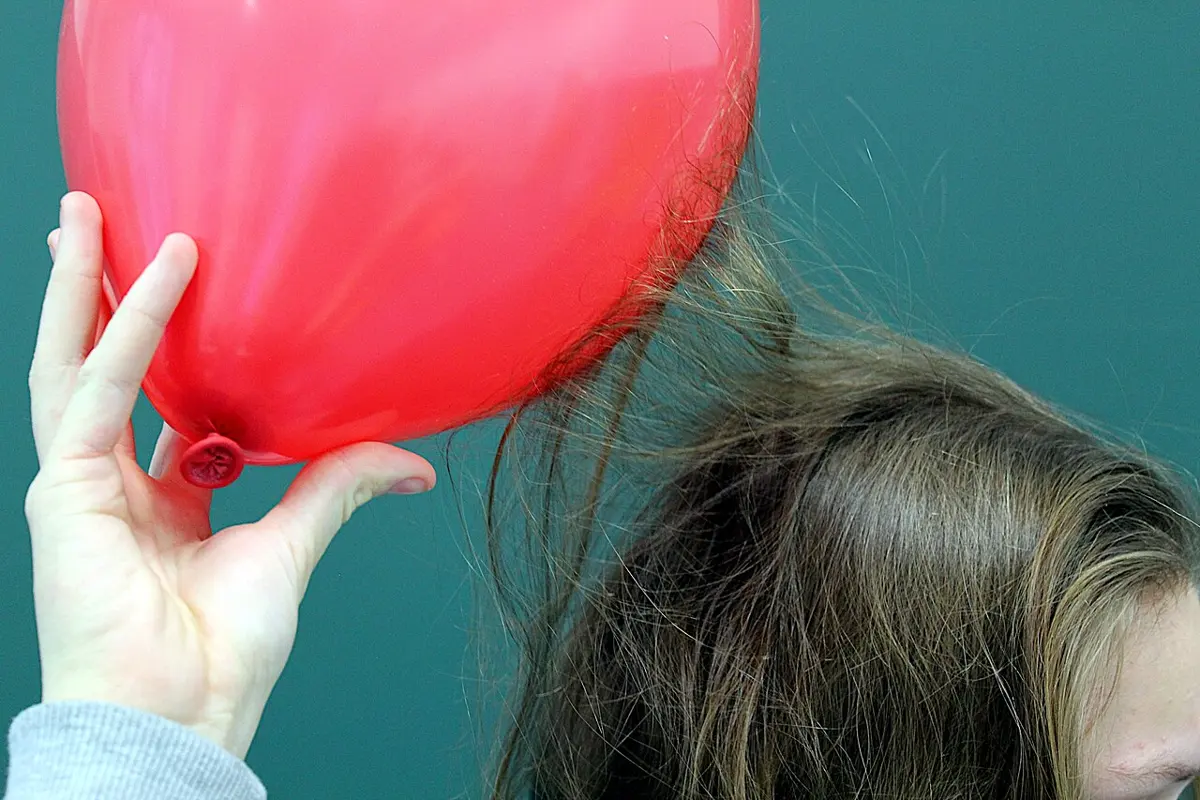
It is the same story again. The balloon and the hair are a system. Pull the balloon away, and you do work against their pull: the stored energy grows. Bring it close, and the system gives out energy: it is what lifts the hair. And two rubbed balloons, both negative, push each other apart: pushing them together stores energy, like north facing north.
So the rule is the same for all three kinds of pull and push across a gap: gravity, magnetism and electricity. Compare them for yourself.
Look at the shapes of the four graphs.
- Stone and Earth: a straight line. Every 10 cm higher stores the same extra energy, because the Earth’s pull is the same at every height you can reach.
- Magnets, N to S: the line rises very steeply, then flattens. The pull between these small magnets is strong when they are close but almost gone a few centimeters apart. So nearly all the energy is stored in the first few millimeters. After that, pulling farther stores almost nothing more.
- Magnets, N to N: the mirror image. The energy is greatest when they are pushed right together, and falls steeply as they move apart.
- Balloon and hair: like the magnets that attract, but more gently, because the electric pull fades more slowly with distance.
The magnet numbers are worked out from the laws of magnetism for real magnets: neodymium discs 10 mm across and 5 mm thick, the same strong magnets as on the balance in What makes a magnetic push stronger?. The balloon’s numbers are made up: the charge on a balloon changes every time you rub it, so we show only the shape.
| Gap between the magnets | 0 mm | 1 mm | 2 mm | 5 mm | 10 mm | 20 mm | 30 mm |
|---|---|---|---|---|---|---|---|
| N to S: energy stored, counted from touching | 0 | 20.9 mJ | 34.2 mJ | 55.0 mJ | 66.6 mJ | 71.7 mJ | 72.7 mJ |
| N to N: energy stored, counted from far apart | 73.3 mJ | 52.4 mJ | 39.1 mJ | 18.3 mJ | 6.8 mJ | 1.7 mJ | 0.6 mJ |
(1 mJ, one millijoule, is a thousandth of a joule.)
Where is the energy stored when you pull a rubbed balloon away from your hair?
Pick an answer to see why.
Investigate at home
Questions
A bag of rice sits on a shelf 2 m up. A second, identical bag sits on a shelf 1 m up. Which statement is right?
Pick an answer to see why.
Two magnets are stuck together, N to S. You pull them 1 cm apart and hold them. Then you turn one round so N faces N, still 1 cm apart. Compared with holding them stuck together, the energy stored is…
Pick an answer to see why.
Look at the cart on the track in Figure 9.3.
- i.Put the places A to E in order, from the most energy stored in the cart and the Earth to the least.
- ii.The cart is moved from E to D. Does the stored energy go up or down? By how many times?
- iii.A student says, “The cart stores more energy at B than at E, because at B it is on a slope.” Is she right about which stores more? Is her reason right?
Answer
- i.A (3 m), D (2 m), B (1.5 m), E (1 m), C (0 m).
- ii.Up, from 1 m to 2 m high: twice as much.
- iii.She is right that B stores more, but for the wrong reason. B is higher (1.5 m against 1 m). The slope doesn’t matter: the stored energy depends only on how high the cart is.
A space probe is far out between the stars, so far from every star and planet that nothing pulls on it. Does it have gravitational potential energy? Explain, using the word “system”.
Answer
No, not in any useful sense. Gravitational potential energy is stored in a system of things that pull on each other, because of how far apart they are. With nothing pulling on the probe, there is no system and no pull for it to be lifted against, and nothing it can fall towards, so there is no stored energy for it to give out. (Strictly, everything in the universe pulls on everything else a little, but far from all stars these pulls are tiny.)
A shopkeeper lifts a 3 kg pot from the floor onto a shelf 2 m high, and a 6 kg pot onto a shelf 1 m high. A mass of 1 kg weighs 9.8 N.
- i.How much energy is stored with each pot?
- ii.If each pot fell to the floor, which would hit it with more energy? Why?
Answer
- i.3 kg pot: weight 3 × 9.8 = 29.4 N; energy = 29.4 N × 2 m = 58.8 J. 6 kg pot: weight 6 × 9.8 = 58.8 N; energy = 58.8 N × 1 m = 58.8 J. The same!
- ii.They would hit with the same energy, 58.8 J each: twice the mass makes up for half the height. (The heavier pot lands at a lower speed, but it is twice as heavy.)
A student rubs a balloon on her hair and holds it 20 cm above her head. Then she brings it down to 2 cm above her head.
- i.Draw two energy bars for the balloon and the hair, one at 20 cm and one at 2 cm, showing which is taller.
- ii.Explain your bars.
- iii.She rubs two balloons and holds them close together. They push apart. Should the bar for close together be taller or shorter than for far apart?
Answer
- i.The bar at 20 cm is taller than the bar at 2 cm.
- ii.The balloon (negative) and the hair (positive) pull together. Pulling them apart takes work, which is stored, so the system stores more energy when they are farther apart (20 cm). Moving the balloon closer lets the system give out energy, which lifts the hair.
- iii.Taller for close together. Both balloons have the same charge, so they push apart; pushing them together takes work, which is stored. Let go and they move apart, giving out the energy.
Use the magnet table in this topic.
- i.How much energy is stored by pushing two N-to-N magnets from far apart to 5 mm apart? From 5 mm to touching?
- ii.A student says, “The energy grows steadily as the gap closes.” Do the numbers agree? What happens instead?
Answer
- i.To 5 mm: 18.3 mJ. From 5 mm to touching: 73.3 − 18.3 = 55.0 mJ, three times as much in the last 5 mm as in all the distance before.
- ii.No. The energy grows faster and faster as the gap closes: from 30 mm to 20 mm it rises only 1.1 mJ, but from 1 mm to 0 mm it rises 20.9 mJ. The push gets much stronger as the magnets get closer, so each millimeter takes more work than the last.
Water in a reservoir high in the hills is used to make electricity. Using the idea of a system, explain where the energy comes from, and what put it there in the first place.
Answer
The energy is stored in the system of the water and the Earth, because the water is high above the power station: they have been pulled apart against gravity. As the water falls through the pipe, the system gives out energy, which becomes the water’s kinetic energy and then turns the turbines. It got there because the Sun heated the sea and the land, water evaporated and rose as vapor, and fell as rain on the hills (you met this in Grade 9: Water energy). So the Sun did the lifting.
Where to go next
- Why Is Speeding So Dangerous? Let go of a stored arrangement and the energy becomes kinetic energy. How it grows with mass, and with speed.
- How Can Something Push Without Touching? The pulls and pushes across a gap that store this energy, and the fields that carry them.
- Going further still: Where Does the Energy Go When a Ball Bounces? in Going Further 9–12: the formulas for the energy of height and of motion, and how a bouncing ball swaps one for the other. And How Do Magnets Push Without Touching?, for working out the energy stored between magnets and charges.