
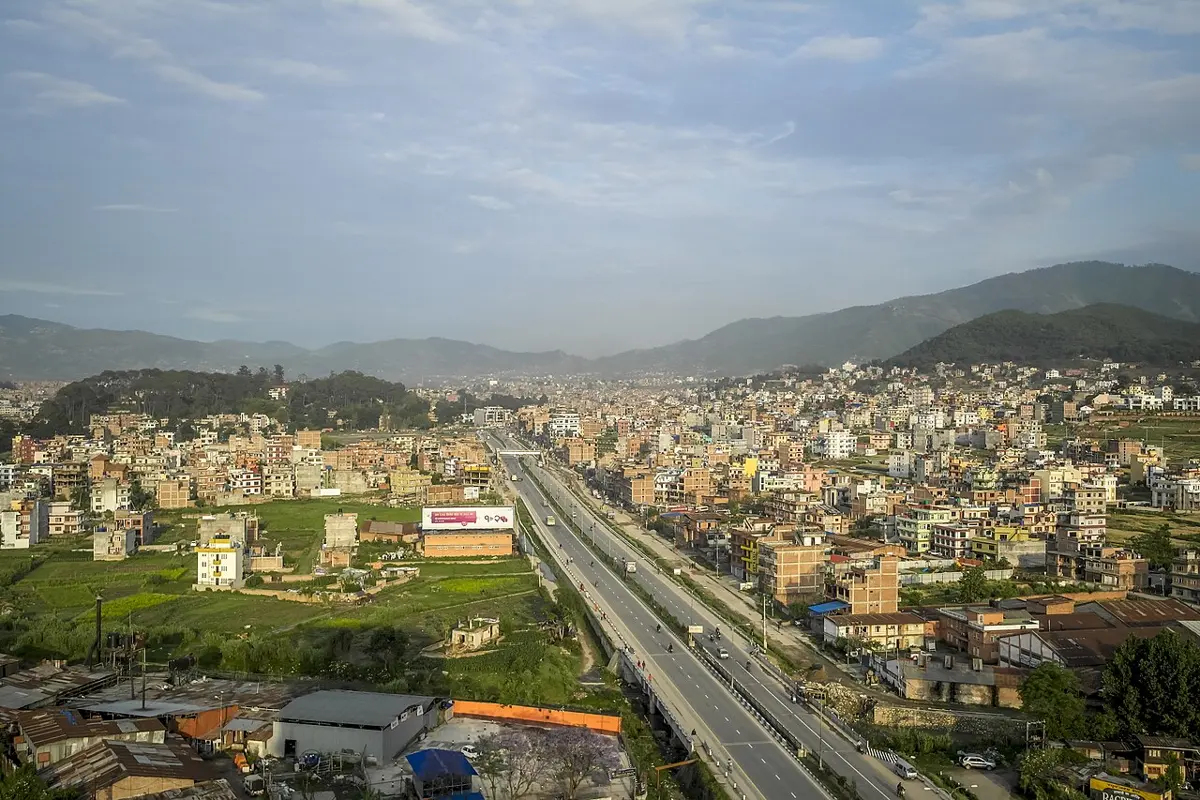
On the Araniko Highway from Koteshwar to Bhaktapur, the speed limit is 50 km/h. On such a wide, straight road that can feel slow. What difference can another 10 or 20 km/h make?
A big one. In Nepal’s year to mid-July 2025, 2,549 people were killed on the roads: about seven every day. The World Health Organization says that a person on foot hit by a car at 65 km/h is 4.5 times as likely to die as one hit at 50 km/h. The speed went up by less than a third, but the danger went up four and a half times. Why should a little more speed matter so much?
The answer is in the energy a moving thing carries, and in a surprising pattern: it doesn’t grow in step with speed. In this topic you will find that pattern for yourself, with data and graphs.
Moving things carry energy
You learned in Grade 6 that anything that moves has kinetic energy, the energy of motion, and that it has more if it is heavier or faster. A cricket ball hurts more than a tennis ball; a ball thrown fast hurts more than one thrown slowly. You learned in Grade 8 that energy is the ability to do work, measured in joules (J) Grade 8: Energy in daily life.
You can see a moving thing’s energy in what it does when it hits something. A rolling football knocks over a plastic bottle. A stone thrown into wet mud makes a hole. A falling coconut dents a tin roof. The more kinetic energy it has, the more work it can do: the farther it pushes, the deeper it dents, the more it breaks. And to stop a moving thing, all of its kinetic energy has to go somewhere: into the brakes, into the ground, into bending metal, or into a person’s body.
So the danger of a crash depends on the kinetic energy that must be got rid of. The question is how kinetic energy depends on mass, and on speed. Grade 6 gave the direction (more and more). This topic gives the shape: how much more?
A cyclist and a loaded truck pass you at the same speed. Which has more kinetic energy?
Pick an answer to see why.
Twice the mass
Here is a way to work out the first rule without any measuring.
Two identical bicycles, with identical riders, ride side by side at the same speed. Each has some kinetic energy; call it E. Together they have 2E. Now tie the two bicycles together. Nothing about their motion changes: they are still moving at the same speed, and still have 2E between them. But now they are one object with twice the mass. So twice the mass, at the same speed, has twice the kinetic energy.
Tie on a third bicycle and you get three times the mass and three times the energy. Ten bicycles, ten times. So at a fixed speed:
Kinetic energy is directly proportional to mass. Two quantities are directly proportional when making one 2, 3 or 10 times bigger makes the other 2, 3 or 10 times bigger too. Their ratio stays the same.
On a graph, two quantities that are directly proportional give a straight line through zero (the origin): no mass, no energy; and every extra kilogram adds the same amount of energy.
A motorbike with its rider has a mass of 200 kg. A car has a mass of 1,200 kg. If they travel at the same speed, the car has…
Pick an answer to see why.
Twice the speed
You might guess that speed works the same way: twice the speed, twice the energy. It doesn’t. Twice the speed gives four times the energy.
Why four times?
Think about stopping. Suppose a car brakes, and the brakes always push back with the same force. Then the car slows down by the same amount every second (you met slowing down, retardation, in Grade 8: Retardation). Now compare a car going at 30 km/h with the same car at 60 km/h.
- From 60 km/h, it takes twice as long to slow down to zero, because there is twice as much speed to lose.
- And during that time it is moving, on average, twice as fast.
Twice as long, at twice the average speed, means it goes 2 × 2 = 4 times as far before it stops. You learned in Grade 8 that work = force × distance Grade 8: Efficiency. The brakes push with the same force over four times the distance, so they do four times the work: the car had four times the kinetic energy to get rid of.
The same reasoning at three times the speed: three times as long, three times as fast on average, 9 times as far. Four times the speed: 16 times. The energy goes up with speed × speed, the square of the speed (written v²).
| Speed | 1 × | 2 × | 3 × | 4 × | 5 × |
|---|---|---|---|---|---|
| Kinetic energy | 1 × | 4 × | 9 × | 16 × | 25 × |
So kinetic energy is not proportional to speed. It is proportional to the square of the speed. On a graph, that gives not a straight line but a curve that bends upwards, getting steeper and steeper. Each extra km/h adds more energy than the one before.

A boy cycles to school at 3 m/s. One morning he is late and cycles at 6 m/s. His kinetic energy is…
Pick an answer to see why.
Graph it yourself
Scientists find the shape of a relationship by changing one thing at a time, keeping everything else the same, measuring, and plotting a graph. To see how kinetic energy depends on mass, keep the speed fixed and change the mass. To see how it depends on speed, keep the mass fixed and change the speed. If you changed both at once, you couldn’t tell which change did what.
Compare your two graphs.
- Energy against mass (speed fixed) is a straight line through zero. Each extra kilogram adds the same energy (8 J, at 4 m/s). Double the mass from 3 to 6 kg, and the energy doubles from 24 to 48 J.
- Energy against speed (mass fixed) is a curve that gets steeper. Going from 1 to 2 m/s adds only 6 J; going from 5 to 6 m/s adds 22 J. Double the speed from 2 to 4 m/s, and the energy goes up four times, from 8 to 32 J. Double it again, from 3 to 6 m/s, and it goes from 18 to 72 J: four times again.
Which of these graphs would be a straight line through zero?
Pick an answer to see why.
Working it out: ½ m v²
Both rules together give the formula for kinetic energy:
with the mass m in kilograms and the speed v in meters per second (m/s); the kinetic energy then comes out in joules. (1 J = 1 kg m²/s².) The mass is there once: the straight line. The speed is there twice, multiplied by itself: the curve. The ½ comes from the averaging in the braking argument above (from speed v down to zero, the average speed is ½v).
You can often compare without the formula, using the two rules: multiply by the change in mass, and by the change in speed squared.
Why speeding is so dangerous
Now you can answer the question in the title.
Stopping takes longer than you think
When something appears on the road, a driver doesn’t brake at once. It takes a moment, usually between about two-thirds of a second and one and a half seconds, to see it, decide, and move a foot to the brake. All that time the car carries on at full speed. The distance it covers is the thinking distance. Then the brakes work, and the car slows down; the distance it covers while braking is the braking distance. Together they make the stopping distance.
- The thinking distance is speed × reaction time, so it is proportional to speed: twice the speed, twice the thinking distance.
- The braking distance is set by the kinetic energy the brakes must take away, so it grows with the square of the speed: twice the speed, four times the braking distance.
Look at the data in Figure 8.4. From 32 km/h to 64 km/h the speed doubles. The thinking distance doubles, from 6 m to 12 m. The braking distance goes from 6 m to 24 m: four times. From 48 to 96 km/h it is the same: 14 m to 55 m, about four times. At high speeds, the braking distance is most of the stopping distance.
At 50 km/h, with an alert driver on a dry road, the car stops just before the ball’s line. At 60 km/h, the thinking distance is only 2 m longer, but the braking distance is 6.5 m longer, and the car reaches the line still going at about 37 km/h. A small rise in speed turned a near miss into a crash.
A car’s braking distance at 40 km/h is 10 m. On the same road, what would it be at 80 km/h?
Pick an answer to see why.
When a crash happens
If a vehicle can’t stop in time, whatever kinetic energy it still has goes into the crash: into bending metal, breaking glass, and the bodies of the people involved. That energy grows with the square of the speed. That is why the WHO finds that a person on foot hit at 65 km/h is 4.5 times as likely to die as one hit at 50 km/h, and why speed limits are lowest where people walk: near schools, markets and in town.
Cars are designed with this in mind. The front of a modern car is a crumple zone, made to crumple in a controlled way in a crash, so that the kinetic energy is taken away over a longer distance and the people inside are pushed less hard. Helmets do the same for a motorbike rider’s head: the foam inside crushes, using up energy before it reaches the skull.
Investigate at home
Questions
A heavy truck and a car are traveling side by side at the same speed. The truck has 8 times the mass of the car. How does the truck’s kinetic energy compare with the car’s?
Pick an answer to see why.
Which graph shows how the kinetic energy of a bicycle and rider changes with their speed?
Pick an answer to see why.
A ping-pong ball (mass 2.7 g) and a cricket ball (mass 160 g) are each thrown at you at 20 m/s.
- i.Find the kinetic energy of each.
- ii.Explain why one stings and the other could break a finger.
Answer
- i.Ping-pong ball: m = 2.7 g = 0.0027 kg. KE = ½ × 0.0027 × 20² = 0.00135 × 400 = 0.54 J. Cricket ball: m = 0.16 kg. KE = ½ × 0.16 × 20² = 0.08 × 400 = 32 J.
- ii.At the same speed, kinetic energy is proportional to mass. The cricket ball is about 59 times as heavy, so it carries about 59 times as much energy, all of which must be taken away when your hand stops it. The ping-pong ball’s half a joule is used up in a tiny squeeze of your skin; the cricket ball’s 32 J can bend and break bone.
A student measured the kinetic energy of the same bicycle and rider at different speeds:
| Speed (m/s) | 2 | 4 | 6 | 8 |
|---|---|---|---|---|
| Kinetic energy (J) | 160 | 640 | 1,440 | 2,560 |
- i.Describe what happens to the kinetic energy each time the speed doubles.
- ii.Is kinetic energy proportional to speed? Use the data to explain.
- iii.Predict the kinetic energy at 10 m/s.
- iv.What is the mass of the bicycle and rider?
Answer
- i.From 2 to 4 m/s, the energy goes from 160 to 640 J: four times. From 4 to 8 m/s, from 640 to 2,560 J: four times again. Each time the speed doubles, the energy is multiplied by 4.
- ii.No. If it were proportional, doubling the speed would double the energy, and the graph would be a straight line. Instead the energy goes up with the square of the speed: 3 times the speed (2 to 6 m/s) gives 9 times the energy (160 to 1,440 J).
- iii.10 m/s is 5 times 2 m/s, so the energy is 5² = 25 times 160 J = 4,000 J.
- iv.KE = ½ m v², so at 2 m/s: 160 = ½ × m × 4 = 2m, giving m = 80 kg.
A loaded truck of mass 10,000 kg is moving at 10 m/s. A car of mass 1,000 kg is moving at 30 m/s. Which has more kinetic energy? Show your working.
Answer
Truck: KE = ½ × 10,000 × 10² = 5,000 × 100 = 500,000 J.
Car: KE = ½ × 1,000 × 30² = 500 × 900 = 450,000 J.
The truck has a little more, even though the car is 3 times as fast. The truck has 10 times the mass (×10), the car 3 times the speed (×9). Mass and speed both matter, but speed counts twice.
Many countries set a speed limit of 30 km/h near schools, instead of 50 km/h. By how many times does the kinetic energy of a car go down when it slows from 50 to 30 km/h? Why does this make a big difference to children’s safety?
Answer
The speed is multiplied by 30 ÷ 50 = 0.6. Kinetic energy goes with the square of the speed: 0.6² = 0.36. So the car has only about a third of the kinetic energy (it goes down nearly 3 times).
That makes a big difference in two ways. With a third of the kinetic energy, the braking distance is about a third as long, so the car is much more likely to stop before it reaches a child who runs out (the thinking distance is shorter too). And if it can’t stop, there is far less energy to go into the child’s body, so injuries are much less serious.
Use the stopping distances in Figure 8.4.
- i.Plot a graph of braking distance (vertical) against speed (horizontal), from 0 to 112 km/h. Plot thinking distance on the same axes.
- ii.Describe the shape of each line.
- iii.Explain the difference in terms of kinetic energy.
Answer
- i.The points are (0, 0), (32, 6), (48, 14), (64, 24), (80, 38), (96, 55), (112, 75) for braking and (0, 0), (32, 6), (48, 9), (64, 12), (80, 15), (96, 18), (112, 21) for thinking.
- ii.Thinking distance is a straight line through zero: every 16 km/h adds the same 3 m. Braking distance is a curve that gets steeper and steeper: at low speeds it is less than the thinking distance, but above 32 km/h it is bigger, and at 112 km/h it is more than three times as big.
- iii.During the thinking time the car keeps its speed, so the distance is just speed × time: proportional to speed. During braking, the brakes must take away all the car’s kinetic energy, pushing with about the same force; the work they do is force × distance, so the distance is proportional to the kinetic energy, which grows with the square of the speed.
Ram says: “If I drive at 80 km/h instead of 40 km/h, my braking distance will be twice as long.” Is he right? Explain, and say what you would tell him.
Answer
He is wrong. Doubling the speed gives four times the kinetic energy, and the brakes, pushing with the same force, need four times the distance to take it all away. So his braking distance would be about four times as long, not twice. (His thinking distance would be twice as long, which is perhaps why he thinks so.) I would tell him that each extra km/h adds more to his stopping distance than the one before, and that a crash at 80 km/h has four times the energy of one at 40 km/h.
Plan an investigation to find out how the kinetic energy of a rolling object depends on its mass. Say what you would change, what you would keep the same, what you would measure, and what graph you expect.
Answer
One way: roll a toy car down a ramp into a light paper cup and measure how far the cup slides, as a measure of the car’s kinetic energy.
Change: the mass of the car, by taping on 0, 1, 2, 3, 4 identical loads, and weigh the car each time.
Keep the same: the starting point on the ramp (so the speed at the bottom is the same), the ramp, the floor, the cup, and the distance from ramp to cup.
Measure: how far the cup slides; repeat each run three times and take the average.
Expected graph: slide distance against total mass is a straight line, pointing back towards zero, because at the same speed kinetic energy is proportional to mass.
Where to go next
- Where Does a Lifted Stone Keep Its Energy? A stone at the top of a hill has no speed, but it has energy waiting: potential energy. Where it is stored, and how it turns into kinetic energy as the stone rolls down.
- Who Feels the Bigger Push in a Crash? When a truck hits a car, the forces on each are the same size. Why, and what that means for the people inside.
- Why Does a Rolling Ball Stop? Forces that slow things down, and what happens when the forces on something don’t balance.