
In the last days of March 2021 the government closed every school in Nepal. It wasn’t for a strike or a festival. It was for the air. Forests were burning across the country, smoke lay over Kathmandu and the hills, and the air in the capital had reached levels counted as hazardous. Classes stopped from 30 March to 2 April. On 25 March alone a record 479 forest fires were reported, and an officer at the Department of Forest and Soil Conservation called it one of the worst fire seasons the country had known.
In a way the fires had started three months earlier. The winter just gone had brought only a quarter of its normal rain. By March the ground and the fallen leaves were dry, and the hottest, driest weeks of the year were still to come.
That is how closely a forest lives with the weather. Which trees grow in a place, when they drop their leaves, when they can burn, and which animals live among them all follow the climate. And Nepal’s climate follows the year.
The year in four parts
Nepal’s calendar counts six seasons, the six ऋतु. The Department of Hydrology and Meteorology, which keeps the country’s weather records, counts four, and it divides the year by the rain. The monsoon runs from June to September. After it come the post-monsoon months, October and November; then winter, from December to February; then the pre-monsoon, from March to May.
The monsoon is most of the story. The Department keeps the normal rain of almost a hundred weather stations, from the plains to the high valleys, and at a typical one four-fifths of the year’s rain falls in those four months. How it arrives, and why it comes from the east and leaves last from the west, is the monsoon’s own story. The other eight months share what is left, and they don’t share it evenly.
Winter is cold and mostly dry. In Kathmandu the normal January night falls to about 3 °C and the afternoon reaches about 19 °C. At Jumla, 2,363 m up in the west, January nights average −4.8 °C, well below freezing, while down on the eastern plains Biratnagar’s January averages about 16 °C over the whole day. What little rain winter brings comes from the west, with the storms called western disturbances, so the west gets more of it. At stations in the far west, winter brings about a twentieth of the year’s rain. In the east it brings about a fiftieth. On the high mountains it falls as snow. A winter like 2020–21’s, with a quarter of its usual rain, leaves the whole country dry going into spring.
Spring, the pre-monsoon, is when the heat builds. At Nepalgunj, on the western plains, the normal daily high reaches 38 °C in May, the hottest month of its year; once the monsoon comes, cloud and rain bring it down. The air is dry, and on hot afternoons tall clouds can build into thunderstorms, with lightning and sometimes hail. Those spring storms matter more the farther east you go. Stations in the far west get about 7% of their year’s rain from March to May, and stations in the east about twice that. At Taplejung, in the hills of the far east, it is more than a fifth.
Then the monsoon, and after it the post-monsoon, when the rain stops almost as if a tap had been turned off. October and November together bring less than a twentieth of the year’s rain. Every month after September is cooler than the one before, until January.
Five climates up one hillside
Every one of these seasons looks different at a different height. Air cools as you climb, by about 5 °C for every 1,000 m on Nepal’s slopes, and the stations show it like the rungs of a ladder. Averaged over the whole year, Biratnagar, 72 m above the sea, is about 25 °C. Kathmandu, at 1,337 m, is about 19 °C. Jumla, at 2,363 m, is about 13 °C. The Pyramid, the research station at 5,035 m below Everest, is −2.4 °C.
Nepal’s school books turn that ladder into five climate regions, each named for what it feels like. Up to about 1,200 m, across the Terai, the inner Terai valleys and the Chure hills, is the subtropical monsoon climate, उपोष्ण मनसुनी हावापानी: hot summers and mild winters. From 1,200 to 2,100 m, on the Chure and the Mahabharat range, is the warm temperate climate, warm in summer and cool in winter. From 2,100 to 3,300 m is the cool temperate climate, where winters bring frost and snow. From 3,300 to 5,000 m is the लेकाली climate, from लेक, the high, cold hills. Above 5,000 m is tundra, which the books also call a mountain desert, where almost all the water is frozen.
The lines are round numbers, and nobody should expect to see them on the ground. Another scheme, the one Nepal’s biodiversity strategy uses, draws them at 1,000, 2,000, 3,000, 4,000 and 5,000 m and calls even those approximate. Sorted by Köppen’s letters, about half of Nepal falls in the same class as Kathmandu, a climate with mild, dry winters and hot summers, and none of it is truly tropical; the climate map shows how the classes crowd together in the north.
Height isn’t the only thing that moves the lines. In Nepal the sun shines from the south, so a slope facing south is sunnier, warmer and drier than a slope facing north at the same height, and the same mountain can wear two different forests on its two sides. The east is wetter than the west. And behind the high mountains, in the rain shadow, valleys like Mustang, Manang and Dolpa are as cold as their height says but much drier, so the forests that their height would allow never grow.
From sal to birch
Walk up from the plains to the snow and the forests change with the climate, band by band. In 1972 the botanist Adam Stainton sorted Nepal’s forests into 35 types, and botanists have grouped them on his work ever since. Fewer than a dozen trees, though, tell you where you are.
At the bottom is sal, साल. It grows across the Terai from east to west and up into the Chure hills, and it is the main tree of the चारकोसे झाडी, the wide forest along their foot. A sal tree can grow 40 m tall, and its wood is hard and lasts: Bhaktapur’s Nyatapola temple is built of brick and sal. Along the rivers grow खयर, सिसौ and सिमल, the silk-cotton tree.
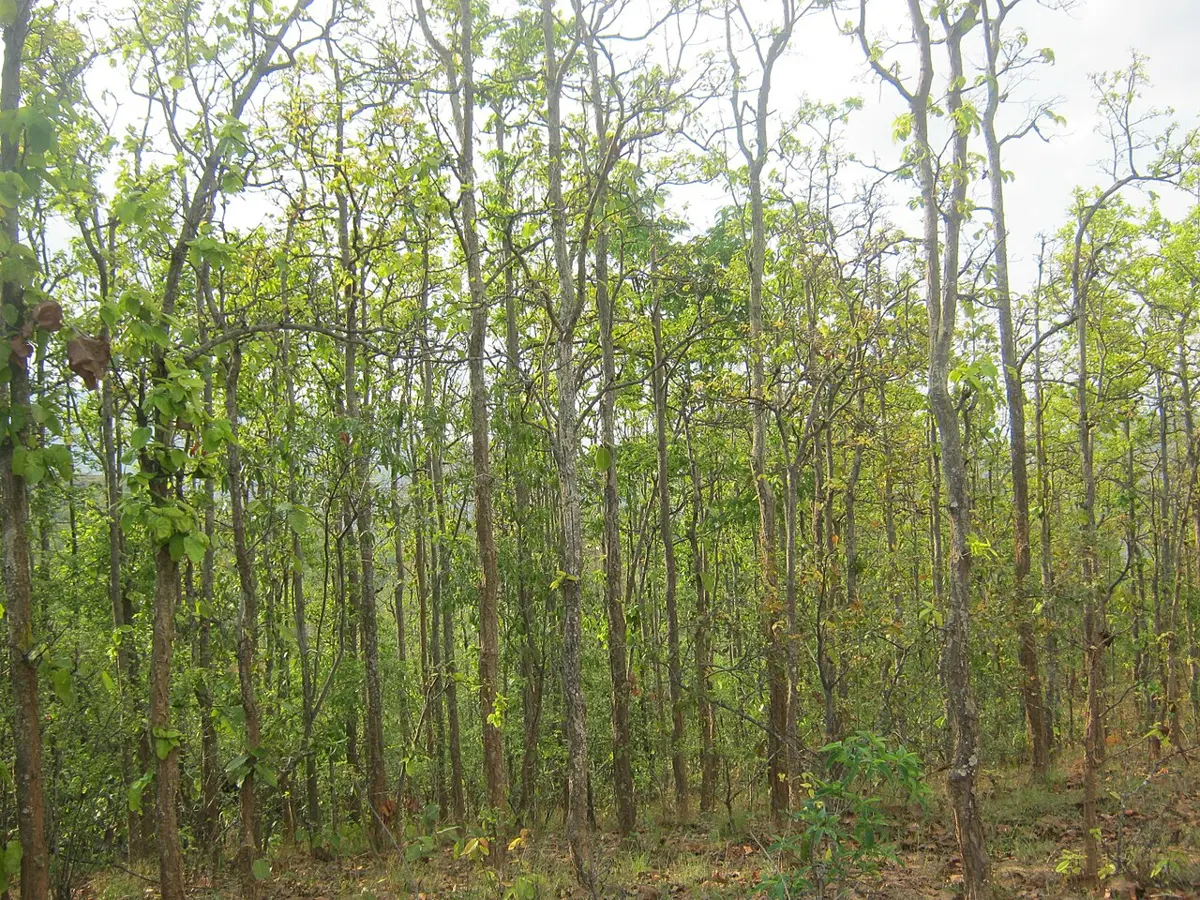
Sal is sometimes called evergreen, and in wet places it nearly is. In drier places it drops most of its leaves between February and April and grows new ones in April and May. So the forest floor is deep in dry leaves exactly when the weather is at its hottest and driest. That is the fire season.
From about 1,000 to 2,000 m, in the hills, the sal gives way. In the eastern half of the country the hill forest is broadleaf, of चिलाउने and कटुस. On dry, sunny slopes facing south grows chir pine, a tall pine with long needles in bundles of three. Chir pine lives with fire. Its cones open slowly, or quickly when a fire heats them, and the carpet of needles it drops makes the soil beneath hard for most other plants to grow in.
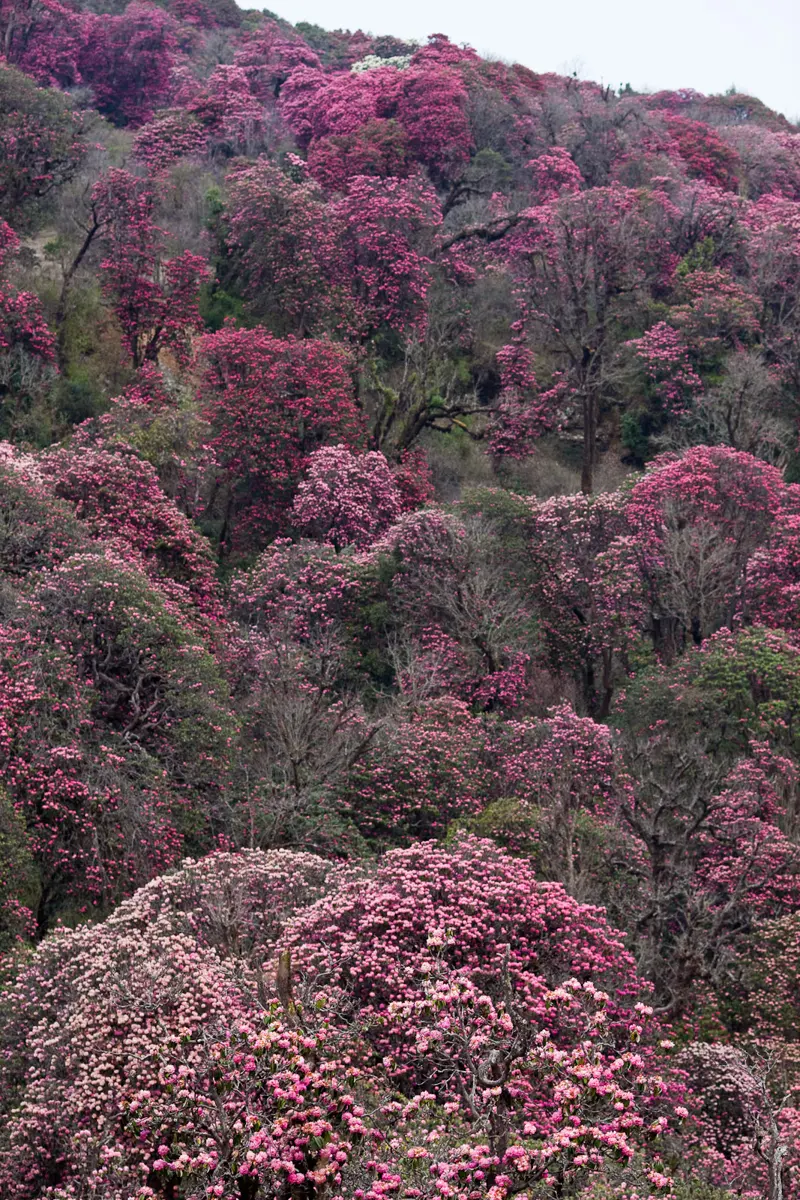
From about 2,000 to 3,000 m come the oaks and the rhododendrons. The tree rhododendron, लालीगुराँस, is Nepal’s national flower, and in spring whole hillsides of it turn red. On the dry south-facing slopes higher up, oak forest of one kind takes over; on the damp slopes facing north and west, maple and rhododendron. With them grow conifers: blue pine, fir and spruce, and in the west, beyond the Bheri river, the tall deodar cedar. In and around Langtang grows a larch, the only conifer in the region that drops its needles every year. Nepal’s national bird, the डाँफे, the Himalayan monal, lives in these upper forests and on the grassy slopes above them, from about 2,400 to 4,500 m.
From about 3,000 to 4,100 m is the last forest, small and often crooked: fir, spruce, rhododendron, and भोजपत्र, the Himalayan birch whose papery bark people once wrote on. The treeline, the height where trees give out, lies at about 4,000 m. Above it, rhododendron and juniper shrink into scrub, and the scrub runs up through the high pastures to the snowline, at about 5,500 m. Above that is rock and ice.
School books fold all of this into three forests: an evergreen forest up to about 1,200 m, a forest that drops its leaves from 1,200 to 2,100 m, and a forest of conifers from 2,100 to 3,300 m. It is a fair summary of the big picture, as long as it is held loosely. Chir pine grows up to 2,000 m, चिलाउने, कटुस and गुराँस keep their leaves all year, and real forest climbs well past 3,300 m, to the treeline at about 4,000.
How much of Nepal is forest? By the government’s latest count, made from satellite pictures of 2022, forest covers about 43% of the country, and with shrubland about 46%. Thirty years ago it was well under that. How the forests came back, and who helped, is another story.
A crowded country
Nepal is about a tenth of one percent of the world’s land. Yet it has about 3% of all the kinds of plant that scientists know, and about 1% of the animals. Its lists run to nearly 7,000 kinds of flowering plant, 208 mammals, about 650 butterflies, and 867 birds by the count of 2011, nearly a tenth of all the birds in the world. Bird watchers have added more since.
Two things explain the crowd. The first is the climb: in 150 to 250 km from south to north, Nepal runs from the edge of the tropics almost to the Arctic, so every belt brings its own plants and animals. The second is where Nepal sits. To the south lies the warm world of India and Southeast Asia, and to the north the cold world of Tibet, Central Asia and Europe, and Nepal is where they meet. In the Terai live elephants, rhinoceroses and tigers. High in the mountains live the snow leopard and the musk deer.
Some live nowhere else. Nepal has 284 flowering plants found only within its borders, and the higher you go, the more of them there are. It has one mammal of its own, a field mouse, and one bird, the spiny babbler, काँडे भ्याकुर, a shy bird of the scrub in the middle hills, including around the Kathmandu Valley. Brian Hodgson, a British official in Kathmandu, described it in the nineteenth century. Then nobody recorded it again for about a hundred years, and some feared it was extinct, until an American ornithologist, Dillon Ripley, found it again in the late 1940s.
Much of this lives inside protected land. The first national park was Chitwan, in the inner Terai, and its story shows why. In 1950 Chitwan’s forests and grasslands covered more than 2,600 km² and held about 800 rhinoceroses. Then malaria was stamped out, farmers moved down from the hills, and by the end of the 1960s about 70% of Chitwan’s forest had been cleared and only 95 rhinos were left. The park was set up to save them, and opened in 1973. By 2015 Chitwan had 605 of Nepal’s 645 rhinos.
Today there are 13 national parks, from Chitwan and Bardia on the plains to Sagarmatha below Everest; the newest, Chhayanath, in Mugu, was carved out of Shey-Phoksundo in 2025. With them are a wildlife reserve at Koshi Tappu, a hunting reserve at Dhorpatan, six conservation areas, and buffer zones around the parks. Together they cover about 23% of the country, one of the highest shares in Asia. Most of that land is in the mountains.
A few of these plants grow in the center’s own Garden in Bhaktapur, among them लालीगुराँस and the Himalayan yew, लौठ सल्ला, which Nepal’s Grade 10 geography book lists among the plants that have grown rare.
The fires of 2021 came, as Nepal’s forest fires do, in the dry months before the monsoon, when the winter’s little rain is long gone and the sal leaves lie thick on the ground. Then the monsoon brings four-fifths of the year’s rain in four months, and the forests grow. In Nepal the year makes the forest, and the forest keeps the year’s marks: in the season it drops its leaves, in the cones that open after a fire, and in the band of hillside where it can live.
Found a mistake? Please tell us.