
Stand a stick one meter tall on flat ground in Kathmandu, and look at its shadow at midday. On 21 June the shadow is a stub about 7 cm long, pointing north. The Sun is only four degrees from straight overhead. On 21 December, at the same hour, the shadow is 1.24 m long, longer than the stick itself, because the Sun climbs no higher than 39° above the southern horizon. Same stick, same city, same Sun.
Now the odd part. Less than two weeks after the shadow is at its longest, the Earth is closer to the Sun than at any other time of year. On 3 January 2026, पुस १९, it was 147.1 million km away. On 6 July it was 152.1 million km away, the farthest of the year. Kathmandu’s coldest weeks come when the Sun is nearest.
So nearness isn’t what makes winter. The answer is that the Earth leans. Here is how it works, in a few steps.
The Earth does two things at once. It spins, once a day, and that gives us day and night. It also travels around the Sun, once a year. Its spin is around a line through the poles called its axis, and that axis isn’t upright: it leans over by about 23.4°. The lean always points the same way in space, toward the Pole Star, all year round. So for half of each trip around the Sun, the northern half of the Earth is tipped toward the Sun, and for the other half it is tipped away.
Tipped toward the Sun, Nepal gets the Sun high in the sky and long days. A high Sun shines straight down, and its light is packed onto less ground; a long day gives it more hours to work. That is summer. Six months later the Earth is on the other side of the Sun, the same lean now tips Nepal away, and the Sun stays low and sets early. That is winter. And since the two halves of the Earth lean opposite ways, their seasons are always opposite: when it is winter in Nepal, it is summer in Australia, where Christmas comes in the hot season.
Two ways of moving
The spin is the simpler of the two. The Earth turns from west to east, so every morning your side of it rolls toward the Sun, which seems to come up in the east and cross the sky to the west. The Moon and the stars do the same, for the same reason. Because the Earth is a ball, only the half facing the Sun is lit at any moment; the other half is in its own shadow, which is what night is. Jhapa, at Nepal’s eastern edge, turns into the morning about half an hour before Kanchanpur in the far west. How that half hour turns into the time on a clock is a story of its own, for later in this book.
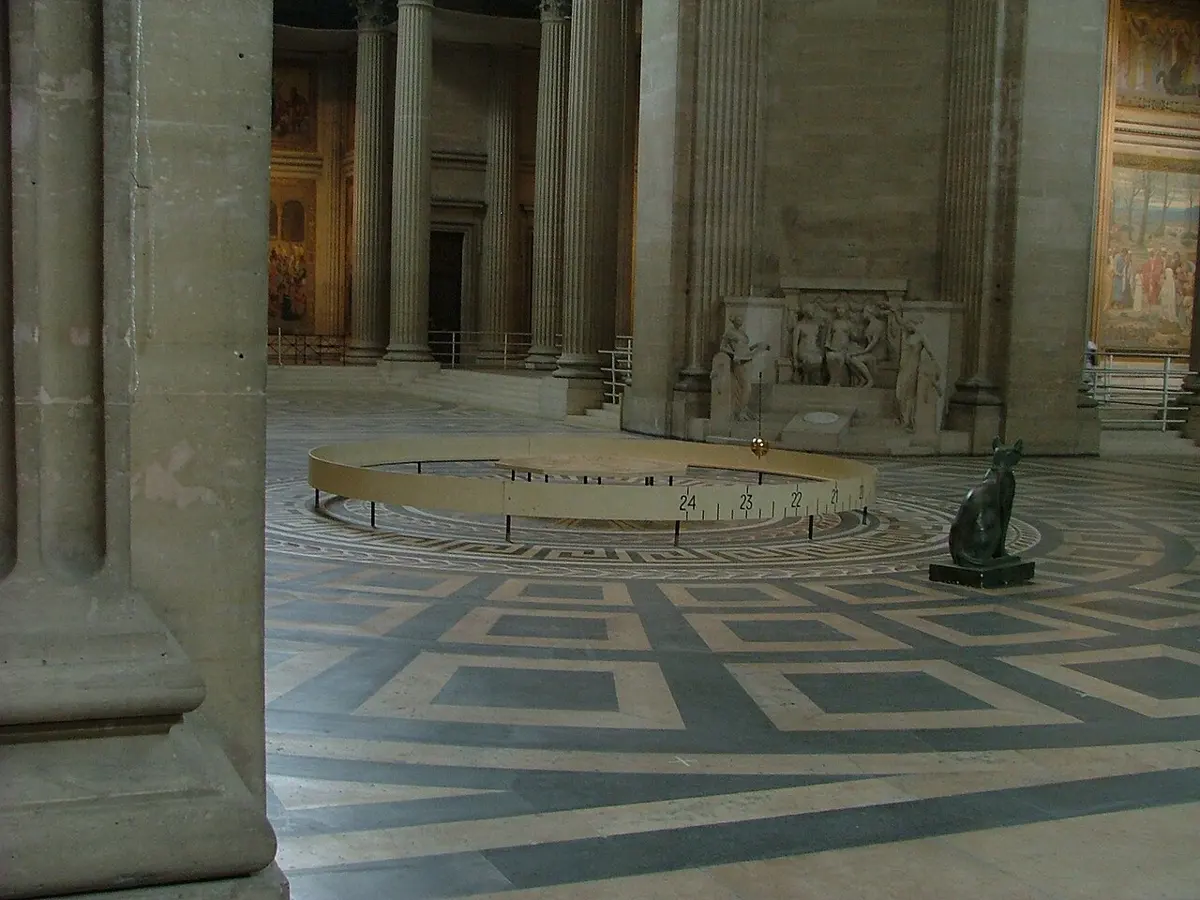
Nobody feels the turning, because everything around you, the air included, is carried along with it. One of the plainest ways to see it came in 1851. In Paris, the physicist Léon Foucault hung a 28 kg ball on a wire 67 meters long from the dome of the Panthéon and set it swinging. A swinging weight keeps swinging in the same direction unless something pushes it. But over the hours, the line of Foucault’s swing slowly turned around the floor. The pendulum wasn’t turning. The floor was, with the city and the Earth under it. In Kathmandu the swing would take about 51 and a half hours to go all the way around. On the equator it wouldn’t turn at all, and at the poles it would turn once a day.
One turn of the Earth, measured against the stars, takes 23 hours, 56 minutes and 4 seconds. Our day is four minutes longer than that. The reason is the second motion. During one turn, the Earth also travels a little way around the Sun, about a degree of its 360, so it has to turn a little extra before the Sun comes back to the same place in the sky. A day from noon to noon averages 24 hours.
The trip around the Sun is long. The path, the orbit, is nearly a circle about 150 million km from the Sun, so once around is about 940 million km, and the Earth covers it at about 30 km every second. It takes about 365.2422 days, which is 365 days, 5 hours, 48 minutes and 46 seconds. That awkward quarter of a day is why there are leap years. Add a day every fourth year and the calendar keeps up; but a quarter is slightly too much, and over the centuries the extra adds up. Julius Caesar’s calendar used exactly 365¼ days, which drifts off the seasons by about three days every four centuries. By 1582 Pope Gregory XIII had ten days cut out of October to put it back: Thursday 4 October was followed by Friday 15 October. His rule is the one still in use. A year divisible by 4 is a leap year, except that a year divisible by 100 isn’t, unless it is also divisible by 400. So 2000 was a leap year, 1900 wasn’t, and 2100 won’t be.
The lean
The tilt of the axis is 23.44° from upright today. Many books, CDC’s among them, give the same lean as 66.5°: that is the angle between the axis and the flat plane of the orbit, 90° minus 23.5°. It is the same lean measured from the other side.
What matters is that the lean doesn’t change direction as the Earth goes around. A spinning top holds its axis steady in the same way. In June the Earth is on the side of its orbit where the north end of the axis points toward the Sun. In December it is on the far side, and the same lean points the north end away. In March and September it is halfway between, the axis leans sideways to the Sun, and neither half is favored.
Those four turning points have names. The June solstice, around 21 June, is when the northern half leans most toward the Sun, and the December solstice, around 21 or 22 December, when it leans most away. Solstice is Latin for “the Sun stands still”: for a few days around each one, the noon Sun stops climbing (or sinking) and turns back. The March and September equinoxes, around 20 March and 23 September, are when it leans sideways. Equinox means “equal night”, and on those days the day and the night are about 12 hours each, all over the Earth. Not quite equal, in fact: sunrise is counted from the moment the Sun’s top edge appears, and the air bends its light up over the horizon, so in Kathmandu the equinox day is 12 hours 6 minutes.
Leaning toward the Sun does two things, and both are easy to see from a roof in Kathmandu.
The first is the Sun’s height. Shine a torch straight down on a table and you get a small, bright circle. Tip the torch and the same light spreads into a long, dim oval. Sunlight does the same: a high Sun’s light falls almost square on the ground, and a low Sun’s light comes in at a slant and is spread thin. In Kathmandu the noon Sun stands 86° above the horizon in late June, nearly overhead, and 39° in late December. At 39°, each square meter of ground gets a little under two-thirds of the light it would get from straight above.
The second is the length of the day. Every place on the Earth is carried around once a day on its own circle of latitude, part of the way through the lit half and part through the dark. When the north leans toward the Sun, more of every northern circle is in the light. On 21 June Kathmandu has 13 hours 54 minutes from sunrise to sunset, and on 21 December 10 hours 24 minutes. The Sun doesn’t only climb higher in summer; it also rises far to the northeast and sets far to the northwest, so it spends longer crossing the sky.
Put the two together and the difference is large. Counting all the sunshine that reaches the top of the air above Kathmandu over a whole day, from sunrise to sunset, a square meter gets about 11.3 kilowatt-hours on 21 June and about 5.8 on 21 December. Nearly twice as much, from one lean. (That is the light arriving above the air; clouds, haze and the hills decide how much of it reaches the ground, and in Kathmandu’s monsoon the clouds take a large share.)
If the Earth stood upright, every day everywhere would be 12 hours long, and Kathmandu’s noon Sun would stand at 62° every day of the year. It would still be hotter at the equator than at the poles, but there would be no summer and no winter.
Lines the Sun draws
The tilt draws four lines around the globe, the ones printed on every map of the world.
The noon Sun can be straight overhead only in the band where the lean can bring it: from 23.44° north of the equator to 23.44° south. The northern edge is the Tropic of Cancer and the southern edge the Tropic of Capricorn, and the band between them is the tropics. Each June the overhead Sun reaches the Tropic of Cancer and turns back south; tropic comes from the Greek for a turning. The names come from the star patterns the Sun stood in at the solstices when the lines were named, more than two thousand years ago: Cancer, the crab, and Capricorn, the goat. The slow wobble of the Earth’s axis has since moved the Sun on; at the June solstice it now stands in Taurus.
The Tropic of Cancer runs through India, from Gujarat to Mizoram, and on through Bangladesh, Myanmar, southern China, Taiwan and Mexico, and across the Sahara and Arabia. Nepal’s southernmost point, in Jhapa, is at about 26°22′ N, a little over 300 km north of it. So nowhere in Nepal is the Sun ever straight overhead. At its very highest, at noon in late June in Jhapa, it is about three degrees short, and a stick still keeps a small shadow on its north side.
On the equator itself the day is a little over 12 hours long all year, the noon Sun never sinks below about 66°, and there is hardly a summer or a winter at all. Seasons there are mostly wet and dry, set by the rain belt.
The other two lines are near the poles. At 66.56° from the equator, 23.44° from each pole, run the Arctic Circle and the Antarctic Circle. North of the Arctic Circle there is at least one day in June when the Sun doesn’t set, and at least one day in December when it doesn’t rise. Farther north those spells grow longer. At Murmansk, in Russia, about two and a half degrees inside the circle, the Sun doesn’t rise for about 40 days around the December solstice, and doesn’t set for about two months around the June one; the summer spell is the longer because the air bends the Sun’s light up over the horizon. At the North Pole there is one day and one night a year, each about six months long. (The air bends sunlight a little, so the midnight Sun can be seen about 90 km south of the Arctic Circle too.)
None of the four lines is fixed. The Earth’s tilt slowly changes, between about 22.0° and 24.5° over roughly 41,000 years, and today it is getting smaller. So the Tropic of Cancer is creeping south, by about 15 meters a year, and the Arctic Circle is creeping north at almost the same speed. What changes that slow do to the climate belongs to a chapter much later in this book.
Nearer in January
You may have learned that summer is when the Earth is nearer the Sun. It is the most common wrong answer there is. In 1987 two researchers at the Harvard-Smithsonian Center for Astrophysics, Matthew Schneps and Philip Sadler, filmed people at Harvard, graduates, teachers and former students, and asked them about the seasons and the phases of the Moon. Of the 23 they asked, 21 got it wrong, and the wrong answer about the seasons was the familiar one: hotter in summer because the Sun is nearer. Their short film, A Private Universe, then follows a bright schoolgirl who, while being taught the seasons, holds on to some of her own wrong ideas, and it became a lesson for teachers in how firmly a sensible-sounding idea can survive years of school.
It does sound sensible. A fire feels hotter when you stand closer to it. And part of it is true. The orbit is not quite a circle, and the Earth’s distance from the Sun changes by about 5 million km over the year. Sunlight weakens with the square of the distance, so on 3 January the sunlight reaching the Earth is about 7% stronger than on 6 July.
But two things sink the idea. First, the Earth is nearest in early January, which is winter in Nepal and in every country north of the equator. If distance made the seasons, Kathmandu would be warmest in January. Second, the whole Earth is at the same distance from the Sun at any moment, yet in January Nepal is shivering while Sydney and Buenos Aires are at the beach. Whatever makes the seasons must be something that treats the two halves of the Earth differently, and the distance can’t. The lean can, and does: it nearly doubles a day’s sunshine in Kathmandu between December and June, against a 7% change from the distance, which runs the other way.
The oval orbit does leave a mark, though, and you can see it on the wall calendar. A month of Nepal’s calendar, Bikram Sambat, lasts as long as the Sun takes to move through one of the twelve signs of the zodiac. The Earth moves fastest when it is nearest the Sun, about 30.3 km a second in early January against 29.3 km a second in early July. So in winter the Sun seems to cross a sign quickly, in about 29½ days in पुस and माघ, and in summer slowly, in about 31½ in असार and साउन. A month must be a whole number of days, so the lengths shift a day from year to year, but the long ones stay in summer: in 2083 BS, असार has 32 days and माघ 29. For the same reason the Earth’s summer half of the year, from the March equinox to the September one, is about a week longer than its winter half: in 2026, about 186 days against 179.
Some books add eclipses and the tides to the list of things the orbit causes. Both come mainly from the Moon, and the tides have a chapter of their own.
Six seasons
Most of the world splits the year into four seasons. Nepal’s calendar and its old poetry count six ऋतु (ritu), each two months long: वसन्त (spring), in चैत and वैशाख; ग्रीष्म (the hot season), in जेठ and असार; वर्षा (the rains), in साउन and भदौ; शरद् (autumn), in असोज and कात्तिक; हेमन्त (early winter), in मङ्सिर and पुस; and शिशिर (late winter), in माघ and फागुन. Six fit Nepal better than four. The hot, dry weeks before the rain and the rain itself are different seasons here, and so are the mild days after it and the deep cold that follows.
The tilt sets the rhythm, but it doesn’t set the dates of the hottest and coldest weather on its own. Ground and air take time to warm and to cool, as a pot of water does when the flame is turned up or down. So Kathmandu’s coldest month is January, weeks after the shortest day, not December. Its summer is flattened instead: once the monsoon arrives, its clouds block the Sun and its rain cools the ground, and June, July and August all average about 24.5 °C. Why the rain itself keeps such a steady date is the subject of The Monsoon, and the answer begins with this same tilt.
That steadiness is what calendars count on. The stick in Kathmandu tells you the season without a calendar: the noon shadow is longest around पुस ६ or ७, shortest around असार ७, and on the equinoxes about half the stick’s height, every year.
On the site, Time Zones shows day and night on the Earth as they are right now: look in June and again in December, and the edge between them leans opposite ways. The Night Sky shows the sky from Nepal at any date and hour, the Sun among the stars included. Why Is It Cold in Winter?, in Going Further, works out the numbers in this chapter step by step, with a globe to turn and the Moon’s eclipses added, and Why Can’t a Formula Convert Bikram Sambat to AD? follows the calendar’s long and short months into a program. In Nepali, Grade 7’s सामाजिक book has the seasons and their key days in ऋतु परिवर्तन, and Grade 8’s has the effects of both motions in पृथ्वीको दैनिक र वार्षिक गति.
Found a mistake? Please tell us.