
A poor old man goes into the forest with an axe, and the tree he is about to cut down begs him, in a human voice, to stop. Everything his wife then wishes for, the tree gives her: a cart, a house, gold, guards. Why does she end up with nothing?
This unit is about persuading: getting someone to do something because they want to, not because they must. You will read a folk tale and a poem that both try to move people, learn the short phrases that do it (Come on! You can do this easily), and find out how to report an order or a request in your own words (She told me to wait. He warned us not to touch it). You will also count syllables, punctuate a paragraph, build a story from clues, and take words apart with prefixes and suffixes.
Getting started: how would you convince them?
To persuade or convince someone is to make them willing to do something. The unit opens with four pictures. In each, you can think of something you would like the person to do, and a reason that might win them over.
| Picture | What it shows | What you might say |
|---|---|---|
| a boy sitting on the floor, close to a TV | he has been watching for a long time | Bikash, stop watching TV. Help your parents in the kitchen. |
| three students in uniform walking by a road, a zebra crossing beside them and a red bus coming | they could cross in the wrong place | Please cross at the zebra crossing, friends. It’s much safer. |
| a man bent under a huge, heavy sack | he is struggling alone | Put it down for a minute. Let me help you carry it. |
| a farmer plowing with two oxen, his stick raised to hit them | the animals are being beaten | Don’t hit them, please. They will work better if you are gentle. |
Look at the second sentence of each. It gives a reason. That is what turns an order into persuasion: Stop! only tells people what to do, but It’s much safer tells them why they should want to.
Reading I: The Old Woman and the Lime Tree
Before you read
Have you ever heard or read a fairy tale?
A model answer
Do you think a tree can talk?
A model answer
What kind of text it is
This is a folk tale: a story that people told aloud for many years before anyone wrote it down, so nobody knows who first made it up. It begins as such tales do, Once upon a time, and has no names, only the old man and the old woman. This one is told in Ukraine, in Eastern Europe.
Folk tales love repetition, because repeated lines are easy to remember and fun to hear. Watch for what comes round again and again: the wife’s new wish, the walk back to the forest, and the tree’s calm reply. Then watch for the one time the reply is different.
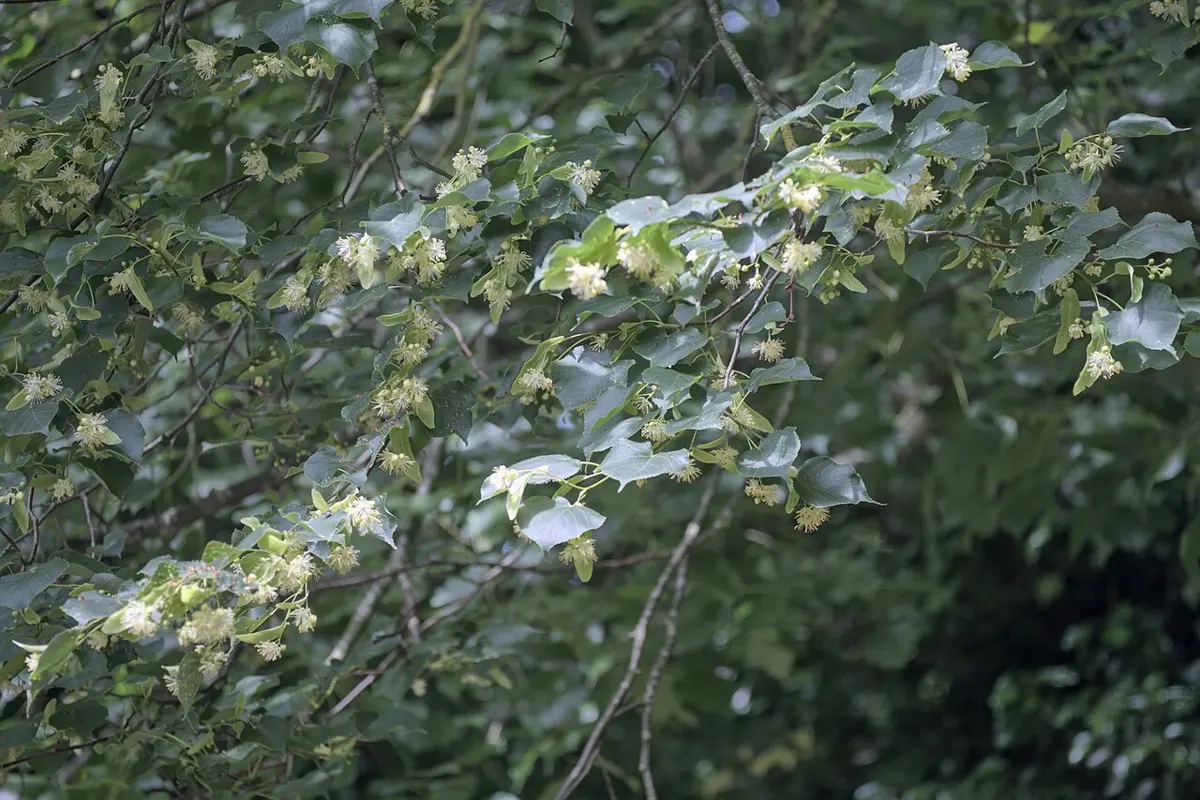
The story, part by part
1. A tree that speaks
An old couple are very poor. The wife tells her husband to cut down a lime tree for firewood, and he goes off with an axe. He is about to chop (cut) it when the tree speaks in a human voice. It asks him to spare it, and it promises to do him a good turn (help him) some day.
The old man is so frightened that he drops his axe. After thinking for a while, he goes home without any wood.
2. The first wish
The wife isn’t impressed. She calls him a fool: a tree that talks is a chance not to be missed! She sends him straight back to ask for a horse and a cart, because she is tired of walking. The tree agrees and tells him to go home. There he finds a cart beside the hut, with a horse harnessed to it (tied to it with straps, ready to pull).
3. A new hut
Now the wife says they are as good as anyone, except for their hut, which is so old that it might cave in (fall down). The man goes back, and the tree agrees. At home, he can hardly believe his eyes: a new hut stands where the old one was. The two of them are as happy as children.
4. Animals, then money
But the wife wants livestock (farm animals) and fowls (hens, ducks and other birds kept for eggs and meat). Once they have those, she says, they will need nothing else. The tree agrees, and the yard fills up with them. The old man is overjoyed (extremely happy) and thinks that they have everything now.
She tells him that he is wrong. Now it is money. When he gets home this time, she is sitting at the table, counting gold coins and stacking them (putting them in neat piles).
5. From having to ruling
Now the wishes change. So far she has wanted things. Next she wants power. Rich people, she says, must be feared, so the tree must make everyone fear them. The man no longer simply asks: he begs. The tree agrees, and he comes home to find policemen and soldiers guarding the house.
Even this doesn’t satisfy her (make her feel she has enough). She has one wish left: every person in the village must work for them.
6. One last thing
The man goes back and begs again. For the first time, the tree doesn’t answer at once. It stays silent for a while. It doesn’t say “Very well”, only that it will do one last thing for him.
He walks home, and there is the old hut, with his wife standing beside it. The new house is gone, and everything else with it.
Read Figure 5.2 from the bottom. Five wishes are granted, and each one makes the next one seem necessary. More than once she says that this will be enough, and it never is.
What it means. The tale is about greed: wanting more and more than you need. Having more doesn’t make the old woman content, because each gift only moves her eyes to the next thing. Her last two wishes go furthest, because they ask for power over other people. Notice also that the old man, who does all the walking, never once says no.
What changes when the old woman asks the tree to make everyone fear them?
Pick an answer to see why.
How is the tree’s last reply different from the others?
Pick an answer to see why.
Words from the story
Words linked here open in English Vocabulary, where you can see an example and practice them in the word game. The meanings below are the ones the words have in this story.
| Word | Meaning here |
|---|---|
| chop | to cut with strong blows, as with an axe |
| do someone a good turn | to do something helpful for someone |
| frightened | afraid |
| fool | a silly person with no good sense |
| harnessed | tied to a cart with straps, so that the animal can pull it |
| cave in | to fall down or fall inward, as an old roof or wall does |
| livestock | farm animals such as cows, goats and sheep |
| fowls | birds kept for eggs or meat, such as hens and ducks |
| overjoyed | extremely happy |
| stack (stacking) | to put things in a neat pile, one on top of another |
| beg (begged) | to ask for something very strongly, almost desperately |
| satisfy | to give someone enough, so that they want no more |
A. Replace the words
Replace the words in italics with their synonyms from the story.
- a.The old bridge was going to collapse, which terrified the people.
- b.The little girl pleaded with her parents to buy her a bicycle.
- c.The players were delighted after scoring the winning goal.
- d.When I lost my passport, I felt such an idiot.
- e.The mountaineer was scared as he tried to climb a dangerous rock.
Answer
B. Put the events in order
Put the following events in the correct order.
- a.The old man asked for a new hut.
- b.The old woman wanted to frighten everyone.
- c.The old man went to the forest to cut down a lime tree.
- d.There lived an old man and an old woman.
- e.The two old people were as happy as children.
- f.Everything was lost at the end.
- g.The old woman sent her husband to ask for a horse and a cart.
Answer
C. Answer the questions
Why did the old man go to the forest with an axe?
Answer
What did the lime tree tell the old man when he was about to cut it down?
Answer
List the things that the old people received from the lime tree.
Answer
Do you like the old woman? Why?
A model answer
What lesson did you learn from this story?
A model answer
D. If you were the old woman
What would you do if you were the old woman? Discuss.
A model answer
Pronunciation: counting syllables
A syllable is one beat of a word. Every syllable has one vowel sound, often with consonants around it. Ex-cept has two beats, so it has 2 syllables.
There are three easy ways to count:
- Clap once for each beat as you say the word slowly.
- Feel your chin. Put your hand under it. It drops once for each syllable.
- Count vowel sounds, not vowel letters. Police has three vowel letters but two vowel sounds; the e at the end is silent.
Say these words and give the number of syllables in each: frightened, harnessed, except, hardly, policeman, livestock, soldier, permission, satisfy, punishment.
Answer
Grammar I: Reported speech, commands and requests
In Unit 3 you reported yes/no questions. Now you will report commands and requests: sentences that tell or ask someone to do something (Sit down. Please wait. Don’t run.). They have no subject, and their verb is in the base form. They are called imperatives.
Here is the pattern, which is simpler than the one for statements:
| Direct speech | Reported speech |
|---|---|
| Pragya said to him, “Put out the light.” | Pragya told him to put out the light. |
| My brother said to me, “Please go to the market.” | My brother requested me to go to the market. |
| She said to him, “Don’t touch the hot water.” | She warned him not to touch the hot water. |
| Shreya said to me, “Get me a cup of tea.” | Shreya told me to get her a cup of tea. |
| My father said to me, “Think before you act.” | My father advised me to think before I act. |
| Neha said to Dipa, “Don’t touch my things.” | Neha forbade Dipa to touch her things. |
| He said to me, “Give me a pen.” | He asked me to give him a pen. |
| The teacher said to his students, “Don’t waste your time.” | The teacher advised his students not to waste their time. |
The steps
- Choose the reporting verb. Said to becomes a verb that shows what kind of sentence it was (see the table below).
- Name the listener right after it: told him, asked me.
- Change the verb to to + base form. Put → to put. For a negative, Don’t put → not to put.
- Drop please, the quotation marks and any exclamation mark.
- Change the pronouns to fit, and this → that, here → there. Get me a cup → get her a cup.
The verb after to never changes for tense, since to + base form has no tense. Only a second verb, later in the sentence, moves back after a past reporting verb: “Wait here till I return” → He asked me to wait there till he returned. Advice that is always true may stay as it is, which is why think before I act is fine (before I acted is right too).
Which reporting verb?
| The speaker is… | Verb | Example |
|---|---|---|
| giving a plain order or instruction | told | Jiban told me to clean the bedroom. |
| giving a strong order, from above | ordered | The officer ordered them to stop. |
| asking politely, often with please | asked, requested | She requested me to sit down. |
| asking desperately | begged | He begged the tree to help. |
| saying what is good for you | advised | The doctor advised him to rest. |
| saying that there’s a danger | warned | She warned him not to touch the wire. |
| saying that something isn’t allowed | forbade (forbid) | Neha forbade Dipa to touch her things. |
“Don’t open that box,” Aishwarya said to Nirajan. Which report is right?
Pick an answer to see why.
“Sleep early before an exam,” said the teacher to us. Which verb fits best when you report it?
Pick an answer to see why.
B. Choose the correct alternative
Read each sentence, then tap the report that is right.
a. Jiban said, “Clean the bedroom.”
Pick an answer to see why.
b. The teacher said to her, “Work with your classmates.”
Pick an answer to see why.
c. The doctor said to him, “Take your medicine regularly.”
Pick an answer to see why.
d. She told me, “Don’t do it.”
Pick an answer to see why.
e. I said to him, “Please go to the market.”
Pick an answer to see why.
f. He said to me, “Post this letter at once.”
Pick an answer to see why.
g. He said to me, “Wait here till I return.”
Pick an answer to see why.
h. Sunita said to him, “Don’t stay here anymore.”
Pick an answer to see why.
Reading II: Free Birds
Before you read
Where do you think the birds are flying to?
A model answer
How do you think a student is like a bird?
A model answer
What kind of text it is
This is a short poem of four stanzas, four lines each. The second and fourth lines of each stanza rhyme or nearly rhyme (fly and sky, caution and nation). It speaks directly to “you”, the students, and it wants something from you. That makes it a poem of persuasion: it gives you orders, and it tells you why you can do it.
The whole poem rests on one comparison: students are free birds. When a poem says that one thing is another, without like or as, that is a metaphor. Nobody thinks that you have feathers. The idea is that you, like a bird, have the power to rise.
The poem, stanza by stanza
Stanza 1: fly
The poem begins by calling students free birds. It tells them to flap their wings (move them up and down), and to keep going on their expedition (a journey with a purpose) until they touch the sky. Your studies, then, are a long journey upward.
Stanza 2: you can arrive
Come on, the poet says: you can reach your destination (the place you are going to). Hindrances (things that get in your way) will come, and the poet doesn’t pretend that they won’t. You must overcome them (win against them) with determination (a firm decision not to give up).
Stanza 3: you are stronger than you know
Try, the poet says. Nothing is easy, yet nothing is impossible either. Look for the courage inside you, because you have incredible strength (so great it is hard to believe).
Stanza 4: use your time, love your country
The poet takes an old saying, Time and tide wait for no one: chances won’t stop for you, so don’t delay. Follow time with care and caution (taking care to avoid danger or mistakes). Then the poem widens from you to your country: a true patriot (a person who loves and supports their country) can make the nation a piece of heaven, a wonderful place to live.
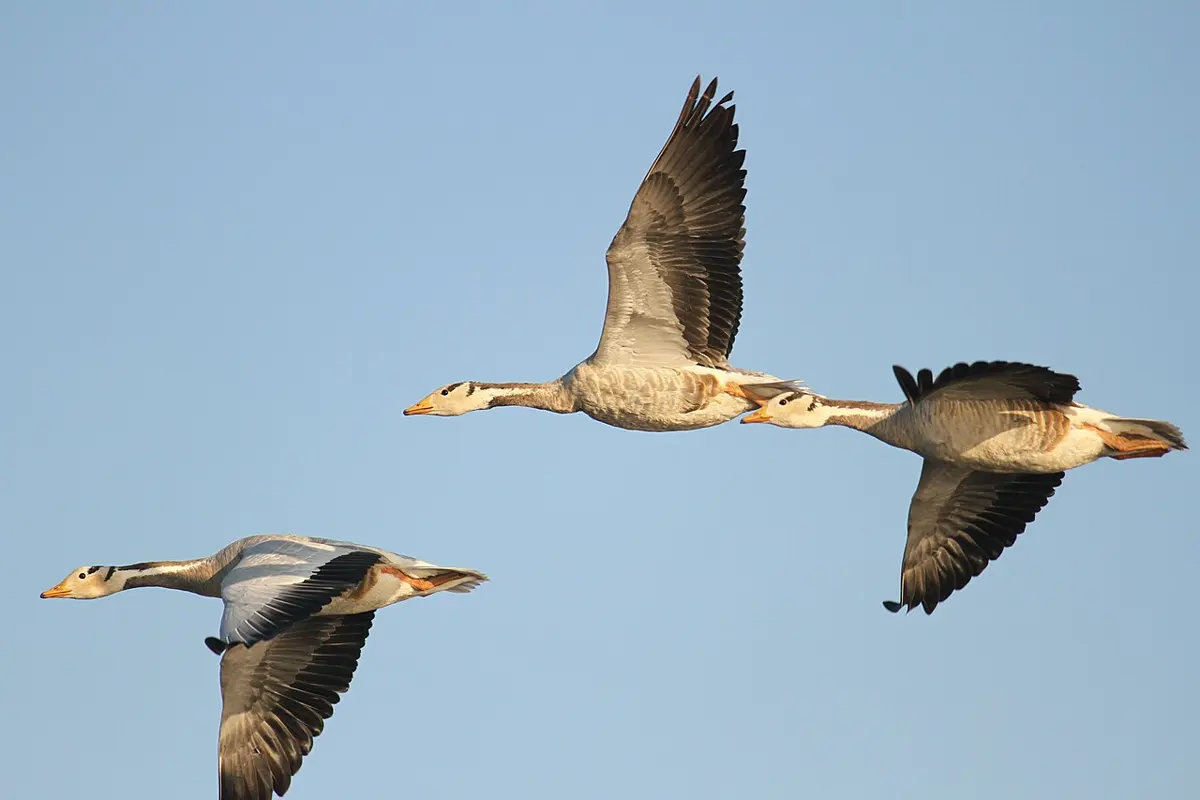
Real birds do what the poem asks. Bar-headed geese fly over our own mountains: they have been heard passing Makalu, on Nepal’s border. They can cross the range from low land, without stopping, in as little as seven hours. Flapping is hard work in such thin air, so for them the poem’s “hindrances” are very real.
“Free birds you are students” is an example of…
Pick an answer to see why.
What does the poet say about hindrances?
Pick an answer to see why.
Words from the poem
| Word | Meaning here |
|---|---|
| flap | of a bird: to move its wings up and down |
| expedition | a journey made for a special purpose |
| destination | the place you are going to |
| hindrance | something that makes it harder to do something |
| overcome | to succeed in dealing with a difficulty |
| determination | a firm decision to go on, even when it is hard |
| courage | the ability to do something dangerous or frightening |
| incredible | very hard to believe; extraordinary |
| caution | care to avoid danger or mistakes |
| patriot | a person who loves and strongly supports their country |
A. Find the words
Find the words from the poem that match the following meanings.
- a.things that make it more difficult for somebody to do something
- b.the ability to do something dangerous
- c.a person who loves and strongly supports or fights for his or her country
- d.(of a bird) move (its wings) up and down when flying or preparing to fly
- e.an excursion or a journey made for some specific purpose
- f.difficult to believe; extraordinary
Answer
B. Answer the questions
What are students compared with in the poem?
Answer
How can students overcome the hindrances on their way?
Answer
How is it possible to achieve your goal?
Answer
Why is it necessary to value time?
Answer
How can we make our country a piece of heaven?
Answer
C. How does the poet persuade?
What expressions does the poet use to persuade you to do these things?
Answer
These two kinds of expression are the spine of this unit: a command, then a reason to believe it. You will use the same pair in Speaking, and the commands are exactly what Grammar teaches you to report.
Grammar II: Reporting commands, for practice
Follow the steps from Grammar I. Look at each sentence first: is it positive, negative, or a polite request?
Change the following sentences into reported speech as in the example.
Example: Bring me a glass of cold water. → My mother told me to bring her a glass of cold water.
- a.Please open the window. She asked me ………
- b.Do not waste your time. My teacher advised us ………
- c.Speak the truth. The old man advised us ………
- d.Avoid eating unhealthy food. My grandmother told him ………
- e.Please come to my birthday party. Ranjana requested me ………
- f.Clean the room. My brother told me ………
- g.Do everything in time. My parents advised us ………
- h.Give up bad habits. The monk advised us ………
Answer
Listening: a free morning
A man and a woman have a free morning in a city and are deciding what to do with it. He has one idea; she has another. Listen to how he tries to persuade her. Read the questions in B first, then listen, as many times as you need. The recording is CDC’s; the answers below are hidden under the questions.
Words to know: a leaflet (a printed sheet that advertises something), the sights (the famous places that visitors go to see), a weather forecast (what the weather is expected to be), I don’t fancy (I don’t feel like; a British way of saying it), a tour guide (the person who leads a tour).
A. Before you listen
Answer these questions.
- a.What do you often do in your free time?
- b.What do you plan to do in your upcoming vacation?
Model answers
B. Answer the questions
What does the man propose to do in their free time?
Answer
What does the man prefer?
Answer
How is the weather forecast?
Answer
Who will be the tour guide?
Answer
What can the woman do when they are on the tour?
Answer
C. Activities on a tour
Make a list of the activities you would do if you were going on a tour.
A model list
Practice listening alone
Speaking: persuading
Persuading people is usually two small moves: say what you want them to do, and give them a reason. The reason can be about the thing (It’s interesting), or about the person (You are good at this).
A. Two short conversations
B. Expressions for persuading
| Expression | What it does |
|---|---|
| Try it. It suits you. | action + praise for how it looks on them |
| Give it a try. It’s really nice. | a gentle push + a reason |
| Come on! You can do this easily. | urging + confidence in them |
| Watch the film. It’s interesting. | action + a reason |
| Go on, open your present. | a friendly push |
| You are good at singing. | praise alone: the action is understood |
Come on! and Go on are friendly and informal: use them with friends and family. To a teacher or a stranger, use a softer form, such as Why don’t you…? or You should really try….
Your friend is afraid to read a poem in assembly. Which sentence persuades best?
Pick an answer to see why.
C. Persuade someone
You want to persuade someone to do something in the following situations. What do you say? Take turns in pairs.
- a.You want your friend to sing a song.
- b.You want your sister to prepare an omelette.
- c.Your friend is good at dancing, but she does not want to take part in a dance competition.
- d.Your friend does not want to go on a picnic.
- e.You want your friend to take part in athletics.
- f.Your friend hesitates to speak English in the class.
Model answers
Writing: punctuation and a story from clues
A. Punctuate a paragraph
In the exam, a short paragraph comes with punctuation missing. Read it aloud first: where your voice stops, a sentence probably ends. Then go through it for each of these.
| Check | What to look for |
|---|---|
| Capital letters | the first word of a sentence; names of people and places |
| Full stops | the end of every sentence, including the last one |
| Commas | before but or so joining two sentences; after an opening phrase like In fact,; in lists |
| Apostrophes | short forms such as didn’t and I’m |
| Question marks | any direct question |
Rewrite the following paragraph with the correct punctuation marks.
david didnt really like school but he did enjoy practical subjects where he could use his hands to make things he also loved biology because he could draw lots of diagrams and do experiments In fact his mother once told him that he should become a surgeon
Hint
Answer
B. A story from clues
You did this in Unit 2: the clues are the bones, and you add the flesh. Keep every clue, put it all in the past tense, join short notes with and, but, so, when, and add a feeling or a few spoken words. A fable like this one usually ends with its moral (its lesson).
Develop a story with the help of the clues given below. Give a suitable title to the story.
A crow … sticks some peacock feathers … flies to peacocks … claims peacocks as relatives … they drive him away … flies to ducks … ducks also drive him away … crow is left alone … friendless …
Hint
A model story
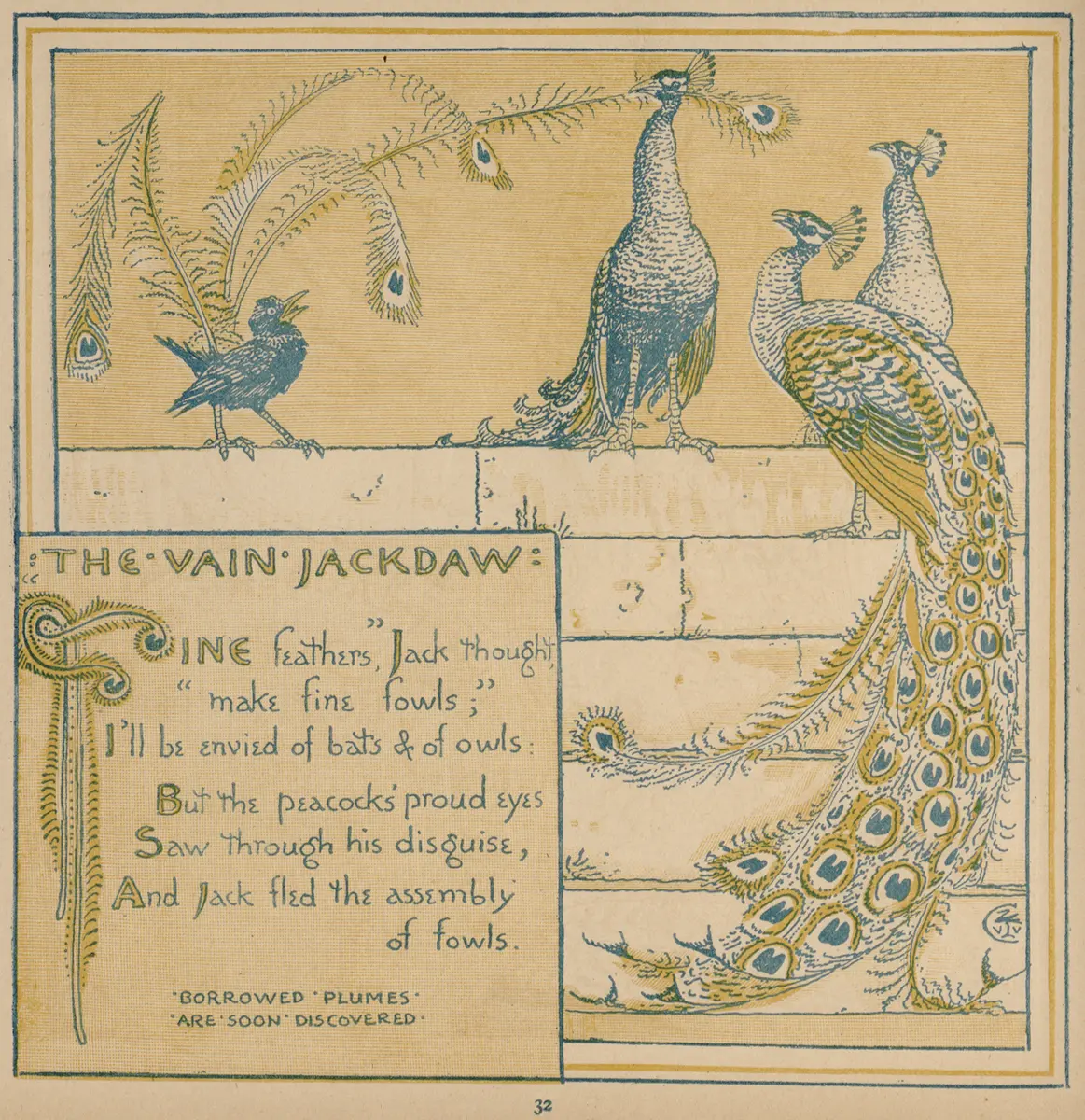
This story is very old, and it is usually said to be one of Aesop’s fables, from ancient Greece. In one old Latin version, a jackdaw sticks peacock feathers among its own; the peacocks strip them off, and its own kind then reject it. It gave English a phrase: someone who shows off what isn’t really theirs is “strutting in borrowed plumes”. (Plumes are feathers.)
Project work
Extra bit: prefixes and suffixes
Many long English words are built from smaller pieces. A prefix goes before a word and usually changes its meaning. A suffix goes after it and often changes what kind of word it is. Learn a dozen of these, and hundreds of new words will open up.
| Prefix | Meaning | Examples |
|---|---|---|
| de- | opposite, undo | decode, deform, defame, demoralize |
| dis- | not, opposite, reverse, away | disagree, disappear, dishonest, distrust |
| mis- | bad, wrong | mislead, misplace, misunderstand |
| pre- | before | preboard, prehistoric, prepaid |
| re- | again, back | react, reappear, rethink, rewrite |
| un- | not, opposite, reverse | undo, unequal, unusual, uncertain |
| Suffix | Meaning | Examples |
|---|---|---|
| -able | able to be, having the quality of | comfortable, portable, sociable, readable |
| -er | more (comparative) | bigger, stronger, faster, easier |
| -ful | full of | beautiful, grateful, thoughtful, painful |
| -ly | makes an adverb | happily, lazily, easily, calmly |
| -ness | a state or condition | kindness, wilderness, sharpness, brightness |
| -y | full of, a condition | healthy, messy, dirty, filthy |
What does misplace mean?
Pick an answer to see why.
Which word is spelled correctly?
Pick an answer to see why.
Exercise
Practice on this unit in the style of the final exam. Try each one as in the exam, then open the answer.
Read “The Old Woman and the Lime Tree” again and answer these questions.
- a.Why did the old woman want a horse and a cart?
- b.Why did she want a new hut?
- c.What was she doing when the old man came home after asking for money?
- d.Who guarded the house?
- e.What did the old man find when he came home for the last time?
Answer
Read “Free Birds” again and complete the sentences with suitable words.
- a.The poet compares students to free ……… .
- b.Students should continue their ……… to touch the sky.
- c.Hindrances can be overcome with ……… .
- d.The strength within students is ……… .
- e.A true ……… keeps loving the nation.
Answer
Read the story and write True or False.
Sharmila had never spoken in front of the school. When her teacher asked her to give a short talk on Children’s Day, she said no. “My voice shakes,” she said. Her friend Yubaraj did not laugh. “Everyone’s voice shakes at first,” he told her. “Practice with me after school.” For a week they practiced under the mango tree. On the day, Sharmila’s hands were cold, but she walked to the front and began. Her voice shook for one sentence and then grew steady. When she finished, the whole school clapped, and Yubaraj clapped the loudest.
- a.Sharmila often spoke in front of the school.
- b.Yubaraj laughed at her.
- c.They practiced for a week.
- d.Her voice shook all through the talk.
- e.The school clapped at the end.
Answer
Rewrite the given sentences as indicated in the brackets.
- a.The guard said to the visitors, “Wait here.” (Change into indirect speech.)
- b.“Don’t feed the monkeys,” the ranger said to us. (Change into indirect speech.)
- c.Rakesh said to me, “Please lend me your pen.” (Change into indirect speech.)
- d.The doctor said to my uncle, “Stop smoking.” (Change into indirect speech.)
- e.Mother said to Srijana, “Don’t go near the river. It’s dangerous.” (Change the first sentence into indirect speech.)
Answer
Choose and copy the best answer for each numbered blank.
Dawa’s mother was worried about the storm. She (a) ……… (said, told, spoke) him to come home early. She also warned him (b) ……… (not to, to not, don’t) walk by the river. His teacher (c) ……… (said, suggested, advised) him to take the bus. The guard forbade the boys (d) ……… (to cross, not to cross, cross) the old bridge. At home, Dawa’s sister said, “Pass me the salt,” so he passed it to (e) ……… (me, her, you).
Answer
Correct the punctuation and capital letters in this paragraph. There are ten errors.
last saturday my friend hema came to our house. Lets go to the fair she said. I didnt want to go, but she told me it would be fun we bought sweets, balloons and a kite.
Answer
Develop a story of about 100 words from these clues, and give it a title.
a fox falls into a well … cannot climb out … a thirsty goat comes … fox says the water is sweet … persuades goat to jump in … fox climbs on goat’s back and jumps out … goat is left in the well
A model story
Write a letter to your friend in Biratnagar persuading him or her to join you on a school trip to Lumbini. Give at least two reasons.
Hint
A plan
Printable PDFs
- Study notes 2 pages
- Harder practice questions 3 pages Answer key
Practice every question in the book, and keep track of the ones you miss →
A companion to your textbook, not a replacement for it: study from the book your school uses, and where the two differ, follow your teacher. Found a mistake? Please tell us.