
A loaded bus leaving Ratnapark lurches forward and every standing passenger sways back. A cricket fielder pulls her hands in as she catches a hard drive. A rocket at Sriharikota rises on a column of fire with nothing to push against. A tractor in Chitwan needs four people to start a stuck trailer moving, and two to keep it going.
In Unit 3 you learned to describe motion: where, how fast, which way. This unit asks why things move as they do. Dynamics is the branch of mechanics that studies motion together with its causes: forces. Its heart is three short laws written by Isaac Newton in 1687. With them, and with the ideas of momentum, impulse, torque and friction, you can explain every one of those scenes, and work out the numbers.
4.1 Introduction
People had argued about motion for two thousand years before it was put right. The Greek philosopher Aristotle taught that a moving body needs a force to keep it moving, and stops when the force stops. It seems obvious: a cart stops when the horse stops pulling.
In the early 1600s the Italian scientist Galileo Galilei (1564–1642) tested the idea. He rolled smooth balls down one ramp and up another and found that, the smoother the ramps, the closer the ball came to rising to its starting height, however gentle the second slope. If the second ramp were flat and perfectly smooth, he reasoned, the ball would roll on forever. So a force is needed not to keep a body moving but to change its motion: friction is the force that stops the cart. Galileo also worked out how bodies fall (Unit 3).
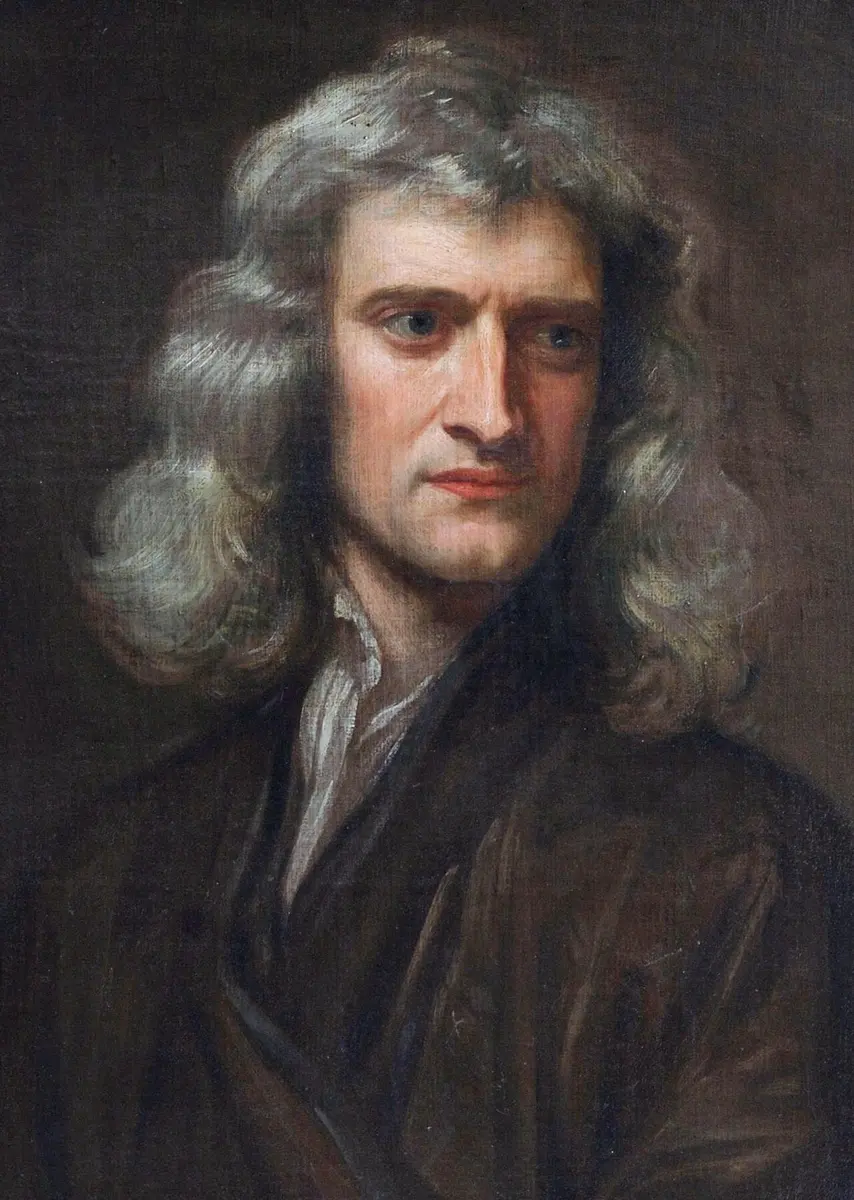
Isaac Newton (1643–1727) built on Galileo. In his Principia (1687) he stated the three laws of motion that are still the basis of mechanics for everything larger than an atom and slower than light: how a force changes a body’s velocity, and how bodies push on each other.

4.1.1 Force
A force is a push or a pull that one body exerts on another, which changes, or tends to change, the body’s state of rest or of uniform motion in a straight line (and can also change its shape). It is a vector: it has a size and a direction. Its SI unit is the newton (N), defined below by Newton’s second law.
4.1.2 Inertia
Every body tends to stay in the state it is in: at rest if it is at rest, moving steadily in a straight line if it is moving. It resists any change in its state of motion. This resistance is called inertia.
The mass of a body is the measure of its inertia: the greater the mass, the greater the inertia, and the harder it is to start, stop or turn the body.
- Two buckets stand in the yard, one full of water, one empty. A strong gust of wind topples or slides the empty one; the full one doesn’t move. The full bucket has much more mass, so much more inertia.
- An iron ball and a hollow rubber ball of the same size roll towards you at the same speed. The rubber ball is far easier to stop: less mass, less inertia.
Inertia shows itself in three ways:
- Inertia of rest. A bus starts suddenly and the standing passengers sway backwards. Their feet move off with the floor, but their upper bodies tend to stay at rest. Shake a mango tree and ripe mangoes fall: the branch moves away, but the mango tends to stay where it was, and its weak stalk snaps.
- Inertia of motion. A moving bus brakes suddenly and the passengers lurch forwards. Their feet stop with the floor, but their upper bodies tend to keep moving.
- Inertia of direction. A bus turns sharply left and the passengers lean to the right: their bodies tend to keep moving in the straight line they were moving in, while the bus turns out from under them.
A bus moving north turns sharply to the east. The standing passengers lurch towards the:
Pick an answer to see why.
4.1.3 Linear momentum and impulse
A cyclist and a loaded truck both move at 5 m/s. Which is harder to stop? The truck, because it has far more mass. A rifle bullet weighs only a few grams but is dangerous because it is so fast. How hard a moving body is to stop depends on both its mass and its velocity, and their product is its linear momentum:
Momentum is a vector in the direction of the velocity. Its SI unit is the kilogram meter per second, kg m/s (the same as N s). A body’s momentum changes only if its velocity changes, that is, only if it accelerates, and Newton found that the rate at which a force changes a body’s momentum is the force itself (Section 4.3.2).
Impulse
Think of three things: a slap on the cheek, a slip on a wet road, two vehicles colliding. In each, a large force acts for a very short time, and the motion changes suddenly. The product of a force and the time for which it acts is the impulse of the force:
Impulse is a vector in the direction of the force; its unit is the newton second, N s, which is the same as kg m/s.
Newton’s second law (Section 4.3.2) says that a force is the rate of change of momentum:
The impulse of a force equals the change in momentum it produces. This is the impulse–momentum theorem. A running man who slips, a ball struck by a bat, two cars in a crash: in each, the impulse of the force is exactly the change in momentum.
When the force changes during the impact (as it nearly always does), is the average force, and the impulse is the area under the force–time graph.
The same change in momentum can be made by a large force for a short time or a small force for a long time. So, to reduce the force of an impact, make it last longer:
- A cricketer catching a hard ball draws her hands back with it, stretching the time the ball takes to stop, so the force on her hands is smaller.
- Falling on a rock or a concrete floor stops you almost at once: a huge force, and an injury. Falling on sand or a mattress stops you over a longer time with a smaller force.
- Glasses and china are packed in straw, paper or bubble wrap, so that a knock is spread over a longer time with a smaller force.
- Cars have crumple zones and airbags; helmets have foam liners; high jumpers land on thick mats.
The opposite is also used: a hammer delivers a large impulse in a very short time, so it drives a nail with a very large force.
A 0.15 kg ball reaches a batter at 30 m/s and leaves the bat at 30 m/s straight back. The size of the impulse on the ball is:
Pick an answer to see why.
4.2 Principle of conservation of linear momentum
Two bodies collide: billiard balls, two carts, a bat and a ball. During the collision each pushes on the other, and each one’s momentum changes. But what happens to the total?
Statement: for a system of two (or more) colliding bodies, the total momentum before the collision equals the total momentum after it, provided no external force acts on the system. More generally, the total momentum of an isolated system (one with no resultant external force on it) stays constant.
Derivation (from Newton’s second and third laws). Two bodies of masses and move along one line with velocities and , with , so the first catches up with the second (Figure 4.4). They are in contact for a short time , and then move on with velocities and .
- During the contact, body 1 pushes body 2 with a force . By the second law, this force is the rate of change of body 2’s momentum:
2. At the same time body 2 pushes body 1 with , the rate of change of body 1’s momentum:
3. By the third law the two forces are equal and opposite, , and they act for the same time :
4. Multiply by and rearrange:
Total momentum before = total momentum after. The forces between the two bodies are internal to the system: they change each body’s momentum, but by equal and opposite amounts, so the total cannot change. Only an external force (friction from the ground, a push from outside) can change the total momentum.
The law holds whether the bodies bounce apart, stick together, or fly apart in an explosion, and in two or three dimensions (each component separately). It holds for every collision ever measured, from galaxies to subatomic particles.
Some examples:
- A gun recoils. Before firing, gun and bullet are at rest: total momentum zero. After, the bullet has forward momentum and the gun an equal backward momentum.
- A rocket pushes hot gas backward at high speed; the rocket gains an equal forward momentum, even in empty space with nothing to push against.
- Jumping from a boat onto the bank, you push the boat away from the bank.
A 50 kg girl standing on a stationary 150 kg boat dives off it horizontally at 3 m/s. Ignoring the water’s drag, the boat moves off at:
Pick an answer to see why.
4.3 Newton’s laws of motion
Newton’s three laws are the foundation of classical mechanics. The first says what happens when no resultant force acts; the second, how a force changes a body’s motion; the third, that forces always come in pairs.
4.3.1 Newton’s first law of motion
Statement: every body continues in its state of rest, or of uniform motion in a straight line, unless an external (resultant) force acts on it to change that state.
So a body at rest stays at rest, and a moving body keeps moving at the same speed in the same straight line, unless a resultant force acts. To start a body moving, to stop it, to speed it up or slow it down, or to turn it, needs a force.
- The first law defines force: a force is whatever changes, or tends to change, a body’s state of rest or of uniform motion in a straight line.
- The first law is the law of inertia: it says that bodies by themselves keep their state, which is just what inertia means.
Everyday examples:
- A bus starts suddenly and standing passengers fall backwards. The floor pushes their feet forward with the bus, but no forward force acts directly on their upper bodies, which tend to stay at rest.
- A bus brakes suddenly and passengers fall forwards. The floor stops their feet, but their upper bodies tend to keep moving forward.
- A bus turns and the passengers lean to the outside of the turn: their bodies tend to keep going straight.
- Mangoes fall when the branch is shaken: the branch is jerked away but the mango tends to stay at rest, and its stalk breaks.
- A long jumper runs up before jumping: the speed she has at take-off carries her on through the air.
- Jumping off a moving bus (dangerous: never do it). Your feet stop when they touch the road, but your upper body keeps moving forward with the bus’s speed, so you fall forward. If you ever must, you would have to land running forward, in the bus’s direction.
- A fan switched off slows down and stops; a ball rolling on the ground slows down and stops. Neither breaks the first law: friction and air resistance are forces, and they are what stop it. On ice the ball rolls much farther; in space, with no friction, it would never stop.
A spacecraft far from every star and planet switches off its engines while moving at 10 km/s. It will:
Pick an answer to see why.
4.3.2 Newton’s second law of motion
Statement: the rate of change of momentum of a body is directly proportional to the resultant force acting on it, and takes place in the direction of the force.
Deriving F = ma. A body of mass moving at is acted on by a constant force for a time , and reaches a velocity .
- Its momentum changes from to , so the rate of change of momentum is .
- By the second law, .
- Since , the acceleration, , that is, , where is a constant.
- The unit of force is chosen to make : one newton is the force that gives a mass of 1 kg an acceleration of 1 m/s². Putting N, kg and m/s² gives , so , and
So 1 N = 1 kg m/s². The second law measures force: from a body’s mass and its acceleration you know the resultant force on it. In calculus form, , which also covers a body whose mass changes (a rocket burning fuel).
The is the resultant (vector sum) of all the forces on the body, and the acceleration is in its direction.
A 2 kg trolley is pulled with 10 N along a level track against a friction of 4 N. Its acceleration is:
Pick an answer to see why.
4.3.3 Newton’s third law of motion
Think about these:
- Swimming: you push the water backward with your hands and feet, and you move forward.
- Jumping: you push the ground down and back, and you rise up and forward.
- Firing a gun: the bullet goes forward, and the gun kicks back into the shoulder (the recoil).
- Punching a wall: a concrete wall hurts far more than a cushion, because it pushes back harder on your fist.
- Walking: a day’s walk on a tarred road tires your feet more than a walk on grass: the hard road pushes back on each footfall over a shorter time, with a bigger force.
In every case there are two forces, on two different bodies, equal in size and opposite in direction.
Statement: to every action there is always an equal and opposite reaction. That is, when two bodies interact, the force that A exerts on B is equal in size and opposite in direction to the force that B exerts on A:
It is also called the law of action and reaction. Three facts about the pair matter:
- They act on different bodies. Your hand pushes the wall; the wall pushes your hand. So they never cancel each other: forces cancel only when they act on the same body.
- They act at the same instant. Neither comes first; which one we call the “action” is only a name. They start together and stop together.
- They are the same kind of force: both contact forces, or both gravitational, or both magnetic.
More examples:
- Rowing a boat: the oar pushes the water backward; the water pushes the oar, and the boat, forward.
- A rocket pushes its burnt gas backward out of the nozzle at great speed; the gas pushes the rocket forward. It doesn’t need air to push against.
- Walking or a horse pulling a cart: the foot or hoof pushes back on the ground; the ground pushes forward on the foot (Section 4.4).
Why the second law is “the real law”
The second law contains the first. Write it as
If no force acts, , so . Since , , that is : the body keeps its velocity, at rest if it was at rest, moving steadily in a straight line if it was moving. That is the first law. If a force acts, , so : the state changes. So the first law follows from the second, and the second is often called the real law of motion. (The third law is a separate statement about pairs of forces; together with the second it gives conservation of momentum, Section 4.2.)
A heavy truck and a small car collide head-on. During the collision, the force of the truck on the car is:
Pick an answer to see why.
4.4 Applications of Newton’s laws of motion
The method is always the same: pick one body, draw all the forces acting on it (a free-body diagram), find the resultant in the direction of motion, and set it equal to mass × acceleration.
Horse and cart
Horse: David Orr, CC0, via PhyloPic
A horse pulls a cart by pushing its hooves down and back on the ground. By the third law the ground pushes the hooves up and forward with a force (Figure 4.8). The vertical part of balances the horse’s weight; its forward horizontal part moves the horse on. The rope pulls the cart forward with a tension , and pulls the horse back with an equal tension (third law). Friction on the cart’s wheels acts backward. Let the horse’s mass be , the cart’s , and their common acceleration .
- On the horse, the horizontal forces are forward and back:
2. On the cart, the horizontal forces are forward and back (its weight is balanced by the ground’s normal reaction ):
3. Adding (4.1) and (4.2), the tensions cancel:
Another way: treat horse and cart as one system. The rope’s tensions are internal, equal and opposite, and cancel. The only external horizontal forces are forward (the ground on the hooves) and back (the ground on the wheels), so at once.
So the force that moves the horse and cart is provided by the ground, pushing on the horse’s hooves. The system accelerates when , moves steadily when , and slows down when . A horse on ice, whose hooves can’t push on the ground, can’t pull anything.
Two masses over a pulley
Two masses and , with , hang from the ends of a light, inextensible string over a smooth (frictionless) pulley (Figure 4.9). The string has the same tension all along. The heavier mass accelerates down and the lighter up, with the same acceleration (the string doesn’t stretch).
- For (accelerating down), the resultant force is down: , that is . (4.3)
- For (accelerating up), the resultant force is up: , that is . (4.4)
- Adding, cancels: , so
4. Tension: from (4.4), , so
Another way: treat both masses as one system moving along the string. The driving force is the difference of the weights, , and the mass being moved is (the tensions are internal and cancel): .
Notice that lies between the two weights: less than (so falls) and more than (so rises). With equal masses, and . This arrangement is the Atwood machine (George Atwood, 1784): it slows free fall down by the factor , so that can be measured with a clock.
Motion in a lift: apparent weight
When you stand on a weighing scale, it shows how hard it pushes up on you, the normal reaction , not your mass. In a lift that is accelerating, that push changes, and you feel heavier or lighter: your apparent weight is .
Take a person of mass standing on the floor of a lift. Two forces act on the person: the weight down and the floor’s push up (Figure 4.10).
- Lift at rest, or moving up or down at a steady speed (): , so . The person feels their normal weight.
- Lift accelerating upward (speeding up on the way up, or slowing down on the way down): the resultant is upward, , so
The person feels heavier.
3. Lift accelerating downward (speeding up on the way down, or slowing down on the way up): the resultant is downward, , so
The person feels lighter: an apparent loss of weight.
- 4.Lift falling freely (the cable breaks, ): . The floor doesn’t push at all; the person feels weightless, floating with the lift. Astronauts in orbit are weightless in exactly this way: they and their spacecraft are falling together round the Earth.
- 5.Lift pulled down with (faster than free fall): the floor would have to pull the person down, , but a floor can only push. So the floor drops away from the person’s feet, and relative to the lift the person moves up until they reach the ceiling, which then pushes them down with a force . They are pressed against the ceiling, as if standing on it.
Your weighing scale in a lift reads less than your normal weight. The lift could be:
Pick an answer to see why.
4.5 Moment, torque and equilibrium
The door turns about the line of its hinges, the stone about the edge it tips over. This line is the axis of rotation. How strongly a force turns a body about an axis depends on two things: the size of the force, and how far from the axis it acts.
The moment of a force, or torque, about an axis is the product of the force and the perpendicular distance from the axis to the force’s line of action:
where is that perpendicular distance (the moment arm). Its SI unit is the newton meter, N m. Torque turns a body about the axis: a larger torque turns it faster and faster (gives it a larger angular acceleration, Grade 12).
In vector form, with the position vector of the point where the force acts, measured from the axis,
where θ is the angle between and ; is the perpendicular distance. The torque is greatest when the force is at right angles to , and zero when the force acts along (pushing a door straight towards its hinges) or at the axis itself.
So for the same torque, a larger needs a smaller : that is why a door’s handle is at the edge far from the hinges, why a spanner has a long handle, and why a long bar turns a stone you couldn’t move by hand.
A spanner 0.25 m long needs a force of 80 N at its end to loosen a nut. With a pipe slipped over it to make it 0.50 m long, the force needed at the end is:
Pick an answer to see why.
Clockwise and anticlockwise moments
A rod pivoted at O has two forces on it (Figure 4.11). , on the left, tends to turn it anticlockwise; its moment is an anticlockwise moment. , on the right, tends to turn it clockwise; its moment is a clockwise moment. Moments are often given a sign: anticlockwise positive, clockwise negative.
Principle of moments
Let a rod pivoted at O be in equilibrium under several forces. and act at A and B and turn it anticlockwise; , and act at C, D and E and turn it clockwise (Figure 4.12).
Sum of the anticlockwise moments
Sum of the clockwise moments
When the rod is in equilibrium, it is found that
This is the principle of moments: when a body is in equilibrium under several forces, the sum of the clockwise moments about any point equals the sum of the anticlockwise moments about that point; the resultant moment is zero. A see-saw balances, and a shopkeeper’s beam balance weighs, by this principle.
Like and unlike parallel forces
Two parallel forces on a body can be replaced by a single force, their resultant, which has the same effect.
- Like parallel forces act in the same direction. Their resultant is their sum, , in the same direction, and it acts at a point C between them, nearer the larger force, such that .
- Unlike parallel forces act in opposite directions. If , their resultant is their difference, , in the direction of the larger force, and it acts at a point C outside them, on the side of the larger force, again with .
If two unlike parallel forces are equal, , their resultant is zero, yet they still turn the body: they form a couple (Section 4.5.1).
4.5.1 Torque of a couple
Two equal and opposite parallel forces whose lines of action don’t coincide form a couple. A couple has no resultant force, so it can’t move the body along, but it turns it.
In Figure 4.15, equal forces act at the ends L and M of a rod pivoted at its midpoint O, one down and one up. Both turn the rod anticlockwise, so the moment of the couple is the sum of the two moments:
The moment (torque) of a couple is either force multiplied by the perpendicular distance between their lines of action (the arm of the couple). It is the same about every point, not just about O: try it about L, where one force has no moment and the other has .
Couples are everywhere a thing is turned without being moved along:
- turning a tap, a key in a lock, or a screwdriver: the fingers push one side one way and the other side the other way;
- turning a car’s steering wheel with both hands;
- a compass needle in the Earth’s magnetic field: the north pole is pulled one way and the south pole the other, so the needle turns until it lies along the field.
A driver turns a steering wheel of diameter 0.40 m with two equal and opposite forces of 30 N on opposite sides of the rim. The torque is:
Pick an answer to see why.
4.5.2 Work done by a couple
Two equal and opposite forces act along the rim, at the two ends of a diameter of a wheel of radius (Figure 4.16), and the wheel turns through an angle θ (in radians).
- Each force stays along the rim, so it moves its point of application along an arc of length in its own direction. The work done by each force is .
- The total work done by both forces is .
- is the torque of the couple (its arm is the diameter ):
The work done by a couple is its torque multiplied by the angle turned through (in radians). This is the turning version of “work = force × distance” (Unit 5).
4.5.3 Equilibrium
A body is in equilibrium when its state of motion doesn’t change: the forces on it produce no acceleration and no turning.
- Translational equilibrium: the resultant (vector sum) of all the forces on the body is zero, . The body then has no acceleration: it is at rest, or moving with a constant velocity. The forces balance each other.
- Rotational equilibrium: the sum of the torques on it about any point is zero, : the clockwise and anticlockwise torques balance (the principle of moments). The body doesn’t start to turn, or keeps turning at a steady rate.
Concurrent forces are forces whose lines of action all pass through one point. They have no moment about that point, so a body under concurrent forces is in equilibrium when their resultant is zero (three such forces then form a closed triangle, Unit 2).
Equilibrium of rigid bodies
A rigid body is one in which the distance between any two of its points stays the same, however the body moves: it doesn’t stretch, bend or squash. (No real body is perfectly rigid, but a steel beam or a cricket bat is close enough for most purposes.) Unlike a point, a rigid body can turn as well as move along, so it needs both conditions:
- The vector sum of all the forces on it is zero, . Then ; since , , so is constant: the body is at rest or moves with constant velocity (translational equilibrium).
- The sum of the torques on it about any point is zero, . In Grade 12 you will meet (torque = moment of inertia × angular acceleration, the turning version of ); with , , so the angular velocity ω is constant: the body is not turning, or turns at a steady rate (rotational equilibrium).
A ladder leaning against a wall, a bridge, a loaded beam and the mast of Question 42 are all solved with these two conditions: the forces add up to zero, and the moments about a well-chosen point add up to zero.
A gymnast holds a still handstand. Which is true?
Pick an answer to see why.
4.6 Solid friction
When two solid surfaces touch and one slides, or tries to slide, over the other, a force appears that opposes their relative motion. This resistance is friction, and the force is the frictional force. It acts along the surfaces in contact.
4.6.1 Laws of solid friction and their verification
Introduction. Look at these everyday things:
- Walking on a tarred road is easy; on a muddy path, or on ice, your feet slip.
- A pen writes easily on paper, but slides about and hardly writes on a sheet of plastic.
- A nail driven into a wall stays put and can hold a load.
- A fan switched off slows down and stops.
- A ball rolling on the ground slows down and stops.
In each there is something that opposes motion between surfaces: friction. Friction is what gives your shoe grip, makes a nail hold, and stops the fan and the ball (which is why they don’t break the first law: friction is the force that changes their motion).
Cause of friction. Friction comes from the interactions of the atoms and molecules where the two surfaces touch. It acts along the surface, against the relative motion. It was explained in two ways:
- The old view: interlocking. Every surface, however smooth it looks, is rough at a small scale (Figure 4.17). The bumps of one surface catch in the hollows of the other, and to slide, one must be lifted over or the bumps broken off. This is why sandpaper and a rough road give more friction.
- The modern view: adhesion. The bumps touch only at their tips, so the true area of contact is very small, and the pressure there is huge. At these points the molecules of the two surfaces come close enough to attract one another and stick (adhere): tiny “cold welds“. To slide, these welds must be broken, again and again. A heavier load presses the surfaces closer, flattens the tips and increases the true area of contact, which is why friction grows with the load (the sixth law below). And it explains why two very smooth, clean surfaces (polished glass on glass, clean metal on metal in a vacuum) can have more friction, not less: more of them touches.
4.7 Types of friction
Static and kinetic friction
- Static friction is the friction between two surfaces in contact that are not sliding over each other. It adjusts itself: it is exactly as large as it needs to be to stop sliding, and no larger. Push the box with 50 N and static friction is 50 N; push with 100 N and it is 100 N, so the box stays still.
- Limiting friction is the greatest value static friction can reach, at the moment the body is just about to slide.
- Kinetic (dynamic) friction is the friction between two surfaces that are sliding over each other. It is roughly constant, and it is smaller than limiting friction.
The graph in the widget shows the whole story (Figure 4.18): as the pull rises from zero, the friction rises with it along a 45° line (static friction equals the pull); at the limiting friction the block starts to slide, and the friction drops to the kinetic value and stays there.
Sliding and rolling friction
- Sliding friction is the kinetic friction when one body slides over another: a book pushed across a table, a sledge on snow.
- Rolling friction is the resistance when one body rolls over another: a wheel on a road, a ball on the ground. It comes mainly from the slight squashing of the wheel and the surface where they touch, which never quite springs back with all its energy.
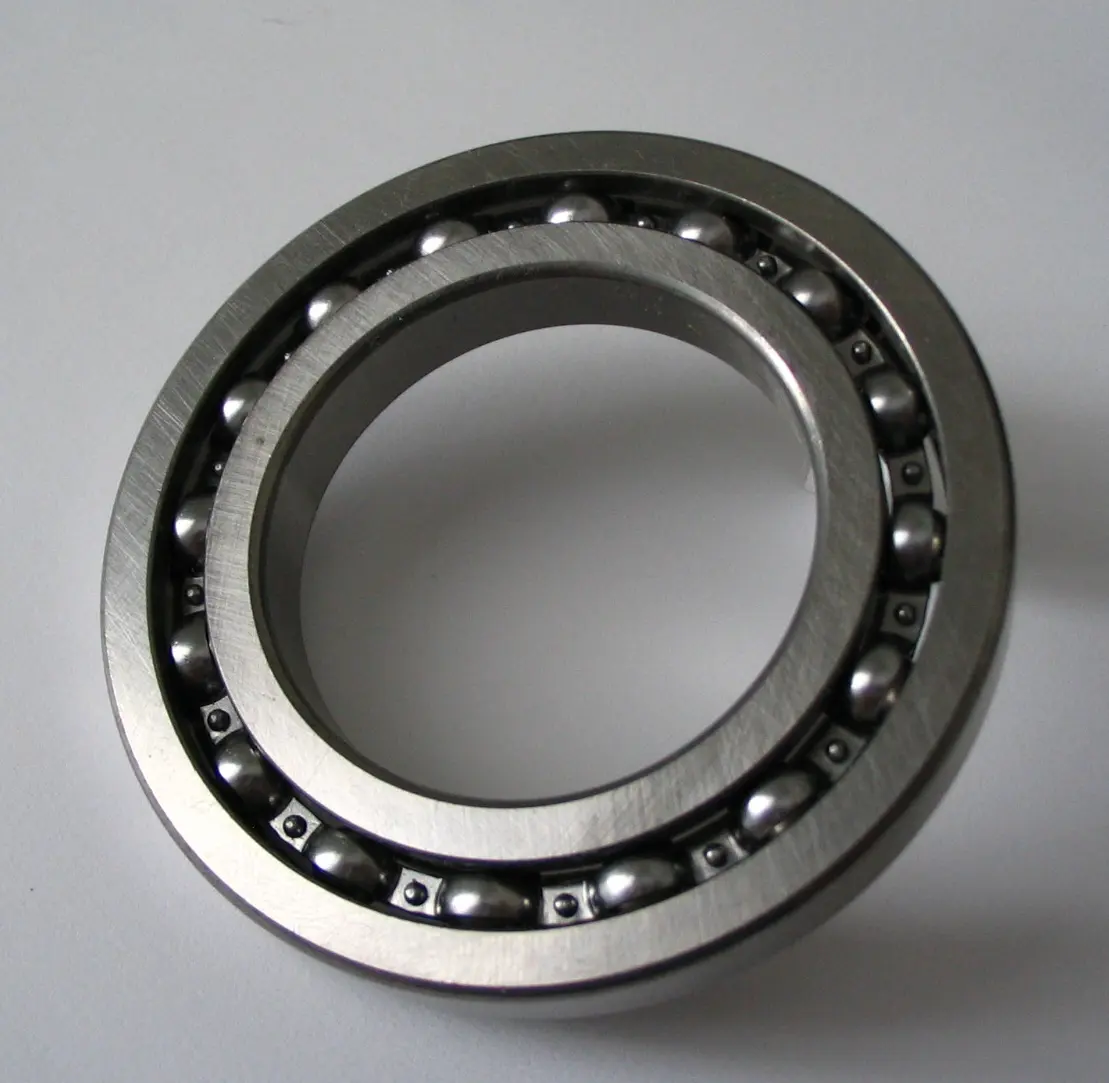
Rolling friction is far smaller than sliding friction, often tens or even hundreds of times smaller. That is why the wheel was such an invention, why heavy machines are moved on rollers, and why ball bearings are fitted in bicycle hubs, fans and motors: they turn sliding into rolling.
A heavy cupboard is easier to keep moving than to start moving because:
Pick an answer to see why.
4.8 Laws of friction
- Friction between two surfaces opposes their relative motion (or the motion they tend to have).
- Friction depends on the nature and roughness of the two surfaces.
- The frictional force acts parallel to the surfaces in contact (along them).
- Limiting friction is independent of the area of the surfaces in contact (for the same load).
- Kinetic friction is (nearly) independent of the relative speed of the surfaces.
- Limiting friction is directly proportional to the normal reaction between the surfaces: .
From the sixth law,
where the constant μ is the coefficient of friction of that pair of surfaces, . It has no unit. For limiting friction, (the coefficient of static friction); for kinetic friction, (the coefficient of kinetic friction). Since kinetic friction is smaller than limiting friction, .
| Surfaces | (about) | (about) |
|---|---|---|
| Rubber tire on dry road | 1.0 | 0.8 |
| Rubber tire on wet road | 0.7 | 0.5 |
| Wood on wood | 0.5 | 0.3 |
| Steel on steel (dry) | 0.7 | 0.6 |
| Steel on ice | 0.03 | 0.02 |
| Joint in the human body | 0.01 | 0.003 |
Friction is a necessary evil.
- Necessary: without friction we couldn’t walk (our feet would slip), hold a pen or write on paper, drive a nail into a wall, tie a knot, or start, steer or stop a vehicle. Brakes, belts and shoes all work by friction.
- Evil: friction turns useful energy into heat, wastes fuel, and wears out tires, shoe soles, gears and engines. Because of it, no machine is 100 % efficient.
So we increase friction where we need it (tread on tires, sand on icy roads, grips on shoes) and reduce it where we don’t (oil and grease, ball bearings, smooth polished surfaces, streamlined shapes).
Verifying the laws
a. Limiting friction is proportional to the normal reaction (F ∝ R). A wooden block A rests on a horizontal table (Figure 4.20). A light string tied to it runs horizontally over a smooth pulley at the table’s edge to a scale pan. Add small weights to the pan until the block just begins to slide: the weight of the pan and its load is then the limiting friction. Now put a second, identical block B on top of A, doubling the normal reaction, and repeat: the load needed to start them sliding doubles. With three blocks it triples. So limiting friction ∝ normal reaction.
b. Limiting friction is independent of the area of contact. Now place the two blocks one after the other, side by side on the table (c), instead of stacked (b). The normal reaction is the same, but the area of contact has doubled. The load needed to start them sliding is the same as in (b). So limiting friction doesn’t depend on the area of contact.
4.9 Angle of friction
A block of mass rests on a horizontal surface, and is pulled sideways until it is just about to slide (Figure 4.21). The surface exerts two forces on it: the normal reaction ( here) and the limiting friction . Their resultant, , leans back from the normal.
The angle of friction, λ, is the angle between the resultant of the limiting friction and the normal reaction, and the normal reaction itself. From the right-angled triangle of forces,
The tangent of the angle of friction equals the coefficient of (limiting) friction.
4.10 Angle of repose
The angle of repose, θ, is the angle of an inclined plane at which a body placed on it just begins to slide down.
A block of mass lies on a plane inclined at θ (Figure 4.22). Its weight acts vertically down; split it into two parts:
- , down the slope, which tends to make it slide;
- , into the slope, at right angles to it.
- Into the slope, the block doesn’t move, so the normal reaction balances that part: .
- Along the slope, when the block is just about to slide (at the angle of repose), the limiting friction , up the slope, balances the pull down the slope: .
- Dividing, . And at the limit , so
The tangent of the angle of repose equals the coefficient of friction. Since also , the angle of friction equals the angle of repose: .
The angle of repose doesn’t depend on the mass of the block, since cancels. It is why every heap of sand, gravel or grain has the same slope whatever its size (dry sand about 34°), and it matters in Nepal’s hills: a slope cut steeper than the angle of repose of its soil, and wetted by the monsoon (which lowers μ), slides. That is one reason landslides follow new roads cut into the hillsides.
A block rests on a plank with . The plank is slowly tilted. The block starts to slide at about:
Pick an answer to see why.
Exercise
Choose the correct option
- What makes mangoes fall when the branch of a mango tree is shaken?
Pick an answer to see why.
- A body is moving at a constant speed along a straight path. In which case is no force required?
Pick an answer to see why.
- When two surfaces are coated with lubricating oil, they:
Pick an answer to see why.
- A force N gives a body an acceleration of 1 m/s². The body’s mass is:
Pick an answer to see why.
- A person jumps off a moving bus. In which direction does he tend to fall?
Pick an answer to see why.
- A 6 kg object is acted on by the three forces , and (in newtons). Its acceleration is:
Pick an answer to see why.
- A 50 kg man pushes on a 40 kg man with a force of 40 N. What force does the 40 kg man exert on the 50 kg man?
Pick an answer to see why.
- A force of 6 N acts on a 1 kg body at rest, until its velocity is 30 m/s. For how long did the force act?
Pick an answer to see why.
- Which of these is not a force?
Pick an answer to see why.
- Friction is:
Pick an answer to see why.
- A lift moves up with an acceleration equal to of g. The apparent weight of a 60 kg man standing in it is (g = 10 m/s²):
Pick an answer to see why.
- A ball of mass m meets a wall at speed u at 30° to the normal, and bounces off at the same speed, at 30° on the other side of the normal (the picture above). The time of contact is t. The average force on the wall is:
Pick an answer to see why.
- A book lies on a table. The angle between an action and its reaction is:
Pick an answer to see why.
- Blocks of 8 kg and 12 kg hang from the ends of a light, inextensible string over a frictionless pulley (the picture above). The acceleration of the system is (g = 10 m/s²):
Pick an answer to see why.
- The coefficient of friction between a block and an inclined plane is μ. The angle of repose θ is:
Pick an answer to see why.
- A horizontal force of 100 N pulls a 10 kg block along a rough horizontal surface whose coefficient of friction is 0.5. The acceleration is (g = 10 m/s²):
Pick an answer to see why.
- A 2 kg block rests on a plane inclined at 30°; the coefficient of friction is 0.7. The limiting friction on it is (g = 9.8 m/s²):
Pick an answer to see why.
- A block slides down a smooth plane inclined at 30°. Its acceleration is (g = 10 m/s²):
Pick an answer to see why.
- Which best explains why an empty bucket is blown over in a storm?
Pick an answer to see why.
Answer these questions
- a.State Newton’s first law of motion.
- b.How does it define force?
- c.Why is it called the law of inertia?
Answer
- a.State the impulse–momentum theorem.
- b.Show that impulse equals the change in momentum of a body.
- c.Why are china and glassware wrapped in straw or paper before packing?
Answer
- a.Why is the second law called the real law of motion?
- b.Why is k taken as 1 in deriving F = ma?
- c.A 2 kg body moving at 8 m/s is stopped in 2 s by a force. Find the force.
Answer
- a.Define a couple.
- b.A wheel of radius 0.5 m is turned through 30° by a couple of two forces of 100 N each. Find the work done.
- c.In finding this work, why is the arm of the couple twice the radius?
Answer
- a.“Friction is a necessary evil.” Justify this.
- b.Show that the angle of friction equals the angle of repose.
- c.A ball sliding on ice at 14 m/s comes to rest after 40 m. Find the coefficient of friction (g = 9.8 m/s²).
Hint
Answer
- a.How would you verify the principle of moments in the laboratory?
- b.A uniform meter rule of mass 100 g carries masses of 10 g, 30 g, 50 g, 70 g and 90 g at the 10 cm, 30 cm, 50 cm, 70 cm and 90 cm marks. Find the position of the center of gravity.
Hint
Answer
- a.State the principle of conservation of linear momentum and explain it from Newton’s third law.
- b.A superhero throws a boulder of weight 2400 N. What horizontal force must he apply to give it a horizontal acceleration of 12.0 m/s²?
- c.If a friction of 60 N opposes the motion, what horizontal force gives the same acceleration?
Answer
- a.Define impulse.
- b.The graph shows the force on an object against time. Find the impulse between 0 and 10 s.
- c.If the object’s mass is 2 kg, find its acceleration at i. 2 s and ii. 6 s.
Hint
Answer
- a.Define the angle of friction and the angle of repose, and show that they are equal.
- b.A 1 kg block on a plane inclined at 30° starts to slide down from rest. If the coefficient of kinetic friction is 0.2, find its velocity after 5 s.
- c.Find its velocity one second later, at 6 s.
Hint
Answer
Numerical problems
A little wagon of mass 7 kg moves in a straight line on a frictionless horizontal surface at 4 m/s. It is then pushed 3 m in the direction of its velocity by a force of 10 N. Find the acceleration produced and the wagon’s final speed.
Answer
Find the acceleration of a block sliding down a plane inclined at 45° to the horizontal, if the coefficient of sliding friction is 0.3 (g = 9.8 m/s²).
Answer
A 150 g wooden block rests on an inclined plane; the coefficient of static friction is 0.30. Find a. the greatest angle to which the plane can be tilted without the block slipping, and b. the force parallel to the plane needed to stop it slipping when the plane is at 30° (g = 9.8 m/s²).
Answer
A shot-putter moves a 7 kg shot from rest through 2.8 m and releases it at 13 m/s. Find the average force on the shot.
Answer
A 5 kg block on a horizontal table is tied by a cord, over a light frictionless pulley at the table’s edge, to a hanging 5 kg block. The coefficient of kinetic friction between the block and the table is 0.5. Find the acceleration and the tension in the cord (g = 9.8 m/s²).
Answer
A shot of mass 7.30 kg is released at 15.0 m/s at 40° above the horizontal. Find the horizontal and vertical components of its momentum.
Answer
Two skaters collide and hold on to each other on frictionless ice. One, of mass 70.0 kg, moves to the right at 2.00 m/s; the other, of mass 65.0 kg, moves to the left at 2.50 m/s. Find their velocity just after the collision.
Answer
A bullet of mass 1.80 g moving at 350 m/s strikes a tree and penetrates 0.130 m. Assuming a constant retarding force, find a. the time it takes to stop and b. the force the tree exerts on it.
Answer
Two dogs pull horizontally on ropes tied to a post, with 60.0° between the ropes. Dog A pulls with 270 N and dog B with 300 N. Find the size of the resultant force and the angle it makes with dog A’s rope.
Answer
A hockey puck of mass 0.160 kg is at rest at the origin on frictionless ice. From t = 0 a player pushes it with 0.250 N along the x-axis until t = 2.00 s. a. Find its position and speed at 2.00 s. b. The same force is applied again from t = 5.00 s. Find its position and speed at 7.00 s.
Answer
A 12.0 kg chair stands on a rough horizontal floor. You push it with a force of 40.0 N directed at 37.0° below the horizontal, and it slides. a. Draw a labeled free-body diagram for the chair. b. Find the normal force of the floor on the chair.
Answer
A baseball of mass 0.145 kg moves in the +y direction at 1.30 m/s, and a tennis ball of mass 0.0570 kg moves in the −y direction at 7.80 m/s. Find the size and direction of the total momentum of the two balls.
Answer
A radio aerial on top of a 20 m mast pulls horizontally on it with 600 N. The mast is held by a stay wire from a point 6 m below the top to the ground, at 60° to the horizontal. Taking the ground’s action on the mast as a single force at its base, find the tension in the stay wire.
Hint
Answer
A typical car weighs about 12 000 N (a mass of about 1200 kg). If the coefficient of rolling friction is 0.015, find the horizontal force needed to keep it moving at a constant 72 km/h on a level road, and the power the engine must develop to keep up this speed (ignoring air resistance).
Answer
A roller of diameter 1.0 m weighs 360 N. Find the horizontal force, applied at its center, needed to pull it over a brick 0.1 m high.
Hint
Answer
A block of mass on a smooth plane inclined at θ is tied by a light string, over a pulley at the top of the plane, to a hanging block of mass .
- a.Find the acceleration of the system in terms of , , θ and g.
- b.Find the tension in the string.
- c.If and θ = 25°, find the acceleration.
Answer
Printable PDFs
- The unit as a book (A5) 28 pages Answers as an A4 booklet, 7 sheets
- Study notes 3 pages
- Worksheet 4 pages Answer key
- Harder practice questions 2 pages Answer key
Quiz yourself: Force, Motion and Machines, Grades 5–12 →
Practice every question in the book, and keep track of the ones you miss →
A companion to your textbook, not a replacement for it: study from the book your school uses, and where the two differ, follow your teacher. Found a mistake? Please tell us.