
The steel deck of the Mugling bridge on the Prithvi Highway is 125 m long. Between a cold January dawn and a hot June afternoon it grows by about 3.5 cm, and nothing in the world can stop it: hold its ends fast and the steel pushes on them with millions of newtons. So the bridge is built to let it grow.
Nearly everything gets bigger when it is heated and smaller when it cools. This unit measures that growth exactly: in length, in area and in volume; for solids and for liquids; and the forces it sets up when it is stopped. You will see why a pendulum clock loses time in summer, why a thermostat clicks, why a full flask of mercury overflows when warmed, and how a U-tube of mercury measures a liquid’s expansion without caring how the glass expands.
10.1 Introduction
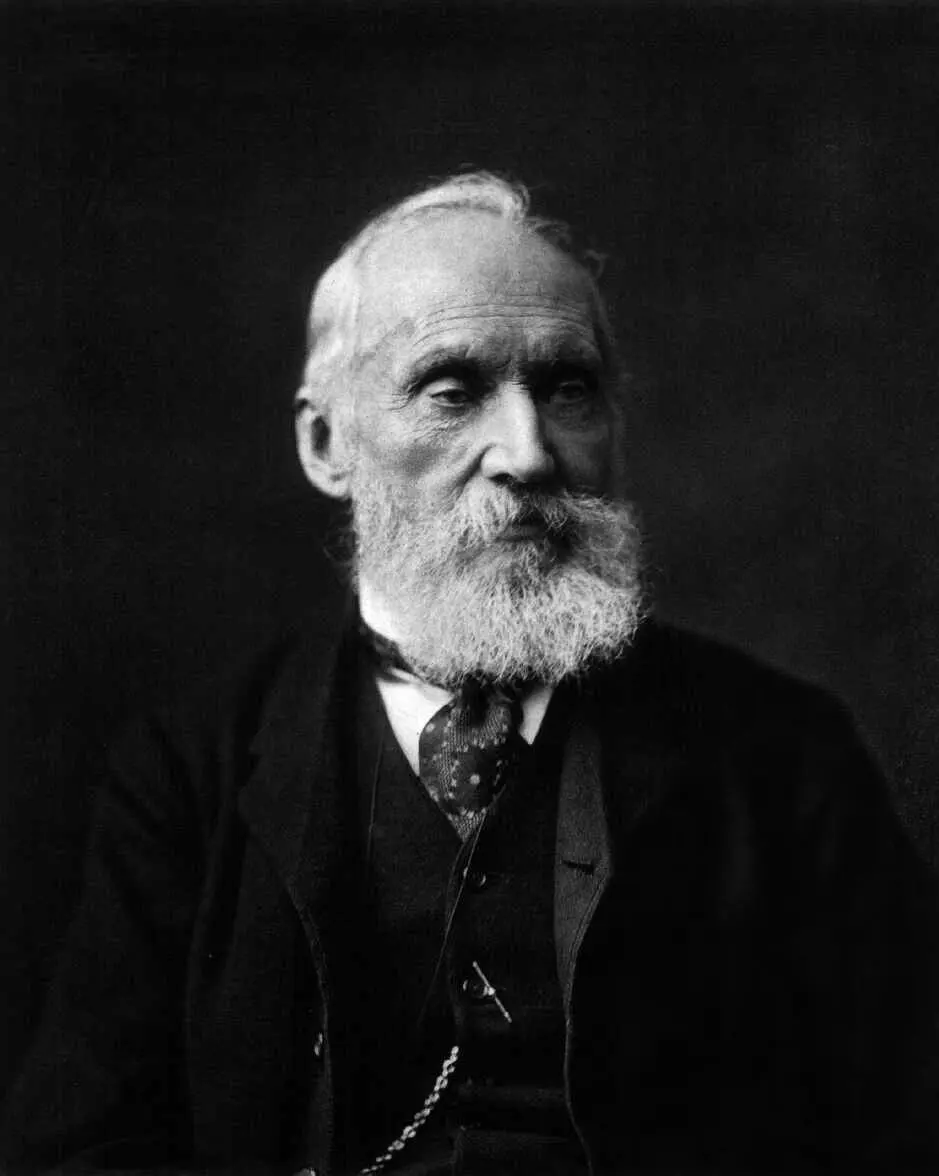
Two things engineers do every day show that heat changes size:
- the long steel girders of a bridge are laid with gaps between them, or rest on rollers at one end, so that they can grow in summer without pushing the piers apart;
- a blacksmith makes the iron rim (tyre) of a wooden cart wheel slightly smaller than the wheel, heats it until it grows enough to slip over the wood, and lets it cool: it shrinks and grips the wheel tightly.
When a body is heated, its atoms or molecules vibrate (or move) more vigorously, and on average they sit a little farther apart. So the body grows in length, in area and in volume. This is thermal expansion. It happens in solids, liquids and gases. How much a substance expands depends on what it is made of: its structure and the strength of the forces between its particles. Gases expand most, liquids less, solids least.
Water is the famous exception: heated from 0 °C to 4 °C it contracts, and only above 4 °C does it expand as other liquids do.
Engineers, architects and instrument makers need to know exactly how much things expand: a railway, a bridge, a dam, a power line, a pendulum clock, a dental filling, a glass flask that must survive boiling water. This unit gives them the numbers.
10.2 Thermal expansion
The two demonstrations show that when heat is given to a body, its temperature rises and its size increases: the ball grew, and both the flask and the water in it grew.
Why? In a solid, each atom is held in place by its neighbors, as if joined to them by springs, and it vibrates about that place. Heating gives the atoms more kinetic energy, so they vibrate with bigger amplitude. The “springs” are lopsided: squeezing two atoms closer than their usual spacing takes a large force, while pulling them apart takes much less. So an atom swinging harder can’t go much closer to its neighbor but goes a good deal farther away, and on average the atoms sit a little farther apart. Every gap between neighbors grows a little, and the whole body grows. In a liquid or a gas, the particles also move faster and push each other farther apart.
The increase in the size of a body when it is heated is called thermal expansion. (When it cools, it shrinks: thermal contraction.)
A metal plate with a round hole in it is heated. The hole:
Pick an answer to see why.
Test yourself
10.3 Linear expansion
The increase in the length of a solid when it is heated is called linear expansion. It matters for long, thin things (wires, rods, rails, pipes, bridges), and it can also be seen in the diameter of a heated plate or coin.
Take a metal rod of length at temperature , and heat it to ; its length becomes . Careful measurements show that the increase in length is
- proportional to the original length: . A rod twice as long grows twice as much, because each half grows by the same amount as the short rod;
- proportional to the rise in temperature: , as long as the rise is not very large.
Combining the two,
The constant α (alpha) is the coefficient of linear expansion, or linear expansivity, of the material. Put = 1 unit and = 1 degree, and . So:
The linear expansivity of a solid is the increase in length per unit original length per degree rise in temperature.
- Its unit is K⁻¹ (per kelvin), the same number as °C⁻¹, because a change of 1 K is a change of 1 °C. The unit of length cancels, so α is the same in meters or centimeters.
- It depends on the material, not on the rod’s length or the shape of its cross-section. (It changes a little with temperature, so a table gives its value near room temperature.)
Rearranging (10.1) gives the length after heating:
where . For cooling, Δθ is negative and the same formula gives the shorter length.
| Substance | α (K⁻¹ or °C⁻¹) |
|---|---|
| Quartz (fused) | 0.05 × 10⁻⁵ |
| Invar (an iron–nickel alloy) | 0.12 × 10⁻⁵ |
| Glass | (0.3 – 0.9) × 10⁻⁵ |
| Steel | 1.1 × 10⁻⁵ |
| Iron | 1.2 × 10⁻⁵ |
| Gold | 1.4 × 10⁻⁵ |
| Copper | 1.7 × 10⁻⁵ |
| Brass | 1.9 × 10⁻⁵ |
| Silver | 1.9 × 10⁻⁵ |
| Aluminium | 2.3 × 10⁻⁵ |
The numbers are tiny: steel grows by about 11 millionths of its length for every degree. But multiplied by a long length and a large temperature change, they add up. (Values for one metal differ a little from book to book, since alloys vary; use the value a question gives.)
Thermal expansion and the pendulum clock
A pendulum clock counts the swings of its pendulum. A simple pendulum of length has a time period (one complete swing, there and back)
where is the acceleration due to gravity. The clock’s gears are set so that each swing advances the hands by exactly seconds; a seconds pendulum, with s (one second each way), is about 99.4 cm long.
The pendulum rod is metal, so its length depends on the temperature:
- in hot weather the rod is longer, the period is longer, the pendulum makes fewer swings in a day, and the clock loses time (runs slow);
- in cold weather the rod is shorter, the period is shorter, and the clock gains time (runs fast).
How much? Let the clock keep correct time at , with length and period . At its length is and its period
using for a very small . So each swing takes longer by a fraction . The clock still counts seconds for each swing, so it falls behind by that same fraction of every stretch of time:
In one day (86 400 s), the loss is s. A rise in temperature makes it lose; a fall makes it gain.
A pendulum clock that keeps correct time in spring is moved to a much colder room. It will:
Pick an answer to see why.
Sample questions
10.4 Superficial expansion
The increase in the area of a solid (a sheet, a plate, a disc) when it is heated is called superficial (or areal) expansion.
Take a metal sheet of area at , heated to , where its area is . The increase in area is found to be proportional to the original area and to the rise in temperature:
β (beta) is the coefficient of superficial expansion, or superficial expansivity.
The superficial expansivity of a solid is the increase in area per unit original area per degree rise in temperature. Its unit is K⁻¹. Like α, it depends on the material, not on the original area or the shape of the sheet.
The area after heating:
A metal plate of area 2.000 m² is heated by 50 K. Its superficial expansivity is 4 × 10⁻⁵ K⁻¹. Its new area is:
Pick an answer to see why.
10.5 Cubical expansion
The increase in the volume of a body when it is heated is called cubical (or volume) expansion. It is the only kind a liquid or a gas can have, since they take the shape of their container.
Take a metal cube of volume at , heated to , where its volume is . The increase is proportional to the original volume and to the rise in temperature:
γ (gamma) is the coefficient of cubical expansion, or cubical expansivity.
The cubical expansivity of a substance is the increase in volume per unit original volume per degree rise in temperature. Its unit is K⁻¹; it depends on the substance, not on its volume or shape.
The volume after heating:
Sample questions
10.6 Relation among α, β and γ
If you know α for a solid, can you find β and γ without another experiment? Yes: area and volume are made of lengths, and every length grows by the same fraction.
β = 2α
Take a square metal sheet of side at , so its area is . Heat it by . Each side becomes , and the area becomes .
- From the definition of β (10.5): , that is, .
- Put in : .
- Cancel and expand the square: .
- α is tiny (about 10⁻⁵ K⁻¹), so is far smaller than (their ratio is , about 1/2000 for steel heated by 100 K): neglect it. Then , and
γ = 3α
Take a metal cube of side , volume . Heated by , its side becomes and its volume .
- From the definition of γ (10.7): .
- Put in : .
- Expand the cube, : .
- Neglect the terms in and , which are far smaller: , and
The picture is the same as for the square: the cube grows by three thin slabs, one on each of three faces; the thin edge pieces and the corner are too small to count.
Together:
These hold for an isotropic solid, one that expands equally in every direction (metals, glass). A crystal like quartz or a piece of wood expands differently along different directions, and then γ is the sum of its three linear expansivities.
Sample questions
- Which of the following is correct for an isotropic solid?
Pick an answer to see why.
- The relation among the three coefficients of thermal expansion of a solid is:
Pick an answer to see why.
- The volume of a metal block increases by 0.12% when it is heated through 20 °C. The linear expansivity of the metal is:
Pick an answer to see why.
10.7 Determination of linear expansivity of a solid: Pullinger’s apparatus
A rod 1 m long heated by 80 °C grows by only about a millimeter. To measure α, we must measure that millimeter to a hundredth of a millimeter, and Pullinger’s apparatus does it with a spherometer, a screw gauge that reads to 0.01 mm.
10.8 Force set up by expansion or contraction: thermal stress
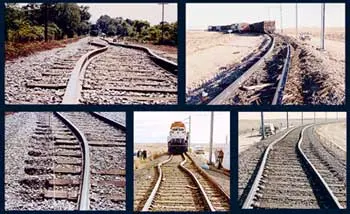
Heat a metal bar and it expands. But hold its ends between two rigid walls so that it can’t expand, and the bar pushes on the walls with a large force. That force is exactly the force needed to squeeze the bar back from the length it wanted to have to the length it is allowed. In the same way, a metal wire stretched between two rigid poles and then cooled tries to contract, can’t, and pulls on the poles.
The force set up in a body when it is prevented from expanding on heating, or from contracting on cooling, is called the force set up by expansion (or contraction), or the thermal force.
How big? From Unit 8, Young’s modulus is . The supports stop a growth , so they must compress the bar by a strain of
and the stress needed is
where is the area of cross-section. The same expressions give the tension in a wire that is held when it cools.
Notice that the force does not depend on the length: a long rail and a short one, equally heated and held, push equally hard. A longer rail would grow more, but it also needs more squeezing to shorten it by that much: the two cancel.
10.9 Differential expansion
The bimetallic strip
Weld or rivet together, along their whole length, two thin strips of different metals, brass and steel, say: a bimetallic strip. Brass expands more than steel. Heated, the brass gets longer than the steel, but the two are joined, so the strip bends into an arc with the brass on the outside (the longer strip goes round the bigger curve). Cooled below the temperature at which it is straight, it bends the other way, with the steel on the outside.
A strip like this, with one end fixed and the other touching a contact, is a thermostat: when the temperature rises past a set value, the strip bends away and breaks the circuit; as it cools, it straightens and closes it again. Thermostats keep the temperature steady in electric irons, rice cookers, water heaters, room heaters, ovens and aquarium heaters, and act as a safety cut-out against overheating.
The difference in the expansions of two bodies of different expansivities, heated through the same range of temperature, is called differential expansion.
A bimetallic strip is made of strips A and B, with . When it is heated, it:
Pick an answer to see why.
Zero differential expansion
Can two rods of different metals keep the same difference in length at every temperature? Yes, if their growths are equal.
Rod A has length and expansivity α; rod B has length and expansivity . Heated by :
The difference in their lengths before heating is , and after heating
so the differential expansion is
For the difference to stay the same (, with Δθ not zero):
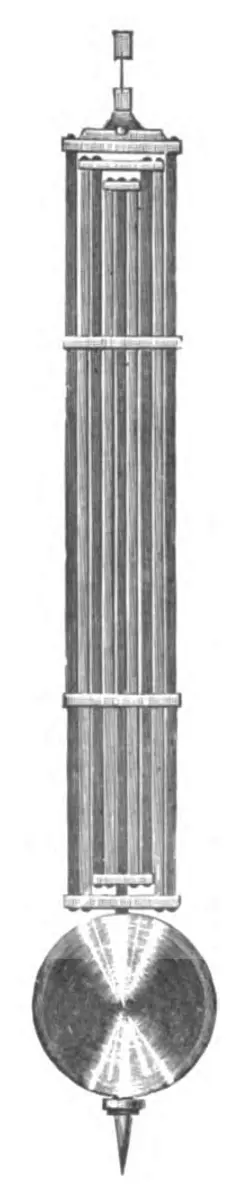
The lengths must be in the inverse ratio of the expansivities: the rod of the metal that expands less must be longer. This is the principle of the compensated pendulum (Harrison’s gridiron, the story in 10.3): steel rods carry the bob down and brass rods carry it up, with lengths in the inverse ratio of their α’s, so the bob stays at the same distance below the pivot.
Sample questions
10.10 Thermal expansion of liquids
A liquid has no shape of its own, so it is always held in a container, and the container expands too. What we see is the liquid’s expansion minus the container’s.
So a liquid has two coefficients of expansion.
Coefficient of real (absolute) expansion of a liquid: the real increase in volume per unit original volume per degree rise in temperature,
Coefficient of apparent expansion of a liquid: the apparent increase in volume (the increase seen in its container) per unit original volume per degree rise in temperature,
And the container’s coefficient of volume expansion, the increase in the volume inside the vessel per unit original volume per degree rise:
The relation between γᵣ, γₐ and γ_g
From the levels: . Multiply by the tube’s cross-section :
Real expansion of the liquid = apparent expansion + expansion of the vessel. Put in (10.12) to (10.14):
If the vessel is glass of linear expansivity , then and .
- γᵣ belongs to the liquid alone; γₐ depends on the liquid and the container. The same mercury has a smaller apparent expansivity in a glass vessel than in a less expanding quartz one.
- If , the apparent expansion is zero: the level never moves. If , the level falls on heating.
A liquid shows no change of level at all when heated in a vessel. Then:
Pick an answer to see why.
Sample questions
10.11 Variation of density with temperature
When a substance is heated, its mass stays the same while its volume increases. Density is mass ÷ volume, so the density decreases.
Let a mass have volume and density at , and volume at . Then
Because is small, this is very nearly : the density falls by the same fraction as the volume grows.
The density of a substance falls as its temperature rises. (Water between 0 °C and 4 °C is the exception: there its volume falls and its density rises, to its greatest at 4 °C.)
10.12 Dulong and Petit’s experiment: the real expansivity of a liquid
In 1817 the French physicists Pierre Dulong and Alexis Petit found a way to measure a liquid’s real expansivity with no correction at all for its container. The trick: compare two columns of the same liquid by their pressure, which depends only on height and density, never on the width of the tube.
The method:
- Fill a U-shaped glass tube ABCD with the liquid (mercury, say).
- Surround the limbs AB and CD with glass jackets J₁ and J₂.
- Pass ice water through J₁, to keep the liquid in AB at a low temperature .
- Pass steam through J₂, to keep the liquid in CD at a high temperature .
- Read the two temperatures on the thermometers T₁ and T₂ in the jackets.
- Keep the horizontal tube BC cool and at one temperature with a wet cloth over which cold water is sprayed, so heat doesn’t pass from one limb to the other.
- Wait until everything is steady: the hot liquid in CD has expanded and stands higher, and the cold liquid in AB lower.
- Measure the heights of the two columns above BC, (cold) and (hot), and the temperatures.
The theory. The liquid in BC is at rest, so the pressure at B equals the pressure at C. Both columns have the same air pressure on top, so their own pressures are equal:
A height of liquid is in inverse proportion to its density. From (10.16), , with and γ the real expansivity:
Every quantity on the right is measured. And because the pressure of a column doesn’t depend on its width, the expansion of the glass (which widens the tube) doesn’t enter at all: this gives the real expansivity directly.
Exercise
Choose the correct option
- What happens to the density of a liquid when its temperature rises?
Pick an answer to see why.
- A metal piece is weighed while hanging in a liquid whose temperature is raised steadily. Its apparent weight:
Pick an answer to see why.
- When does 5 liters of benzene weigh more?
Pick an answer to see why.
- Two rods of different materials expand by the same amount for the same rise in temperature. The condition is:
Pick an answer to see why.
- Two spheres of the same size and material, one solid and one hollow, are heated through the same range of temperature. How do they expand?
Pick an answer to see why.
- A bimetallic thermostat is made of strips A and B with linear expansivities . On heating, the strip:
Pick an answer to see why.
- A clock with a metal pendulum (α = 2 × 10⁻⁵ K⁻¹) keeps correct time at 20 °C. The temperature falls to 10 °C. How many seconds does the clock lose or gain per day?
Pick an answer to see why.
- A thin copper wire of length L gets 1% longer when heated from T₁ to T₂. By what percentage does the area of a thin copper plate measuring 2L × L change when heated from T₁ to T₂?
Pick an answer to see why.
- A disc (α = 1.9 × 10⁻⁵ K⁻¹) has a hole of diameter 1.5 cm at 20 °C. What happens to the diameter of the hole when the disc is heated to 150 °C?
Pick an answer to see why.
- The coefficient of apparent expansion of mercury in a glass vessel is 153 × 10⁻⁶ K⁻¹, and in a steel vessel 144 × 10⁻⁶ K⁻¹. If the linear expansivity of steel is 12 × 10⁻⁶ °C⁻¹, the linear expansivity of glass is:
The textbook prints 114 × 10⁻⁶ K⁻¹ for the steel vessel, but then glass would have a negative expansivity, so the book’s numbers don’t work; 144 × 10⁻⁶ K⁻¹ gives its answer.
Pick an answer to see why.
- A glass flask of volume 1 liter is full of mercury at 0 °C. Both are heated to 100 °C. How much mercury spills out? (Cubical expansivity of mercury 1.82 × 10⁻⁴ °C⁻¹, linear expansivity of glass 0.1 × 10⁻⁴ °C⁻¹.)
Pick an answer to see why.
- A liquid of cubical expansivity γ is heated in a container whose linear expansivity is γ/3. The level of the liquid will:
Pick an answer to see why.
- The coefficient of linear expansion of a substance is 18 × 10⁻⁵ °C⁻¹. What is it on the Fahrenheit scale?
Pick an answer to see why.
- An iron rod of radius 2.4 cm (Y = 2 × 10¹² dyne/cm², α = 1.2 × 10⁻⁵ °C⁻¹) is heated from 0 °C to 50 °C. What force does it exert if it is prevented from expanding?
Pick an answer to see why.
- The side of a cube increases by 0.50% when its temperature changes by 100 °C. By how much does its volume increase?
Pick an answer to see why.
Answer these questions
- a.Why does a bimetallic strip bend to one side when heated?
- b.A solid sphere is heated from to . Find a relation between its final and initial diameters.
- c.A hole 2 cm in diameter is drilled through a piece of steel at 30 °C. What happens to the diameter of the hole when the steel is heated to 80 °C? (α for steel = 1.2 × 10⁻⁵ °C⁻¹)
Hint
Answer
- a.Define the coefficients of linear and cubical expansion of a material.
- b.A solid cube of metal is heated. Derive the relation between its coefficient of linear expansion and its coefficient of cubical expansion.
- c.Would the coefficient of cubical expansion change if the same solid cube were made into a hollow cube?
Answer
- a.A liquid is heated in a flask as in the first figure above. Identify the real and apparent expansion of the liquid.
- b.Show that , where the symbols have their usual meanings.
- c.A glass flask of volume 200 cm³ is filled up to 180 cm³ with mercury at 0 °C. How much space is left above the mercury when the flask and mercury are heated to 60 °C? (Cubical expansivity of glass = 2.7 × 10⁻⁵ °C⁻¹, of mercury = 18 × 10⁻⁵ °C⁻¹.)
- d.From the bimetallic thermostat in the second figure above:
- i.Which expands more for the same rise in temperature, brass or steel?
- ii.Why does the strip bend towards the steel side?
- iii.You have two rods, one brass and one steel, each 1 m long with a cross-section of 1 m². To make them reach the same final length, which must be heated through more degrees?
- e.A glass tube 133 cm long, of uniform cross-section, is to be partly filled with mercury so that the volume of the tube not occupied by mercury stays the same at all temperatures. The cubical expansivities of glass and mercury are 0.000 026 °C⁻¹ and 0.000 182 °C⁻¹. Find the length of the mercury column.
Hint
Answer
- a.A physics teacher asks a student to measure the real expansivity of mercury. What experiment can measure it without taking the expansion of the vessel into account?
- b.Using the figure above, show that .
- c.In such an apparatus, the liquid column is 65 cm high at 0 °C and 66.18 cm high at 100 °C. Find the real expansivity of the liquid.
Answer
- a.A brass rod measured with an aluminium scale reads shorter on a hot summer day than on a cold winter day. Why?
- b.A disc has a hole at its center. When the disc is heated, what happens to the diameter of the hole?
- c.A one-rupee coin has a diameter of 2.0 cm at 20 °C. It is made of an alloy (mostly copper) whose linear expansivity is 1.76 × 10⁻⁵ K⁻¹. What is its diameter i. on a hot day in Nepalgunj (48 °C), ii. on a cold night in the mountains of the Annapurna range (−23 °C)?
Answer
- a.Two rods of the same size, one steel and one aluminium, are heated through the same rise in temperature. The aluminium rod expands more. Why?
- b.The two rods are joined along their length, so that the pair can bend when heated evenly. Explain what happens, with a diagram.
- c.Explain, with examples, how differential expansion is seen and used in everyday life.
- d.A steel rod and an aluminium rod, each 1 m long, are heated through the same rise in temperature (α for steel 1.2 × 10⁻⁵ K⁻¹, for aluminium 2.3 × 10⁻⁵ K⁻¹). Then they are cooled back to their first temperature and joined end to end. What is the length of the combined rod?
Answer
Numerical problems
The distance between two points A and B on a railway is 625 km. Find the total space that must be left between the rails to allow for a change of temperature from 36 °F in winter to 117 °F in summer. (Linear expansivity of iron = 12 × 10⁻⁶ °C⁻¹.)
Hint
Answer
A brass rod 0.40 m long and a steel rod 0.60 m long, both at 0 °C, are heated to 85 °C. Both grow by the same amount. Find the linear expansivity of brass (α for steel = 12 × 10⁻⁶ °C⁻¹).
Answer
Find the temperature at which wood will just sink in benzene. At 0 °C the density of benzene is 9 × 10² kg/m³ and its cubical expansivity 1.2 × 10⁻³ K⁻¹; the density of the wood is 8.8 × 10² kg/m³ and its cubical expansivity 1.5 × 10⁻⁴ K⁻¹.
Hint
Answer
The markings on an aluminium ruler and a brass ruler are exactly in line at 0 °C. How far apart will their 20.0 cm marks be at 100 °C, if their left-hand ends are kept exactly in line? (Take α from the table in 10.3: aluminium 2.3 × 10⁻⁵ °C⁻¹, brass 1.9 × 10⁻⁵ °C⁻¹.)
The textbook prints no expansivities for this question, so the book’s numbers don’t work as given; with the table’s values it gives the book’s answer, 0.008 cm.
Answer
An underground tank with a capacity of 1700 liters (1.70 m³) is filled with ethanol at 19 °C. The ethanol cools to the temperature of the tank and the ground, 10 °C. How much air space will there be above the ethanol? (Take the tank’s volume as unchanged; γ for ethanol = 75 × 10⁻⁵ K⁻¹.)
Answer
A wire 1.5 m long at 20 °C gets 1.9 cm longer when warmed to 420 °C.
- a.Find its average coefficient of linear expansion over this range.
- b.The wire is stretched just taut (zero tension) at 420 °C. Find the stress in it if it is cooled to 20 °C without being allowed to contract (Y = 2 × 10¹¹ Pa).
Answer
A steel tape measure is accurate at 20 °C. It is used at 10 °C to measure a distance of exactly 1 km. What will the tape read? (α for steel = 12 × 10⁻⁶ K⁻¹)
Answer
Printable PDFs
- The unit as a book (A5) 25 pages Answers as an A4 booklet, 7 sheets
- Study notes 3 pages
- Worksheet 4 pages Answer key
- Harder practice questions 2 pages Answer key
Quiz yourself: Energy, Heat, Light and Sound, Grades 5–12 →
Practice every question in the book, and keep track of the ones you miss →
A companion to your textbook, not a replacement for it: study from the book your school uses, and where the two differ, follow your teacher. Found a mistake? Please tell us.