
Put a pot of water on the stove in Kathmandu and it boils at about 95 °C. Keep the flame high and it goes on boiling for twenty minutes, swallowing heat the whole time, and its temperature doesn’t move by a degree. Where does all that heat go?
This unit is about measuring heat. You will meet the heat equation and the calorimeter, see why water is the best coolant and the best hot-water bag, follow a hot cup of tea as it cools by Newton’s law, and measure the heat that melts ice and boils water without warming them, the latent heat. Then pressure: why rice cooks quicker in a pressure cooker, why a wire can pass through a block of ice and leave it whole, and the one temperature and pressure at which ice, water and steam all exist together.
11.1 Introduction
When two bodies at different temperatures are in thermal contact, the hotter one cools and the colder one warms until both reach the same temperature, thermal equilibrium. Energy passes from the hotter body to the colder one; this energy in transit, passed because of a temperature difference, is heat. It flows as long as there is a temperature difference. Heat is a form of energy, a scalar, measured in joules.
We can’t measure the “heat in a body”, only the heat passed from one body to another. That heat may change a body’s temperature, and how much depends on the body’s mass and on what it is made of. Knowing the mass, the material (its specific heat capacity) and the change of temperature, we can calculate the heat.
A temperature can also be raised without heat. Shake a closed thermos flask of water hard for a few minutes and the water gets warmer; pump up a bicycle tyre and the pump gets warm. The work done on the system raises its internal energy, just as heat would.
Calorimetry
The measurement of the heat passed from one body to another is calorimetry: the branch of physics that deals with the experimental methods for measuring heat exchanged. The vessel used for it is a calorimeter.
A calorimeter is a thin-walled, polished cylindrical vessel, usually of copper, with a stirrer of the same metal. It is insulated so that as little heat as possible passes between it and the surroundings: it stands on a poor conductor inside a wooden box, packed round with cotton, wool or another insulator. A thermometer passes through a hole in the lid to read the temperature of the calorimeter and its contents.
Why copper?
- Copper’s specific heat capacity is low (about 385 J/(kg K)), so the calorimeter itself takes little of the heat being measured, and it nearly stays constant over the usual range of temperatures.
- Copper is a good conductor, so the calorimeter quickly comes to the same temperature as its contents.
- Polished walls lose and take in little heat by radiation.
11.2 Heat equation
When a body takes in heat and stays in the same state (solid, liquid or gas), its temperature rises; when it gives out heat, its temperature falls. Experiments show that the heat taken in or given out is
- proportional to the mass of the body: ;
- proportional to the change in temperature : .
Combining these, , and with a constant ,
This is the heat equation. The constant is the specific heat capacity of the material (Section 11.4).
An older unit of heat is the calorie: 1 calorie is the heat needed to raise the temperature of 1 g of pure water by 1 °C (from 14.5 °C to 15.5 °C, since the heat needed changes very slightly with temperature).
The Calorie printed on food packets, with a capital C, is a kilocalorie: 1000 calories, about 4.2 kJ.
11.3 Heat capacity (thermal capacity)
The heat capacity (thermal capacity) of a body is the heat needed to change its temperature by 1 °C (or 1 K).
From the heat equation, the heat to change the temperature of a body of mass by K is . So
Heat capacity depends on both the material and the mass of the body: a bucket of water has a far larger heat capacity than a cup of it. Its SI unit is J/K (J K⁻¹).
11.4 Specific heat capacity
Rearranging the heat equation,
Put kg and K, and . So:
The specific heat capacity of a substance is the heat needed to change the temperature of unit mass (1 kg) of it by 1 °C (or 1 K).
- It depends only on the substance (and its state: ice and water differ), not on how much of it there is: it is the heat capacity per kilogram.
- Its SI unit is J/(kg K).
Water’s specific heat capacity, 4200 J/(kg K), is one of the highest of all common solids and liquids: only a few substances, such as liquid ammonia, have higher values.
| Substance | Specific heat capacity (J/(kg K)) |
|---|---|
| Water | 4200 |
| Copper | 380 |
| Aluminium | 910 |
| Iron | 470 |
| Brass | 372 |
| Steel | 447 |
| Mercury | 138 |
| Sand (dry) | 800 |
| Glass | 677 |
| Kerosene | 2090 |
| Ice | 2100 |
| Alcohol (ethanol) | 2440 |
A 2 kg block of aluminium (910 J/(kg K)) has a heat capacity of:
Pick an answer to see why.
11.5 Specific heat capacity and change in temperature
Give the same heat to two bodies of equal mass but of different specific heat capacities and , and let their temperatures rise by and . Then
So for a given heat (and mass), : the change in temperature is inversely proportional to the specific heat capacity. A substance with a high specific heat capacity changes its temperature little; one with a low specific heat capacity changes a lot.
11.6 Uses of high and low specific heat capacity
High specific heat capacity: water. A substance with a high specific heat capacity can take in a lot of heat from a hotter body while its own temperature rises only a little, so it cools that body a great deal. So water is used
- as the coolant in car, bus and motorcycle engines, and in many machines that get hot;
- to bring down a high fever: a cloth soaked in water on the forehead takes heat from the skin (and its evaporation takes more, Section 11.15).
It can also give out a lot of heat while its own temperature falls only a little, so it keeps something warm for a long time. So water is used
- in hot-water room heaters (radiators), where hot water carries heat round a building;
- in a hot-water bag, which stays warm for hours.
Low specific heat capacity. A substance with a low specific heat capacity takes in or gives out very little heat for a change of temperature, so it soon comes to the temperature of whatever it touches, and it warms up quickly on a little heat.
- Mercury in a thermometer: it takes very little heat from the body it measures, so it barely changes that body’s temperature, and it quickly reaches the same temperature.
- Copper for a calorimeter: it takes little of the heat being measured.
- Cooking oil for frying: it gets very hot quickly on the same flame, and can be heated far above 100 °C without boiling, so food fries fast.
Sample questions
11.7 Newton’s law of cooling
A bowl of hot soup is too hot to eat for the first few minutes; then it cools to a pleasant temperature and stays warm for a long while. It cools fast at first and slowly later. How fast a hot body cools depends on how much hotter it is than its surroundings, on its surface area, on what it is and what holds it; but when everything except the temperature difference is kept the same, Isaac Newton found the rule in 1701:
Newton’s law of cooling: the rate at which a body loses heat is proportional to the difference between its temperature and the temperature of its surroundings.
where is the body’s temperature and the surroundings’ (the minus sign because the body loses heat).
Its equation
Take a hot body (a liquid in a vessel, say) of mass and specific heat capacity at temperature , in surroundings at . In a short time it loses heat .
By Newton’s law, with a constant :
depends on the body’s surface area exposed to the surroundings and on the nature of its surface. Then, step by step:
- Losing , its temperature falls by (a negative change): .
- Put this into (11.4): . So the rate of cooling, , is also proportional to the temperature difference.
- Separate the variables: .
- Integrate both sides: , where is the constant of integration.
This is of the form . A graph of against is a straight line with a negative slope ; plotting the measured temperatures this way and getting a straight line is how the law is tested. (Taking the exponential of both sides, : the excess temperature falls by the same fraction in every equal interval of time.)
When does it hold? Newton’s law is a good description when
- the temperature difference is small (a few tens of degrees);
- the body loses heat in the same way throughout: the same surface, the same draught of air. For a small difference, both radiation and convection carry heat away at a rate nearly proportional to the difference; for a large one, radiation (which depends on the fourth power of the absolute temperature) and convection in still air grow faster than the difference;
- the temperature of the surroundings stays constant while the body cools.
Where we see it:
- A cup of hot tea or coffee cools fast at first and then more and more slowly as its temperature nears the room’s.
- In forensic science, the body’s temperature and the room’s give an estimate of the time of death.
- Tea cools faster in winter than in summer: the room is colder, so the difference, and with it the rate of cooling, is larger.
- A hot liquid cools faster than a warm one in the same room: its temperature difference is larger.
- Animals eat more in winter: they lose heat faster and must make more.
11.8 Principle of calorimetry
When two bodies at different temperatures are put in thermal contact, the hotter one loses heat and the colder one gains it until both reach the same temperature. If no heat is lost to the surroundings,
Principle of calorimetry: in a closed (isolated) system, the heat lost by the hotter bodies equals the heat gained by the colder bodies.
A closed, or isolated, system is one that exchanges no heat with its surroundings; a well-insulated calorimeter is close to one. The principle is the law of conservation of energy applied to heat, and it is the basis of every calorimeter measurement in the next sections.
100 g of water at 80 °C is mixed with 300 g of water at 20 °C in an insulated flask. The final temperature is:
Pick an answer to see why.
11.9 Specific heat capacity of a solid by the method of mixtures
The method of mixtures uses the principle of calorimetry: heat a solid to a known temperature, drop it into water in a calorimeter, and measure how much the water warms. The solid’s heat is found from the water’s. Regnault designed an apparatus that heats the solid in steam and drops it into the calorimeter quickly.
Method:
- Weigh the clean, dry calorimeter with its stirrer: .
- Fill it about two-thirds with water and weigh it again: .
- Place it in its insulating box with a thermometer, and note the temperature of the water and calorimeter: .
- Meanwhile, hang the solid in the steam chamber and pass steam until its thermometer shows a steady temperature: (near 100 °C, less at altitude).
- Slide the calorimeter under the chamber and drop the solid in quickly, so it loses no heat on the way.
- Stir gently until the temperature stops rising, and note the highest steady temperature of the mixture: .
- Weigh the calorimeter with its water and the solid: .
Calculation. Mass of water ; mass of the solid .
The solid’s temperature falls by ; the water’s and calorimeter’s rises by .
- Heat lost by the solid: .
- Heat gained by the water and the calorimeter: ,
where and are the specific heat capacities of water and of the calorimeter’s metal, from tables.
By the principle of calorimetry, :
11.10 Change of phase
Matter is found in three states: solid, liquid and gas. In a solid the particles are packed closest and held in place; in a liquid they are about as close but free to move past each other; in a gas they are far apart and move freely. Which state a substance is in depends on its temperature and the pressure on it. A change of state is a physical change.
The changes come in pairs, each the reverse of the other:
- melting (fusion) solid → liquid, and freezing (solidification) liquid → solid;
- vaporization liquid → gas (by evaporation or boiling), and condensation gas → liquid;
- sublimation solid → gas directly, and deposition gas → solid directly (hoar frost forming on a cold night).
Heating through the changes. Heat a block of ice from well below 0 °C with a steady heater, and its temperature rises steadily to the melting point, 0 °C. Then the temperature stops rising: the ice melts, and ice and water stay at 0 °C, side by side, until all the ice has melted, although heat is going in all the time. Then the water warms steadily to the boiling point, 100 °C at sea level, and stops again until all of it has boiled away. On cooling, the same happens in reverse: the temperature stops at the freezing point until all the liquid has frozen.
Latent heat. The heat taken in or given out by a substance while it changes state at a constant temperature is called its latent heat.
- The latent heat during melting or freezing is the latent heat of fusion.
- The latent heat during vaporization or condensation is the latent heat of vaporization.
“Latent” means hidden: this heat doesn’t show on a thermometer. It is also called the heat of transformation.
Where does it go? During a change of state, the heat does two things:
- Internal latent heat: most of it goes into pulling the particles apart against their attraction for each other, raising their potential energy. Their average kinetic energy, and so the temperature, stays the same.
- External latent heat: a small part does work pushing back the atmosphere as the substance expands (steam takes about 1700 times the volume of the water it came from).
On vaporization, the particles are pulled right apart and the expansion is huge; on melting they only loosen. So both parts are far larger for vaporization: the latent heat of vaporization of a substance is always much greater than its latent heat of fusion (for water, 2.26 × 10⁶ J/kg against 3.36 × 10⁵ J/kg, nearly 7 times).
11.11 Specific latent heat of fusion
The heat needed to melt a solid at its melting point is proportional to its mass: , or
The constant is the specific latent heat of fusion of the substance. Put kg and :
The specific latent heat of fusion of a substance is the heat needed to change unit mass (1 kg) of it from solid to liquid at its melting point, without a change of temperature.
Its SI unit is J/kg. For ice, J/kg: 336 000 J changes 1 kg of ice at 0 °C into 1 kg of water at 0 °C. (The same heat is given out when 1 kg of water at 0 °C freezes.)
11.12 Specific latent heat of vaporization
In the same way, the heat needed to change a liquid into vapor at its boiling point is .
The specific latent heat of vaporization of a substance is the heat needed to change unit mass (1 kg) of it from liquid to vapor at its boiling point, without a change of temperature.
Its SI unit is J/kg. For water, J/kg: 2 260 000 J changes 1 kg of water at 100 °C into steam at 100 °C. That is more than five times the heat that warms the same water from 0 °C to 100 °C (420 000 J).
Good to know
- While a substance is heated, it either changes its temperature or its state, not both at once.
- While a solid melts, the solid and the liquid coexist at the melting point, in thermal equilibrium; while a liquid boils, the liquid and its vapor coexist; during sublimation, the solid and the vapor coexist.
- Specific heat capacity is different in different states of the same substance: water 4200 J/(kg K), ice 2100 J/(kg K).
- On a graph of temperature against heat supplied, the flat part for boiling is much longer than the flat part for melting: the latent heat of vaporization is much larger than that of fusion.
- The sloping parts for the solid, the liquid and the gas have different slopes: different specific heat capacities in each state (the steeper the slope, the smaller the specific heat capacity). They also differ from one substance to another.
Sample questions
11.13 Specific latent heat of fusion of ice by the method of mixtures
The specific latent heat of fusion of ice is the heat needed to change 1 kg of ice at 0 °C into water at 0 °C. It can be measured with a calorimeter: melt a known mass of ice in warm water and see how much the water cools.
Method:
- Weigh the clean, dry calorimeter with its stirrer: .
- Fill it about two-thirds with water warmed a little above room temperature (say 10 °C above), and weigh it again: .
- Put it in its insulating box with a thermometer, and note the temperature: .
- Dry some pieces of melting ice (so they are at 0 °C) with blotting paper and drop them in.
- Stir until all the ice has melted, and note the lowest steady temperature of the mixture: .
- Weigh the calorimeter and its contents again: .
Calculation. Mass of water ; mass of ice .
- Heat gained by the ice: it melts, , then the water from it warms from 0 °C to , .
- Heat lost by the calorimeter and the warm water as they cool from to : .
By the principle of calorimetry:
Every quantity on the right is measured or from tables, so is found.
Why start the water about as much above room temperature as it will end below it? Then the mixture gains heat from the room during the second half of the experiment about as much as it lost in the first, and the two errors nearly cancel.
Sample questions
11.14 Boiling
Boiling is the fast, bubbling change of a liquid into vapor that happens throughout the liquid at one fixed temperature, the boiling point. While it boils, the liquid takes in its latent heat of vaporization and its temperature stays constant. Each liquid has its own boiling point; water boils at 100 °C under a pressure of 760 mm of mercury (one standard atmosphere).
Effect of pressure on the boiling point
Bubbles of vapor can form and grow inside a liquid only when the pressure of the vapor in them (the liquid’s saturated vapor pressure, which rises steeply with temperature) is as large as the pressure pressing on the liquid. So:
A liquid boils at the temperature at which its saturated vapor pressure equals the pressure on its surface.
- Raise the pressure and the liquid must get hotter before it boils: the boiling point rises.
- Lower the pressure and it boils at a lower temperature: the boiling point falls.
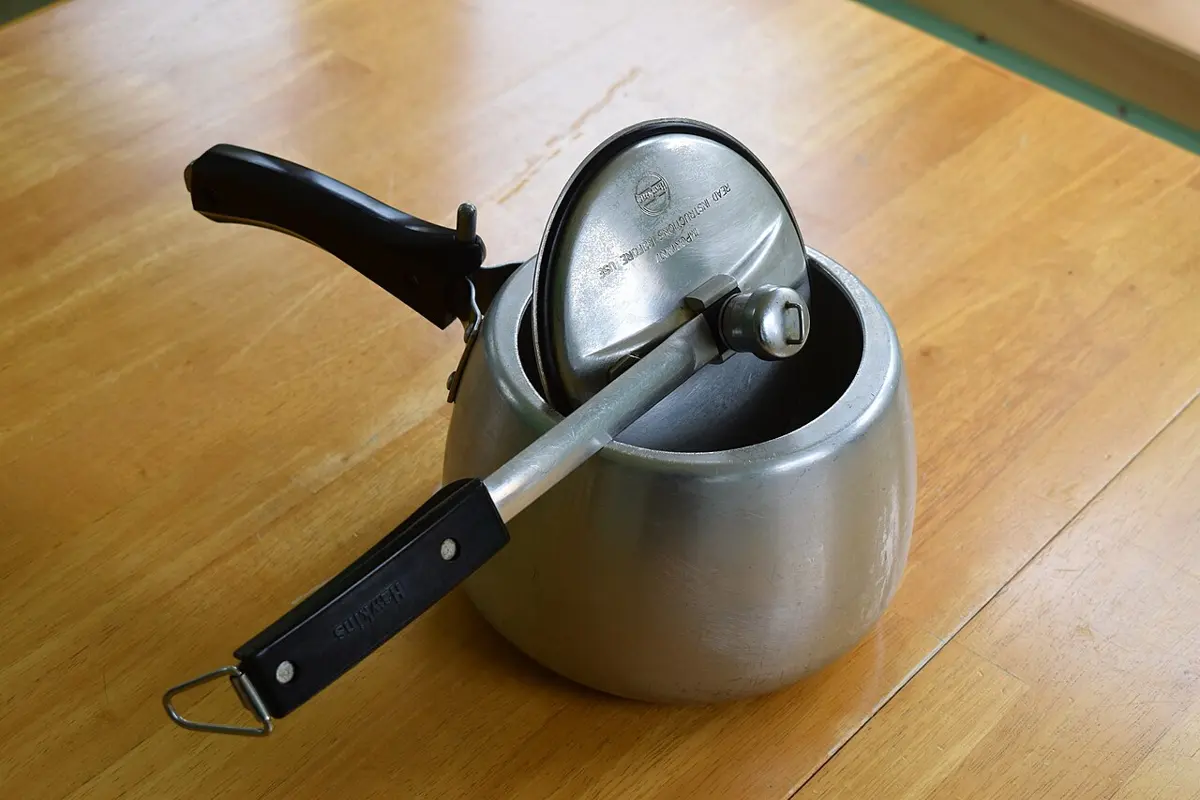
Air pressure falls with height, so water boils at a lower temperature the higher you go: at about 100 °C in Birgunj (about 90 m), 95 °C in Kathmandu (1400 m), 89 °C in Namche Bazaar in Solukhumbu (3440 m), and about 71 °C on top of Everest.
11.15 Evaporation
Spray perfume on your arm and the spot feels cold; a menthol sweet such as a Halls gives a cool feeling in the mouth. The perfume’s cold is the cooling effect of evaporation. (Menthol’s coolness is a trick of the nerves: it sets off the nerve endings that sense cold, without any actual cooling.)
Evaporation is the slow, quiet change of a liquid into vapor from its surface, at any temperature below its boiling point. In a liquid, the molecules move with a range of speeds. The fastest ones near the surface can break free of the others’ attraction and escape. They take more than their share of energy with them (each needs its latent heat to leave), so the average kinetic energy of the molecules left behind falls, and the liquid cools: the cooling effect of evaporation.
Examples:
- a.After sweating we feel cool: the sweat evaporates, taking its latent heat from the skin.
- b.Wet clothes dry: the water in them evaporates, faster in the sun and in wind.
- c.Spirit (alcohol), which evaporates fast at room temperature, is rubbed on the skin before an injection or a blood test: it kills germs and evaporates quickly, leaving the skin clean and dry, and feeling cold.
- d.In the water cycle, water evaporates from seas, lakes, rivers and leaves into the air; the vapor cools as it rises, condenses into clouds, and falls as rain.
- e.After a bath we feel cold when we step into the open air but not inside the bathroom: outside, the air is drier and moving, so the water on the skin evaporates much faster.
| Evaporation | Boiling |
|---|---|
| Happens only at the surface of the liquid. | Happens throughout the liquid (bubbles form inside). |
| Happens at all temperatures. | Happens only at the boiling point (for the pressure). |
| Slow and quiet. | Fast and bubbling. |
| Cools the liquid that is left. | The temperature stays constant: the heat supplied is taken as latent heat. |
| Depends on the surface area, wind and dampness of the air. | Depends on the pressure on the liquid. |
Sample questions
11.16 Effect of pressure on the melting point
Pressure changes the melting point of a solid, in a direction that depends on whether the solid expands or contracts on melting.
- Ice (and cast iron, bismuth and a few others) contracts on melting: water takes less room than the ice it came from. Squeezing helps it melt, so its melting point falls as the pressure rises, by about 0.0075 °C for each extra atmosphere.
- Wax, lead and most other substances expand on melting. Squeezing resists melting, so their melting point rises with pressure.
Regelation
Press two pieces of ice firmly together, and then let go: they come away joined into one piece. Where they touch, the pressure is high, the melting point there falls below 0 °C, and a little ice melts. When the pressure is released, the melting point returns to 0 °C, and the water, now below its melting point, freezes again, joining the pieces.
Regelation is the melting of ice under pressure and its freezing again when the pressure is removed.
Sample questions
11.17 Phase diagram and triple point
A graph of pressure against temperature showing the conditions in which a substance is solid, liquid or gas, separated by three curves, is called a phase diagram or P–T diagram.
The three curves:
a. Vaporization curve (steam line): how the boiling point changes with pressure. Above (and to the left of) the curve the substance is a liquid; below (and to the right) it is a vapor (gas). Along the curve, liquid and vapor coexist. It ends at the critical point (374 °C and 218 atm for water), above which liquid and vapor can no longer be told apart.
b. Fusion curve (ice line): how the melting point changes with pressure. It separates the solid (to the left) from the liquid (to the right). For water it leans slightly to the left as it rises: more pressure, lower melting point. For most other substances, which expand on melting, it leans to the right.
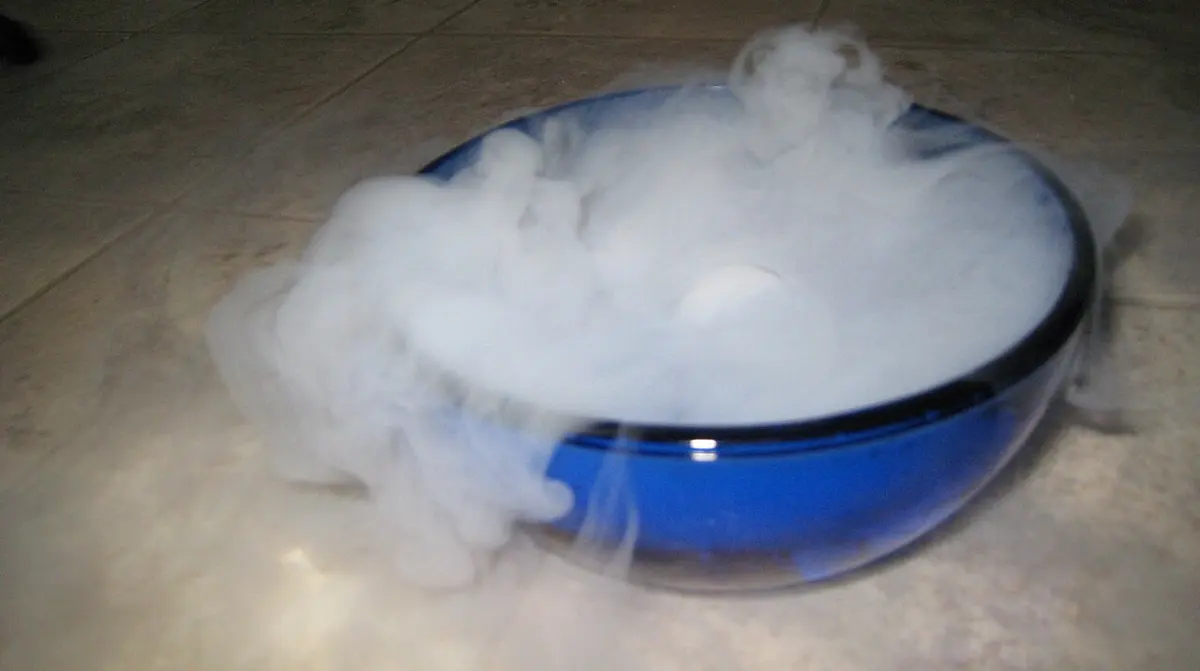
c. Sublimation curve (hoar-frost line): how the sublimation point changes with pressure, at low pressures and temperatures. Above it the substance is a solid, below it a vapor. Solid carbon dioxide (dry ice) lies on this side even at atmospheric pressure: at 1 atm it changes straight from solid to gas at −78.5 °C, which is why it is called “dry”. Frost forming on a cold night is deposition, water vapor turning straight into ice.
Triple point
The triple point of a substance is the one temperature and pressure at which its solid, liquid and vapor can all exist together in equilibrium. On the phase diagram, it is the point where the vaporization, fusion and sublimation curves meet.
- Water: 0.006 atm (611.657 Pa, or 4.58 mm of mercury) and 0.01 °C (273.16 K).
- Carbon dioxide: 5.11 atm and −56.6 °C.
Because CO₂’s triple-point pressure is above atmospheric pressure, liquid carbon dioxide can’t exist at 1 atm: it only sublimes. Water’s triple point can be set up in a sealed glass cell in any laboratory and gives exactly the same temperature every time; until 2019 it defined the kelvin, as 1/273.16 of the triple point’s temperature.
At the top of a very high mountain, water in an open pot boils at 70 °C. Compared with sea level, the temperature at which water freezes there is:
Pick an answer to see why.
Exercise
Choose the correct option
- Which of these is true of a substance with a low specific heat capacity?
Pick an answer to see why.
- What is the specific heat capacity of water while it is boiling?
Pick an answer to see why.
- For Newton’s law of cooling to hold, the temperature difference between a body and its surroundings must be:
Pick an answer to see why.
- Which of these gives the most severe burn?
Pick an answer to see why.
- A 10 kg iron bar (specific heat capacity 462 J/(kg K)) at 80 °C is placed on a block of ice at 0 °C (latent heat of fusion 3.36 × 10⁵ J/kg). How much ice melts?
Pick an answer to see why.
- Three liquids A, B and C are at 10 °C, 25 °C and 40 °C. When equal masses of A and B are mixed, the mixture is at 15 °C; when equal masses of B and C are mixed, it is at 30 °C. What will the temperature be when equal masses of A and C are mixed?
The textbook gives only the temperatures, without “equal masses”, so the book’s numbers don’t work as given; with equal masses they do.
Pick an answer to see why.
- Equal volumes of two liquids have densities in the ratio 1 : 3 and specific heat capacities in the ratio 3 : 1. The ratio of their heat capacities is:
Pick an answer to see why.
- What happens to the melting point of ice?
Pick an answer to see why.
- The latent heat of fusion of ice is 3.36 × 10⁵ J/kg and its specific heat capacity 2100 J/(kg K). How much heat changes 1 kg of ice at −10 °C into water at 50 °C? (Water 4200 J/(kg K).)
Pick an answer to see why.
- Two blocks of ice pressed together join into one. Why?
Pick an answer to see why.
- The specific heat capacity of a substance is J/(kg K) when measured per kelvin and J/(kg °F) when measured per degree Fahrenheit. Which is true?
Pick an answer to see why.
- Water falls from a height of 84 m. Half of its kinetic energy turns into heat in the water. What is the rise in temperature of the water when it strikes the bottom? (g = 10 m/s², water 4200 J/(kg K).)
Pick an answer to see why.
- Two liquids are at 20 °C and 40 °C. When equal masses of them are mixed, the mixture is at 32 °C. What is the ratio of their specific heat capacities (the first liquid’s to the second’s)?
Pick an answer to see why.
- 10 g of ice at −20 °C is dropped into a calorimeter holding 10 g of water at 10 °C. The specific heat capacity of water is twice that of ice. Ignoring the calorimeter, what does it contain at equilibrium?
Pick an answer to see why.
- A 1 kW immersion heater heats 1 liter of water in a kettle for 5 minutes, raising its temperature by 60 °C. What is the heat capacity of the kettle? (Water 4200 J/(kg K).)
Pick an answer to see why.
Answer these questions
- a.What does the statement “the specific heat capacity of water is 4200 J/(kg K)” mean?
- b.Why are raw peanuts fried in a sand bath?
- c.An 80 kg man with flu has a fever of 39.0 °C instead of his normal 37.0 °C. Taking the human body as mostly water, how much heat raised his temperature by this amount? (Water 4200 J/(kg K).)
Answer
- a.State and explain Newton’s law of cooling.
- b.A body at 100 °C cools to 60 °C in 5 minutes and to 40 °C in 10 minutes. What will its temperature be at the end of 15 minutes?
Hint
Answer
The graph above shows the temperature of 1.00 g of ice, initially at −30 °C, as energy is added until it is steam at 120 °C.
- a.What do the parts B and D show?
- b.Are the slopes of the parts A, C and E equal or different? Why?
- c.Why is part D longer than part B?
- d.What are the temperatures of the parts B and D called?
- e.From the graph, calculate the specific latent heat of fusion of ice and the specific latent heat of vaporization of water.
Answer
- a.To raise the temperature of an object, must you add heat to it? If you add heat to an object, must its temperature rise? Explain.
- b.A nail driven into a board gets warmer. Ankit strikes an 8.00 g aluminium nail ten times with a 1.80 kg hammer moving at 7.80 m/s. If 60% of the hammer’s kinetic energy turns into heat that stays in the nail, by how much does the nail’s temperature rise? (Aluminium 910 J/(kg K).)
Answer
- a.A beaker of water at room temperature is placed in a closed chamber, and the air is slowly pumped out. When the pressure is low enough, the water begins to boil, but its temperature doesn’t rise; in fact it falls slightly. Why?
- b.1 g of steam at 100 °C and 5 g of ice at 0 °C are mixed. What is the final result? (Water 4200 J/(kg K); latent heat of fusion of ice 3.36 × 10⁵ J/kg; of vaporization of water 2.26 × 10⁶ J/kg.)
Answer
- a.Explain the role of latent heat in a change of phase, and how it affects the temperature during the change.
- b.Design an experiment to find the energy needed to change 1 kg of ice into water at 0 °C. Give the steps, the materials and equipment, the variables to keep the same, and the measurements to take.
- c.Suggest how the results might be interpreted, and what they mean for materials science.
- d.Discuss how pressure affects the melting point of substances.
Answer
Numerical problems
A 1 kW immersion heater heats 1 liter of water in a kettle for 5 minutes, and the temperature rises by 60 °C. Find the heat capacity of the kettle. (Water 4200 J/(kg K).)
Answer
A lead bullet hits a target at 500 m/s. Find the rise in its temperature, if 40% of the heat produced goes into heating the bullet. (Lead 126 J/(kg K).)
Answer
You are designing an electronic circuit element made of 23 mg of silicon. The current through it adds energy at 7.4 × 10⁻³ J/s. If the design lets no heat out of the element, how fast does its temperature rise? (Silicon 705 J/(kg K).)
Answer
Yangchen, a geologist working in the field, drinks her morning coffee from an aluminium cup of mass 0.120 kg at 20.0 °C. She pours in 0.300 kg of coffee at 70.0 °C. What is the final temperature, once the cup and coffee are at the same temperature? (Take coffee’s specific heat capacity as water’s, 4200 J/(kg K); aluminium 910 J/(kg K); no heat lost to the surroundings.)
Answer
Printable PDFs
- The unit as a book (A5) 23 pages Answers as an A4 booklet, 6 sheets
- Study notes 3 pages
- Worksheet 5 pages Answer key
- Harder practice questions 2 pages Answer key
Quiz yourself: Energy, Heat, Light and Sound, Grades 5–12 →
Practice every question in the book, and keep track of the ones you miss →
A companion to your textbook, not a replacement for it: study from the book your school uses, and where the two differ, follow your teacher. Found a mistake? Please tell us.