
Seal a plastic water bottle at Lukla, 2,860 m up, and carry it down to Kathmandu. By the time you land it has crumpled, as if someone had squeezed it, though nobody touched it. Carry a sealed packet of chips the other way and it puffs up like a pillow. Nothing got in or out of either: the air inside simply answered the air outside, exactly as the gas laws say it must.
This unit is about the three states of matter and why they behave so differently. It starts with gases, the simplest: a few laws, all tied together by one equation, PV = nRT, and one picture, molecules flying about in mostly empty space. Then come liquids, held together just enough to have a surface: why water evaporates, boils at about 82 °C at Everest Base Camp, beads up on a leaf and flows faster than honey; and the strange liquid crystals inside every phone screen. Last come solids: glass and crystals, salts that pull water out of the air or give it up, how crystals grow, and the repeating patterns of atoms inside them.
Matter is anything that has mass and occupies space: every element, compound and mixture, whether solid, liquid or gas. Chemistry studies what matter is made of, its properties, its structure and the changes it goes through. The three states of matter differ in their properties because the forces of attraction between their particles, the intermolecular forces, differ in strength compared with the energy of the particles’ motion.
| Solid | Liquid | Gas | |
|---|---|---|---|
| Shape | definite | takes the shape of its container | fills its container |
| Volume | definite | definite | fills its container |
| Intermolecular forces | strongest | intermediate | weakest |
| Space between particles | least | little | very large |
| Particles’ motion | vibrate about fixed places | move about, sliding past one another | move fast and freely in every direction |
| Compressibility | almost none | almost none | very high |
7.1 Gaseous state
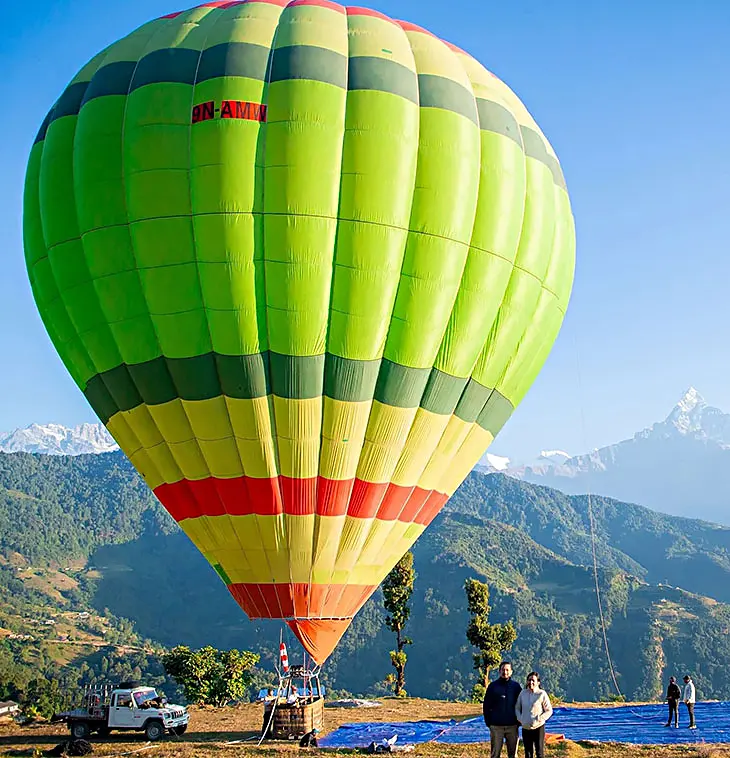
The gaseous state is the state of matter in which the forces of attraction between the particles are the weakest. Its particles are far apart, move fast and spread out evenly through whatever space they have. It is the simplest state of matter, because its particles hardly affect one another, and so the one whose behavior we can describe with a few exact laws.
Because a gas has the most space between its particles and the weakest forces between them, gases have properties that liquids and solids don’t:
- No definite shape or volume. A gas fills any container it is put in, completely.
- Very low density. Its particles are far apart: air at sea level is about 800 times less dense than water.
- Expand without limit and are easily compressed. There is so much empty space between the particles that a gas can be squeezed into a much smaller volume, or spread into a much bigger one.
- Exert pressure on the walls of their container, equally in all directions.
- Diffuse quickly: two gases put together mix completely by themselves.
The same substance can be a solid, a liquid or a gas, depending on its temperature and pressure. Heating or lowering the pressure moves the particles farther apart; cooling or squeezing brings them closer. When the arrangement of the particles changes, the state changes.
Measurable properties of gases
Four quantities describe a sample of gas completely: its volume, temperature, pressure and amount (number of moles). The gas laws are relations between them.
1. Volume (V). A gas fills its container, so the volume of a gas is the volume of its container. It can also be measured directly, for example in a graduated eudiometer tube inverted over water or mercury. Volume is expressed in liters (L), milliliters (mL) or cubic centimeters (cm³, often written cc):
2. Temperature (T). Gases expand on heating and contract on cooling; at very low temperatures they turn into liquids or solids. Temperature is measured with a thermometer in degrees Celsius (°C), sometimes in degrees Fahrenheit (°F). The SI unit of temperature is the kelvin (K), on the absolute scale, which starts from absolute zero (Section 7.1.2.1):
In every gas law, temperature must be in kelvin.
3. Pressure (P). The pressure of a gas is the force it exerts per unit area on the walls of its container, and it acts equally in all directions. The SI unit is the pascal (Pa):
The air around us presses on everything: this is atmospheric pressure. It is what holds up the column of mercury in a barometer, and what pushes a drink up a straw when you lower the pressure inside the straw by sucking. The pressure of the atmosphere at sea level is used as a unit of its own, the atmosphere (atm):
So 1 mmHg is the pressure of a column of mercury 1 mm tall, and 1 torr is the same pressure, named after Evangelista Torricelli, who made the first barometer in 1643.
Atmospheric pressure is measured with a barometer: a glass tube of mercury, closed at the top, upside down in a dish of mercury. The air pushing on the dish holds the mercury up the tube, about 760 mm at sea level. The pressure of a gas in a container, whether it is one gas or a mixture, is measured with a manometer: a U-tube of liquid, one side joined to the gas. The difference between the liquid’s two levels shows how far the gas’s pressure is above or below the air’s.
A gas is held at 27 °C. What is its temperature on the absolute scale?
Pick an answer to see why.
7.1.1 Kinetic theory of gases and its postulates
The gas laws you are about to meet were found by experiment. The kinetic theory of gases explains them from a picture of what a gas is made of. Its postulates (assumptions) are:
- a.A gas is made of a very large number of tiny particles (atoms or molecules), which are in constant, random motion in straight lines.
- b.The volume of the particles themselves is negligible compared with the volume of the container: a gas is mostly empty space.
- c.There are no forces of attraction or repulsion between the particles, except during collisions.
- d.The particles collide with one another and with the walls of the container.
- e.The collisions are perfectly elastic: no kinetic energy is lost in them (it may pass from one particle to another, but the total stays the same).
- f.The pressure of a gas is caused by its particles hitting the walls of the container. Each hit pushes on the wall; billions of hits every second add up to a steady force.
- g.The average kinetic energy of the particles is proportional to the absolute temperature of the gas:
Hotter gas means faster particles.
From these postulates, Grade 11 Physics works out the pressure of a gas, , and the speeds of its molecules: Unit 13, Ideal Gas. Here we need the picture, not the derivation.
Which postulate of the kinetic theory explains why a gas exerts pressure?
Pick an answer to see why.
7.1.2 Gas laws
A punctured tyre or football goes flat as gas leaks out and its volume falls. A balloon left in a hot car on a sunny day may burst. Such everyday things follow a few exact rules, the gas laws, which describe how the pressure, volume, temperature and amount of a gas depend on one another. Each was found by experiment, by changing one quantity while keeping the others fixed.
7.1.2.1 Boyle’s law and Charles’s law
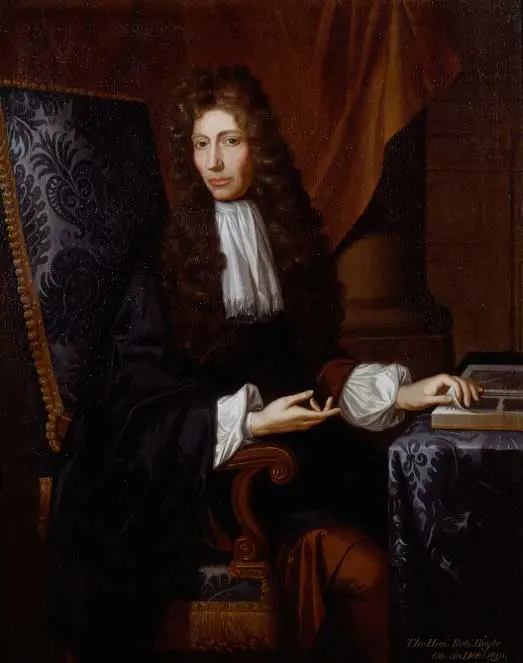
Robert Boyle studied this systematically in the 1660s. He trapped air in the short closed arm of a J-shaped glass tube with mercury, and poured in more mercury to squeeze it. Doubling the pressure on the air halved its volume; tripling the pressure cut it to a third. From his results came Boyle’s law:
The volume of a fixed amount of gas at a constant temperature is inversely proportional to its pressure.
where is a constant. The product of the pressure and the volume of a fixed amount of gas at a constant temperature is constant. For the same gas under two sets of conditions (1, the start, and 2, the end) at the same temperature,
Graphs of Boyle’s law
A graph of pressure against volume at a constant temperature is a curve, a hyperbola: double P, and V halves. Each curve is for one temperature, called an isotherm (“same temperature”). At a higher temperature the gas takes up more room at the same pressure, so its curve lies farther from the axes.
A graph of pressure against 1/V is a straight line through the origin: . Its slope is , which is bigger at a higher temperature. And since PV is constant, a graph of PV against P is a horizontal straight line, higher for a higher temperature.
Applications of Boyle’s law.
- a.Aerosol and paint sprays. The can holds gas at high pressure; when the valve opens, the gas expands into the low pressure outside and drives the paint out as a fine spray.
- b.Breathing. The diaphragm moves down and the ribs out, so the lungs’ volume grows and the pressure inside falls below the air’s: air flows in. To breathe out, the lungs’ volume shrinks, the pressure rises above the air’s, and air flows out.
- c.Soda bottles. Carbon dioxide is packed into the bottle at high pressure; opening the cap lets the pressure fall, so the gas expands and comes out in a rush of bubbles.
- d.Gas cylinders. Squeezing a gas into a small volume raises its pressure, which is how a large amount of gas (oxygen, LPG) is stored in a small cylinder.
At a constant temperature, the pressure on a gas is made four times as great. Its volume becomes:
Pick an answer to see why.
Charles’s law
The French scientists Jacques Charles (in 1787) and Joseph Gay-Lussac (who published it in 1802) studied how heating changes the volume of a gas. Every gas they tried expanded by the same fraction for the same rise in temperature. In terms of the absolute temperature, Charles’s law (also called Charles’s and Gay-Lussac’s law) is:
The volume of a fixed amount of gas at a constant pressure is directly proportional to its absolute temperature.
For two sets of conditions at the same pressure,
with both temperatures in kelvin. A graph of volume against absolute temperature is a straight line through the origin.
The law in degrees Celsius. Measured in °C, a gas’s volume changes by 1/273 of its volume at 0 °C for every degree its temperature rises or falls (more exactly, 1/273.15). If is the volume at 0 °C, the volume at °C is
with negative below 0 °C. So at 10 °C a gas fills of its volume at 0 °C, and at −10 °C, . Now put °C:
The volume would become zero at −273 °C.
In 1848 Lord Kelvin (William Thomson) proposed that this temperature, −273.15 °C, is the lowest temperature possible, which he called absolute zero, and built a new scale starting from it, the absolute or kelvin scale. Absolute zero (−273.15 °C, roughly −273 °C) is a theoretical temperature: no real gas reaches zero volume, because every real gas turns into a liquid or a solid long before, and the law can only be measured over the range where the substance stays a gas. Nothing can even be cooled all the way to absolute zero, though laboratories have come within a billionth of a degree.
We write T for an absolute (kelvin) temperature and t for a Celsius one:
So the boiling point of water, 100 °C, is 100 + 273.15 = 373.15 K, and its freezing point, 0 °C, is 273.15 K. A kelvin is the same size as a degree Celsius; only the starting point differs.
The pressure law. If the volume of a fixed amount of gas is kept constant (in a closed, rigid container), its pressure is directly proportional to its absolute temperature:
This is another form of Charles’s law, usually called Gay-Lussac’s law (or the pressure law). Hotter molecules move faster and hit the walls harder and more often, so the pressure rises.
Applications of Charles’s law.
- a.A hot air balloon flies. Heated air expands, so the balloon holds less air than the same space outside: it is less dense, and floats.
- b.A tyre goes soft in winter. Its air cools and its pressure falls (the pressure law), so the tyre sags a little.
- c.A dented table tennis ball comes back into shape in hot water: the air inside expands and pushes the dent out.
- d.Balloons burst on hot days: the air inside expands until the rubber can’t stretch any more.
A gas fills 300 mL at 27 °C. At constant pressure, it is heated to 127 °C. Its new volume is:
Pick an answer to see why.
Combined gas equation
Boyle’s and Charles’s laws can be put together into one equation. For a fixed amount of gas,
- by Boyle’s law, at constant temperature, ;
- by Charles’s law, at constant pressure, .
- When both change, the volume depends on both: , or , so
For the same amount of gas under two sets of conditions,
where are the starting pressure, volume and temperature, and the final ones. This is the combined gas equation. It covers Boyle’s law (), Charles’s law () and the pressure law () as special cases, and lets you find any one quantity when the other five are known.
7.1.2.2 Avogadro’s law
In 1811 the Italian scientist Amedeo Avogadro proposed that equal volumes of all gases at the same temperature and pressure contain equal numbers of molecules (Avogadro’s hypothesis, Unit 2, Section 2.3). It follows that if a container holds moles of gas in a volume , then at the same temperature and pressure moles fill : the volume is proportional to the number of moles.
Avogadro’s law: The volume of a gas is directly proportional to the number of moles of gas, at constant temperature and pressure.
where are the starting volume and number of moles and the final ones. A graph of volume against number of moles is a straight line through the origin.
Avogadro’s law is the hypothesis put as a working rule: the same number of molecules always means the same volume, whatever the gas, so 1 mol of any gas fills 22.4 L at STP.
7.1.2.3 Dalton’s law of partial pressures
A gas exerts pressure because its molecules keep hitting the walls. What happens when two or more gases that don’t react are mixed in one container? John Dalton studied this and in 1801 gave the answer: each gas pushes on the walls as if it were alone.
The partial pressure of a gas in a mixture is the pressure it would exert if it alone filled the whole container at the same temperature.
Suppose moles of one gas and moles of another are mixed in a container of volume at temperature , making moles in all. Let their partial pressures be and .
- Each gas obeys the ideal gas equation (Section 7.1.3) on its own, filling the whole volume :
- Add them:
- But is the pressure of the whole mixture, . So
Dalton’s law of partial pressures: The total pressure of a mixture of gases that don’t react with one another is the sum of the partial pressures of the gases in it.
Partial pressure and mole fraction
Divide the partial pressure of gas 1 by the total pressure:
where (chi, “kai”) is the mole fraction of gas 1, the share of the molecules that are gas 1. So
The partial pressure of a gas is its mole fraction times the total pressure. Air is about 21% oxygen by moles, so at sea level (1 atm) the partial pressure of oxygen is about 0.21 atm; at Everest’s summit, where the total pressure is about a third of an atmosphere, it is about 0.07 atm, and that is why climbers carry oxygen.
The pressure each gas exerts doesn’t depend on the other gases: each one’s molecules hit the walls as if the others weren’t there. The law holds well for gases at ordinary pressures, in a closed space such as a cylinder or a flask.
Uses of Dalton’s law. Air is a mixture, and the partial pressure of each gas in it is what matters to living things: oxygen at high altitude, carbon dioxide dissolved in blood, the oxygen in a diver’s tank. In analytical chemistry it is used to work out the amounts of the gases in a mixture from the pressures they exert, and in processing natural gas, a mixture of hydrocarbons, it is used to find the share of each.
Gas collected over water
In the laboratory, a gas such as oxygen, hydrogen or nitrogen that doesn’t dissolve much in water is often collected over water: it bubbles up into an inverted jar of water and pushes the water down and out. The gas in the jar is then moist: it is a mixture of the gas and water vapor. By Dalton’s law,
The pressure of the water vapor is the vapor pressure of water at that temperature, also called aqueous tension (f). It depends only on the temperature (Section 7.2.1.2): 17.5 mmHg at 20 °C, 23.8 mmHg at 25 °C, 26.7 mmHg at 27 °C. So
When the water levels inside and outside the jar are the same, the moist gas inside is at the air’s pressure.
A mixture of gases contains 2 mol of N₂ and 3 mol of O₂ at a total pressure of 10 atm. The partial pressure of N₂ is:
Pick an answer to see why.
7.1.2.4 Graham’s law of diffusion
Put a drop of ink into a glass of still water and, without stirring, the color slowly spreads until the water is evenly tinted. This spreading of particles from where they are crowded to where they are fewer, by their own random motion, is diffusion. Gases diffuse much faster than liquids, because their molecules move fast with lots of space between them. You smell ammonia across a room, or food cooking in the next house, because the molecules diffuse through the air. The rate of diffusion depends on the temperature, the pressure and the gas itself.
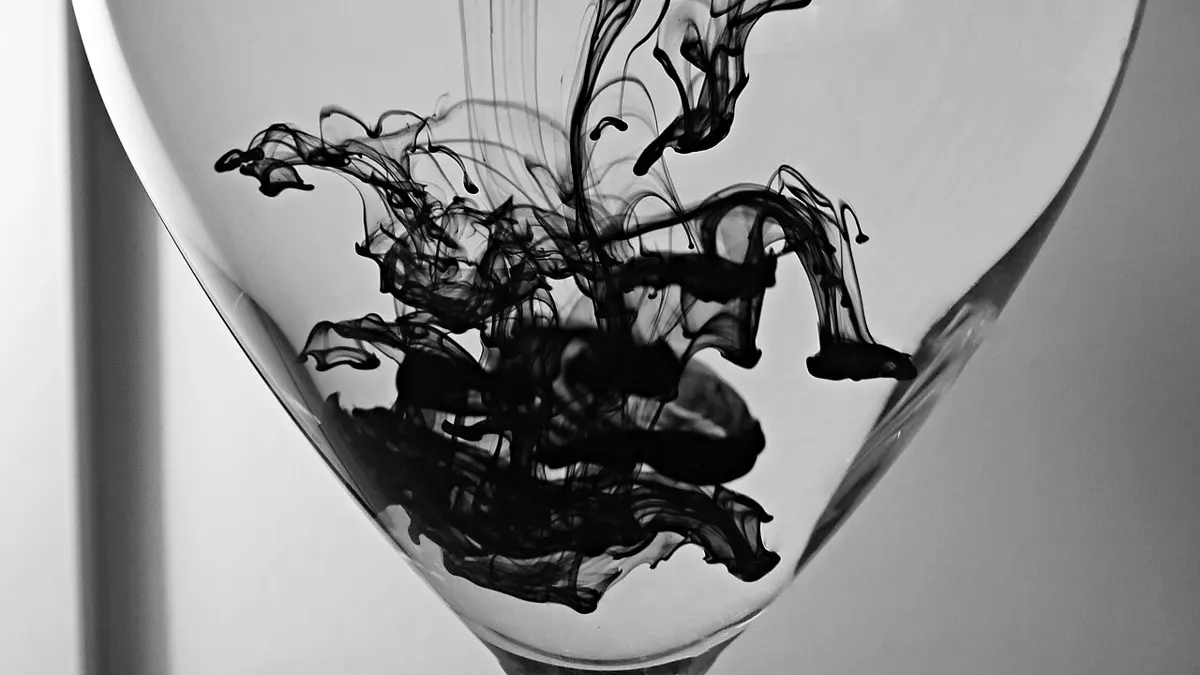
In the 1830s the Scottish chemist Thomas Graham (1805–1869) measured how fast different gases diffuse, and found that the lighter the gas, the faster it goes. Graham’s law of diffusion:
The rate of diffusion of a gas is inversely proportional to the square root of its molar mass, at the same temperature and pressure.
Hydrogen (M = 2) diffuses times as fast as oxygen (M = 32).
Why. At the same temperature all gas molecules have the same average kinetic energy, . So heavier molecules must move more slowly: , and a gas spreads as fast as its molecules move.
In terms of density. At the same temperature and pressure, the density of a gas is proportional to its molar mass (, Section 7.1.3). So the law can also be written with the gases’ densities, or their vapor densities (VD = M/2, Unit 2):
In a tube, as in Figure 7.16, the two gases meet nearer the end of the heavier gas, because the lighter gas has covered more of the distance in the same time.
Rates of diffusion measured in different ways
The rate of diffusion is the volume of gas that diffuses per unit time:
- Same volume, different times: if equal volumes of two gases diffuse in times and , the faster gas takes less time:
- Same time, different volumes: in the same time, the volumes diffused are in the ratio of the rates:
And by Avogadro’s law, volumes of gas at the same temperature and pressure are in the ratio of their moles: .
- Same time, distances along a tube: in the same time, each gas travels a distance in proportion to its rate:
Putting all of these together:
where is the molar mass, the density, the time taken for the same volume, and , and the volume, moles and distance in the same time. Notice which way round each one goes: the faster gas has the smaller M, d and t, but the bigger V, n and l.
Effusion
Prick a tiny hole in a balloon and the air escapes through it. The escape of a gas under pressure through a tiny hole into a space of lower pressure is effusion. Here the molecules pass through the hole one by one, so each gas leaks out at the rate its molecules reach the hole, and Graham’s law holds exactly:
That is partly why a helium balloon goes soft in a day or two, while an air balloon of the same rubber lasts much longer: small, light helium atoms (M = 4) work their way out through the rubber far faster than the heavier molecules of air (average M ≈ 29).
Applications of Graham’s law.
- a.Separating isotopes. Uranium for nuclear power is enriched in the light isotope uranium-235 by making it into the gas uranium hexafluoride, UF₆, and letting it effuse through porous barriers again and again: ²³⁵UF₆ (M = 349) gets through a little faster than ²³⁸UF₆ (M = 352), by a factor of only , so it takes over a thousand stages.
- b.Finding molar masses. Timing the effusion of an unknown gas against a known one gives its molar mass (the solved problems below).
- c.Gas leaks. Light gases leak and spread fastest: the smell put into LPG (an added sulphur compound) reaches you quickly from a small leak, and hydrogen stored for fuel cells needs especially tight seals.
Which gas diffuses fastest at the same temperature?
Pick an answer to see why.
7.1.3 Ideal gas and ideal gas equation
Boyle’s, Charles’s and Avogadro’s laws each tell how the volume of a gas depends on one thing while the others are held fixed:
- Boyle’s law: (n and T constant)
- Charles’s law: (n and P constant)
- Avogadro’s law: (T and P constant)
When all of them change at once, the volume depends on all three:
where the constant is the gas constant. Rearranged:
This is the ideal gas equation: P is the pressure, V the volume, n the number of moles, R the gas constant and T the absolute temperature.
It is called the ideal gas equation because only an ideal gas (a perfect gas) would obey it exactly, at every temperature and pressure. An ideal gas is a gas that follows the kinetic theory’s assumptions exactly: its molecules take up no volume and have no forces between them. It is a hypothetical gas, a simplified model: every real gas (H₂, He, N₂, CO₂, NH₃…) has molecules of some size that attract one another a little. Real gases behave almost ideally at low pressures and high temperatures (Section 7.1.5), which is why the equation is so useful.
The number of moles is the mass, , divided by the molar mass, : . So
and since density ,
The density of a gas is proportional to its molar mass and its pressure, and inversely proportional to its temperature. Hot air is less dense than cold, which is why the balloon rises.
7.1.4 Gas constant and its significance
In , the constant is the universal gas constant, the same for every gas. Rearranging,
Pressure × volume has the units of work (force/area × area × distance = force × distance): when a gas expands by against a constant pressure , it does work . So R is the work done by one mole of an ideal gas per kelvin rise in temperature (when it expands at constant pressure). It links the quantities we can measure in bulk, pressure and volume, to the behavior of the molecules: divided by the Avogadro constant, it gives the energy scale of a single molecule, Boltzmann’s constant .
The value of R. At STP, 1 mole of any gas occupies 22.4 L (22.414 L), at P = 1 atm and T = 273.15 K:
In SI units, P = 101 325 Pa and V = 22.414 L = 0.022414 m³:
(Pa × m³ = N/m² × m³ = N m = J.) The value of R depends only on the units used:
| Units of P and V | Value of R |
|---|---|
| atm, L | 0.0821 L atm/(mol K) |
| Pa, m³ (SI) | 8.314 J/(mol K) |
| dyne/cm², cm³ (CGS) | 8.314 × 10⁷ erg/(mol K) |
| in calories | 1.987 cal/(mol K) |
Use R = 0.0821 when the pressure is in atm and the volume in liters, and R = 8.314 when they are in pascals and cubic meters. The temperature is always in kelvin.
In , with P in atm and V in liters, R is:
Pick an answer to see why.
7.1.5 Deviation of real gases from ideal behavior
The ideal gas equation rests on the kinetic theory’s two simplifying assumptions: the molecules have no volume, and no attractions between them. When those are true, a gas obeys the gas laws exactly; this is ideal behavior. For real gases they are nearly true when the molecules are far apart, at high temperature and low pressure: then the molecules take up a tiny share of the space, and move too fast and too far apart for their attractions to matter.
At high pressure and low temperature, the molecules are crowded together. Their own volume becomes a noticeable part of the container, and they pull on one another. The gas then no longer obeys : this is deviation from ideal behavior.
Carbon dioxide shows it plainly. At room temperature, squeezed to about 60 atm, it turns into a liquid; cooled to −78.5 °C at 1 atm it turns straight into a solid, dry ice. An ideal gas would never condense, however hard it was squeezed or cooled, because its molecules don’t attract one another. That a real gas condenses at all shows its molecules have volume and attract each other.
Measuring the deviation. For an ideal gas , so the ratio
called the compressibility factor, is exactly 1 at every pressure. A graph of Z (or of PV at a fixed temperature) against P is a horizontal straight line for an ideal gas. For a real gas:
- Z < 1 where the attractions win: they pull the molecules together, so the gas fills less volume than an ideal gas would (it is easier to compress). This happens at moderate pressures for gases with strong attractions, such as CO₂, CH₄ and N₂.
- Z > 1 where the molecules’ own volume wins: the molecules can’t be squeezed into each other, so the gas fills more volume than an ideal gas would (it is harder to compress). This happens for every gas at very high pressures.
- Z → 1 as P → 0: at very low pressure every real gas behaves ideally.
The van der Waals equation. In 1873 the Dutch physicist Johannes Diderik van der Waals corrected the ideal gas equation for both effects:
- : the space the molecules can actually move in is the container’s volume less the volume the molecules themselves take up; is that volume per mole.
- : a molecule about to hit the wall is pulled back by the molecules behind it, so it hits the wall less hard and the measured pressure is lower than it would be without attractions; adds that pressure back. measures how strongly the molecules attract one another.
and are the van der Waals constants, different for each gas: for helium, a = 0.034 L² atm/mol² and b = 0.024 L/mol; for carbon dioxide, a = 3.59 L² atm/mol² and b = 0.043 L/mol. Gases that condense easily have large values of . Van der Waals won the Nobel Prize in Physics in 1910 for this work, and the weak forces between molecules Grade 11: Unit 5 carry his name.
A real gas behaves most like an ideal gas at:
Pick an answer to see why.
Exercise (7.1 Gaseous state)
A. Multiple choice questions
- At constant temperature, what happens to the volume of a gas if the pressure is doubled?
Pick an answer to see why.
- When a gas is collected over water, its partial pressure is equal to:
Pick an answer to see why.
- Which of the three containers in Figure 7.20 shows the least intermolecular force of attraction and the greatest distance between the particles?
Pick an answer to see why.
- Assuming ideal behavior, which of the following gases has the greatest volume at STP?
Pick an answer to see why.
- Which of the graphs in Figure 7.21 shows Boyle’s law?
Pick an answer to see why.
- A gas under a free piston is heated; its volume grows while its pressure stays the same (Figure 7.22). Which gas law does this show?
Pick an answer to see why.
- Which of the following gases has the highest rate of diffusion?
Pick an answer to see why.
- At constant pressure, by how much does the volume of a gas increase when its temperature rises by 1 °C?
Pick an answer to see why.
- Hydrogen sulphide (H₂S) has a strong rotten-egg smell, methyl salicylate (C₈H₈O₃) a strong minty smell and benzaldehyde (C₇H₆O) a pleasant almond smell. If their vapors were released at the same time from across a room, which smell would you notice first?
Pick an answer to see why.
- A mixture of carbon dioxide and an unknown gas was allowed to effuse from a container. The carbon dioxide took 1.25 times as long to escape as the unknown gas. Which one could the unknown gas be?
Pick an answer to see why.
- What is the partial pressure of neon in a 4.00 L vessel that contains 0.838 mol of methane, 0.184 mol of ethane and 0.755 mol of neon at a total pressure of 928 mmHg?
Pick an answer to see why.
- A real gas behaves most like an ideal gas under conditions of:
Pick an answer to see why.
- The volume of an ideal gas would become zero at:
Pick an answer to see why.
- A sample of gas in a closed container of fixed volume is heated until its absolute temperature is doubled. Which of the following is also doubled?
Pick an answer to see why.
B. Short answer questions
What are the postulates of the kinetic theory of gases? Which postulate explains the pressure of a gas?
Hint
Answer
State Boyle’s law, with its mathematical relation and a graph.
Answer
State Charles’s law and show the relationship between volume and temperature on a graph.
Answer
State Dalton’s law of partial pressures and give two applications of it.
Answer
The relationship between pressure and volume of a gas at three temperatures is plotted in Figure 7.23.
- a.State the law shown in the graph.
- b.Which curve is at the highest temperature? Give the reason.
- c.A gas is confined in a cylinder with an initial volume of 4.0 L at a pressure of 2.0 atm. If it is compressed to 2.0 L at a constant temperature, what is the new pressure?
Answer
Differentiate between:
- a.diffusion and effusion
- b.a real gas and an ideal gas
Answer
Give reasons:
- a.A hot air balloon rises into the air.
- b.Gas comes out of an LPG cylinder when the regulator is turned on.
- c.Ammonia diffuses faster than oxygen.
- d.A balloon left in a refrigerator gets smaller.
- e.Bicycle tyres are more likely to burst in summer than in winter.
Answer
The volume of a gas changes with pressure at a constant temperature.
- a.Why does the volume of a gas decrease when the pressure on it is increased?
- b.Find the change in the volume of a gas if the pressure is increased from 4.0 atm to 12 atm at constant temperature.
- c.Does the volume of the gas reach zero if the pressure is increased without limit? Why?
Answer
A graph of pressure against the reciprocal of volume at a constant temperature is a straight line through the origin (Figure 7.24).
- a.What does this graph say about the relationship between pressure and volume?
- b.Which gas law shows this relation?
- c.Give an application of this law.
Answer
is called the ideal gas equation, where R is a constant.
- a.Define an ideal gas, and write the meaning of each term in the equation.
- b.Calculate the unit and value of R at STP for 1 mol of gas, and write its significance.
- c.A 3.20 g sample of a gas occupies 2.0 L at 17 °C and 380 mmHg. What is its molar mass?
Answer
PV against pressure at a constant temperature is shown in Figure 7.25 for an ideal gas and some real gases.
- a.Why does the ideal gas give a horizontal straight line at all pressures?
- b.Real gases deviate at high pressure but not at very low pressure. Why?
- c.Which real gas shows the greatest deviation?
Answer
A gaseous mixture contains 11.0 g of carbon dioxide and 48.0 g of oxygen in a 222.4 L container at 273 °C. Calculate:
- a.the moles of each gas
- b.the total moles
- c.the mole fraction of each gas
- d.the partial pressure of each gas
- e.the total pressure of the mixture
Answer
Two gas cylinders contain hydrogen and helium. The gases from them are then mixed in a third container.
- a.If the cylinders have the same volume at the same temperature and pressure, which holds more molecules?
- b.Which cylinder empties first if both are opened at the same time through holes of the same size, and why?
- c.What happens to the total number of molecules, and the total pressure, when the gases are mixed in a container of the same volume and temperature?
Answer
15 mL of moist oxygen is collected over water, as in Figure 7.13, at 25 °C and a pressure of 645 mmHg. The vapor pressure of water at 25 °C is 23.76 mmHg.
- a.Calculate the pressure of the dry oxygen.
- b.What would the volume of the dry oxygen be at STP?
Answer
State Graham’s law of diffusion, and write the relationship between the rates of diffusion of two gases and their molar masses, the distances they travel along a tube, and the volumes they diffuse.
Answer
Using Boyle’s law, Charles’s law and Avogadro’s law, derive the ideal gas equation, and write its significance.
Answer
Charles’s law leads to the idea of absolute zero.
- a.Define absolute zero. Why is it called a theoretical temperature?
- b.Show absolute zero on a graph of volume against temperature in °C.
Answer
C. Long answer questions
0.5 mol of gas A and 1.5 mol of gas B are mixed in a container. The pressure gauge on it reads the total pressure, 1 atm.
- a.Why does a gas exert pressure?
- b.What is meant by partial pressure?
- c.Calculate the partial pressures of A and B.
Answer
Pressure against volume of a gas is plotted at 200 K, 400 K and 600 K (Figure 7.26).
- a.Which gas law does the graph show? State it.
- b.What would the graph look like for a real gas?
- c.What does it mean that the curve moves up and out as the temperature increases?
- d.A helium balloon with a volume of 0.2 L at sea level rises to a height where the pressure is about 0.40 atm. Assuming the temperature stays the same, what is its final volume?
Answer
Answer these questions from the graph of volume against temperature at constant pressure in Figure 7.9.
- a.What is the relationship between the volume of a gas and its temperature at constant pressure?
- b.What is the cause of this relationship?
- c.Name the temperature 0 K. Why is it called a theoretical temperature?
- d.A gas occupies 2.0 L at STP. If its temperature is raised to 100 °C at constant pressure, what is its new volume?
Answer
A 2.0 L bulb of neon at 1.5 atm is joined to a 1.5 L bulb of helium at 0.5 atm by a tube with a stopcock (Figure 7.27).
- a.When the stopcock is opened, the pressure of each gas changes. Why?
- b.Calculate the partial pressure of each gas and the total pressure after the stopcock is opened (at the same temperature).
Answer
Nitrogen gas is collected over water by the downward displacement of water.
- a.Calculate the pressure of the dry gas at 25 °C if the total pressure is 645 mmHg (vapor pressure of water at 25 °C = 23.8 mmHg).
- b.Find the mass of nitrogen collected if the gas fills 100 mL.
Answer
State Graham’s law of diffusion and write one application of it. Gases A and B have molar masses of 16 g/mol and 64 g/mol. If the rate of diffusion of A is 2 m/s, what is the rate of diffusion of B under the same conditions?
Answer
Three gases X, Y and Z have molar masses of 20, 30 and 40 g/mol. The rate of diffusion of X is 3 m/s.
- a.Which gas travels fastest? Why do the gases diffuse at different rates?
- b.Calculate the rates of diffusion of Y and Z.
Answer
Ammonia and hydrogen chloride are released at the same moment from opposite ends of a glass tube 24 cm long: ammonia from end A, hydrogen chloride from end B.
- a.Which gas travels faster, and why?
- b.Find the distance from A at which the gases meet.
- c.Write the formula of the compound formed where they meet.
Answer
28.02 g of nitrogen and 44.01 g of carbon dioxide are kept in separate containers. Calculate:
- a.the number of moles of each
- b.the number of molecules of each
- c.the volume each gas occupies at STP
- d.the total pressure if both are put together in a 1.5 L container at 15 °C
Answer
Figure 7.28 shows the same gas at the same temperature in two cylinders, X at a low pressure and Y at a high pressure.
- a.Why can a gas be compressed?
- b.How does the volume of the gas change if its pressure is made 4 times as great?
- c.Which cylinder shows more nearly ideal behavior, and why?
Answer
Project work
7.2 Liquid state
A liquid sits between a gas and a solid. Its particles are touching, held by intermolecular forces much stronger than a gas’s, so a liquid has a definite volume, a much higher density than a gas, and is nearly incompressible: there is almost no empty space left to squeeze. But the forces aren’t strong enough to hold the particles in fixed places: they keep moving, sliding past one another, so a liquid flows and takes the shape of its container. Which liquid it is (how strong the forces between its molecules are) decides how fast it evaporates, when it boils, how strongly its surface pulls, and how thickly it flows.
7.2.1 Physical properties of liquids
a. Evaporation and condensation
Water left in a glass slowly disappears, a wet cloth dries, and a puddle vanishes after rain, though nothing boiled. Evaporation is the change of a liquid into vapor at its surface, at any temperature below its boiling point.
The molecules in a liquid don’t all move at the same speed: at any moment a few are much faster than the average. A molecule can escape only if it is at the surface (one deep inside would just hit its neighbors) and is moving fast enough, outwards, to break free of the attraction of the molecules behind it. So evaporation happens only at the surface, and the molecules that leave are the fastest ones. Heating a liquid gives more molecules enough energy to escape, so evaporation speeds up; it is faster too over a larger surface, in a breeze (which carries the vapor away) and in dry air.
The energy needed to turn one mole of a liquid into vapor at the same temperature is its enthalpy of vaporization, (40.7 kJ/mol for water at 100 °C).
Evaporation cools. The molecules that escape are the fastest, so the ones left behind are slower on average: the liquid gets cooler, unless heat flows in from its surroundings. That is why sweat cools the skin, why water in a clay pot (ghaito) stays cool in summer as it seeps through and evaporates from the outside, and why a drop of rubbing alcohol on your arm feels cold.
Condensation. Heat water in a closed container and look at the lid: drops form on it. The vapor molecules move about above the liquid, and when they lose energy (on the cooler lid, or by colliding) and come close together, the attractions pull them back into a liquid. This change from vapor to liquid, the reverse of evaporation, is condensation. Clouds, dew on grass in the morning, and the drops on the outside of a cold glass of water are all condensation. It releases heat (it is exothermic), the same amount evaporation took in.
Which of these does NOT speed up evaporation?
Pick an answer to see why.
b. Vapor pressure and boiling point
In a closed container, molecules leave the liquid and fill the space above it as vapor. At first evaporation is fast and condensation slow, since there is little vapor to return. As the vapor builds up, more and more molecules return each second, until the rate of condensation equals the rate of evaporation. From then on, the amount of vapor stays the same: the liquid and its vapor are in equilibrium (a dynamic one: molecules still leave and return, at equal rates).
The vapor pressure of a liquid is the pressure exerted by its vapor when the vapor is in equilibrium with the liquid, at a given temperature.
- Vapor pressure rises with temperature. A hotter liquid has more molecules fast enough to escape, so more vapor is needed before condensation keeps up. It rises steeply: water’s vapor pressure is 17.5 mmHg at 20 °C, 92.5 mmHg at 50 °C and 760 mmHg at 100 °C.
- Vapor pressure depends on the liquid. The stronger the forces between its molecules, the fewer escape, and the lower its vapor pressure at the same temperature.
Boiling. Heat a liquid in an open pan and its vapor pressure climbs, until it equals the pressure of the air above it. Then bubbles of vapor can form inside the liquid and grow, instead of being crushed by the air’s pressure, and they rise and burst at the surface: the liquid boils. The boiling point of a liquid is the temperature at which its vapor pressure equals the pressure on its surface (the atmospheric pressure, for an open vessel):
Unlike evaporation, boiling happens throughout the liquid, and at one temperature for a given pressure. The temperature stays at the boiling point while the liquid boils: the heat goes into turning liquid into vapor. The boiling point at 1 atm (760 mmHg) is the normal boiling point.
A liquid with a high vapor pressure (weak intermolecular forces) reaches the air’s pressure at a lower temperature, so it has a low boiling point. Diethyl ether has the highest vapor pressure of the liquids in the table below and the lowest boiling point, 34.6 °C; water, whose molecules are held by hydrogen bonds, has the lowest vapor pressure and the highest boiling point.
| Liquid | Vapor pressure at 25 °C (atm) | Boiling point (°C) |
|---|---|---|
| Diethyl ether | 0.70 | 34.6 |
| Bromine | 0.30 | 58.8 |
| Ethyl alcohol | 0.08 | 78.5 |
| Water | 0.03 | 100 |
Boiling point and altitude. At sea level the air’s pressure is about 1 atm (101.3 kPa), and water boils at 100 °C. Higher up, the air’s pressure is lower, so water’s vapor pressure reaches it at a lower temperature: water boils below 100 °C. In Kathmandu (about 1,400 m) it boils at about 95 °C, at Everest Base Camp at about 82 °C, and on the summit of Everest at only about 70 °C. That is why rice and dal take so long to cook in the mountains, and why every kitchen above the hills has a pressure cooker.
Where does water boil at the lowest temperature?
Pick an answer to see why.
c. Surface tension
Raindrops sit as round beads on a leaf, and small insects, the water striders, skate across a pond without sinking. Both come from a pull at the liquid’s surface.
The attraction between molecules of the same substance is called cohesion (cohesive force). A molecule deep in a liquid is pulled equally in every direction by the molecules around it, so the pulls cancel. A molecule at the surface has liquid molecules beside and below it but none above, so it is pulled sideways and inwards, with nothing to balance the inward pull. Every surface molecule is pulled into the liquid, and the surface draws itself in, as small as it can be, like a stretched rubber sheet.
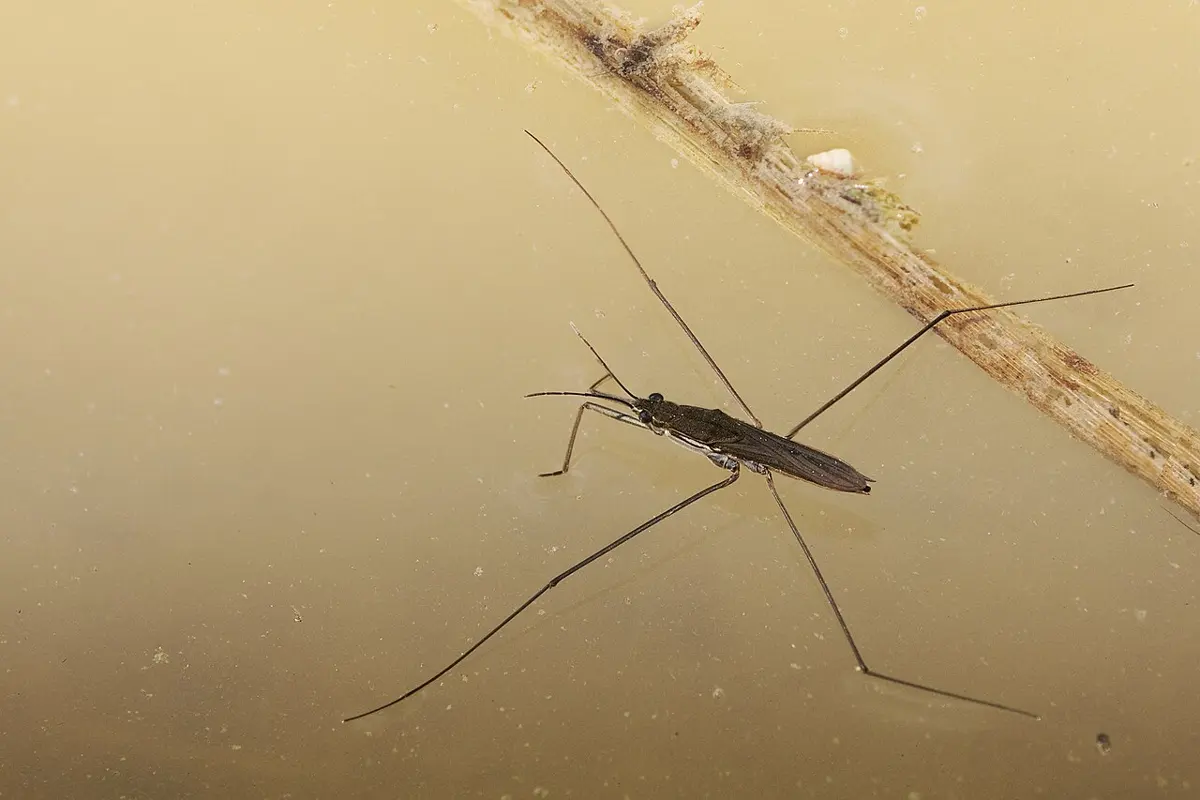
Surface tension is the force acting along the surface of a liquid, at right angles to any line drawn in it, per unit length of that line:
Its SI unit is N/m (newtons per meter; the same as J/m², the energy needed to make 1 m² of new surface), and its CGS unit is dyne/cm (1 dyne/cm = 10⁻³ N/m = 1 mN/m). Surface tension is the property of a liquid, arising from the cohesive forces among its molecules, by which its surface behaves like a stretched elastic sheet and tends to have the least possible area.
Temperature. The surface tension of a liquid decreases as its temperature rises: its molecules move faster and pull on one another less effectively. At the liquid’s critical temperature (647 K, 374 °C, for water) the liquid and its vapor become the same, there is no surface left, and the surface tension falls to zero. Hot water with soap washes better partly for this reason.
Impurities. Substances that gather at the surface, such as soaps, detergents and alcohols, lower a liquid’s surface tension a lot. Dissolved salts like common salt stay inside the water and raise its surface tension slightly.
Applications of surface tension.
- a.Soaps and detergents contain surfactants, molecules that gather at the surface and lower water’s surface tension, so the water spreads over a greater area, wets cloth and gets between the fibers, and washes better.
- b.Ducks stay dry and float. A duck spreads oil from a gland near its tail over its feathers; water doesn’t wet the oiled feathers, and its surface tension keeps it from soaking between them, so air stays trapped in the feathers and the duck floats.
- c.Drops are round. Surface tension pulls a small drop into the shape with the least surface for its volume, a sphere: raindrops in the air, mercury drops on a table, water beading on a waxy leaf.
- d.Capillary action. Water rises in a thin glass tube, and up the narrow spaces in a towel, a paper towel or a lamp’s wick, pulled up by surface tension and the attraction between water and the tube’s wall (below).
- e.Inkjet printers fire tiny drops of ink, and the ink’s surface tension controls the drops’ size and shape, so that each lands as a neat dot.
Meniscus and capillary rise
The attraction between molecules of different substances, such as water and glass, is adhesion. Where a liquid meets the wall of its container, the balance of cohesion and adhesion decides the shape of its surface, the meniscus:
- Water is attracted to glass more than to itself (adhesion > cohesion): it creeps up the wall and its surface is concave (curving down in the middle), and in a narrow glass tube it rises above the level outside.
- Mercury is attracted to itself far more than to glass (cohesion > adhesion): it pulls away from the wall, its surface is convex (bulging up in the middle), and in a narrow tube it is pushed down below the level outside.
Measuring surface tension: the drop count method
The surface tension of a liquid can be compared with water’s using a stalagmometer, a glass tube with a bulb between two marks and a flat, circular tip at the bottom. The liquid is let out of the bulb drop by drop, and the drops are counted.
A drop hangs from the tip held up by surface tension acting all round the tip’s circumference, . It grows until its weight, , is just more than surface tension can hold, and falls. At that moment,
where is the surface tension, the radius of the tip and the mass of one drop.
Now let the same volume of two liquids run out of the same stalagmometer. If liquid 1 (usually water) gives drops and liquid 2 gives drops, one drop of each has mass
where and are their densities. For each liquid, ; the tip () and are the same, so dividing one by the other,
where is the surface tension of the known liquid, that of the unknown liquid, their densities and the numbers of drops each gives from the same volume. A liquid with a lower surface tension makes smaller drops, so more of them.
Liquid drops are spherical because:
Pick an answer to see why.
d. Viscosity
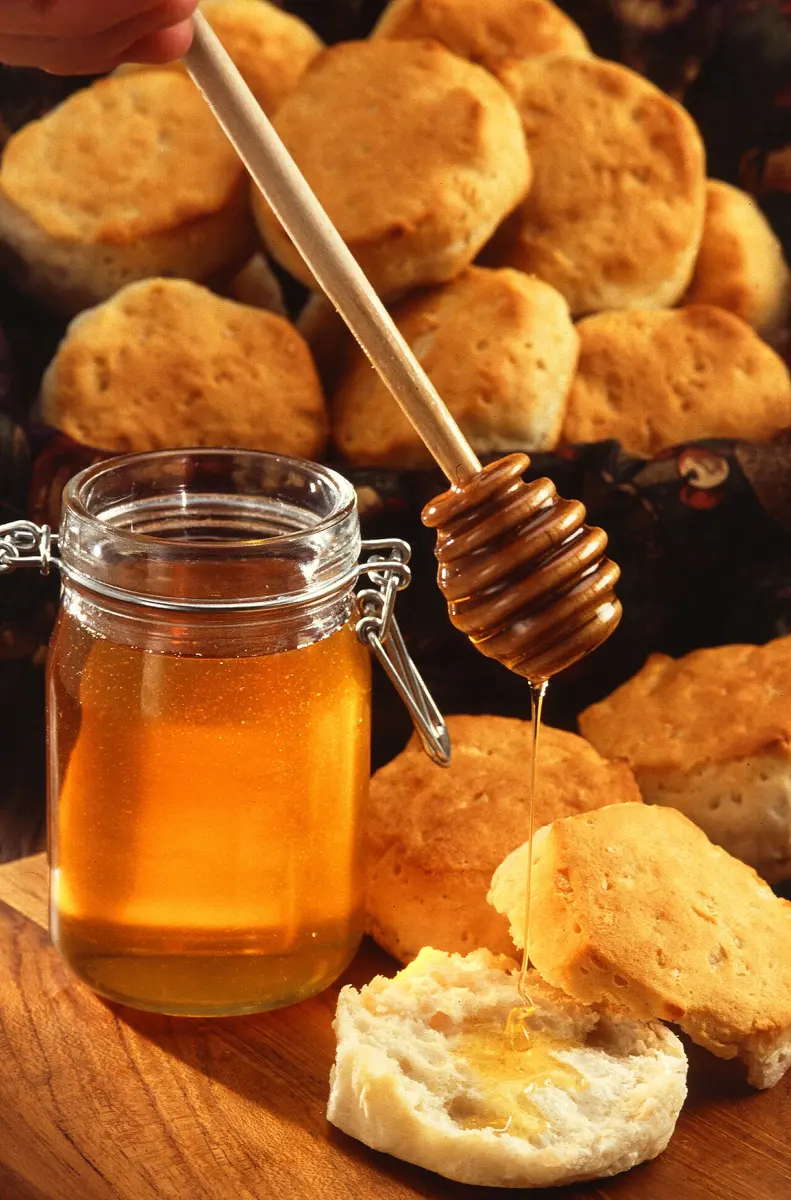
In winter we rub glycerine on cracked skin, and mechanics put thick oil and grease on moving parts. Some liquids, like petrol and ether, flow easily; others, like honey and glycerine, flow slowly. Viscosity is the property of a fluid by which it resists flowing, because of internal friction between its layers. The internal friction force is the viscous force, and a liquid with a high viscosity is called viscous. Viscous forces are intermolecular forces acting between molecules in layers of liquid moving at different speeds.
Flow in layers. When a liquid flows smoothly through a pipe, it moves in thin layers (laminar flow). The layer touching the wall doesn’t move at all (the stationary layer); each layer nearer the middle moves a little faster than the one outside it, and the middle layer is fastest. Each layer drags on its neighbors: the faster layer pulls the slower one forward, and the slower one holds the faster one back.
Take two layers a small distance apart, whose speeds differ by . The viscous force between them is proportional to the area of the layers and to the velocity gradient , how fast the speed changes with distance across the flow:
The constant (eta) is the coefficient of viscosity of the liquid. Putting and gives : the coefficient of viscosity is the force needed to keep a unit velocity gradient between two parallel layers of liquid of unit area.
Its SI unit is the pascal second (Pa s), the same as N s/m². In CGS units it is the poise (P):
so water, at about 0.001 Pa s, is about 1 centipoise.
| Substance (about 20 °C) | η (Pa s) |
|---|---|
| Air | 1.8 × 10⁻⁵ |
| Diethyl ether | 2.4 × 10⁻⁴ |
| Water | 1.0 × 10⁻³ |
| Ethyl alcohol | 1.2 × 10⁻³ |
| Mercury | 1.5 × 10⁻³ |
| Ethylene glycol | 2.0 × 10⁻² |
| Olive oil | 0.08 |
| Glycerol (pure) | 1.4 |
| Honey | 2 to 10 |
| Bitumen (road tar) | about 10⁸ |
Measuring viscosity. Viscosity is measured with Ostwald’s viscometer, a U-shaped glass tube with a bulb between two marks, A and B, above a narrow capillary tube. The liquid is sucked up past A, and the time it takes to drain from mark A to mark B through the capillary is measured, then compared with the time water takes: the more viscous the liquid, the longer it takes.
What viscosity depends on.
- a.Temperature. The viscosity of a liquid decreases as its temperature rises: its molecules move faster and slip past one another more easily. Cold honey or engine oil barely flows; warmed, it pours. (A gas does the opposite: it gets slightly more viscous when hot.)
- b.The size and shape of the molecules. Long, large molecules get tangled with one another and flow slowly. Polymers, long chains of repeating units, make liquids very viscous, which is why a little starch or a gum thickens a sauce.
- c.The forces between the molecules. The stronger they are, the more viscous the liquid. Glycerol is very viscous because each of its molecules has three –OH groups and makes hydrogen bonds with many neighbors at once.
Applications of viscosity.
- a.Lubricants. An engine oil must be viscous enough to keep a film between moving parts, yet thin enough to flow when the engine is cold; oils are graded by their viscosity.
- b.Paints and coatings must flow enough to spread evenly but not run down a wall.
- c.Cosmetics such as lotions and creams are made to the viscosity that spreads well on the skin. Glycerine also attracts water from the air (Section 7.3.3), keeping the skin moist.
- d.Medicine. Blood’s viscosity affects how hard the heart must pump; it also matters in designing drips, syringes and drug delivery.
- e.Quality control. Factories making paints, glues, syrups and oils check the viscosity of each batch.
When honey is warmed, its viscosity:
Pick an answer to see why.
7.2.2 Liquid crystals and their applications
Press gently on the screen of a cheap digital watch or calculator and the digits around your finger change color for a moment, then slowly return. The pressure has disturbed the arrangement of the molecules inside, which are neither a solid nor an ordinary liquid: they are a liquid crystal.
In 1888 the Austrian botanist and chemist Friedrich Reinitzer (1857–1927) was studying cholesteryl benzoate, a compound made from cholesterol taken from carrots. He found that it seemed to have two melting points: at 145.5 °C it melted into a cloudy liquid, and at 178.5 °C the cloudy liquid suddenly turned clear. He sent samples to the German physicist Otto Lehmann (1855–1922), who studied them under his heated polarizing microscope and found that the cloudy liquid flowed like a liquid yet affected light like a crystal. Lehmann called such substances flowing crystals and then liquid crystals (around 1889–1904). In 1922 the French scientist Georges Friedel named their kinds: nematic, smectic and cholesteric.
In a liquid, the molecules point in every direction at random. In a crystalline solid they are in perfect order, fixed both in position and in direction. In a liquid crystal they can move about and the substance flows, but the molecules (usually long and rod-shaped) still tend to point the same way: it has order of direction but little or none of position.
Liquid crystals are an intermediate state of matter between a crystalline solid and a liquid: they flow like a liquid, but their molecules keep some of a crystal’s order. A liquid crystal phase exists only over a range of temperature: below it the substance is a crystalline solid, above it an ordinary liquid.
Two properties make them useful:
- They are anisotropic: their properties, the way light passes through them above all, are different in different directions, because their rod-shaped molecules all point roughly one way.
- They are sensitive: a small change of temperature, pressure or an electric field turns the molecules, and with them the way the liquid crystal affects light. Liquid crystals can twist the direction in which light vibrates as it passes through (they rotate polarized light), which is how a screen turns its dots light and dark.
Types of liquid crystals. Depending on how the rod-shaped molecules are ordered, there are three kinds:
- Nematic: the molecules’ long axes point roughly in the same direction, but their positions are random: the ends aren’t lined up. (Most screens use nematic liquid crystals.)
- Smectic: the molecules point the same way and are packed in layers: the most ordered kind, the nearest to a solid.
- Cholesteric (chiral nematic): in each layer the molecules point the same way, but from one layer to the next the direction turns a little, so the direction winds round like a spiral staircase. The spiral reflects light of one color, which changes with temperature, and that is how a strip thermometer changes color.
Applications of liquid crystals.
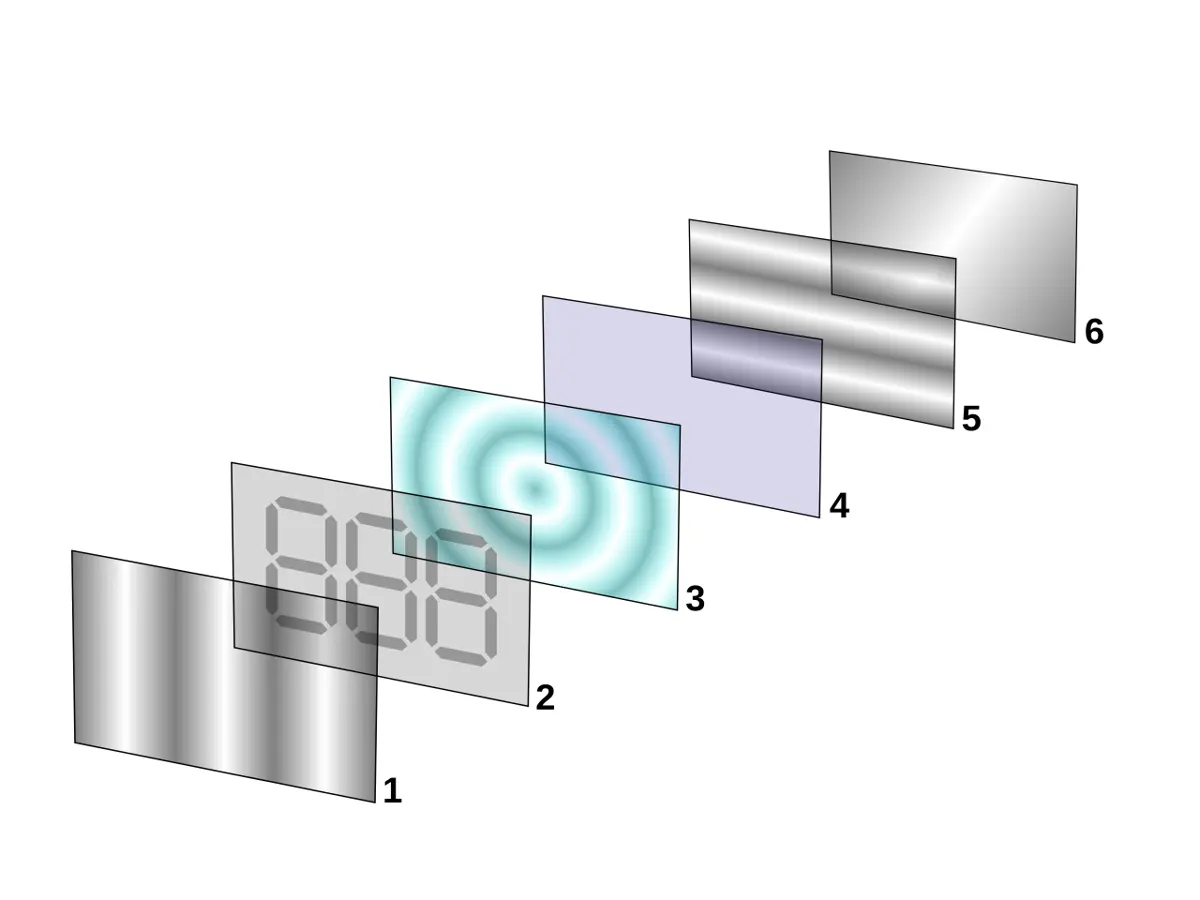
- a.Liquid crystal displays (LCDs). The most important use. Each tiny dot of the screen is a thin layer of liquid crystal between two polarizing filters; a voltage across the dot turns its molecules and lets more or less light from the backlight through. LCDs are in televisions, computer monitors, phones, calculators and watches.
- b.Electro-optical devices, such as light modulators and optical shutters, use the same effect, controlled by an electric field, to switch or dim light: in some cameras, projectors, welding masks that darken in an instant, and car mirrors that dim at night.
- c.Thermometers and temperature mapping. Cholesteric liquid crystals change color with temperature, so they are used in strip thermometers for the forehead or an aquarium, and in sheets that map warm and cool spots, for example to find faults in electronic circuits.
- d.Imaging. Liquid-crystal filters, tuned by a voltage to pass one color at a time, are used in cameras and microscopes that take pictures in many narrow colors, to study tissues, crops and paintings.
- e.Liquid crystal polymers (LCPs), plastics whose long molecules line up as they flow, are very strong and stable, and are used in electronic parts and in the antennas of phones and other wireless devices.
- f.Holographic and 3D displays use liquid-crystal panels to shape light so that it forms changing three-dimensional images.
In a smectic liquid crystal, the molecules:
Pick an answer to see why.
Exercise (7.2 Liquid state)
A. Multiple choice questions
- Evaporation is a surface phenomenon which occurs at all temperatures. The rate of evaporation increases with:
Pick an answer to see why.
- A liquid boils when its vapor pressure equals the atmospheric pressure. Where is the boiling point of water lowest?
Pick an answer to see why.
- Which of the following liquids is the most viscous?
Pick an answer to see why.
- Which of the following is responsible for capillary action in a narrow tube?
Pick an answer to see why.
- A characteristic property of a liquid crystal is that it is:
Pick an answer to see why.
- What happens to the boiling point of water when some common salt is dissolved in it?
Pick an answer to see why.
- Why are beans cooked faster in a pressure cooker?
Pick an answer to see why.
- Which of the following liquids forms the most nearly spherical drops?
Pick an answer to see why.
- Which property shows that a liquid crystal is a liquid?
Pick an answer to see why.
- Grease and other lubricants are used on machine parts. Which properties make them suitable?
Pick an answer to see why.
B. Short answer questions
Define evaporation and vapor pressure. How do temperature and the nature of the bonding affect the rate of evaporation of a liquid?
Answer
The boiling point of a liquid is influenced by the nature of the liquid and the atmospheric pressure.
- a.What is the boiling point of a liquid?
- b.How does the boiling point depend on the intermolecular forces and the atmospheric pressure?
Answer
- a.What is surface tension?
- b.How do intermolecular forces affect the surface tension of a liquid?
- c.Write any two applications of surface tension.
Answer
Differentiate between:
- a.evaporation and boiling
- b.surface tension and viscosity
- c.vapor pressure and atmospheric pressure
Answer
Give reasons:
- a.The boiling point of water is lower in Jomsom than in Bharatpur.
- b.Liquid drops are spherical.
- c.Water forms a concave meniscus.
- d.Drops of water are bigger than drops of alcohol from the same tube.
- e.It is difficult to transfer an organic solvent such as ether with a glass dropper.
- f.Glycerine is used in skin care.
- g.For a given substance, the liquid crystal phase is more viscous than the liquid phase.
Answer
The arrangement of the molecules of a substance depends on the temperature. Figure 7.47 shows three arrangements, A, B and C, at three different temperatures.
- a.Which one is not a liquid crystal, and why?
- b.Which one is at the lowest temperature? Give the reason.
- c.Which is the most viscous, and why?
Answer
C. Long answer questions
LCDs are commonly used in electronic devices because of their special features. An LCD contains liquid crystals.
- a.What is a liquid crystal?
- b.How do liquid crystals differ from ordinary solids and liquids?
- c.What properties make them useful in technology?
- d.How is an LCD better than a CRT?
- e.What are the types of liquid crystal, and how does a liquid crystal respond to outside stimuli?
Answer
The vapor pressures of three liquids, A, B and C, are plotted against temperature in Figure 7.48.
- a.Define vapor pressure. How does the nature of the bonding affect the vapor pressure of a liquid?
- b.From the graph, which liquid has the highest rate of evaporation, and which the highest boiling point?
- c.If the atmospheric pressure were 300 mmHg instead of 760 mmHg at sea level, which liquid would boil first, and why?
Answer
Liquids form drops at the open end of a capillary tube because of surface tension. Drops of water, diethyl ether and ethyl alcohol formed at the same tip are shown in Figure 7.49.
- a.Define surface tension and write its unit.
- b.Why do liquid drops try to be spherical?
- c.Name the liquid that forms each of the drops A, B and C, with the reason.
- d.After an injection, a health worker may dab the spot with cotton soaked in rubbing alcohol, which feels cool. Why?
Answer
The boiling points of the hydrogen halides are plotted in Figure 7.50.
- a.Define boiling point. How is boiling different from evaporation?
- b.What factors does the boiling point of a liquid depend on?
- c.Which hydrogen halide has the highest boiling point? What is the reason?
- d.Why is the boiling point of HBr lower than that of HI?
- e.Which hydrogen halide has the lowest vapor pressure?
Answer
The table gives the boiling points and surface tensions of three liquids.
| Liquid | Boiling point (°C) | Surface tension (N/m) |
|---|---|---|
| Water | 100 | 7.3 × 10⁻² |
| Ethanol | 78 | 2.3 × 10⁻² |
| Propanol | 97 | 2.4 × 10⁻² |
- a.Define boiling point and surface tension.
- b.Water has the highest boiling point of the three. Why?
- c.Which liquid forms the largest drop from the same capillary? Why?
- d.Which liquid boils first in a pressure cooker?
Answer
A marble is dropped into each of three measuring cylinders, holding water, diethyl ether and glycerol. Figure 7.51 shows the marbles a moment later.
- a.Define viscosity. How does temperature affect the viscosity of a liquid?
- b.Identify the liquid in each cylinder, with the reason.
- c.Write any two applications of viscosity.
Answer
7.3 Solid state
In a solid the particles are held by the strongest forces of the three states. They still have kinetic energy, but they can only vibrate about fixed positions: they can’t move past one another. So a solid has a definite shape and a definite volume, is almost incompressible, and doesn’t flow. Solids fall into two broad groups, by whether their particles are arranged in order or not: amorphous and crystalline.
7.3.1 Amorphous and crystalline solids
Amorphous solids (“without form”) have no regular arrangement of their particles: like a crowd in a busy square, each particle sits wherever it happens to be, with no pattern repeated over any distance. Glass, rubber, plastics and wax are amorphous. Because their particles are in no particular order, their properties (strength, how they conduct heat or electricity, how light passes through them) are the same in every direction: they are isotropic. When heated, they soften gradually over a range of temperatures instead of melting at one temperature, and when they break, they break along curved surfaces.
Crystalline solids have their particles arranged in a regular, repeating pattern in three dimensions, like soldiers lined up for a march past: the pattern is called a crystal lattice. Common salt, sugar, quartz, ice, diamond and every metal are crystalline. Because the particles are lined up differently along different directions, many of their properties are different in different directions: they are anisotropic. A crystal of mica splits easily into thin sheets one way but not another; a crystal of calcite splits along flat faces at fixed angles and shows a double image through it. Crystalline solids melt sharply at one temperature, at which the whole regular lattice breaks up at once.
| Crystalline solids | Amorphous solids |
|---|---|
| Particles in a regular, repeating pattern (long-range order). | Particles in no regular pattern (only short-range order). |
| Definite geometrical shape, with flat faces and fixed angles between them. | No definite geometrical shape. |
| Sharp melting point. | Soften over a range of temperatures. |
| Anisotropic. | Isotropic. |
| Break along flat surfaces (cleavage). | Break along curved, irregular surfaces. |
| Examples: NaCl, quartz, ice, diamond, copper. | Examples: glass, rubber, plastics, wax. |
7.3.2 Types of crystalline solids
Crystalline solids are also grouped by what their lattice is built of and what holds it together. Their properties follow from those forces.
| Type | Particles at the lattice points | Held together by | Properties | Examples |
|---|---|---|---|---|
| Ionic | positive and negative ions | electrostatic attraction between the ions (ionic bonds) | hard, brittle, high melting points; conduct electricity only when molten or dissolved | NaCl, KCl, CaF₂, MgO |
| Covalent network | atoms | covalent bonds through the whole crystal | very hard, very high melting points, don’t conduct (graphite is the exception) | diamond, quartz (SiO₂), silicon |
| Molecular | molecules | intermolecular forces (London forces, dipole–dipole, hydrogen bonds) | soft, low melting points, don’t conduct | ice, iodine, sugar, solid CO₂ (dry ice) |
| Metallic | metal cations | attraction between the cations and a “sea” of delocalized electrons (metallic bonding) | conduct heat and electricity when solid; malleable, ductile, shiny | copper, iron, aluminium |
These forces were the subject of Unit 5; here they explain why salt melts at 801 °C, ice at 0 °C and diamond only above 3,500 °C.
Which kind of solid conducts electricity when solid?
Pick an answer to see why.
7.3.3 Efflorescent, hygroscopic and deliquescent solids
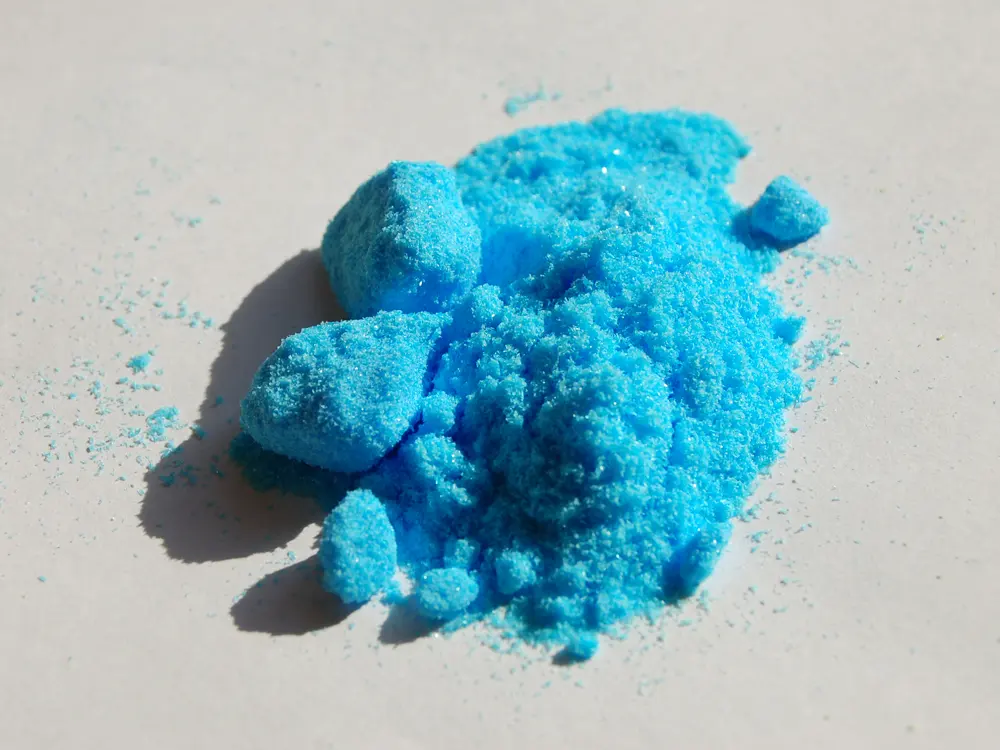
Many salts crystallize with water molecules built into their crystals: blue copper sulphate is CuSO₄·5H₂O, with five water molecules for each CuSO₄ (Section 7.3.5). Heating such a hydrated salt drives the water out, leaving the anhydrous salt (“without water”). Heating hydrated copper sulphate, for example:
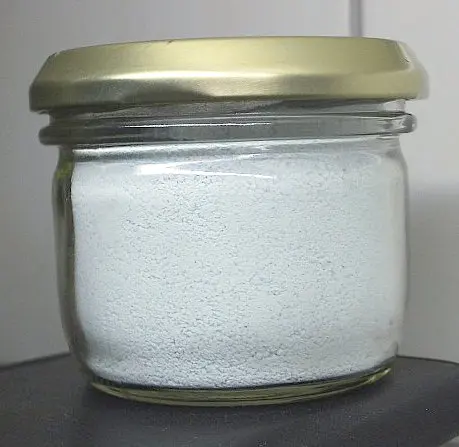
The blue color belongs to the copper(II) ions with water molecules bound to them; without the water, the solid is white.
Some hydrated salts lose part of their water by themselves, just left in the open air, especially in dry weather. Their crystals lose their shine and crumble into powder on the surface.
Efflorescence is the loss of some or all of a salt’s water of crystallization when it is exposed to the air; such salts are efflorescent. Examples are washing soda and Glauber’s salt:
Clear crystals of washing soda left on a shelf soon turn into a white powder this way. Green vitriol (FeSO₄·7H₂O) and blue vitriol (CuSO₄·5H₂O) effloresce slowly, in dry air. A salt effloresces when the vapor pressure of the water in its crystals is higher than the water vapor in the air around it, so more so in dry weather. (Driving the water out by heating, as in the activity, is dehydration, not efflorescence.)
Hygroscopic substances. A seed in dry soil does nothing; water it, and its coat soaks up moisture and swells before it germinates. Many substances take up water vapor from the air in the same way.
Hygroscopic substances absorb moisture from the air at ordinary temperatures without dissolving in it; the property is hygroscopy. Examples are quicklime (CaO), anhydrous copper sulphate, silica gel, sucrose (table sugar), sodium nitrate and concentrated sulphuric acid (a liquid that takes up water from the air and grows in volume). Taking up water changes a substance’s volume and other properties: a sugar jar left open in the monsoon turns into lumps. Anhydrous copper sulphate takes the water back and turns blue:
(That color change is the standard test for water.) Efflorescence and taking up water are opposite changes, and for a salt like copper sulphate each can be reversed by the other.
Hygroscopic solids are used as desiccants, drying agents, to keep things dry: in a desiccator in the lab (a glass vessel with fused calcium chloride or silica gel under a perforated plate), and in the small packets of silica gel packed with shoes, bags, medicines and electronics. A related use is in humectants, such as glycerol and honey, which hold water and keep things moist: in skin creams, toothpaste and soft foods.
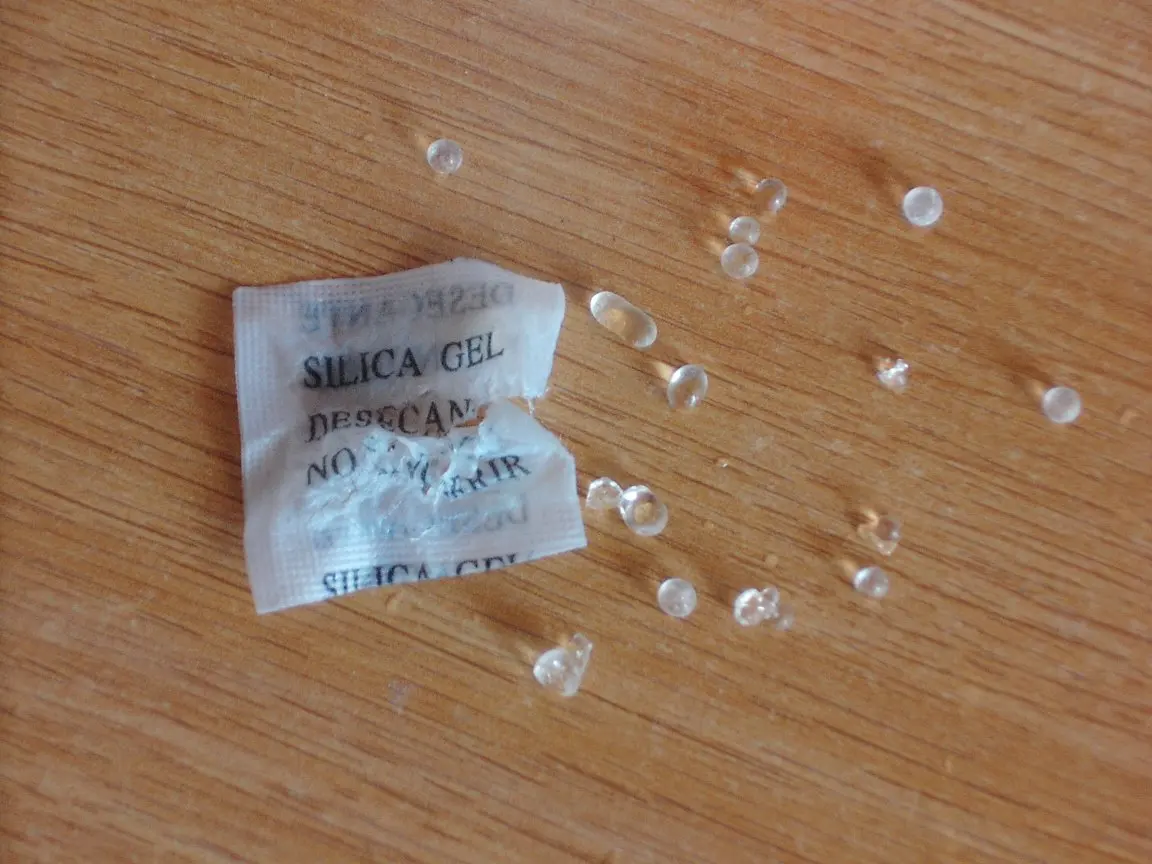
Deliquescent substances. Some solids take up so much water from the air that they dissolve in it, turning into a puddle of their own solution.
Deliquescence is the absorption of moisture from the air by a solid until it dissolves in the water taken up, forming a solution; such solids are deliquescent. Examples are sodium hydroxide (caustic soda), potassium hydroxide, calcium chloride, magnesium chloride, iron(III) chloride and phosphorus pentoxide (P₄O₁₀). Deliquescence happens when the vapor pressure of water over the substance’s saturated solution is lower than that of the water vapor in the air, so it is greatest in humid air: in Nepal’s monsoon, a bottle of caustic soda left open turns to a puddle in hours. Deliquescent substances are very strong desiccants too: fused calcium chloride is used in desiccators, though once it has deliquesced it must be dried again.
Common salt from the shop turns damp and lumpy in the monsoon for the same reason: it contains a little magnesium chloride, which is deliquescent. Pure sodium chloride hardly takes up water until the air is very humid.
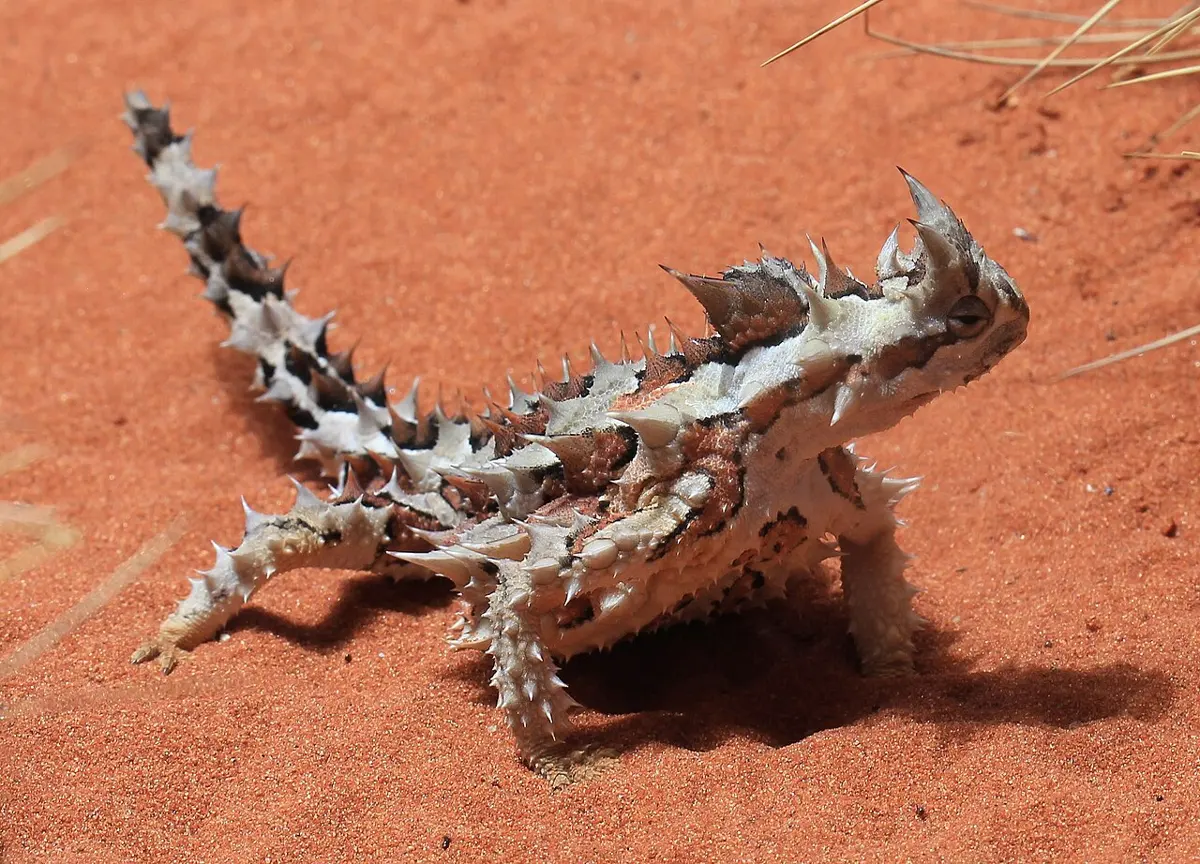
| Efflorescent | Hygroscopic | Deliquescent | |
|---|---|---|---|
| What happens in air | loses water of crystallization | takes up water vapor, stays solid | takes up water vapor and dissolves in it |
| Mass in air | decreases | increases | increases a lot |
| More so in | dry air | humid air | humid air |
| Examples | Na₂CO₃·10H₂O, Na₂SO₄·10H₂O | CaO, silica gel, anhydrous CuSO₄ | NaOH, KOH, CaCl₂, MgCl₂ |
Pellets of sodium hydroxide left in the open become wet and turn into a solution. This is:
Pick an answer to see why.
7.3.4 Crystallization and crystal growth
Under suitable conditions, a solid forms with a fixed geometrical shape: flat faces meeting at fixed angles. Such a solid is a crystal, and the process by which it forms, from a solution, a melt or a vapor, is crystallization. A substance made of many small crystals stuck together, like most metals and rocks, is polycrystalline. Each substance’s crystals have their own color, shape and cleavage (the flat planes along which they split). Crystallization is a physical change: no new substance is formed, the same substance just comes out of solution, or a melt freezes, in order.
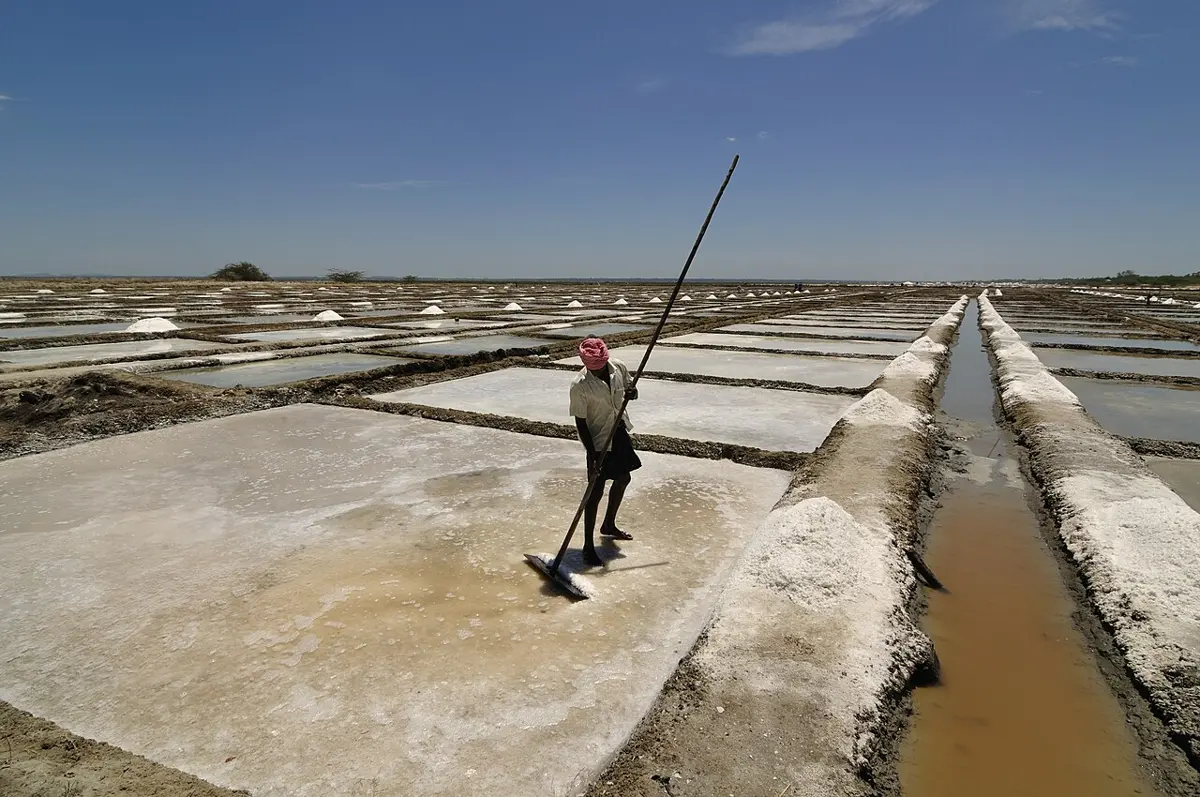
Crystals can be made in several ways: by evaporating a solution (salt from seawater), by cooling a hot saturated solution, by precipitation (mixing two solutions that form an insoluble solid), by cooling a melt (water to ice, molten rock to granite) and by sublimation (a vapor turning straight into a solid, as iodine does on a cool surface).
Crystallization happens in two steps:
- Nucleation. In a supersaturated solution (one holding more solute than it can normally dissolve at that temperature), particles of the solute come together by chance into tiny ordered clusters. Most fall apart again; a cluster that grows past a critical size is stable, a nucleus. A speck of dust, a scratch on the glass or a tiny “seed” crystal makes nucleation much easier.
- Crystal growth. More particles join the nucleus in the positions the lattice requires, layer upon layer of particles deposited on its faces, so the crystal keeps its shape as it grows. On some crystals new particles add round a step that winds up the face, so the crystal grows in a spiral. Growth goes on as long as the solution stays supersaturated.
What decides the size and quality of the crystals.
- a.Supersaturation drives both steps. A slightly supersaturated solution makes few nuclei, which grow slowly into a few large, well-formed crystals; a strongly supersaturated one makes many nuclei at once, and a mass of small crystals.
- b.The rate of cooling or evaporation. Slow cooling or slow evaporation keeps the supersaturation low, so the crystals come out big and well formed; cooling suddenly gives a powder of tiny crystals. (Granite, which cooled slowly deep underground, has crystals you can see; basalt, cooled quickly at the surface, has tiny ones.)
- c.Temperature and concentration set how quickly particles reach the faces: within limits, a warmer, more concentrated solution grows crystals faster.
- d.Impurities and disturbance: impurities can stop growth on some faces and change the crystals’ shape; shaking makes more nuclei.
Applications of crystallization.
- a.Purification. A solid is dissolved in a hot solvent and allowed to crystallize as it cools: the pure substance crystallizes, and the small amounts of impurities stay dissolved. It is one of the commonest ways to purify a solid in industry and the lab (sugar, salt, alum).
- b.Medicines are made and stored as crystals, because a pure crystalline form is stable and dissolves at a known rate.
- c.Materials science. The structure of crystals explains the properties of materials: the silicon in computer chips is grown as single, perfect crystals.
- d.Geology. Minerals are crystals; their crystal shapes and sizes tell geologists how and how fast a rock formed.
7.3.5 Water of crystallization
When an anhydrous salt meets water, it takes up water molecules into its crystal and becomes hydrated. The water changes the crystal’s properties: anhydrous copper sulphate is a white powder, the hydrated salt blue crystals.
Water of crystallization is the water held in fixed proportion in the crystal structure of a substance; crystals that hold it are hydrated crystals (hydrates). Each formula unit holds a fixed number of water molecules: CuSO₄·5H₂O, copper(II) sulphate pentahydrate, has five. The dot in the formula means the water is part of the crystal; it is not mixed in or merely damp. In CuSO₄·5H₂O, four of the waters are bound to each Cu²⁺ ion, and the fifth is held by hydrogen bonds between the sulphate ions and the other waters.
| Chemical name | Common name | Formula |
|---|---|---|
| Copper(II) sulphate pentahydrate | Blue vitriol | CuSO₄·5H₂O |
| Magnesium sulphate heptahydrate | Epsom salt | MgSO₄·7H₂O |
| Calcium sulphate dihydrate | Gypsum | CaSO₄·2H₂O |
| Iron(II) sulphate heptahydrate | Green vitriol | FeSO₄·7H₂O |
| Zinc sulphate heptahydrate | White vitriol | ZnSO₄·7H₂O |
| Sodium carbonate decahydrate | Washing soda | Na₂CO₃·10H₂O |
| Calcium sulphate hemihydrate | Plaster of Paris | CaSO₄·½H₂O |
| Potassium aluminium sulphate dodecahydrate | Potash alum (phitkiri) | KAl(SO₄)₂·12H₂O |
| Sodium sulphate decahydrate | Glauber’s salt | Na₂SO₄·10H₂O |
Water of crystallization can be driven out by heating: dehydration. Weighing a hydrated salt before and after heating gives its water of crystallization:
and the number of water molecules per formula unit, in , is the ratio of their moles:
How many molecules of water of crystallization does gypsum have per formula unit?
Pick an answer to see why.
7.3.6 Crystal lattice and unit cell
Every crystal is built of some particle repeated in a regular pattern: ions in sodium chloride, positive metal ions in a metal, molecules in ice or iodine, atoms in diamond.
A crystal lattice is the regular, repeating three-dimensional arrangement of the particles (atoms, ions or molecules) of a crystal. Each particle’s position is represented by a point, a lattice point (lattice site). The lattice keeps the crystal’s regular structure: its flat faces and fixed angles are the outside of the pattern within. By the particles at the lattice points, lattices are of three main kinds:
1. Ionic lattice. Positive and negative ions are arranged in a repeating three-dimensional pattern in which each ion is surrounded by ions of the opposite charge, so that the electrostatic attractions are as strong as possible. Compounds with ionic lattices are called giant ionic structures. In sodium chloride, each Na⁺ ion is surrounded by six Cl⁻ ions, and each Cl⁻ ion by six Na⁺ ions (its coordination number is 6). The strong electrostatic forces holding the whole lattice explain ionic compounds’ high melting points and hardness; their brittleness (a blow shifts a layer so that like charges meet and repel); and their conductivity only when molten or dissolved, when the ions are free to move.
Turn the crystal of sodium chloride and tap an ion to see its six neighbors.
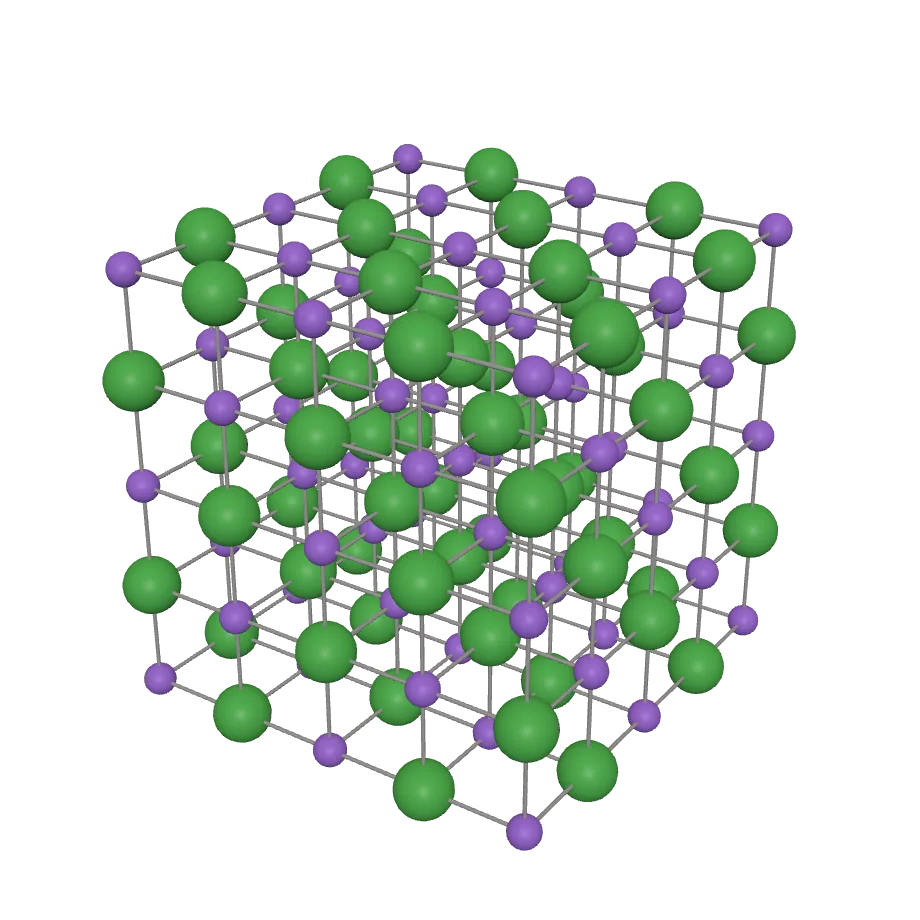
This browser can’t show the 3D model. The picture above is the same model.
A real salt crystal, five ions each way: sodium ions, Na⁺ (purple), and chloride ions, Cl⁻ (green), take turns in every direction. The lines only show which ions are neighbors: they are not shared-pair bonds.
A sodium ion, Na⁺Six chloride ions round it, above and below, left and right, in front and behind, each 0.282 nm away, and every one of them pulls on it.
A chloride ion, Cl⁻Six sodium ions round it in the same way. No ion belongs to just one partner, so the crystal is one block, not separate NaCl molecules.
The ions at their real sizes: each touches its six neighbors, and the chloride ions are much bigger than the sodium ions. A salt crystal is one packed block of ions.
Drag to turn it. Tap a part, or a name below, to pick it out; tap it again to see the whole.
Salt (halite): COD 9003308, Walker and others (2004), Crystallography Open Database, CC0: www.crystallography.net/cod/9003308.html
2. Metallic lattice. The metal’s positive ions are arranged in a regular pattern, and its outer electrons are not attached to any one atom: they move freely through the whole lattice, a sea of electrons. The attraction between the cations and the delocalized electrons holds the lattice together. It explains metals’ strength and hardness (most metals), their high tensile strength, and why they conduct heat and electricity (the electrons move) and can be hammered into sheets and drawn into wires without breaking (the layers of ions can slide, and the electron sea still holds them).
3. Molecular lattice. The particles at the lattice points are whole molecules, held in place by intermolecular forces: London forces, dipole–dipole forces and hydrogen bonds. Iodine (I₂ molecules held by London forces) and ice (H₂O molecules held by hydrogen bonds) have molecular lattices. These forces are much weaker than the bonds inside the molecules, or the forces in ionic and metallic lattices, so molecular solids are soft and have low melting points: iodine melts at 114 °C, ice at 0 °C. In ice each water molecule hydrogen bonds to four others, in an open pattern with large empty spaces: that is why ice is less dense than water, and floats.
A fourth kind, the covalent network (giant covalent) lattice, has atoms at its lattice points joined by covalent bonds right through the crystal, so the whole crystal is one giant molecule. Diamond, silicon and quartz are covalent networks, which is why they are so hard and melt only at very high temperatures.
Silicon’s crystal, the same structure as diamond: turn it and tap an atom to see its four neighbors, at the corners of a tetrahedron.
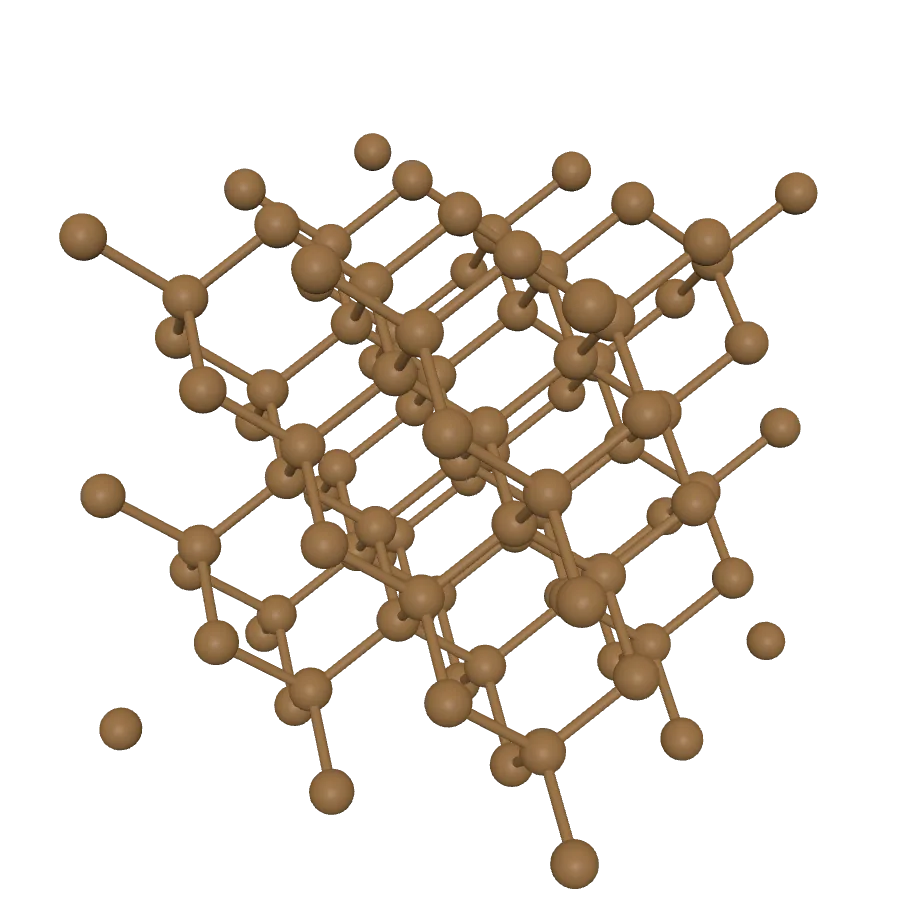
This browser can’t show the 3D model. The picture above is the same model.
A real silicon crystal, two repeating cubes each way: every silicon atom inside is bonded to four others, and the bonds run through the whole crystal in three dimensions.
One atom’s four neighborsEach atom sits at the center of a tetrahedron of four neighbors, 0.235 nm away, every two bonds 109.5° apart. Each bond is one pair of shared electrons, so all four outer electrons are held in bonds.
Drag to turn it. Tap a part, or a name below, to pick it out; tap it again to see the whole.
Silicon: COD 9011998, Hom, Kiszenick and Post (1975), Crystallography Open Database, CC0: www.crystallography.net/cod/9011998.html
Unit cell
Just as our body is built of cells, a crystal is built of unit cells. The unit cell is the smallest repeating unit of a crystal lattice which, repeated over and over in three dimensions, generates the whole lattice. The shape and size of the unit cell, and where the particles sit in it, decide the shape of the crystal and many of its properties; from them crystallographers calculate the crystal’s density, the number of particles per unit cell and each particle’s number of nearest neighbors (its coordination number).
Parameters of a unit cell. A unit cell is described by six numbers:
- the lattice constants, the lengths of its three edges, , and ;
- the angles between the edges, (between and ), (between and ) and (between and ).
Different values of these six give the different shapes of crystal (seven crystal systems in all). For example, a cubic unit cell has and ; a hexagonal one has , and .
Types of cubic unit cell. In a cubic unit cell, the lattice points can be placed in three ways:
- a.Simple cubic (SC), or primitive cubic: lattice points only at the eight corners of the cube. It is rare among elements, because it wastes space: only polonium (α-Po) has it.
- b.Body-centered cubic (BCC): a lattice point at each corner and one at the center of the cube. Iron (at room temperature), tungsten, chromium, and the alkali metals sodium, potassium, rubidium and cesium are BCC.
- c.Face-centered cubic (FCC): a lattice point at each corner and one at the center of each face. Copper, aluminium, silver, gold and nickel are FCC; so is the pattern of sodium chloride’s ions (each kind of ion makes an FCC lattice, the two fitted together), and potassium chloride’s.
A corner of a cube is shared by eight cubes meeting there, and a face by two, so an atom at a corner counts to each unit cell and one on a face :
| Unit cell | Atoms per unit cell | Coordination number | Space filled |
|---|---|---|---|
| Simple cubic | 6 | 52 % | |
| Body-centered cubic | 8 | 68 % | |
| Face-centered cubic | 12 | 74 % |
How many atoms belong to one face-centered cubic unit cell?
Pick an answer to see why.
Isomorphism, polymorphism and crystal habit
A crystal’s form comes from its lattice, so it says something about the substance, but not everything. Two different substances can crystallize in the same form; one substance can crystallize in two different forms; and one form can grow into crystals of different outward shapes.
Isomorphism. Substances with similar formulas, their atoms combined in the same ratio and the same way, often crystallize in the same crystal form. Such substances are isomorphous (“of the same form”), and the property is isomorphism. The German chemist Eilhard Mitscherlich found it in 1819, when he saw that corresponding phosphates and arsenates, such as potassium dihydrogenphosphate, KH₂PO₄, and potassium dihydrogenarsenate, KH₂AsO₄, crystallize in the same form. The best-known family of isomorphous salts is the alums, M⁺M³⁺(SO₄)₂·12H₂O: potash alum, KAl(SO₄)₂·12H₂O (the phitkiri of the market, also written K₂SO₄·Al₂(SO₄)₃·24H₂O), and chrome alum, KCr(SO₄)₂·12H₂O, dark purple, both grow as octahedra. Because their particles are so alike in size and arrangement, isomorphous substances can often take one another’s places in one lattice and crystallize together, as mixed crystals.
Polymorphism. One substance may crystallize in two or more crystal forms, with its particles arranged differently; this is polymorphism, and the forms are polymorphs. Calcium carbonate is the classic example. As calcite, with a rhombohedral lattice, it makes limestone and marble, and the clear crystals that split at fixed angles and show a double image (Section 7.3.1). As aragonite, with an orthorhombic lattice, it makes almost every snail and clam shell, the shining mother-of-pearl inside them, and coral. At the Earth’s surface calcite is the stable form, so aragonite slowly turns into calcite over tens of millions of years, and old fossil shells are usually calcite.
Allotropy. When the substance is an element, its different forms are called allotropes, and the property allotropy. Diamond and graphite are allotropes of carbon, as Unit 9 shows, and rhombic and monoclinic sulphur are two crystalline allotropes of sulphur, both made of S₈ rings packed in different ways. (Allotropy is wider than polymorphism: oxygen, O₂, and ozone, O₃, are allotropes too, though both are gases.)
Transition temperature. Of two polymorphs or allotropes, usually one is stable below a certain temperature and the other above it. The temperature at which the two are equally stable, and can exist together in equilibrium, is the transition temperature. For sulphur it is 95.6 °C:
Below it rhombic sulphur is stable; above it, up to its melting point, monoclinic. Tin has one too: ordinary white tin, the metal, is stable above 13.2 °C, and below it slowly changes into powdery gray tin, a different lattice that takes up more room, so tin objects left for long in severe cold crumble (“tin pest”).
Crystal habit. The outward shape a crystal grows into is its habit. The lattice and its unit cell stay the same, but which faces grow fastest depends on the conditions, above all on what else is in the solution (Section 7.3.4, d). Sodium chloride crystallizes from water as cubes; from a solution containing urea, as octahedra, because urea molecules cling to the octahedral faces and slow their growth. Both are the same face-centered cubic lattice of Na⁺ and Cl⁻ ions: only the habit differs. Habit is not polymorphism: polymorphs differ inside, in their lattices; crystals of different habit differ only in their outside shape.
| Term | What is the same | What differs | Example |
|---|---|---|---|
| Isomorphism | crystal form | the substance (similar formulas) | KH₂PO₄ and KH₂AsO₄; potash and chrome alum |
| Polymorphism | the substance | the crystal form (lattice) | CaCO₃: calcite and aragonite |
| Allotropy | the element | its form | rhombic and monoclinic sulphur; diamond and graphite |
| Crystal habit | the substance and its lattice | the outward shape | NaCl: cubes from water, octahedra with urea |
Calcite and aragonite are both pure calcium carbonate, with their particles arranged in different lattices. This is an example of:
Pick an answer to see why.
Project work
Exercise (7.3 Solid state)
A. Multiple choice questions
- Which of the following is an example of a molecular solid?
Pick an answer to see why.
- What do efflorescent substances do?
Pick an answer to see why.
- In crystal growth, what is the adding of new particles to the surface of a crystal called?
Pick an answer to see why.
- Which type of solid conducts electricity well when molten or dissolved in water, but not when solid?
Pick an answer to see why.
- The smallest repeating unit of a crystal lattice is called:
Pick an answer to see why.
- Diamond is an example of:
Pick an answer to see why.
- Which property can crystals with water of crystallization show?
Pick an answer to see why.
- Which of the following is NOT a factor in the size and quality of crystals during crystal growth?
Pick an answer to see why.
- The numbers of water molecules of crystallization in copper sulphate, gypsum and washing soda are, in order:
Pick an answer to see why.
- The property of different substances with similar chemical formulas of crystallizing in the same crystal form is:
Pick an answer to see why.
B. Short answer questions
Give reasons:
- a.Anhydrous copper sulphate changes color when exposed to moisture.
- b.Calcium chloride is used as a desiccant in desiccators.
- c.Pellets of caustic soda change their shape when exposed to air.
Answer
Differentiate between:
- a.a crystal and crystallization
- b.a hygroscopic substance and a hydrated salt
- c.a deliquescent and a hygroscopic substance
- d.a crystal lattice and a unit cell
Answer
By the arrangement of their particles, solids are divided into crystalline and amorphous.
- a.Define amorphous and crystalline solids, and write the differences between them.
- b.Give examples of materials that are amorphous and crystalline.
- c.Imagine you are designing a new material for electronic devices. Would you prefer an amorphous or a crystalline material, and why?
Answer
Two forms of copper sulphate, A (blue crystals) and B (a white powder), can be turned into each other: process x turns A into B, and process y turns B into A.
- a.Define hygroscopic and efflorescent, and identify A and B.
- b.Name the processes x and y, and write an equation for each.
- c.Why are A and B different colors?
- d.In the laboratory, why is it important to know whether a substance is efflorescent, deliquescent or hygroscopic?
Answer
Discuss the effects of efflorescent, deliquescent and hygroscopic solids on storage, transport and use in different climates.
Answer
Crystallization is one of the commonest methods of separating mixtures in the laboratory.
- a.Define crystal and crystallization.
- b.Name the two main steps of crystallization.
- c.How does crystallization help to purify substances? What kinds of mixture can be separated by it?
Answer
A sample of copper sulphate pentahydrate, CuSO₄·5H₂O, has a mass of 250 g. After heating, the mass of the salt is found to be 160 g.
- a.CuSO₄·5H₂O is called efflorescent. Why?
- b.Why is there a loss of mass on heating?
- c.What is the change in the salt’s color on heating, and why?
- d.Find the percentage of water of crystallization in the original sample.
Answer
The crystal lattice of a solid is shown in Figure 7.69.
- a.Define crystal lattice, identify the type of lattice in the figure, and give two properties of such a lattice.
- b.What are the other types of crystal lattice?
Answer
A crystal lattice is made of unit cells. Two unit cells are shown in Figure 7.70.
- a.What is a unit cell?
- b.Name each unit cell, with the reason for the name.
- c.How does knowing crystal structures and unit cells help in developing new materials?
Answer
- a.Define isomorphism and polymorphism, with an example of each.
- b.What is a transition temperature? Give its value for sulphur, and say which allotrope is stable on each side of it.
- c.Common salt crystallizes as cubes from water but as octahedra from a solution containing urea. Is this polymorphism? Explain.
Answer
Printable PDFs
- Study notes 3 pages
- Worksheet 4 pages Answer key
Quiz yourself: Matter, Atoms and Reactions, Grades 5–12 →
Practice every question in the book, and keep track of the ones you miss →
A companion to your textbook, not a replacement for it: study from the book your school uses, and where the two differ, follow your teacher. Found a mistake? Please tell us.