
Cut an apple in the morning and leave half of it on the plate: by lunchtime its white flesh has gone brown. An iron gate in Bhaktapur’s monsoon grows orange flakes of rust. A phone battery gives you a day of videos, a police officer’s breath tester turns orange to green when a driver has been drinking, and a firefly blinks in a summer field above the paddy. All of these are the same kind of chemistry: electrons moving from one substance to another.
This unit is about that movement. It starts with the old idea of oxidation as “gaining oxygen”, and widens it to the loss and gain of electrons, which takes in reactions with no oxygen at all. Then come oxidation numbers, the bookkeeping that tells you which atom lost electrons and which gained them, and two ways to balance even the most tangled redox equation. Last comes electrolysis: driving a reaction backwards with a battery, to plate a spoon with copper, pull sodium out of salt, or split water into hydrogen fuel, and Faraday’s two laws, which say exactly how much you get.
6.1 General and electronic concept of oxidation and reduction
A. General concept of oxidation and reduction
Iron left out in the rain rusts. Rust is mostly hydrated iron(III) oxide, Fe₂O₃·xH₂O, and it forms only when iron meets both oxygen and water. Leaving out the water, the overall change is:

When a magnesium ribbon is held in a flame, it burns with a dazzling white light and leaves a white ash, magnesium oxide:
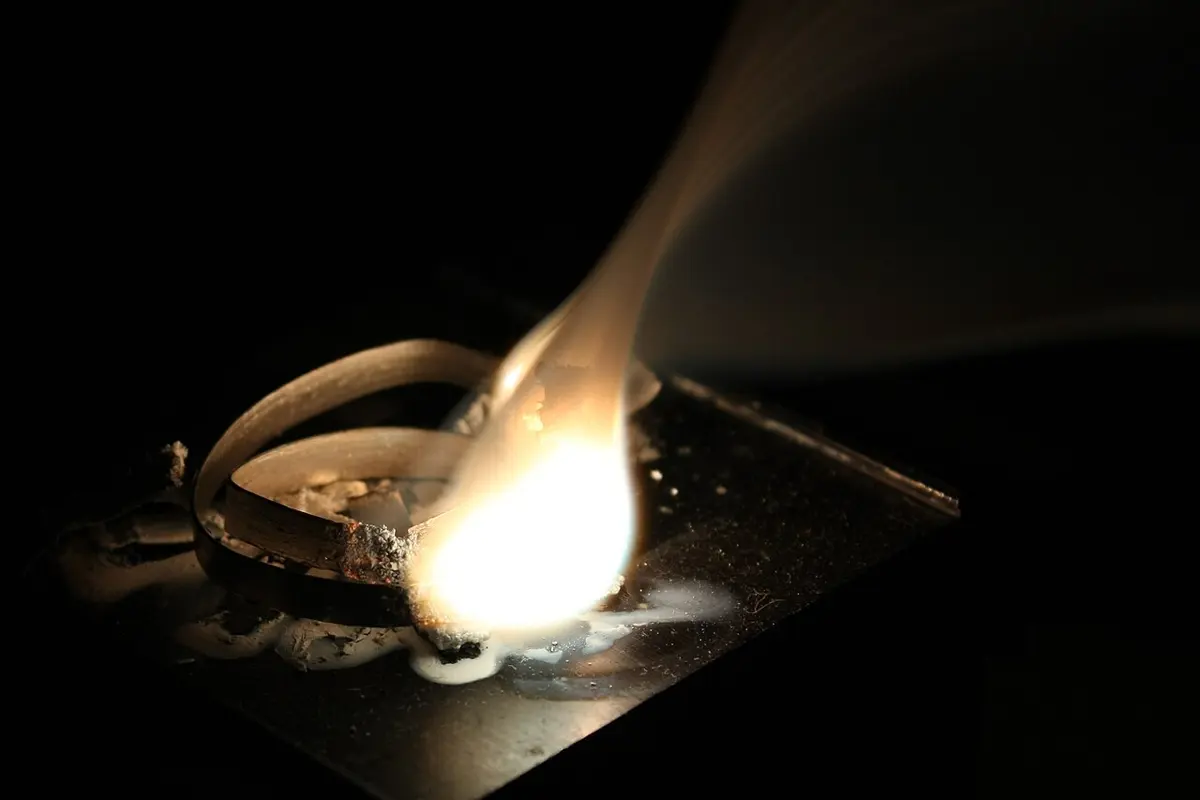
Iron and magnesium both gain oxygen. The oldest meaning of the word is exactly that:
Oxidation is the gain of oxygen, and the substance that gains oxygen is said to be oxidized.
The opposite happens when a metal oxide is heated with something that takes its oxygen away. Hot zinc oxide in a stream of hydrogen gives zinc and water; copper(II) oxide heated with carbon gives copper and carbon dioxide:
Reduction is the loss of oxygen, and the substance that loses oxygen is said to be reduced. The name comes from ores: when a heap of ore is turned into metal, it gets smaller, it is “reduced”, because the oxygen goes off as gas.
Notice that in each of these, one substance gains oxygen while another loses it: hydrogen is oxidized to water while zinc oxide is reduced, and carbon is oxidized to carbon dioxide while copper oxide is reduced. You will meet this again and again: oxidation and reduction happen together.
Wider than oxygen
Chemists soon noticed that hydrogen behaves as oxygen’s opposite: removing hydrogen from a substance is like adding oxygen to it. And other non-metals (sulphur, chlorine), which pull on electrons as oxygen does, can play oxygen’s part; metals, which give electrons away easily, can play hydrogen’s. So the classical idea was widened to electronegative elements (usually non-metals) and electropositive elements (usually metals):
- : iron gains sulphur, an electronegative element, so iron is oxidized to iron(II) sulphide.
- : potassium iodide loses iodine and gains chlorine, both electronegative. Its iodide is oxidized to iodine.
- : iron(III) chloride loses chlorine, an electronegative element, so it is reduced to iron(II) chloride; hydrogen gains chlorine and is oxidized.
The general (classical) concept, in short
| Oxidation is | Reduction is |
|---|---|
| addition of oxygen | removal of oxygen |
| addition of an electronegative element (Cl, S…) | removal of an electronegative element |
| removal of hydrogen | addition of hydrogen |
| removal of an electropositive element (a metal) | addition of an electropositive element (a metal) |
This list works, but it is clumsy, and it can’t explain many reactions between ions, such as the zinc and copper ions below, where no oxygen, hydrogen or extra element is gained or lost at all. The electronic concept fixes that.
In , which substance is oxidized?
Pick an answer to see why.
B. Electronic concept of oxidation and reduction
Dip a strip of zinc into blue copper(II) sulphate solution. Within minutes the zinc is coated with a crumbly red-brown layer of copper, and over a day or so the blue fades towards colorless. Zinc atoms are giving their electrons to copper ions:
Each of these is a half-equation: it shows one half of the change, with the electrons written in. Adding them, the electrons cancel, and you get the ionic equation:
The sulphate ions don’t change, so they are left out: they are spectator ions. The blue color belongs to the Cu²⁺ ion; zinc ions are colorless, so the blue fades as copper ions are used up.
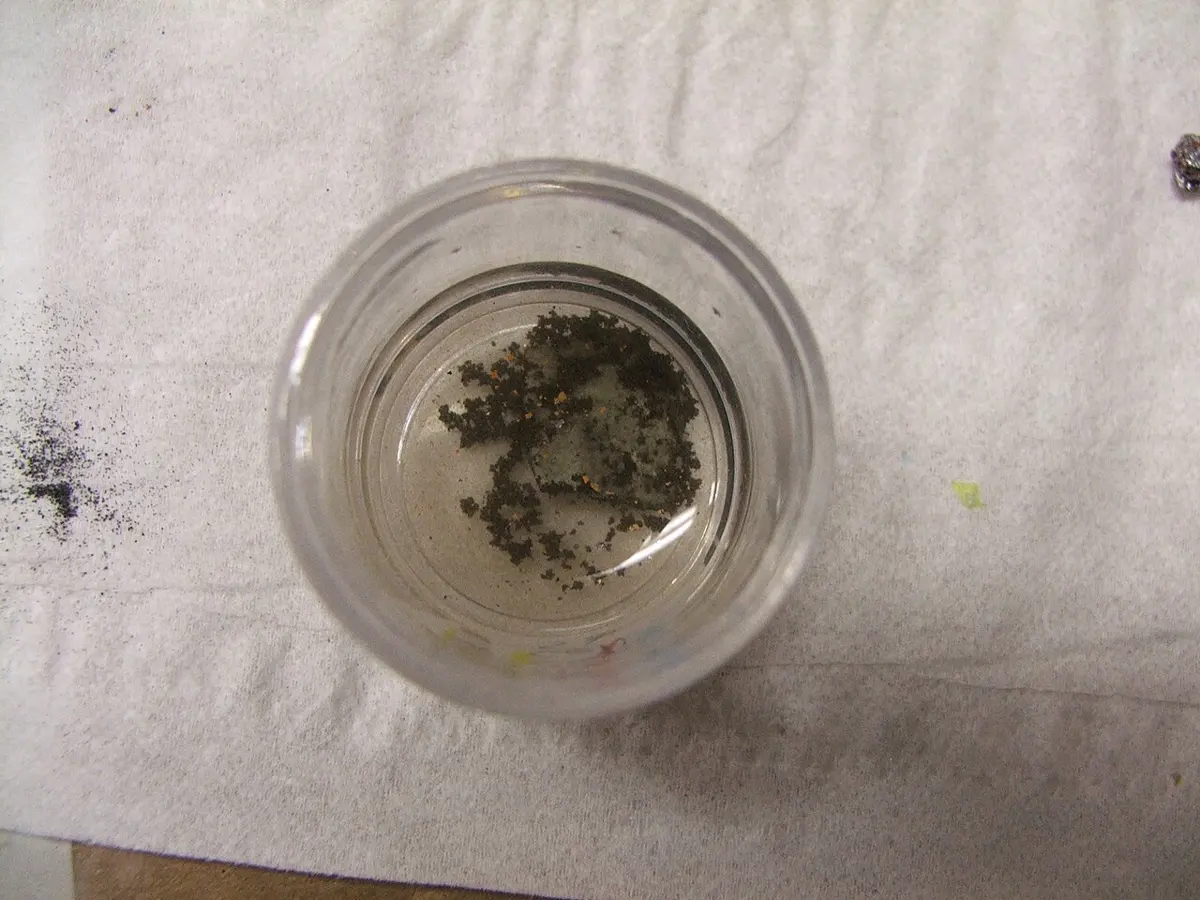
Nothing in this reaction gains or loses oxygen. But zinc loses electrons and copper ions gain them, and that is the heart of it. So chemists now define the two words by electrons:
- Oxidation is the loss of electrons (also called de-electronation).
- Reduction is the gain of electrons (also called electronation).
- A reaction in which one substance loses electrons and another gains them is a redox reaction (reduction + oxidation).
A way to remember it: OIL RIG, Oxidation Is Loss, Reduction Is Gain (of electrons).
Electrons can’t vanish or appear from nowhere, so a substance can lose electrons only if something else takes them. Oxidation and reduction always happen together, and the electrons lost always equal the electrons gained. Every reaction in Part A fits this too: when magnesium burns, each Mg atom gives two electrons to oxygen, making Mg²⁺ and O²⁻ ions; magnesium is oxidized and oxygen is reduced.
In the reaction , what happens to the silver ion?
Pick an answer to see why.
Redox in your pocket: the dry cell
Batteries are redox reactions arranged so that the electrons are made to travel through a wire on their way from one substance to the other, and do work (light a bulb, run a toy) as they go. In the ordinary zinc–carbon dry cell of a torch or a TV remote, the zinc case is oxidized and manganese(IV) oxide packed round the carbon rod is reduced:
Adding the two, with the electrons canceling:
The electrons leave the cell at its negative terminal (the zinc), go round the circuit, and come back in at the positive terminal (the carbon rod), where the manganese oxide takes them.
Oxidizing and reducing agents
In every redox reaction one substance gives electrons and another takes them. The one that takes them away causes oxidation in the other; the one that gives them causes reduction:
- An oxidizing agent (or oxidant) is a substance that oxidizes another substance by taking electrons from it, and is itself reduced.
- A reducing agent (or reductant) is a substance that reduces another substance by giving it electrons, and is itself oxidized.
It sounds back to front at first, so think of a thief: a thief who takes your money (electrons) makes you poorer (oxidized) and himself richer (reduced).
When ammonia burns in oxygen on a hot platinum gauze (the first step in making nitric acid), ammonia is oxidized to nitrogen monoxide and oxygen is reduced to water:
A small piece of hot sodium lowered into a flask of chlorine burns with a bright yellow-white light and fills the flask with white smoke, salt:
Sodium gives electrons to chlorine, so sodium reduces chlorine: sodium is the reducing agent. Chlorine takes electrons from sodium, so chlorine oxidizes sodium: chlorine is the oxidizing agent. The reaction gives out a great deal of energy, which is why it glows.
| Oxidizing agent | Reducing agent |
|---|---|
| gains (accepts) electrons | loses (donates) electrons |
| is itself reduced | is itself oxidized |
| its oxidation number decreases (6.2) | its oxidation number increases (6.2) |
| e.g. O₂, Cl₂, F₂, KMnO₄, K₂Cr₂O₇, HNO₃, H₂O₂ | e.g. Na, Mg, Zn, H₂, C, CO, H₂S |
Strong and weak agents
A substance that grabs electrons easily is a strong oxidizing agent; one that gives them away easily is a strong reducing agent. The list below puts some of them in order. Each line is a reduction half-equation; the substance on the left of a line is an oxidizing agent and the one on the right a reducing agent. The higher a line, the more strongly its left side pulls in electrons; the lower a line, the more easily its right side gives them away. The number is each half-reaction’s standard electrode potential, E° (measured against hydrogen; you will meet it properly in Grade 12): the more positive, the stronger the oxidizing agent.
| Oxidizing agent (takes electrons) | Reducing agent (gives electrons) | E° (V) | |
|---|---|---|---|
| → | +2.87 | ||
| → | +1.36 | ||
| → | +1.23 | ||
| → | +1.07 | ||
| → | +0.80 | ||
| → | +0.34 | ||
| → | 0.00 | ||
| → | −0.13 | ||
| → | −0.14 | ||
| → | −0.26 | ||
| → | −0.45 | ||
| → | −0.74 | ||
| → | −0.76 | ||
| → | −0.83 | ||
| → | −1.66 | ||
| → | −2.37 | ||
| → | −2.71 |
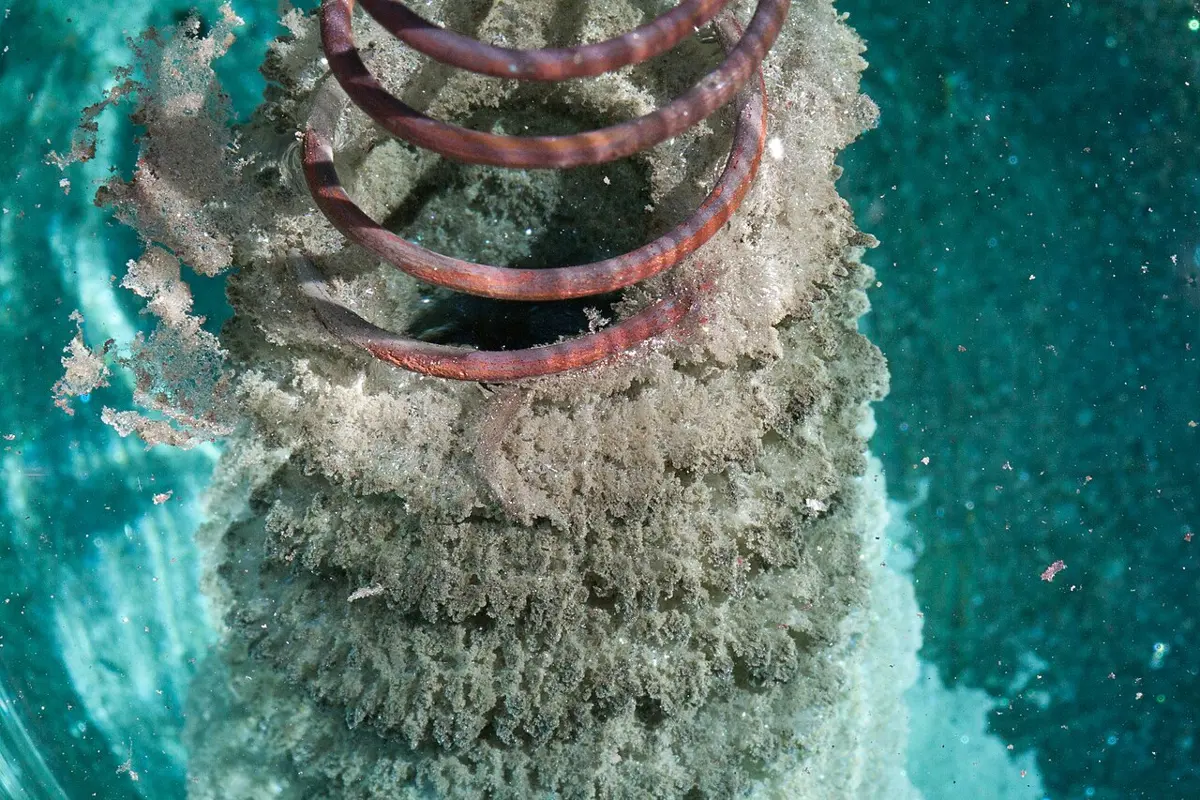
Fluorine at the top is the strongest oxidizing agent of all; sodium at the bottom right is the strongest reducing agent here. The table also tells you which reactions go: a substance on the left reacts with one on the right that is lower down. Cu²⁺ (left, higher) takes electrons from Zn (right, lower), as you saw; but Zn²⁺ does nothing to copper metal.
Using the table, which of these reactions happens?
Pick an answer to see why.
6.2 Oxidation number and rules for assigning oxidation number
In an ionic compound such as NaCl it is easy to see who lost electrons: sodium is Na⁺, chlorine is Cl⁻. But most compounds are covalent: in water, oxygen only pulls harder on the electrons it shares with hydrogen. To track electrons in all compounds alike, chemists pretend that every bond is ionic, and give each atom an oxidation number:
The oxidation number (or oxidation state) of an atom in a molecule or ion is the charge the atom would have if all the electrons in each of its bonds were given to the more electronegative atom of the bond.
In water, oxygen is more electronegative than hydrogen, so both bonding pairs are counted as oxygen’s: oxygen gets 2 extra electrons (−2), and each hydrogen loses its one (+1). Nobody claims water really contains O²⁻ and H⁺; the numbers are bookkeeping, but very useful bookkeeping.
An oxidation number is written with its sign first (+2, −1), to tell it apart from an ion’s charge (2+, 1−).
Rules for assigning oxidation numbers
You almost never need to draw the bonds. These rules give the answer, applied in this order:
- a.An element on its own (an atom in its free or elemental state) has oxidation number 0: Cl in Cl₂, P in P₄, S in S₈, Fe in iron metal, O in O₂ and O₃.
- b.A simple ion’s oxidation number is its charge: Na⁺ is +1, Fe³⁺ is +3, Cl⁻ is −1.
- c.Some elements have the same oxidation number in almost all their compounds:
- i.Fluorine is always −1 (it is the most electronegative element of all).
- ii.Group 1 metals (Li, Na, K…) are always +1.
- iii.Group 2 metals (Mg, Ca, Ba…) are always +2; aluminium is +3.
- d.Hydrogen is +1 when bonded to non-metals (H₂O, NH₃, CH₄, HCl), but −1 in metal hydrides, ionic compounds with metals (NaH, LiH, CaH₂), where hydrogen is the more electronegative partner.
- e.Oxygen is −2 in most compounds (normal oxides such as NO, CO₂, P₂O₅, and in acids and bases). The exceptions are peroxides, with an O–O bond, where it is −1 (H₂O₂, Na₂O₂, BaO₂); superoxides, where it is −½ (KO₂, NaO₂); and its compounds with fluorine, where it is positive (+2 in OF₂).
- f.The oxidation numbers of all the atoms add up to the total charge: to 0 in a neutral compound, and to the ion’s charge in an ion.
The last rule finds any atom not covered by the others. Call its oxidation number x.
What is the oxidation number of sulphur in sodium thiosulphate, Na₂S₂O₃?
Pick an answer to see why.
A range of oxidation numbers
Many elements take more than one oxidation number, depending on what they are bonded to: nitrogen goes from −3 in ammonia to +5 in nitric acid. How far up and down an element can go depends on its group.
| Group | Highest | Lowest | For example |
|---|---|---|---|
| 1 | +1 | 0 | Na: 0 in the metal, +1 in NaCl |
| 2 | +2 | 0 | Mg: +2 in MgO |
| 13 | +3 | −5 | Al: 0 in the metal, +3 in Al₂O₃ |
| 14 | +4 | −4 | C: −4 in CH₄, +4 in CO₂ |
| 15 | +5 | −3 | N: −3 in NH₃, +5 in HNO₃ |
| 16 | +6 | −2 | S: −2 in H₂S, +6 in H₂SO₄ |
| 17 | +7 | −1 | Cl: −1 in HCl, +7 in HClO₄ |
- The highest is the number of outer (valence) electrons: the atom can’t lose or share away more than it has. For groups 13–17 that is the group number minus 10.
- The lowest for a non-metal is minus the number of electrons it needs to complete its octet: group number minus 18 (−4 for group 14, −3 for 15, −2 for 16, −1 for 17). A metal’s lowest is 0, as it doesn’t take extra electrons in its usual compounds.
- Group 13’s −5 is the same rule applied to boron, its one non-metal, and it is met only in a rare solid of aluminium, boron and carbon (Al₃BC). In nearly all their compounds boron and aluminium are between 0 and +3; carbon’s −4, by contrast, is common, as in methane.
- Fluorine never reaches +7, and oxygen never +6: they are the most electronegative elements, and nothing pulls their electrons away.
In a molecule of two non-metals, the more electronegative atom takes the negative oxidation number and the other a positive one:
- ClO₂: oxygen is more electronegative than chlorine, so O is −2 and Cl is +4 ().
- ICl₃: chlorine is more electronegative than iodine, so Cl is −1 and I is +3.
Same element, different oxidation numbers in one molecule
The sum rule gives an average. Atoms of one element in the same molecule have the same oxidation number only when they sit in the same kind of place. When they don’t, each must be worked out from its own bonds, giving each bond’s electrons to the more electronegative atom (an O–O or S–S bond between two like atoms is split evenly).
In Cl₂O₄ (chlorine perchlorate, Cl–O–ClO₃), chlorine (a) is bonded to four oxygen atoms and has given its electrons to all of them: it is +7. Chlorine (b) is bonded only to the one bridging oxygen: it is +1. The average, +4, belongs to neither.
In disulphurous acid, H₂S₂O₅ (pyrosulphurous acid in older books), the two sulphur atoms are bonded to each other. Sulphur (a) has three oxygen atoms (two double bonds and an OH): it is +5. Sulphur (b) has two (one double bond and an OH): it is +3. The S–S bond counts for neither. The average, , is what the sum rule gives.
Averages can even be fractions. In Fe₃O₄ (magnetite, the black oxide on a blacksmith’s iron) gives : really one Fe²⁺ and two Fe³⁺. In the tetrathionate ion, S₄O₆²⁻, the average is +2.5.
Oxidation numbers in names
In a compound’s name, an element’s oxidation number is written as a Roman numeral in brackets, with no space (the Stock system):
| Formula | Name |
|---|---|
| FeCl₃ | iron(III) chloride |
| FeCl₂ | iron(II) chloride |
| Cu₂O | copper(I) oxide |
| H₂SO₄ | sulphuric(VI) acid (sulphuric acid) |
| H₂SO₃ | sulphuric(IV) acid (sulphurous acid) |
| KMnO₄ | potassium manganate(VII) (potassium permanganate) |
Oxidation and reduction in terms of oxidation numbers
When an atom loses electrons, its oxidation number goes up; when it gains electrons, it goes down. That gives the third and most useful definition:
- Oxidation is an increase in oxidation number.
- Reduction is a decrease in oxidation number.
It works for covalent reactions as well as ionic ones, and for every example in this unit. The substance containing the atom whose oxidation number goes down is the oxidizing agent; the one whose oxidation number goes up is the reducing agent.
Iron’s oxidation number decreases from +3 to +2: iron(III) chloride is reduced to iron(II) chloride, so FeCl₃ is the oxidizing agent. Tin’s increases from +2 to +4: tin(II) chloride is oxidized to tin(IV) chloride, so SnCl₂ is the reducing agent. Chlorine stays at −1 throughout.
Disproportionation
Sometimes a single element is both oxidized and reduced in the same reaction: some of its atoms go up in oxidation number and others go down. A redox reaction in which the same element is both oxidized and reduced is a disproportionation reaction (also called an auto-redox reaction).
Chlorine in cold, dilute sodium hydroxide (how household bleach, sodium hypochlorite, is made):
Hydrogen peroxide slowly breaking down (faster with a catalyst such as manganese(IV) oxide, or the enzyme catalase in a cut potato):
Which of these is a disproportionation reaction?
Pick an answer to see why.
6.3 Balancing redox reaction by oxidation number and ion-electron method
A redox equation has to balance in three ways at once: atoms, charge, and electrons. Juggling coefficients by trial and error rarely gets there, for an equation such as permanganate with oxalate. Both methods below rest on one fact:
In a redox reaction, the number of electrons lost in the oxidation equals the number of electrons gained in the reduction.
So you first make the electrons match, and only then fill in everything else.
A. Oxidation number method
The steps:
- a.Write the oxidation number over each atom, and find the atoms whose oxidation numbers change.
- b.Decide which substance is the oxidant (its oxidation number goes down) and which the reductant (its goes up).
- c.Work out the total change in oxidation number for each, per formula as written: a Cr₂O₇²⁻ ion has two Cr atoms, so its change is 2 × 3 = 6.
- d.Cross-multiply: put the oxidant’s change in front of the reductant, and the reductant’s in front of the oxidant (then simplify), so that the electrons lost equal the electrons gained.
- e.Balance the atoms whose oxidation numbers changed on the other side, then the remaining atoms by inspection: metals, then non-metals, then hydrogen, and oxygen last. For an ionic equation, balance the charge with H⁺ (in acid) or OH⁻ (in alkali), then add water to balance hydrogen and oxygen.
B. Ion-electron (half-reaction) method
This method splits the reaction into its two half-reactions, balances each one completely on its own, electrons and all, and then adds them. It never needs oxidation numbers on every atom, and it is the method chemists use for reactions in solution.
- Write the skeleton ionic equation, and find (with oxidation numbers if needed) what is oxidized and what is reduced.
- Split it into two half-equations: the oxidation half and the reduction half.
- In each half, balance the atoms other than O and H first.
- Balance oxygen by adding H₂O to the side short of oxygen.
- Balance hydrogen by adding H⁺ to the side short of hydrogen.
- Balance the charge by adding electrons (e⁻) to the more positive side.
- Multiply each half by a number that makes the electrons equal in the two halves.
- Add the halves, and cancel the electrons and anything else that appears on both sides.
- In basic (alkaline) solution: add as many OH⁻ to both sides as there are H⁺; each H⁺ + OH⁻ pair becomes H₂O; cancel any water on both sides.
Then check: atoms balance, and the total charge is the same on both sides.

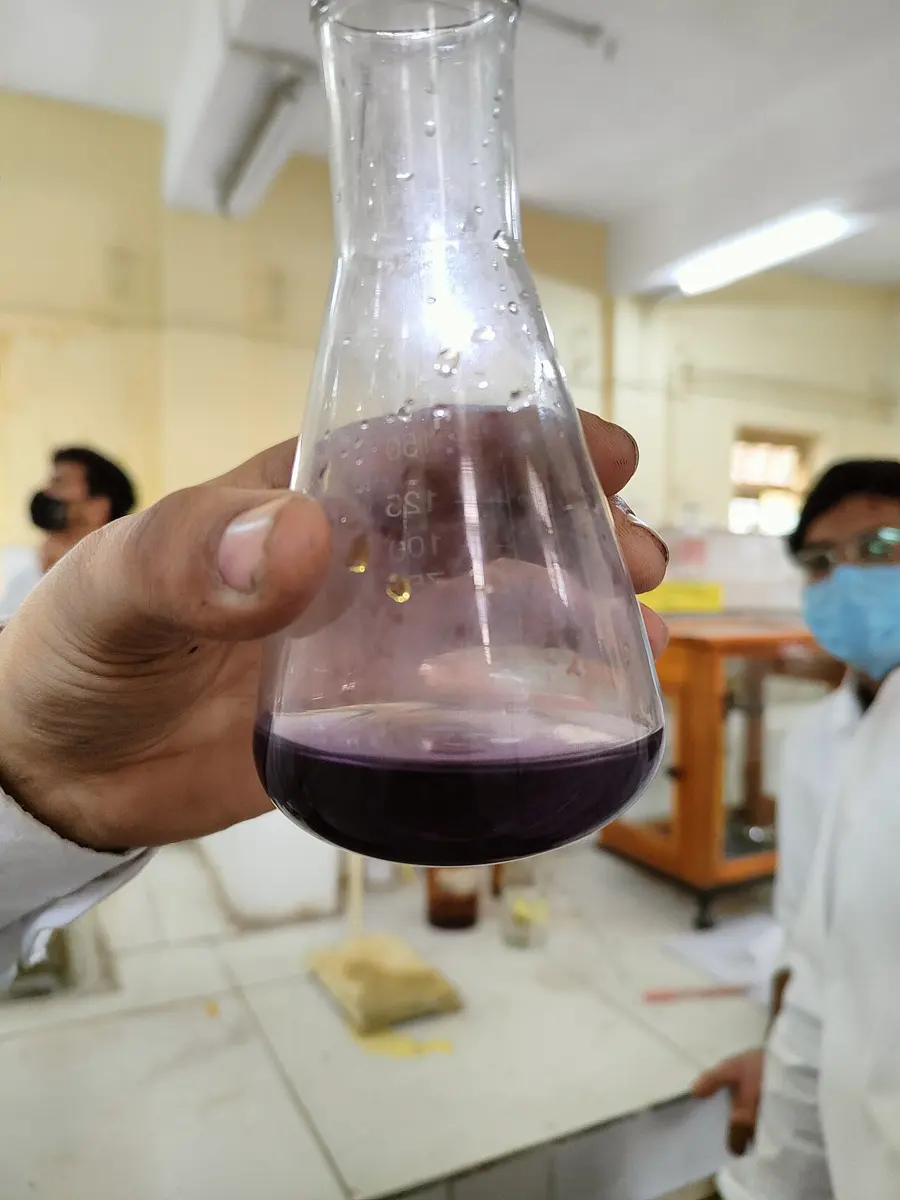
This reaction is the basis of a classic laboratory redox titration: purple potassium permanganate is run from a burette into a flask of acidified iron(II) solution. Each drop loses its color at once while iron(II) is left; the first drop that stays pink marks the end point, so permanganate is its own indicator.
When MnO₄⁻ is reduced to Mn²⁺ in acid, how many electrons does each MnO₄⁻ ion gain?
Pick an answer to see why.
6.4 Electrolysis
Nepal makes nearly all its electricity from rivers, and in the monsoon it has more than it can use. One way to store that energy is to use it to split water into hydrogen and oxygen, and burn the hydrogen later. Scientists at Kathmandu University’s hydrogen laboratory, working with partners in the UK and Switzerland, have been testing hydrogen as a cooking fuel in Nepal’s kitchens.
A battery drives electrons round a circuit; a redox reaction can push them. Electrolysis turns this round: an electric current from outside pushes a redox reaction that would not happen on its own.
Gold-plated jewelry is made the same way: a cheaper metal (often copper or brass) is the negative electrode in a solution of a gold salt, and a thin layer of gold is laid on it. This is electroplating: coating one metal with another by electrolysis. The metal statues and roofs of many temples and stupas in the Kathmandu Valley are gilded copper, and electroplating is how a modern workshop gilds a small piece.
Electrolytes
The liquid in a plating bath conducts electricity, and it does so by its ions moving. Such a liquid is an electrolyte:
An electrolyte is a compound that conducts electricity, by the movement of its ions, when it is molten or dissolved in water, and is decomposed by the current.
- Strong electrolytes are almost completely ionized in solution, so they conduct well: strong acids (HCl, H₂SO₄, HNO₃), strong bases (NaOH, KOH) and salts (NaCl, CuSO₄).
- Weak electrolytes are only slightly ionized, so they conduct poorly: weak acids such as acetic acid (CH₃COOH, in vinegar), and ammonia solution.
- Non-electrolytes dissolve as whole molecules, with no ions, and don’t conduct: solutions of cane sugar, glucose, glycerol (glycerin), ethanol (alcohol) and urea.
A solid ionic compound has ions too, but they are locked in their crystal and can’t move, so solid salt doesn’t conduct. Melting it or dissolving it sets the ions free.
Electrolysis and the electrolytic cell
Electrolysis is the decomposition of an electrolyte, molten or in solution, by passing an electric current through it: the current drives a chemical change at each electrode.
In electrolysis, electrical energy is used to bring about a chemical change that is not spontaneous. The arrangement in which it is done is an electrolytic cell (Figure 6.20):
- The electrodes are the solid conductors (metal or graphite rods or plates) dipped into the electrolyte, where the current enters and leaves it.
- The anode is the electrode joined to the positive terminal of the battery.
- The cathode is the electrode joined to the negative terminal.
Take a molten or dissolved electrolyte AB, which exists as A⁺ and B⁻ ions:
- The positive ions, cations (A⁺), are attracted to the negative cathode. There each gains an electron: reduction happens at the cathode.
- The negative ions, anions (B⁻), are attracted to the positive anode. There each loses its extra electron: oxidation happens at the anode.
The electrons taken from the anions at the anode go round the wire, through the battery, to the cathode. So electrons travel through the wires, and ions through the liquid. A reminder that works for every cell: An Ox, Red Cat: anode oxidation, reduction cathode.
In an electrolytic cell, which of these happens at the cathode?
Pick an answer to see why.
6.4.1 Qualitative aspects of electrolysis
What comes out at each electrode? That is the qualitative side of electrolysis.
Hydrogen is a promising clean fuel, and electrolysis of water is the way to make it with no carbon at all. (Most of the world’s hydrogen today is still made from natural gas, which gives off carbon dioxide.) Water itself is very slightly ionized:
The H⁺ ions move to the cathode and the OH⁻ ions to the anode:
For every 4 electrons, two molecules of hydrogen form and one of oxygen. Adding the two, and the 4 water molecules that made the 4 H⁺ and 4 OH⁻:
Which products you get depends on:
- a.the nature of the electrolyte: whether it is molten (only its own ions are there) or aqueous (water’s H⁺ and OH⁻ are there too, and compete), and for a solution, how concentrated it is;
- b.the nature of the electrodes: whether they are inert (platinum, graphite: they only carry the current) or active (a metal such as copper or silver, which can itself be oxidized at the anode).
A. Electrolysis of molten sodium chloride
Molten sodium chloride contains only Na⁺ and Cl⁻ ions, so there is no choice to make:
(The anode reaction happens in two steps, , then two chlorine atoms join, .) Multiplying the cathode reaction by 2 and adding:
This is how all the world’s sodium is made, in the Downs cell: molten sodium chloride, mixed with calcium chloride so that it melts at about 600 °C instead of 801 °C, between a graphite anode and a steel cathode, with a steel gauze between them. Liquid sodium floats up round the cathode and is drawn off; chlorine bubbles up from the anode.
B. Electrolysis of aqueous sodium chloride
A solution of sodium chloride has four kinds of ion: Na⁺ and Cl⁻ from the salt, and H⁺ and OH⁻ from water.
Two cations go to the cathode and two anions to the anode, and at each electrode the ion that needs the least energy to be discharged changes first. The voltage at which an ion is discharged at an electrode is its discharge potential (or deposition potential). Listed from the hardest to discharge to the easiest:
Cations: Li⁺ > K⁺ > Ca²⁺ > Na⁺ > Mg²⁺ > Al³⁺ > Zn²⁺ > Fe²⁺ > Ni²⁺ > H⁺ > Cu²⁺ > Hg²⁺ > Ag⁺ > Au³⁺
Anions: SO₄²⁻ > NO₃⁻ > OH⁻ > Cl⁻ > Br⁻ > I⁻
The cation list is the table of strengths in 6.1 read from the bottom: a metal that gives up electrons easily forms an ion that is hard to turn back into the metal.
- At the cathode, H⁺ is far easier to discharge than Na⁺, so hydrogen forms and sodium stays in solution as Na⁺. In a neutral solution the H⁺ comes from water itself, which is written:
- At the anode, in a concentrated solution, Cl⁻ is discharged before OH⁻, and chlorine forms:
So aqueous (concentrated) sodium chloride gives hydrogen at the cathode and chlorine at the anode, and the Na⁺ and OH⁻ left behind make the solution into sodium hydroxide:
This is the chlor-alkali industry, which makes the world’s chlorine and caustic soda from brine.
C. Electrolysis of copper(II) sulphate solution
Copper(II) sulphate solution contains Cu²⁺ and SO₄²⁻ from the salt, and H⁺ and OH⁻ from water:
At the cathode the electrodes don’t matter. Cu²⁺ is easier to discharge than H⁺, so copper is deposited:
At the anode the electrodes decide:
| With inert electrodes (platinum or graphite) | With copper electrodes (active) |
|---|---|
| OH⁻ is easier to discharge than SO₄²⁻, so OH⁻ is oxidized and oxygen is given off: | The copper anode itself gives up electrons more easily than either OH⁻ or SO₄²⁻, so the anode dissolves: |
| Products: copper at the cathode, oxygen at the anode | Products: copper at the cathode; copper lost from the anode |
| Cu²⁺ is used up, so the blue color fades; H⁺ is left, so the solution turns acidic (sulphuric acid) | Copper goes into solution at the anode as fast as it comes out at the cathode, so the blue stays the same |
| The anode gets thinner and the cathode thicker |
Copper electrodes simply carry copper from the anode to the cathode. That is how copper is purified (electrorefining): a lump of impure copper is the anode, a thin sheet of pure copper the cathode, and the impurities either stay in solution or drop under the anode as “anode mud”, from which silver and gold are recovered.
Products of electrolysis: a summary
| Electrolyte | Electrodes | At the anode (+) | At the cathode (−) |
|---|---|---|---|
| NaCl, molten | Pt or graphite | ||
| NaCl, aqueous (concentrated) | Pt or graphite | ||
| NaOH, molten | Pt or graphite | ||
| NaOH, aqueous | Pt or graphite | ||
| CuSO₄, aqueous | Pt or graphite | ||
| CuSO₄, aqueous | copper | ||
| H₂SO₄, concentrated | Pt | (peroxodisulphuric acid) | |
| H₂SO₄, dilute | Pt or graphite | ||
| AgNO₃, aqueous | Pt or graphite | ||
| AgNO₃, aqueous | silver |
6.4.2 Quantitative aspects of electrolysis
Michael Faraday found the rules for “how much” in 1833–34, by measuring the gases and metals produced by known currents for known times. He also gave us, with the help of the Cambridge scholar William Whewell, the words: electrolysis, electrolyte, electrode, anode, cathode, ion, anion, cation. The more current, or the longer it flows, the more substance forms at the electrodes.

Faraday’s first law of electrolysis
The mass of a substance deposited or liberated at an electrode is directly proportional to the quantity of electricity (charge) passed through the electrolyte.
If a charge deposits a mass :
where is the current in amperes (A), the time in seconds (s), and a constant for each substance, its electrochemical equivalent. Putting C gives :
The electrochemical equivalent (Z) of a substance is the mass of it deposited or liberated by 1 coulomb of charge. Its SI unit is kg/C (often given in g/C). For copper, Z = 3.29 × 10⁻⁴ g/C: one coulomb deposits a third of a milligram.
The faraday
A coulomb is a small amount of charge. Chemists count in moles of electrons instead.
One faraday (1 F) is the charge carried by one mole of electrons:
which is rounded to 96,500 C in most calculations. This number, F, is the Faraday constant.
A half-equation now tells you how many faradays a mole of product needs. For a metal ion with charge n+:
So the method for any problem is: charge (C) → moles of electrons (÷ F) → moles of product (from the half-equation) → mass or volume.
Faraday’s second law of electrolysis
In a series circuit the same charge passes through every cell. The same number of electrons arrives at each cathode, but they make different masses of product:
- 1 mol of electrons makes 1 g of hydrogen (½ mol of H₂, ),
- 31.75 g of copper (½ mol of Cu, ),
- 108 g of silver (1 mol of Ag, ).
These are the substances’ equivalent masses (equivalent weights, or chemical equivalents): the mass deposited by one mole of electrons. For an element,
So the masses deposited by the same charge are proportional to the equivalent masses:
Faraday’s second law: when the same quantity of electricity is passed through different electrolytes connected in series, the masses of the substances produced at the electrodes are proportional to their chemical equivalents (equivalent masses).
Linking Z, E and F
The electrochemical equivalent Z is the mass deposited by 1 C, and the equivalent mass E is the mass deposited by 1 mol of electrons, 1 F (96,500 C). So
and the first law, , becomes the one formula for every problem:
The same charge is passed through silver nitrate and copper(II) sulphate solutions in series. If 0.1 mol of silver is deposited, how much copper is deposited?
Pick an answer to see why.
Exercise
A. Multiple choice questions
- Which of the following statements is true about oxidation?
Pick an answer to see why.
- Which substance undergoes reduction in a redox reaction?
Pick an answer to see why.
- In the redox reaction , how many electrons are transferred from the reducing agent to the oxidizing agent?
Pick an answer to see why.
- Water is decomposed by electrolysis into hydrogen and oxygen. According to Faraday’s laws, if 1 mol of oxygen is liberated, how many moles of hydrogen are liberated?
Pick an answer to see why.
- Which of the following is a disproportionation reaction?
Pick an answer to see why.
- Aluminium is made by electrolysis of molten aluminium oxide (Al₂O₃). How much electricity is needed to deposit 108 g of aluminium? (Al = 27)
Pick an answer to see why.
- Which is true of the reduction of 2 mol of permanganate ions (MnO₄⁻) to Mn²⁺ in acidic solution?
Pick an answer to see why.
- The reactions at the anode and the cathode of a cell are (anode) and (cathode). Which is the overall redox reaction?
Pick an answer to see why.
- In the electrolysis of copper(II) chloride, CuCl₂, a current of 2.0 A flows for 30 minutes. What mass of copper is deposited on the cathode? (Cu = 63.5, F = 96,500 C/mol)
Pick an answer to see why.
- What are the products of electrolysis of a concentrated aqueous solution of KCl with platinum electrodes?
Pick an answer to see why.
- In the reaction , which statement is true?
Pick an answer to see why.
- In the cells in series of Figure 6.24, the same current flows for 10 minutes. Which substance collected at the cathodes has the greatest mass?
Pick an answer to see why.
B. Short answer questions
Define each of the following, with one example:
- a.oxidation in the electronic concept
- b.reduction in the electronic concept
- c.redox reaction
- d.oxidation in terms of oxidation number
- e.oxidizing agent and reducing agent
Answer
Differentiate between:
- a.an oxidizing agent and a reducing agent
- b.oxidation and reduction
- c.electrochemical equivalent and chemical equivalent
- d.Faraday’s first law and second law of electrolysis
Answer
State and explain:
- a.electrolysis
- b.Faraday’s first law of electrolysis
- c.Faraday’s second law of electrolysis
- d.oxidation number
Answer
Give a reason, with a suitable chemical equation:
- a.The combustion of ethane is a redox reaction.
- b.Oxidation and reduction occur together.
- c.An oxidizing agent is itself reduced.
Answer
A lead–acid battery (lead storage battery) undergoes a redox reaction when it discharges and when it is recharged. The basic reaction during discharge is:
- a.Write the oxidation numbers of lead in the reaction.
- b.Write the oxidation half and the reduction half of the reaction.
- c.Balance each half and find the balanced redox reaction.
- d.What happens to this reaction when the battery is recharged?
Answer
Assign oxidation numbers to the underlined atoms: NaCl, ClO₂, Fe₂(SO₄)₃, SO₂, I₂, KMnO₄, CaH₂, PO₄³⁻.
Answer
Define oxidation number, and find the oxidation number of nitrogen in NF₃, N₂O, N₂H₄, NO, N₂O₄, NO₂⁻ and Ba₃N₂.
Answer
Chlorine and its compounds are used as oxidizing agents. Some compounds of chlorine are Cl₂O, HClO₃, HCl and ClF₃.
- a.Define oxidizing agent.
- b.Find the oxidation number of chlorine in each compound.
- c.Using oxidation numbers, which one is the strongest oxidizing agent, and why?
Answer
The redox reaction in the zinc–carbon dry cell is:
- a.Assign oxidation numbers to each atom, and show that this is a redox reaction.
- b.Name the oxidizing and the reducing agents, from the changes in oxidation number.
Answer
What is a redox reaction? For the reaction :
- a.how can you show that it is a redox reaction?
- b.balance it by the oxidation number method.
Answer
Balance each redox reaction by the oxidation number method, and name the oxidizing agent and the reducing agent.
- a.
- b.
- c.
- d.
- e.
- f.
- g.
- h.
- i.
- j.
- k.
- l.
- m.
- n.
- o.
- p.
- q. (in acidic solution)
- r. (in acidic solution)
- s. (in acidic solution)
- t. (in basic solution)
Hint
Answer
The redox reaction between the chlorate ion and the nitride ion is
- a.Write its oxidation half and reduction half.
- b.Balance each half (in acidic solution).
- c.Write the balanced redox reaction.
Answer
Balance each reaction by the ion-electron method, and name the oxidant and the reductant.
- a. (in acidic solution)
- b. (in acidic solution)
- c.
- d. (in basic solution)
- e. (in acidic solution)
- f.
- g. (in basic solution)
- h.
- i.
- j.
- k.
- l.
- m. (in basic solution)
- n. (in basic solution)
- o. (in basic solution)
- p. (in basic solution)
- q. (in acidic solution)
- r. (in acidic solution)
- s. (in acidic solution)
Hint
Answer
C. Long answer questions
In an electrolysis experiment, a steady current was passed for five hours through two cells in series. The mass of gold deposited in the cell containing AuCl₃ solution was 9.85 g. (Au = 197)
- a.State Faraday’s first law of electrolysis.
- b.Find the current passed.
- c.Calculate the mass of copper deposited in the next cell, which contains copper(II) sulphate solution. (Cu = 63.5)
- d.Give some applications of electrolysis.
Answer
10 g of silver is to be deposited on the surface of a copper object by electrolysis.
- a.Which is the anode and which the cathode?
- b.Write the reaction at each electrode.
- c.Find the time needed if the current is 2 × 10⁻³ A. (Ag = 108)
- d.Name an electrolyte that can be used.
Answer
A silver nitrate cell and a copper(II) sulphate cell are connected in series, as in Figure 6.25, to show Faraday’s second law.
- a.State the second law of electrolysis.
- b.Write the reaction at the cathode of each cell.
- c.Calculate the mass of silver deposited at the cathode if 9650 C of charge passes through the circuit. (Ag = 108)
- d.Balance the redox reaction by the oxidation number or ion-electron method.
Answer
A copper wire is dipped into silver nitrate solution, and the color of the wire changes.
- a.Write the reaction between copper and silver nitrate.
- b.Assign oxidation numbers to each atom, and name the oxidant and the reductant.
- c.Balance the equation by the oxidation number method.
- d.What is this type of reaction used for?
Answer
Electroplating is one of the uses of electrolysis. In Figure 6.26, an iron spoon is being plated with silver in silver nitrate solution with a silver anode.
- a.Define electrolysis and electroplating.
- b.Write the reactions at the anode and the cathode.
- c.What happens to the products if the silver anode is replaced by platinum?
- d.Find the mass of silver deposited on the spoon if a current of 2 A flows for half an hour. (Ag = 107.9)
- e.Does the amount of silver nitrate in the solution change? Why?
Answer
The reaction of chlorine with hot, concentrated sodium hydroxide (caustic soda) solution is a disproportionation, or auto-redox, reaction:
- a.What is a redox reaction?
- b.Assign oxidation numbers to the chlorine atoms in the reactants and products.
- c.Why is this reaction called an auto-redox reaction?
- d.Name the reductant and the oxidant.
- e.Balance the equation by the oxidation number method.
Answer
Molten sodium chloride is electrolyzed with platinum electrodes in the cell of Figure 6.22, with a current of 5 A.
- a.Define electrolysis.
- b.Write the balanced redox reaction for the cell.
- c.Find the mass of sodium and the volume of chlorine at STP produced at the electrodes when the cell runs for 1 hour. (Na = 23)
- d.How do the products change if water is added to the electrolyte?
- e.Give one use of this process.
Answer
Project work
Printable PDFs
- Study notes 3 pages
- Worksheet 5 pages Answer key
Quiz yourself: Matter, Atoms and Reactions, Grades 5–12 →
Practice every question in the book, and keep track of the ones you miss →
A companion to your textbook, not a replacement for it: study from the book your school uses, and where the two differ, follow your teacher. Found a mistake? Please tell us.