
Hold a brick in one hand and a pillow in the other. The pillow is bigger, but the brick pulls your hand down much harder. Drop the brick into a bucket of water and it sinks, but a block of wood the same size floats. Why? And what are the brick, the pillow, the water and the air around them all made of?
In this unit you will measure how tightly matter is packed (its density), find out why some things float and others sink, look inside the tiny atoms that everything is built from, and learn to tell a change you can undo, like melting ice, from one you can’t, like burning wood.
What matter is
Look around you: air, water, soil, stones, wood, your own body. Do all of them take up space? Do they all have mass? And could you catch light or sound in a box, the way you catch air in a balloon or a football?
Anything that has mass and occupies space (has volume) is called matter. Air, water, soil, stone and wood are all matter, in one of three states: solid, liquid or gas (Figure 9.1).
Light, heat, sound and shadows are not matter. They have no mass and take up no space. Light, heat and sound are forms of energy; a shadow is only a place where light doesn’t reach. You can catch air in a balloon, but you can’t fill a box with light and weigh it.
Some substances have a lot of mass in a small space: a small lump of iron, gold or mercury is surprisingly heavy. Others have little mass even though they take up a lot of space: paper, plastic foam, cotton wool. The difference is in how closely their particles are packed and how heavy each particle is.
Which of these is not matter?
Pick an answer to see why.
9.1 Density of matter
At normal temperature, substances are found as solids, liquids or gases. The particles are packed less closely in a liquid than in a solid, and much less closely in a gas than in a liquid. So equal volumes of different substances don’t have equal masses: the particles are packed more or less closely, and some particles are heavier than others. How much mass is packed into each bit of space is called density.
Mass per unit volume of a substance is called its density: the mass of 1 cm³ (or of 1 m³) of it.
- If mass is measured in kilograms (kg) and volume in cubic meters (m³), density is in kilograms per cubic meter (kg/m³). This is the SI unit of density.
- If mass is measured in grams (g) and volume in cubic centimeters (cm³), density is in grams per cubic centimeter (g/cm³). This is the CGS unit of density.
To change g/cm³ into kg/m³, multiply by 1000. Water has a density of 1 g/cm³, which is 1000 kg/m³.
Numerical problems
The same three steps work for every problem: write down what is given (with units), write the formula, then put in the numbers.
Relative density
To compare how dense a substance is, scientists compare it with water at 4 °C, whose density is 1 g/cm³ (1000 kg/m³). (Water is densest at 4 °C, so that temperature is chosen.)
The ratio of the density of a substance to the density of water at 4 °C is called the relative density of the substance. It tells you how many times heavier the substance is than the same volume of water.
Relative density has no unit: it is one density divided by another, so the units cancel. In g/cm³, the relative density is simply the same number as the density, because water’s density is 1 g/cm³.
| S.N. | Substance | Density (kg/m³) | Density (g/cm³) | Relative density |
|---|---|---|---|---|
| 1. | ice | 920 | 0.92 | 0.92 |
| 2. | aluminium | 2700 | 2.7 | 2.7 |
| 3. | iron | 7800 | 7.8 | 7.8 |
| 4. | kerosene | 800 | 0.8 | 0.8 |
| 5. | mercury | 13 600 | 13.6 | 13.6 |
| 6. | gold | 19 300 | 19.3 | 19.3 |
Floating and sinking
The rule is simple:
- If its relative density is more than 1 (denser than water), a substance sinks in water.
- If its relative density is less than 1 (less dense than water), it floats.
The same rule works in any liquid: a substance sinks in a liquid if it is denser than the liquid, and floats if it is less dense than the liquid.
Why? An object in a liquid pushes some liquid out of the way, and the liquid pushes back up on it. A floating object sinks only until the liquid it has pushed aside weighs as much as the object itself. The less dense the object, the less of it needs to be under the surface. An object denser than the liquid can’t push aside enough, even when it is completely under, so it sinks.
A piece of candle wax (relative density 0.9) is dropped into kerosene (relative density 0.8). What happens?
Pick an answer to see why.
9.2 Element and compound
Element
Break a piece of copper into smaller and smaller bits by any means you like, and every bit is still copper, with all the properties of copper. Copper can’t be split by any chemical process into anything simpler. Substances like this are called elements.
An element is a pure substance that can’t be broken down into simpler substances by any chemical process. Iron, gold, silver, copper, oxygen, hydrogen and sulphur are elements.
Scientists know 118 elements. About 92 of them are found in nature (the elements up to uranium); the rest have been made in laboratories, a few atoms at a time.
Elements are found in all three states. At normal temperature:
- solid: iron, gold, silver, copper, carbon, sulphur, and most others;
- liquid: only mercury and bromine;
- gas: hydrogen, oxygen, nitrogen, chlorine, and the noble gases such as helium, neon and argon.
Figure 9.3 sorts matter into these groups. A mixture is made of two or more substances mixed together without joining chemically. Each keeps its own properties, and they can be mixed in any amounts: salt water can be a little salty or very salty. A mixture that is the same all through, like salt water, air or sharbat, is homogeneous; one in which the parts can be seen, like sand in water or muddy water, is heterogeneous.
Atom
If an element is broken down further and further, in the end we reach the smallest particles of all. These smallest particles are called atoms.
An atom is the smallest particle of an element that can take part in a chemical reaction. When iron reacts with another substance, it is iron atoms that take part.
All the atoms of one element are alike, and different from the atoms of every other element: an oxygen atom is different from a hydrogen atom. Since there are 118 elements, there are 118 kinds of atoms. Every substance in the universe, from your fingernail to the Sun, is made of these 118 kinds, in different combinations.
Structure of an atom
Small as it is, an atom is made of even smaller parts, called sub-atomic particles: electrons, protons and neutrons.
An atom has two parts:
- the nucleus, the tiny center of the atom, where the protons and neutrons are;
- the shells (also called orbits) round the nucleus, where the electrons move.
Proton
A proton is a positively charged (+) sub-atomic particle, found in the nucleus. Its mass is almost exactly the mass of one hydrogen atom, and is taken as 1 atomic mass unit (amu).
Neutron
A neutron has no charge: it is neutral. It is also found in the nucleus. Its mass is almost the same as a proton’s, so it too has a mass of about 1 amu.
Electron
An electron is a negatively charged (−) particle. It moves round the nucleus in a fixed path called a shell or orbit. Its mass is tiny compared with a proton’s or a neutron’s: about 1/1837 of the mass of a hydrogen atom (1/1836 of a proton’s), so small that it is usually ignored.
| Sub-atomic particle | Symbol | Mass | Charge | Where it is |
|---|---|---|---|---|
| proton | p⁺ | 1 amu | positive (+) | nucleus |
| electron | e⁻ | 1/1837 amu | negative (−) | shells |
| neutron | n⁰ | 1 amu | none (0) | nucleus |
An atom has as many electrons as protons. The positive charges of the protons and the negative charges of the electrons cancel, so an atom as a whole has no charge: it is electrically neutral.
Which two particles are found in the nucleus of an atom?
Pick an answer to see why.
Symbols of elements
Each element has a symbol: one capital letter, or a capital letter followed by a small one. Usually it comes from the element’s English name (H for hydrogen, Ca for calcium), but a few come from the old Latin names: Na from natrium (sodium) and K from kalium (potassium).
| S.N. | Element | Symbol | Protons | Electrons | Neutrons |
|---|---|---|---|---|---|
| 1. | hydrogen | H | 1 | 1 | 0 |
| 2. | helium | He | 2 | 2 | 2 |
| 3. | lithium | Li | 3 | 3 | 4 |
| 4. | beryllium | Be | 4 | 4 | 5 |
| 5. | boron | B | 5 | 5 | 6 |
| 6. | carbon | C | 6 | 6 | 6 |
| 7. | nitrogen | N | 7 | 7 | 7 |
| 8. | oxygen | O | 8 | 8 | 8 |
| 9. | fluorine | F | 9 | 9 | 10 |
| 10. | neon | Ne | 10 | 10 | 10 |
| 11. | sodium (natrium) | Na | 11 | 11 | 12 |
| 12. | magnesium | Mg | 12 | 12 | 12 |
| 13. | aluminium | Al | 13 | 13 | 14 |
| 14. | silicon | Si | 14 | 14 | 14 |
| 15. | phosphorus | P | 15 | 15 | 16 |
| 16. | sulphur | S | 16 | 16 | 16 |
| 17. | chlorine | Cl | 17 | 17 | 18 |
| 18. | argon | Ar | 18 | 18 | 22 |
| 19. | potassium (kalium) | K | 19 | 19 | 20 |
| 20. | calcium | Ca | 20 | 20 | 20 |
The neutron numbers are for each element’s most common kind of atom.
Two numbers describe an atom:
The atomic number is the number of protons in the nucleus; in a neutral atom it is also the number of electrons. Every element has its own atomic number: every atom with 8 protons is oxygen. The atomic mass (more exactly called the mass number) adds up the particles in the nucleus, since the electrons weigh almost nothing.
Molecule
Atoms usually don’t stay alone: they join together in small groups. A group of two or more atoms joined together is called a molecule. Water, air, sugar and much of the matter around you are made of molecules.
- The molecules of an element are made of atoms of one kind: a hydrogen molecule (H₂) is two hydrogen atoms; an oxygen molecule (O₂) is two oxygen atoms; nitrogen (N₂) and chlorine (Cl₂) are the same.
- The molecules of a compound are made of atoms of different kinds: a water molecule (H₂O) is one oxygen atom joined to two hydrogen atoms; a hydrogen chloride molecule (HCl) is one hydrogen atom and one chlorine atom.
A molecule has all the properties of its substance. A spoonful of sugar tastes sweet, and so does each molecule of sugar. Split a sugar molecule into its atoms (carbon, hydrogen and oxygen), and they are not sweet at all. So:
A molecule is the smallest particle of an element or a compound that has all the properties of that substance.
The molecule of an element is made of the same kind of atoms (two oxygen atoms make an oxygen molecule). The molecule of a compound is made of two or more different kinds of atoms (one oxygen atom and two hydrogen atoms make a water molecule). In nature, elements join to form compounds, and compounds break down into new substances. That is how matter changes.
Compound
When atoms of two or more elements react together, a new substance is formed: this is called a chemical reaction. A compound is the substance formed when two or more elements combine chemically, in a fixed ratio by number of atoms. Water is formed from hydrogen and oxygen, always two hydrogen atoms to one oxygen atom. Common salt is formed from sodium and chlorine, always one to one. Water (H₂O) and common salt (sodium chloride, NaCl) are compounds.
A compound is a new substance with new properties, often nothing like the elements it is made from. Sodium is a soft metal that reacts violently with water, and chlorine is a poisonous yellow-green gas, yet together they make the salt you sprinkle on your food.
How is a compound different from a mixture?
Pick an answer to see why.
9.3 Change in matter
Matter changes all the time, because of heat, light, pressure, electricity and so on. In some changes only the state, shape, size or color changes; in others the substance itself changes into a new one with new properties. So there are two kinds of change: physical change and chemical change.
Physical change
A change in which the color, volume, shape, size, state or density of matter changes, but not its chemical nature, is called a physical change. No new substance is formed.
Physical changes are all around us: a big lump of salt is crushed into fine powder; ice or snow melts into water; water freezes into ice; a log is chopped into firewood; spices are ground into powder; salt dissolves in water to make salt water.
Make a list of other physical changes in your daily life and present it in class.
Characteristics of physical changes
- a.The state, shape or size of the matter may change, but its chemical nature stays the same.
- b.No new substance is formed.
- c.The change can usually be reversed.
- d.It is a temporary change.
- e.The mass of the matter doesn’t change.
- f.Physical changes are brought about by heat, light, pressure, electricity and so on.
- g.The molecules themselves don’t change.
Chemical change
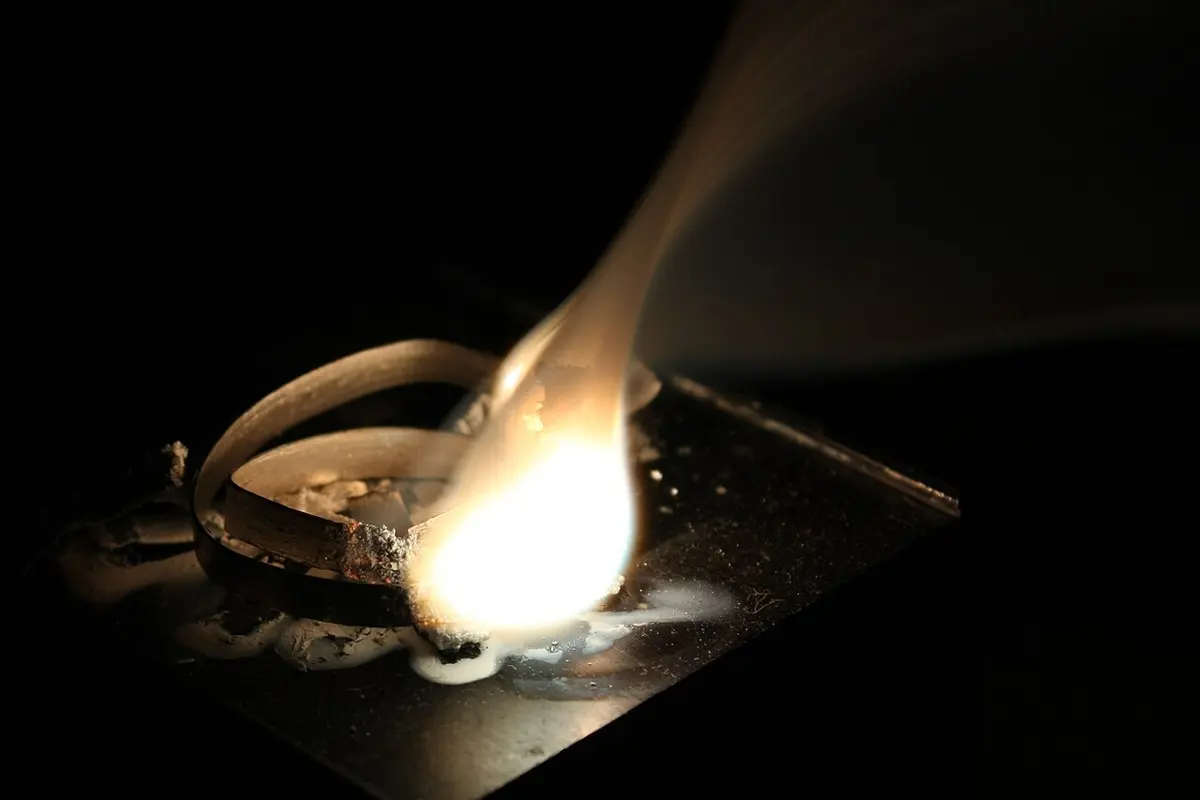
A change in which a substance turns into a new substance with new properties is called a chemical change. In it, the molecules themselves change: their atoms separate and join up in new ways.
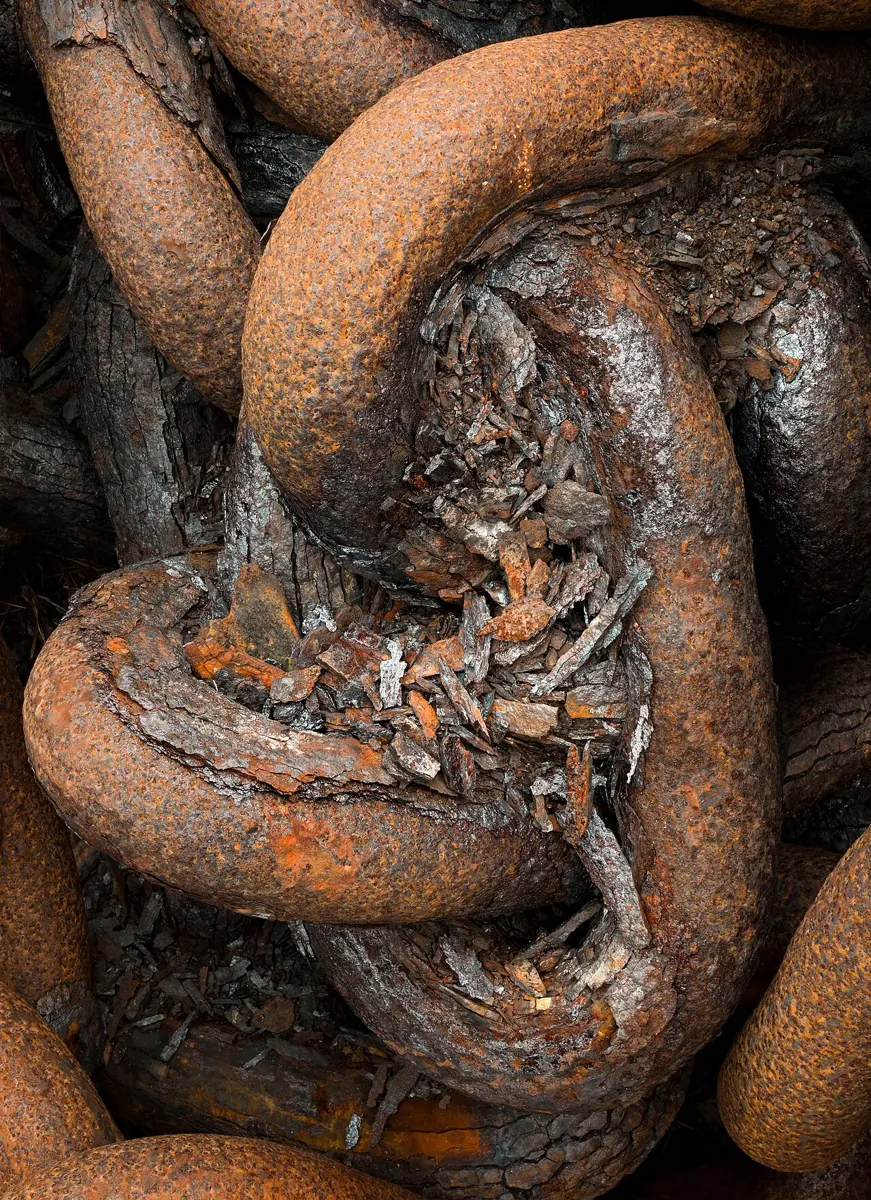
Burning magnesium into magnesium oxide is a chemical change: the magnesium reacts with oxygen in the air. Other chemical changes: iron rusting, fruit rotting, food being digested and used (“burnt”) in our bodies, photosynthesis in leaves, wood burning, waste turning into compost, and hydrogen and oxygen joining to form water.
Make a list of other chemical changes in your daily life and present it in class.
Characteristics of chemical changes
- a.New substances with different properties are formed.
- b.It is a permanent change: the new substance can’t easily be turned back into the original one.
- c.The molecules themselves change: their atoms are rearranged.
- d.Some chemical changes give out heat, and some take in heat.
Signs that a chemical change has happened: a new color, a gas given off (bubbles or a smell), heat or light given out, or a solid appearing.
Comparing physical and chemical changes
| Physical change | Chemical change |
|---|---|
| 1.The state, shape or size may change; the substance stays the same. | 1.The substance changes: its properties change, and its state may too. |
| 2.The change can usually be reversed. | 2.The change can’t usually be reversed. |
| 3.No new substance is formed. | 3.A new substance is formed. |
| 4.It is a temporary change. | 4.It is a permanent change. |
| 5.The molecules don’t change. | 5.The molecules change: atoms join up in new ways. |
| 6.Example: ice melting. | 6.Example: wood burning. |
Which of these is a chemical change?
Pick an answer to see why.
Exercise
1. Fill in the blanks with suitable words from the box
1/1837 · Na · volume · chemical · less · K · more · sinking
The density of a substance depends on its mass and __________.
Answer
volume (density = mass ÷ volume)
A substance which has __________ density than water floats in water.
Answer
less
A __________ body has more density than water.
Answer
sinking
The mass of an electron is __________ amu.
Answer
1/1837
Potassium is represented by the symbol __________.
Answer
K (from its Latin name, kalium)
Rusting of iron is a __________ change.
Answer
chemical
2. Match the following
Match each atom with its atomic number.
| Name of atom | Atomic number |
|---|---|
| potassium | 8 |
| helium | 16 |
| boron | 19 |
| sulphur | 20 |
| silicon | 5 |
| oxygen | 14 |
| 2 |
Answer
| Name of atom | Atomic number |
|---|---|
| potassium | 19 |
| helium | 2 |
| boron | 5 |
| sulphur | 16 |
| silicon | 14 |
| oxygen | 8 |
(20, calcium’s atomic number, is left over.)
3. Choose the best answer
a. What is the density of water?
Pick an answer to see why.
b. Which is the correct formula for density?
Pick an answer to see why.
c. Which sub-atomic particle is positively charged?
Pick an answer to see why.
d. Which of the following best defines a molecule?
Pick an answer to see why.
e. Which group shows only physical changes?
Pick an answer to see why.
f. Which of the following is true for an element?
Pick an answer to see why.
g. Which statement is true for a compound?
Pick an answer to see why.
h. Which of the following is true for potassium?
Pick an answer to see why.
4. Differentiate between
Chemical change and physical change
Answer
| Chemical change | Physical change |
|---|---|
| A new substance with new properties is formed. | No new substance is formed. |
| It is permanent: it can’t usually be reversed. | It is temporary: it can usually be reversed. |
| The molecules change. | The molecules stay the same. |
| Example: burning wood, rusting. | Example: melting ice, dissolving salt. |
Element and compound
Answer
| Element | Compound |
|---|---|
| A pure substance that can’t be broken down into simpler substances by a chemical process. | A pure substance formed by two or more elements combined chemically. |
| Made of only one kind of atom. | Made of two or more kinds of atoms, in a fixed ratio. |
| Example: oxygen, iron, copper. | Example: water, common salt. |
Density and relative density
Answer
| Density | Relative density |
|---|---|
| Mass per unit volume of a substance. | The density of a substance divided by the density of water at 4 °C. |
| D = m ÷ V | RD = density of substance ÷ density of water at 4 °C |
| Has a unit: kg/m³ (SI) or g/cm³ (CGS). | Has no unit: it is a ratio. |
| Example: iron, 7800 kg/m³. | Example: iron, 7.8. |
5. Give reasons
An egg sinks in pure water but floats in salty water.
Answer
An egg is a little denser than pure water, so it sinks. Dissolving a lot of salt makes the water denser, until it is denser than the egg; then the egg floats. An object floats in a liquid that is denser than itself.
An atom is electrically neutral.
Answer
An atom has the same number of protons (positive) and electrons (negative). Their charges are equal and opposite, so they cancel, and the atom as a whole has no charge.
Breaking a lump of salt into fine powder is a physical change.
Answer
The powder is still salt, with the same taste and properties: only the size of the pieces has changed, and no new substance is formed. A change in which no new substance is formed is a physical change.
Forming water from hydrogen and oxygen is a chemical change.
Answer
Hydrogen and oxygen are gases; the water formed from them is a new substance, a liquid with completely different properties. The atoms join in a new way (two hydrogen atoms to one oxygen atom). A change that forms a new substance is a chemical change.
An iron frame must be painted regularly, but an aluminium frame needs no paint.
Answer
Iron rusts when air and moisture reach it, and rust slowly eats the frame away, so it is kept painted. Aluminium also reacts with air, but it at once forms a very thin, tough, invisible layer of aluminium oxide that sticks to the metal and stops any further reaction. So aluminium protects itself.
6. Answer the following questions
Draw the structure of an atom, showing protons, electrons and neutrons.
Answer
Draw a small circle in the middle for the nucleus, with protons (marked +) and neutrons inside it. Draw one or more circles round it for the shells, with electrons (marked −) on them. Label each part, as in Figure 9.4: helium has 2 protons and 2 neutrons in the nucleus and 2 electrons in the shell.
What is density? What is the mass of aluminium of volume 2 m³? (The density of aluminium is 2700 kg/m³.)
Answer
Density is the mass per unit volume of a substance.
Given: V = 2 m³, D = 2700 kg/m³, m = ?
The mass of the aluminium is 5400 kg.
What is relative density? If the densities of pure milk and of water at 4 °C are 1030 kg/m³ and 1000 kg/m³, what is the relative density of pure milk?
Answer
Relative density is the ratio of the density of a substance to the density of water at 4 °C.
The relative density of pure milk is 1.03.
Balls of cork, wood and aluminium of the same size are put into water, as in Figure 9.12.
- i.Why does cork float in water, but aluminium sink?
- ii.If the density of aluminium is 2.7 g/cm³, find its relative density.
Answer
i. Cork (density about 0.24 g/cm³) is less dense than water (1 g/cm³), so it floats, mostly above the surface. Aluminium (2.7 g/cm³) is denser than water, so it sinks. (Wood, about 0.7 g/cm³, floats too, but lower in the water than cork, because it is denser than cork.)
ii.
The relative density of an object is 0.92. Does it sink or float in water? Explain why.
Answer
It floats. A relative density of 0.92 means the object is less dense than water (0.92 is less than 1): the same volume of it weighs only 0.92 times as much as water. Anything less dense than water floats. (Ice has exactly this relative density, and floats with about 92 % of it under the surface.)
What is an element? Write the names and symbols of the elements with atomic numbers 7, 13 and 17.
Answer
An element is a pure substance that can’t be broken down into simpler substances by any chemical process.
- 7: nitrogen, N
- 13: aluminium, Al
- 17: chlorine, Cl
Using Figure 9.13, describe how elements, molecules, compounds and mixtures are related.
Answer
- An element is made of one kind of atom (H, O, Cl).
- Atoms join to form molecules. Two atoms of the same element make a molecule of that element (H₂, O₂, Cl₂).
- When atoms of different elements join chemically, in a fixed ratio, they make molecules of a compound (H₂O, HCl), a new substance.
- When molecules of different substances are only mixed together, not joined, they make a mixture: here hydrogen, oxygen and water molecules, each keeping its own properties.
Which atoms are there in a molecule of water? How many of each?
Answer
A water molecule (H₂O) has two hydrogen atoms and one oxygen atom.
What are sub-atomic particles? Draw an atom and label its sub-atomic particles.
Answer
Sub-atomic particles are the particles an atom is made of: protons (positive, in the nucleus), neutrons (no charge, in the nucleus) and electrons (negative, moving round the nucleus in shells). Draw them as in Figure 9.4, labeling the nucleus, a proton, a neutron, an electron and a shell.
Name the state of each kind of matter in Figure 9.14 from how closely its particles are packed.
Answer
- Matter A is a gas: its particles are few and far apart.
- Matter B is a liquid: its particles are close together but jumbled, free to slide past each other.
- Matter C is a solid: its particles are packed tightly in a regular pattern.
What kind of change is called a physical change? Give examples.
Answer
A change in which the state, shape, size or color of a substance changes, but no new substance is formed, is a physical change. Examples: ice melting, water boiling, salt dissolving in water, wood being chopped, spices being ground.
What is a chemical change? Give any three examples from daily life.
Answer
A change in which a substance turns into a new substance with new properties is a chemical change. Examples: cooking rice, iron rusting, milk turning into curd (also: wood burning, fruit rotting, food being digested).
Sort these into physical and chemical changes:
- i.evaporation of water
- ii.boiling an egg
- iii.condensation of vapor
- iv.burning fossil fuels
- v.dissolving sugar in water
Answer
| Physical change | Chemical change |
|---|---|
| i.evaporation of water | ii.boiling an egg |
| iii.condensation of vapor | iv.burning fossil fuels |
| v.dissolving sugar in water |
(Boiling an egg changes its proteins for good: the clear white turns solid and white, and nothing turns it back.)
Which element has atomic number 18? Make a model of its atom.
Answer
Argon (Ar). An argon atom has 18 protons and (in its most common kind) 22 neutrons in the nucleus, and 18 electrons: 2 in the first shell, 8 in the second and 8 in the third. Make the model as in the project above.
Practice every question in the book, and keep track of the ones you miss →