
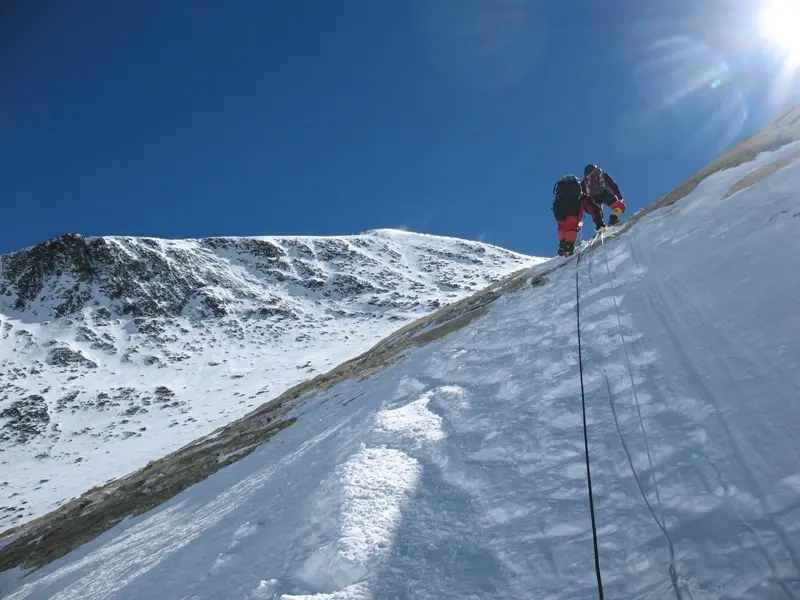
The highest rock on Earth, the top of Sagarmatha, Mount Everest, 8,848.86 m above the sea, is limestone. Swiss climbers in 1956 and an American team in 1963 carried small pieces of it down, and the Swiss geologist Augusto Gansser found broken bits of sea lilies in both, animals related to starfish that lived on the floor of a shallow, warm sea. The summit of the world was once a sea floor, more than 440 million years ago.
A little lower, climbers cross a pale brownish stripe in the rock that they call the Yellow Band. It is marble: limestone that was buried, heated and squeezed until it changed. Lower still, the mountain is made of banded rocks called schist and gneiss, threaded with pale granite, rock that was molten only about 20 million years ago. So one mountain holds all three kinds of rock you met in Grade 7, and each of them was once something else. How does one rock become another? And what keeps the changes going? This topic is about the rock cycle, the never-ending journey of Earth’s materials, and the two sources of energy that drive it.
Three kinds of rock
In Grade 7 you sorted rocks into three kinds, by how they form. Here they are again, with rocks you can find in Nepal:
| Kind | How it forms | Examples | In Nepal |
|---|---|---|---|
| igneous | molten rock (magma) cools and hardens | granite, basalt, pumice, obsidian | granite on Everest, Makalu and Manaslu |
| sedimentary | pieces of other rocks, or shells, are laid down in layers, buried and hardened | sandstone, shale, conglomerate, limestone | sandstone and conglomerate in the Churia hills; limestone at Chobhar and Godawari |
| metamorphic | a rock is changed by heat and pressure, without melting | marble, slate, schist, gneiss, quartzite | marble at Godawari; slate roofs in the hills; schist and gneiss in the High Himalaya |
Every rock is made of minerals (you met them in Grade 8: What a mineral is), and a rock’s minerals and the way its grains fit together hold clues to how it formed.
- In an igneous rock, the grains are crystals that grew as the magma cooled. Magma that cools slowly, kilometers underground, has thousands of years to grow big crystals you can see, as in granite. Lava that cools in hours or days at the surface makes tiny crystals (basalt), or none at all: obsidian is a natural glass.
- A sedimentary rock is made of grains or shells stuck together, usually in layers, and it may hold fossils.
- In a metamorphic rock, the minerals have grown again in the solid rock. Squeezed from one side, the new flat crystals line up, so that slate splits into thin sheets and gneiss has bands of light and dark minerals.
Everest shows all three kinds, one above the other.
A rock has big crystals of three minerals, all fitted together, with no layers. How did it most likely form?
Pick an answer to see why.
Any rock can become any other
Pick up a pebble from the bed of the Trishuli or the Bagmati. It is round and smooth, but it didn’t start that way. It was broken off a cliff higher up, then rolled and knocked along the riverbed until its corners were worn away. One day it may be ground into sand, carried to the plains, and buried. That is one step of a journey that never ends. Here are all the steps, the processes that change rock:
- Weathering: rock at the surface is broken up by frost, heat and cold, plant roots and water, and some of its minerals are dissolved or rotted into clay (Grade 6).
- Erosion: the pieces, called sediment, are carried away by rivers, glaciers, wind and landslides, always downhill in the end.
- Deposition: where the water or wind slows down, it drops its load: on riverbeds, plains, lake floors and above all the sea floor. Dissolved minerals reach the sea too, where sea animals use them to build shells.
- Compaction and cementation: as more layers pile on top, the weight squeezes the sediment, and minerals crystallize between the grains and glue them together. Loose sand becomes sandstone, mud becomes shale, and heaps of shells become limestone. This takes thousands to millions of years.
- Metamorphism: buried deeper, or caught where two plates push together, the rock is heated to a few hundred degrees and squeezed. Its minerals change, without melting: shale becomes slate, then schist, then gneiss; limestone becomes marble; sandstone becomes quartzite.
- Melting: deeper and hotter still, any rock begins to melt, and becomes magma.
- Cooling: magma is less dense than the solid rock around it, so it rises. It cools and crystallizes into igneous rock, slowly underground (granite) or fast at the surface after a volcano erupts (basalt).
- Uplift: the pushing of the Earth’s plates lifts rock that formed deep down, or on the sea floor, up into mountains, where weathering starts on it again.
Because each step can follow almost any other, these processes don’t make a neat circle. Granite can be weathered into sand without ever being metamorphosed; a sedimentary rock can be pushed deep and melted without being metamorphosed first; a metamorphic rock can be squeezed again into another metamorphic rock. Geologists call the whole web the rock cycle: Earth’s materials go round and round it, changing their form but never being used up.
The rock cycle is about matter, and matter is not made or destroyed. The atoms in a grain of quartz in Everest’s granite may have been in a sandstone before, and in a granite before that. A calcium atom in the summit limestone was in a sea lily’s skeleton, and before that dissolved in sea water, and before that in a rock worn away on some other land. When that limestone is worn away, its calcium will wash down the Dudh Koshi to the sea, and may end up in a shell again.
A geologist finds a marble on a mountain. What must have happened to it?
Pick an answer to see why.
What drives the cycle: two engines
Nothing changes without energy. Lifting a mountain, grinding a pebble, melting rock: each needs energy, and the rock cycle has two sources of it.
The Sun
Sunlight warms the land and the sea. It evaporates water, which rises as vapor, comes down as rain and snow on the mountains, and runs back to the sea in rivers. The Sun lifts the water; then gravity pulls it downhill, and the moving water carries rock with it. Glaciers are snow that the Sun lifted, too. The Sun heats the air unevenly, which makes the winds. Its daily warming and nightly cooling crack rock and freeze and melt the water in its cracks. And it feeds the plants whose roots split rock. So weathering, erosion and deposition all run on energy from the Sun Grade 9: Grade 9: The Sun, the ultimate source of energy.
The Earth’s internal heat
The inside of the Earth is hot. In Nepal, you can feel it in the hot springs of the villages called Tatopani (“hot water”), and miners know it: the deeper a mine goes, the hotter its rock. In the upper crust, the temperature rises by roughly 25 °C for every kilometer you go down. The heat has two sources. Some is left over from the Earth’s violent birth, when rocks crashed together and the whole planet melted Grade 8: Grade 8: A young, violent Earth. The rest, about half, is made all the time by radioactive atoms of uranium, thorium and potassium in the rock, as they decay.
This heat escapes slowly towards the surface. On its way it makes the mantle flow, slowly, which moves the plates of the Earth’s crust. So metamorphism, melting, volcanoes and uplift all run on the Earth’s internal heat. (How it moves the plates is the topic Do Continents Really Move?.)
Gravity joins in on both sides: it pulls water, ice and landslides downhill, and it is the weight of new layers that squeezes buried sediment into rock.
Which engine is bigger? The heat coming out of the Earth is spread over its whole surface: on average about 0.09 watts through every square meter. Sunlight absorbed by the Earth, averaged over day and night and the whole globe, is about 240 watts per square meter: some 2,700 times as much.
So why does the small engine matter at all? Because the Sun’s energy works only at the surface. Sunlight warms only the top few meters of the ground, and most of its energy goes back into space as heat within days. It can wear rock away, but it can’t melt rock, or lift a mountain. The Earth’s heat works at depth, everywhere, without stopping, for millions of years. Without it, the Sun’s engine would wear the continents down flat into the sea, and the cycle would stop.
Which of these is driven mainly by the Earth’s internal heat?
Pick an answer to see why.
Slow and sudden
You might never see a mountain rise or a valley deepen: most of the rock cycle is far too slow. Rivers in the Himalaya cut down into their beds by a few millimeters a year, up to about a centimeter in the fastest places. Mountains rise at about the same pace. In a human lifetime, that adds up to less than a meter. But the Earth has had millions of lifetimes.
Not everything is slow. Some of the biggest changes happen in seconds or minutes:
| What happens | An example | How long it takes | What it changes |
|---|---|---|---|
| an earthquake | Gorkha earthquake, 25 April 2015 | under a minute | the land under Kathmandu and around it, about 100 km across, rose by up to about 1 m |
| a landslide | Jure, Sindhupalchok, 2 August 2014 | a few minutes | about 5.5 million m³ of rock fell, burying a village and damming the Sun Koshi into a lake 3 km long |
| a glacial lake bursting | Dig Tsho, Khumbu, 4 August 1985 | a few hours | an ice avalanche fell into a lake; the lake burst through its wall of stones, and its flood tore down the valley, sweeping away a nearly finished hydropower plant, bridges, houses and fields |
| a meteorite hitting the ground | Lonar crater, Maharashtra, India | seconds | made a crater 1.8 km wide and 150 m deep in basalt |
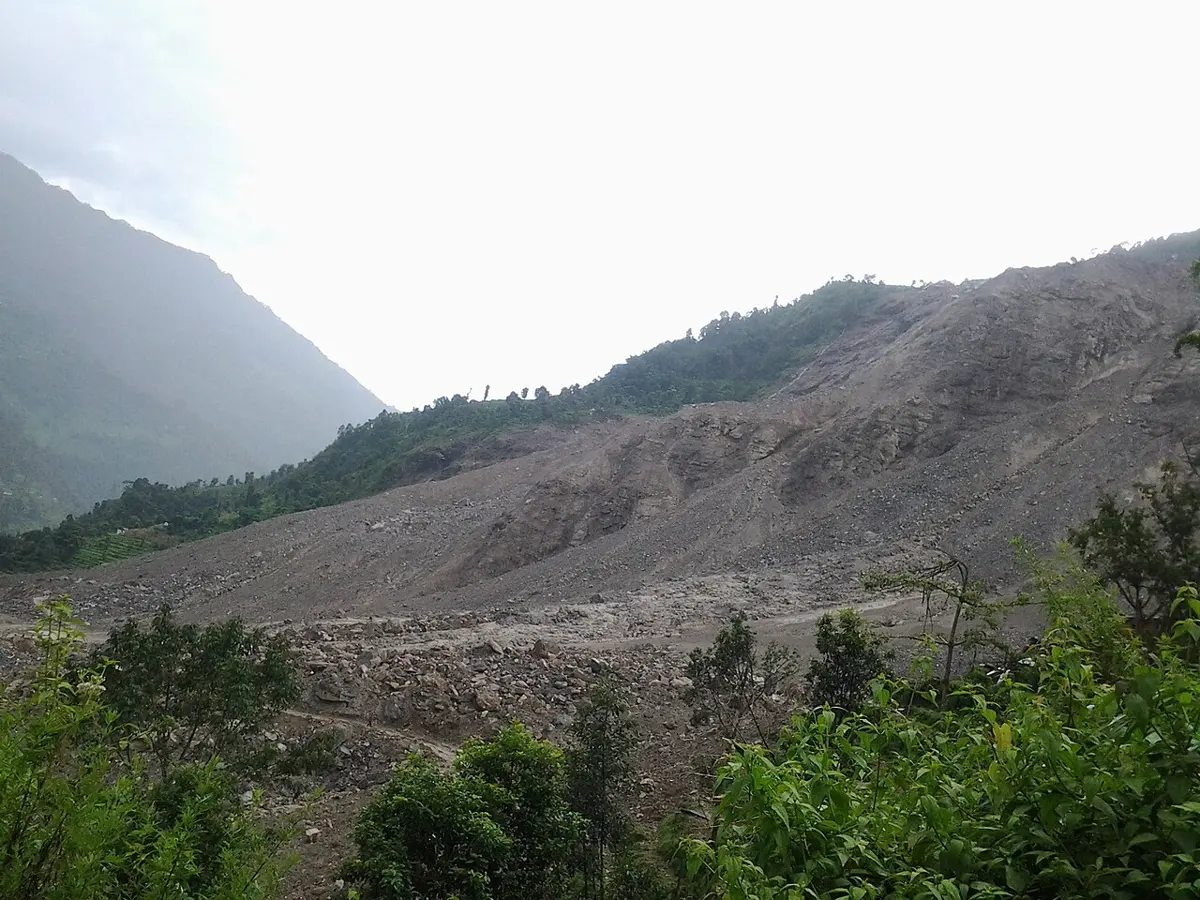
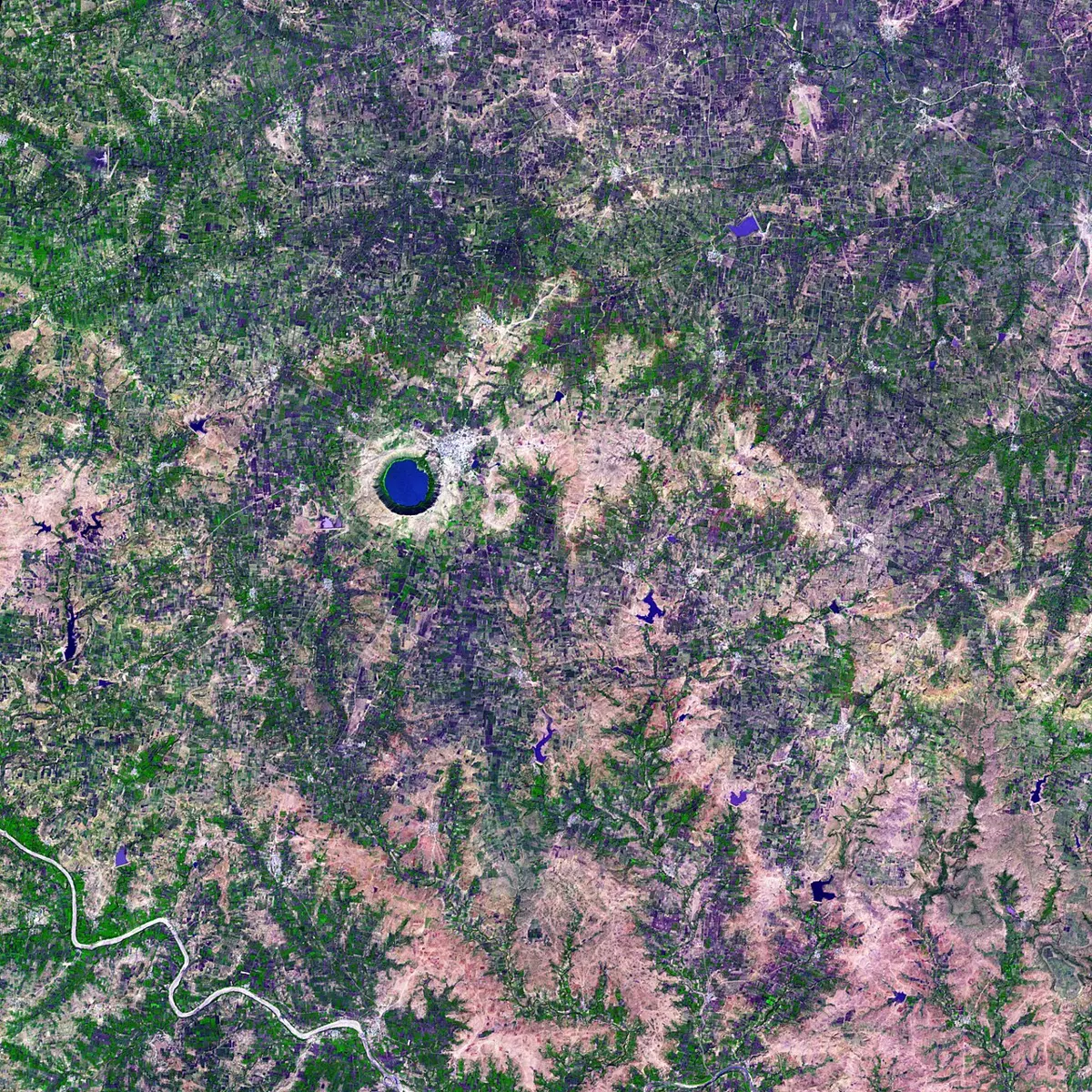
Sudden events and slow ones work together. An earthquake shakes the slopes; the next monsoon’s rain sets off landslides on them; the landslides drop rock into the rivers; and the rivers spend years carrying it away, a little at a time.
Things also happen on every size. A grain of sand is a fraction of a millimeter across; a landslide is hundreds of meters; a river’s valley is tens of kilometers long; and the Himalaya stretch about 2,400 km. Big, slow changes are made of countless small, quick ones: each grain moved, each crack opened.
Which of these changes Earth’s surface fastest?
Pick an answer to see why.
Reading the land
Water, ice and wind each shape the land in their own way, and the shapes they leave behind are evidence. A geologist walking up a valley in Nepal can read what made it, the way you read footprints.
Rivers
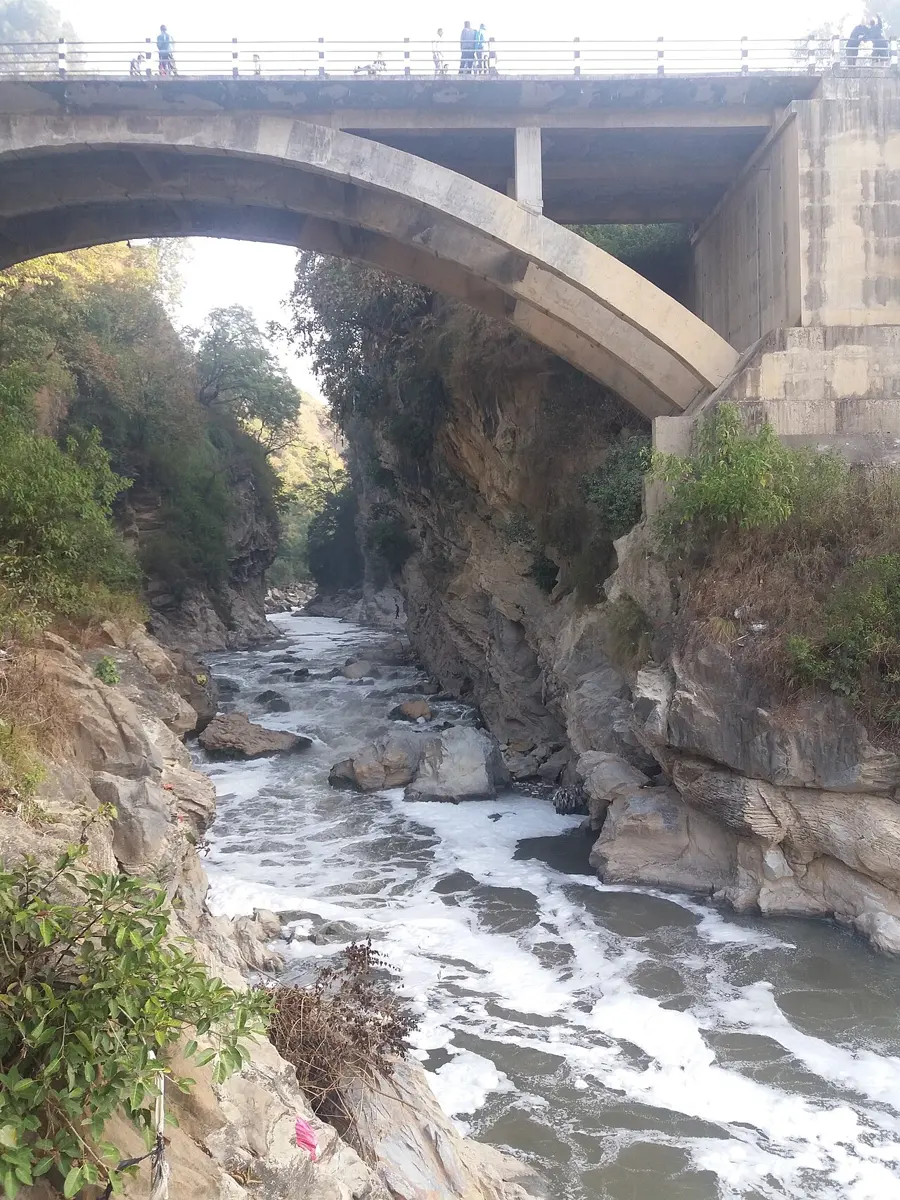
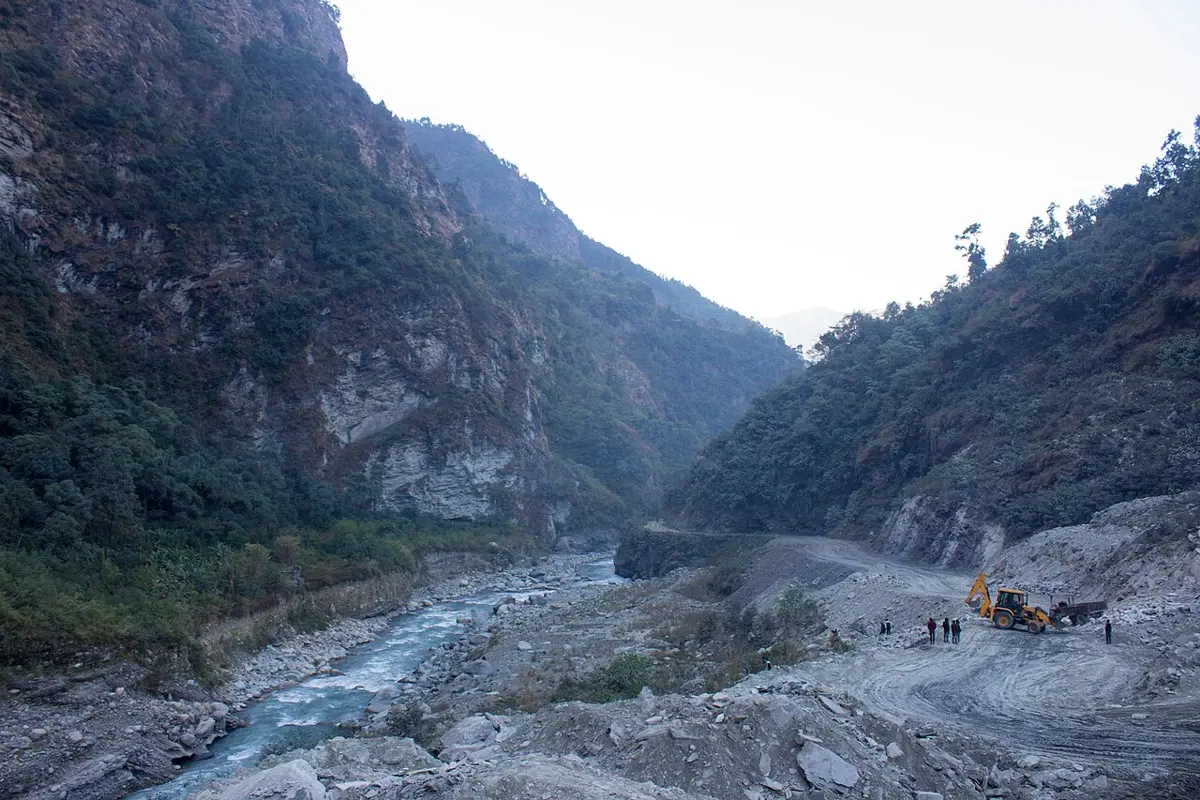
A river cuts down into its bed, while landslides and rain on the slopes on either side keep wearing them back. So a river valley is a V, often a deep and narrow one: a gorge. Rivers in Nepal’s mountains cut some of the deepest gorges on Earth, like the Kali Gandaki’s, between Dhaulagiri and Annapurna. Where a river comes out of the hills and slows down, it drops its stones and sand in a wide fan; a river that later cuts down into its old bed leaves its old floor as a flat step on the valley side, a terrace, a good place for a village or rice fields.
Glaciers
A glacier is a river of ice, fed by snow. It flows downhill slowly, from a few meters to a few hundred meters a year, and it is often hundreds of meters thick, so it fills its valley. Rocks frozen into its bottom and sides scrape and grind the rock beneath like sandpaper. So a glacier wears away the sides of its valley as well as the floor, and turns a river’s V into a U, with a wide, flat floor and steep sides. The rocks it carries are dropped where the ice melts, in long ridges of jumbled stones of every size, called moraines.
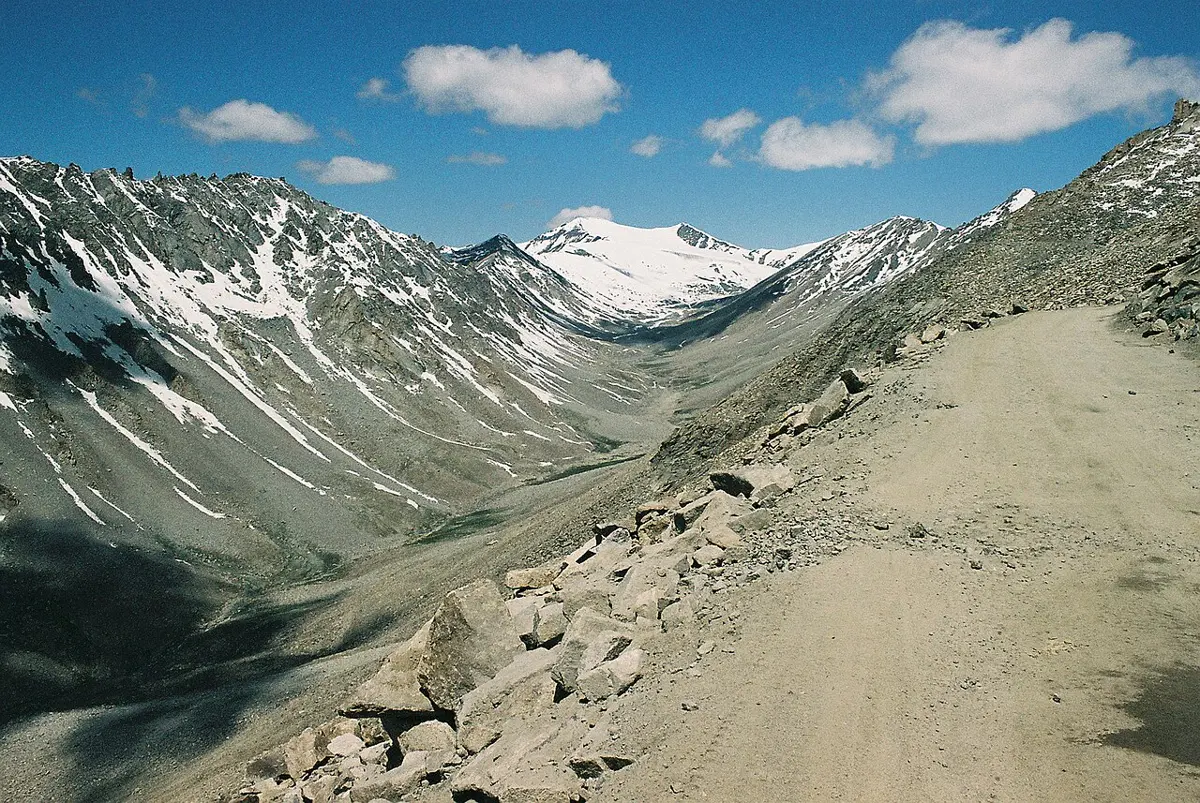
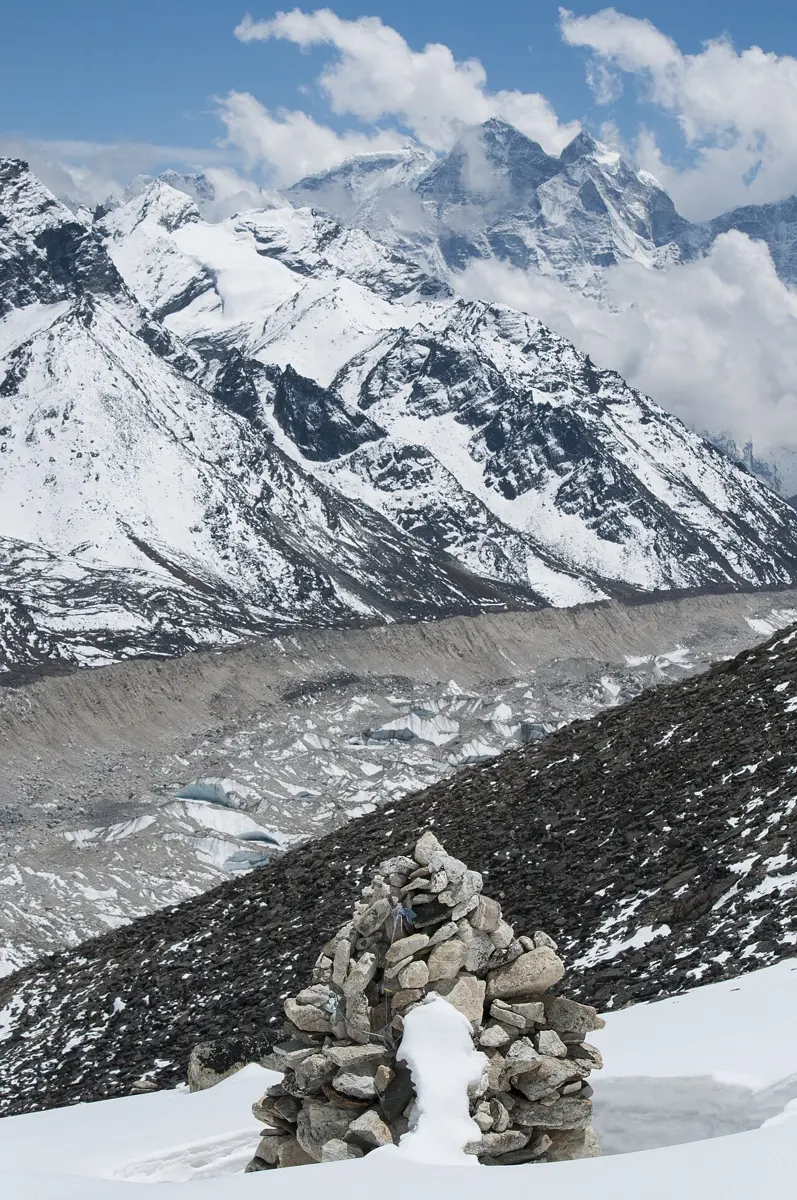
Many valleys in the Himalaya, like the Khumbu and Langtang, are U-shaped in their upper parts, where the glaciers reached in the last ice age, and V-shaped lower down, where only rivers have worked. Their moraines show how far down the ice once came.
Wind
Wind can carry only small grains, sand and dust, so in a wet, green country like Nepal it does little. In dry places with little to hold the ground, it does much more. In the Thar Desert of India and Pakistan, it piles sand into dunes that creep across the land. And in northern China, dust blown from the deserts over the last 2.6 million years has piled into the Loess Plateau, a land of fine yellow soil, in places more than 100 m deep. Wind-blown sand also scours rock, like sandpaper, close to the ground.
In a valley far from any ice today, you find a wide, flat floor with steep sides, and long ridges of jumbled stones of every size, from sand to boulders, along its sides. What made it?
Pick an answer to see why.
Make a rock cycle
Questions
Which process turns sand into sandstone?
Pick an answer to see why.
Where does the energy come from that lifts limestone from the sea floor to the top of Everest?
Pick an answer to see why.
Describe one possible journey for a grain of quartz, starting in the granite of Everest and ending in a metamorphic rock. For each step, name the process and the source of the energy that drives it.
Answer
One possible journey:
- The granite is lifted up as the Himalaya rise (uplift; the Earth’s internal heat, which moves the plates).
- Frost and water break the granite up, freeing the quartz grain (weathering; the Sun’s energy, which drives the weather).
- Glaciers and rivers carry it down to the Bay of Bengal (erosion; the Sun, which lifted the water, and gravity, which pulls it downhill).
- It settles on the sea floor with other sand (deposition; gravity, which pulls the grain down once the water slows).
- More layers bury it, and the sand is pressed and cemented into sandstone (compaction and cementation; gravity, the weight of the layers above).
- The sandstone is pushed deep down where plates collide, and heated and squeezed into quartzite (metamorphism; the Earth’s internal heat).
Other routes are just as good, as long as each step is a real process with its energy source: for example, the grain could stay in the granite while it is buried and squeezed into a gneiss.
Sea lily fossils are found in the limestone at the top of Everest. Explain what this tells us, and give the evidence for each step of your explanation.
Answer
- Sea lilies lived only in the sea, and limestone forms from shells and skeletons heaped up on a sea floor. So this rock formed on the floor of a sea, at or below sea level.
- The rock is now 8,849 m above the sea, so it has been lifted nearly 9 km.
- Nearby, lower on the mountain, the same kind of rock has been changed into marble (the Yellow Band), and there is granite that formed from melted rock: evidence that the rocks of the Himalaya were pushed deep and heated, as well as lifted.
- What could do the lifting? The plates: India is still moving into Asia, at about 4 cm a year, and GPS shows the Himalaya still rising by a few millimeters a year.
So the fossils show that the top of the world was once a sea floor, and that the Earth’s internal heat has lifted it, slowly, over tens of millions of years.
A river cuts down at 4 mm a year.
- a.How deep a gorge can it cut in 500,000 years, in meters?
- b.How much does it cut in a human lifetime of 80 years?
- c.Use your answers to explain why we don’t notice the land changing.
Answer
- a.4 mm/year × 500,000 years = 2,000,000 mm = 2,000 m, 2 km.
- b.4 mm/year × 80 years = 320 mm, about 32 cm, and spread over 80 years.
- c.In a year the change is a few millimeters, smaller than the bumps on the riverbed, so nobody can see it happening. But the Earth is so old that even a slow change adds up to kilometers: 500,000 years is only about a hundredth of the time the Himalaya have been rising.
Sort these into sudden (seconds to days) and slow (thousands to millions of years), and say for each whether the Sun’s energy or the Earth’s internal heat drives it:
- a.a landslide in the monsoon
- b.a glacier carving a U-shaped valley
- c.an earthquake
- d.marble forming from limestone
- e.a flood when a glacial lake bursts
Answer
- a.Landslide: sudden; the Sun (the monsoon rain, which the Sun’s heat lifted from the sea, soaks the slope), with gravity.
- b.Glacier carving a valley: slow; the Sun (it lifted the water that fell as snow), with gravity.
- c.Earthquake: sudden; the Earth’s internal heat (it moves the plates, which build up strain until the rock snaps).
- d.Marble forming: slow; the Earth’s internal heat.
- e.Glacial lake flood: sudden; the Sun (it melted the ice and lifted the water), with gravity.
Draw your own model of the rock cycle: a slice through the land from a mountain to the sea, like Figure 23.3. Show the three kinds of rock, sediment and magma, and arrows for at least six processes, colored by the energy that drives them. Then write one thing your model doesn’t show well.
Answer
A good model has: a mountain with weathering at the top; a river carrying sediment to the sea (erosion) and dropping it (deposition); layers on the sea floor becoming sedimentary rock (compaction and cementation); rock deep below being heated and squeezed (metamorphism), and deeper still melting into magma; magma rising and cooling into igneous rock, underground or from a volcano; and uplift lifting rock back up into the mountain. Sun-driven arrows (weathering, erosion, deposition) in one color, internal-heat-driven arrows (metamorphism, melting, uplift, volcanoes) in another.
Things a model like this doesn’t show well (any one is fine): the time each step takes, from minutes (a landslide) to millions of years (uplift); the sizes, since the deep part is squeezed up and the land shortened; that the steps don’t happen in a fixed order, and any rock can skip steps; or that the cycle happens in many places at once.
Where to go next
- How Do Rocks Tell Time? The layers that the rock cycle lays down, read like the pages of a book, to put the Earth’s history in order.
- Do Continents Really Move? The internal heat moves the plates. The clues that the continents were once joined, and how they move.
- What Does Water Do to Rock? In the Grades 9–12 book: how frost, acid rain and rivers break rock down and carry it away, in detail, with the caves of Pokhara.
- Why Is Everest Still Rising? In the Grades 9–12 book: what is inside the Earth, how we know, and how the heat inside lifts the Himalaya.