
In August 2000 a hillside at Krishnabhir, in Dhading, slid onto the main road that joins Kathmandu to the plains, and so to India, and for eleven days almost nothing could come in or go out along it. The capital felt it. Nobody had blown anything up and no river had flooded. A slope had simply come down, which is something slopes in Nepal do every year.
Everyone in the hills knows the word पहिरो, landslide. It arrives with the rain, like leeches. But a landslide is only the loudest of the ways the land moves downhill. Some of them are too slow to see, some are faster than a bus, and all of them are driven by the same thing: gravity, pulling everything on a slope toward the bottom of it. Geographers call this the movement of mass, CDC’s पिण्ड परिचालन, and it is one of the great shapers of land, as important in steep country as rivers or ice.
What holds a hillside up
Picture a block of soil sitting on a slope. Gravity pulls it straight down, but because the ground is tilted, part of that pull points along the slope, trying to slide the block downhill. The rest presses the block into the ground beneath it. The steeper the slope, the more of the pull goes into sliding and the less into pressing.
Three things hold the block in place. The first is friction, the grip of grains on grains, and friction depends on how hard they are pressed together. The second is stickiness: clay, a little water between the grains, and the cement of the rock itself all hold particles to each other. The third is roots, which run through the soil like reinforcing wire.
A slope stays put as long as what holds it is stronger than what pulls it. Engineers put that as a ratio of the two, holding over pulling, and call it the factor of safety. When it falls to one, the slope goes.
Water is what changes the balance most, and it works both ways. Anyone who has built a sandcastle knows the first way. Dry sand pours into a low heap. Damp sand stands up in walls, because thin films of water between the grains pull them together. Now pour a bucket over the castle and it slumps. The spaces between the grains have filled, the films are gone, and the water in the spaces pushes the grains apart. Pushed apart, they are pressed together less, so they grip less. That loss of grip is the main way rain brings a hillside down. Water also adds weight, and it softens clay. A slope that has stood all through the dry months can fail after a week of monsoon without anything about it changing except the water inside.
Two other things upset the balance. One is taking away the foot of a slope. The bottom of a hillside carries the weight of everything above it, like the lowest people in a human pyramid, so a river cutting into the bank, or anyone digging into the base, removes support from the whole slope. The other is adding weight near the top. A heap of rubble or a new house on the upper edge of a steep bank pushes it toward failure.
And then there is shaking. An earthquake jolts every grain on every hillside at once. The Gorkha earthquake of 25 April 2015 and its aftershocks set off at least 25,000 landslides across central Nepal.
Slow and fast
The slowest way down is creep. On almost any soil-covered slope, the top layer is moving downhill all the time, far too slowly to see, usually less than a meter in ten years. Wetting and drying do much of it: clay swells when wet, pushing the soil out from the slope a little, and when it dries and shrinks, it settles back a little lower down. Freezing and thawing do the same in cold places. Each step is tiny, but the slope never stops taking them. In Nepali the word for it is घस्रिनु, to slide along.
You can’t see creep, but you can see what it does. Trees on a creeping slope have trunks that bend at the bottom and then grow straight up, because the soil keeps tilting them downhill and the tree keeps growing upward. Fence posts and electricity poles lean downhill. Old retaining walls bulge. On grassy hillsides the creep leaves rows of little steps along the slope, which cattle and sheep then use as paths. In cold soils that thaw only on top each summer, the wet top layer slips over the frozen ground below, a creep of its own called solifluction.
Creep can also be the slow start of something fast, and the most famous example is in Italy. Between 1957 and 1960 a company built one of the tallest dams in the world, 262 m high, across the narrow Vajont gorge north of Venice. Geologists studying the valley had found a great landslide in the mountainside above the lake, Monte Toc. The lake was filled anyway, and each time the water rose, the slope crept: a few centimeters a day during the first filling, then less, then a few millimeters a day through the summer of 1963. In late September parts of it were moving 3.5 cm a day. The engineers lowered the lake to slow it, but it only sped up, and on 9 October it was moving 20 cm a day. At 10:39 that night, around 270 million cubic meters of rock slid into the lake in well under a minute, by most accounts at around 100 km an hour. The wave it raised, some 200 m high, went over the dam and swept down the valley below. Around 2,000 people died. The dam itself stayed almost whole. Geologists still argue about exactly what tipped the slope, the lake’s water soaking into it or a wet September or both, but nobody argues that the warnings were there.
Faster than creep is a slide. Here a whole block of hillside breaks away along a surface of weakness and moves as one piece, sometimes in a spoon-shaped scoop that tilts backward as it goes, sometimes down a flat layer, like a book sliding off a tilted desk. Most of the slips you see on a hill road are slides, small or large.
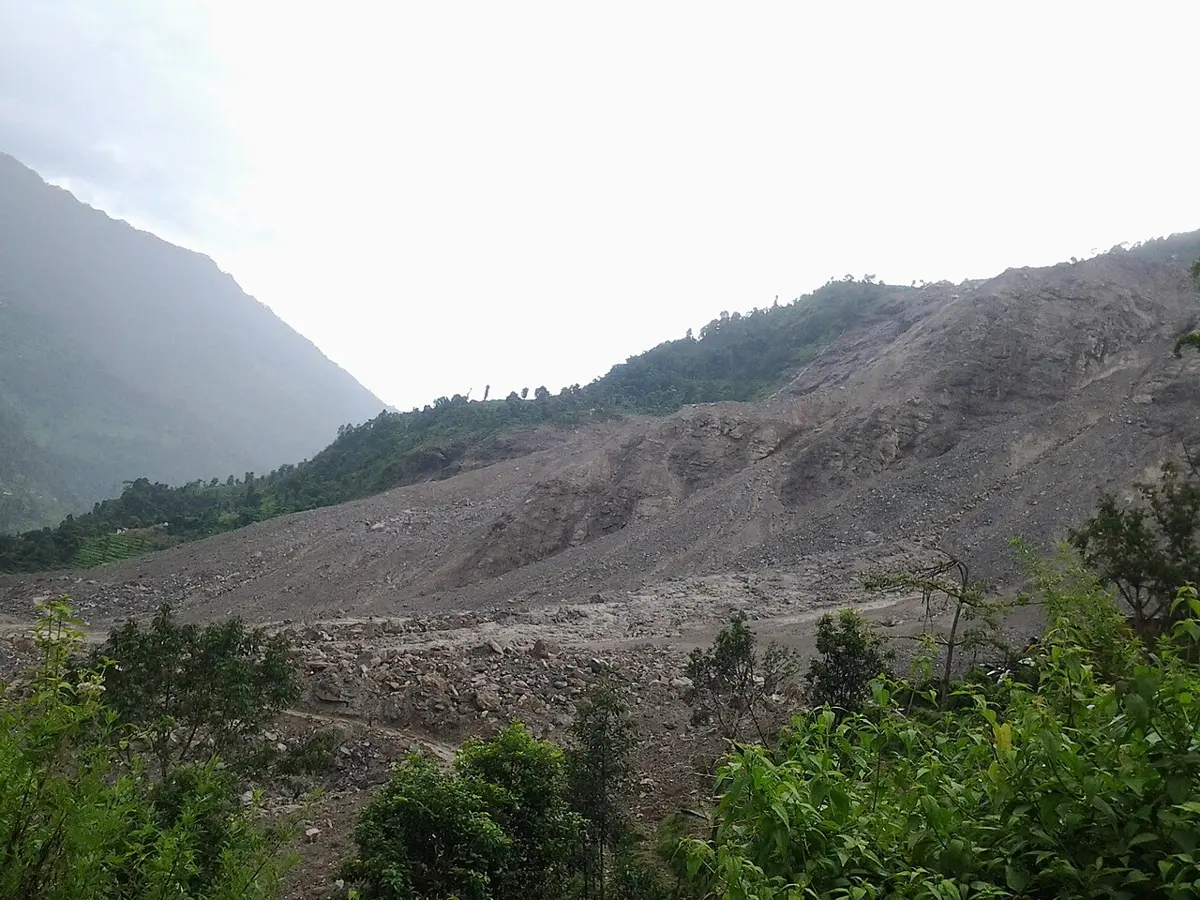
Nepal’s best-known slide of recent years came down at Jure, in Sindhupalchok, on 2 August 2014, after heavy rain. Millions of cubic meters of hillside fell into the Sunkoshi in the early hours, burying houses and a stretch of the Araniko Highway, the road to Tibet, and killing at least 156 people. The slope had been slipping now and then for more than ten years. It also dammed the river. A lake rose behind the rubble, and everyone downstream waited for the dam to burst. The army blasted a channel to drain it, and weeks later the water was let out.
Then there are flows. When soil and rubble take in so much water that they lose their shape, they stop sliding and start to pour. A debris flow is a slurry of mud, stones, boulders and broken trees running down a gully, sometimes at fifty kilometers an hour or more. It can move things as large as houses, and it spreads out at the gully’s mouth as a fan of jumbled rock. Heavy rain on loose ground in a steep gully is enough to start one, it can come without any warning, and from below it is easily taken for a flood.
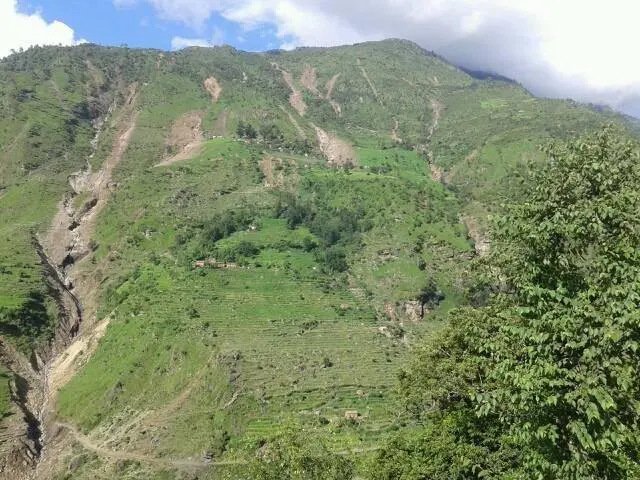
Nepal’s worst came in July 1993, when an extreme cloudburst over central Nepal set off floods and debris flows together across the Bagmati, Kulekhani and Narayani basins. More than 1,160 people died. Landslide scientists count it as the worst disaster in Nepal’s record that wasn’t an earthquake, though even they could not separate the people killed by the flooding rivers from those killed by the slopes.
The fastest of all are falls and avalanches of rock, where the slope is so steep that pieces simply drop, bounce and roll. One of the deadliest ever came off Huascarán, the highest mountain in Peru, when an earthquake on 31 May 1970 shook loose a mass of glacier ice and rock. It picked up mud and boulders as it went and reached the towns of Yungay and Ranrahirca at an average speed of more than 160 km an hour. More than 20,000 people died under it.
All of these are part of how mountains are made, not only how they are spoiled. The Himalaya are still being pushed up, and rivers cut down into them as fast as they rise, so the valley sides stand steep, and slopes in such mountains are always close to their limit. Landslides are the main way the rock lifted into the range comes down off its hillsides, to be carried away by the rivers. Seen across millions of years, they are the mountains keeping their balance. Seen from a house below one, they are something else.
Why the roads and the landslides go together
Of all the fatal rainfall landslides in the world from 2004 to 2016, about one in ten were in Nepal, a country with well under one percent of the world’s people. Ninety-three percent of Nepal’s came in the monsoon. Some of this is just geography: young, steep, broken mountains with the heaviest rain of the year falling on them in a few months. But the numbers have been rising, and that needs another explanation.
From 1978 to 2005 Nepal had at least 397 fatal landslides, killing 2,179 people, about 78 a year, and not one recorded death between November and April. Around 1995 the number jumped. The rise came mostly in the hill districts, not on the plains. Forest loss can’t explain it well, because the cutting had peaked years earlier, and nor can the civil war that began at the same time. The likeliest reason, the scientists who counted them concluded, is roads. The count has gone on since: from 1968, more than 1,400 fatal landslides have killed over 6,000 people, and the three years with the most fatal landslides have all been since 2020. Counting got much better after about 2000, so the early years are surely too low, but the rise is too large to be only that. The same counters have since found some evidence that the monsoon itself changed around 1996, and its wettest years now bring far more fatal landslides than they used to. How much of the rise is the rain and how much the roads is still being worked out.
The roads did arrive quickly. Nepal’s local roads grew from about 4,800 km in 1998 to about 57,600 km in 2016, twelve times as long in eighteen years. Most were not designed by anyone. A village wanted a road; a bulldozer owner and a local politician agreed to make one; and in the dry season the machine was driven along the hillside, cutting a shelf and shoving the loose earth over the edge, with no drains and no leveling. Then the monsoon came.
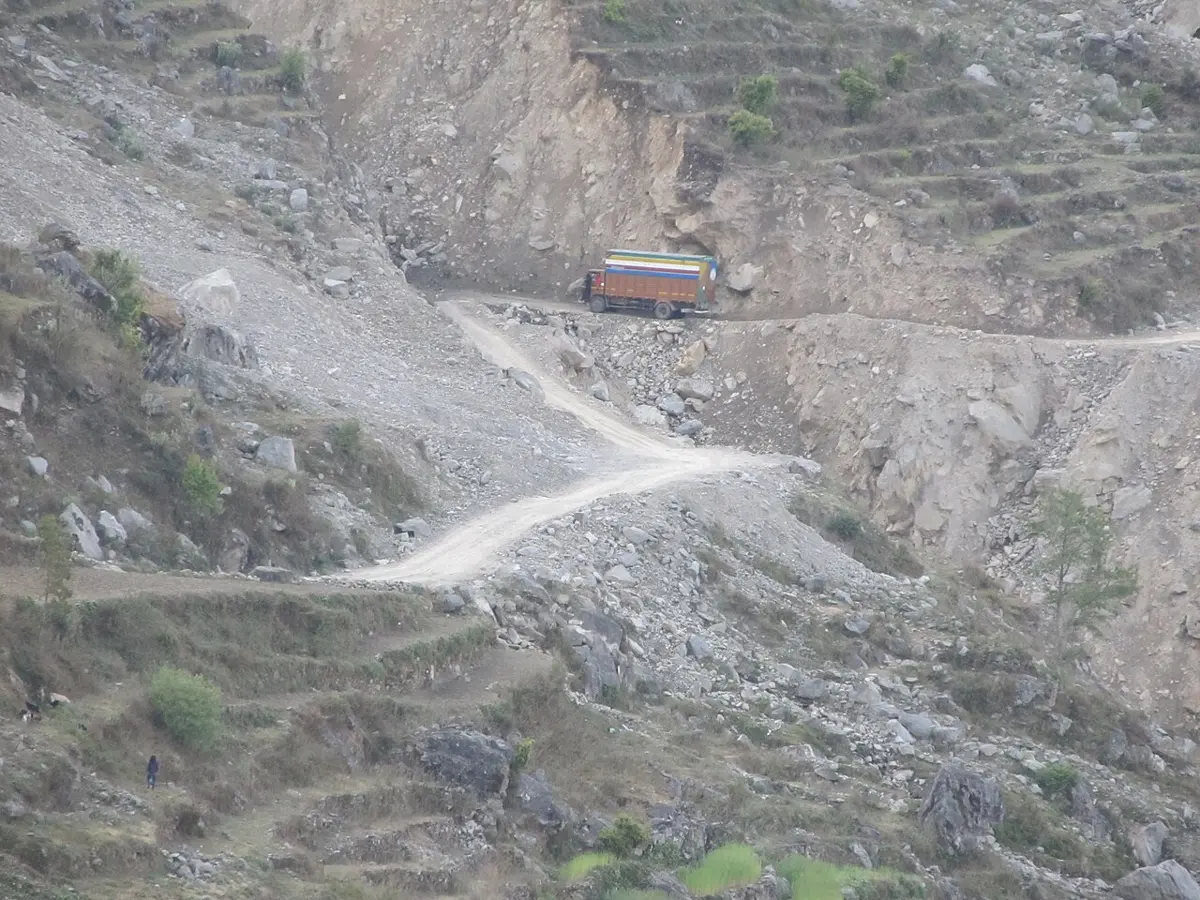
A road cut into a hillside breaks every rule of what holds a slope up, all at once. The cut takes away the foot of the slope above it, leaving a bank steeper than the hill ever stood. The dug earth tipped over the edge loads the top of the slope below, and since it is loose and full of air, the first heavy rain turns it into a debris flow. The road itself collects rainwater along its length and lets it go wherever it happens to run off, often straight into one patch of hillside, filling its pores. Most of the slips along mountain roads, about seven in ten, are the cut bank above the road coming down, not some great natural landslide.
There is a neat way to see it. In Sindhupalchok, scientists mapped the landslides set off by the 2015 earthquake, which shook every slope whether it had a road or not, and compared them with the landslides the monsoon had set off before it. The rain-triggered slides were more than twice as likely to lie within 100 m of a road. The earthquake’s were spread about as if roads didn’t exist. Roads don’t only attract landslides; they seem to make them. Part of the pattern may also be that roads are built where the ground is already weak, along valley floors and ridges.
Even well-meant roads are hard to get right. Many local engineers design their cut banks by rule of thumb, and banks are often dug steeper than the official guidelines advise and left bare. One reason is money: a gentler cut needs more of someone’s land, and a municipality often can’t pay for it. Roads, too, aren’t the only digging at the foot of a slope. Families dig clay from banks to build and plaster their houses, and in Nepal at least four in ten of the people killed in landslides from such digging were children.
None of this means Nepal should not have roads. A road brings a clinic within reach, and gets crops to market. But landslide scientists have an old saying: it is harder to stop a landslide than to start one.
Holding a slope
So what does hold a hillside? Mostly, the same three things as before, helped.
Keeping water out comes first. A slope that stays drained stays strong, so the most useful things on a hill road are often the plainest: lined drains that lead water off the road to a safe place instead of onto the slope, culverts that are kept clear, and pipes driven into a wet hillside to let the water inside escape.
Weight at the foot helps, weight at the top harms. A wall of stones in wire cages, a gabion, at the base of a slope props it up, and because water runs straight through the stones, it never builds up behind them.
And then there are plants. Grass on a bare bank stops rain washing it away; the roots of shrubs and trees bind the soil near the surface and draw water out of it. Nepal’s road builders became good at this, using local grasses, shrubs and bamboo, often planted in lines across or down a slope, together with small walls. They call it bioengineering, and since the 1980s it has been part of how hill roads are meant to be built, along with keeping roads narrow and balancing the earth dug out of the hillside against the earth used to build up the road, so none is thrown down the slope. A wall is strongest the day it is finished and weakens year by year; a planted slope is weakest at first and grows stronger as the roots spread.
But roots go only so deep. Trees can hold shallow soil that would otherwise slip in a downpour, and that covers most of the small slides on Nepal’s hillsides. They cannot hold a whole mountainside that fails along a surface deep in the rock, as at Jure or Vajont. Forests help, and bare hills slide more, but “plant trees” is not the whole answer. The deep slides are best handled by knowing where they are and not building beneath them.
Nobody can stop gravity, and in a country rising as fast as Nepal nobody would want to stop the mountains wearing down. What people can choose is how they cut into the slopes, where they put the water, and where they live. The places that do it best, and what people in Nepal and elsewhere have built on steep ground, are in Uses of Nepal’s Slopes, starting with green roads. How forecasters judge when the rain has become too much for the hills is in Can We Tell When Disaster Will Strike?
Found a mistake? Please tell us.