
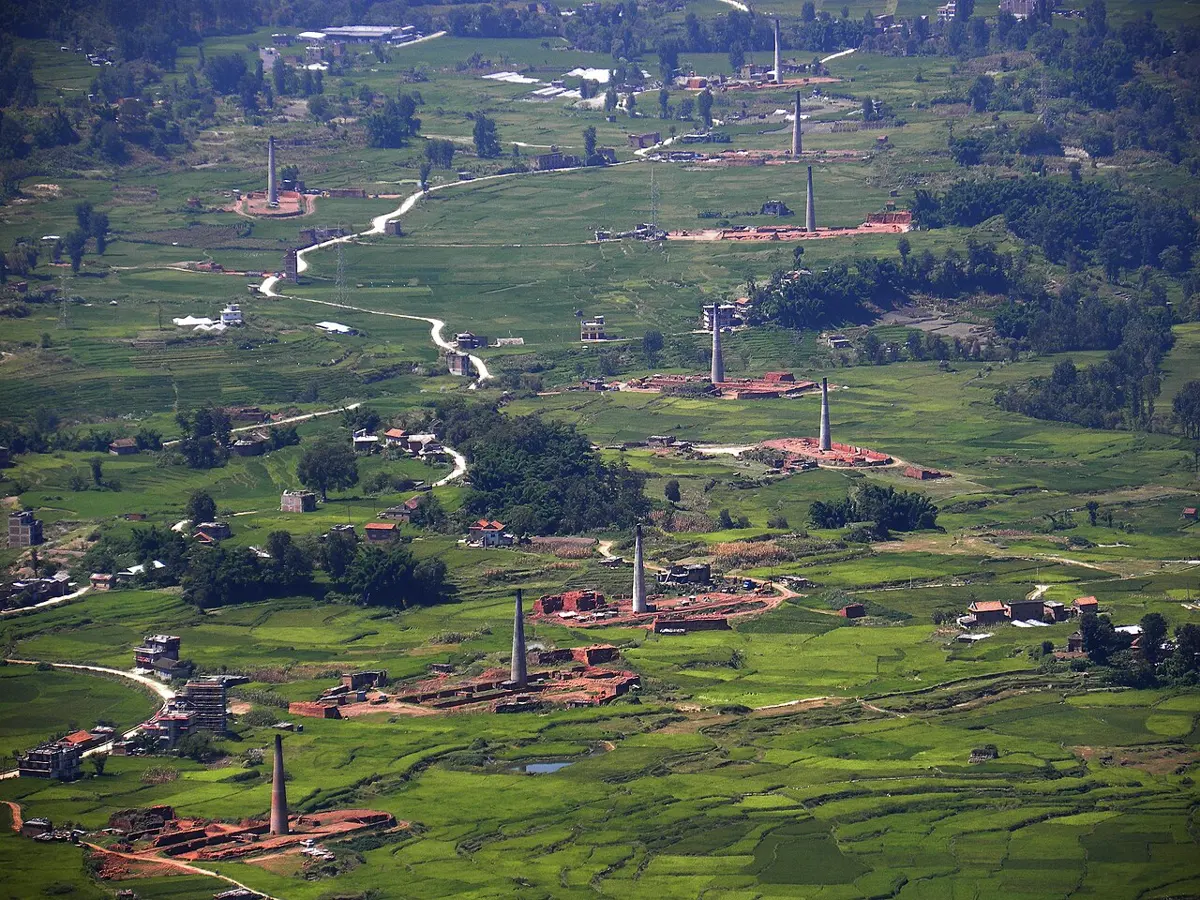
Every winter, a little after the rice is cut, the brick kilns of the Kathmandu Valley are lit, burning coal that Nepal has to buy from abroad. Out of the fields come stacks of bricks for the houses going up across the Valley. Out of the chimneys comes smoke.
The owner of a kiln keeps careful accounts. He pays for the clay and the coal, the wages of the families who mold and stack and carry, the trucks, the rent of the field. Every one of those costs is in the price of a brick. One cost is not. The smoke drifts over Bhaktapur and Lalitpur into the lungs of people who never bought a brick and never agreed to breathe it. In 2024 three World Bank economists put a number on it, in a working paper the Bank publishes as work in progress. A brick from a Nepali kiln costs its owner about Rs. 17 or 18 to make. The harm to other people’s health from its fine dust came to about Rs. 4 to 7 a brick, by the study’s estimate, and the harm from its carbon dioxide to about Rs. 2 more. For every brick, the kiln’s neighbors and the world pay something like a third or a half again of what it costs to make, and nobody sends them the bill.
Chapter 4 named this as one of the things markets get wrong. This chapter is about how it happens, what can be done about it, and why the largest case of all, the warming of the climate, is so hard to fix.
The cost that isn’t on the bill
Chapter 7 showed a market settling on a price where buyers’ and sellers’ wishes meet. Economists claim a lot for that price: at it, everything gets made that is worth more to some buyer than it costs, and nothing that costs more than it is worth. The claim rests on a quiet assumption, that the costs the seller counts are all the costs there are.
Economists split the cost of making something in two. The private cost is what the maker pays: the clay, the coal, the wages. The external cost is what falls on others outside the deal, the cough, the doctor’s bill, the dirty washing, the crops dulled by soot. Add the two and you have the social cost, the whole cost to everyone. A cost that lands outside the deal is called an externality, बाह्य प्रभाव.
The idea is old. The Cambridge economist Arthur Pigou set it out in The Economics of Welfare in 1920, and his example could have been written about Bhaktapur. The smoke from factory chimneys in towns, he wrote, “inflicts a heavy uncharged loss on the community, in injury to buildings and vegetables, expenses for washing clothes and cleaning rooms, expenses for the provision of extra artificial light”. Uncharged is the key word. The loss is real, but no one is charged for it, so no one making the decision weighs it.
Here is why that matters. The kiln owner decides how many bricks to make by comparing what a brick sells for with what it costs him. Buyers compare the price with what a brick is worth to them. Neither counts the smoke. So bricks are made that are worth less to their buyers than they cost everyone. That is what over-production means here: not more bricks than anyone wants, but more than are worth their whole cost.
It works the other way round too. A lamp at the door of a house, Pigou noticed, lights the street for everyone who walks past, and a forest planted on a hillside does good to the weather well beyond the edges of the estate. Whoever pays for the lamp or the trees counts only the good done to himself, so too few are hung and planted. That is a positive externality. The good to the buyer is the private benefit, the good to others the external benefit, and the two together the social benefit; a market that counts only the first makes too little.
Two more words sit close by. Merit goods, such as schooling and a visit to the clinic, do people more good than they themselves expect, and much good to others besides: a vaccinated child keeps others from catching what she would have caught. Left to the market, too little of them is bought, which is part of why states give them away or pay for some of them. Demerit goods are the reverse, things such as cigarettes and liquor that do people more harm than they reckon. Chapter 18 met the heavy tax on cigarettes meant to make people smoke less.
How large is the smoke’s cost? In the Kathmandu Valley the United States Embassy’s monitor at Maharajgunj measures the finest dust, PM2.5, particles small enough to pass deep into the lungs, every hour. Averaged over the days it recorded, the air held about 46 micrograms of it in each cubic meter in 2019 and about 48 in 2024, with about 71 in January 2024 and 100 in April, against about 11 in the rain of July. The World Health Organization’s first and easiest target is 35. In 2025 the World Bank put the cost of Nepal’s dirty air at about 26,000 early deaths a year, and more than 6% of everything the country produces.
Not all of that is the kilns. Vehicles and the dust of the roads dirty the Valley’s air too, and smoke blows in from across the border. Studies a decade ago put the kilns’ share at about 28% of the coarser dust and about 40% of the black soot in winter, while the head of the Department of Environment said in 2018 that the pollution came mainly from vehicles and road dust. The World Bank estimated that pollution from kilns caused about 600 deaths in Nepal in 2015. The numbers are rough, but they say the same thing: part of the cost of every brick is paid in other people’s lungs.
Making the price tell the truth
A government that wants less smoke has three kinds of tools. The oldest is a rule, and Nepal has made several. Kilns of the oldest type, with a chimney that moves along a trench, were banned in the Valley from 2004, and in 2009 the government ordered every one in the country replaced within two years. In 2018 the ministry for the environment set limits on how much dust a kiln’s smoke may carry, and in 2026 it set a limit of 250 milligrams in each cubic meter of smoke, required every new kiln to be of the cleaner zigzag kind and gave the old ones two years to meet it.
Rules are easy to understand, and for the worst harms they are often the best tool. Their weakness is that someone has to check them. A World Bank study in 2020 found the enforcement of Nepal’s kiln rules lax and the penalties low, and the Department of Environment’s own study of 30 factories in 2017 found not one with a pollution-control device. A rule also treats every kiln alike, though some could cut their smoke cheaply and others only at great cost.
Pigou’s answer was a price. If the trouble is that the smoke is uncharged, charge for it. Put a tax on each gram of smoke equal to the harm it does, and the owner faces the whole cost of a brick in his own accounts. He doesn’t need to care about his neighbors’ lungs for the tax to work, only about money, which he already does. Pigou called his remedies “bounties and taxes”: a tax where a thing does uncharged harm, a payment where it does unpaid good. Such a tax is still called a Pigouvian tax.
What happens next is the interesting part, and the kiln below is made up to show it. Its numbers are invented, but its shape follows the real studies: the cleaner kiln puts out about 40% less smoke for each brick, and the harm of a gram of smoke is set so that a brick’s harm comes out close to the World Bank’s estimate.
Two things happen as the tax rises. At first the owner keeps his old kiln and pays the tax, his price creeps up and a few buyers buy fewer bricks. Then, at Rs. 0.75 a gram, the tax on the old kiln’s smoke costs more than rebuilding would, and he rebuilds. The smoke falls far more than the bricks do. With the tax set at the harm, Rs. 1.4 a gram, the market sells about 29% fewer bricks than with no tax, but there is 57% less smoke. Only half the smoke saved comes from making fewer bricks. The other half comes from the owner finding a cleaner way to make them.
That is the tax’s great advantage over a rule. The state doesn’t need to know how each kiln could cut its smoke. Every owner works that out for himself, and those who can cut cheaply cut most. Chapter 18 showed that most taxes change what people do, and that the change is a loss. Here the change is the point.
Its weakness is the rule’s: someone has to measure the smoke, which is why a tax on the coal, easier to count, is often the practical choice. The World Bank’s study worked out that a tax of $10 a tonne of carbon dioxide would raise the cost of making a brick in Nepal by 2 to 6%, and one of $100 a tonne by 12 to 36%, depending on the kiln.
Ronald Coase, whom Chapter 9 met asking why firms exist, pointed out in 1960 that a tax isn’t the only way. If the right to clean air, or the right to make smoke, were clearly someone’s and could be traded, the two sides could bargain: the neighbors could pay the kiln to cut its smoke, or the kiln pay them to put up with it, and either way the smoke would be cut as far as it is worth cutting. That works when there are a few people on each side. With a few kilns and a million breathers, the cost of bargaining makes the bargain impossible, and Coase, who won the Nobel Prize in 1991, made economists take such costs seriously.
The third tool joins the rule and the price. A state caps the total smoke, prints that many permits and lets firms buy and sell them. A firm that can cut cheaply cuts and sells its spare permits; one that can’t, buys. The total is fixed, and the cutting is done wherever it is cheapest. The United States did this from 1995 for the sulfur dioxide from its power stations, which fell as acid rain, with a cap meant to keep it 10 million tons a year below what they had put out in 1980. The European Union started the first big market in permits for carbon dioxide in 2005, and by 2023 the emissions it covers, about 40% of the Union’s, had fallen by about 47%.
In Nepal the change came another way. The earthquake of April 2015 hit about 350 of the country’s 800 or so kilns, and damaged about 100 in the Valley. They had to be rebuilt anyway, and within months ICIMOD, the mountain research center in Lalitpur, with the brick makers’ federation and engineers, drafted a manual for rebuilding them as zigzag kilns, in which the bricks are stacked so that the air winds back and forth through them and the coal burns more fully. The first five were fired in January 2016, and by the end of that year, by the federation’s count, almost all the Valley’s kilns had been rebuilt, all 63 in Bhaktapur among them. A study that measured seven kilns, four old and three zigzag, found that the zigzag kilns, with the bricks properly stacked and fired, put out about 40% less fine dust and 55% less black soot for each kilogram of brick. The earthquake forced the rebuilding; the manual decided what was built.
The largest case
Everything said about the kiln is true of the gases that warm the climate, on the scale of the planet. A tonne of carbon dioxide from a power station in Ohio or a truck on the Mugling road warms the same air, and the harm falls everywhere, on people not yet born too. How the gases do it is the subject of The Changing Climate. The report the economist Nicholas Stern wrote for the British government in 2006 called climate change “the greatest and widest-ranging market failure ever seen”.
The tools are the same. A tax on carbon, a cap with permits, rules on cars and power stations, money for the clean ways of doing things. What is missing is the state. In a country, a government can tax a kiln. There is no world government to tax a country.
So each country decides for itself, and here the logic of shared air bites hardest. A country that cuts its gases pays the whole cost of cutting but gets only a small share of the good, which is spread across everyone. Each does best if the others cut and it doesn’t. This is the free rider problem, which Chapter 26 comes back to, and it is why climate talks are long arguments about who should cut and who should pay.
A poor country stands in an odd place in that argument. In 2024, counting carbon dioxide and the other warming gases such as methane together, Nepal put out about 1.4 tonnes for each person, against a world average of about 6.4, about 3 in India and about 17 in the United States: about 0.08% of the world’s. (The Changing Climate counts only the carbon dioxide from fuels and cement, which is why its share is smaller still.)
But the damage doesn’t follow the smoke. Nepal is steep and wet, its farms hang on the monsoon, and its rivers come off shrinking glaciers; its own plan for adapting calls it highly vulnerable to the climate’s risks. For a country in that place, most of what is worth doing is adapting, building for floods and droughts that will come anyway, and that costs money a poor country doesn’t have.
The rich countries, which put most of the gases into the air, have agreed to pay something towards it. At the talks of 2024 they agreed to provide at least $300 billion a year, within a wider goal of $1.3 trillion a year for poorer countries by 2035; the poorer countries, which had asked for more than a trillion, called it far too little. In 2022 countries agreed to set up a fund for the “loss and damage” that adapting can’t prevent, and in 2023 they put it to work. How much reaches the places that need it is what every round of talks argues over.
What a warming climate costs Nepal
The most careful attempt to count it is a study the Ministry of Science, Technology and Environment published in 2014. Its first finding is about today’s weather. The floods, droughts and landslides Nepal already lives with cost it about 1.5 to 2% of everything it produces in an ordinary year, and 5% or more in a bad one; the drought of 2006 alone cost about 1.9%. On top of that, the study estimated, climate change could cost a further 2 to 3% of output a year by the middle of the century in the three things it modeled, farming, hydropower and floods.
Farming comes first. In the Terai the study found yields of some key crops, rice and wheat above all, falling by 10 to 20% by the 2070s. In the hills the picture was mixed, some crops doing better as the warmth climbs uphill, and in the 2030s the country might even gain a little. By the 2070s the losses win, at about 0.8% of output a year, before counting the irrigation and changes of crop that farmers would make. The government’s plan for adapting, in 2021, put climate behind 10 to 30% of the losses in farm production, drought the worst.
Rivers bring both the country’s great dangers and much of its hope. The study found the highest flows in two river basins rising by 20 to 100% by the 2040s: a flood that now comes once in ten years could come every few years. It put the extra damage from floods at about 0.6 to 1.1% of output a year by mid-century. More than 300 people a year already die in floods and other disasters of water, and more than 80% of the property lost to disasters is lost to the climate’s hazards. In 1985 the burst of a glacial lake destroyed a hydropower plant worth millions of dollars.
That makes energy the oddest case. When the study was written about 90% of Nepal’s electricity came from its rivers, so it rises and falls with the water. Of the study’s two models, one found that by 2050 Nepal would need about 2,800 megawatts more to make up for lost flow, at a cost of $2.6 billion; the other found a small gain. When two careful models disagree about which way a thing goes, nobody knows yet, and a country building dams for a century has to build for both. Which energy to build is the question of Which Energy Should Nepal Use?
The rest of the cost spreads through everything. Roads, bridges and power lines are washed out and have to be built again, or built stronger, which costs more. Industry needs power and water, and loses both in a dry year. Tourism, in a country that sells its mountains, depends on trails, bridges and airstrips a flood can take in an afternoon, and on the snow and ice visitors come to see. And when the land fails, through a drought that won’t end or a village under a landslide, people move. Those who leave because the climate has made their home unlivable are called climate refugees.
Protecting the environment, वातावरण संरक्षण, is in the end the same idea as the tax on the kiln. A forest that holds a hillside, a clean river, clean air: each does good beyond the people who pay for it, and each is looked after too little if left to the market. What the land and forests give is the subject of What the Land Gives.
The kiln and the climate come down to one question. When a cost falls on people who have no say in the deal, who should see it in the price? The economist’s answer is plain: the price should carry the whole cost, so that whoever makes the harm is the one who weighs it. Within a country that can be done by a rule, a tax or a permit. For the whole planet it can be done only by countries agreeing, the hardest kind of agreement there is.
Found a mistake? Please tell us.