
On 20 December 2021, Nepal Rastra Bank sent a letter to the country’s commercial banks. From then on, twenty kinds of goods, listed by their customs codes, could come into Nepal only through a bank’s letter of credit, and only if the importer first put down cash with the bank: the whole price for most of them, half for cars and motorcycles that weren’t fully electric. The bank wasn’t allowed to pay interest on that money, or to lend the importer the money to put down. Factories bringing in their own raw materials were spared, and so were medicines, hospitals, embassies and government offices. In February the list grew to 47 kinds of goods. In April the government went further and banned some imports outright: SUVs, cars and vans, mobile phones costing more than $600, big color televisions and a few more.
Nepal wasn’t short of rupees. It was short of dollars. The country’s store of foreign money, its foreign exchange reserves (विदेशी मुद्रा सञ्चिति), had been falling for more than a year, from $11.7 billion in January 2021 to $8.9 billion by May 2022, and in the second half of 2021 about $220 million a month was draining away. Early in 2022 the store would have paid for less than seven months of what Nepal bought from abroad, the least in the central bank’s records since 2001. People had borrowed cheaply after the pandemic and spent, the world’s prices for fuel and food had risen, and every rupee’s worth of imports had to be paid for, in the end, in someone else’s money.
The rules worked, a little. The IMF later worked out that they cut imports by about $80 million a month at most, far less than was being lost. They cost the government too, since cars and other vehicles alone brought in more than a third of all customs duty, and they gave importers a reason to write lower prices on their bills and pay the rest by other routes. The bans lapsed in December 2022, and by January 2023 the last of the cash rules was gone.
What happened next is stranger. By mid-July 2026 the reserves had grown to $25.3 billion, enough for 19.6 months of imports, the most since the bank’s monthly records began in 2001. Yet Nepal still bought more than six times as much as it sold. How a country with a gap like that ends up with more foreign money than ever is the puzzle of this chapter, and it starts with why a rupee has a price at all.
The price of a rupee
A rupee is good only in Nepal. A shop in Kathmandu buying phones from China has to pay in yuan or dollars, and a worker in Qatar paid in riyals needs rupees for his family. So money is swapped all day, and every swap has a price, the exchange rate (विदेशी विनिमय दर): how many rupees a dollar costs. Like any price, it comes from buyers and sellers. Nepalis who need dollars, to import goods, to pay fees for a son in Australia, to travel, are selling rupees to get them. Those who bring foreign money in, exporters, tourists and above all workers sending wages home, are doing the opposite. When more people want dollars than want rupees, the dollar gets dearer.
A country can let that price go wherever buyers and sellers take it. That is a floating rate, परिवर्तनशील विनिमय दर. Or its central bank can fix the price and promise to buy and sell at it in any amount, a fixed rate or peg, स्थिर विनिमय दर. Many sit somewhere between: a managed float, where the market sets the rate but the central bank steps in to smooth big swings, or a crawling peg, fixed but moved a little at a time on a known plan.
Nepal does both at once. Against the Indian rupee its rate is fixed: Nepal Rastra Bank has tied the two since 1960 and changed the level seven times; the last change, in 1993, set today’s 1.6. So Rs. 160 buys 100 Indian rupees, today as in 1993. Against every other currency the Nepali rupee floats, but only by way of India. The bank’s price for a dollar is, near enough, India’s price for a dollar times 1.6, as Money Sent Home in Money, for the Curious shows. When the dollar gets dearer in Delhi, it gets dearer in Kathmandu by the same share, which is how a dollar went from about Rs. 137 in mid-July 2025 to about Rs. 154 a year later without Nepal doing anything at all.
A peg is a promise, and a promise has to be backed. The bank says it will change Nepali rupees for Indian ones at 1.6 in any amount, so it has to hold Indian rupees, and when they run low it has to buy more with dollars, or borrow them. Yuba Raj Khatiwada, then the bank’s governor, wrote in 2014 that Nepal’s endless deficits drained Indian rupees from the market and made managing them a constant strain. The reserves, then, aren’t only savings for a bad day. They are what makes the rupee’s price believable.
What a peg gives up has a name, the impossible trinity. A country would like three things at once: a fixed exchange rate, money free to flow in and out, and a central bank free to set interest rates to suit its own economy. It can have any two of them, never all three. If money can move freely, savers chase the best interest rate, so a country whose rates drift from its anchor’s sees money rush in or out, and its central bank has to spend reserves holding the peg or bring its rates back in line. So Hong Kong keeps its money fixed and its doors open, and gives up control of its own interest rates. The United States and Japan keep open doors and their own rates, and let their currencies float.
Nepal chose the third pair: the peg and a policy of its own, with the door to money flowing in and out kept mostly shut. Hardly any shares or bonds are bought and sold across its borders, and most of what comes in as lending or investment is long-term loans to the government. On paper that leaves the central bank free to set its own interest rates. In practice its room is small, because goods cross the border at a fixed price and Nepal’s prices follow India’s anyway, as Rising Prices tells.
Where the dollars come from
Every payment between a country and the rest of the world is written down in one account, the balance of payments, भुक्तानी सन्तुलन, which the dashboard chapter introduced. Walked through line by line, it takes the puzzle apart.
Start with goods. In 2025/26 Nepal paid Rs. 1,676 billion more for the goods it bought than it earned from the goods it sold. Services made it slightly worse. Nepal earns from tourists, and from Nepalis writing software and giving advice to clients abroad, but the fees and living costs of Nepali students abroad came to Rs. 142 billion, more than all the money foreign travelers spent in Nepal. Interest earned abroad, much of it on the reserves themselves, brought a little back.
Then comes the line that changes everything. Workers abroad sent home Rs. 2,351 billion, after the little sent the other way, more than the whole goods gap on its own. Pensions from abroad, aid and other gifts added Rs. 230 billion. Taken together, the trade in goods and services, the income and the money sent home make up the current account, चालु खाता, and it ended the year Rs. 924 billion in surplus. The other two accounts, the capital account (grants for building things) and the financial account (loans and investment), added about Rs. 100 billion more, after Rs. 11 billion the bank couldn’t trace, and the Rs. 1,027 billion left over went into the reserves.
So the balance of trade, goods sold minus goods bought, is only one line of the balance of payments, and a trade deficit, व्यापार घाटा, can be paid for by the lines below it. Nepal pays for its imports largely with its workers’ wages from abroad, the story of Leaving. When riyals and ringgit arrive, banks change them for rupees, and the foreign money gathers at the central bank. If imports grow faster than the money sent home, as in 2021/22, the reserves fall. If the money sent home grows faster, as it has since, they pile up. In the first three months of 2026/27, to mid-October, imports were 38% higher than a year before, and remittances 27% higher, and the reserves still rose, to $27.4 billion.
That makes the gap safe only as long as the wages keep coming. Whether they will is the argument at the end of Leaving, and 2022 showed how quickly the store can run down when they don’t keep pace.
One neighbor
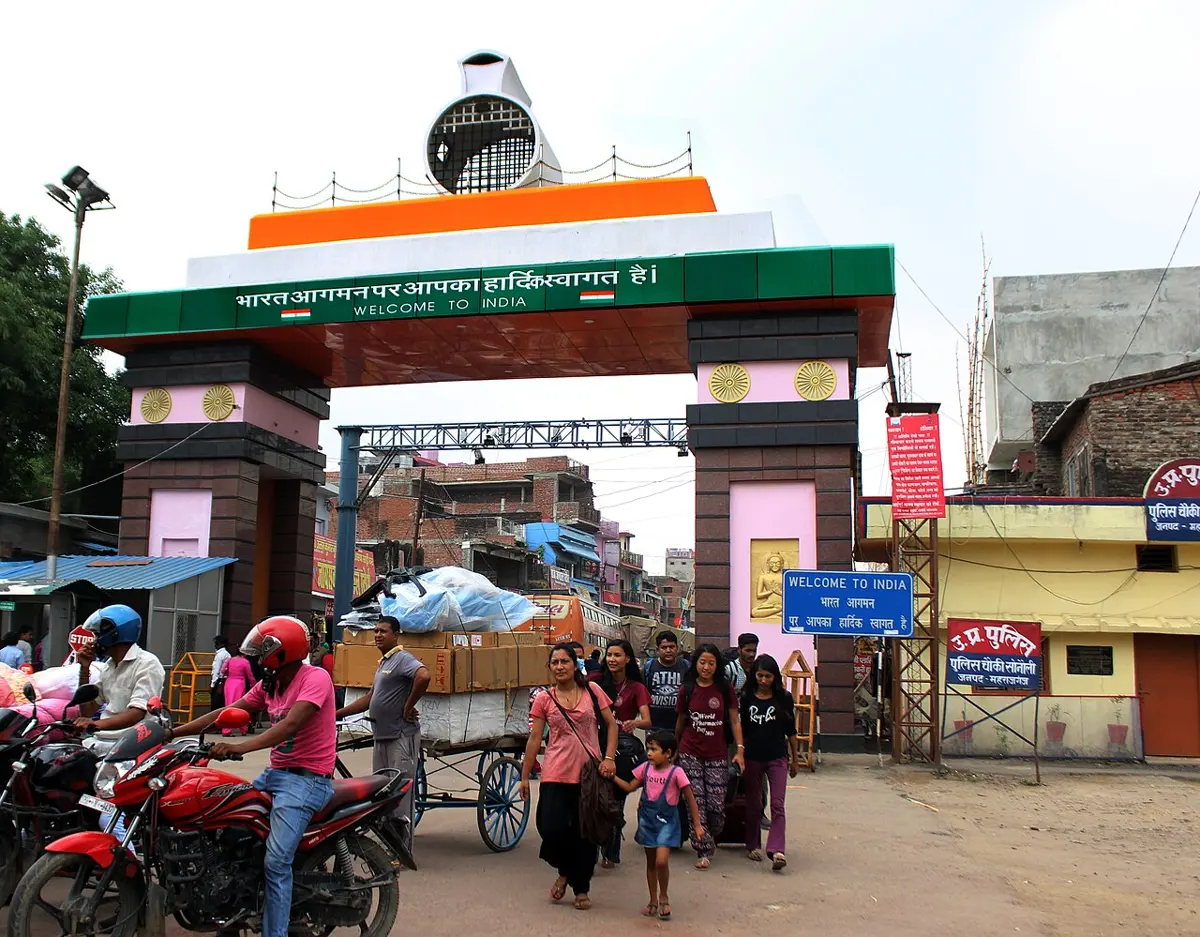
Nepal has no coast, and India wraps round it on three sides. Goods from overseas reach Nepal through Indian ports, Kolkata and Haldia or Visakhapatnam, under a Treaty of Transit between the two countries; its latest version was signed on 1 June 2023 for seven years, and is then renewed automatically. Trade itself runs under the Treaty of Trade of 2009, whose story is told in Why Countries Trade; it renewed itself again in October 2023. Almost all of Nepal’s petrol and diesel comes from India, some of it since 2019 through a 41-kilometer pipeline from Raxaul to Amlekhgunj.
The border is open in a way few borders are. Nepalis and Indians cross it by road without passports or visas, and even flying between the two countries an Indian needs only a passport or a voter card. The Treaty of Peace and Friendship of 1950 promises each country’s people, in the other, the same treatment as its own in industry and economic development, and, each side matching the other, the same freedom to live, own property, trade and move about. The treaty doesn’t mention the border itself. It is often blamed for the open border, though some answer that people crossed freely long before it, as the chapter on 1950 in Nepal’s History, for the Curious tells. About 1.1 million Nepalis live and work in India, with no permit to count them, as People on the Move in Geography, for the Curious describes.
So India is close, its roads lead everywhere, and its money has a fixed price. In 2025/26 it bought 82% of everything Nepal sold abroad and supplied 58% of what Nepal bought. China, behind the mountains, supplied 20%, and the share has been growing. But India’s place hasn’t always been this large. In 1974/75 it took 84% of Nepal’s exports. Through the 1980s the share slid. In March 1989 the two countries’ trade and transit treaties lapsed, and India closed all but two of the border crossings for more than a year. In 1989/90 India took 12% of Nepal’s exports. Until the mid-1990s its share stayed at about a fifth or less, because what Nepal mostly sold then were carpets, clothes and other factory goods, and most of them went overseas, the story of Factories, Roads and Visitors. Then the factories’ sales overseas faded, and India’s share climbed back.
What Nepal sells has changed completely, twice. Fifty years ago it was mostly food and crops. By the 1990s it was mostly things made in factories. Now almost half is cooking oil, refined in Nepal from crude soybean and palm oil bought abroad and sold to India under a tariff rule that Why Countries Trade takes apart. What Nepal buys has changed far less: factory goods, machines and vehicles, fuel and food, as in 1975, though fuel has grown from about a tenth of the bill to nearly a fifth. Petrol and other fuel alone cost Rs. 386 billion, more than every export put together.
Why is the gap so wide? Nepal makes few of the things it needs: no oil of its own, few machines, and not enough of its own food. Its factories are small, and the money sent home is spent largely on goods from abroad. So what could shrink the gap? Selling more is one road. Electricity from Nepal’s rivers already sells to India in the monsoon, as Water, Forests and Minerals describes, and the same electricity used at home, for cooking and for cars, would mean buying less fuel. Services travel without roads: in 2025/26 Nepalis earned Rs. 59 billion more than they spent on computer work and consulting for foreign clients. Tourists bring dollars in their pockets. Making at home more of what is now imported, food above all, at Rs. 216 billion a year, is another road, and it depends on everything the chapters on farms and factories say. Banning imports isn’t one. The bans of 2022 cut imports a little and briefly, and the IMF, drawing on research from other countries, found that trade barriers make no lasting difference to a country’s trade balance.
Keep the peg, or loosen it?
That leaves the price of the rupee itself, and here economists disagree.
One side says keep the peg, and its case starts at the border. With people and goods moving across it almost freely, Khatiwada wrote, “Nepal has no choice but to adopt the pegged exchange rate with Indian currency.” In the 1950s, before the bank fixed the rate, the price of Nepal’s rupee against India’s swung so much that people used Indian money even inside Nepal. India accounts for about three-fifths of Nepal’s trade in goods and is a major investor there, so a fixed price spares every trader and investor a guess. The peg is also Nepal Rastra Bank’s anchor for prices, its own word, as Booms and Slumps describes: Nepal borrows India’s record of keeping inflation in check. The IMF’s reviews of 2023 and 2026 agreed that the peg is “a reliable anchor” and “reduces exchange rate uncertainty” with Nepal’s main partner.
The other side says the price has been the same for over thirty years while Nepal’s costs rose faster than its neighbors’. If prices in Nepal rise faster than in India and the exchange rate never moves, Nepali goods simply get dearer, year after year, against Indian ones, and against everyone else’s too. Ramesh Paudel, a Nepali economist, and Paul Burke, at the Australian National University, measured it. From 1998 to 2010, they found, the real price of an Indian rupee in Nepali rupees fell by 24%, and of its other partners’ currencies by 38%: the Nepali rupee had grown dearer, and that went with exports about two-fifths smaller than they would have been. Nepal, they wrote, “may wish to reconsider its current peg”, either by a devaluation, a one-time move to a cheaper rupee, or by moving to something more flexible, like Botswana’s crawling peg or the floating rate of Paraguay, another country with no sea. The same worry runs through the debate about remittances in Leaving.
Neither side denies that the peg has kept prices steady, and the peg’s defenders at the IMF accept that a rupee rising in real terms can hurt. They differ on what a cheaper rupee would do. It would make every import dearer at once, petrol and machines included. Whether it would sell enough more Nepali goods to be worth that is the question, and settling it would take a measure nobody yet has with confidence: how much more the world would buy from Nepal if its goods were cheaper. Until someone has it, the bank keeps the promise it made in 1993.
A rupee’s price is set like any other: by those who want it and those who offer it, unless a central bank fixes it and stands ready to trade at that price. Nepal fixes it to India’s money, at 1.6, because the two economies are joined by an open border, roads and treaties, and it lets the rupee float against everything else through India. A peg needs reserves and gives up much of a country’s say over its own interest rates. Nepal can buy six times as much as it sells because its workers abroad send home more than the whole gap, which is why the reserves now stand at a record. That makes the gap affordable for now, but no smaller, and it leaves open how a country that sells so little can sell more.
Found a mistake? Please tell us.