
In the middle of November 1950, a plane flew from Patna to Delhi carrying the leaders of the Nepali Congress and a great deal of money. A few days earlier their volunteers had taken Birgunj, the busy town on Nepal’s border with Bihar, and with it the town’s treasury: millions of Indian rupees, some of it in silver coins. The leaders decided it shouldn’t be theirs to spend. They would take it to their king, Tribhuvan, who had fled the Ranas and was now living in Delhi as India’s guest.
They never reached him. At the airport the Indian police arrested them, kept them for most of the night like a band of thieves, as one account puts it, and took the money. For two days they couldn’t see Nehru, India’s prime minister. When he did see them, he was furious, and they weren’t allowed to meet the king.
It is a strange scene, and it holds the whole story of these months in small. Nepalis were fighting their own rulers, with real courage. Their king had chosen their side. And the country sheltering both of them had plans of its own. Nepal’s school books call what followed the revolution of 2007: the year 2007 in Nepal’s own calendar, the Bikram Sambat, which ran from April 1950 to April 1951. In Nepali it is simply सात सालको क्रान्ति (Sāt Sālko Krānti), the revolution of the year seven.
In outline it took a little over three months. In July 1950, before any of it began, the Rana prime minister signed a treaty with India. In November the king took refuge in India’s embassy, and the Nepali Congress began an armed rising along the border. Through December and January, towns in the Tarai and the hills were taken, lost and taken again, while India talked to each side separately in Delhi. In February 1951 the king came home under a deal made there, and the Ranas’ century ended. The deal was a compromise, and Nepalis have argued ever since about whose victory it was.
A treaty signed in July
The Ranas’ last great act of state wasn’t made under pressure from the streets. On 31 July 1950, in Kathmandu, the prime minister, Mohan Shumsher, signed a Treaty of Peace and Friendship with the new India. For India the signature was its ambassador’s, Chandreshwar Prasad Narain Singh. It is short, ten articles on a few pages, and it is still in force.
It begins with “everlasting peace and friendship”, and with each country promising to respect the other’s “complete sovereignty, territorial integrity and independence”. Each would tell the other of any serious trouble with a neighbor. Nepal would be free to bring in arms “from or through the territory of India”. Each country would treat the other’s people, in trade and industry, as it treated its own, and give them the same rights to live, own property, trade and move about. And the treaty canceled the old agreements Nepal had made with the British, so far as they covered the same ground. Either side can end it with a year’s notice. Neither ever has.
With the treaty came letters between the two governments, kept secret until 1959. In them each promised not to tolerate a threat to the other’s security from a foreign aggressor, and to consult the other about how to meet it; and arms brought in through India were to come with India’s help and agreement. The letters name no aggressor. They didn’t need to. China’s communists had won their civil war in October 1949, and India was watching the mountains.
Why did a Rana sign it? Mohan had been to Delhi on a state visit that February and been given a red carpet. Critics in Nepal have long said the Ranas wrote the treaty to India’s liking to buy India’s goodwill and keep their rule. If so, it bought them four months. Others point out that Nepal’s negotiator, Mohan’s son Bijaya Shumsher, won India’s written word that Nepal was fully sovereign, at a moment when India was anxious about China and willing to give it.
The treaty’s second life has been longer than its first. Many Nepalis call it unequal, and some note that a prime minister signed for Nepal while only an ambassador signed for India. Others answer that the open border it is often blamed for is older than the treaty: people crossed freely under the British too, and millions of Nepalis live and work in India today. In 2014 the two governments agreed it needed “reviewing, adjusting and updating”, and a group of four Nepalis and four Indians wrote a joint report on it in 2018. The report was never formally received, and the treaty of 1950 still stands.
Town by town
The rising began with the king. On 6 November Tribhuvan went to the Indian embassy, and on the 11th Indian planes flew him and his family to Delhi. The Nepali Congress had planned to start fighting later. Its leaders didn’t want the king to leave Nepali soil before it began, so they gave the order at once. Commanders on the border were told to attack together, at one hour, at Birgunj, Bhairahawa, Biratnagar, Ilam and other posts. Planes dropped leaflets over Kathmandu and the Tarai towns calling on the people and the army to join. Some of the volunteers’ guns had come from Burma, with the help of its socialist leaders.
Birgunj fell first. One story told later by a Rana historian is that two prisoners in the barracks, seeing a plane circle overhead, persuaded the soldiers that bombers would follow, and the soldiers showed a white flag. The town was taken, and the rebels declared a people’s government in it, the first of many. Its commander, Thir Bam Malla, a young man from the western hills trained at a military school in India, was shot by a Rana officer while he was giving orders to keep the peace. He was carried to a hospital across the border in Raxaul and died there. The treasury was the one the leaders flew to Delhi.
Biratnagar was harder. It was the Koiralas’ home town, and the volunteers there were mostly Rai and Limbu men. The governor’s troops held his walled compound, and a first attack in December failed. Before the second, local mechanics armored a farm machine into a rough tank. This time B. P. Koirala was there himself, the tank went in with the attack, and the governor, Uttam Bikram Rana, gave up. One of his sons was killed. B. P. remembered the scene in the courtyard afterward: the governor, his wife and his daughters trembling, and a commander, G. B. Yakthumba, shouting that the governor must be cut down. B. P. pushed him away. Yakthumba struck a wooden pillar with his khukuri so hard that the blade stuck in it, shaking. Whatever the provocation, B. P. said, an enemy who surrenders must be protected. A young Indian doctor who had come to help, Kuldip Jha, was killed in the fighting there.
At Bhairahawa, in the western Tarai, the commander was K. I. Singh, who was mostly called Doctor, since he had once been a first-aid man.
These towns were the easy ground. They sat on the border, the rebels’ bases were across it in India, and India let them be. The Ranas’ army could still march down from Kathmandu, and it did: the rebels took several Tarai towns but couldn’t hold them against counterattacks, and Birgunj’s people’s government lasted only until Rana reinforcements arrived. The rising was spreading in another way, though, up into the hills, where the Ranas’ hold rested less on soldiers than on fear.
Palpa showed how far that fear had gone. Its governor at Tansen was Rudra Shumsher, one of the Ranas struck off the roll of succession in 1934, and the Congress had already asked him to join them. First students marched in the streets, and Rudra’s own family cheered them. Then Rudra and the troops under his command went over to the revolution. By the third morning the crowd in Tansen was huge. The prime minister had sent a senior general to keep watch on Rudra, with weapons from Kathmandu, and after talks with Kathmandu by wireless the general handed the weapons to Rudra. It was a surrender without a shot, early in January 1951, and news of it went round the country.
Pokhara’s governor was Rudra’s son, Dhan Shumsher, and Pokhara’s revolution was made almost without guns. Local memoirs tell it. On the first day only three young men dared to walk through the market with the party’s flag, shouting slogans no one there had heard before. Some of the young people who joined later thought जिन्दाबाद (zindabad, long live) was झिनुवा भात (jhinuwā bhāt), Pokhara’s best rice. On the second day there were more, and on the third the whole town came out, carrying the flowering लालुपाते (lālupāte, poinsettia) when the five hundred flags ran out. The crowd took the telephone office, the jail and the court, and stood outside the governor’s house into the night. The next afternoon a few of them went in and brought him out. He gave up, the memoirs say, in tears, and agreed to shout “Long live the Nepali Congress!” But he begged not to be made to shout “Down with Rana rule”, since that would be a sin against his forefathers. The town was the rebels’ for less than a day. Next morning soldiers and men from the nearby villages beat the activists out of it, and the old order came back until the ceasefire.
In the eastern hills, Rai and Limbu fighters took Bhojpur, Khotang and Solukhumbu, and one historian says a Kirati republic was declared there. Further west the rebels took Gorkha for part of a day. In the far west they took Doti’s treasury, and in Dadeldhura a young man named Bhim Dutta Pant, made governor because the people backed him, tore up forged loan papers and freed people jailed on false charges. His fight, against landlords and moneylenders as much as Ranas, went on long after this one.
There was no fighting in Kathmandu, but the city didn’t stay quiet. In late November crowds of up to 50,000 marched for the king’s return. A police baton killed Nhuchhe Ratna Tuladhar, a man of sixty-three with tuberculosis who may not even have been marching, and after his funeral the playwright Balkrishna, a Rana, dropped the family name and called himself Sama, “equal”. Days later a student, Bhogendra Man Singh, was shot in a march to free the prisoners. Then the curfews tightened, and the city went quiet.
So the rising was neither a sweeping victory nor a failure. The rebels couldn’t beat the Rana army in open battle, and they didn’t need to. What they showed was that the Rana state, away from Kathmandu, was hollow: governors gave in, officers resigned, soldiers handed over their guns, and in Pokhara a governor wept in front of his own subjects.
The deal in Delhi
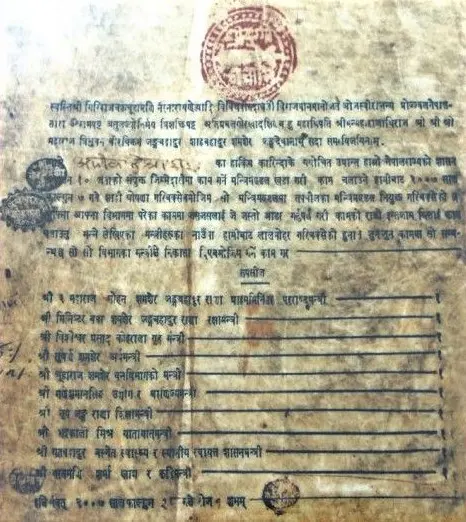
The end was settled elsewhere. Mohan sent his son Bijaya Shumsher to Delhi with offers of reform, and talks with India began just before Christmas. India would not accept the boy king the Ranas had crowned the day after Tribhuvan fled, his three-year-old grandson Gyanendra. On 8 January 1951 Mohan announced that Tribhuvan would be king again, that a constituent assembly would be elected by 1952, that political prisoners would be freed, and that there would be an interim cabinet with members of the people. Two days later the king accepted, and asked the Mukti Sena, the Congress’s liberation army, to stop fighting.
The Nepali Congress hadn’t been asked. Its leaders learned of the deal from the newspapers. B. P. said publicly that it kept alive the Ranas who opposed democracy, and that a second stage of the struggle lay ahead. His half-brother Matrika, the party’s president, said no interim arrangement would be accepted until real power passed to the people. India’s own socialists, Jayaprakash Narayan and Ram Manohar Lohia, who had helped the Nepali rebels for years, said Nehru was being far too generous to the Ranas. But the party’s leaders had nowhere to fight from except India, and in the end they agreed. The ceasefire came on 16 January.
In February the three sides met in Delhi to make the deal final, though “met” is too strong a word. The king was in one house, the Ranas’ team in another, the Congress leaders in a third. The Ranas and the Congress never once sat across a table. India’s ambassador, the same Singh who had signed the treaty, went from one to the next. In one account, after some weeks of this B. P. simply heard one day that it had been done.
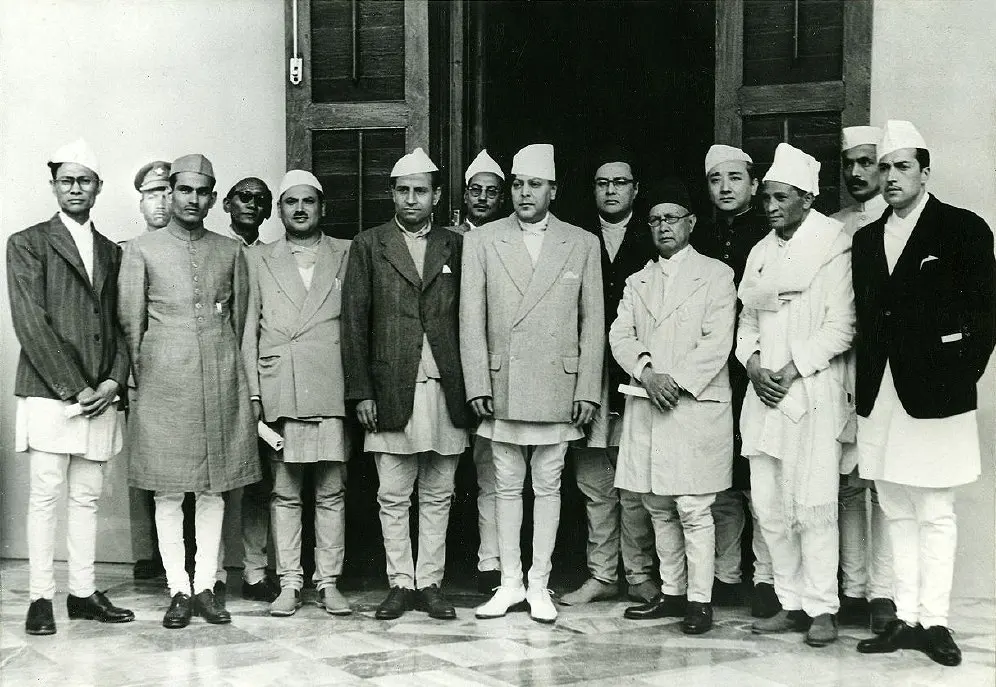
What had been done was a coalition. Mohan stayed prime minister. Five Ranas and five Congress men made up the cabinet, with the Congress holding home affairs, under B. P., and finance. The king would rule as the head of a constitutional government until an elected assembly wrote a constitution. On 15 February Tribhuvan landed at Kathmandu’s Gauchar airfield with the Congress leaders, and three days later he proclaimed it.
Not everyone stopped. K. I. Singh called the Delhi deal a betrayal and attacked Bhairahawa again, until he was arrested. In the eastern hills Ram Prasad Rai, who had led the fighters of Bhojpur, refused it too.
Three ways to tell it
Nepalis have told this story in at least three ways. Each fits some of the facts.
The first is that it was a people’s revolution. The Nepali Congress and the men and women who fought for it tell it this way. Ordinary people took up arms, marched, faced bullets and broke a regime that had looked unbreakable. The Ranas didn’t give up their power because of an agreement in Delhi. They gave it up because their governors were surrendering, their officers resigning and their own cousins walking in the processions. One fighter later called his book on it नेपालको जनक्रान्ति २००७ (Nepal’s people’s revolution of 2007). The Hindi writer Phanishwar Nath Renu, who fought beside B. P., put it another way: “not unsuccessful but rather unfinished”.
The second is that it was India’s settlement. The rebels fought, but India decided the result. India gave the king refuge, flew him out, let the rebels arm on its soil and then stopped them. It wouldn’t recognize the boy king, it made the deal at its own table, and it set the shape of the government. Nehru said plainly what he wanted: Nepal peaceful and stable on India’s northern frontier, with China now in Tibet, by a middle way that didn’t uproot the old order completely. Those who tell it this way see the treaty of July and the secret letters as part of the same story, and they quote Matrika Koirala: the Ranas, not the revolution’s commanders, got to Delhi first. Even a writer from the Rana side calls the deal Delhi’s manipulation, and says it left India seen as an interfering bully instead of a kind elder brother.
The third is that it was the king’s return. The Rana prime ministers had kept the Shah kings shut in their palace since 1846. Tribhuvan broke out of it, and without him the rising would have had no one to rally round, and India no lawful ruler to back. One historian of these months calls the king’s own part a decisive one. The Grade 9 इतिहास book tells it largely this way: Rana rule ended, and the rights of both king and people were restored. The day Nepal keeps as Democracy Day is the day the king proclaimed.
There’s no need to choose one, and historians don’t all agree. The three views mostly differ about what mattered most. Nobody denies that people fought and died, that India arranged the deal, or that the king came back with more power than any Shah had held for a century: the interim constitution of 1951 gave him all executive power, command of the army among it.
The plain lesson of these months is that Rana rule ended in many places at once. In July the Ranas signed a treaty with India that still governs much of how the two countries live together. In November the king fled to India and the Nepali Congress rose in arms. Through the winter, towns from Birgunj to Pokhara were taken, sometimes by fighting and often because the Ranas’ own men gave up, and some were lost again. In Delhi, India brought the king, the Ranas and the Congress to a compromise none of them had wanted. What Nepal got in February 1951 was a beginning: freedom to speak and organize, the promise of an elected assembly, and a coalition that satisfied nobody for long.
Found a mistake? Please tell us.