
When the census of 2021 went from door to door, it asked every household about the people who weren’t there: is anyone from this house living abroad? Almost one household in four said yes. Added up, the answer was 2,190,592 people, more than four in five of them men. That is more people than live in the whole of Kathmandu district.
The same census asked something quieter, too: where were you born? In Kathmandu district, more than half the people counted had been born in some other district. In Khotang, in the eastern hills, it was one in twenty.
So Nepalis are on the move in two directions at once, out of the country and across it. Neither is new, and neither is simple. Leaving can be a plan a family has worked toward for years, or the only thing left to do, and very often it is both. This chapter is about where people go, why, and what their going does to the places at either end.
Push, pull and the road between
The plainest way to think about why people move goes back to the 1880s, and it was set out most clearly by an American demographer, Everett Lee, in 1966. Every place, the one you live in and the one you might go to, has things that hold people and things that drive them away. Too little land to feed a family, no paid work within a day’s walk, a school that stops at Grade 8: these push. Wages, a college, a cousin who already has a room: these pull. Geographers usually call them push and pull factors.
But Lee added two things that make the idea much more useful. The first is that between any two places lies a road, and the road has its own obstacles: distance, the cost of the ticket, a visa, a debt to the agent who arranged the job. A pull that can’t get past the obstacles moves no one. The second is that people don’t weigh their home and their destination equally. You know your own village down to the last terrace. You know the place you are going to only in part, from what others tell you.
That is why the same push sends people from one village to the Gulf and from the next one to Delhi, and why people from one district follow each other to the same places abroad. The first person who went learns the road; everyone after travels it more cheaply.
Before going on, it helps to know that Nepal counts its movers in three different ways, and they never agree. The census counts the people a household says are abroad on the day it is asked. A national household survey taken in 2022 and 2023 asked the same question more carefully and found about 3.0 million. And the government counts labor permits, which are papers, not people: one worker who renews a contract three times is counted three times, and a worker who goes to India needs no permit at all, so isn’t counted once. Each number is right about what it measures. Mixing them up is the commonest mistake in writing about migration.
Moving inside Nepal
Most movement never crosses a border. In 2021, 69% of Nepalis lived in the same local level they were born in, and another 19.5% had been born in some other district.
The census also asked people who had moved why they moved, and the biggest answer is not work. It is marriage, at 38%. In most of Nepal a bride goes to live in her husband’s home, so a woman who marries in the next district becomes, to the census, a migrant. Of all the women who had moved, 58% had moved for marriage. Among men the biggest reason was work, given by 31%. Behind those come family members moving with someone else, study, and coming home again.
Where the movers end up shows the pulls at work. In Kathmandu district 56% of the people had been born somewhere else, in Bhaktapur half, in Lalitpur 45%. In Chitwan it was 38%, and in the big districts of the eastern and western Terai, Jhapa, Morang, Rupandehi and Kailali, more than a quarter. In Ramechhap, in the hills, it was 7%; in Siraha, a crowded district of the eastern Terai that sends people out rather than drawing them in, 6%. Across the whole mountain belt, barely one person in twenty had been born in another district.
The longest of these moves has been downhill. The Terai is less than a quarter of Nepal’s land. In 2001 it held 48% of its people; in 2011, 50%; in 2021, 54%. The hills and mountains are losing their share of the country.
It hasn’t always been that way. From the middle of the 1950s the government, with American help at first, began resettling hill families on land in the Terai and the inner Terai, first in the Rapti valley of Chitwan and then in districts from Jhapa, Morang and Udayapur in the east, through Chitwan and Nawalparasi, to Bardiya, Kailali and Kanchanpur in the west. In the same years a campaign against malaria began, spraying DDT, and after it the number of people moving down from the hills and mountains rose sharply. How the land was handed out, who came and when, and what it all meant for the Terai are still argued over, in Nepal’s politics as much as in its history books. The census can say how many people live in the Terai now. It can’t settle that argument, and this chapter won’t try.
The most recent moves are shorter. In one valley of Kaski, whole families have been moving downhill to the market towns lower down. The fields they leave behind on the upper slopes go back to scrub and then to forest, while the land below grows more crowded and more exposed to floods, one small part of the story told in The forests come back. And all of Nepal’s fastest-growing places, the valley first, are the ones in Three million people.
Abroad
India, with its open border, still takes more Nepalis than any other country: the household survey found about 1.1 million there. They need no papers, so they appear in no permit count. The far west sends its people that way: more than four in ten of the Nepali workers in India come from Sudurpaschim.
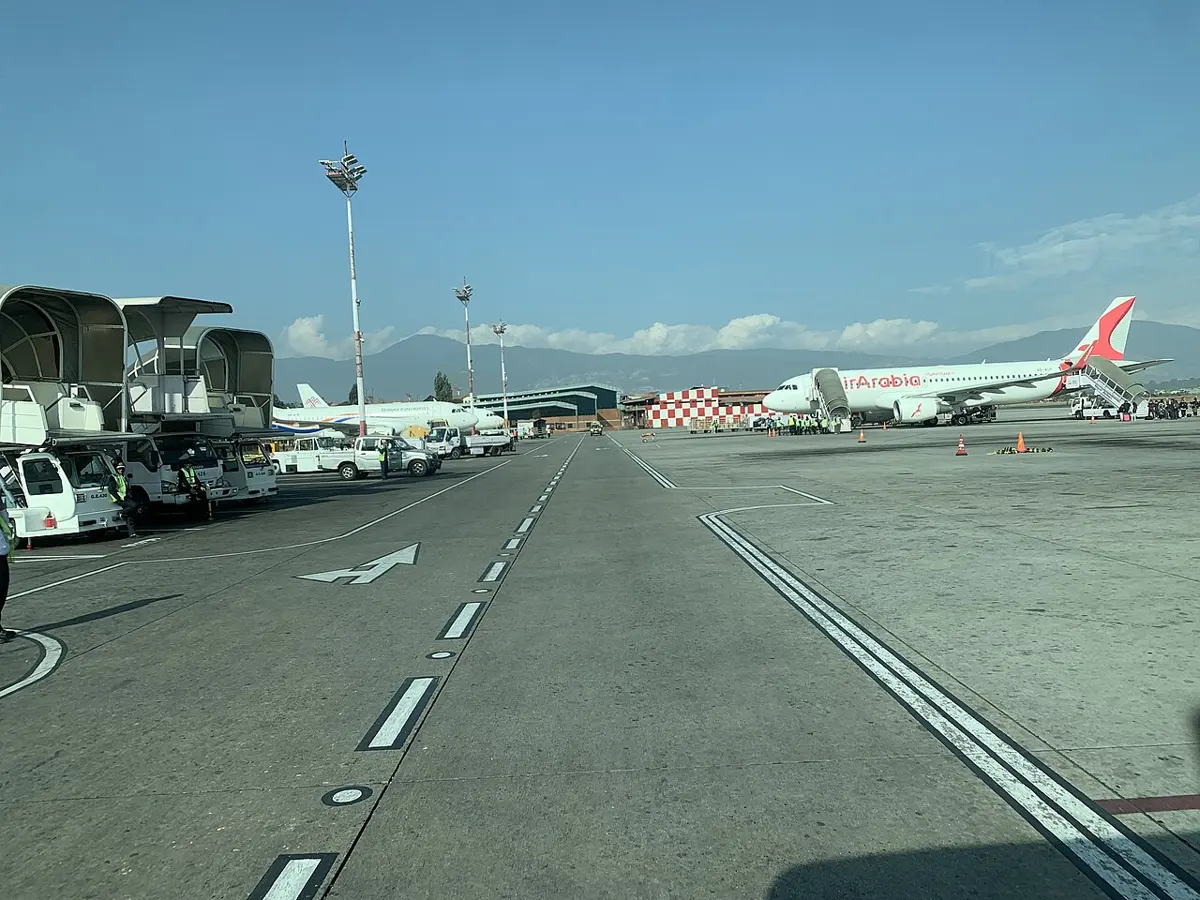
The big change of this century has been the Gulf and Malaysia. From 2008/09 to 2023/24, Nepal issued more than 5.7 million new permits to work abroad.
In 2023/24 the government issued 460,102 of them. Over that year and the one before, workers went to 148 countries, but most went to a handful:
| Country | New labor permits, 2023/24 |
|---|---|
| United Arab Emirates | 131,026 |
| Malaysia | 81,382 |
| Saudi Arabia | 73,094 |
| Qatar | 40,932 |
| Kuwait | 28,776 |
| Croatia | 14,240 |
| Romania | 12,700 |
| Japan | 10,500 |
The order changes fast. The year before, Malaysia took 219,354 workers, almost four times as many as the Emirates; a year later it took fewer than they did. A factory closes, a government changes its rules for foreign hiring, and a village in Dhanusha changes its plans. Over those two years, the six Gulf states and Malaysia took 81% of all new permits between them. The new names near the bottom of the list, Croatia, Romania, Japan, are the newest roads.
Nearly half the workers who leave are between 25 and 34. More women are among them than before: 12.9% of new permits in 2023/24, against 3.9% fifteen years earlier, and that counts only women who went with papers. The places they leave from are uneven too. Koshi and Madhesh each send over a hundred thousand workers a year on permits, the most of any province, and the districts that send most are in the eastern and central Terai: Jhapa, Dhanusha, Morang, Sarlahi, Siraha, Mahottari. Karnali and Sudurpaschim each send fewer than thirty thousand, because their people mostly go to India instead.
Some of them don’t come back. The Foreign Employment Board pays a sum to the family of a worker who dies abroad, and its records show more than 1,200 such deaths in each of the two years to mid-2024. Since 2008/09 the most common cause on the records, about one in five, is simply “natural causes”, with nothing more said. The government’s own report on migration points to studies linking hard labor in great heat to heart disease and to failing kidneys. In Malaysia, in those two years, the most common recorded cause was suicide. These are the deaths the Board knows of; a worker who went without a permit, or to India, isn’t in its records at all. They are a small fraction of the people who go, and each one is a family’s loss.
And then there are the people who come home, more than half a million in each of those two years, some for a holiday between contracts, some for good. Many bring back skills and savings. Some come back early and in trouble, cheated by an agent or sick. Of all the complaints people brought to Nepal’s migrant resource centers, almost half were about being cheated.
What leaving does to both ends
For the country the workers leave, the most visible result is money. In the year to mid-July 2024, Nepalis abroad sent home about 1.4 trillion rupees. In 2023, more than a third of all households received some. The World Bank, comparing it with everything Nepal produces in a year, put it at 26% in 2024; only three countries in the world, all of them smaller, had a higher share. Its first figure for 2025 is higher still, about a third, after a year in which more people went and much more of the money came through the banks instead of informal dealers.
What does the money do? Asked how they used it first, 72% of receiving households said daily needs: food, clothes, the ordinary cost of living. The next most common first use was paying off loans, which is often the loan that paid for the journey. The most common second use is children’s schooling. How much arrives isn’t the same everywhere, either. In Koshi, Gandaki and Bagmati, each person sending money sent over 240,000 rupees a year on average; in Sudurpaschim, Karnali and Madhesh, between 80,000 and 135,000, because many more of their workers are in India.
The fields are harder to read. Walk through the hills and you will see terraces gone to grass. Studies of the same hills don’t agree on how much of that is migration’s doing. One, in the western middle hills, found that families with someone abroad let their cereals slip and hired labor for the work family members had done, but didn’t turn to growing crops to sell: the money eased their lives without changing how they farmed. Another, in Lamjung, found that fields grown less than they could be were far more common than fields given up entirely, and that households with no one abroad were farming their land less too. So fewer hands are only part of the story; something else is at work as well.
Then there are the households themselves. In 2021, 31.6% of Nepal’s households had a woman at their head, up almost six points in ten years. The census doesn’t say why, and it would be easy to assume the reason is men abroad. It is surely part of it. But what having a husband abroad means for a woman depends on whose house she lives in. A study in Jhapa found that women running their own households took over the decisions about the farm as well as the work, while women living with their husband’s parents took on less of the say. And, to the researchers’ surprise, the women in charge of their own households seemed to be moving away from farming altogether.
The other end has its own story. The countries that take the workers get their work, and they decide most of the rules the workers live by. A worker’s life there, the wages, the room, whether a worker can change employers, depends on laws Nepal doesn’t make. That is the thing a sending country can do least about, and it is where two other countries have tried very different things.
Mexico and the Philippines
In the dollars sent home, the world’s two largest receivers in 2024 were India and Mexico, and the Philippines was fourth. Nepal, a much smaller country, was twentieth. But measured against the size of each country’s economy, the picture turns over.
Mexico’s migration is mostly to one neighbor, the United States, and much of it began with an agreement between governments. From 1942 to 1964, the two countries ran the Bracero Program, which signed about 4.6 million contracts for Mexican men to work in the United States, many of them for the same men going again, the largest contract-labor scheme the United States ever ran. When it ended, the going didn’t: the work and the connections were still there, and people kept crossing, now without papers. By 2023 about 10.9 million people born in Mexico lived in the United States. The number has fallen since its peak of 11.7 million in 2010, and for a decade from 2005 more Mexicans left the United States than arrived. Money sent home was worth about $66 billion in 2023 (in 2024, only India received more), but under 4% of Mexico’s large economy. For most of Mexico, it matters. For the country as a whole, it is not what Nepal’s is.
The Philippines was one of the first countries to organize its migration on purpose. In 1974 its new labor law created an office to run “a systematic program for overseas employment”, for workers “in excess of domestic needs”, banned foreign employers from hiring Filipinos directly, and required workers to send a part of their earnings home. In 1982 the work was brought together in one agency, the Philippine Overseas Employment Administration. Then, in 1995, a new law turned the old one round: the state “does not promote overseas employment as a means to sustain economic growth”, and workers would be sent only to countries where their rights were protected. A law signed at the end of 2021 gave migrant workers a ministry of their own, the Department of Migrant Workers, which took over the agency’s work from 2022. In 2025 about two million Filipinos were working abroad, more of them women than men, a quarter of them in Saudi Arabia. Their money is under a tenth of the economy, a share that has been slowly falling for twenty years.
Nepal sits somewhere between the two. Like the Philippines, it has a government that licenses agents, approves each worker and keeps a fund for those who die or are injured. Like Mexico, it has a long open road to one big neighbor that no one counts. And it depends on the money more than either does, more, in fact, than almost any country on Earth.
None of this makes leaving either a triumph or a tragedy. It makes it a choice that millions of families weigh, with what they know of home and what they’ve heard of away, and the road between. If you or someone in your family is getting ready for that road, Life Skills has a series on Going Abroad, from the papers to the flight to the first weeks there.
Found a mistake? Please tell us.