
On 24 March 2020 Anshu pulled down the shutter of her tea shop and didn’t lift it again for weeks. Nepal had gone into lockdown, and so had most of the world. Nothing in her shop was broken. The stove worked, the milk could be bought, and Anshu wanted to work as much as ever. What had gone was the customers: the bus drivers, the shop assistants and the builders from the site across the road, who had stopped earning and so stopped spending. The milkman lost Anshu’s order, the bakery lost her biscuit order, and each of them spent less in turn. (Anshu and her shop are made up; the lockdown is not.)
That is the puzzle of this chapter. Sometimes a whole economy sits idle while its people want work and its machines stand ready, and nobody chose it. In the 1930s the richest country on Earth spent years with a quarter of its workers jobless, and no virus, war or drought to blame. Economists still argue about why that happens, and about whether a government can or should do anything about it. To follow the argument, start with one plain fact: every rupee somebody spends is a rupee somebody else earns.
Spending is someone’s income
Suppose the municipality pays a road crew Rs. 1 lakh to mend the bazaar’s road. The crew doesn’t keep the money in a drawer. Say they spend half of it in the bazaar, at Anshu’s shop, the vegetable seller’s and the barber’s, and the other half leaks away: some is saved, some goes in taxes, and some buys things made in other countries. Then the bazaar’s shops have earned Rs. 50,000 more than they would have. They too spend half in the bazaar, which earns another Rs. 25,000, and so on, each round half the size of the one before.
Add up the rounds and the Rs. 1 lakh has become Rs. 2 lakh of income in the bazaar: 1 lakh, then 50,000, 25,000, 12,500 and a tail that shrinks to nothing. The number that turns the first spending into the total is the multiplier. If a share of each extra rupee leaks out and the rest is spent again close to home, the multiplier is 1 divided by the share that leaks. Half leaking gives 2. A quarter leaking gives 4, and nine-tenths leaking gives only 1.1. The more of each rupee that is spent again at home, the bigger the multiplier.
The same sum runs backwards, which is the dark side of the idea. If the road crew is laid off, the bazaar loses not Rs. 1 lakh but Rs. 2 lakh, because each shop that earns less spends less. A fall in spending anywhere spreads, in shrinking ripples, through everyone’s income.
This is not the money multiplier of the banks, the chain by which one deposit turns into loans and more deposits. That one is about how much money there is; this one is about how much is spent and earned. They share a name and a kind of arithmetic, and nothing else.
The textbook courses work it out with three leaks: what people save, what goes in taxes and what buys imports. CORE’s course, taught at universities round the world, takes a household that spends 60 paise of each extra rupee of income after tax, a tax of 20 paise on each rupee and imports of 10 paise. Then each rupee spent becomes about 1.6 rupees of income. Without the taxes and the imports, the same households would turn it into 2.5. The idea was first set out by Richard Kahn, a Cambridge economist, in 1931, and made famous five years later by a better-known one from the same university.
Ups and downs
An economy never grows at a steady pace. For a while output and jobs rise fast, factories run flat out and prices start to climb. That is a boom, in Nepali तेजी. Then growth slows, or output actually falls, firms lay people off and shops stand empty. That is a slump, मन्दी. The whole wave of rise and fall is the business cycle, व्यापार चक्र. Keeping the economy steady through it, without wild booms or deep slumps, is what Nepal’s Grade 10 book calls आर्थिक स्थायित्व, economic stability, and it is one of the reasons a government manages its spending and its income.
A slump bad enough is called a recession. A common rule of thumb is two quarters in a row in which GDP falls, but the body that dates America’s recessions, the National Bureau of Economic Research, uses a broader test: a significant fall in economic activity that is spread across the economy and lasts more than a few months, judged by jobs, incomes and sales as well as output. In Britain’s records, which go back to 1875, output has fallen about twice a decade. But the cycle keeps no clock: booms and slumps come at no fixed interval.
The Great Depression
The worst slump of modern times began in the United States in August 1929, two months before the stock market crash that is usually remembered as its start. It didn’t touch bottom until March 1933. In those years America’s real output fell by about 29%, and its prices by about a quarter. By 1933 one worker in four was out of work. It spread round the world, partly because the gold standard tied countries’ interest rates and money to one another, so that what America’s central bank did, other countries felt.
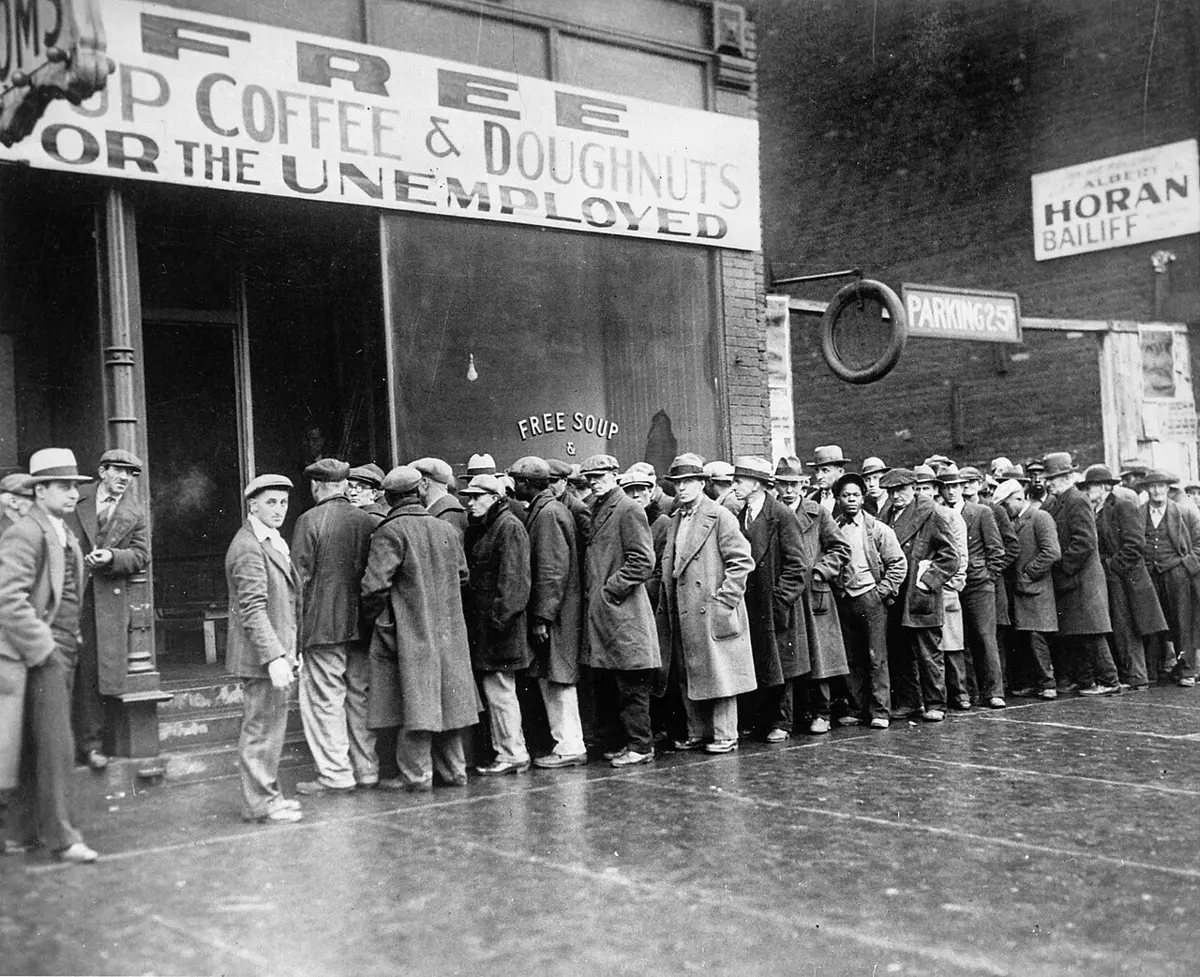
What made it so strange was that nothing real had been destroyed. The farms, the factories and the people who knew how to run them were all still there. The older economics had an answer that sounded sensible: if workers are idle, their wages will fall until it pays employers to hire them again, and if savings pile up, interest rates will fall until it pays firms to borrow and build. Leave it alone and the slump cures itself. Year after year, it didn’t.
The economist who offered a different answer was John Maynard Keynes, of Cambridge, in his General Theory of Employment, Interest and Money of 1936. His central point was that spending decides how much is made, rather than the other way round. Firms make what they expect to sell. If households and firms all decide to spend less at once, sales fall, firms cut output and jobs, incomes fall and spending falls again, the multiplier working backwards. The economy can settle at a level of output well below what its workers and machines could make, and stay there, because nothing in the slump itself pushes spending back up.
That leads to what economists call the paradox of thrift. One family that saves more in hard times is wise: the savings will be there if things get worse. But if every family does it at once, the shops’ sales fall, their owners and workers earn less, and in the end incomes fall so far that the country as a whole may save less than before, not more. What is true for one household is not true for all of them together.
Why would everyone cut back at once? Keynes thought much of the answer lay in how firms decide to invest. A new factory pays off over many years that nobody can foresee, and he doubted that such choices were ever really a matter of careful sums. Most of them, he wrote, are taken “as a result of animal spirits”, “a spontaneous urge to action rather than inaction”. When confidence drains away, firms wait, and their waiting is a fall in spending that the multiplier spreads.
His cure followed. If private spending has fallen, the government can spend in its place, and once the slump is deep enough, almost any spending will do. With a straight face he imagined the Treasury filling old bottles with banknotes, burying them in disused coal mines, covering them with town rubbish and letting private firms dig them up again: “there need be no more unemployment.” It would, he added, “be more sensible to build houses and the like”, but if that were blocked, the bottles “would be better than nothing”. The joke had a serious point. In a slump, the danger is not that a government wastes workers who could be busy elsewhere, since they are idle anyway. The danger is doing nothing.
Keynes had one more worry. A central bank normally fights a slump by cutting interest rates, so that borrowing to build or buy is cheaper. But once rates are very low, he thought, people may prefer to hold cash rather than lend it at almost nothing, and then the central bank has lost its grip on the rate. Economists now call that limit a liquidity trap. Keynes himself said in 1936, “I know of no example of it hitherto.”
Keynes’s critics
For a generation after the war, most economists followed Keynes, and many of them paid little attention to money. Then came the argument back.
The sharpest critic was Milton Friedman, of the University of Chicago. With Anna Schwartz he wrote A Monetary History of the United States (1963), which told the Depression another way. From the fall of 1930 to the winter of 1933, as banks failed in waves of panic and frightened people pulled out their deposits, America’s money supply fell by nearly 30%. The central bank could have stopped it by lending freely to the banks, and it let it happen. On this account the Depression was not proof that private economies are unstable; it was the work of a central bank that failed at its job. Almost seventy years later, at a conference for Friedman’s ninetieth birthday in 2002, Ben Bernanke, then a governor of the Federal Reserve and later its chairman, told him and Schwartz: “You’re right, we did it. We’re very sorry. But thanks to you, we won’t do it again.” Bernanke’s own work, which Chapter 15 told, had added the bank failures to their story.
Friedman doubted that governments could steer well. It takes time to see that a slump has begun, more time to decide what to do, and more again before anything done takes effect, and by then the economy may already be turning. A government that steers by what it sees in the mirror can make the swings worse. Better, he argued, for the central bank to let the money supply grow at a steady pace, year in, year out, and stop trying to be clever.
The 1970s seemed to prove the critics right. In America and much of the rich world, prices and joblessness rose together, which the old Keynesian models said shouldn’t happen, and people coined a word for it, stagflation. American inflation passed 14% in 1980. It was beaten only when the Federal Reserve raised interest rates so high that unemployment reached nearly 11% in 1982, a slump brought on by the cure. Friedman had already argued that pumping up spending could buy fewer jobless people only for a while, and that over more than about five years it would leave nothing but higher prices. Robert Lucas went further. If people learn what a government is doing and plan around it, he argued, policy can’t keep fooling them. Of his work the Nobel committee wrote that a stabilization policy “cannot systematically affect long-run employment.”
Where economists disagree today is less about whether Keynes or Friedman was right than about how much of each to believe, and when. Almost all now accept Friedman’s point that a central bank must never let money collapse as it did in the 1930s, and almost all accept that in a deep slump, with interest rates already near zero, the government’s spending matters a great deal. They still argue about the middle: how big the multiplier really is, whether a government should steer in ordinary times or only in emergencies, and whether the debts it runs up in a slump cost more later than the jobs saved now. The answer seems to depend on the country and the moment.
2008 and 2020
Two slumps since have tested the ideas. The first began in America in December 2007. Housing was at its center: American home prices fell by about 30% from 2006 to 2009, and the losses on loans to buy them shook the banks. America’s output fell by 4.3%, its unemployment doubled from 5% to 10%, and the slump lasted until June 2009, the longest since the Second World War. In 2009 the world’s output fell, for the first time in the World Bank’s figures, which go back to 1961.
This time the Federal Reserve, led now by Bernanke, didn’t let money collapse. By December 2008 it had cut its interest rate from 5.25% to almost zero, and it went on to buy about $1.75 trillion of government bonds and bonds backed by home loans, to push long-term rates down too. With its own rate at the floor, it could go no lower, and the government did what Keynes would have done: in 2009 the United States passed a stimulus of $787 billion, in spending and tax cuts. How much it helped is still argued, because the places that got most of the money were also the places hit hardest.
The slump revived the study of the multiplier, and economists found clever ways round that problem. In Italy, after a law of 1991, the government dismissed local councils found to have close links with the Mafia, and the officials sent in their place cut spending by about a fifth. Those cuts had nothing to do with how the local economy was doing, so they show what spending does on its own. The answer was a multiplier of about 1.5. Another study found that the size of the multiplier depends on the moment: in America a dollar of government spending added between $1.50 and $2 to output in a recession, but only about 50 cents in a boom, when the workers and machines it hires would have been busy anyway, and its spending crowds out other spending.
The slump of 2020 was different from all of these. It began not with falling confidence but with an order to stay at home, and in a slump like that nothing a government does can open the shops. What governments did instead was keep people and firms afloat until they could. The world’s output fell by about 2.9% in 2020, its biggest fall in the World Bank’s figures, and rose by 6.5% the next year.
A small country with a pegged rupee
How much of this fits Nepal? Less than one might guess, and the first clue is in its own history.
Nepal’s slumps mostly don’t come from spending that dries up. They come from a blow to what the country can make. In 1982/83 a severe drought and then floods cut the rice harvest by about 18%, and the economy shrank by about 3%. In 2015 the earthquake struck, and in the year after it, trade across the border with India was completely disrupted, and growth fell to almost nothing. In 2019/20 the lockdown, from 24 March to 21 July 2020, cut what mines, factories, builders, shops, hotels and restaurants produced, and output fell by about 2.4%. Meanwhile, when the world fell into its slump of 2009, Nepal hardly noticed. The money its workers sent home from abroad, a large part of what Nepali families spend, rose from $2.73 billion in 2008 to $2.98 billion in 2009.
The cure for a slump like these is not mainly more spending. A government can’t spend rain into a dry field or reopen a border by buying more. It can help people through, rebuild what was broken, and, when the cause has passed, step back. After the earthquake, rebuilding, more electricity and one of the best monsoons in years helped the economy grow by about 9% in 2016/17.
The multiplier works in Nepal too, but it leaks badly. Keynes noticed that in a country that trades, part of any new spending “will accrue to the benefit of employment in foreign countries”. In 2025/26 Nepal bought Rs. 2,096 billion of goods abroad, close to a third of all it produced, so a large share of each extra rupee buys goods made in India, China and elsewhere, and the round of spending that follows happens there, not in Nepal. A study of 44 countries by Ethan Ilzetzki and two colleagues found that government spending does less in open economies than in closed ones, and less in developing countries than in rich ones, which counts against Nepal. It also found that the multiplier is fairly large where the exchange rate is fixed, as the rupee’s is to India’s, and nothing at all where it floats, which counts in Nepal’s favor. And in countries already deeply in debt they found it was negative. Nobody has measured Nepal’s own multiplier in a way we could check, so we give no number for it.
The peg ties the central bank’s hands. Nepal Rastra Bank calls the fixed rate, Rs. 1.60 to one Indian rupee, the “nominal anchor” of its monetary policy, the fixed point everything else is set around, and its policy for 2026/27 kept it. A central bank that fixes its currency to another gives up much of its freedom to set interest rates of its own, and, as Chapter 16 told, the peg is part of why Nepal’s prices follow India’s. In a slump it can still help at the edges. In March 2020, as the lockdown began, it cut the share of deposits banks must hold back from 4% to 3%, freeing about Rs. 35 billion to lend, let borrowers pay the installments due in mid-April as late as mid-July, offered cheap loans for banks to lend on to small firms, and cut the interest of borrowers who paid on time.
And cheap money can’t make anyone borrow. In 2026 the central bank’s rate stood at 4.25% and banks had far more to lend than people would borrow, yet lending grew slowly. Keynes’s warning, that when firms have lost confidence no cut in interest rates may be enough, was there in miniature: the rates were not at zero, but what was missing was the will to spend, not the money to spend with. Some steadying happens by itself: in a slump a government’s takings from tax fall and what it pays out to help people rises, without anyone deciding it. Whether it should do more, filling the gap with spending of its own, and what that would cost, is a question for the next two chapters, on taxes and the budget.
So a slump is spending that dries up, spread by the multiplier through everyone’s income, until a whole economy sits idle for want of customers. Keynes thought a government should spend in its place; Friedman thought the first duty was to keep money from collapsing and then to leave things alone; and economists still argue about the space between. For Nepal, most slumps have been blows to what it can make, the drought, the earthquake, the lockdown, not shortfalls of spending, and each extra rupee it spends leaks abroad faster than in most countries. The next chapter is about where a government finds its money.
Found a mistake? Please tell us.