
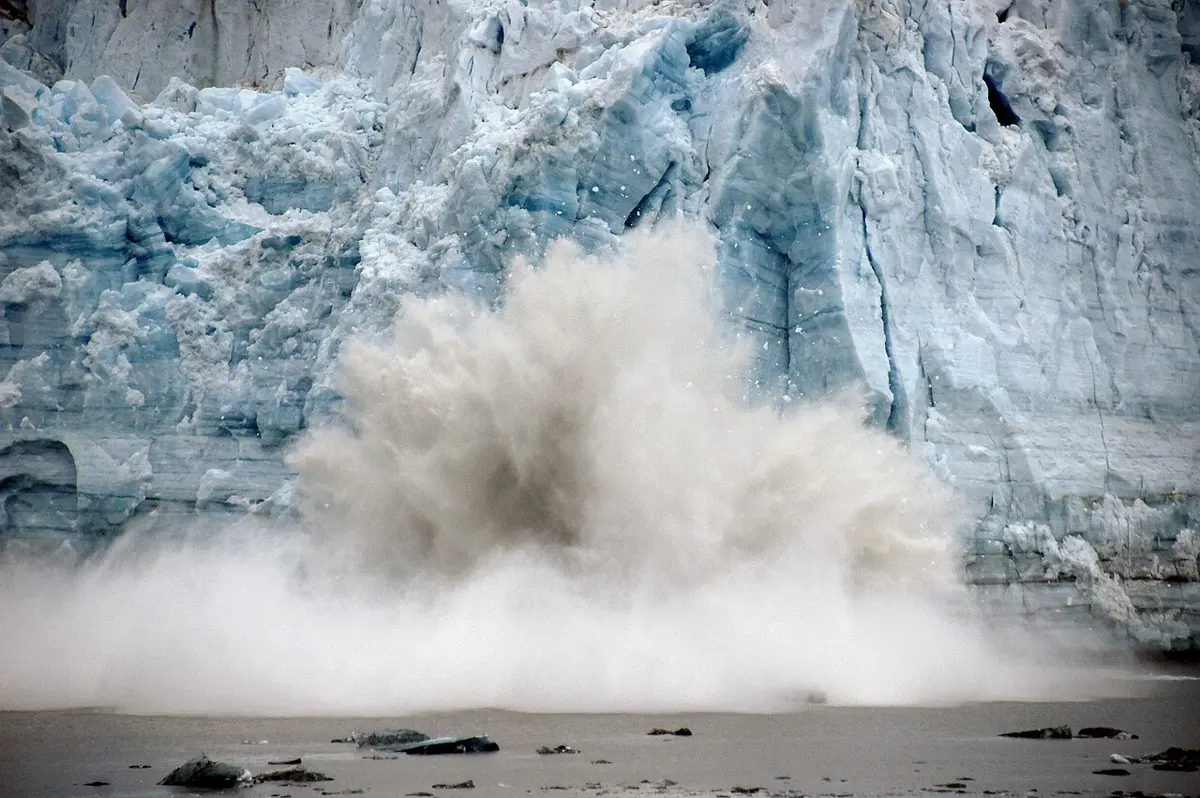
In May 2008, two young men sat on a rock above Ilulissat Glacier in Greenland with their cameras running. In front of them, the end of the glacier began to break up: towers of ice taller than a skyscraper rolled over, crashed into the sea and turned into icebergs. It went on for about seventy-five minutes, the largest such break-up anyone had ever filmed. Their footage became the climax of a documentary called Chasing Ice.
This unit is about global warming and climate change: a review of Chasing Ice, a funny play about neighbors who imagine the worst, and a short talk on how people in England and Dubai think about the weather. You will sort the vowels of book and food, say how sure you are (He must be a chef. They can’t have returned), talk about the future in three ways (I will finish, I will be working, I will have finished), make wh-questions and report them (She asked me where I was from), and write a movie review and a notice. The Extra bit is about linking verbs: be, seem, look, feel, become…
Getting started
The unit opens with three pictures:
- A polar bear standing on a small, broken piece of floating ice in a dark sea, with no land in sight.
- A steep, rocky mountain with only thin patches of snow left in its gullies.
- A town after a storm: houses with their roofs torn off, palm trees snapped or bent, people walking among the wreckage.
Together they show three consequences (results) of a warming world: sea ice melting under the animals that need it, snow and glaciers disappearing from the mountains, and storms growing more violent.
Global warming and climate change
Global warming is the rise in the average temperature of the Earth’s air and seas over many years. Climate change is wider: the long-term change in the pattern of weather in a place, its heat and cold, rain and drought, snow and storms. Warming is the cause; the changed climate is what we live with. (Weather is what happens today; climate is the weather a place has year after year.)
The causes. Some gases in the air, mainly carbon dioxide (CO₂) and methane, trap heat like a blanket: this is the greenhouse effect (Figure 17.1). Without it the Earth would be frozen. But since the 1800s people have made the blanket thicker:
- burning fossil fuels (coal, petrol, diesel, gas) in vehicles, factories, power stations and kitchens, which adds carbon dioxide;
- cutting down forests, which took carbon dioxide out of the air;
- farming and waste: rice paddies, cattle and rotting rubbish in landfills give off methane.
The consequences. The world is now about 1.3 °C warmer than in the late 1800s (as of 2025), and:
- glaciers and ice sheets melt, and sea level rises, flooding low coasts;
- heat waves, droughts and very heavy rain come more often;
- storms grow stronger, because warm seas give them more energy;
- plants and animals must move or die out: the polar bear hunts from sea ice, which melts earlier every summer;
- people suffer: crops fail, water runs short, and diseases such as dengue spread to new places.
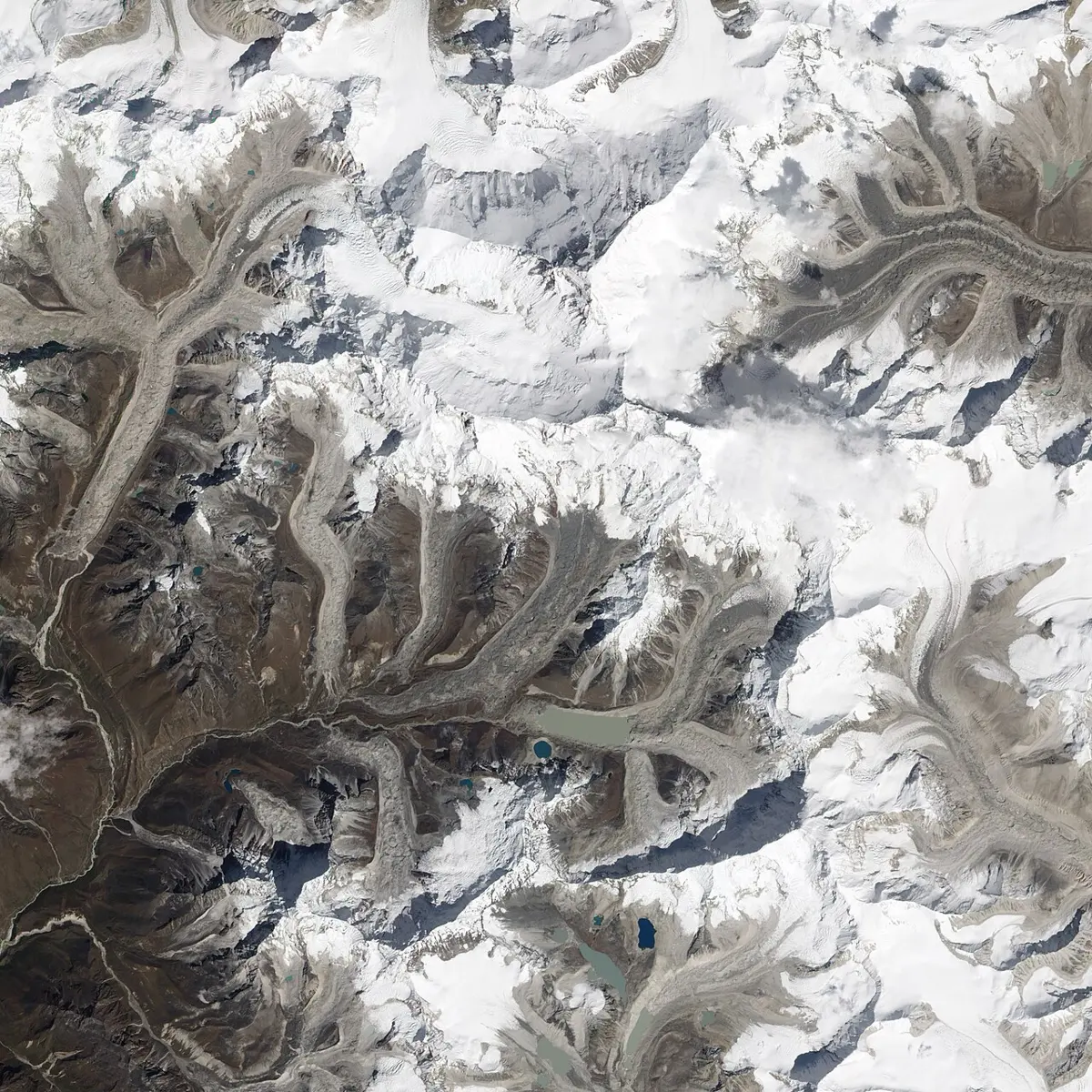
In Nepal. Nepal’s mountains are warming faster than the world’s average. Its glaciers have been shrinking for decades, and new glacial lakes have formed behind walls of loose rock: if one of these walls bursts, a flood rushes down the valley. In 2016 the Nepali Army lowered Imja Tsho in Khumbu by about 3.4 meters to make it safer. ICIMOD, the mountain research center in Lalitpur, has warned that the glaciers of the Hindu Kush Himalaya could lose a third to a half of their ice by 2100 even if warming is held to 1.5–2 °C, and up to 80% if emissions stay high (2023).
Look at the pictures and discuss the causes and consequences of global warming and climate change.
A model discussion
What is the difference between global warming and climate change?
Pick an answer to see why.
Reading I: Movie Review: Chasing Ice
Before you read
- a.What is the name of your favorite movie?
- b.What sort of movie is it?
- c.What do you like about the movie? What are its weaknesses?
Model answers
What kind of text it is
A movie review is a short article that tells readers about a film and judges it: what it is, what it shows, what is good and bad about it, and whether it is worth seeing. This one is about a documentary, a film about real events and real people, not a made-up story. Like most published reviews, it starts with a box of details:
| Detail | What it means | In this review |
|---|---|---|
| Title | the film’s name | Chasing Ice |
| Genre | the kind of film | documentary, biography (the story of a real person’s work) |
| Language | English | |
| Director | the person in charge of making the film | Jeff Orlowski |
| Producers | the people who organize the money and the team | Jerry Aronson, Paula DuPré Pesmen, Jeff Orlowski |
| Writer | who wrote the words and planned the story | Mark Monroe |
| Release | when it was first shown | 2012: first at the Sundance Film Festival in January, then in cinemas from November |
| Runtime | how long it lasts | 1 hour 14 minutes |
| Produced by | the companies that made it | Exposure, Diamond Docs |
The review was written by Andrea Seikaly. The photo beside it shows a climber, tiny against walls of blue ice.
The review, part by part
Paragraph 1: why the film matters now
The review begins with Hurricane Sandy, the huge storm that struck the Caribbean and the east coast of the United States in October 2012, killing more than two hundred people and flooding New York. In the wake of (just after) such a storm, the review says, everyone can see how powerful and unpredictable nature is, and that weather patterns keep changing. Since weather and global warming are now prevalent (common, everywhere) in talk and the news, a film that shows evidence comes at the right time. The review calls it James Balog’s documentary, because it follows the work of that photographer (its director was Jeff Orlowski): it gives striking (very noticeable, impressive) pictures of glaciers shrinking as the climate changes.
Paragraph 2: the photographer’s plan
The film follows Balog’s journey as he tries to capture (record) on photos and video how the glaciers of the Arctic (the region around the North Pole) are disappearing. To accomplish (achieve) this, he started his own project and dubbed it (gave it the name) the Extreme Ice Survey. The endeavor (a serious attempt) began as work for National Geographic magazine and grew into something much bigger: an attempt to show the whole problem.
Paragraph 3: the cameras
The survey began with 25 cameras to be watched over three years. Each was housed (put) in a protective box, so the harsh Arctic weather would not destroy it, and the team came back from time to time to download the footage (take the pictures off the cameras). Balog had photographed glaciers before, and he wanted to return to the same places to see how they had changed. The team set up cameras in Greenland, Iceland, Alaska and Glacier National Park in Montana, in the United States. Each camera took a photo about once every hour of daylight, for years: played one after the other, the photos make a time-lapse film, in which years pass in seconds and the ice can be seen shrinking.
Paragraph 4: a doubter at the start
The film opens with striking and intense clips of natural disasters. Then Balog explains that he himself was once skeptical: he doubted that the climate was really changing and did not trust the scientists’ research. That makes him relatable (easy to understand and feel close to: viewers who doubt can see themselves in him), and it increases his credibility (how much people believe him). A man who set out doubting and ended up finding the evidence himself is hard to dismiss.
Paragraph 5: facts and pictures together
The film combines data and scientific facts with beautiful pictures, and that makes climate change feel real. Balog’s photographs and time-lapse footage of glaciers calving, breaking apart into icebergs, let viewers see and experience what is happening far away. The reviewer’s advice: watch it on the biggest screen you can, because most people will never see such places with their own eyes.
Paragraph 6: easy to follow
Balog refrains from (holds back from) overwhelming the audience with too many scientific details, and makes the data easy to understand. He explains how he works and what his results mean without coming across as boring (seeming dull). When you watch an avalanche on screen, or see a glacier lose so much ice in so short a time, you cannot help realizing that Balog is onto something (has found something real and important).
Paragraph 7: the risks the team took
The film also shows the extreme lengths the team went to: a glaciologist (a scientist who studies glaciers) and a climatologist (a scientist who studies climate) worked with Balog. There are scenes where Balog cries out in disappointment because cameras have failed, and others where he puts himself in precarious (dangerous, likely to fall) positions, climbing down into holes and caves in the ice to get the best shot. Not to mention (and on top of all that) the knee surgery that threatens to stop him hiking on the ice at all.
Paragraph 8: the verdict
Chasing Ice is worthwhile (worth the time it takes). It combines intriguing (very interesting) theories and exquisite (extremely beautiful) images. People who are skeptical about theories on the environment may be reluctant (unwilling) to watch it, but even they will gain something: the film makes viewers think critically about climate change and what it may mean for our future.
Why does Balog’s early skepticism make the film more convincing?
Pick an answer to see why.
What is time-lapse footage?
Pick an answer to see why.
Words from the review
| Word | Meaning here |
|---|---|
| prevalent | common; found everywhere |
| erosion | the gradual wearing away of soil and rock by water, wind or ice |
| accomplish | to succeed in doing; to achieve |
| dub | to give a name to |
| endeavor | a serious attempt to do something |
| footage | film of a particular event |
| intense | very strong; showing strong feelings |
| skepticism | doubt that something is true |
| relatable | easy to understand and feel close to |
| credibility | the quality of being believed and trusted |
| calving | a glacier’s ice breaking off into the sea or a lake as icebergs |
| refrain from | to stop yourself from doing |
| overwhelming | too great or too much to deal with |
| avalanche | a mass of snow, ice and rock falling fast down a mountainside |
| glaciologist | a scientist who studies glaciers |
| climatologist | a scientist who studies climate |
| precarious | not safe; likely to fall |
| intriguing | very interesting, making you curious |
| exquisite | extremely beautiful or finely made |
| reluctant | unwilling, hesitating to do something |
A. Match the words
Match the following words with their meanings.
a. reluctant b. intriguing c. exquisite d. avalanche e. overwhelming f. credibility
i. extremely beautiful or carefully made ii. a mass of snow, ice and rock that falls down the side of a mountain iii. very great; so powerful that you cannot resist it iv. arousing one’s curiosity or interest; fascinating v. hesitating to do something vi. the quality of being trusted and believed in
Answer
B. The crossword
C. Complete the sentences
Complete the sentences with the appropriate words/phrases from the text “Chasing Ice”.
- a.In Chasing Ice, glacial erosion is the result of ……… .
- b.The beginning of the film is set in ……… .
- c.James Balog began his project with a photography program called ……… .
- d.Balog wanted to go back to the scene of the photography to see how the ……… had changed.
- e.The film is based on both data and ……… .
- f.The audience can have a better view of the images on a ……… .
- g.Balog’s project team included ……… .
- h.A person who doubts ……… may hesitate to see the film.
Answer
D. Answer the questions
What kind of film is Chasing Ice?
Answer
What is the main objective of the film?
Answer
Why did Balog and his team set up cameras in different places?
Answer
What helps the audience experience what is happening in the Arctic zones?
Answer
How did Balog try to make the film interesting?
Answer
Why is Chasing Ice a worthwhile film?
Answer
E. Slowing climate change
Work in a group of four or five. Suggest five practical ways to slow down the adverse effects of climate change.
A model answer
Pronunciation: /ʊ/ and /uː/
The letters oo spell two different vowel sounds:
| Sound | How you make it | Examples |
|---|---|---|
| /ʊ/, short | quick and relaxed, lips only a little rounded | book, foot, good, put, could |
| /uː/, long | held longer, lips pushed forward and rounded, as for a whistle | food, moon, school, blue, true |
The two dots in /uː/ mean long. Nepali has both lengths too: the short उ of उठ and the long ऊ of ऊन (though in everyday speech they are often said alike).
Read the words in the box below with the correct pronunciation. Put them in the correct groups.
food book cook foot moon noon roof room good school look hook stood took soon wood too zoo zoom wool
Answer
Speaking: how sure are you?
A. The conversation
Two students, a boy and a girl, talk in speech bubbles:
- Boy: Who is that man? — Girl: He is wearing a chef’s uniform. He works in a restaurant. He must be a chef.
- Boy: Do you think they have returned home? — Girl: Their car is not at home. So, they can’t have returned.
The girl isn’t told the answers: she works them out from what she can see. This is called deduction, and English uses the modal verbs must, may, might, could and can’t to show how sure you are:
| How sure | About now | About the past |
|---|---|---|
| sure it’s true (about 95%) | He must be a chef. | He must have been tired. |
| perhaps (about 50%) | She may / might / could be at home. | She may / might / could have missed the bus. |
| sure it’s not true (about 95%) | They can’t be at home. | They can’t have returned. (or couldn’t have) |
Notice the shape: modal + be (or the plain verb) for now; modal + have + past participle for the past.
The lights are off and nobody answers the door. They ……… out.
Pick an answer to see why.
Sanjeev hasn’t eaten anything since morning. He ……… hungry.
Pick an answer to see why.
B. Situations
Work in pairs. Have similar conversations in the following situations using must, can’t, may or might.
Example: Suman is not at home. These are office hours. A: Where is Suman? B: He must be in his office.
- a.They are coming this week, but I am not sure. They will probably come tomorrow.
- b.Dolma is not sure that she will pass the exam.
- c.Shishir has bought a lottery ticket. He could become a millionaire.
- d.Rajesh looks like a foreigner. He speaks excellent French.
- e.Sambriddhi has got a job. I’m sure she is very happy.
- f.I hope to finish the project tonight. However, I am not sure.
- g.There is somebody at the gate. They always come at eight. I am sure they are road cleaners.
Model conversations
C. At a party
The things in C have already happened, so the answers are about the past: must have, might have, can’t have + past participle.
You met a friend at a party and started talking about your day. Ask his/her opinions about the things below. Your friend will answer you using “must”, “can’t”, “may” or “might”.
- a.My father wasn’t in a very good mood today when I reached home from school.
- b.My English teacher got a phone call during the class and left the room immediately. He looked very worried at that time.
- c.My friend Pratima looked very pleased today when she returned back to the class from the principal’s office.
- d.Someone’s stomach in the class made a growling sound. I do not know why she/he had that problem.
- e.A friend of mine was terribly worried after the English test.
Model conversations
Grammar I: talking about the future
You met the future forms in Unit 1. This unit practices three of them:
| Form | How it is made | What it says | Example |
|---|---|---|---|
| simple future | will + plain verb | a future fact, a prediction, a decision or promise | The team will reach the glacier on Friday. |
| future continuous | will be + -ing | an action in progress at a future time, or over a stretch of future time | This time tomorrow, we will be flying over Khumbu. The workers will be building the bridge for the next two months. |
| future perfect | will have + past participle | an action finished before a future time | By 11 p.m., she will have prepared the report. |
The time words are the clues:
- by (by Friday, by the time he finishes, by 2030) usually means the future perfect: it will be done before then.
- this time tomorrow / next week, at 10 tonight, for the next … usually mean the future continuous: it will be going on then.
- tomorrow, next year, soon, in an hour, I think … with a single event: the simple future.
By the end of this century, Nepal’s glaciers ……… a third of their ice, even in the best case.
Pick an answer to see why.
Don’t phone me at seven tomorrow: I ……… the evening news then.
Pick an answer to see why.
A. Fill in the gaps
Fill in the gaps with the correct forms of the verbs in the brackets.
- a.I ……… (have) no time to do any additional projects next year.
- b.Sambriddhi ……… (finish) her homework before her parents returned home.
- c.My uncle ……… (learn) to talk in English by the time he finishes this course.
- d.Sandeep ……… (stay) at ours till Monday.
- e.The workers ……… (build) the building for the next two months.
- f.You ……… (find) the meaning of the unfamiliar words in an hour.
- g.We ……… (stay) in Damauli until next Saturday.
- h.I think our team ……… (win) the match.
- i.By 11 p.m. tonight, she ……… (prepare) the report.
- j.After I finish my work tonight, I ……… (watch) TV for some time.
- k.The weather forecast says that it ……… (rain) heavily today.
Hint
Answer
B. Visiting Her Majesty
The paragraph is a funny, made-up story told in the past: the writer disguises himself (dresses up so as not to be recognized) as a prince, walks into Buckingham Palace in London, gets directions from a chambermaid (a woman who cleans bedrooms), and surprises the Queen with a hearty slap on the back. Then he tips his hat (touches or lifts it, a polite greeting), bows, and pays her the usual compliments; they open a bottle of champagne, exchange pleasantries (polite friendly remarks), talk about their families for over an hour, show each other his stamp album and her historic jewels, trade (exchange) email addresses, and he kisses her goodbye, on the fingertips of her white gloves. (The Queen then was Elizabeth II, who died in 2022.)
To put it in the future, change every past verb to will + the plain verb. Where two verbs share one subject (I tipped my hat, bowed, and delivered…), one will covers them all. Words like After receiving and After uncorking don’t change: -ing has no tense.
Rewrite the paragraph “Visiting Her Majesty” using the verbs in the future tense.
Hint
Answer
Writing I: a movie review
You wrote a book review in Unit 12. A movie review has the same two jobs, to inform and to judge, and the same rule: never give away the ending. Its parts:
- The details, in a box or a first paragraph: title, genre, director, main actors (or the real people in a documentary), language, year, runtime.
- What it is about: the story or subject in a few sentences, in the present tense (Balog sets up cameras…).
- What is good: the acting, the story, the pictures (cinematography), the music, the message, with examples.
- What is weak: be fair, and give reasons.
- The verdict: is it worth seeing, and who will enjoy it?
Useful words: gripping, moving, hilarious, beautifully shot, well acted, slow, predictable, a must-see, worth watching, I’d recommend it to…
Write a short review of your favorite movie. You may use the movie review in Reading I as a model.
Hint
A model review
Reading II: A Noisy Party
Before you read
The picture shows a man in a cap and a dark jacket, bent over, digging in a garden with a spade; there is a heap of fresh soil in front of him.
- a.Where do you think the man is?
- b.How old do you think he is?
- c.What might he be doing?
Model answers
What kind of text it is
A Noisy Party is a short comic play (a funny dialogue). Its joke is a misunderstanding: a husband and wife lie awake listening to the noise next door, and with each new sound they guess what is happening, each guess darker than the last, until the truth turns out to be quite ordinary. It is also full of the language of certainty from this unit’s Speaking:
| Very sure | Fairly sure | Unsure |
|---|---|---|
| I’m sure…, I’m certain…, there is no doubt that…, It must be…, It can’t be… | I’m pretty sure…, I think… | Maybe…, He might be…, Who could it be? |
The play, part by part
Half past one: the party
Ramila wakes her husband Ramesh, calling him “Silu’s Papa” (in many Nepali homes, husband and wife call each other by their child’s name: Silu’s father). Ramesh thinks it can’t be eight o’clock already: it is only half past one. The noise is from the people next door, having another party. Ramila is angry: they are surely waking up the whole street, the noise is disgusting (horrible), somebody should call the police. Ramesh pretends he wasn’t asleep, and is a little jealous: they must be having a good time, and they never invite us, do they?
Nearly three: the row
Later the guests leave. Ramesh hopes for some sleep at last, but at nearly three o’clock there is more noise: he thinks the neighbors are having a row (a noisy quarrel). Ramila isn’t surprised: they always have rows after parties, she says. Ramesh is certain they are throwing pots and pans; Ramila is sure that crash was a plate, maybe even the TV. They’ll be sorry in the morning.
Before dawn: the spade
Later still, Ramila hears someone in the garden next door. Ramesh guesses it must be the milkman; Ramila is certain it isn’t, because it’s too early. Ramesh looks out: Gosh! It’s Mr. Dahal, and he is carrying a spade. Now their imaginations run wild. Has he killed his wife after the row? If so, he might be burying the body. He can’t be planting potatoes at this hour, can he? Ramesh wants to call the police; Ramila tells him to ask Mr. Dahal what he is doing first.
The truth
Ramesh calls out politely: You are up early this morning. Mr. Dahal hasn’t been to bed: they had a party, and he hopes they didn’t keep the neighbors awake. Oh, no, says Ramesh, who has been awake all night, we didn’t hear anything, nothing at all. Mr. Dahal explains: it was a noisy party, and while they were clearing up, his wife knocked over the goldfish tank. The poor fish died, and he is burying them before his children wake up.
What does Ramesh mean by “They never invite us, do they?”
Pick an answer to see why.
Words from the play
| Word | Meaning here |
|---|---|
| matter | what is wrong; a situation you must deal with (What’s the matter?) |
| disgusting | very unpleasant, horrible |
| row (rhymes with now) | a noisy quarrel |
| gosh | a word of surprise |
| spade | a tool with a flat metal blade for digging |
| goldfish | a small orange or red fish kept as a pet |
| bury | to put something under the ground |
A. Find the words
Find the words from the text above that match with the given meanings.
- a.a situation that you must deal with
- b.unpleasant, horrible
- c.noisy quarrel
- d.expression of surprise
- e.a small orange or red fish
- f.to put something under the ground
Answer
B. Choose the correct answers
What is the relationship between Ramila and Ramesh?
Pick an answer to see why.
Who is woken up by the noise?
Pick an answer to see why.
Why is Ramila certain that it’s not the milkman in their neighbor’s garden?
Pick an answer to see why.
What do Ramesh and Ramila suspect about Mr. Dahal?
Pick an answer to see why.
What was Mr. Dahal actually doing in the garden?
Pick an answer to see why.
What was the party like last night?
Pick an answer to see why.
Who had broken the goldfish tank?
Pick an answer to see why.
C. True, false or not given
Write T for true statements, F for false ones and NG if the information is not given in the text.
- a.Silu is the daughter of Ramesh and Ramila.
- b.Ramesh and Ramila are disturbed by the first noise at midnight.
- c.The Dahals have a good relationship with their neighbors.
- d.The Dahals always quarrel after parties.
- e.Ramesh and Ramila called the police to arrest Mr. Dahal.
- f.Mr. Dahal wants his children to know about the death of the fish.
Hint
Answer
D. Disturbed at night
Have you ever been disturbed in the middle of the night? What happened? Share your experiences with your friends.
A model answer
Listening: the weather in England and Dubai
A. Before you listen
Six pictures show six kinds of weather: in the first row, a house and trees under a bright sun; trees bending in the wind; a sky of big, piled-up clouds. In the second row, children in warm clothes round a fire with snow falling; a gray forest hidden in mist; heavy rain streaming from dark clouds.
Most weather adjectives are made by adding -y to the noun: sun → sunny (double the n), wind → windy, cloud → cloudy, snow → snowy, fog → foggy (double the g), rain → rainy.
Look at the following pictures. They represent various weather conditions. Choose correct adjectives from the box and write them below the pictures.
windy cloudy rainy sunny snowy foggy
Answer
The recording
A man who grew up in England and once lived in Dubai, a desert city of the United Arab Emirates, talks about how people in the two places think about the weather. Read the sentences in B first, then listen, as many times as you need.
Words you will hear: can’t deal with (can’t cope with, can’t manage); heat wave (a spell of unusually hot days); emergency (a sudden dangerous situation needing quick action); weather forecast (what the weather is expected to be); desert, rainforest.
B. Match the halves
Listen to the audio and match the beginnings of the sentences (a–e) with the sentence endings (A–F).
Example: Different people → E. think differently about the weather.
a. The people in England b. The weather in England c. The people in Dubai d. The weather in Dubai e. Global warming
A. don’t think about the weather much. B. is almost the same the whole year. C. are always concerned about the weather there. D. is changing weather patterns. E. think differently about the weather. F. is very changeable.
Answer
Grammar II: wh-questions and reported questions
Making wh-questions
A wh-question asks for information, not yes or no. It starts with a question word:
| Asks about | Word | Example |
|---|---|---|
| a person (the subject) | who | Who found the camera? |
| a person (the object) | whom (formal) or who | Whom did they invite? |
| a thing or an action | what | What did Dawa find? |
| one of a known few | which | Which tent did Lhamu choose? |
| belonging | whose | Whose is this bag? |
| a place | where | Where does Mr. Chaudhari live? |
| a time | when, what time | When did they go to Spain? |
| a reason | why | Why are the glaciers shrinking? |
| a way or a manner | how | How can I send the application? |
| an amount, a length | how much, how many, how long, how far | How long have you been living here? |
To ask about the underlined part of a statement:
- Choose the wh-word that fits the underlined part, and take that part out.
- Put the helping verb before the subject: They are having lunch → What are they having?
- No helping verb? Add do, does or did, and use the plain verb: They went → Where did they go?
- But if the wh-word is the subject (who, what about the doer), keep the statement’s order and add no do: Who went to Spain? (✗ Who did go…?)
- Change I/you, my/your as the speaker would: You can send it by mail → How can I send it?
Ask about the underlined part: “The tourists stayed in Namche for three nights.”
Pick an answer to see why.
Ask about the underlined part: “Pemba climbed Ama Dablam last spring.”
Pick an answer to see why.
A. Make questions
Change the following statements into questions, asking for information as indicated in the brackets.
- a.They went to Spain last week. (When)
- b.Mr. Chaudhari lives in Pokhara. (Where)
- c.I finally discovered the truth. (What)
- d.She wants to learn the English language to find a better job. (Why)
- e.They are having lunch now. (What)
- f.You can send the application by mail. (How)
- g.They have informed the police about the incident. (Whom)
- h.The Smiths sold the house where they had lived for five years. (Which)
Answer
Reporting a wh-question
You reported yes/no questions in Unit 6. A wh-question is reported the same way, but it keeps its wh-word (no if or whether):
- Reporting verb: asked, enquired, wanted to know, wondered.
- Keep the wh-word, then put the words in statement order: subject before the verb, and no do/does/did: “Where are you from?” → She asked me where I was from.
- Move the tense back after a past reporting verb: is → was, does → did, have been → had been, will → would, can → could.
- Change pronouns and time and place words: you → I/me, here → there, now → then.
- No question mark: the reported question is a statement.
| Direct | Reported |
|---|---|
| “Where is the bank?” | He asked where the bank was. |
| “What does your father do?” | Rohan enquired what my father did. |
| “Who will bell the cat?” | The mouse asked who would bell the cat. |
B. Report the questions
Change the following questions into indirect speech. Use the given sentence starters.
- a.“Where are you from?” My new friend asked me ………
- b.“Where is the nearest bank?” The stranger enquired ………
- c.“What have you been doing until now?” My mother wanted to know ………
- d.They said, “How long have you been living here?” They asked ………
- e.“Who is the Prime Minister of Canada?” My brother wanted to know ………
- f.“What does your father do?” Rohan enquired ………
- g.“Where were you living before you came here?” She asked me ………
- h.“Who will bell the cat?” The old mouse asked ………
- i.“What time does the train leave?” She wanted to know ………
- j.“How could you desert me?” She wondered ………
Answer
C. Your own questions
Collect at least ten statements and change them into wh-questions. Swap with a partner and check each other’s answers.
Ten model pairs
Writing II: a notice
A notice is a short, formal announcement for many people at once: a school’s students and parents, a ward’s residents, the members of a club. It is put up on a notice board, read out, or shared online. It must be clear, short and complete: the reader should know at a glance what, when, where, who and what to do.
A. The parts of a notice
The model notice, from a school in Bhanu, Tanahun, has all the parts:
- The name and address of the organization giving it: Shree Janajagriti Secondary School, Bhanu-10, Tanahun.
- The date it was written: 14 June 2021.
- The heading NOTICE.
- The message, in one or two short paragraphs: who it is for (all the students and parents), what (the school will remain closed for the summer vacation), when (from 15 June to 15 July 2021), and what next (regular classes will resume from 16 July).
- Who it is from: the signature and title, Head Teacher.
Notices use formal phrases: This is to notify/inform all … that …, will remain closed, will resume, Interested students are requested to …, For more information, contact …
Read the following notice and underline all the important information.
Answer
B. Write a notice
Imagine your school is organizing an Inter-house Spelling Contest next week. Prepare a short announcement notice on behalf of your head teacher.
Hint
A model notice
Project work
Extra bit: linking verbs
A linking verb joins the subject to a word that says what it is or what it is like. It shows no action; it simply links: in The ball is red, is links the ball to red. The word after a linking verb is called the complement: an adjective (red, tired) or a noun (a chef, a doctor).
The most common linking verbs:
| Kind | Verbs | Example |
|---|---|---|
| being | be (is, are, was…) | The glacier is huge. |
| becoming | become, get, grow, turn | The sky turned gray. He became a pilot. |
| seeming | seem, appear | The neighbors seem angry. |
| staying | remain, stay | The roads remained closed. |
| the senses | look, feel, sound, taste, smell | The soup smells good. You look tired. |
| proving | prove | The forecast proved wrong. |
A test: replace the verb with is (or was). If the sentence still makes sense, the verb is linking: The soup smells good → The soup is good. ✓
Which sentence uses a linking verb?
Pick an answer to see why.
After the long trek, the porters ……… .
Pick an answer to see why.
Exercise
Practice on this unit in the style of the final exam. Try each one as in the exam, then open the answer.
Read the text and answer the questions.
In the 1950s, there was no lake below Island Peak in Khumbu, only the long tongue of Imja Glacier covered in rocks. In the 1960s, small ponds appeared on the glacier’s surface. As the ice melted, they joined into one lake, Imja Tsho, which kept on growing. By 2010 it was about two kilometers long, held back only by a wall of loose rock and ice. Scientists worried that the wall might burst and send a flood down to the villages of the Imja and Dudh Koshi valleys. In 2016, the Nepali Army dug a channel with a gate and lowered the lake by about three and a half meters.
- a.What was there below Island Peak in the 1950s?
- b.How did Imja Tsho form?
- c.Why were scientists worried?
- d.What did the Nepali Army do in 2016?
- e.Find a word in the text that means “a long, narrow piece of land or ice that sticks out”.
Answer
Fill in the gaps with the correct form of the verbs in brackets.
- a.This time next week, we ……… (walk) to Everest Base Camp.
- b.By the end of the year, the survey team ……… (photograph) twenty glaciers.
- c.I think it ……… (snow) in Jumla tonight.
- d.Don’t call at nine: Grandfather ……… (sleep) then.
- e.By the time you arrive, the film ……… (start).
Answer
Ask questions to get the words in bold.
- a.The cameras took a photo every hour.
- b.Balog led the Extreme Ice Survey.
- c.Sushila bought the blue jacket, not the black one.
- d.The road was closed because of a landslide.
Answer
Change into indirect speech.
- a.The guide asked, “Where are you staying tonight?”
- b.Pramila said to me, “What did you eat for lunch?”
- c.Arjun asked his sister, “How many glaciers are there in Nepal?”
Answer
Complete with must, might or can’t, in the right form.
- a.Tenzing’s boots are wet and muddy. He ……… (walk) in the rain.
- b.Salina hasn’t answered her phone all day. She ……… (lose) it, or the battery ……… (be) dead.
- c.Sabina ……… (be) at the party: she flew to Doha yesterday.
Answer
Your ward office is organizing a tree-planting program on World Environment Day. Write a notice for the ward’s residents.
A model notice
Practice every question in the book, and keep track of the ones you miss →
A companion to your textbook, not a replacement for it: study from the book your school uses, and where the two differ, follow your teacher. Found a mistake? Please tell us.