
In Japan, a guest who slurps noodles loudly is paying the cook a compliment. In Nicaragua, people point with their lips. In Nigeria, a Yoruba boy greets his grandfather by lying flat on the ground. And in Bode, near Bhaktapur, a man walks through the town with a needle through his tongue and a frame of burning lamps on his shoulders. To an outsider, each of these looks strange. To the people who do it, it is simply how things are done, and it means something.
This unit is about custom and culture: the ways of living that a group of people share and pass on. You will read a journalist’s account of a Tibetan sky burial that he and his children happened to see, and a short article on surprising customs from around the world. You will learn to ask for permission politely, and to refuse it politely too; to make yes/no questions and give short answers (Yes, I am. No, she didn’t.); and to report a question that someone asked you (She asked me if I was ready.). You will write two essays, and at the end you will meet the four main types of essay.
Getting started: customs in pictures
Two words name this unit, and they go together:
| Word | What it means | An example |
|---|---|---|
| custom | one particular practice that a group of people have done for a long time, and expect each other to do | touching an elder’s feet at Dashain; taking off your shoes before entering a house |
| culture | the whole way of life a group shares: its language, beliefs, values, customs, food, clothes, music, festivals and art | Newar culture, Sherpa culture, Tharu culture, Nepali culture |
So a custom is one part of a culture. A tradition is a custom or belief handed down from parents to children over many generations, and a ritual is a set of actions done in a fixed order, often in a religious ceremony.
The unit opens with four pictures:
| Picture | What it shows |
|---|---|
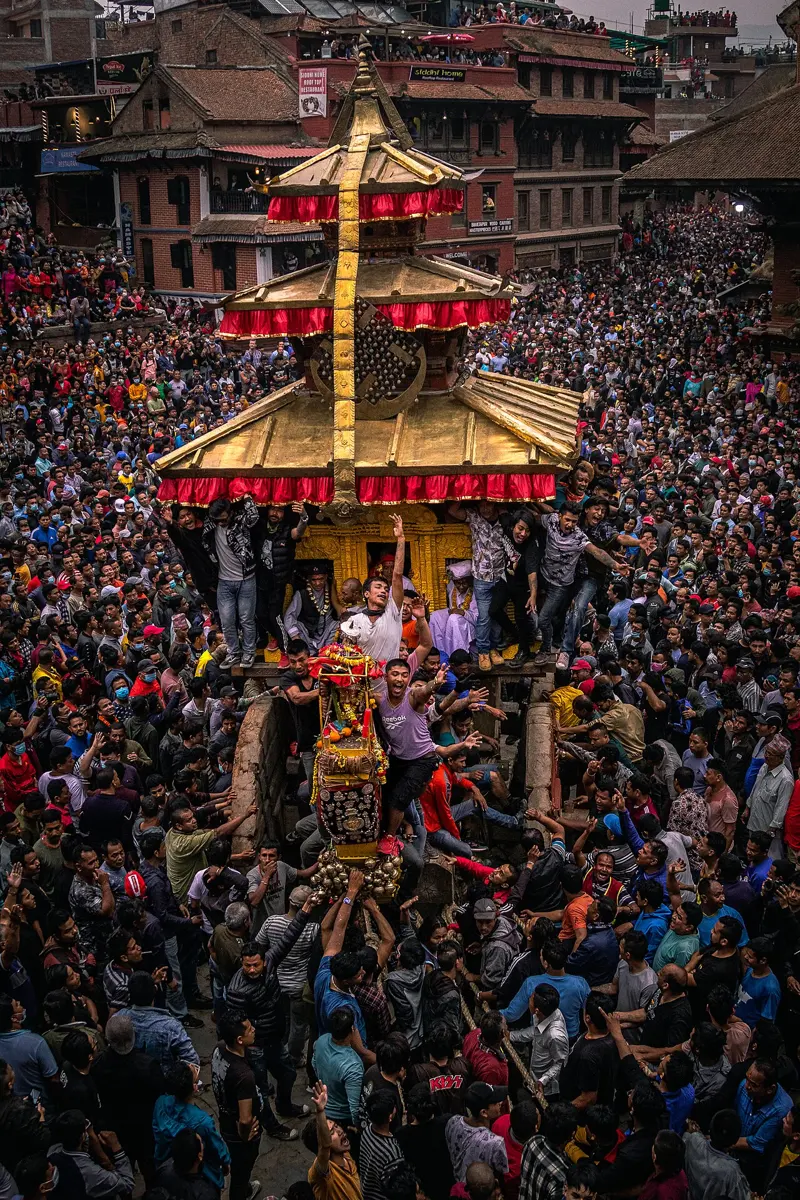
| a man carrying a huge fan-shaped frame of long bamboo arms on his shoulders, a crowd round him in a street of old brick houses | Jibro Chhedne, the tongue-piercing festival of Bode in Madhyapur Thimi, Bhaktapur, on the second day of the Nepali New Year, during Bisket Jatra. A Shrestha man of Bode, after prayers to the local gods, has his tongue pierced with a long iron needle, then carries the mahadwip, a half-circle frame of burning oil lamps, round the town. Local stories say it began as an offering to save the town from a famine. |
| rows of monks in saffron and maroon robes, sitting and praying together | Buddhist monks at prayer: chanting and meditating together, as in the monasteries of Boudha, Swayambhu and Lumbini. |
| a bullfighter in a gold costume holding out a pink cape, a black bull charging at it in a sandy ring | a bullfight in Spain: a show hundreds of years old, admired by some as an art and attacked by many as cruel to the bull. |
| a woman kneeling on straw mats, making tea at a small hearth with steam rising, a young man and woman kneeling opposite with tea bowls in their hands | the Japanese tea ceremony (chadō, “the way of tea”): powdered green tea (matcha) made and served with calm, exact movements, as a form of art and of quiet thinking. |
“In our village, the bride’s family washes the groom’s feet when he arrives.” This is…
Pick an answer to see why.
Reading I: Sky Burials
Before you read
- a.Describe death rituals in your culture.
- b.Why do you think it is important?
Model answers
What kind of text it is
The text is a personal account, a true experience told by the person who had it, in the first person (I, we). Its writer, Matthew Carney, is an Australian journalist who ran the ABC’s (the Australian Broadcasting Corporation’s) news office in China from 2016 to 2018, and lived there with his wife and three children. On a family trip to Tagong, a Tibetan town on the high grasslands of western Sichuan (in China’s Garzê Tibetan region, nearly 4,000 meters up), they stumbled on a sky burial.
Sky burial is a funeral custom of Tibetan Buddhists: the body of the dead person is cut up and offered to vultures on a mountain. Tibetans don’t use the English name; they call it jhator, “giving alms to the birds”.
The text, part by part
1. What a sky burial is
The writer explains it bluntly (plainly, without trying to be polite): the body is chopped into pieces and fed to waiting vultures. Outsiders are now mostly forbidden (not allowed) to watch. He admits he felt a mixture of horror and fascination (a strong wish to know more) when he first heard of it.
2. Only to see the place
The family reached an isolated Tibetan Buddhist monastery near Tagong. They had been told that foreigners couldn’t see the ritual anyway, so they planned only to look at the site where it happens. Their driver showed them the way up the mountain: a hilltop covered in Tibetan prayer flags, with a stone slab in the middle.
3. A burial about to begin
As they arrived, they heard Tibetan nuns chanting. Then the writer saw about 100 vultures sitting on the hill, waiting, and what looked like a body bag on the stone slab. They had stumbled into (found by chance) the start of a sky burial. Through a translation app on his phone, he asked a Tibetan beside him what was happening, and was told: “Flesh-eating birds.” May they stay? Yes, but to the side, and no photos.
4. A quick family decision
He was excited, but he had his children with him, so he and his wife had to decide fast:
- The six-year-old son was given the iPad to play games: he was too young to see this. He was thrilled, and his parents had never been so glad to give it to him.
- The 11-year-old son and the 13-year-old daughter were told honestly by their mother, Catherine, what was about to happen, and why, in its cultural and religious context. Then they could choose to stay or go. They stayed.
The writer himself was nervous: he had first seen a dead body at 12, and it had a profound (very deep) effect on him.
5. The body breaker
The bag was taken off: it was a middle-aged woman. A rogyapa, a “body breaker”, came quickly up the hill, in a thick dark scarlet coat with a black hood and a butcher’s knife in his hand, and began cutting the body at once. It was gruesome (horrible to see); the writer almost vomited. His children seemed to take it in their stride (deal with it calmly).
6. The vultures
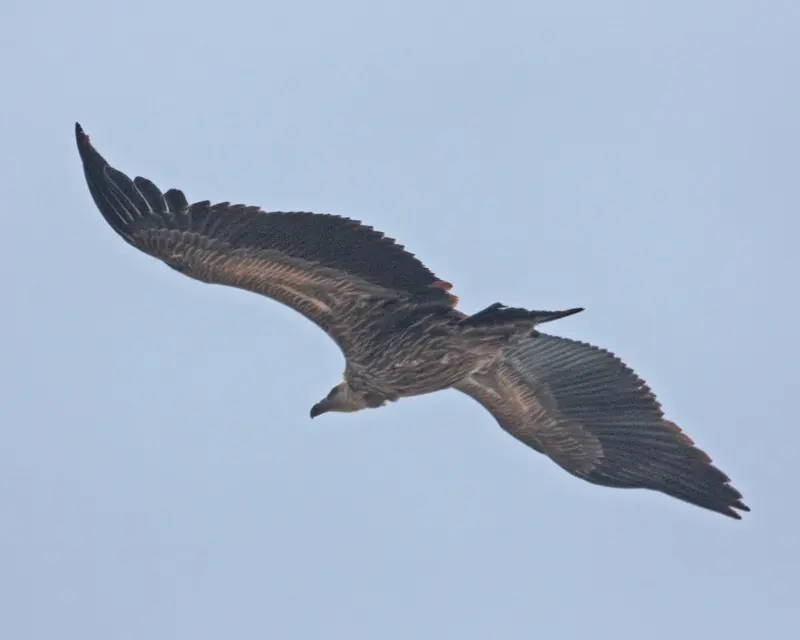
The vultures grew impatient. At the rogyapa’s signal, the Tibetans holding them back let them through, and they swarmed over the body in a frenzy (wild excitement), jumping on one another. In 15 minutes at most, every piece of flesh was gone; only bones were left. The rogyapa then pulverized the bones (beat them into powder) with a mallet (a heavy wooden hammer), mixed the powder with yak butter and barley flour, walked into the middle of the birds and threw it high into the air. Then he was gone. Nothing at all was left of the body.
7. What it means
A bad omen (a sign that something bad will happen) is when the vultures don’t eat the body, or even leave small bits. Tibetans see the vultures as dakinis, beings like angels that carry the soul up into the heavens, to wait to be reborn (reincarnation). The body is only a vessel for the soul. When it was over, a peace and calm seemed to come over the place: everyone was glad the ritual had been done properly.
8. A proud father
His children were fine: they seemed to understand that an ancient culture was giving meaning to a life. He was proud of their maturity and intelligence. And the six-year-old was none the wiser (knew nothing about it): he had been engrossed (completely absorbed) in Minecraft the whole time.
Why did the writer and his family go up the mountain?
Pick an answer to see why.
What is a bad omen at a sky burial?
Pick an answer to see why.
Words from the text
Words linked here open in English Vocabulary, where you can see an example and practice them in the word game. The meanings below are the ones the words have in this text.
| Word | Meaning here |
|---|---|
| forbidden | not allowed |
| fascination | a very strong interest in or attraction to something |
| bluntly | plainly and directly, without trying to be polite |
| stumble into | to find yourself in something by chance |
| profound | very great, very deep |
| gruesome | very unpleasant, filling you with horror (usually about death or injury) |
| take (something) in your stride | to deal with something difficult calmly |
| frenzy | a state of wild activity and strong feeling |
| pulverize | to crush or beat into a fine powder (British pulverise) |
| mallet | a hammer with a large wooden head |
| omen | a sign of what is going to happen in the future |
| vessel | here, a container (a body that holds the soul) |
| reincarnation | being born again in a new body after death |
| none the wiser | knowing no more than before |
| engrossed | so interested in something that you notice nothing else |
A. Find the words
Choose the words from the box that match with the given meanings from a–h.
forbidden, fascination, profound, gruesome, frenzy, pulverize, omen, engrossed
- a.……… very great
- b.……… a state of great activity and strong emotion
- c.……… very unpleasant and filling with horror
- d.……… not allowed
- e.……… a sign of what is going to happen in the future
- f.……… very strong attraction
- g.……… involved in something with whole attention
- h.……… to make something into a fine powder
Answer
B. True or false
Write True for true statements and False for false ones.
- a.Foreign visitors are welcome to see Sky Burial rituals.
- b.The visitors are not allowed to take photos of the rituals.
- c.The vultures took more than fifteen minutes to finish the entire corpse.
- d.The Tibetans perceive the body as a vessel for the soul.
- e.The youngest son of the writer was busy with his toys.
- f.The author visited the burial sites with his wife and three children.
Answer
C. Answer the questions
Why did the author visit a traditional Tibetan Buddhist monastery?
Answer
What did the author see on the hill?
Answer
Why did the author give the iPad to his youngest son?
Answer
Describe the appearance of a Rogyapa, the body breaker.
Answer
What did the body breaker do after collecting the bones?
Answer
What is considered to be a bad sign?
Answer
Why did the author feel proud?
Answer
D. Customs from other countries
Research customs from other countries and talk about an interesting one with your friends.
A model talk
Pronunciation: negative contractions
A negative contraction joins a helping verb and not into one word, with an apostrophe where the o of not is left out: is not → isn’t. Each is one stressed syllable, or two with a very weak second one (isn’t = “IZ-nt”). The t at the end is light, and before a consonant it is often hardly heard.
| Contraction | Full form | Sounds like | IPA |
|---|---|---|---|
| aren’t | are not | “arnt” (rhymes with aunt in British English) | /ɑːnt/ |
| isn’t | is not | “IZ-nt” | /ˈɪznt/ |
| wasn’t | was not | “WOZ-nt” | /ˈwɒznt/ |
| weren’t | were not | “wurnt” | /wɜːnt/ |
| haven’t | have not | “HAV-nt” | /ˈhævnt/ |
| hasn’t | has not | “HAZ-nt” | /ˈhæznt/ |
| hadn’t | had not | “HAD-nt” | /ˈhædnt/ |
| don’t | do not | “dohnt” (rhymes with won’t) | /dəʊnt/ |
| doesn’t | does not | “DUZ-nt” | /ˈdʌznt/ |
| didn’t | did not | “DID-nt” | /ˈdɪdnt/ |
| can’t | cannot | “kahnt” (British), “kant” (American) | /kɑːnt/, US /kænt/ |
| couldn’t | could not | “KUD-nt” (the l is silent) | /ˈkʊdnt/ |
| mustn’t | must not | “MUS-nt” (the first t is silent) | /ˈmʌsnt/ |
| won’t | will not | “wohnt” (rhymes with don’t) | /wəʊnt/ |
Which word has a silent t in the middle?
Pick an answer to see why.
Speaking: asking for permission
To ask for permission is to ask if you may do something. How you ask depends on whom you are asking and how big the favor is:
| Asking | Saying yes | Saying no, politely | |
|---|---|---|---|
| a friend, a small thing | Can I…? Is it OK if I…? | Sure. Go ahead. Of course. No problem. | Sorry, I need it now. |
| a teacher, a stranger | May I…? Could I…? | Yes, please do. Certainly. Please feel free. | I’m afraid not. I’m sorry, but… |
| a bigger favor, very polite | Do you mind if I…? Do you think I could…? Would you mind if I…? | No, not at all. Not at all, go ahead. | Well, I’d rather you didn’t. Actually, I do mind. |
Three things to notice:
- After May I, Can I, Could I comes the base verb: May I sit here? After Do you mind if I, Is it OK if I comes a present verb: Do you mind if I sit here? Do you think I could takes the base verb after could. Would you mind if I takes the past: Would you mind if I sat here?
- Do you mind…? asks “Does it bother you?” So No means you may: “Do you mind if I open the window?” “No, not at all.” Answering Yes to it means Yes, I mind: please don’t.
- A polite refusal rarely says a plain “No”. It says sorry and gives a reason (I’m sorry, I’m using it), or uses I’d rather you didn’t (I would prefer you not to). A plain No, you can’t is for a firm rule, or sounds rude.
A. Sentences from the table
Make as many sentences as possible from the following table.
May / Can / Do you think / Could / Do you mind if / Is it OK if + I + go out, please? / bring my doggie / could have a look / taste that hot spicy dish? / use your protractor / ask you something / sit here + at your photo album? / for a while? / with you? / to the party? / on Ecology?
Model sentences
B. Ask and answer
Work in pairs. Ask for permission and respond to the situations given in the left column of the table. The responses are in the right column of the table.
Example: A: I feel sick. May I leave for home? B: Sure.
| Situations for asking permission | Responses |
|---|---|
| a.sore throat / doctor | a.Sure. |
| b.headache / go home | b.Yes, please do. |
| c.blister on foot / clinic | c.Sure, go ahead. |
| d.radio / news | d.Of course, go ahead. |
| e.camera / photos | e.No problem. |
| f.telephone / chat with friend | f.Please feel free. |
| g.toilet / no, so dirty | g.Well, I’d rather you didn’t. |
| h.day off tomorrow / no, very busy day | h.No. You can’t. |
Model conversations
C. Conversations for situations
Have conversations with your partner for the situations given below.
- a.It’s very hot in the room and you would like to open the window.
- b.You need to borrow a pen from a friend because you have lost yours.
- c.You didn’t understand the lesson in the class very well. You want your friend’s help.
- d.You are watching the TV but you can’t hear because the volume is very low. Your brother or sister has the remote control.
- e.You would like to take a photo of your friend.
- f.You left your mobile phone at home but it’s quite necessary for you to call your parents. Your friend has a mobile phone.
Model conversations
Grammar I: yes/no questions
A yes/no question can be answered with yes or no: Are you ready? Did you eat? (A wh-question asks for information: Where are you going?) To make one from a statement:
| The statement has | Rule | Statement → question |
|---|---|---|
| a helping verb (am, is, are, was, were, have, has, had, or a modal: will, would, can, could, may, might, shall, should, must) | move the helping verb in front of the subject | Pemba is coming. → Is Pemba coming? She can swim. → Can she swim? |
| a form of be as its only verb | move be to the front | He was at home. → Was he at home? |
| no helping verb (present or past simple) | add do / does / did in front of the subject; the main verb goes back to its base form | They live here. → Do they live here? She plays football. → Does she play football? He went out. → Did he go out? |
Then end with a question mark. In speech, a yes/no question usually rises at the end.
Short answers
We rarely answer a yes/no question with only Yes or No (it can sound cold), and we don’t repeat the whole sentence. We give a short answer: Yes/No + subject pronoun + the helping verb of the question:
| Question | Yes | No |
|---|---|---|
| Are you busy? | Yes, I am. | No, I’m not. |
| Does Harish play football? | Yes, he does. | No, he doesn’t. |
| Did you go out? | Yes, I did. | No, I didn’t. |
| Has your brother gone to sleep? | Yes, he has. | No, he hasn’t. |
| Can she swim? | Yes, she can. | No, she can’t. |
| Is there a bus? | Yes, there is. | No, there isn’t. |
A positive short answer is never contracted (Yes, I am, not Yes, I’m); a negative one usually is (No, I’m not).
But an offer or a request gets a friendly answer, not a grammar answer: “Can I carry your bag?” “It’s all right, thanks.” (a polite no) / “Yes, please. That’s kind of you.”; “Would you like to come?” “Yes, I’d love to.”
Which is the correct question for Rabina wrote a poem for the competition?
Pick an answer to see why.
“Is your sister coming to the wedding?” Which is the best short answer?
Pick an answer to see why.
A. Match the answers
Match the questions in column A with the answers in column B.
- a.Are you ready? — i. Yes, it’s on the chair.
- b.Can I carry something for you? — ii. Yes, of course.
- c.May I use your phone? — iii. Yes, I’d love to.
- d.Has anyone seen my bag? — iv. No, it’s OK. It’s not that heavy.
- e.Would you like to come to the party? — v. Yes, nearly.
Answer
B. Ask in these situations
How do you ask questions in these situations?
- a.You want to know if it is raining.
- b.You want to know if Harish plays football.
- c.You want to know if the bus is on time.
- d.You want to know if your friend, Ramesh, went to the market yesterday.
- e.You want to know if it is Tuesday today.
- f.You want to know if your teacher opened your letter.
- g.You want to know if your brother has gone to sleep.
- h.You want to know if there will be a food party.
Answer
C. The correct answer
Circle the correct answer.
- a.Are you busy today? i. Yes, busy. ii. Yes, I am.
- b.Is it too hot in here for you? i. No, it isn’t. ii. No, I’m fine, thanks.
- c.Tell me, did you steal my money? i. No. I won’t. ii. No, I didn’t steal your money.
- d.Can I carry your bags? i. No, you can’t. ii. It’s all right, thanks.
Answer
D. Write yes/no questions
Write yes/no questions for these statements.
- a.The family has got three mobile phones.
- b.Januka works at the supermarket.
- c.Anita is learning English.
- d.The meeting will be held next Tuesday.
- e.Tanka switched off the computer.
- f.He went to the cinema yesterday.
- g.Everyone is ready.
- h.It is raining outside.
- i.Vicky’s lost her credit card.
- j.She’d done the work on time.
Answer
Writing I: Our Culture, Our Pride
An essay is a short piece of writing on one topic, in paragraphs, that gives information, describes, tells or argues. Its three parts:
- Introduction: catches the reader’s attention and says what the essay is about.
- Body: two to four paragraphs, each on one main idea, which its first sentence (the topic sentence) states, and the rest explains with facts and examples.
- Conclusion: sums up and leaves the reader with a final thought. No new points here.
Give it a title. Join the paragraphs with linking words (first, also, moreover, however, for example, in conclusion). In your final exam, a short essay is a Free writing II task: about 200 words, 8 marks, marked on its content, organization, language and layout.
Write a short essay about ‘Our Culture, Our Pride’.
Hint
A model essay
Reading II: Surprising Customs
Before you read
- a.Is there any unique custom in your community? What is it?
- b.Why is it unique?
Model answers
What kind of text it is
It is a short informative article: an introduction, then four customs, each under its own subheading, with the country, what people do and why. It explains, without telling a story or arguing: an expository text (see the Extra bit).
The text, part by part
Introduction: why customs?
What sets humans apart from other animals is our propensity (natural tendency) to build customs and traditions around everything, from beauty to death. Thousands of cultures have grown since civilization began, and each has its own etiquette (rules of polite behavior) and its own sense of identity. Then come four astonishing (very surprising) customs.
1. Pointing with lips (Nicaragua)
Hand gestures differ from culture to culture, but few cultures use the mouth. In Nicaragua, in Central America, people often point with their lips instead of a finger or thumb: they pucker up (push the lips forward, as for a kiss) toward the thing they mean, to show something happening nearby during a conversation.
2. Tipping (the United States)
In many countries people don’t tip, or tip a little for very good food. In the United States, a tip (extra money for the person who served you) is rather mandatory (almost compulsory) at most restaurants: customers (patrons) are expected to leave 10–20 percent of the bill, and there are rules for tipping bartenders, delivery people and others. Some call it irrational (not sensible), but it gives waiters and waitresses an incentive (a reason) to serve better.
3. Slurping (Japan)
In Western countries, eating noisily is rude, and noodles are eaten by twirling them round a fork or spoon first. In Japan, people simply slurp noodles up, without contorting (twisting) them, which is naturally noisier. Slurping there shows you are really enjoying the noodles, and some scientists say that drawing in air with them even improves their flavor.
4. Kneeling or lying flat to greet (the Yoruba of Nigeria)
The Yoruba, a people living mostly in Nigeria, in West Africa, take greetings seriously, especially greeting elders. When an adult comes near, young people go down: women and girls kneel, and men and boys lie prostrate (flat on the ground, face down). It shows respect and deference (polite obedience) to the community’s elders, and it marks the Yoruba out from other Nigerian peoples, such as the Bini and the Kalabari.
Why do Japanese people slurp their noodles?
Pick an answer to see why.
How do Yoruba young men usually greet an elder?
Pick an answer to see why.
Words from the text
| Word | Meaning here |
|---|---|
| propensity | a natural tendency to behave in a certain way |
| etiquette | the rules of polite behavior in a society or group |
| astonishing | very surprising |
| customary | usual, as custom expects |
| pucker (up) | to push the lips forward and together, into small folds |
| mandatory | required, compulsory |
| patron | a customer of a restaurant, shop or hotel |
| bartender | a person who serves drinks in a bar |
| irrational | not based on good reasons; not sensible |
| incentive | something that makes you want to do something, such as a reward |
| slurp | to eat or drink noisily, sucking in air |
| contort | to twist out of the usual shape |
| palate | the roof of the mouth; also the sense of taste |
| prostrate | lying flat, face down |
| deference | polite respect for someone older or more important |
A. Find the words
Find the words from the text that match the following meanings.
- a.……… a natural desire
- b.……… the rules of correct or polite behavior in society
- c.……… people who work in a bar, serving drinks
- d.……… to become twisted
Answer
B. True or false
Write True for true and False for false statements.
- a.In Nicaragua, people prefer to point with their thumb.
- b.Tipping is compulsory at most restaurants in the US.
- c.Contorting is less noisy than slurping.
- d.People from the West take noodles by twisting them on a spoon.
- e.The Bini and the Kalabari are ethnic groups of Nigeria.
Answer
C. Answer the questions
What makes a group of people different from others?
Answer
What is the unique tradition of Nicaragua?
Answer
What is a positive aspect of tipping culture?
Answer
Why do Japanese make slurping sounds while eating noodles?
Answer
How do Yoruba people greet their elders?
Answer
D. The most interesting custom
Which of the customs mentioned in the text did you find more interesting? Share it with your friends.
A model answer
Listening: wedding traditions
The listening is a short talk on five of the world’s most fascinating wedding traditions. CDC’s own recording is below: read the questions in B and C first, then listen, as many times as you need.
A. Before you listen
The pictures show a Nepali wedding: men in a crowd dancing outdoors, a bride’s hands covered in henna designs with gold bangles, and a man’s hand with red powder over a white cloth, held over a bride in red.
- a.Are you familiar with these marriage traditions?
- b.How do you celebrate the marriage ceremony in your community?
Model answers
B. The countries
Listen to the audio and match the marriage traditions with the related countries.
- a.Jumping over the broom — i. China
- b.Dancing covered with money — ii. India
- c.Painting the hands and feet — iii. Ghana
- d.Changing wardrobes — iv. Cuba
Answer
C. Fill in the blanks
Listen to the audio again and fill in the blanks with the correct words/phrases given below.
profitable, custom, Jewish, cocktail dress, evil spirits, lucky colour, henna paste
- a.Breaking a glass is a ……… wedding tradition.
- b.Jumping over the broom is done to sweep away the ……… .
- c.Dancing while covered with money is considered as a ……… .
- d.Female friends decorate the bride’s hands and feet during marriage with a ……… in India.
- e.Chinese brides wear a red dress first because red is considered as a ……… .
- f.A ……… is the third wardrobe for Chinese brides.
Answer
These answers have been checked against the recording. It also says the groom breaks the glass under his foot, near the end of the ceremony; that whichever of the couple jumps higher over the broom is said to become the head of the household; that the money dance is common in Poland, Greece, the Philippines and parts of the southern United States too; and that the Chinese bride’s second dress is usually a white ball gown, in the Western fashion.
D. Your own traditions
Which of the marriage traditions is most similar to your own? Talk to your friends.
A model answer
Practice listening alone
Grammar II: reporting a yes/no question
When you report a question someone asked, you tell what they asked in your own sentence, without quotation marks. A yes/no question is reported with if or whether:
Barsa said to her teacher, “Should I write the story again?”
→ Barsa asked her teacher if she should write the story again.
The steps:
- Reporting verb: said (to) becomes asked (or wanted to know, wondered, enquired). Keep the listener after asked, with no to: asked her teacher, not asked to her teacher.
- Add if or whether.
- Statement order: the subject comes before the verb, and do, does, did disappear: “Do you like it?” → … if I liked it.
- Tense one step back, after a past reporting verb: am/is → was, are → were, do/does + verb → past simple, did + verb / has / have → had + past participle, will → would, can → could, may → might. Should, would, could, might, must stay.
- Pronouns change to fit who is reporting: you → I/he/she, my → his/her, and time and place words move: now → then, tonight → that night, yesterday → the day before, last night → the night before / the previous night, tomorrow → the next day, here → there, this → that.
- Full stop, not a question mark.
A wh-question keeps its question word instead of if: “How is your family?” → She asked me how my family was.
Dilmaya said to me, “Have you seen my umbrella?” Which is the correct reported question?
Pick an answer to see why.
“Will you visit me in Dharan?” Tashi asked her cousin. Report it.
Pick an answer to see why.
A. Match the reported questions
Choose the following sentences in indirect speech to match with their direct speech.
- i.I asked the woman next to me if the bus to Kathmandu had already left.
- ii.I asked the teacher whether the book had been translated into Nepali.
- iii.Barsa asked her teacher if she should write the story again.
- iv.Samir asked Rohan whether he had finished reading his book.
- v.The new pupil asked me if I was a class captain.
- a.The new pupil said to me, “Are you a class captain?”
- b.Samir asked Rohan, “Have you finished reading my book?”
- c.I asked the teacher, “Has the book been translated into Nepali?”
- d.“Has the bus to Kathmandu already left?” I said to a woman next to me.
- e.“Should I write the story again?” Barsa asked her teacher.
Answer
B. Change into indirect speech
Change the following sentences into indirect speech.
- a.Rahul said to me, “Did you watch the cricket match on TV last night?”
- b.“Are you coming home with me?” he said.
- c.“Do you really come from India?” said the prince.
- d.“Have you anything to say?” said the judge finally.
- e.She said to me, “Is he at home?”
- f.Usha says, “Can you solve the problem?”
- g.Badri said to Asmita, “Will you visit me in Australia?”
- h.Radhika said to Rebecca, “Did you hear the noise?”
- i.He said, “Have you seen my hat?”
- j.He said to me, “Does he come or not?”
- k.Rohan said to me, “Did you spill the milk on the floor?”
- l.The pilot said to the air hostess, “Have the passengers fastened their seatbelts?”
Answer
C. Report a friend’s questions
Imagine that you met a friend after two years. He or she asked you the following questions. Report them.
a. Are you fine? b. How is your family? c. Have you had breakfast? d. What are you doing now? e. Are you playing chess or not? f. Do you need any good books? g. Can you share your future plan? h. Why don’t you come to meet me?
Answer
Writing II: an essay on a custom
You have learned about some unusual and interesting customs and cultures of the world. Nepal is also rich in its unique customs and cultures. Write an essay on any one of the unique customs using the given outlines.
introduction … time to celebrate … historical and cultural values … community observing it … activities of celebration … your opinions … conclusion
Hint
A model essay
How to write an essay on a custom
- Title: the custom’s name.
- Introduction: a vivid opening (a sight or a sound), then what the custom is.
- Time: when it happens (month, day, season).
- History and meaning: how it began (say “people believe” or “a legend says” for a story that can’t be proved) and what it means.
- Community: who observes it.
- Activities: what people do, in order, with details of sight, sound and taste.
- Your opinion: why you like it, or what you would change.
- Conclusion: one or two sentences on why it matters.
Project work
The picture Figure 6.3 shows culture in the middle and its elements around it: attitudes, beliefs, language, customs, rituals, behavior, faith and religion, food, and art, drama and music. Each petal is one way a culture shows itself. Some you can see (food, art, rituals); others are inside people’s minds (attitudes, beliefs), and you see them only through what people do.
Types of essay
Essays are grouped by the writer’s goal: to tell, to describe, to explain or to persuade.
| Type | The writer’s goal | What it is like | An example title |
|---|---|---|---|
| narrative | to tell a story from real life | usually in the first person (I); vivid, in time order; ends with what the writer learned | The Day I Got Lost in Asan |
| descriptive | to paint a picture in words of a person, place, object or memory | shows, not tells: details of sight, sound, smell, taste and touch; appeals to feelings | My Grandmother’s Kitchen |
| expository | to explain or inform, in a balanced way | facts, figures and examples; no personal feelings; can compare and contrast, give causes and effects, or explain how to do something | How Bisket Jatra Is Celebrated |
| persuasive | to convince the reader to accept a view or do something | an argument built on facts, logic, examples and expert opinion; answers the other side, then makes its case clearly | Every School Should Teach Its Students’ Mother Tongues |
In this unit, Sky Burials is a narrative: a true experience told by the person who had it. Surprising Customs is expository: it informs, with examples. Our Culture, Our Pride is often written as a persuasive essay (we should be proud of our culture and protect it), and the essay on a custom mixes expository (when, who, history) and descriptive (the celebrations).
An essay titled Why Plastic Bags Should Be Banned in Nepal is most likely…
Pick an answer to see why.
Which essay would mostly use facts, figures and examples, with no personal feelings?
Pick an answer to see why.
Exercise
Practice on this unit in the style of the final exam (Grade 9’s exam follows the SEE’s kind of chart). Try each one as in the exam, then open the answer.
Write True or False after each statement about the two readings.
- a.The writer of Sky Burials had planned to watch a sky burial.
- b.The writer’s 13-year-old daughter chose to stay and watch.
- c.The body breaker mixed the powdered bones with yak butter and barley flour.
- d.In the US, waiters expect a tip of between 10 and 20 percent of the bill.
- e.Among the Yoruba, women lie prostrate to greet their elders.
Answer
Choose the correct answer for each numbered blank.
Pasang met his cousin Yangchen at Lhosar and asked her (a) ……… (that / if / whether if / do) she (b) ……… (has / had / have / is) finished her exams. Then he asked her (c) ……… (where was she going / where she was going / where she is going to / where did she go) after the holidays. She asked him (d) ……… (whether / what / that / does) he (e) ……… (can / could / is able / will be able) come to her school play.
Answer
Change these sentences as instructed in brackets.
- a.Muna sings at the temple every morning. (Make a yes/no question.)
- b.The vultures had eaten the whole body. (Make a yes/no question.)
- c.“Is the monastery far from here?” the writer asked the driver. (Change into indirect speech.)
- d.Sabina said to me, “Did you see the chariot yesterday?” (Change into indirect speech.)
- e.My uncle says, “Do you like momo?” (Change into indirect speech.)
- f.Are they coming to the wedding? (Give a negative short answer.)
Answer
Your school has asked students to write about traditions for the school magazine. Write a short essay of about 200 words on a custom or festival of your community, saying when it is held, who observes it, what people do and why it matters.
A model essay
Name the type of each essay: narrative, descriptive, expository or persuasive.
- a.The Night Our House Shook (a student’s own story of the 2015 earthquake)
- b.Why Every Village Needs a Library
- c.How a Madal Is Made
- d.The Colors and Sounds of Indra Jatra
Answer
Practice every question in the book, and keep track of the ones you miss →
A companion to your textbook, not a replacement for it: study from the book your school uses, and where the two differ, follow your teacher. Found a mistake? Please tell us.