
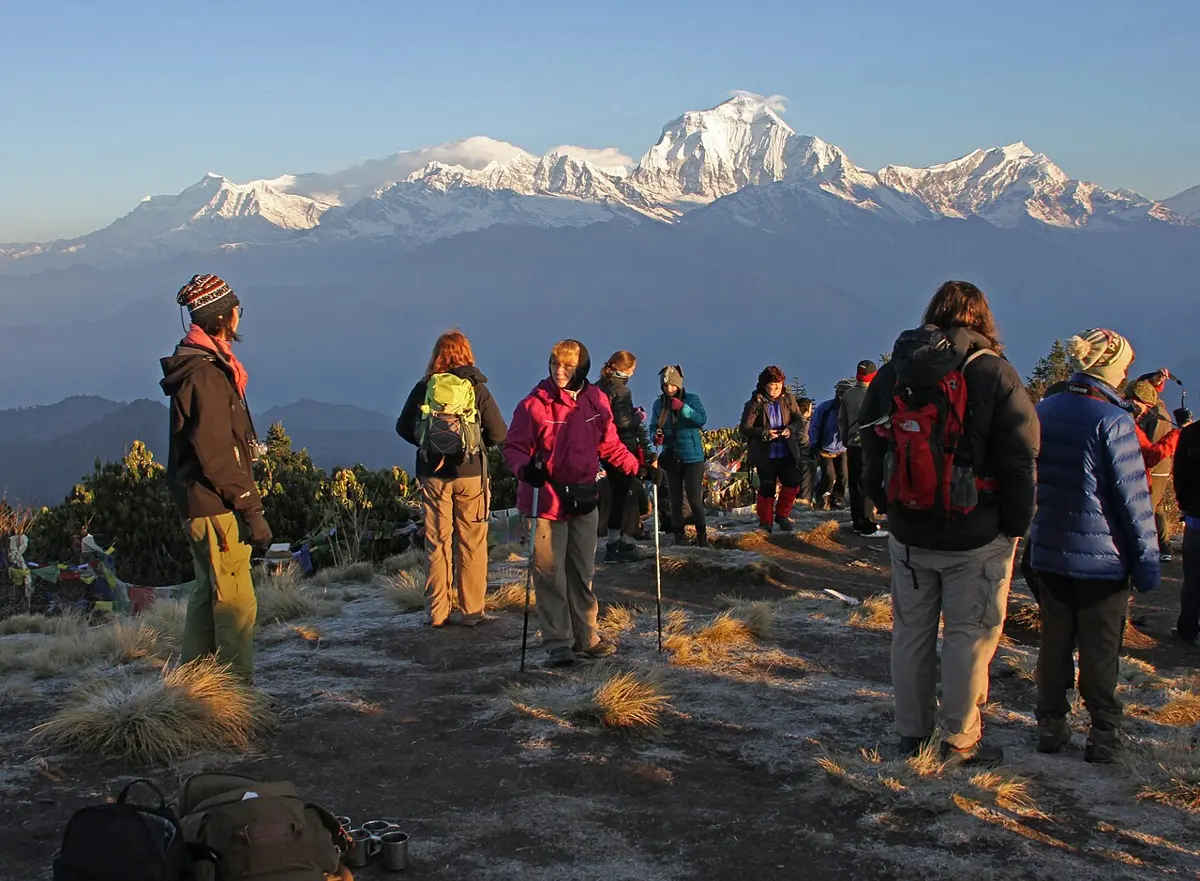
Picture yourself at Poon Hill at five in the morning, in the cold and the dark, with a hundred other people waiting. Then the first light touches the top of Dhaulagiri, and one after another the snow peaks of the Annapurna range turn pink, then gold. People who have stood there say they still remember the moment years later.
This unit begins with a travel company’s plan for eight days of trekking and yoga to Poon Hill, and later reads one of the most famous short poems in English, about a traveler who stops in the snow and must go on. Along the way you will learn the thing every trip is full of: talking about the future. English has no single future tense; it has several forms, and each one tells the listener something different: that the bus leaves at seven, that you are meeting the guide on Monday, that you are going to do yoga every morning, that you will carry your friend’s bag. By the end you will know which to use, and why.
Getting started
The unit opens with four photos of places people travel to see. Here is what each shows, and something you could say about it.
| Picture | What it is | Something to say |
|---|---|---|
| A rhinoceros on a grassy path in a forest | a one-horned rhinoceros in Chitwan National Park, in the Tarai | Chitwan was Nepal’s first national park (1973) and is a World Heritage Site; visitors go on jungle walks and jeep safaris to see rhinos, deer, birds and, if they are lucky, a tiger. |
| A city of skyscrapers lit up at night, one tower far taller than the rest | the Burj Khalifa in Dubai, United Arab Emirates | At 828 meters, it has been the tallest building in the world since 2010. Many Nepalis work in the Gulf, so Dubai is a place many families talk about. |
| A white temple beside a square pond with brick steps | the Maya Devi Temple in Lumbini, Rupandehi | It marks the place where Siddhartha Gautama, who became the Buddha, was born. Pilgrims come from all over Asia; Lumbini is a World Heritage Site. |
| A white marble building with a dome and four tall towers, behind a long pool | the Taj Mahal in Agra, India | The Mughal emperor Shah Jahan built it in the 1600s as a tomb for his wife, Mumtaz Mahal. It is one of the most visited buildings in the world. |
Reading I: Poon Hill Yoga Trek in Nepal
Before you read
What do you think the man in the picture is doing?
A model answer
Are you planning to travel or go on a holiday this year?
A model answer
What kind of text it is
The text is a brochure from a travel company: a short leaflet (or a web page) that advertises a package holiday, a trip where the company arranges everything (transport, rooms, meals, guides) for one price. It has three parts:
- an introduction that says what the trip is and why you should go;
- the main highlights, the best things you will see and do;
- an itinerary, the plan of the trip day by day: where you go, what you do and where you sleep.
A brochure wants to sell the trip, so it is full of strong, positive words: wonderful, magnificent, astonished, enchanting, stunning, spectacular, incredible. When you read one, enjoy the pictures it paints, but remember that these are the company’s opinions, not facts.
The brochure, part by part
1. What the trip offers
The Poon Hill Yoga Trek is a chance to see the beauty of the Annapurna range and the “hidden treasures” of Nepali culture. It joins two things: trekking (long walks on mountain trails, sleeping in villages on the way) and yoga. The program promises to help you make yoga part of your daily life, while you look at snowy peaks and glaciers. Its main benefit, the company says, is that it encourages a deep personal transformation: a real change in the way you live and feel. The trail passes many tourist hotspots (places that are busy with visitors) and icy waterfalls.
2. Yoga and walking together
The trek includes Hatha yoga (the kind built on body postures and breathing) and meditation. Walking and yoga together, the brochure says, are good for both the body and the mind: the walking is exercise, and the yoga makes the mind stronger, calmer and more aware, all in beautiful natural surroundings.
3. Who can come
The program is open to all experience levels: you don’t need to have trekked or done yoga before. It is for anyone who wants to strengthen “body, mind and soul”, and it is also a chance to see how Nepali people live and to learn their “secrets to happiness”.
4. The main highlights
Visitors will be astonished by lovely landscapes. They will look at stunning views of the Himalaya, enjoy (savor) delicious Nepali meals, meet different Nepali cultures, and see the varied flora and fauna (plants and animals), rivers that flow all year (perennial rivers) and suspension bridges. And the sunrise and sunset over the high mountains, says the brochure, will make everyone want to change themselves through yoga and meditation.
5. The itinerary, day by day
| Day | Where | Yoga | Night |
|---|---|---|---|
| 1 | Arrive in Kathmandu: met at the airport, taken to the center, the program explained | none | Kathmandu |
| 2 | Drive to Pokhara, about 4–5 hours, past rivers, forests and terraced fields | none | Pokhara |
| 3 | Drive to Nayapul, then walk to Tikhedhunga, through several small settlements | one hour, before breakfast | Tikhedhunga |
| 4 | Cross a stream on a suspension bridge, climb to Ulleri, a Magar village, then through fields and forests of rhododendron and oak; lunch at Nangethanti, then on to Banthanti | morning and evening | Banthanti |
| 5 | Walk up to Ghorepani, seeing the villages, the land and the mountains; some entertainment in the evening | morning and evening | Ghorepani |
| 6 | An hour’s climb before dawn to Poon Hill for the sunrise; back to Ghorepani for breakfast; along ridges and through pine and rhododendron forest, over Deurali, down to Tadapani | evening | a tourist lodge in Tadapani |
| 7 | About four hours’ walk to Ghandruk, a Gurung village; lunch; drive back to Pokhara by way of Nayapul | morning | Pokhara |
| 8 | Leave after breakfast for the next destination | none | — |
A few things worth knowing about the places:
- Day 2. The road from Kathmandu to Pokhara, the Prithvi Highway, runs beside the Trishuli River for much of the way to Mugling; after that it follows other river valleys into Pokhara.
- Days 3 and 4. Nayapul means “new bridge”. The climb from Tikhedhunga to Ulleri is famous for its thousands of stone steps.
- Day 5. Ghorepani means “horse water”: traders’ mule and horse caravans used to stop here to drink.
- Day 6. Tadapani means “far water”: the village’s water had to be brought from a long way off. The forest on this ridge is one of the best places to see laliguras, the rhododendron, Nepal’s national flower, in bloom in spring.
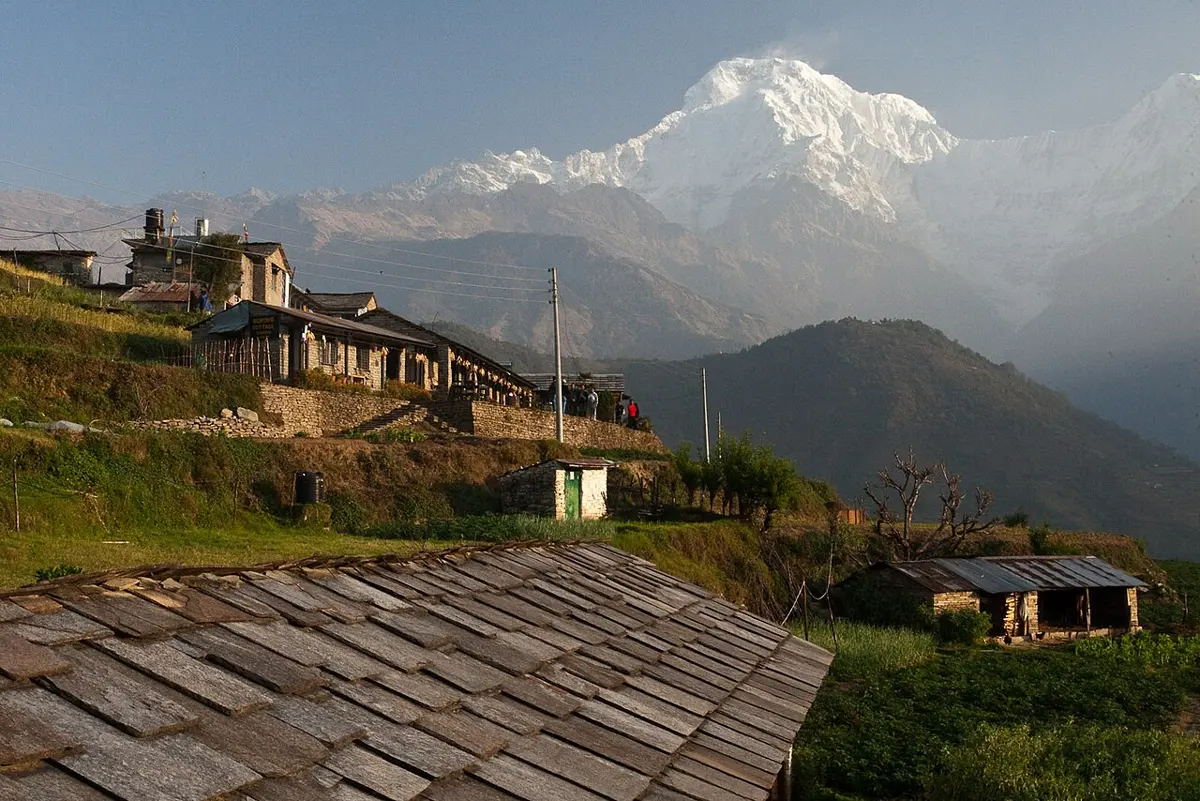
- Day 7. Ghandruk is a large village of the Gurung people, famous for the many men who have served as Gurkha soldiers in the British and Indian armies. It has close views of Annapurna South and Machhapuchhre (“fish tail”). The brochure calls it “the most interesting ethnic village in Nepal”: that is the kind of claim an advertisement makes, an opinion to sell the trip, not a fact anyone could measure.
Which sentence from the brochure is an opinion, not a fact?
Pick an answer to see why.
Where does the group sleep on the night of the sixth day?
Pick an answer to see why.
Words from the brochure
Words linked here open in English Vocabulary, where you can see an example and practice them in the word game. The meanings below are the ones the words have in this text.
| Word | Meaning here |
|---|---|
| magnificent | extremely beautiful and impressive |
| glacier | a slow river of ice on a mountain |
| hotspot | a place where a lot is happening; a tourist hotspot is busy with visitors |
| astonished | very surprised and amazed |
| enchanting | charming; delightful, as if by magic |
| flora and fauna | the plants (flora) and animals (fauna) of a place |
| perennial | lasting all through the year; a perennial river never dries up |
| integrate | to make something a part of something else (“integrate yoga into your daily life”) |
| ample | plenty; more than enough |
| transformation | a complete change |
| savor | to enjoy food (or a moment) slowly, to get the most out of it (British spelling savour) |
| panoramic | showing a very wide view, all around |
| spectacular | very impressive to look at |
| itinerary | a plan of a journey: the places, the days, the times |
| suspension bridge | a bridge that hangs from strong cables, like the steel bridges across Nepal’s rivers |
| accommodate | to give someone a place to stay (“we will be accommodated in a tourist lodge”) |
A. Match the words with their meanings
Match the words in column A with their meanings in column B.
- a.magnificent
- b.glaciers
- c.hotspot
- d.astonished
- e.enchanting
- f.flora and fauna
- g.perennial
- i.charming
- ii.surprised; amazed
- iii.plants and animals
- iv.throughout the entire year
- v.rivers of ice
- vi.extremely attractive and impressive
- vii.a place of significant activity
Answer
B. Choose the correct answers
What are the visitors expected to achieve the most in this package holiday?
Pick an answer to see why.
What will the visitors do on the first day of their tour?
Pick an answer to see why.
Where will they stay on the fourth day?
Pick an answer to see why.
What is the destination of the visitors on the sixth day?
Pick an answer to see why.
Which place will the tourists visit last as a part of the package?
Pick an answer to see why.
C. Answer the questions
List any two advantages of the yoga trek in the Nepali hilly region.
Answer
Who can take part in this yoga trek program?
Answer
What would you enjoy the most in Ghandruk if you were one of the visitors? Why?
A model answer
How many days do the visitors do yoga during the program?
Answer
How is the yoga hour mainly managed every day on this holiday trek?
Answer
D. Your own trip
Have you ever been on a holiday trip or traveled to different places? Mention the hotspots, points of interest, etc. Share your experiences with your friends.
A model answer
Pronunciation: long words
The twelve words below are long, and saying them well depends on one thing: putting the stress (the strong beat) on the right syllable. Here they are as dictionaries write them, with the stressed syllable in capitals. (ˈ marks the main stress in phonemic script, and ˌ a lighter one.)
| Word | Syllables, stress in capitals | British | American |
|---|---|---|---|
| wonderful | WON-der-ful | /ˈwʌndəfl/ | /ˈwʌndərfl/ |
| destination | des-ti-NA-tion | /ˌdestɪˈneɪʃn/ | /ˌdestɪˈneɪʃn/ |
| opportunity | op-por-TU-ni-ty | /ˌɒpəˈtjuːnəti/ | /ˌɑːpərˈtuːnəti/ |
| unimaginable | un-i-MAG-i-na-ble | /ˌʌnɪˈmædʒɪnəbl/ | /ˌʌnɪˈmædʒɪnəbl/ |
| likelihood | LIKE-li-hood | /ˈlaɪklihʊd/ | /ˈlaɪklihʊd/ |
| inspirational | in-spi-RA-tion-al | /ˌɪnspəˈreɪʃənl/ | /ˌɪnspəˈreɪʃənl/ |
| responsibility | re-spon-si-BIL-i-ty | /rɪˌspɒnsəˈbɪləti/ | /rɪˌspɑːnsəˈbɪləti/ |
| astonishing | a-STON-ish-ing | /əˈstɒnɪʃɪŋ/ | /əˈstɑːnɪʃɪŋ/ |
| magnificently | mag-NIF-i-cent-ly | /mæɡˈnɪfɪsntli/ | /mæɡˈnɪfɪsntli/ |
| autobiography | au-to-bi-OG-ra-phy | /ˌɔːtəbaɪˈɒɡrəfi/ | /ˌɔːtəbaɪˈɑːɡrəfi/ |
| insignificant | in-sig-NIF-i-cant | /ˌɪnsɪɡˈnɪfɪkənt/ | /ˌɪnsɪɡˈnɪfɪkənt/ |
| biodiversity | bi-o-di-VER-si-ty | /ˌbaɪəʊdaɪˈvɜːsəti/ | /ˌbaɪoʊdaɪˈvɜːrsəti/ |
Which word is stressed on the third syllable?
Pick an answer to see why.
Speaking: plans and intentions
When you talk about your plans (what you have arranged) and your intentions (what you mean to do), English gives you several ways to say it:
| To say | Use | Example |
|---|---|---|
| what you have decided to do | I intend to + base form | I intend to go. |
| what you have planned | I’m planning to + base form | I’m planning to visit Rara. |
| what you have arranged, with a time | I’m + -ing (present continuous) | I’m leaving on Friday. |
| what you decide now, or a promise | I’ll + base form | I’ll ask my father tonight. |
| an idea you are still considering | I’m thinking of + -ing | I’m thinking of going on a trip. |
| what you expect to happen | (most) likely + will | My parents will most likely let me go. |
A. The conversation
In the picture, three young friends are talking about a trip this year. Here is what each says, in our words:
- The girl: She is thinking of going on a trip this year: she feels it is time. She thinks her parents will allow her to go.
- The older boy: He may not be able to convince his father, who doesn’t like boys staying away from home for several days. So instead, his family is going on a family trip.
- The younger boy: He intends to go, and his parents will most likely let him go. He is thinking of asking Lakpa’s father whether Lakpa can come with them too.
B. Your plans in five situations
What will your plans be in the following situations? Share them with your friends.
- a.You want to go swimming this Saturday.
- b.You and your friends are going to play football tomorrow evening.
- c.Your parents are planning to go to Darjeeling next week.
- d.Your friend has invited you to a birthday party tonight.
- e.You are invited to the wedding of a friend’s sister.
Model answers
C. Choosing between two plans
Talk about your plans in pairs, using I intend to…, I’m planning to…, I’m doing…, I’ll do…, I’m thinking of…. In each situation, A has one plan and B another.
- a.After the SEE. A: study history. B: study mathematics.
- b.After earning a lot of money. A: open a supermarket. B: go on a world tour.
- c.For a party. A: go by bus. B: go on his or her cycle.
- d.To improve vocabulary. A: buy a Nepali dictionary. B: buy an English dictionary.
- e.After completing a bachelor’s degree. A: go abroad. B: start their own business.
Model answers
Grammar I: Talking about the future
English has no single future tense. It has several forms, and the one you choose tells the listener what is already there now that points to the future: a timetable, an arrangement, a plan, a sign, an opinion, or nothing at all because you decide as you speak.
| Form | Example | Use it for |
|---|---|---|
| will + base form | I’ll do it right now. I think it will rain. | a decision made at the moment of speaking, an offer or a promise; a prediction that is your opinion or knowledge |
| be going to + base form | I’m going to open an account. Look at the sky: it’s going to rain. | a plan or intention decided before you speak; a prediction from a sign you can see now |
| present continuous: am/is/are + -ing | I’m meeting Jane at 8 on Saturday. | an arrangement already fixed with other people (a time, a place, a booking) |
| present simple | The bus leaves at 7. | a timetable or schedule: buses, flights, classes, exams |
| future continuous: will be + -ing | Next week, we’ll be boating on Rara Lake. | an action in progress at a time in the future |
“The phone is ringing!” “Don’t get up, I ……… it.”
Pick an answer to see why.
Our school’s first-term exams ……… on Sunday, according to the exam routine.
Pick an answer to see why.
Mingma has been saving her pocket money for months. She ……… a new bicycle.
Pick an answer to see why.
A. Study the sentences
Study these sentences. Say why each future form is used.
- a.A: Did you call your mother? B: Oops, I’ve forgotten! I’ll do it right now.
- b.I can’t decide what to wear tonight. I think I’ll wear my pink saree.
- c.The bus will arrive here soon.
- d.They have bought a lot of chocolates. They are going to have a party.
- e.The sky is overcast. It is going to rain.
- f.I’m meeting Jane at 8 o’clock on Saturday.
- g.A: We’re having a party next Saturday. Would you like to come? B: I’d love to, but I’m quite busy that day.
- h.I’m visiting my grandparents next week.
- i.Are you doing anything interesting this weekend?
Answer
B. Choose the correct answers
It’s really hot here. ……… a window.
Pick an answer to see why.
I don’t have a bank account. ……… an account in Nepal Bank Ltd.
Pick an answer to see why.
A: Would you like tea or coffee? B: ……… a coffee, please.
Pick an answer to see why.
I’ve decided that ……… to the class teacher about my family situation.
Pick an answer to see why.
Next week, we ……… on Rara Lake.
Pick an answer to see why.
I would love to go out with you tomorrow, but ……… dinner with Dolma.
Pick an answer to see why.
I can’t come to class next Monday. ……… a tooth taken out.
Pick an answer to see why.
Writing I: Plans for a three-day trek
Imagine that you are going on a three-day trek during your vacation. What will you do on different days? Write short paragraphs about your plans.
Hint
A model answer
How to write a good paragraph
A paragraph is a group of sentences about one main idea. A good one has three parts:
- The topic sentence, usually first: it says what the paragraph is about. On the second day we are going to walk east along the ridge to Nagarkot.
- Supporting sentences: details, examples or reasons that explain the topic sentence. Each one is about the same idea (unity), and they follow each other in a clear order, joined by words such as then, after that, so, because (coherence).
- A closing sentence that ends the paragraph: a summary, a result, or a link to the next part. I intend to wake up before five the next morning to watch the sunrise.
In your final exam, a paragraph can be asked in Guided writing I (about 100 words from clues, 5 marks) or Free writing I (about 150 words giving your views or experience, 6 marks).
Reading II: Stopping by Woods on a Snowy Evening
Before you read
Where do you think the man in the picture is?
A model answer
Why do you think he has stopped there?
A model answer
The poet and the poem
Robert Frost (1874–1963) was an American poet who lived for many years on farms in New England, the north-eastern corner of the United States, where the winters are long and snowy. He wrote in plain, everyday words about country life (walls, woods, roads, snow), and won the Pulitzer Prize for poetry four times, more than any other poet.
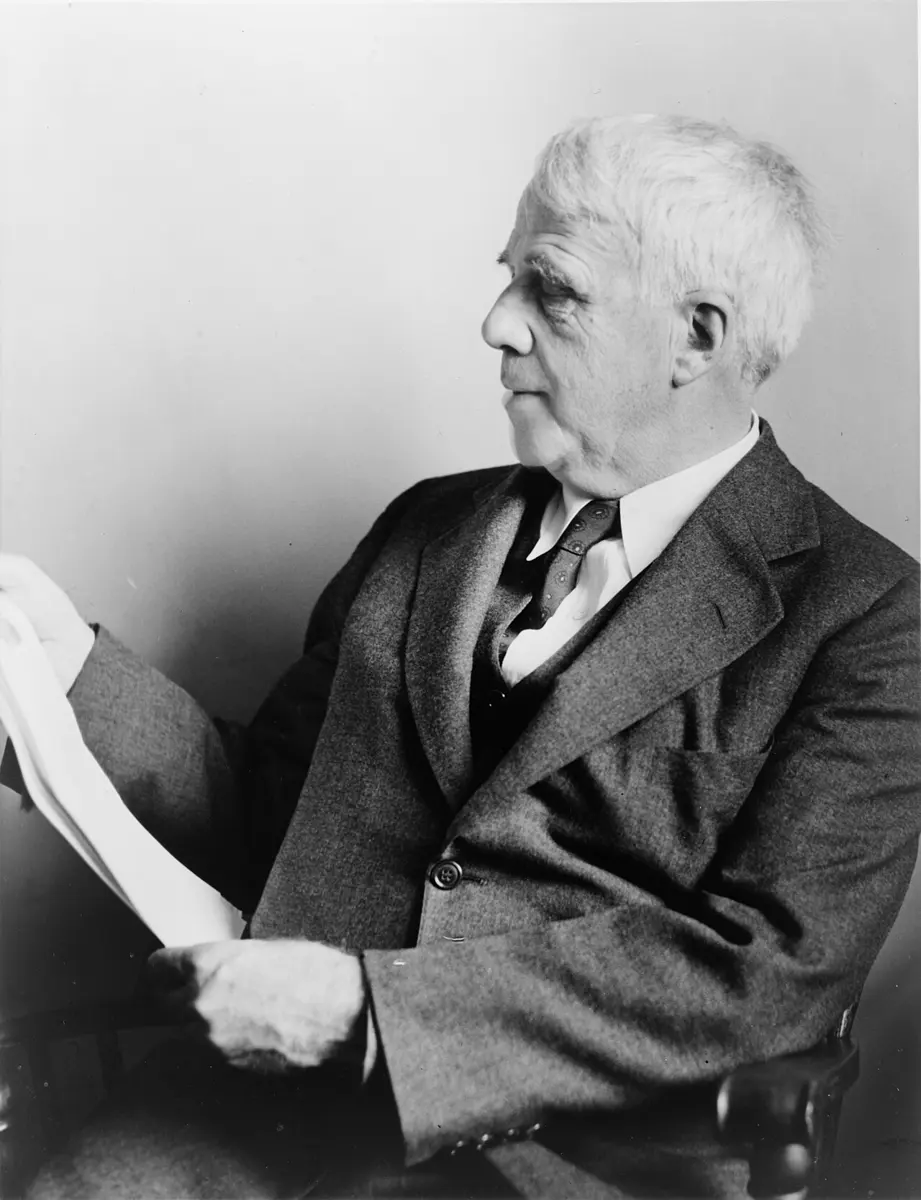
Stopping by Woods on a Snowy Evening was published in 1923. Frost later said he wrote it in a few minutes one summer morning, after staying up all night working on another, longer poem. It is now one of the best-known poems in English.
The poem has four stanzas of four lines each, and every line has four beats: whose WOODS these ARE i THINK i KNOW. Read it aloud and you will hear the steady rhythm, like a horse walking.
The poem, part by part
Stanza 1: whose woods?
A traveler has stopped beside some woods (an area of trees, smaller than a forest). He thinks he knows who owns them, but the owner’s house is in the village, so the owner won’t see him stopping there to watch his woods filling up with snow. He is alone, and nobody is watching him.
Stanza 2: the horse thinks it strange
His little horse must think it queer (strange) to stop where there is no farmhouse near: horses know that a stop usually means a farm, food and a warm stable. Here there is nothing but the woods on one side and a frozen lake on the other, on the darkest evening of the year.
Stanza 3: the only sounds
The horse gives his harness bells a shake, as if asking whether there is some mistake. (A harness is the set of leather straps and metal pieces that joins a horse to the cart or sleigh it pulls; bells were hung on it so that people could hear a sleigh coming.) Apart from the bells, the only sound is the sweep of a gentle wind and the soft (downy, like a bird’s fine feathers) snowflakes falling.
Stanza 4: miles to go
The woods are lovely, dark and deep, and part of the traveler wants to stay and look. But he has promises to keep, things he has said he will do, and miles to go before he sleeps. The last line says it again, and the second time it sounds heavier, as if he is reminding himself.
What it means. On the surface, the poem is a simple moment: a man, a horse, snow. But most readers take it as a picture of life as a journey:
- the traveler is any person on the road of life;
- the woods, lovely, dark and deep, are the pull of rest, beauty and quiet, the wish to stop and forget everything else for a while;
- the promises are our duties and responsibilities to other people;
- sleep is rest at the end of the day, and also, many readers feel, death, the end of life’s journey: there is a lot to do before then.
The horse, practical and impatient, is the voice that brings him back to his duties.
The poet’s devices:
- Rhyme: in each of the first three stanzas, lines 1, 2 and 4 rhyme (know, though, snow), and line 3 has a new sound (here), which becomes the rhyme of the next stanza (queer, near, year). So the stanzas are chained together, aaba bbcb ccdc, and the last stanza rhymes all through, dddd (deep, keep, sleep, sleep): the chain stops, as the traveler must stop dreaming and go on.
- Repetition: the last line is said twice, slowing the poem down at its end.
- Imagery of sight and sound: snow filling the woods, a frozen lake, bells, the soft wind.
- Personification: the horse is given human thoughts; it “must think it queer” and asks “if there is some mistake”.
- Symbolism: the woods, the promises, the journey and sleep stand for bigger things (above).
Why does the horse shake its harness bells?
Pick an answer to see why.
Words from the poem
| Word | Meaning here |
|---|---|
| woods | an area of trees, smaller than a forest |
| queer | strange, odd (an old meaning; today the word is also used for other things, so say strange) |
| farmhouse | the main house on a farm, where the farmer lives |
| harness | the straps and metal pieces put on a horse so it can pull a cart or sleigh |
| sweep | a long, smooth movement, here of the wind |
| downy | soft, like the fine feathers (down) of a young bird |
| flake | a small, thin piece; a snowflake |
| lovely | very beautiful |
| promise | something you have said you will surely do |
A. Find the words
Find the words from the poem that match the following meanings.
- a.an area of trees, smaller than a forest
- b.strange or unusual
- c.the main house on a farm, usually where the farmer lives
- d.a set of leather and metal pieces that is put around the body of a horse
- e.movement of the air
- f.covered in something very soft
Answer
B. Choose the correct answers
Why does the speaker stop while on the journey?
Pick an answer to see why.
What is the setting of the poem?
Pick an answer to see why.
Which one of the following statements is true?
Pick an answer to see why.
How did the horse respond when the speaker stopped there?
Pick an answer to see why.
What does “miles to go before I sleep” mean?
Pick an answer to see why.
C. Complete the summary
Fill in the gaps with words from the box to complete the summary of the poem: promises, traveler, journey, death, the woods, destination.
The poet compares human life with a (a) ……… . The speaker of the poem is a (b) ……… . He has to reach his (c) ……… before taking a rest. However, he is distracted by the momentary pleasure in the form of (d) ……… . His companion, the horse, reminds him of his (e) ……… in life. The speaker realizes that he has to fulfill many responsibilities before his (f) ……… .
Answer
D. A poem of your own
Recall a journey you have recently made. Who accompanied you on the journey? Did you enjoy it? Compose a short poem about it.
A model poem
How to write yours
Listening: booking a hotel room
The textbook’s listening task is a phone call between a hotel receptionist and a customer who wants to book a room. CDC’s own recording is below: read the questions in B first, then listen, as many times as you need. The answers are hidden under the questions; after that, practice with a call of our own that your browser reads aloud.
A. Before you listen
Look at the picture and guess the answers.
- a.Who is the lady?
- b.Who is she talking to?
- c.What is she talking about?
Model answers
B. The textbook’s audio: answers
Listen to the audio and fill in the gaps with suitable words or phrases.
- a.The name of the hotel is ……… .
- b.The $200 room is quite ……… for the customer.
- c.All the non-smoking rooms are ……… on 22nd March.
- d.The non-smoking room costs $ ……… .
- e.The customer finally books the room for ……… March.
Answer
C. Your turn
Where do you often spend nights when you are away on a visit or holidays? How do you, or would you, make a reservation if you had to stay in a hotel? Share your ideas.
A model answer
Practice listening alone
Grammar II: The right future form
Grammar II mixes all the future forms. Before you start, look again at the table of future forms and ask of each sentence: what is there now? A timetable, an arrangement, a plan, a sign, only an opinion, or a decision being made?
We’ve already bought the tickets. We ……… the 7 a.m. flight to Bhairahawa.
Pick an answer to see why.
“I’m too tired to walk any farther.” “OK, we ……… here for the night.”
Pick an answer to see why.
A. Use the correct form of the verbs
Use the correct form of the verbs in brackets to complete the sentences.
- a.As per the schedule, the train ……… (leave) at 3 o’clock.
- b.Look, that airplane is looking shaky! It ……… (crash).
- c.My daughter says she ……… (be) a doctor when she is older.
- d.Tomorrow ……… (be) a sunny day, according to the weather forecast.
- e.A: What ……… (do) tomorrow evening? B: Nothing special. I think I ……… (stay) at home.
- f.It’s very stuffy here. Don’t worry, I ……… (open) the windows for you.
- g.Ann is driving. There is very little petrol left in the tank. The nearest petrol station is a long way from here. She ……… (run) out of petrol.
- h.There is a hole in the bottom of the boat. It is filling up with water quickly. It ……… (sink).
Answer
Writing II: A letter to a friend
Write a letter to your friend describing your travel plans for your upcoming holiday or visit. Use these questions to help you: Where do you plan to go? Who will you go with? Where will you stay? How long will you stay? What are you going to see?
Hint
A model letter
How to write a personal letter
A personal letter (an informal letter) is written to a friend or a relative. In your final exam, a personal letter is a Free writing II task (about 200 words, 8 marks), marked on its content, organization, language and layout. Its parts:
- Your address and the date, at the top right (or left; keep to one). A short address is fine.
- Salutation: Dear Yangchen, (the first name, a comma).
- Opening paragraph: a friendly start; thank them for their letter or ask how they are, then say why you are writing.
- Body: one paragraph for each main point, here the plans: where, with whom, how you are going, where you will stay, for how long, and what you will see and do.
- Closing paragraph: a promise, a question or an invitation, and greetings to the family.
- Closing: With love, / Love, / Your friend, / Best wishes,, then your first name only.
Project work
Use a colon
A colon ( : ) is two dots, one above the other. It says “here comes what I mean”: what follows it explains, lists or completes what came before. Use it:
- After a complete sentence, to introduce a list, an explanation or an example. The part before the colon must be a sentence that could stand on its own.
Professor Pokhrel wrote two books on education: one on educational leadership and the other on educational planning.
Pack three things for the trek: warm clothes, a water bottle and a torch.
We turned back at Deurali: the snow had covered the trail. - In ratios and proportions. Mix salt and water in the ratio 1:8 (one part salt to eight parts water; say “one to eight”).
- In references, between the place of publication and the publisher. London: Oxford University Press; Kathmandu: Curriculum Development Centre.
It has other everyday uses too: times (The bus leaves at 7:30, the American way; British English often writes 7.30), between a title and a subtitle (Nepal: A Guide for Trekkers), and in dialogues written like a play (Guest: I’d like a room, please.).
Which sentence uses the colon correctly?
Pick an answer to see why.
Put a colon where it belongs in each sentence.
- a.The recipe is simple use one part rice to two parts water.
- b.The ratio of boys to girls in our class is 3 4.
- c.Bring the following to the camp a sleeping bag, a torch and a cup.
- d.Kathmandu Ekta Books, 2080.
Answer
Exercise
Practice on this unit in the style of the final exam (Grade 9’s exam follows the SEE’s chart). Try each one as in the exam, then open the answer.
Write True or False after each statement about Reading I.
- a.The yoga trek is only for people who have practiced yoga before.
- b.The group drives from Kathmandu to Pokhara on the second day.
- c.The group sleeps at Poon Hill on the sixth night.
- d.Ulleri is a Magar village.
- e.The visitors return to Pokhara on the seventh day.
Answer
Change these sentences as instructed in brackets.
- a.We visit our grandparents in Dhankuta. (Change into the future with going to.)
- b.I will meet Tilak at the bus park. (Change into the present continuous, adding tomorrow morning.)
- c.They are going to climb Poon Hill. (Change into the negative.)
- d.The flight to Lukla leaves at 6:45. (Make a question with When.)
- e.We will be crossing the suspension bridge at noon. (Change into the negative.)
Answer
Choose the correct answer for each numbered blank.
Dear Urmila, I have great news: my family (a) ……… (go, goes, is going, will be go) to Rara Lake this Dashain! The bus from Kathmandu to Nepalgunj (b) ……… (leave, leaves, leaving, is leave) at five in the morning on the 3rd of Kartik, and my uncle (c) ……… (meet, meets, is meeting, met) us in Nepalgunj the next day. Father has bought new boots and a walking stick: he (d) ……… (walk, walks, is going to walk, walked) all the way to the lake. Look at the weather map: it (e) ……… (rains, is going to rain, rained, will raining) in Karnali next week, so we (f) ……… (taking, are taking, took, taken) our raincoats. I hope we (g) ……… (saw, will see, seeing, seen) the reflection of the hills in the lake. This time next week, we (h) ……… (will be walking, walk, walked, have walked) along the shore. If you like, I (i) ……… (send, sent, will send, sending) you some photos when I (j) ……… (get, will get, got, getting) back. Love, Anju
Answer
Read the notice and answer the questions.
Notice: educational tour for Grade 9. The school is organizing a two-day tour to Bandipur and Pokhara on the 24th and 25th of Magh. The bus leaves the school at 6 a.m. sharp. Students will visit Siddha Cave on the first day and stay overnight in Pokhara. On the second day, they will visit the International Mountain Museum and Phewa Lake. The fee is Rs. 2,500, including meals and the room. Students must bring a signed letter from their parents to the class teacher by the 15th of Magh. Contact: Mr. Dinesh Thapa, tour coordinator.
- a.Which grade is the tour for?
- b.When does the bus leave?
- c.Where will the students stay overnight?
- d.What does the fee include?
- e.What must students bring, and by when?
Answer
Write a paragraph of about 100 words on “My plans for the coming holidays”, using these clues: where you will go, who with, how you will travel, what you are going to do there, when you will come back.
A model answer
Practice every question in the book, and keep track of the ones you miss →
A companion to your textbook, not a replacement for it: study from the book your school uses, and where the two differ, follow your teacher. Found a mistake? Please tell us.