
On 14 July 2019, two men played tennis on the grass of Wimbledon’s Centre Court for four hours and fifty-seven minutes, the longest final in the tournament’s history. At 12 games all in the fifth set, for the first time ever in a Wimbledon singles final, the match went to a tie-break. Novak Djokovic won it, and Roger Federer, who had been one point from the title twice, walked off the court he had won on eight times.
This unit is about games and sports: Wimbledon, the oldest tennis tournament in the world, and sport in general, who plays it, who controls it, who watches it, and how people with disabilities take part. You will talk about what you can, can’t and will be able to do, add question tags (isn’t it? can they? shall we?), turn whole sentences negative, write a news story about a clean-up on Ama Dablam, and learn to paraphrase: to say the same thing in your own words.
Getting started
The unit opens with six pictures of sports:
- Rugby: players in red and in blue-and-white shirts crash into each other on a grass field, one of them holding an oval ball.
- Hockey (field hockey): women with curved sticks chase a small ball on a blue artificial pitch.
- Kabaddi: a team in blue on a blue court, one player diving to touch a raider.
- Basketball: a drawing of an orange ball dropping through a net.
- Athletics: sprinters racing down the lanes of a running track.
- Cycling: a rider on a road bike, leaning into a bend of a road through autumn trees.
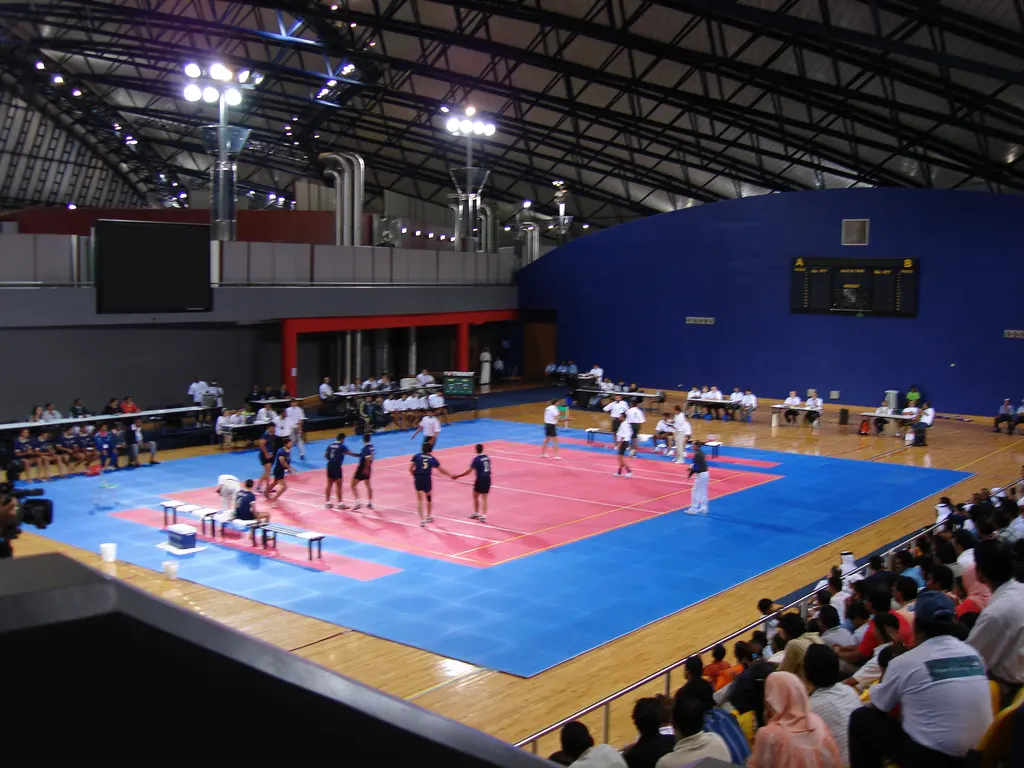
To talk about what people are good at, English uses three ways of saying ability:
- can + the plain verb, for now: I can swim. Negative can’t (or cannot, one word): I can’t swim.
- could, for a general ability in the past: My grandfather could run fast when he was young.
- be able to, which works in every tense, even where can has no form: I will be able to swim next year.
Look at the pictures and identify the sports. Then, talk about them in pairs using “can, can’t, be able to”.
A model conversation
Reading I: Wimbledon
Before you read
The reading begins with two photos: two men in white standing together at the net of a grass court, one holding a racket; and two women in white, each holding up a large shining plate.
- a.What is the name of the sport?
- b.Can you identify the players? Name them.
Model answers
What kind of text it is
Wimbledon is an informative article: it gives facts about one subject, arranged under subheadings (Events, Tickets, Schedule, The Courts, Trophies and Prize Money, A Few Famous Champions), so a reader can find each fact quickly. Notice how many numbers and dates it has: an article like this is easy to turn into true-or-false questions.
The text, part by part
The oldest, and on grass
Wimbledon is the oldest tennis tournament (a set of matches in which the winners play each other until one player is champion) in the world, and many people think it is the most prestigious (most respected and admired). It has been played at the All England Club, in the Wimbledon area of London, since 1877.
It is one of the four Grand Slam tournaments, the biggest four of the year, also called the majors: the Australian Open, the French Open, Wimbledon and the US Open. Wimbledon is the only major still played on grass, the surface tennis began on, which is why the game was first called lawn tennis. The French Open is played on clay, the Australian and US Opens on hard courts.
Events
The championships have five main events: gentlemen’s singles, ladies’ singles, gentlemen’s doubles, ladies’ doubles and mixed doubles (a man and a woman on each side). There are also junior events for players under 18, singles and doubles for boys and for girls, and invitation events, to which famous former players are invited back to play again.
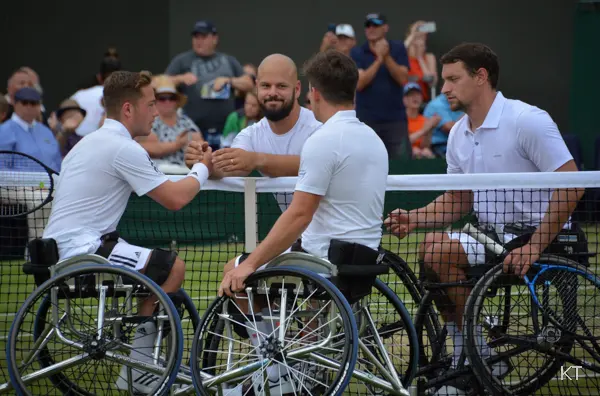
Wheelchair tennis at Wimbledon is neither a junior nor an invitation event: it has events of its own, singles and doubles for men, for women and for quad players (those with an impairment in three or four limbs), played by the world’s best wheelchair players.
Tickets
Most Centre Court tickets are sold through a public ballot: fans apply, and a computer picks the winners at random, like a lottery. Fans with no ticket can queue (wait in a line) all night outside the grounds, because some seats are allocated (set aside) for the queue each day. Wimbledon is one of the very few great sporting events where you can still buy a good seat on the day by waiting in line.
Schedule
The championships last two weeks, beginning in late June and ending in July. In 2017 they began and ended in July, to leave a longer gap after the French Open, which ends in early June; players need time to get used to grass after clay. The five main events go on for both weeks; the junior and invitation events are mostly in the second.
By tradition there was no play on the Middle Sunday, the Sunday between the two weeks, unless rain had put the matches behind. That tradition has ended: since 2022, the Middle Sunday has been an ordinary day of play.
The courts
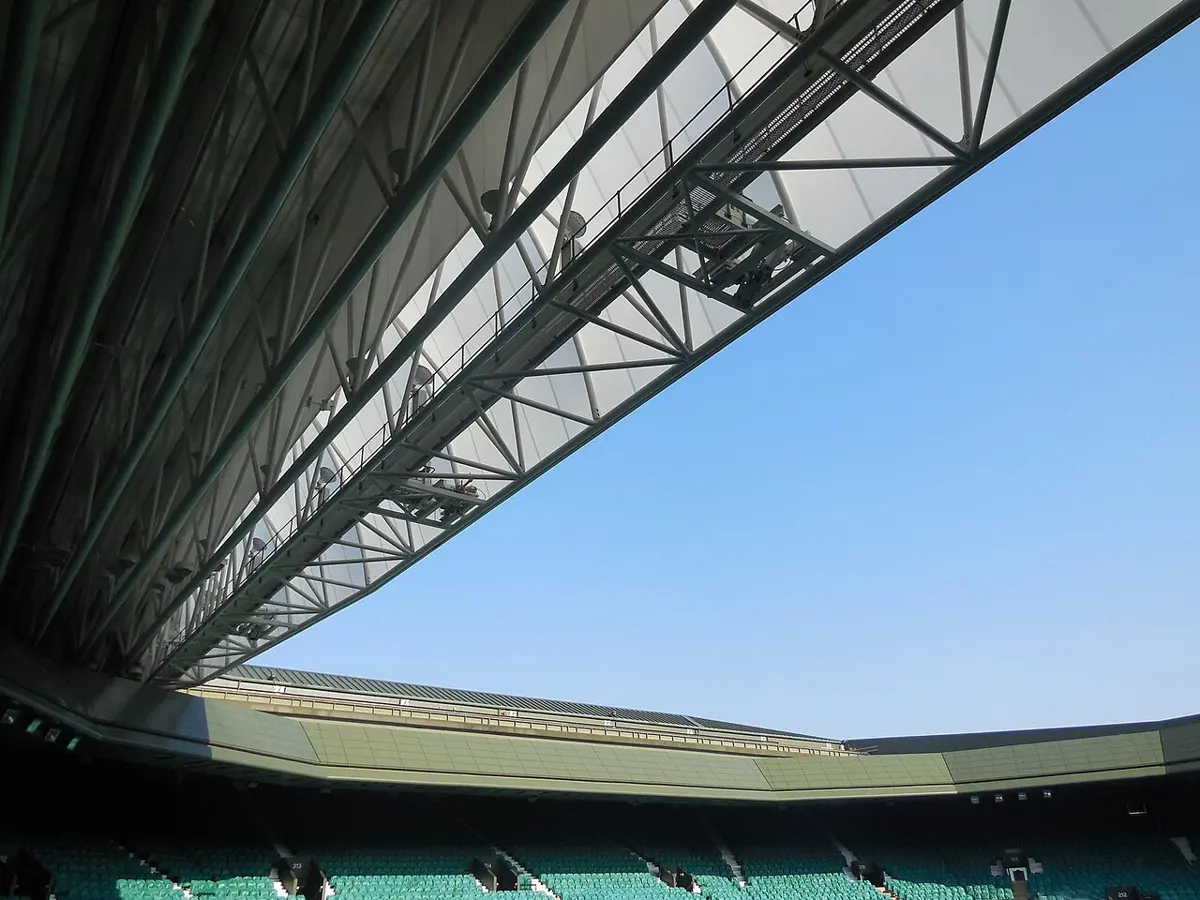
Centre Court, the main court, opened in 1922. In 2009 it was given a retractable roof (a roof that can slide out to cover the court and slide back again), which substantially (a lot) cuts the playing time lost to rain. The two show courts, Centre Court and No. 1 Court, are used for only about two weeks a year, during the championships (a third week only if rain makes it necessary); the club’s other courts are used all year for other events.
Trophies and prize money
The gentlemen’s singles champion receives a silver gilt cup (silver covered with a thin layer of gold), awarded since 1887, with an inscription (words cut into it) calling it the club’s single-handed championship of the world. The ladies’ singles champion receives a sterling silver salver (a large flat plate of almost pure silver), the Venus Rosewater Dish, decorated with figures from mythology (the old stories of gods and heroes). In 2019 each singles winner received £2.35 million.
A few famous champions
- Martina Navratilova won the ladies’ singles a record nine times.
- Roger Federer won the gentlemen’s singles eight times, a record for men.
- In 2019, Novak Djokovic, the defending champion (last year’s winner, playing to keep his title), beat Federer in the longest and one of the most demanding finals ever played. It was his fifth Wimbledon title and his sixteenth Grand Slam singles title.
- In the ladies’ singles, Simona Halep won her first Wimbledon title with a stunning (extremely impressive) win over Serena Williams, 6–2, 6–2: her second Grand Slam singles title.
Why was tennis first called “lawn tennis”?
Pick an answer to see why.
How do most people get a Centre Court ticket?
Pick an answer to see why.
Words from the text
| Word | Meaning here |
|---|---|
| tournament | a set of matches in which the winners go on playing until one is champion |
| prestigious | respected and admired as very important |
| Grand Slam | one of the four biggest tennis tournaments (a major) |
| ballot | a draw in which names are picked at random (also: a vote on paper) |
| queue | a line of people waiting; to wait in one |
| allocate | to set aside for a purpose |
| retractable | able to be pulled back in, as a roof that slides open |
| substantially | considerably, a lot |
| principal | most important, main |
| gilt | covered with a thin layer of gold |
| inscription | words written in the front of a book, or cut into stone or metal |
| salver | a large flat plate, usually of metal |
| mythology | myths, the old stories of gods and heroes; the study of them |
| stunning | extremely impressive or beautiful |
| defending champion | last year’s winner, playing to keep the title |
A. Match the words
Match the words in column A with the meanings in column B.
a. prestigious b. substantially c. gilt d. inscription e. salver f. mythology g. stunning
i. a thin layer of gold ii. a large plate, usually made of metal iii. extremely attractive or impressive iv. considerably v. study of myths vi. respected and admired as very important vii. words written in front of a book or cut in stone or metal
Answer
B. True or False
State whether the given statements are True or False.
- a.The original name of tennis is “lawn tennis”.
- b.Ladies’ wheelchair doubles comes under junior events.
- c.Most of the tickets are distributed through online booking.
- d.The Wimbledon Championship is usually played in June and July.
- e.The players can practice matches in the main show courts at any time.
- f.The prize money for the singles winners was £2.35 million.
Answer
C. Answer the questions
How is Wimbledon different from other Grand Slam tournaments?
Answer
State the four Grand Slam tennis tournaments.
Answer
What are the five main events of Wimbledon?
Answer
What can tennis fans do if they don’t win a ticket in the public ballot?
Answer
Why was Wimbledon Centre Court fitted with a retractable roof?
Answer
What is inscribed on the Gentlemen’s Singles trophy?
Answer
Who won the Gentlemen’s Singles and Ladies’ Singles in 2019?
Answer
D. Tournaments for wheelchair users
Why is it important to have tournaments for wheelchair users?
A model answer
Pronunciation: The Chaos
The Chaos is a long, funny poem by Gerard Nolst Trenité (1870–1946), a Dutch teacher of English, first published in 1920. It strings together about 800 of the hardest words in English to show one thing: the same letters can be said in many different ways. It begins by calling the reader “dearest creature in creation” and promising to teach English pronunciation in verse, and every pair of lines rhymes, so the rhyme often tells you how to say a word: Suzy rhymes with busy, so busy is said BIZ-ee.
The unit gives four stanzas of it. Here is how to say every hard word in them (capitals for the stressed syllable):
| Lines | Words, and how they are said |
|---|---|
| 1–8 | creature KREE-cher, creation kree-AY-shun · corpse KORPS, corps KOR, horse HORSS, worse WURSS · Suzy SOO-zee, busy BIZ-ee, dizzy DIZ-ee · tear (from your eye) TEER, tear (rip) TAIR · prayer PRAIR |
| 9–12 | heart HART, beard BEERD, heard HURD · dies DYZ, diet DY-ut · lord LORD, word WURD · sword SORD, sward SWORD · retain ri-TAYN, Britain BRIT-n |
| 13–18 | plague PLAYG, plaque PLAK, ague AY-gyoo · break BRAYK, steak STAYK, bleak BLEEK, streak STREEK · cloven KLOH-vn, oven UV-n, how HOW, low LOH · script SKRIPT, receipt ri-SEET, show SHOH, poem POH-im, toe TOH |
| 19–28 | devoid di-VOID, trickery TRIK-uh-ree · daughter DAW-ter, laughter LAF-ter, Terpsichore turp-SIK-uh-ree · typhoid TY-foid, measles MEE-zulz, topsails TOP-sulz, aisles EYELZ · exiles EG-zylz, similes SIM-uh-leez, reviles ri-VYLZ · scholar SKOL-er, vicar VIK-er, cigar si-GAR · solar SOH-ler, mica MY-kuh, war WOR, far FAR · one WUN, anemone uh-NEM-uh-nee, Balmoral bal-MOR-ul · kitchen KICH-in, lichen LY-kun, laundry LAWN-dree, laurel LOR-ul · Gertrude GUR-trood, German JUR-mun, wind WIND, mind MYND · scene SEEN, Melpomene mel-POM-uh-nee, mankind man-KYND |
A few of the words are rare: a corps is a group of soldiers; sward is a stretch of grass; ague an old word for a fever with shivering; cloven means split in two (a goat’s cloven hoof); Terpsichore and Melpomene are two of the nine Muses of Greek mythology, of dance and of tragedy; Balmoral is a royal castle in Scotland; mica a shiny mineral that splits into thin sheets; lichen the crusty gray-green growth on rocks and bark.
Read the following part of the poem “The Chaos” by Gerard Nolst Trenité. Try to pronounce each word correctly.
How to practice
Speaking: can, can’t and be able to
A. Three teenagers
Three young people speak in speech bubbles:
- a boy: I can stand on my hands, but I cannot stand on my head. (ability now, and its negative)
- a girl: I was unable to visit him last week. (not able, in the past)
- a young man: I will be able to buy a house when I get a good job. (ability in the future)
Can is special: it has only two forms, can and could. It never takes -s, -ing or to, and it can’t follow will or another helping verb. Wherever English needs one of those forms, it uses be able to instead:
| Time | Ability | No ability |
|---|---|---|
| now | I can swim. / I am able to swim. | I can’t swim. / I am unable to swim. |
| past, in general | I could swim at six. / I was able to swim at six. | I couldn’t swim. / I wasn’t able to swim. |
| past, one success | I was able to (managed to) swim across. | I couldn’t swim across. |
| future | I will be able to swim next year. | I won’t be able to swim. |
| up to now | I have been able to swim since I was eight. | I haven’t been able to swim since my injury. |
| after another verb | I want to be able to swim. / I love being able to swim. |
Next year, Reshma ……… drive her father’s jeep.
Pick an answer to see why.
B. Can you…?
The pictures show five actions: riding a horse, swimming, playing the madal (a man in a dhaka topi with the drum across his body), driving a car and riding a bicycle. The example: A: Can you stand on your hands? B: Yes, I can stand on my hands.
Work in pairs. Ask and answer whether you can or can’t do the actions as shown in the pictures.
Model answers
C. What can your partner do?
Ask your partner whether she or he can do the things mentioned in the table. Then tell the class what your friend can do or can’t do.
write with both hands · draw pictures with legs · drive a car · ride a bicycle · sew a button on a shirt · work with a computer · peel a pineapple · do bungee jumping · make curry · climb a mountain
Example: Janak can write with both hands. He can’t draw pictures with his legs.
A model report
Grammar I: question tags
What a tag is
A question tag is a short question added to the end of a statement: Birds are free, aren’t they? We use it to check something we think is true, or to ask the listener to agree. In Nepali we do the same with होइन? or हैन त? at the end: चराहरू स्वतन्त्र छन्, होइन?
A tag is built from three things:
- the statement’s helping verb (is, are, have, can, will, must…); with no helping verb, do, does or did;
- the opposite sign: a positive statement takes a negative tag, a negative statement a positive one;
- a pronoun for the subject (Preeti → she, the children → they), never the noun again.
| Statement | Helping verb | Tag |
|---|---|---|
| Birds are free, | are | aren’t they? |
| Humans can’t fly, | can | can they? |
| Birds play an important role, | none: play → do | don’t they? |
| Humans have polluted the air, | have | haven’t they? |
| We must keep it clean, | must | mustn’t we? |
Punctuation: a comma before the tag and a question mark after it.
How you say it changes the meaning. With the voice falling on the tag (↘), you are sure and only want agreement: It’s hot today, ↘isn’t it? With the voice rising (↗), it is a real question: You’ve locked the door, ↗haven’t you? (I’m not sure you have.)
A. Mira’s tags
In the text, Mira sits alone, enjoying the place around her, and talks to herself about birds: they are free, they matter to the ecosystem, while humans, the best of creation, can’t fly and have polluted the environment, which we must keep clean.
Read the text below and find the tag questions. Notice what punctuation is used to add the tag.
Answer
The tricky cases
| Statement | Tag | Why |
|---|---|---|
| I’m tired, | aren’t I? | There is no amn’t, so English says aren’t I. |
| Let’s go, | shall we? | A suggestion with let’s (let us) takes shall we. |
| Please keep quiet, | will you? | An order or request takes will you (or won’t you, would you). |
| Let him open the door, | will you? | Let him is an order to you (allow him), so will you, not shall we. |
| Everybody has finished, | haven’t they? | Everybody, somebody, nobody become they in the tag. |
| No one could solve it, | could they? | No one, nobody, never, hardly make the statement negative: positive tag. |
| You’d better help them, | hadn’t you? | ’d better = had better. |
| We’d prefer coffee, | wouldn’t we? | ’d prefer = would prefer. |
| You needn’t stay, | need you? | Needn’t is the helping verb here, so it comes back in the tag. |
| There is a match today, | isn’t there? | There stays in the tag. |
Let’s play one more game, ………?
Pick an answer to see why.
Nobody watched the final on TV, ………?
Pick an answer to see why.
I’m in your team, ………?
Pick an answer to see why.
B. Add the tags
Add correct tag questions to the following statements.
- a.Smoking is hazardous to health, ……… ?
- b.Preeti speaks excellent French, ……… ?
- c.Please keep quiet, ……… ?
- d.Everybody has finished their work, ……… ?
- e.We do not go to school on Saturdays, ……… ?
- f.I’m tired and hungry, ……… ?
- g.Let’s do our homework, ……… ?
- h.Let him open the door, ……… ?
- i.They’d build a house, ……… ?
- j.You’d better help them, ……… ?
- k.No one could solve the problem, ……… ?
- l.Roshan’s gone to school, ……… ?
- m.You needn’t stay out long, ……… ?
- n.We’d prefer coffee, ……… ?
Hint
Answer
Writing I: a news story
You met the news story in Unit 8. Its parts, from the top:
- Headline: the main news in a few words, main words in capitals, often in the present tense: Army Collects 800 kg of Garbage from Ama Dablam.
- Byline: who wrote it: By Our Correspondent, By RSS.
- Dateline: the place and the date the news comes from.
- Lead: the first paragraph, which answers who, what, where, when (and why).
- Body: the details in order of importance, with a quotation, and what happens next.
Write in the past tense, the third person, and short paragraphs. Turn the notes into full sentences, and add only details that follow from them.
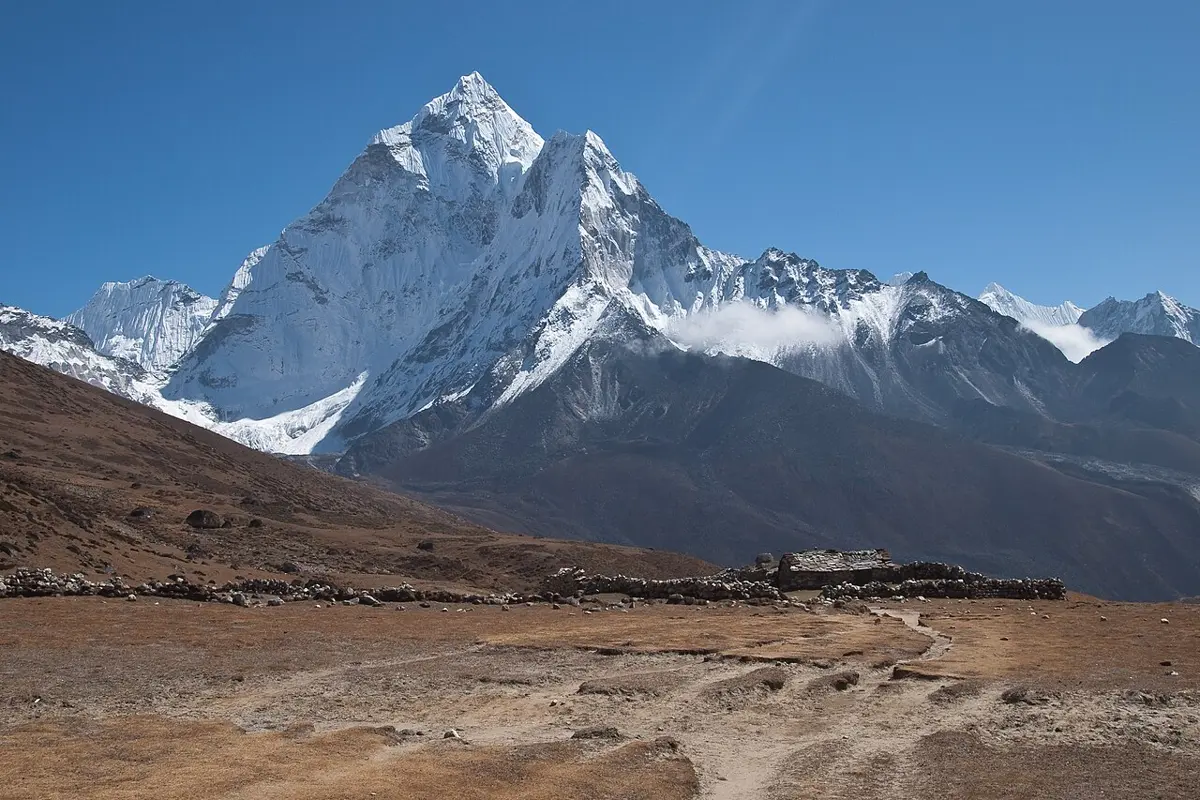
The notes are about a clean-up on Ama Dablam, a 6,812 m peak in the Khumbu region of Solukhumbu. The Sagarmatha Pollution Control Committee (SPCC), a local organization based in Namche Bazaar, looks after the trails, camps and waste of the Everest region. The year 2075 in Bikram Sambat is 2018–19 AD.
Write a news story using the outline given below.
Nepali Army (NA) collects 800 kg of garbage from Mt. Ama Dablam. · Mt. Ama Dablam clean-up campaign 2075 organized by Sagarmatha Pollution Control Committee (SPCC). · The Shumsher Gulma, a company of Nepali Army, participates. · Financial assistance from Khumbu Village Body. · 800 kg of garbage collected. · Handed over to the local community amid the program. · SPCC Chair Mr. Sherpa expresses his gratitude to NA.
Hint
A model news story
Reading II: Sports
Before you read
- a.Which sports do you play or do? Why?
- b.Why are sports important for us?
Model answers
What kind of text it is
Sports is a short informative essay of four paragraphs, each about one side of sport: why people play and what it costs; balls, officials and how long games last; watching sport; and sport for people with disabilities. Beside the second paragraph are twelve pictograms (simple pictures of players) for sports such as badminton, basketball, boxing, canoeing, cycling, horse riding, fencing and football.
The text, part by part
Paragraph 1: who plays, and what it costs
Many kinds of sport are played by many kinds of people. Some make sport their career (their job for life); others play only for fun and recreation (what you do to relax in your free time). Some sports, like cricket, need a lot of equipment (bats, pads, helmets, gloves, stumps); others need very little. Some people play for free on public playing fields; others pay by the hour for courts at a leisure centre (a building with courts and pools for sport), as for squash, tennis, badminton and table tennis.
Paragraph 2: balls, officials, and how long
Most sports use a ball; some use more than one, and snooker is unique (the only one of its kind) in using many: 22 in all. A game is controlled by an impartial person (one who supports neither side): an umpire in cricket, a referee in football and rugby. Most games last no more than a few hours, but an athletics meeting can go on for a week, and a Test match of cricket for five days before there is a result.
Paragraph 3: watching sport
Some people prefer to watch sport: at a stadium, a leisure centre, a park, or on television, which is usually cheaper than going to the stadium. Different countries love different sports: football and cricket are hugely popular in the United Kingdom but not in the USA, where people play basketball and baseball. Still, almost every country takes part in world events such as the football World Cup and the Olympics, held every four years.
Paragraph 4: sport for everyone
Today, people with any kind of disability take part in sport too, with equipment adapted (changed) to their needs: a racing wheelchair, a ball with a bell inside for blind players, a prosthetic running blade. So sport can be enjoyed whatever a person’s body is like. The Paralympics are held in the same city as the Olympics, starting a little over two weeks after the Olympics end (17 days in Paris in 2024), and they are just as popular. Doctors and schools encourage sport, and together with people’s love of competing, that keeps it popular everywhere.
What is the main quality of an umpire or a referee?
Pick an answer to see why.
Why does the essay mention snooker?
Pick an answer to see why.
Words from the text
| Word | Meaning here |
|---|---|
| career | the work a person does for most of their life |
| recreation | what you do for enjoyment when you are not working |
| equipment | the things needed for an activity |
| leisure | free time (leisure centre: a building for sport and fun) |
| unique | the only one of its kind; very unusual |
| impartial | fair to everyone, supporting no side |
| umpire | the official who controls a game of cricket, tennis or volleyball |
| referee | the official who controls a game of football, rugby or boxing |
| duration | how long something lasts |
| adapted | changed to suit a new need |
| participate | to take part |
A. Complete the sentences
Complete the following sentences with these words: career, recreation, unique, impartial, adapted.
- a.As a monitor, I must remain ……… . I should not support one person more than another.
- b.My plan is to pursue a ……… in medicine.
- c.The school ……… the classroom doorway to allow wheelchair users easy access.
- d.We need a sports club in our school for ……… .
- e.He is very different from all of us. He is the most ……… person I’ve ever seen.
Answer
B. Choose the correct answers
Which sport requires the use of a lot of equipment?
Pick an answer to see why.
What sport is popular in the United Kingdom?
Pick an answer to see why.
What sport can last longer than a day in duration?
Pick an answer to see why.
Which of the following information is stated in the first paragraph?
Pick an answer to see why.
Which paragraph states the benefits of sports?
Pick an answer to see why.
C. Answer the questions
Why do people do sports?
Answer
What is common about most sports?
Answer
What is the main quality of an umpire or a referee in sports?
Answer
Is watching sports at home beneficial? How?
Answer
Why is sports equipment adapted for people with disabilities?
Answer
Why do doctors encourage people to do sports?
Answer
D. Sport for everyone
What is your favorite sport? How might you make adaptations for people with disabilities for this sport?
A model answer
Listening: the news headlines
A. Before you listen
Answer the following questions.
- a.Do you listen to English news on radio or watch it on television?
- b.Share some highlights of a recent news broadcast on radio or television.
Model answers
The recording
A radio news bulletin: first the headlines (a sentence for each story), then each story in a little more detail. Read the questions in B and C first, then listen, as many times as you need.
Words you will hear: host (to hold an event in your city); rivals (those competing against you); elimination (being knocked out of a contest); polling stations (places where people vote); exit polls (asking voters as they leave how they voted); to privatize (to sell government industries to private companies); evacuation order (an order to leave an area for safety); prodigious (amazingly great or talented); contract (a written agreement, here to play for a club); interpreter (a person who turns one language into another as people speak); captivity (being kept, not free, as in a zoo).
B and C. Answers
Listen to the headlines on the audio and match the following places/clubs and the news related to them.
a. London b. Estonia c. USA d. Manchester United e. Berlin Zoo
i. Chi Chi gives birth to twins ii. Thousands injured by hurricanes iii. Young player Brillinho bought for the highest price iv. Storms cause damage v. Olympics to be organized vi. New president elected
Answer
Listen to the audio again and answer the following questions in no more than four words.
- a.Which city was competing with London to host the Olympics in 2012?
- b.When is Vladimir Shevchenko going to take power as the president?
- c.Which parts of America are suffering from Maxwell and Nelly?
- d.How long will Brillinho play for his new club?
- e.Since when has the Chinese panda been kept in captivity in Berlin Zoo?
Answer
D. Radio Nepal
Listen to the 8 o’clock news on Radio Nepal and write three news headlines.
How to do it
Grammar II: negatives
A negative sentence says that something is not so. To make one:
- With a helping verb (am, is, are, was, were, have, has, had, will, can, must…), put not after it: The boss was not friendly. Mary will not come.
- With no helping verb (present or past simple), add do, does or did + not, and use the plain verb: His teacher knows → His teacher does not know. Alex ate → Alex didn’t eat. The tense is shown once, in does or did.
- Orders and requests begin with Don’t: Play with the baby → Don’t play with the baby.
- Change the partner words: some → no / not any, someone → no one / not anyone, always → never, either … or → neither … nor, already → not … yet.
| Affirmative | Negative |
|---|---|
| She bought someone a present. | She bought no one a present. / She didn’t buy anyone a present. |
| Mr. Pant has won many awards. | Mr. Pant hasn’t won any awards. |
| Some of the rice has gone bad. | None of the rice has gone bad. |
| Always knock before entering. | Never knock before entering. |
| Either Sobhana or Karma will attend. | Neither Sobhana nor Karma will attend. |
| Stuti used to live in London. | Stuti didn’t use to live in London. |
| We have to work hard. | We don’t have to work hard. |
Which is the negative of “Either Lakpa or Tenzing will carry the flag”?
Pick an answer to see why.
Which is the negative of “Kushal plays chess on Fridays”?
Pick an answer to see why.
A. Match the affirmatives with their negatives
Match the affirmative sentences in column A with their negatives in column B.
Column A: The students have aced the exam. · Play with the baby please. · Could you play the guitar please? · The boss was friendly. · She bought someone a present. · Always knock on the door before entering. · Stuti used to live in London. · Alex ate rice yesterday.
Column B: Could you not play the guitar please? · She bought no one a present. · Never knock on the door before entering. · Alex didn’t eat rice yesterday. · The students have not aced the exam. · Stuti didn’t use to live in London. · The boss was not friendly. · Don’t play with the baby please.
Answer
B. Make them negative
Change the following sentences into negative ones.
- a.Your new friends are chatting online now.
- b.His teacher knows what to do.
- c.My classes started on time yesterday.
- d.Mary will come to the party.
- e.Raju had painted the wall when I reached his home.
- f.Rani is leaving Singapore tomorrow.
- g.My mother and grandmother always go to the temple on Saturdays.
- h.Some of the rice has gone bad.
- i.We have to work hard to live a decent life.
- j.Mr. Pant has won many awards.
- k.She usually carries a walking stick.
- l.Either Sobhana or Karma will attend the meeting.
Hint
Answer
Writing II: a paraphrase
To paraphrase is to say the same thing in your own words: every idea of the original, nothing added, nothing left out, but in different words and different sentences. It is not a summary, which is shorter and keeps only the main points. (You met a paraphrase of a poem in Unit 4.)
The task gives a paraphrase of the last paragraph of Sports as a model. Look at what it does with the original:
- Nowadays becomes Today; participate in sports becomes take part in sports;
- adapted to suit the needs of becomes modified to fit the needs of;
- Participation … is encouraged by doctors and schools becomes Sports activities are encouraged by doctors and schools;
- the reason at the end becomes a short sentence beginning So.
The meaning is the same; the words and sentence shapes are new. (The model drops the sentence about the Paralympics; a full paraphrase keeps it.)
The given paragraph is paraphrased from the last paragraph of Reading II. Read it carefully and paraphrase the first paragraph of it in a similar way.
Hint
A model paraphrase
Project work: a sports week
Extra bit: paraphrasing
Paraphrasing is restating a text or passage, giving its meaning in another form: you rewrite it without changing its meaning. The four steps:
- Read the passage several times, until you fully understand it.
- Note down its key ideas, in a few words each.
- Write your version without looking at the original.
- Compare yours with the original, and change any phrases that are still too close.
Ways to make the words your own:
| Change | Original | Paraphrase |
|---|---|---|
| a word for one that means the same | people purely do sport for enjoyment | some play simply for fun |
| the word class | participation is encouraged | doctors encourage people to take part |
| active ↔ passive | doctors and schools encourage it | it is encouraged by doctors and schools |
| the order of ideas | sports such as tennis are paid for at a leisure centre | at a leisure centre, you usually pay for tennis |
| one long sentence ↔ two short ones | …, while others need very little. | … . Others need very little. |
Keep names, numbers and technical terms as they are (cricket, the Olympics, four years): there is no other word for them.
Exercise
Practice on this unit in the style of the final exam. Try each one as in the exam, then open the answer.
Read the text and answer the questions.
Every winter, a village school in Kaski holds a kabaddi tournament on its ground. Teams come from six wards, and the matches go on for three days. The referee, a retired teacher, is known for being strictly impartial: last year he gave a point against his own grandson’s team. In 2024, for the first time, the tournament added a race for wheelchair users, after the school built a ramp to its ground. The winners receive a brass plate engraved with the year.
- a.How long do the matches go on?
- b.What is the referee known for?
- c.What did the tournament add in 2024?
- d.Find a word in the text that means “cut words into metal or stone”.
Answer
Add question tags.
- a.The final starts at two, ……… ?
- b.Let’s cheer for our house, ……… ?
- c.Nobody saw the referee’s signal, ……… ?
- d.I’m in the relay team, ……… ?
- e.You’d better wear your spikes, ……… ?
Answer
Change into negative sentences.
- a.Dawa can swim across the Phewa Lake.
- b.The coach always shouts at the players.
- c.Somebody has taken my racket.
- d.Either Rabina or Abdul will lead the march.
Answer
Complete with can, could or the right form of be able to.
- a.When she was eight, Muna ……… already ride a bicycle.
- b.The ropes broke, but the climbers ……… reach the camp safely.
- c.In two years, I ……… drive a car.
- d.Since he joined the club, Tilak ……… run five kilometers without stopping.
Answer
Write a news story for your school magazine about your school’s sports week, using these notes: sports week, 13–18 Mangsir · 450 students in 14 events · Everest House overall winner · new record in the 100 m by a Grade 9 girl · ward chair gave prizes. (about 120 words)
A model news story
Practice every question in the book, and keep track of the ones you miss →
A companion to your textbook, not a replacement for it: study from the book your school uses, and where the two differ, follow your teacher. Found a mistake? Please tell us.