
On the morning of 17 December 1903, on a cold, windy beach in North Carolina, a machine of wood, cloth and wire rolled along a wooden rail, lifted into the air and flew for twelve seconds. It went about as far as a cricket pitch is long, twice over. Those twelve seconds were the first time a powered machine heavier than air had carried a person in controlled flight. The two men who built it had no university degrees: they mended bicycles.
This unit is about transportation and communication: how the Wright brothers solved the problem of flight, and a short poem, Rickshaw Ride, about an old man who pulls tourists up a hill for a dollar. You will learn to tell adjectives from adverbs (a serious injury, seriously injured), to compare things (faster, more carefully, the most famous, as tall as), and to hear the intonation of statements, questions and lists. You will describe a bar chart of electric vehicles, listen to a passenger in a taxi, write an account of a journey, and find out how the telephone was invented. The Extra bit sorts adverbs into five kinds.
Getting started
The unit opens with two pairs of pictures:
- Two trains at station platforms: a modern express train with garlands of flowers on its front, as trains are decorated for their first run, and a sleek high-speed train with a long, pointed nose and passengers waiting beside it.
- A small red car and a big white bus.
To talk about pairs like these, you compare them: you say how they are alike and how they differ. English does it with comparative forms (faster, bigger, more comfortable) and words such as than, as … as and whereas.
Look at the pairs of pictures and talk about them in groups, making comparisons.
A model discussion
Which sentence compares the car and the bus correctly?
Pick an answer to see why.
Reading I: Wright Brothers
Before you read
The picture beside the title is an old black-and-white photo. On a bare, sandy beach, two men in dark clothes stand on the ground holding ropes, and above them, in the air, floats a large glider: two long wings, one above the other, joined by struts, with no engine and no one on board.
- a.Who are the people seen in the picture?
- b.What are they doing?
Model answers
What kind of text it is
Wright Brothers is an informative text: a short history of an invention, told in the order things happened, with dates. Watch the years as you read: 1889, 1892, 1896, 1899, 1900, 1901, 1902, 1903, 1904. They are the skeleton of the story, and three of the exercises ask about them.
The text, part by part
Paragraph 1: two curious boys
Wilbur (1867–1912) and Orville (1871–1948) Wright grew up in Dayton, Ohio, in the United States. Their father, Milton, was a bishop (a senior priest) of his church. Their mother, Susan, was good with her hands: she made toys for her children and encouraged their curiosity (their wish to find out how things work). One day their father brought home a small toy “helicopter”, with two twisted rubber bands that turned a small propeller (a set of turning blades that pushes air). The boys played with it until it broke, and then built copies of it themselves. They also made kites and sold toys to their friends. From childhood, the brothers did things together.
Paragraph 2: printers and bicycle makers
In 1889 the brothers started a printing business. Three years later (1892) they opened their first bicycle shop. Initially (at first) they sold and repaired bicycles: they replaced spokes (the thin wires from the center of a wheel to its rim), fixed broken chains and sold accessories (useful extra things, such as lamps and bells). In 1896 they began to build bicycles of their own brand.
The bicycle shop taught them the skills they later needed for airplanes. Their machines used bicycle parts: chains, sprockets (toothed wheels that a chain runs over), spoke wires, ball bearings and wheel hubs. And, more important, a cyclist knows something that most early inventors forgot: a bicycle doesn’t balance by itself. The rider balances it, all the time, by small movements. The Wrights thought an airplane would be the same: the pilot must control it.
Paragraph 3: control in three directions
The brothers were convinced (completely sure) that a pilot must be able to turn an aircraft in three ways, about three axes (imaginary lines it turns round):
- Pitch: climb and descent. An elevator, a flat surface in front of the wings, tipped the nose up or down. The pilot worked it with a lever in his left hand.
- Roll: one wing down. A wing warping system twisted the ends of the wings. The pilot lay on the lower wing with his hips in a cradle; shifting his hips from side to side pulled wires that twisted the wing tips, so one side lifted more than the other and the machine rolled, or came back to level.
- Yaw: the nose left or right. In 1902 they added a vertical rudder at the back.
They got the idea of wing warping from birds. They watched buzzards keep their balance in the wind by twisting their wings, sometimes curving one wing more than the other.
Paragraph 4: kites and gliders, 1899–1901
Their aeronautical (to do with building and flying aircraft) research began in 1899 with a kite that had a 5-foot (1.5 m) wingspan (the distance from one wing tip to the other), to test their notions (ideas) about control. In 1900 they built their first machine designed to carry a pilot, a glider, and took it to Kitty Hawk, North Carolina: a place with strong, steady winds (blowing at the same strength), open spaces and tall, soft sand dunes to land on. The glider gave less lift than they expected, so they flew it as a kite, on ropes, and measured how it behaved. A new glider in 1901 also disappointed them: they had learned a lot, but met new puzzles and dangers.
Paragraph 5: the wind tunnel
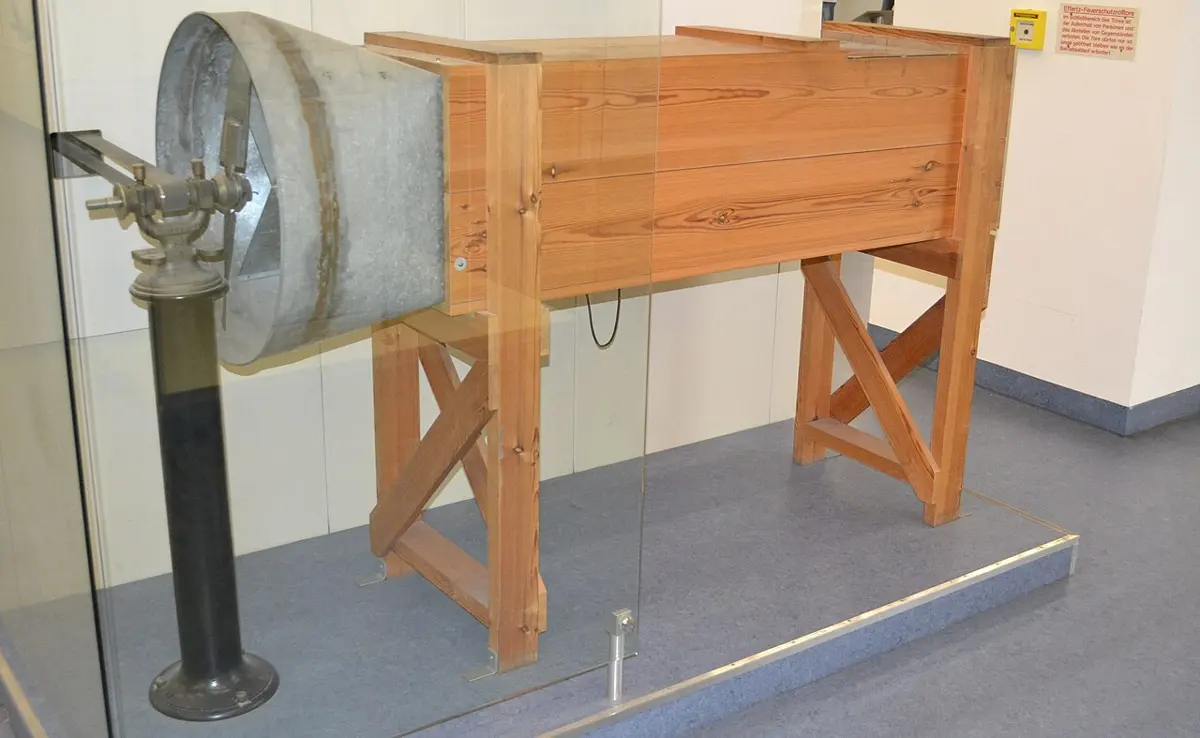
To simulate flight (copy its conditions safely on the ground), they built a wind tunnel: a long box with a fan at one end blowing a steady stream of air over small model wings, which were fixed on a special balance inside. With it they tested many shapes of wing. The tunnel told them the best wing shape, how big the wings must be to lift them into the air, how well their propellers would work, and how much power their engine would need. They designed their next glider from these results.
Paragraph 6: the rudder, 1902
In 1901 they had found a new problem: when they warped the wings, the two wings felt unequal drag (air pushing back), and the machine swung the wrong way. The answer, in 1902, was a rudder at the back, joined to the warping system so that the two moved together. With control solved, they were ready to add an engine.
Paragraph 7: twelve seconds, 17 December 1903
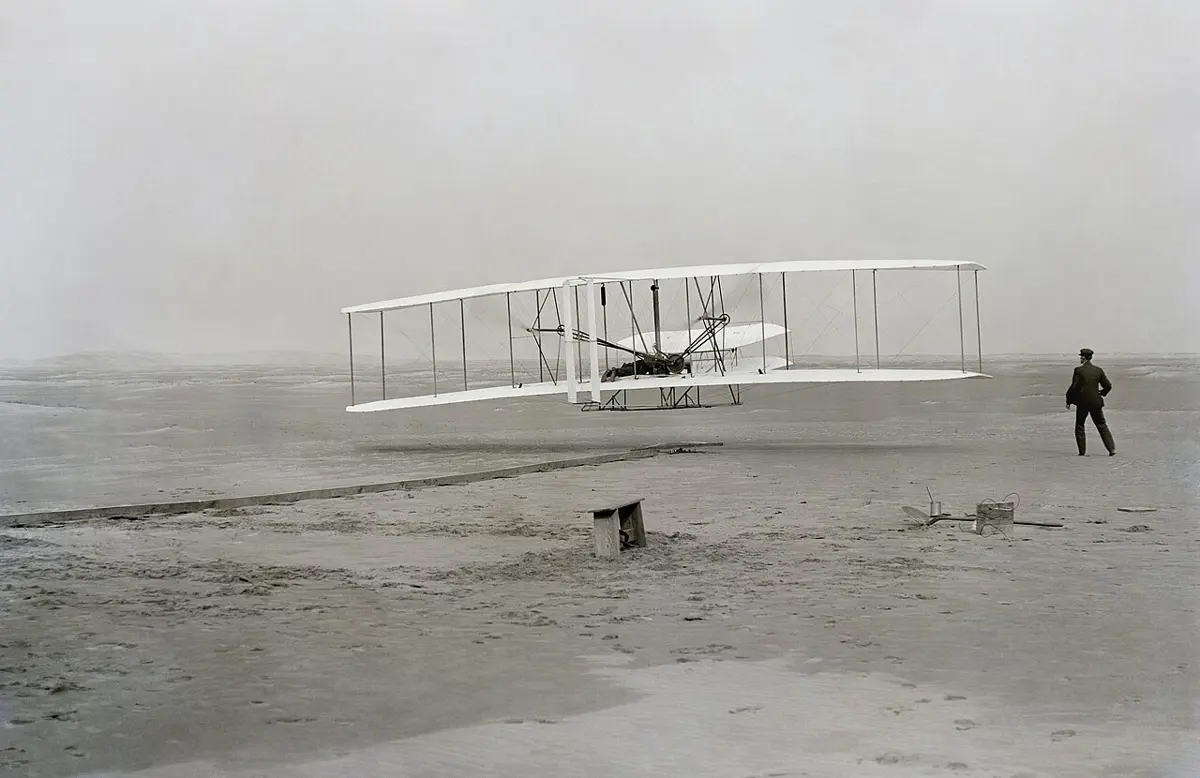
At Kill Devil Hills, near Kitty Hawk, at 10:35 a.m. on 17 December 1903, the Wright Flyer took off under its own power with Orville as pilot. It flew for 12 seconds and covered 37 meters. The brothers took turns and made three more flights that morning; the fourth and longest, with Wilbur at the controls, went 260 meters in 59 seconds. The 1903 Flyer was the first powered, heavier-than-air machine to make a controlled, sustained (kept up) flight with a pilot on board. Today it hangs from the ceiling of the National Air and Space Museum in Washington, D.C.
Paragraphs 8 and 9: Huffman Prairie, 1904 and 1905
After this success, the brothers carried on closer to home. They built a second powered airplane and flew it at Huffman Prairie, a pasture (a field of grass for cattle) eight miles (about 13 km) east of Dayton. Without the strong, steady winds of Kitty Hawk, progress was slow. Still, on 20 September 1904 they made the first circular flight of an airplane: a full circle, 1 minute 36 seconds long, covering 1,244 meters. But stability problems still plagued (kept troubling) the machine, and their changes during 1904 helped without curing them.
In 1905 they built a third Flyer, and this one was the world’s first practical airplane: one that could be flown again and again, safely, wherever the pilot wanted. In more than 40 flights at Huffman Prairie it was banked (tilted into a turn), turned, circled and flown in figures of eight, and twice it stayed up for more than half an hour. The brothers, self-trained engineers who never went to university, had solved problems that had stopped people from flying for centuries.
Why does the text say the bicycle business helped the brothers?
Pick an answer to see why.
Which control made the Wright Flyer roll, one wing going down?
Pick an answer to see why.
Words from the text
| Word | Meaning here |
|---|---|
| bishop | a senior priest in some Christian churches |
| curiosity | the wish to know or learn about things |
| propeller | turning blades that push air (or water) to move a plane (or a boat) |
| spokes | the thin bars or wires from the center of a wheel to its rim |
| accessories | extra things that are useful but not essential |
| sprocket | a wheel with teeth that a chain runs over |
| convinced | completely sure |
| elevator | on an aircraft, a flat surface that tips the nose up or down |
| descent | going down |
| wing warping | twisting the ends of the wings to make the aircraft roll |
| initiate | to start |
| buzzard | a large bird of prey that soars; in America, a turkey vulture |
| rudder | an upright flat surface at the back that turns the nose left or right |
| aeronautical | to do with building and flying aircraft |
| steady | not changing; constant |
| experiment | a scientific test done to discover something |
| simulate | to copy the conditions of something in order to test or practice |
| mounted | fixed in place on something |
| suspended | hanging from above |
| pasture | land covered with grass for cattle and sheep |
| plague | (verb) to cause trouble again and again over a long time |
| stability | staying steady, not tipping over |
| practical | useful for real work, not only an experiment |
A. Find the words
The meanings of the words are given below. Find the words from the text above.
- a.a……. equipment that is useful but not essential
- b.d……. an action of going down
- c.a……. connected with the science or practice of building and flying aircraft
- d.s……. fixed in a place or position, supported or balanced; constant
- e.e……. a scientific procedure undertaken to make a discovery
- f.p……. to cause pain or trouble to somebody over a period of time
Answer
B. Words and pictures
The four pictures, from left to right: (1) the tail of a jet airliner, with its small horizontal wing and the flat flap hinged to it; (2) a large airplane propeller with many curved blades; (3) a bicycle wheel, with thin wires from the hub to the rim; (4) a big brown bird of prey soaring with its wings spread.
Match the words with the appropriate pictures. a. propeller b. spokes c. elevator d. buzzard
Answer
C. True or false?
The Wright brothers sold copies of toy helicopters at the market.
Pick an answer to see why.
They had a printing business in their cycle shop.
Pick an answer to see why.
The experience of cycling helped them to generate ideas for controlling and balancing aircraft.
Pick an answer to see why.
The wing warping system controls the aircraft in a roll.
Pick an answer to see why.
They learned more about balancing by watching other aircraft fly.
Pick an answer to see why.
Their first experimentation was with a kite.
Pick an answer to see why.
Wilbur Wright was the pilot of their 1903 Flyer.
Pick an answer to see why.
Their aircraft could only fly straight.
Pick an answer to see why.
D. Put the events in order
Put the following events from the text in chronological order.
- a.Their first Flyer took off under its own power with a pilot.
- b.The Wright brothers opened a cycle shop.
- c.The Wright brothers developed a machine overcoming complex technical problems.
- d.Milton Wright brought home a toy helicopter.
- e.The Wright brothers built their first machine designed to carry a pilot.
- f.The children made copies of the toy helicopter.
- g.The Wright brothers began their aeronautical research.
- h.The Wright brothers started a printing business.
Hint
Answer
E. Answer the questions
What services did the Wright brothers offer from the cycle shop?
Answer
How did their cycle business help them to build an aircraft?
Answer
How did the brothers develop the idea of balance and control in the flight of an aircraft?
Answer
What was their first aircraft like?
Answer
What did they do to create the flight conditions?
Answer
What is “wing warping”?
Answer
When and where did the first Flyer take off?
Answer
What progress had they made by 1904?
Answer
What was the world’s first practical airplane like?
Answer
F. Since the Wright brothers
What improvements have been made to aircraft since the time of the Wright brothers to the modern day? Discuss.
A model answer
Speaking: making comparisons
When you compare two things, use the comparative and than; when you pick one out of three or more, use the + the superlative:
| Form | Short words (one syllable, or two ending in -y) | Longer words |
|---|---|---|
| comparative (two things) | taller, heavier than | more dangerous than |
| superlative (three or more) | the tallest, the heaviest | the most dangerous |
A: Which animal is more dangerous, a bear or a wolf? B: I think the bear is more dangerous than the wolf. With three: A: Which is the most aggressive? B: I think the tiger is the most aggressive of the three. More about the forms in Grammar II.
A. Talk about the animals
Talk about the following animals using suitable forms of adjectives.
Example: bear/wolf/dangerous. A: Which animal is more dangerous? B: I think the bear is more dangerous than the wolf.
- a.bear/tiger/snail (aggressive)
- b.elephant/giraffe (tall)
- c.monkey/dolphin/tortoise (intelligent)
- d.rhino/elephant (heavy)
- e.bear/lion (strong)
- f.hen/pig/dog (dirty)
- g.rattlesnake/cobra (dangerous)
- h.snail/tortoise (slow)
- i.cobra/python/anaconda (poisonous)
- j.donkey/zebra (fast)
Model conversations
Which is correct?
Pick an answer to see why.
B. A car and a bike
Whereas joins two facts that contrast: one is true of the first thing, the other of the second. Put a comma before it: A car is faster than a bike, whereas a bike is easier to ride. (While works the same way.)
In Nepal, bike often means a motorbike. Here the words eco-friendly and good for health show that the book means a bicycle; in your answer, say bicycle to be clear.
Compare a car and a bike. Use the adjectives and adverbs given: fast, comfortable, expensive, safe, easy, eco-friendly, cheap, good for health.
Example: A car is faster than a bike whereas a bike is easier to ride.
Model sentences
Grammar I: adjectives and adverbs
An adjective describes a noun (a person, place or thing): a small toy, a steady wind, the first flight. It says what kind, which, or how many.
An adverb describes a verb, an adjective or another adverb: it says how, when, where, how often or how much.
| The adverb describes | Example |
|---|---|
| a verb (how it was done) | The Flyer took off slowly. They worked together. |
| an adjective | a very strong wind; seriously injured; terribly upset |
| another adverb | It flew quite smoothly. |
How adverbs are made
Most adverbs of manner are the adjective + -ly: careful → carefully, sudden → suddenly, serious → seriously. Spelling changes: happy → happily (y → i), terrible → terribly (-le → -ly), basic → basically (-ic → -ically).
Some words don’t follow the rule:
- The same form for both: fast, hard, late, early, straight: a fast bus (adjective), it runs fast (adverb). There is no word fastly.
- good → well: a good pilot, she flies well.
- hardly and lately are different words: hardly means almost not (I could hardly see), lately means recently. She worked hard means she worked a lot; She hardly worked means she did almost no work.
- Some words ending in -ly are adjectives: friendly, lovely, lonely, silly, ugly, deadly: a friendly driver. To use them as adverbs, say in a friendly way.
After a linking verb: an adjective
You met linking verbs in Unit 17: be, seem, look, feel, sound, taste, smell, become. They don’t show an action; they link the subject to what it is like. So the word after them describes the subject, and it is an adjective:
- That tree doesn’t look safe. (The tree is not safe.) ✗ look safely
- The snake seems dangerous. ✗ seems dangerously
- The dal tastes good. ✗ tastes well
Ask: what does the word describe? A noun, or the subject after a linking verb: an adjective. A verb, an adjective or an adverb: an adverb.
Rajkumar fell off the roof and hurt himself quite ……… .
Pick an answer to see why.
The new bus driver seems ……… .
Pick an answer to see why.
A. Adjectives and adverbs in the text
Read through the Wright Brothers’ text again and underline the adjectives and adverbs. Then write them under the respective headings in the table. (Given: small, initially.)
Answer
B. Choose the correct words
Choose the correct words from the brackets and fill in the blanks.
- a.Shishir was ……… injured in a car accident. (serious/seriously)
- b.The other passengers sustained ……… injuries. (serious/seriously)
- c.You behaved very ……… . (selfish/selfishly)
- d.Riyasa is ……… upset for having lost the job. (terrible/terribly)
- e.There was a ……… change in the weather. (sudden/suddenly)
- f.All the men and women had worn ……… dresses. (colorful/colorfully)
- g.Lalita was ……… dressed. (colorful/colorfully)
- h.Rajkumar fell off the roof and hurt himself quite ……… . (bad/badly)
- i.Netra was trying ……… to win Nirmal’s trust. (hard/hardly)
- j.Don’t climb that tree. It doesn’t look ……… . (safe/safely)
- k.He gave me an ……… look when I interrupted him. (angry/angrily)
- l.Look at that snake! It seems very ……… . (dangerous/dangerously)
Answer
Writing I: interpreting a bar chart
You described a bar chart of school attendance in Unit 9, with the trend words rise, fall, remain steady. This chart asks you to compare as well.
The chart
The chart is titled Worldwide Number of Electrical Vehicles in Use. The years 2015 to 2019 run along the bottom; up the side is the number of vehicles in millions, from 0 to 6. The bars read 0.72 (2015), 1.18 (2016), 1.93 (2017), 3.27 (2018) and 4.79 (2019): every year taller than the last.
Ways to compare numbers on a chart:
- By how much: rose by 1.52 million; the biggest increase came in 2019.
- As a percentage: went up by about 64%; grew by nearly two-thirds.
- In times: nearly twice as many as the year before; more than six times as many in 2019 as in 2015.
- Comparatives and superlatives: 2019 had the highest number; 2015 the lowest; the rise between 2018 and 2019 was bigger than any before.
Which sentence describes the chart correctly?
Pick an answer to see why.
The bar chart shows the world trend regarding the use of electric vehicles from 2015 to 2019. Write an interpretation of the bar chart, making comparisons where necessary.
Hint
A model answer
Reading II: Rickshaw Ride
Before you read
The picture shows a beach by a calm blue sea under a pale sun. A rickshaw, a light two-wheeled cart with a hood, rolls along the sand. A young man in a yellow shirt sits back in it, relaxed, his legs stretched out in front. Between the shafts, pulling it, runs a thin, bald old man, bent forward, in a checked cloth wrapped round his waist.
- a.What does the rickshaw puller look like?
- b.Is the rickshaw rider happy? Give reasons.
Model answers
What kind of text it is
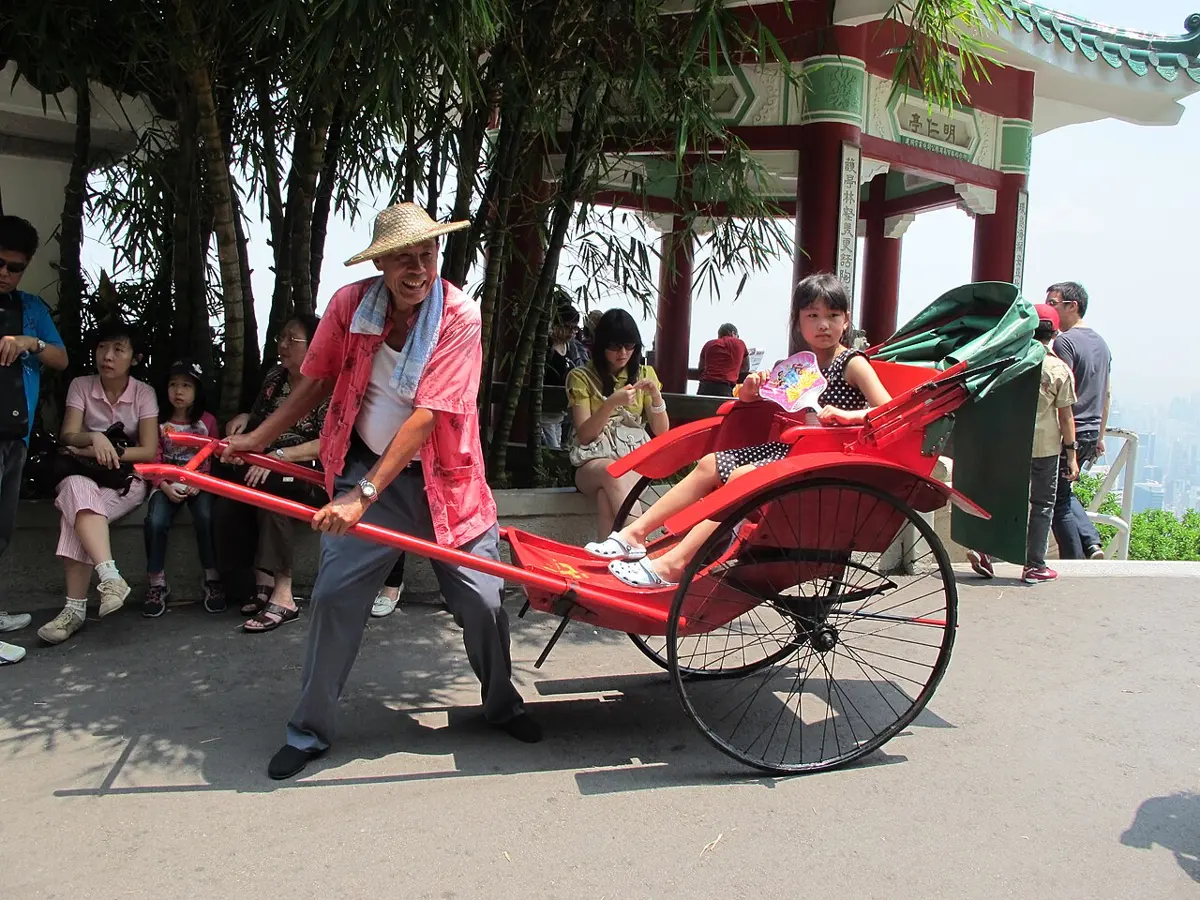
Rickshaw Ride is a short poem by John Hill, in free verse: no fixed rhythm and only a few rhymes and half-rhymes (dollar, matter, clatter; by, eye; break, sake). The speaker is a tourist on holiday in Hong Kong, who takes a ride in a rickshaw pulled by an old man. It is written in six short stanzas, the last only two lines, and it is about what the ride costs: a dollar is nothing to the tourist, but the ride costs the old man his strength.
A rickshaw is a light cart pulled by a person. The word comes from Japanese jinrikisha, “person-power-vehicle”: the first ones were built in Japan around 1869 and soon spread across Asia. Hong Kong had thousands; today almost none are left.
The poem, stanza by stanza
Stanza 1: the man by the harbor
The poem opens on an old man standing by the harbor (a sheltered part of the coast where ships stay safe), spitting into the water: a rough, ordinary, tired man. He is “as old as China”: a simile (a comparison with as or like) that exaggerates how very old he looks, as old as an ancient country.
Stanza 2: a face like a sandbar
He seems made of leather: a metaphor. His skin is brown, dry, tough and lined, like old leather, from years of sun and hard work. His folded (wrinkled) face is like a sandbar at low tide: a long bank of sand, shown when the sea goes out, covered in ridges left by the water. Then the speaker turns to us, the readers, and asks: will you take a ride on his rickshaw?
Stanza 3: off for a dollar
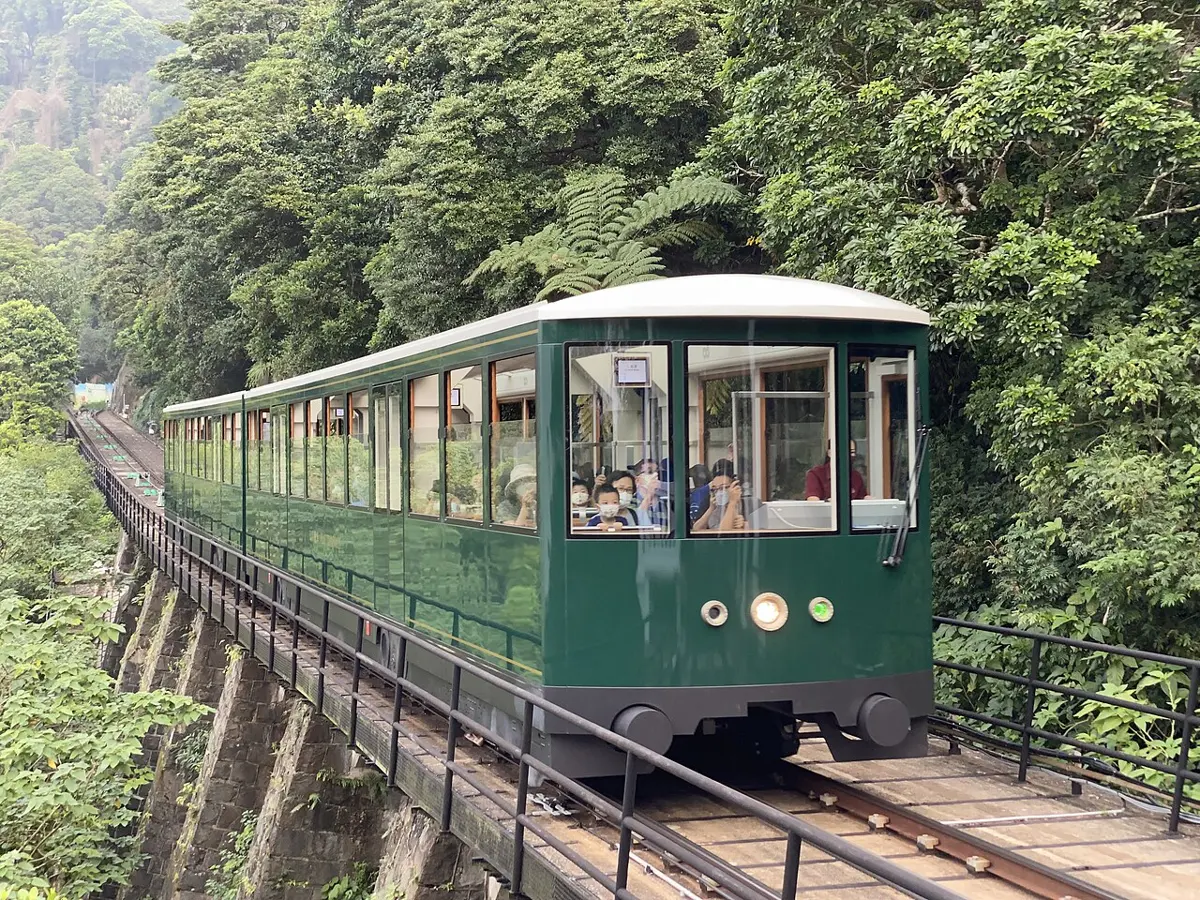
He won’t thank you for your dollar. He knows that a dollar doesn’t matter to a tourist, so he doesn’t pretend to be grateful. Then off you go with a clatter (the loud noise of hard wheels on a hard road), up to Victoria (the old name of Hong Kong’s city center), on up the long hill, past the cathedral (the main church of the area), to the Peak Tram, the railway up the steep hill called the Peak.
Stanza 4: Pull! Pull!
The ride gets hard. Pull! Pull! The repeated words make us feel each heave. The old man leans forward into the work. His muscles at his neck, calves and shoulders strain, and his dark veins stand out and snake (twist like snakes) under his skin. These are what catch the rider’s eye, not the sights of the city he is passing. The speaker begins to worry: let him not break something (a bone, his body) for my sake (because of me), for my dollar.
Stanzas 5 and 6: Was it fun?
Back home, people will ask: You went to Hong Kong. Did you take a rickshaw? Was it fun? Did he run, your rickshaw man? The speaker’s answer, set apart as a stanza of its own, is short and flat: Yes, he ran. No, it was not much fun. The ride a tourist is meant to enjoy was spoiled by the sight of an old man straining for a dollar.
“His folded face is like a sandbar at low tide.” This is a…
Pick an answer to see why.
Words from the poem
| Word | Meaning here |
|---|---|
| harbor | a sheltered area of water on the coast where ships are safe (British spelling harbour) |
| folded | having slight folds; wrinkled |
| sandbar | a long bank of sand in the sea or at the mouth of a river, seen at low tide |
| low tide | the time when the sea is lowest |
| clatter | a loud noise of hard things knocking together |
| cathedral | the main church of an area, where a bishop has his seat |
| tram | a passenger car that runs on rails, driven by electricity or pulled by a cable |
| calf | the back of the leg below the knee |
| snake | (verb) to move or lie in long, twisting curves |
| sake | for someone’s sake: to help them, or because of them |
A. Match the words
Match the words with their meanings.
a. harbor b. folded c. sandbar d. snake e. sake f. clatter g. cathedral h. tram
i. to move in long twisting curves ii. for the purpose of; in the interest of; in order to achieve or preserve iii. a protected area on the coast iv. the main church v. a vehicle driven by electricity vi. loud noise from hard objects knocking together vii. a long mass of sand, especially at the mouth of the river viii. having slight folds; wrinkled
Answer
B. Fill in the blanks
Fill in the blanks with the correct words/phrases from the poem.
- a.The old man is waiting for customers at the ……… .
- b.He is very weak with ……… face.
- c.He knows that a ……… is nothing for the rider.
- d.He takes the rider as far as to ……… .
- e.The rider’s eyes are caught by the old man’s twisted ……… .
- f.The rider didn’t have the ……… when riding.
Answer
C. Answer the questions
How old is the rickshaw puller?
Answer
What does “he is made of leather” mean?
Answer
What attracts the attention of the rider?
Answer
Why does the rider want the rickshaw puller not to fall?
Answer
Did the man enjoy the rickshaw ride? Give reasons.
Answer
D. A mind map
Find suitable adjectives to describe the rickshaw puller. Complete the mind map. (Given: old.)
Model answer
Pronunciation: intonation
Intonation is the way your voice rises (↗) and falls (↘) as you speak. The tune is carried mostly by the last stressed word, and it tells the listener whether you are telling or asking, sure or unsure, finished or not.
| Tune | Used for | Example |
|---|---|---|
| Falling ↘ | statements; wh-questions (what, where, how…); exclamations; greetings and thanks; commands | Santoshi is a smart ↘girl. How can I ↘help you? |
| Rising ↗ | yes/no questions; each item of a list except the last | Can they finish the project in ↗time? rice ↗, cereals ↗ and ↘vegetables |
| Tags: falling ↘ | you are sure, and expect the listener to agree | You don’t often go there, ↘do you? |
| Tags: rising ↗ | you are really asking: you don’t know | You’ve got a ticket, ↗haven’t you? |
Listen to your teacher and read the following sentences. Then write the type of intonation they represent.
- a.Will you go for a ride on his rickshaw?
- b.My parents bought rice, cereals and vegetables.
- c.You don’t often go there, do you?
- d.Santoshi is a smart girl.
- e.Wow! It’s finally snowing.
- f.None of the strategies are working, are they?
- g.What’s your favorite subject?
- h.Can they finish the project in time?
- i.How can I help you?
- j.Nice to meet you.
Answer
Listening: a taxi ride
A. Before you listen
The picture shows a man in a dark suit, a briefcase in one hand, standing at the side of a road with his other arm raised high, as an orange taxi comes towards him.
Answer the following questions.
- a.What is the man doing in the picture?
- b.How do you usually travel?
- c.What is the main means of transportation where you live?
Model answers
The recording
A tourist in a big city stops a taxi and asks the driver how long the ride will take, how much it will cost, when the museum closes, and where to eat. The driver is cheerful and a little boastful. Read the questions in B and C first, then listen, as many times as you need.
Words you will hear: pull over (bring a vehicle to the side of the road and stop); Hop in (get in quickly); Hang on (hold on; wait); fare (the price of a ride); tip (extra money given to say thank you for a service); have something down to an art (be very skilled at it); cruise through traffic (move through it easily); skyscraper (a very tall building); downtown (the center of a city); decor (the way a place is decorated); authentic (real, true to its origin); portions (servings of food); subway (an underground railway); transfer (change from one bus or train to another).
B. Choose the correct answers
Where does the passenger want to go?
Pick an answer to see why.
How long does it usually take to reach the passenger’s destination?
Pick an answer to see why.
What is the taxi fare?
Pick an answer to see why.
What time does the museum close?
Pick an answer to see why.
What is the best way to get to the restaurant, La Fajita, from the museum?
Pick an answer to see why.
Why is it inconvenient to take a taxi from the museum?
Pick an answer to see why.
C. Fill in the gaps
Fill in the gaps with the correct words/phrases from the audio.
- a.The passenger ……… the taxi driver for stopping for him.
- b.The time to reach the museum depends on the ……… .
- c.The driver claims that he is not an ……… .
- d.The passenger enquires about what time the museum ……… .
- e.The taxi driver knows that it’s the ……… the man is visiting the city.
- f.According to the driver, La Fajita is the best ……… in town.
- g.The ……… don’t run by the museum very often.
Answer
D. Places worth visiting
Name any two places in your locality that are worth visiting. Where are these places located? Talk about their facilities, accommodation, etc. for the visitors.
A model answer
Grammar II: comparatives and superlatives
Adjectives and many adverbs have three degrees:
| Degree | Use | Example |
|---|---|---|
| positive | the plain word; equal with as … as | My sister is almost as tall as my mother. |
| comparative | two things, with than | A computer is more expensive than a calculator. |
| superlative | one out of three or more, with the | Mr. Shrestha is the most humorous teacher in the school. |
How to make them:
| The word | Comparative | Superlative |
|---|---|---|
| one syllable: add -er, -est | taller, faster | the tallest |
| one vowel + one consonant: double it | bigger, hotter | the biggest |
| ending in -e: add -r, -st | safer, wiser | the safest |
| two syllables ending in -y: y → i | heavier, easier | the heaviest |
| two or more syllables: more, most | more famous | the most famous |
| adverbs in -ly: more, most | more carefully | the most carefully |
| irregular | good/well → better; bad/badly → worse; far → farther/further; little → less; much/many → more | the best; the worst; the farthest; the least; the most |
Of all the passengers, Sonam waited ……… .
Pick an answer to see why.
A bicycle is not as ……… as a motorbike.
Pick an answer to see why.
Use the correct forms
Use the correct forms of the adjectives or adverbs given in the brackets.
- a.The Marsyangdi is one of the ……… rivers in Nepal. (big)
- b.Thani Mai is the ……… temple in the whole district. (famous)
- c.A spider is not usually as ……… as a snake. (deadly)
- d.The children are really enjoying the movie. They are watching it ……… than the adults. (attentively)
- e.Mr. Shrestha is the ……… teacher in the whole school. (humorous)
- f.Children are considered to be ……… than adults. (innocent)
- g.A computer is ……… than a pocket calculator. (expensive)
- h.My sister is almost as ……… as my mother. (tall)
- i.My maths exam was much ……… than the history exam. (good)
- j.Bungee jumping really scares me. I find it ……… than paragliding. (dangerous)
- k.Sima is walking ……… than Sarad. (carefully)
Hint
Answer
Writing II: an account of a journey
You learned the parts of an account in Unit 10: a heading, an introduction (what, when, where, who), a body in time order with a paragraph for each part, a conclusion with what you learned, and your name and the date. An account of a journey answers five questions, the ones the task gives:
- Where did you go?
- How did you travel there?
- Who did you go with?
- What did you do?
- What have you learned?
Write in the past tense, in time order, and use time words to move the reader along: early in the morning, after two hours, by noon, on the way back, finally. Add a few details of what you saw, heard and felt, and some comparisons (the cable car was faster than the old path, the view was the most beautiful I have seen).
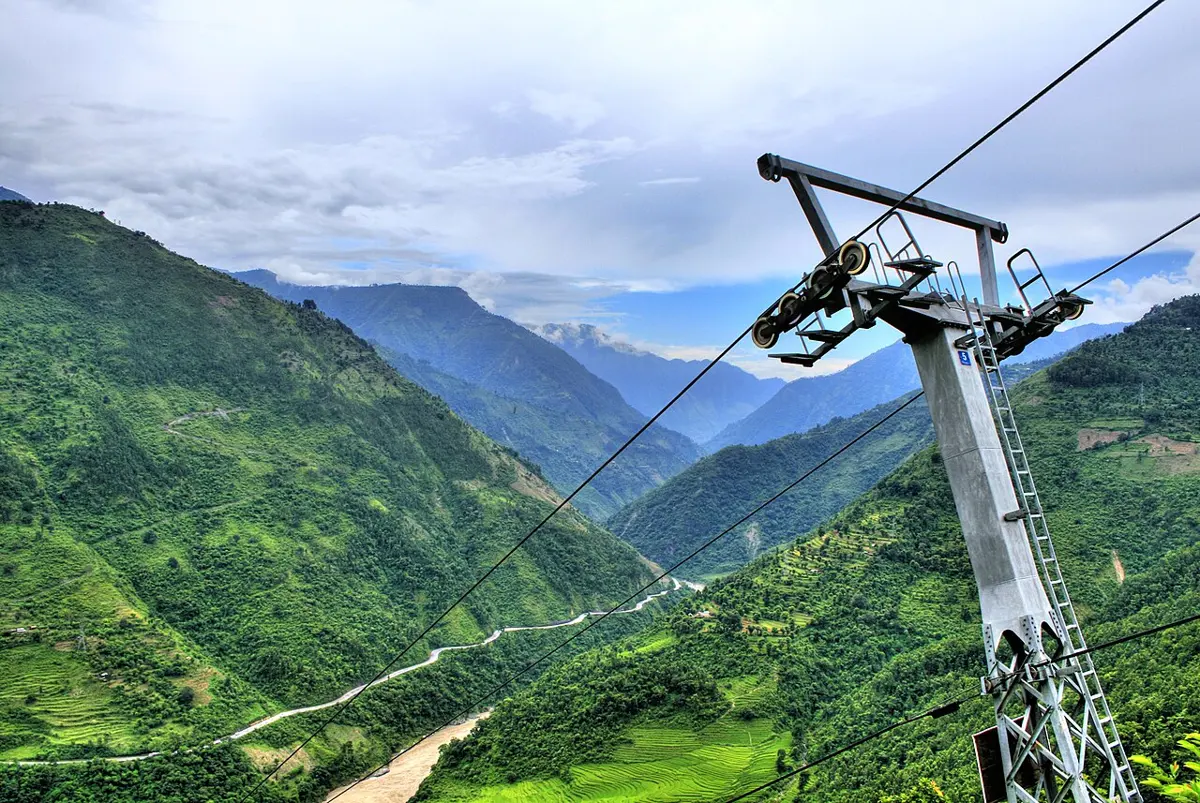
You might have traveled to different places. Write an account of one of your journeys. Include where you went, how you traveled there, who you went with, what you did, and what you’ve learned.
Hint
A model account
Project work
Extra bit: five types of adverbs
Adverbs can be sorted by the question they answer:
| Type | Answers | Examples |
|---|---|---|
| degree | how much? how far? | almost, enough, nearly, quite, so, too, hardly, just, very |
| frequency | how often? | again, always, never, rarely, normally, seldom, sometimes, usually, often |
| manner | how? in what way? | well, happily, beautifully, quickly, easily, slowly, neatly, honestly |
| place | where? | above, below, everywhere, nowhere, out, outside, inside, there, here |
| time | when? | annually, daily, weekly, monthly, today, yesterday, last year, last week, tonight |
In “The Wright brothers flew at Huffman Prairie almost every day in 1905”, almost is an adverb of…
Pick an answer to see why.
Which sentence puts the adverb in the right place?
Pick an answer to see why.
Exercise
Practice on this unit in the style of the final exam. Try each one as in the exam, then open the answer.
Read the text and answer the questions.
Until 1949, Kathmandu had no airport. People and goods reached the city on foot, over the hills from the Tarai, and heavy things such as cars were carried by porters on long poles. That year the first airplane to land in the city, a small four-seat plane, came down on Gauchar, a grassy field on the eastern edge of the city. Within a few years, regular flights linked Kathmandu with India, and in 1955 the field was named Tribhuvan Airport after King Tribhuvan. Today it is Nepal’s busiest airport, and small planes fly from it to mountain airstrips such as Lukla, where the runway is only about 500 meters long and slopes steeply uphill.
- a.How did people reach Kathmandu before 1949?
- b.Where did the first airplane land?
- c.After whom was the airport named?
- d.What is unusual about the runway at Lukla?
- e.Find an adjective of the superlative degree in the text.
Answer
Choose the correct word.
- a.The pilot landed the plane very (smooth/smoothly).
- b.The tea at the airport tasted (good/well).
- c.The flight was (terrible/terribly) late.
- d.Lukla’s runway looks (dangerous/dangerously) from the air.
- e.The porter carried the load (easy/easily).
Answer
Use the correct form of the word in brackets.
- a.A plane is ……… than a bus. (fast)
- b.Everest is the ……… mountain in the world. (high)
- c.The cable car is ……… than the old path. (comfortable)
- d.Of the three drivers, Mingma drives the ……… . (carefully)
- e.This road is not as ……… as the highway. (busy)
- f.Today’s weather is ……… than yesterday’s. (bad)
Answer
Mark the intonation (↗ or ↘) at the end of each sentence.
- a.Where is the bus park?
- b.Is this seat free?
- c.I bought apples, bananas and oranges.
- d.You’re from Ilam, aren’t you? (You are sure.)
Answer
Join each pair with whereas, using a comparative.
- a.A plane is fast. A bus is slow but cheap.
- b.A motorbike is noisy. An electric scooter is quiet.
Answer
Write an account of a journey you made by bus, in about 150 words, for your school magazine.
A model account
Practice every question in the book, and keep track of the ones you miss →
A companion to your textbook, not a replacement for it: study from the book your school uses, and where the two differ, follow your teacher. Found a mistake? Please tell us.