
A teenager in Rio de Janeiro wants only one thing: to be a writer. His parents want a lawyer, and they are so worried that they have him put in a mental hospital. About twenty years later he walks across northern Spain, comes home, and writes a short novel in two weeks. Today that novel, The Alchemist, is read in about 80 languages.
This unit is about people and places: the life of Paulo Coelho, a poem by Langston Hughes about a woman worked almost to breaking, and famous people and places of Nepal. You will learn to give directions (Go straight on, turn left at the crossroads…), to choose between a*, an, *the and no article, to tell apart words that are spelled or said alike (homonyms), and to understand a few common idioms. You will write a book review and a biography of the National Poet Madhav Prasad Ghimire, and listen to a lost visitor asking the way to a museum.
Getting started
A. Three places in Nepal
The unit opens with three photos of famous places in the mountains of Nepal.

Kagbeni is an old village in Mustang, on the bank of the Kali Gandaki river, where the Jhong river joins it. Its flat-roofed houses, green fields of barley and buckwheat and its red monastery sit in a dry, brown valley. It is the gateway to Upper Mustang: north of Kagbeni, visitors need a special permit.
Shey Phoksundo Lake, in Dolpa, is Nepal’s deepest lake (about 145 meters) and one of its most beautiful, famous for its deep turquoise water. It lies at about 3,600 meters inside Shey Phoksundo National Park, Nepal’s largest national park, the home of the snow leopard.

Pathibhara is a temple of the goddess Pathibhara Devi on a high ridge (about 3,800 meters) in Taplejung. Pilgrims from all over Nepal and from India climb up to it, believing that the goddess grants their wishes. From the top, on a clear day, you can see Kanchenjunga, the world’s third-highest mountain.
Where are these places? How would you get there? Discuss.
Model answers
B. Three famous Nepalis
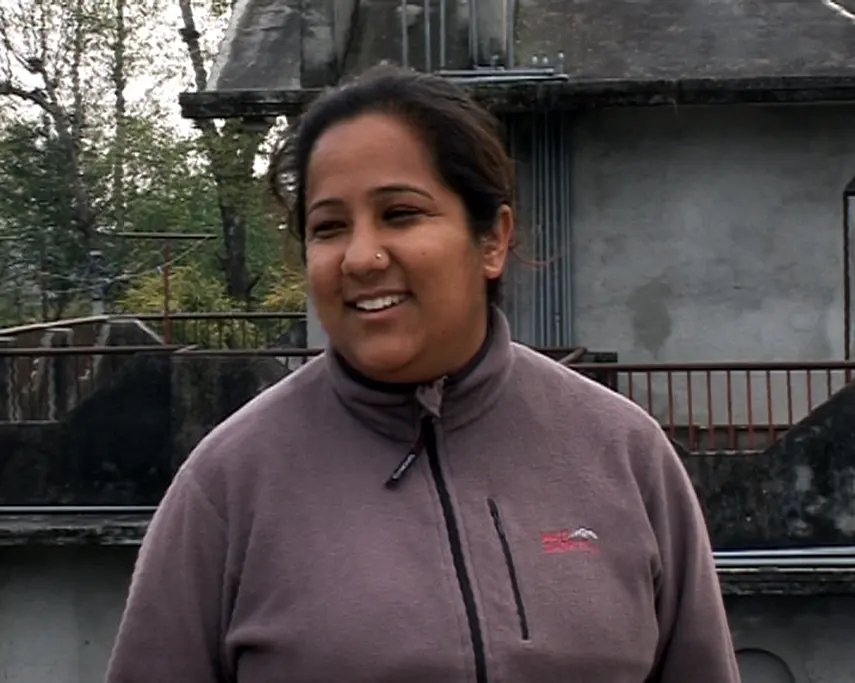
The next photos show three famous Nepalis: a man with a moustache in a white shirt; a young woman and a man wrapped in the flag of Nepal, holding up their medals; and a smiling woman holding a tall trophy that says Hero of the Year.
Identify the following people and say what they are famous for.
Model answers
Reading I: Paulo Coelho
Before you read
- a.How much do you love reading? What is the name of the last book you read?
- b.Who is your favorite writer? Say something interesting about him or her.
Model answers
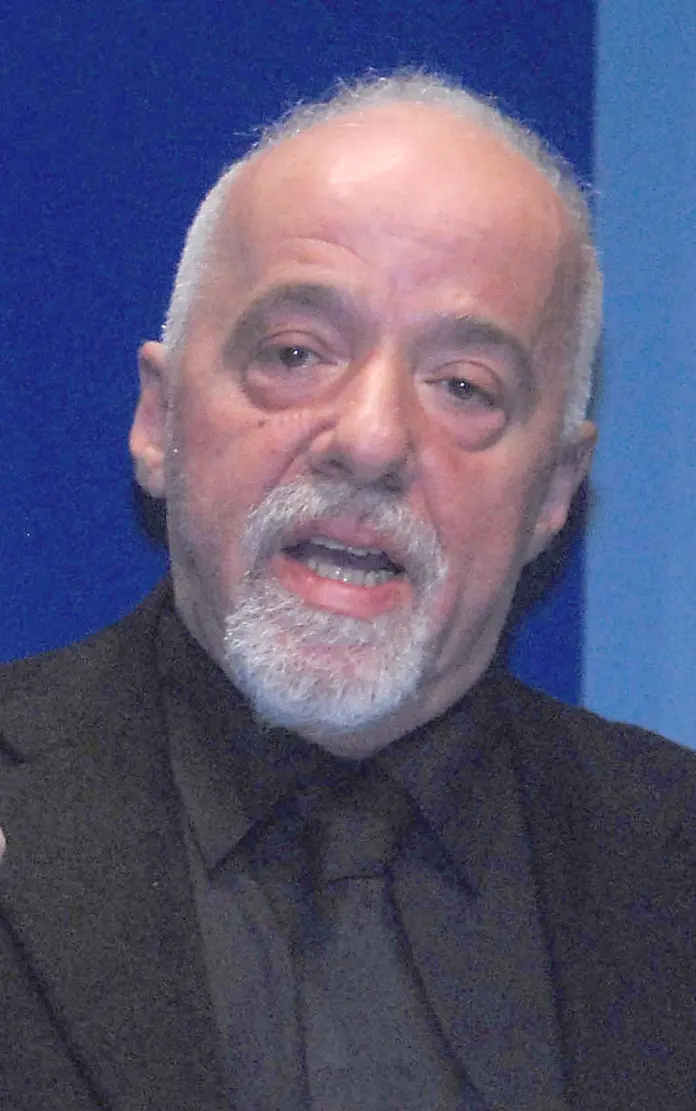
What kind of text it is
Paulo Coelho is a biography: the story of a real person’s life, written by someone else, in the third person (he, his) and mostly in the past tense. A biography usually follows the person’s life in time order: birth and childhood, education, work, achievements, family, and what people think of them. Look for dates and time words (from an early age, during adolescence, in his twenties, at the age of 36, since then): they hold the story together.
The text, part by part
1. A boy who wanted to write
Paulo Coelho is a Brazilian author and lyricist (a writer of song words). He was born on 24 August 1947 in Rio de Janeiro, Brazil. He loved writing and dreamed of being a writer from an early age, but his parents discouraged him (tried to stop him): they wanted him to become a lawyer.
During his adolescence (his teenage years), his parents were so worried about his dream, and his rebellious ways, that they had him put in a mental hospital (a hospital for people with mental illness), not once but three times. In his twenties, under Brazil’s military government of that time, he was arrested and tortured (made to suffer great pain on purpose). Through all this, he kept dreaming of being a writer.
For a while he gave in: he joined law school, as his parents wished, and abandoned (gave up) his dream. After a year he dropped out (left without finishing) and lived as a hippie, one of the young people of the 1960s and 70s who rejected ordinary jobs and comfortable lives, wore long hair, and traveled freely. He traveled through South America, North Africa, Mexico and Europe, and took drugs.
2. The pilgrimage that changed his life
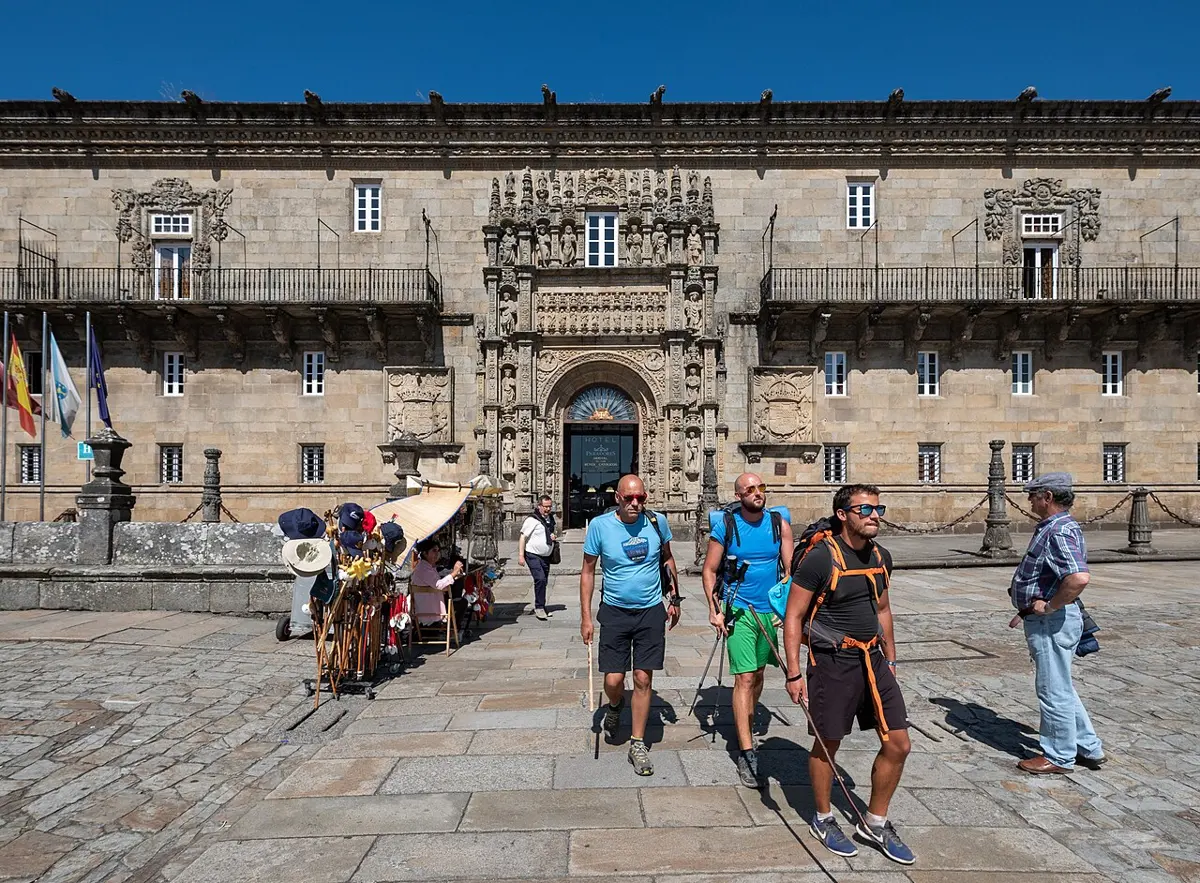
In 1986, in his late thirties, he walked the pilgrimage (a long journey to a holy place) to Santiago de Compostela in Spain. On the way he had a spiritual awakening: he felt a new meaning in life, and he was inspired to write. He changed his life radically (completely).
His first book about it, The Pilgrimage, came out in 1987. A year later, in a two-week spurt of creativity (a sudden, short burst of work), he wrote The Alchemist (1988), the book that made him famous around the world.
3. The Alchemist
The Alchemist is an allegorical novel: a story whose characters and events stand for bigger ideas (an allegory). An alchemist was a person who, in the old days, tried to turn ordinary metals into gold. In the story, a young shepherd boy follows a mystical journey (one with a spiritual, magical meaning), learns to understand the “Language of the World”, and so gets what his heart most wants.
At first, few people noticed the book. Then, in the early 1990s, its French translation suddenly became a bestseller in France, translations into other languages followed, and the book became a worldwide phenomenon (an extraordinary event that everyone talks about). It has been called the most translated book by any living author.
4. His other books
Since then he has written a new book about every two years. Several are autobiographical (based on his own life), and most are about spirituality and faith, how society affects a person, and love. The text lists his best-known works:
| Book | Year | What it is about |
|---|---|---|
| Veronika Decides to Die | 1998 | a young woman in a mental hospital: it draws on his own time in one as a teenager |
| The Devil and Miss Prym | 2000 | an investigation (a careful study) of whether people are good or evil at heart |
| Eleven Minutes | 2003 | love and desire, through the story of a young Brazilian woman who goes to work in Geneva |
| The Witch of Portobello | 2006 | a woman spiritual leader, told through interviews with people who knew her |
| The Winner Stands Alone | 2008 | a thriller (an exciting crime story) set at the Cannes Film Festival |
| Aleph | 2010 | his own 2006 journey on the Trans-Siberian Railway across Russia, which he embroidered (made more exciting with added details) with a meeting with a woman he says he loved in a past life |
| Manuscript Found in Accra | 2012 | the teachings of a Greek wise man in Jerusalem, just before the Crusaders attacked it (1099) |
| Adultery | 2014 | a successful journalist who is unfaithful in her marriage |
| Hippie | 2018 | his own travels as a young hippie in the 1970s |
He also made collections of short pieces: Frases (1996), Life: Selected Quotations (2007), both made of excerpts (short pieces taken from a longer work) from his oeuvre (all the works of a writer), and Maktub (“It is written”, an Arabic word), chosen from his weekly column in the Brazilian newspaper O Globo.
5. Fame, fans and critics
Coelho is often called one of the world’s most widely read authors. He has won many prestigious (highly respected) awards, among them the Crystal Award of the World Economic Forum and France’s highest honor, the Légion d’honneur.
People disagree about his books:
- His fans call them inspiring and life-changing.
- His critics say they offer only vague spirituality (fuzzy ideas about the spirit) devoid of rigor (without careful, exact thinking).
Coelho doesn’t worry about his naysayers (people who criticize or say no). He refuses to be called a “self-help” writer and jokes that he is a “self-problem” writer. He says he writes a book for himself, and how readers react is up to them.
6. His family and his institute
He has been married to the artist Christina Oiticica since 1980. For many years the couple lived half the year in Rio and half in a country house in the Pyrenees mountains of France (they have since moved to Geneva, in Switzerland). In 1996 he started the Paulo Coelho Institute, which helps poor children and old people in Brazil.
Why did Coelho’s parents discourage him from writing?
Pick an answer to see why.
What is an allegorical novel?
Pick an answer to see why.
Words from the text
Words linked here open in English Vocabulary, where you can see an example and practice them in the word game. The meanings below are the ones the words have in this text.
| Word | Meaning here |
|---|---|
| lyricist | a person who writes the words of songs |
| discourage | to try to stop someone from doing something |
| adolescence | the years between being a child and an adult; the teenage years |
| torture | to cause someone great pain on purpose, often to punish them or to get information |
| abandon | to give something up completely |
| pilgrimage | a journey to a holy place, for religious reasons |
| radically | completely, in a basic way |
| spurt | a sudden, short burst of activity |
| allegorical | telling a story whose characters and events stand for bigger ideas |
| mystical | having a spiritual meaning that is beyond ordinary understanding |
| phenomenon | something extraordinary that many people notice and talk about |
| embroider | to add details to a story to make it more interesting (first meaning: to sew a pattern onto cloth) |
| excerpt | a short piece taken from a book, speech or film |
| oeuvre | (from French, said /ˈɜːvrə/) all the works of a writer or artist |
| prestigious | highly respected and admired |
| devoid | completely without something: devoid of rigor |
| rigor | great care and exactness |
| naysayer | a person who criticizes, or says something can’t or shouldn’t be done |
A. Word families
Many English words come in families: a noun (a thing or idea), a verb (an action) and an adjective (a describing word) built on the same root, often with an ending such as -tion, -ment, -ive or -ing.
Complete the table below. Use a dictionary to check the meanings.
| Noun | Verb | Adjective |
|---|---|---|
| ……… | embroider | ……… |
| ……… | torture | ……… |
| ……… | attract | ……… |
| ……… | ……… | inspiring |
| investigation | ……… | ……… |
Answer
Now choose the correct word to complete the sentences. Change the form if necessary.
- a.She was an ……… example to her followers.
- b.It is claimed that the officers ……… a man to death in a city police station.
- c.Naturally, I ……… the tale a little to make it more interesting.
- d.The company conducted its own internal ……… into the robbery.
- e.The exhibition is ……… huge crowds.
Answer
B. Put the events in order
The following sentences depict some of the important events in Paulo Coelho’s life. Put them in chronological order.
- a.He traveled to Santiago de Compostela, which inspired him to write The Pilgrimage.
- b.He was enrolled in a law school.
- c.He got married to the artist, Christina Oiticica.
- d.He stayed in a mental hospital.
- e.Coelho established the Paulo Coelho Institute.
- f.He left school and lived the life of a hippie.
- g.Coelho wanted to become a writer.
- h.Coelho wrote the allegorical novel The Alchemist.
Hint
Answer
C. Answer the questions
Why did Coelho’s parents discourage him from becoming a writer?
Answer
What changed Coelho’s life in a significant way?
Answer
Why is The Alchemist special?
Answer
What are most of his books about?
Answer
Write two evidences that prove Coelho is an international author.
Answer
What are the criticisms of his writing?
Answer
Write the names of two books which focus on Coelho’s travels.
Answer
D. Which book would you read?
Which of Paulo Coelho’s books would you most like to read? Give reasons for your choice.
A model answer
Speaking: giving directions
When someone is lost, we first ask politely, then give clear steps, using landmarks (things that are easy to see: a hotel, a temple, a bridge) and the words left and right from the walker’s point of view.
| To ask the way | To give directions | To say where it is |
|---|---|---|
| Excuse me, how can I get to the post office? | Go straight on. / Go along this street. | It’s on your left / right. |
| Could you tell me the way to the bank? | Turn left / right at the crossroads. | It’s on the corner. |
| Is there a pharmacy near here? | Take the first / second turning on the left. | It’s next to / opposite the cinema. |
| Where is the nearest bus stop? | Go past the hospital. / Cross the road. | It’s about 100 meters on your left. |
| Go round the roundabout. / Go over the bridge. | You can’t miss it! |
Directions are instructions, so they use the imperative (go, turn, take, cross) and sequence words (first, then, after that).
A. On the map
Read and act out the given conversation about directions. Then have similar conversations in pairs, to get to some places on the map.
Stranger: Excuse me. How can I get to the post office?
Girl: Go straight on, and then turn left at the crossroads. It’s about 100 meters on your left. You can’t miss it!
Stranger: Thanks!
Girl: You’re welcome.
Two more conversations
The map shows Central Street running up the middle from You are here, crossed first by 1st Street and then by 2nd Street, with a roundabout where Central Street meets 2nd Street. Tap any place below to see the way there and the words to say.
B. Give directions
Work in pairs. Give directions in the following situations.
- a.Your new friend does not know how to get to the school library.
- b.A visitor wants to go to a nearby bank in your area.
- c.Your friend wants to come to your home but he doesn’t know how to get there.
- d.A visitor wants to meet the head teacher in her office.
- e.Your sister wants to buy books but she does not know where the stationery shop is.
Model answers
Grammar I: articles a, an, the
Articles are small words that come before a noun: a and an (the indefinite articles) and the (the definite article). They tell the listener whether you mean any one thing or a particular one that you both know.
a or an?
A and an go only before a singular countable noun (one thing that can be counted: a book, never ✗ a books or ✗ a water). Which one you use depends on the first sound of the next word, not its first letter:
| an before a vowel sound | a before a consonant sound |
|---|---|
| an ant, an orange, an expensive guitar | a dove, a brook, a beautiful daughter |
| an hour, an honest man, an honorable teacher (h not said) | a house, a hospital (h said) |
| an S.P., an MP, an X-ray (said es, em, ex) | a university, a uniform, a European (said you-) |
| an umbrella, an uncle | a one-rupee coin (said wun-) |
Mr. Gurung is ……… S.P. of Nepal Police.
Pick an answer to see why.
a/an or the?
| Use a / an | Use the |
|---|---|
| when you mention something for the first time: A dove saw an ant. | when you mention it again: The ant struggled. |
| for any one of its kind: Can I borrow a pen? | for the one we both know: Pass me the pen on the table. |
| to say what job someone has, or what kind of person: She is a university student. | when it is clear which one from the situation: the bank (of the brook), the head teacher (of our school) |
| for one in a quantity or rate: half an hour, Rs. 60 a kilo, twice a week | for things there is only one of: the Sun, the Moon, the sky |
| with superlatives and first, second, last: the hardest, the best, the second floor | |
| when a phrase after the noun picks it out: the boy wearing a black cap |
Marking the articles in a fable
A fable is a short story with animals that teaches a lesson (a moral). The book’s fable is one of Aesop’s, told in Greece about 2,500 years ago: a dove saves an ant from drowning by dropping a blade of straw beside it; later the ant saves the dove by stinging a man who is about to throw a stone at it. Its moral: one good turn deserves another (a kindness should be repaid).
Read the story and mark the articles used in it. Why are the articles ‘a’ and ‘an’ used before ‘dove’ and ‘ant’ in the first sentence, and ‘the’ in the sentences that follow?
Answer
B. a, an or the
Complete the following sentences with the article ‘a’, ‘an’ or ‘the’.
- a.Sudip bought ……… expensive guitar yesterday. ……… guitar is beautiful.
- b.Ms. Sherpa is ……… university student.
- c.……… boy wearing a black cap is my brother.
- d.I have given him half ……… hour to finish the task.
- e.Angelia has ……… beautiful daughter named Sophia.
- f.Mr. Gurung is ……… S.P. of Nepal Police.
- g.Is diamond ……… hardest substance in the world?
- h.Mrs. Yadav is ……… honorable teacher.
- i.Rice sells at Rs. 60 ……… kilo.
- j.I met ……… European writer last Monday.
Answer
Writing I: a book review
A book review tells other readers what a book is about and whether it is worth reading. A good review informs (the facts and the story) and judges (your opinion, with reasons), but it never gives away the ending.
The review of The Alchemist, part by part
1. The book’s details, in a list at the top:
| Detail | In the review |
|---|---|
| Title and author | The Alchemist, by Paulo Coelho |
| Year | 1988 (the first, Portuguese, edition) |
| Publisher | HarperCollins, for the English translation |
| Characters | the main ones: Santiago the shepherd boy, Melchizedek (an old king), the Englishman, Fatima, the alchemist, the shopkeeper, the Coptic monk |
| Genre | the kind of book: adventure fiction |
2. The plot, in a short paragraph. The review sums up the story as a quest (a long search): Santiago, a Spanish shepherd boy, keeps dreaming of treasure under the pyramids of Egypt. An old king gives him advice and two magic stones, and he sets off across the Mediterranean Sea and the Sahara Desert to find the treasure and fulfill his Personal Legend (the review explains this as our purpose in life). On the way, among swindlers (cheats), tribal wars and endless sand, he finds love, learns alchemy and the language of his own heart, and keeps struggling toward his treasure. The review stops there: it doesn’t say whether he finds it.
3. The reviewer’s opinion, with reasons. The book offers insightful (wise, deep) ideas about destiny, rising above failure and the oneness of the universe, in quite simple diction (choice of words). Its descriptions are awe-inspiring, its word choice immaculate (perfect), but its real magic is the depth of feeling behind the words. The reviewer’s best line: the book lets you escape reality and understand it at the same time.
4. A recommendation, at the end: it may not be an ordinary novel, but it deserves a place on your bookshelf.
Now, write a similar review of the book that you have recently read.
Hint
A model review
Reading II: Madam and Her Madam
Before you read
The picture shows two women in a house: one, in an apron, is working hard, cleaning, while the other, well dressed, stands by and gives orders.
- a.What are the two women doing?
- b.What do you think the relationship is between the two women?
Model answers
The poet and the poem
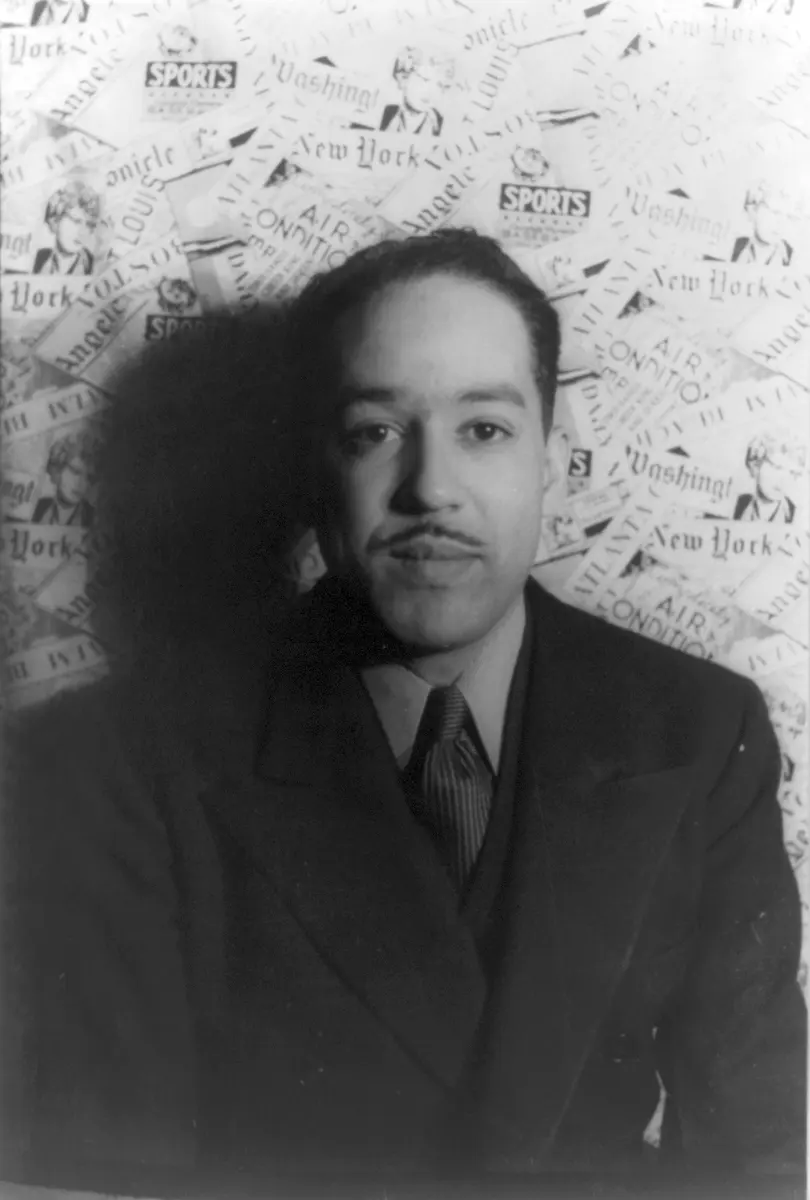
Langston Hughes (1901–1967) was an African American poet from the United States, a leading writer of the Harlem Renaissance, a flowering of Black art, music and writing in New York in the 1920s. He wrote about the lives of ordinary Black Americans in their own everyday speech, often with the rhythms of jazz and blues.
Madam and Her Madam, from his book One-Way Ticket (1949), is one of a set of twelve poems about Alberta K. Johnson, a proud, sharp-tongued working woman who calls herself “Madam”. In those days in America, many Black women could find work only as domestic workers (maids, cooks and nannies) in the houses of white families, for long hours and low pay. So the title has a joke in it: two madams, Alberta herself, and the woman she works for.
What kind of text it is
It is a narrative poem (a poem that tells a little story) in six stanzas of four short lines each. The speaker, Alberta, tells it in the first person (I) and in everyday spoken English: she drops words (Had to get breakfast, without I) and says You trying to instead of Are you trying to. In each stanza, the second and fourth lines rhyme (mean and clean, too and through, be and me), or nearly rhyme (around and down). The tone is funny on the surface but bitter underneath.
The poem, stanza by stanza
Stanza 1. Alberta worked for a woman who was not mean (not unkind). But that woman had a house of twelve rooms to clean, and Alberta cleaned it.
Stanza 2. She also had to cook all three meals, breakfast, dinner and supper (in the old way of speaking, dinner was the big meal in the middle of the day and supper the light meal in the evening), and then, when she got through (finished) all that, look after her employer’s children.
Stanza 3. And more: washing, ironing and scrubbing, and even walking the dog. It was all too much, and it nearly broke her down (nearly made her collapse).
Stanza 4. So Alberta spoke up. Calling her employer “Madam”, she asked whether she was trying to make a pack-horse of her: a horse used to carry heavy loads, an animal that works without rest.
Stanza 5. Her employer opened her mouth and cried, “Oh, no!” and told Alberta how much she loved her. She answered the complaint with loving words, but didn’t offer to reduce the work at all.
Stanza 6. Alberta answered that it might be true that Madam loved her, but she certainly didn’t love Madam. I’ll be dogged if… is an old, mild exclamation, a polite way of saying I’ll be damned if…: “I certainly do not.”
How the poem works
- Irony (saying one thing while the situation shows another): She wasn’t mean, says Alberta, and then lists work enough for three people. The employer isn’t cruel in words, but her demands are cruel in effect.
- A list of jobs, stanza after stanza (clean, breakfast, dinner, supper, children, wash, iron, scrub, the dog), piles up just as the work did.
- A metaphor: a pack-horse compares Alberta to a working animal, treated as a thing that carries loads, not as a person.
- Repetition and reversal: I said, Madam opens stanzas 4 and 6, and the employer’s I love you so is turned around in Alberta’s last line, If I love you! The poem ends with a laugh that is really a protest.
What is the main idea of the poem?
Pick an answer to see why.
A. Match the words
Match the following words/phrases in column A with their meanings in column B.
- a.mean b. get through c. dinner d. break down e. pack-horse f. Madam g. dogged
- i.not giving up easily ii. a horse that is used to carry heavy loads iii. cease to function; collapse iv. unkind v. a formal and polite way of speaking to a woman vi. to manage to do or complete something vii. the main meal of the day
Answer
B. Answer the questions
Was the Madam really not mean? Why does the speaker say ‘she wasn’t mean’?
Answer
Make a list of work that the maid had to do.
Answer
What made her nearly break down?
Answer
How did the Madam respond to the maid’s question?
Answer
C. Discrimination in our society
The poem above presents an example of one type of discrimination. What kinds of discrimination are in existence in your society? Discuss.
A model answer
Pronunciation: homonyms
Homonyms are words that look or sound the same but have different meanings. There are two kinds:
- homophones sound the same but may be spelled differently: right and write, fair and fare, band and banned;
- homographs are spelled the same but may sound different: a lead pencil /led/ and to lead the way /liːd/.
The fifteen words to look up are spelled the same in each meaning, and most also sound the same, so only the sentence tells you which meaning is meant. A dictionary lists each meaning separately, often with a small number: bat¹, bat².
| Word | Said | Meaning 1 | Meaning 2 (and more) |
|---|---|---|---|
| address | /əˈdres/ (verb); noun also /ˈædres/ in American English | n. where someone lives: Write your address on the form. | v. to speak to, or deal with: The mayor addressed the crowd. We must address the problem. |
| band | /bænd/ | n. a group of musicians: a rock band | n. a thin strip or ring: a rubber band |
| bat | /bæt/ | n. a wooden club for hitting a ball: a cricket bat | n. a small flying animal that comes out at night |
| current | /ˈkʌrənt/ | adj. happening now: current affairs | n. a flow of water, air or electricity: a strong current in the river |
| express | /ɪkˈspres/ | v. to show a feeling or idea in words or actions | adj./n. fast, with few stops: an express bus |
| fair | /feə(r)/ | adj. just, treating people equally; light in color (fair hair) | n. an outdoor show with rides, stalls or goods for sale: a trade fair |
| kind | /kaɪnd/ | adj. caring and generous | n. a type: What kind of music do you like? |
| lie | /laɪ/ | v. to say something untrue (lied, lied) | v. to be flat, to rest (lay, lain): lie on the bed |
| match | /mætʃ/ | n. a game: a football match | n. a matchstick; v. to go well together: Your shoes match your bag. |
| pound | /paʊnd/ | n. a unit of weight (about 454 grams); British money (£) | v. to hit hard again and again, to crush: pound the spices |
| ring | /rɪŋ/ | n. a circle of metal worn on a finger | v. to make the sound of a bell or phone (rang, rung) |
| right | /raɪt/ | adj. correct; the opposite of left | n. what you are allowed by law: the right to education |
| rock | /rɒk/ (American /rɑːk/) | n. stone; a type of loud music | v. to move gently from side to side: rock a baby |
| spring | /sprɪŋ/ | n. the season after winter | n. a coil of wire; a place where water comes out of the ground; v. to jump suddenly |
| tender | /ˈtendə(r)/ | adj. gentle and loving; soft (tender meat); painful to touch | n. a formal offer to do work at a stated price: The council asked for tenders to build the road. |
Some of them also have a homophone with a different spelling: right – write, rite; fair – fare; band – banned; current – currant (a small dried grape); ring – wring (to twist out water).
Listening: asking the way
A. Before you listen
The picture shows three people standing in a city street, near a sign. A man in a scarf holds a map; a young woman beside him is pointing down the road, and another young man stands behind them.
Look at the picture and guess the answers to the questions.
- a.Where do you think the three people are?
- b.What do you think the man with the map is asking for?
- c.What do you think the lady is doing?
Model answers
The recording
A young woman visiting a city is lost: she was looking for the art museum but took a wrong turn. She stops a young man in the street and asks the way. Read the questions in B and C first, then listen, as many times as you need.
B. True or false
Listen to the audio and write True for true statements and False for false ones.
- a.The girl wants to go to the art museum.
- b.She prefers to go there by bus.
- c.The bus station is miles away from there.
- d.She has to turn right at the Royal Hotel to get to the bus station.
- e.After crossing the junction she will see the museum on her left.
Answer
C. Short answers
Listen to the audio again and answer the following questions in no more than three words.
- a.What is the best method to get to the museum, according to the boy?
- b.Why does the girl want to walk around instead of taking a bus?
- c.Where is the Royal Hotel located?
- d.What does the girl have to do after going over the junction?
- e.What can the girl do if she is still lost?
Answer
D. The way to the head teacher
Give directions to a new friend in your school to get to the head teacher’s office from your classroom.
A model answer
Grammar II: article or no article?
Many nouns take no article at all (we call it the zero article, and the book marks it with a cross, ✗). Here are the cases this exercise tests.
| No article with… | Examples |
|---|---|
| meals, in general | have lunch, eat breakfast, What’s for dinner? |
| television (as something we watch), TV | watch television, see a film on TV |
| space (beyond the Earth’s air) | travel in space, astronauts in space |
| plural and uncountable nouns meaning things in general | Films teach a lot. Rice is cheap here. |
| names of people, cities, countries and single mountains and lakes | Kathmandu, Nepal, Mt. Everest, Rara Lake |
But we do say the:
| the with… | Examples |
|---|---|
| things there is only one of | the Moon, the Sun, the sky, the world |
| rivers, seas and oceans | the Narayani River, the Koshi, the Pacific |
| the radio and the cinema, in fixed phrases | listen to the radio, go to the cinema |
| superlatives and order words | the best holiday, the second floor, the nearest shop |
| a place both speakers know | the head teacher’s room (of our school), the end of this street |
And a/an for one, not yet known: We went to a restaurant. I haven’t got a radio. We had a nice time.
Astronauts on the International Space Station live in ……… for six months at a time.
Pick an answer to see why.
We watched the final on ……… and then listened to the news on ……….
Pick an answer to see why.
Fill in the blanks
Fill in the blanks with a, an or the where necessary. If no article is necessary, put a cross (✗).
- a.A: Where did you have ……… lunch? B: We went to ……… restaurant.
- b.A: Did you have ……… nice holiday? B: Yes, it was ……… best holiday I’ve ever had.
- c.A: Where’s ……… nearest grocery shop? B: There is one at ……… end of this street.
- d.A: Do you often listen to ……… radio? B: No. In fact, I haven’t got ……… radio.
- e.A: Would you like to travel in ……… space? B: Yes, I’d love to go to ……… Moon.
- f.A: Do you go to ……… cinema very often? B: No. But I do watch a lot of films on ……… television.
- g.A: You had ……… nice time yesterday, didn’t you? B: Yes, we went for a walk by ……… Narayani River.
- h.A: Can you tell me where ……… head teacher’s room is? B: It’s on ……… second floor.
- i.A: What did you have for ……… breakfast this morning? B: Nothing. I never eat ……… breakfast.
Answer
Writing II: a biography
A biography is the story of a person’s life written by someone else. When you write one from notes, you turn each note into full sentences, in time order, in the past tense (for someone who has died), joined by time words: in 1919, as a child, after his mother’s death, later, in his old age.
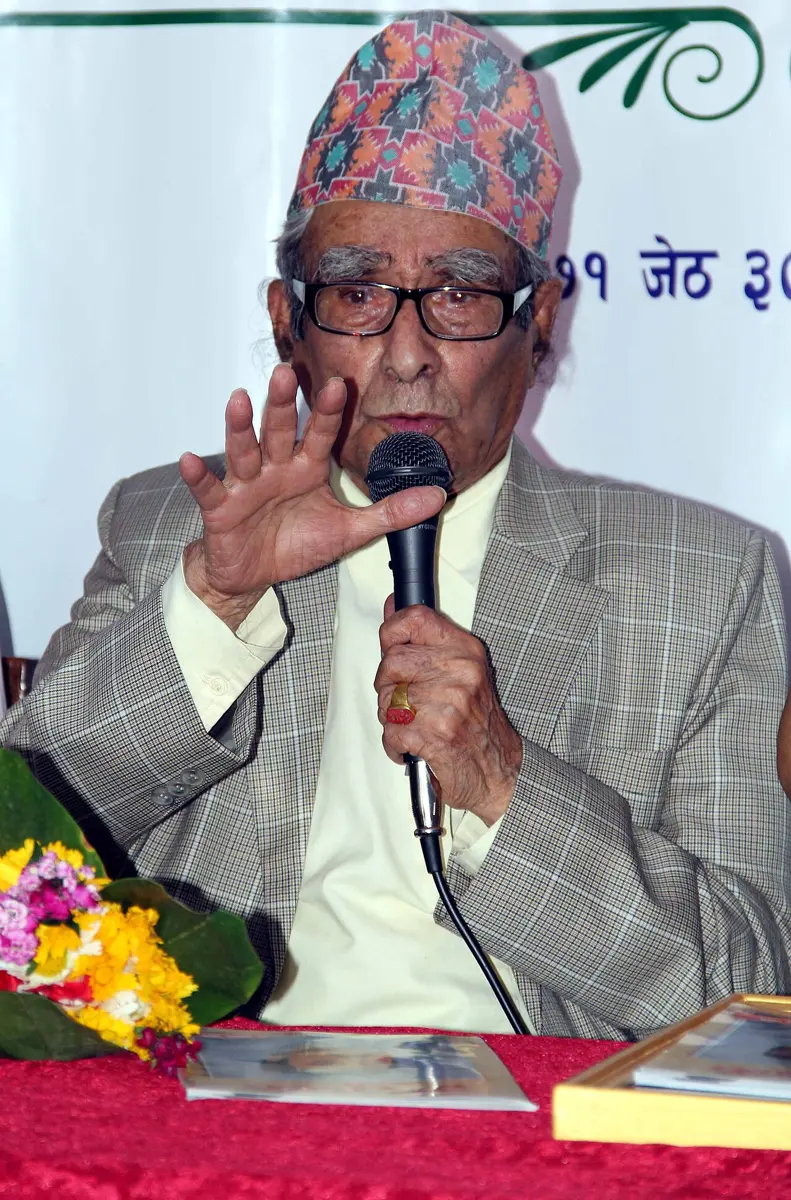
Madhav Prasad Ghimire (1919–2020) was one of Nepal’s greatest poets. In 2003 the Government of Nepal gave him the title Rashtrakavi, the National Poet. Many of his poems became much-loved songs, among them Gauncha Geet Nepali and Nepali Hami Rahaula Kaha. His long poem Gauri, a lament (a poem of grief) for his first wife, Gauri, who died young, is still one of the most moving poems in Nepali.
Write a short biography of Nepali National Poet, Madhav Prasad Ghimire, based on the outline given below.
Birth: 23 September 1919, Pustun, Lamjung
Childhood: brought up by his father and grandfather after his mother’s death; learned the Panchanga; went to Duradanda, Lamjung, and later to Kathmandu to study Sanskrit; studied in Banaras, India, too
Career: writing career began in Lamjung as a writer for Bhashanubad Parishad, and later as an editor for The Gorkhapatra
Works: Gauri (epic), Malati Mangale, Manjari, Indrakumari, Rastra Nirmata, Kinnar-Kinnari (lyrical anthology), Charu Charcha (essay collection), Aafno Bansuri Aafnai Geet, Himal Pari Himal Wari, Aswathama, Rajheswari and Shakuntala (epic)
Awards and honors: Distinguished Academy Medal; Shree Prasiddha Praval Gorkha Dakshinabahu; Bhanubhakta Award; Tribhuwan Pragya Puraskar; Padmashree Sadhana Samman; Sajha Puraskar
Personal life: six daughters and two sons from two marriages
Death: 18 August 2020, at the age of 100, Lainchaur, Kathmandu; cremated with state honors
Hint
A model biography
Project work: a personality from your area
Idioms
An idiom is a fixed expression whose meaning is not the meaning of its words put together. It’s raining cats and dogs has nothing to do with animals: it means it’s raining very hard. You learn an idiom as a whole, like a single word. Nepali is full of them too: आँखा लाग्नु doesn’t mean that eyes are stuck on, but to fall asleep.
| Idiom | Meaning | Example |
|---|---|---|
| a hot potato | a subject or problem that is difficult and that people argue about, so no one wants to deal with it | Raising bus fares is a political hot potato. |
| a tall story | a story that is hard to believe because it is exaggerated | He told a tall story about meeting a yeti on the trek. |
| a night owl | a person who likes to stay up late at night | My brother is a night owl: he studies until 2 a.m. |
| no pain, no gain | you must work hard, or suffer a little, to get something good | Training at 5 a.m. is hard, but no pain, no gain. |
| miss the boat | to lose a chance because you were too slow | Applications closed yesterday, so I missed the boat. |
| put a bug in someone’s ear | to give someone a quiet hint or idea about something | I put a bug in Dad’s ear about a new bicycle for my birthday. |
| see eye to eye | to agree completely with someone | My sister and I don’t always see eye to eye about music. |
| give it a shot | to try something | I’ve never played chess, but I’ll give it a shot. |
| kill two birds with one stone | to get two things done with a single action | I bought vegetables on my way back from school, killing two birds with one stone. |
“I’d love to try rock climbing. I’ll ……… this weekend.” Which idiom fits?
Pick an answer to see why.
Srijana studies best after midnight, when the house is quiet. She is ……….
Pick an answer to see why.
Exercise
Practice on this unit in the style of the final exam. Try each one as in the exam, then open the answer.
Read the text and write True or False after each statement.
Chiring grew up in a village in Solukhumbu where there was no school above Grade 5. Every morning he watched the trekkers walk past his house, and he taught himself English by talking to them. At eighteen he became a porter, carrying loads of up to thirty kilos up to Everest Base Camp. He saved every rupee he could, and at twenty-five he passed his exams as a mountain guide. Today he runs a small trekking company in Kathmandu, and every year he pays the school fees of ten children from his village. “Nobody gave me a chance,” he says, “so I give one to others.”
- a.Chiring’s village had a school up to Grade 10.
- b.He learned English from the trekkers.
- c.He worked as a porter before he became a guide.
- d.His trekking company is in Solukhumbu.
- e.He helps children from his village go to school.
Answer
Fill in the gaps with a, an, the, or ✗ for no article.
- a.Shristi is ……… honest girl who wants to be ……… engineer.
- b.……… Koshi is ……… biggest river in Nepal.
- c.We usually have ……… dinner at seven, after we watch ……… news on ……… television.
- d.Lochan bought ……… umbrella and ……… raincoat. ……… umbrella was red.
- e.……… Sun is a star; it looks bigger than other stars because it is ……… nearest one.
Answer
Look at the map of Central Street (Speaking, above). You are at You are here. Write directions to the bus station in about 40 words.
A model answer
Replace the words in bold with an idiom from the box: see eye to eye, miss the boat, kill two birds with one stone, a tall story.
- a.If you don’t book your bus ticket today, you’ll lose your chance.
- b.Grandfather’s account of fighting a tiger with his bare hands is hard to believe.
- c.Zeenat and her brother agree completely about almost everything.
- d.I studied on the bus and so did two jobs at once.
Answer
Write a short biography (about 120 words) of Pushpa Basnet from these notes.
born 1984, Kathmandu – studied social work – age 21: visited a prison, saw children living with their parents behind bars – 2005: started the Early Childhood Development Center – later the Butterfly Home, where the children live and go to school – 2012: CNN Hero of the Year – still runs the home
A model biography
Write a review of about 150 words of a book, a film or a TV program you enjoyed recently.
A model review
Practice every question in the book, and keep track of the ones you miss →
A companion to your textbook, not a replacement for it: study from the book your school uses, and where the two differ, follow your teacher. Found a mistake? Please tell us.