
In a Scratch game the cat can walk left and face left. Nobody drew a second cat: the computer keeps one drawing and flips it. Press another key and the same drawing slides across the screen, or spins round.
A picture on a screen is made of points, and each point is two numbers. So here is this unit’s question: what must happen to those two numbers to flip, slide or turn a picture? One small rule for each move is enough, used on every point. In Back to the game you will move a flag with all three, using nothing but its coordinates.
19.0 Review
A transformation moves a point or a shape by a fixed rule. The shape you start with is the object, and where it ends up is its image. The image of A is written A′, read “A-dash”. You met reflection in Grade 7, so start there.
19.1 Reflection
On a still morning, Phewa Lake shows the mountain twice. The top of the real peak is high above the water, and the top of the one in the lake is just as far below it. The waterline is a mirror line.

A reflection flips a shape over a line, the mirror line. Each point and its image are the same distance from the line, on opposite sides, and the line joining them crosses the mirror at a right angle. Now put that on graph paper, with an axis as the mirror.
Why does this work? Reflecting in the X-axis, a point moves straight up or down, so its x can’t change. It ends as far from the axis as it began, on the other side, so y becomes −y. The same reasoning works for the Y-axis, with the two numbers changing jobs.
| Mirror | P(x, y) goes to | Example |
|---|---|---|
| X-axis | P′(x, −y) | (3, 5) → (3, −5) |
| Y-axis | P′(−x, y) | (3, 5) → (−3, 5) |
The point (−4, 7) is reflected in the X-axis. What is its image?
Pick an answer to see why.
What stays, and what changes
The image has the same side lengths and the same angles as the object, so the two are congruent, as in Unit 15. One thing does change. Go round A → B → C anticlockwise, then go round A′ → B′ → C′: now you are going clockwise. A reflection turns a shape over, as a page is turned over. That is why your right hand looks like a left hand in a mirror.
Exercise 19.1
Question 1
Using graph paper, write the coordinates of the image of A(1, 2) after reflection in the X-axis.
Answer
Using graph paper, write the coordinates of the image of M(−2, 3) after reflection in the X-axis.
Answer
Using graph paper, write the coordinates of the image of C(4, −5) after reflection in the X-axis.
Answer
Using graph paper, write the coordinates of the image of D(−6, 6) after reflection in the X-axis.
Answer
Using graph paper, write the coordinates of the image of E(−5, −4) after reflection in the X-axis.
Answer
Using graph paper, write the coordinates of the image of F(−2, 5) after reflection in the X-axis.
Answer
Using graph paper, write the coordinates of the image of G(9, −8) after reflection in the X-axis.
Answer
Using graph paper, write the coordinates of the image of H(−3, −9) after reflection in the X-axis.
Answer
Using graph paper, write the coordinates of the image of I(−10, 12) after reflection in the X-axis.
Answer
Using graph paper, write the coordinates of the image of W(7, 8) after reflection in the X-axis.
Answer
Question 2
Reflect A(1, 2) in the Y-axis, and show the point and its image on graph paper.
Answer
Reflect M(−2, 3) in the Y-axis, and show the point and its image on graph paper.
Answer
Reflect C(4, −5) in the Y-axis, and show the point and its image on graph paper.
Answer
Reflect D(−6, 6) in the Y-axis, and show the point and its image on graph paper.
Answer
Reflect E(−5, −4) in the Y-axis, and show the point and its image on graph paper.
Answer
Reflect F(−2, 5) in the Y-axis, and show the point and its image on graph paper.
Answer
Reflect G(9, −8) in the Y-axis, and show the point and its image on graph paper.
Answer
Reflect H(−3, −9) in the Y-axis, and show the point and its image on graph paper.
Answer
Reflect I(−10, 12) in the Y-axis, and show the point and its image on graph paper.
Answer
Reflect W(7, 8) in the Y-axis, and show the point and its image on graph paper.
Answer
Question 3
Reflect the point P(5, −6) in the Y-axis. Find the coordinates of P′.
Answer
The point P(5, −6) is reflected in the Y-axis to P′. Find the length of PP′.
Answer
Question 4
P(4, 3), Q(7, 3) and R(4, −3) are the vertices of a right-angled triangle. Draw the triangle and its image after reflection in the Y-axis. Then draw its image after reflection in the X-axis.
Answer
Question 5
A(2, −2), B(8, 3) and C(5, −2) are the vertices of a triangle. Draw the triangle and its image after reflection in the Y-axis.
Answer
Question 6
Plot A(−2, 3), B(−5, 2) and C(−4, 5) on graph paper. Find the image △A′B′C′ after reflection in the X-axis. Then reflect △A′B′C′ in the Y-axis and show the result on the graph paper.
Answer
Question 7
The graph shows △ABC and its image △A′B′C′ after reflection in the X-axis. Write the coordinates of A′, B′ and C′.
Answer
19.2 Translation
Scroll a page on your phone. Every word moves up by the same amount, and nothing tilts or changes size. That is the second move.
A translation shifts a point or a shape in a given direction through a given distance. Every point of the shape moves in the same way.
For any coordinates, a move to the right is written + and a move to the left is written −. A move up is written + and a move down is written −. So a rule (a, b) sends a point to
and “4 left and 3 down” is the rule (−4, −3).
Which rule moves (2, −1) to (−3, 1)?
Pick an answer to see why.
Exercise 19.2
Question 1
Translate this shape in the direction of the arrow, through the distance given.
Answer
Translate this shape in the direction of the arrow, through the distance given.
Answer
Translate this shape in the direction of the arrow, through the distance given.
Answer
Question 2
Plot the point A(4, −5) on graph paper. Translate it 3 units right and 4 units up, and show it.
Answer
Question 3
Plot A(4, 9) on graph paper, translate it 3 units left and 3 units up, and show the image.
Answer
Plot A(−3, 6) on graph paper, translate it 3 units left and 3 units up, and show the image.
Answer
Plot A(−2, 2) on graph paper, translate it 3 units left and 3 units up, and show the image.
Answer
Plot A(−5, 5) on graph paper, translate it 3 units left and 3 units up, and show the image.
Answer
Plot A(2, 3) on graph paper, translate it 3 units left and 3 units up, and show the image.
Answer
Plot A(4, −7) on graph paper, translate it 3 units left and 3 units up, and show the image.
Answer
Plot A(−4, 8) on graph paper, translate it 3 units left and 3 units up, and show the image.
Answer
Plot A(−5, −6) on graph paper, translate it 3 units left and 3 units up, and show the image.
Answer
Question 4
Translate P(−1, −3) and Q(4, 5) 2 units right and 3 units up, and show them on graph paper.
Answer
Question 5
Plot the vertices A(1, 0), B(4, 5) and C(7, −2) of △ABC on graph paper. Translate the triangle 3 units right and 5 units down, and show the image.
Answer
Question 6
Plot the points P(4, 6), Q(7, 5), R(5, 1) and S(2, 2) on graph paper. Translate them 4 units right and 5 units down, and show the result.
Answer
Question 7
Plot the point A(4, 1) on graph paper and translate it 5 units right and 4 units up. Then translate the image 2 units right and 5 units down, and show it on the graph paper.
Answer
Question 8
How must the point (−3, 5) be translated to reach (4, 5)? Show it on graph paper.
Answer
Question 9
A translation takes P(3, −2) to Q(2, −1). Use the same translation on the line segment AB, with A(4, 4) and B(−5, 7).
Answer
19.3 Rotation
The third move is a turn: a wheel, a tap, a door, a jaato grinding grain. To describe one, what must you say?
A rotation turns a shape about a fixed point. Three things are needed:
- the center of rotation, the point that stays still (where the thread is pasted);
- the angle of rotation, how far it turns (45°, 90° or 180°);
- the direction of rotation, which way it turns (+ or −).
The direction of a clock’s hands, clockwise, is the negative direction. The opposite direction, anticlockwise, is the positive direction. So +90° is a quarter turn anticlockwise and −90° is a quarter turn clockwise. A half turn is 180° either way, so it needs no sign.
Rotating a point with a protractor
Why the numbers swap
Look at the numbers: (4, 6) became (6, −4), and (3, 1) became (−1, 3). The same two numbers come back, swapped, with one sign changed. The reason is a path.
To reach P(x, y), go x across and then y up. When the point turns about O, that whole path turns with it, like a bent wire pinned at O. After +90°, the part that went across now goes up, and the part that went up now goes left. So the image is y to the left and x up: (−y, x).
| Rotation about O | P(x, y) goes to | Example |
|---|---|---|
| +90° (anticlockwise) | P′(−y, x) | (4, 6) → (−6, 4) |
| −90° (clockwise) | P′(y, −x) | (4, 6) → (6, −4) |
| 180° | P′(−x, −y) | (4, 6) → (−4, −6) |
The last row is two quarter turns: (x, y) → (−y, x) → (−x, −y).
What is the image of (2, 5) after a rotation of −90° about the origin?
Pick an answer to see why.
A point turns about O through +90° and then through +90° again. Which single move does the same?
Pick an answer to see why.
Back to the game
The answer to the unit’s question, in one line: a flip changes one sign, a slide adds, and a quarter turn swaps the two numbers and changes one sign.
Here it is at work. A flag in a game is stored as three points: the foot of its pole F(1, 1), the top T(1, 4) and the flag’s tip K(3, 3). Follow it through three moves, as a computer would.
Where this is used
Games. In Scratch, a sprite set to the left-right rotation style is flipped when it faces left, so one drawing serves for both directions. The Python game library pygame has a flip for pictures and a rotate that turns a picture anticlockwise for a positive angle and clockwise for a negative one: the same signs as this unit.
Your phone. Every scroll is a translation. Rotate a photo in your gallery, and every point of it moves by a quarter turn.
Road safety. The mirrored word on an ambulance is a reflection, worked out in advance so that a driver’s mirror can undo it.
How the exam asks it
The grid’s Grade 8 model paper asks for a +90° rotation of a triangle on a graph. This question is ours. It starts in the same way and adds the shapes of the Grade 7 model paper, with the marks shared the way a teacher might. Read it as practice, not a prediction. Cover the answer and try it.
Where marks are lost
- Reflecting in the wrong axis: the X-axis changes y.
- Turning the wrong way: positive is anticlockwise.
- Swapping the two numbers but forgetting the sign in a quarter turn.
- Losing a sign when a coordinate is already negative: −(−5) = 5.
- Writing the images but not drawing them, when the question says to show them.
Exercise 19.3
Question 1
Plot P(−4, 7) on graph paper and rotate it about the origin through +90°.
Answer
Plot P(4, −7) on graph paper and rotate it about the origin through +90°.
Answer
Plot P(5, 9) on graph paper and rotate it about the origin through +90°.
Answer
Plot P(3, 0) on graph paper and rotate it about the origin through +90°.
Answer
Plot P(−4, −8) on graph paper and rotate it about the origin through +90°.
Answer
Plot P(2, −5) on graph paper and rotate it about the origin through +90°.
Answer
Plot P(10, −10) on graph paper and rotate it about the origin through +90°.
Answer
Plot P(0, 6) on graph paper and rotate it about the origin through +90°.
Answer
Plot P(0, 0) on graph paper and rotate it about the origin through +90°.
Answer
Plot P(−9, −9) on graph paper and rotate it about the origin through +90°.
Answer
Question 2
Plot P(−4, 7) on graph paper and rotate it about the origin through −90°.
Answer
Plot P(4, −7) on graph paper and rotate it about the origin through −90°.
Answer
Plot P(5, 9) on graph paper and rotate it about the origin through −90°.
Answer
Plot P(3, 0) on graph paper and rotate it about the origin through −90°.
Answer
Plot P(−4, −8) on graph paper and rotate it about the origin through −90°.
Answer
Plot P(2, −5) on graph paper and rotate it about the origin through −90°.
Answer
Plot P(10, −10) on graph paper and rotate it about the origin through −90°.
Answer
Plot P(0, 6) on graph paper and rotate it about the origin through −90°.
Answer
Plot P(0, 0) on graph paper and rotate it about the origin through −90°.
Answer
Plot P(−9, −9) on graph paper and rotate it about the origin through −90°.
Answer
Question 3
What relation did you find in Questions 1 and 2? Write it as a formula.
Answer
Question 4
Draw the square with vertices A(0, 0), B(3, 0), C(3, 3) and D(0, 3) on graph paper, and rotate it about the origin through +90°.
Answer
Draw the square with vertices A(0, 0), B(3, 0), C(3, 3) and D(0, 3) on graph paper, and rotate it about the origin through −90°.
Answer
Question 5
Draw the triangle with vertices (2, 7), (3, 3) and (6, 7). Rotate it about the origin O(0, 0) through a. +90° and b. −90°, and show each on separate graph paper.
Answer
Draw the parallelogram with vertices (−2, 2), (3, 2), (6, 5) and (1, 5). Rotate it about the origin O(0, 0) through a. +90° and b. −90°, and show each on separate graph paper.
Answer
Draw the line segment joining (10, 6) and (12, 6). Rotate it about the origin O(0, 0) through a. +90° and b. −90°, and show each on separate graph paper.
Answer
Question 6
Rotate this parallelogram about the origin through +90° and through −90°.
Answer
Rotate this triangle about the origin through +90° and through −90°.
Answer
Rotate this five-sided shape about the origin through +90° and through −90°.
Answer
Rotate this kite about the origin through +90° and through −90°.
Answer
Printable PDFs
- Study notes 2 pages
- Harder practice questions 2 pages Answer key
Practice every question in the book, and keep track of the ones you miss →
Where these facts come from
- The exam (For the exam, How the exam asks it): CDC, विशिष्टीकरण तालिका (कक्षा ६-८) गणित – नमुना प्रश्नहरु (Geometry 15 marks in three questions; Grade 8 model question 11c and Grade 7 model question 10, read on the PDF pages); our question is our own.
- Everyday examples of turning: CDC, शिक्षक निर्देशिका कक्षा ८ गणित (२०८१), the lesson on transformation.
- The Scratch sprite: Scratch Wiki, “Set Rotation Style () (block)” (flipped when facing left in the left-right style), read November 2026.
- pygame: pygame documentation,
pygame.transform(flip;rotate, counterclockwise for a positive angle, clockwise for a negative one), read November 2026. - Mirrored words and Leonardo: Wikipedia, “Mirror writing”, read November 2026.
- Clocks, sundials, angles and compasses: Wikipedia, “Clockwise”, read November 2026.
- The Kaleidoscope: the exhibit’s own page on this site.
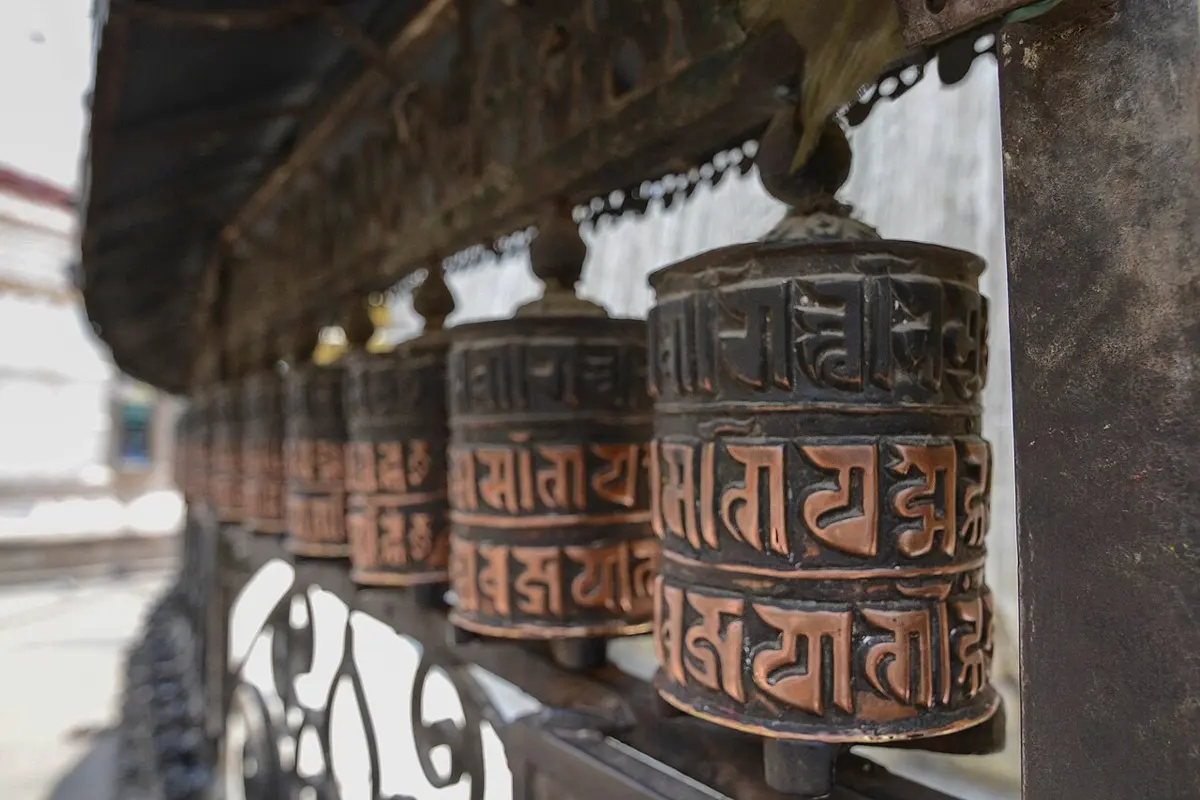
- Swayambhunath’s eyes: Wikipedia, “Swayambhunath”. Prayer wheels: Wikipedia, “Prayer wheel”. Both read November 2026.
- Every answer: worked out here and checked by a computer program.
A companion to your textbook, not a replacement for it: study from the book your school uses, and where the two differ, follow your teacher. Found a mistake? Please tell us.