
Anju’s father lays floors in Bhaktapur, and in Plane Figures Anju found out why regular pentagons won’t cover one. Now a customer brings him a box of regular octagons and asks for a whole floor of them. That fails too: two octagons at a corner take 270°, and the 90° left over is too small for a third.
Then Anju looks at that 90°. It is the corner of a square.
So regular tiles that fail alone can work together. Which mixes work, how do you name one, and how many are there? In Back to the tile shop you will have the whole list, and it is short.
18.0 Review
A tessellation is a covering of a flat surface by shapes, with no gaps and no overlaps. The shapes are called tiles. The word comes from the Latin tessella, a small square piece of stone or clay used in mosaics.
Look around you. The bricks of a wall, the tiles of a bathroom floor, the squares woven into a nanglo and the pattern of a carpet are all tessellations, or close to it. So is the bees’ honeycomb you met in Plane Figures.
18.1 Regular tessellation
Start with the simplest tile: one regular polygon, used again and again.
Naming a tessellation
Tessellations are named with numbers. Here is how:
- Pick any corner where the tiles meet.
- Start at a tile with the fewest sides.
- Go round the corner in order and write how many sides each tile has, with a dot between the numbers.
Six triangles meet at a corner of Figure 18.3 a, so its name is 3.3.3.3.3.3. Four squares give 4.4.4.4, and three hexagons give 6.6.6. The name has one number for every tile at the corner, so squares are 4.4.4.4, never 4.4.4.
A floor made of one kind of regular polygon, all the same size, with whole sides meeting whole sides, is called a regular tessellation. That gives the three above.
What is the name of a floor of regular hexagons?
Pick an answer to see why.
Why only three?
Tiles close up round a corner only if their angle goes into 360° exactly, as you found in Plane Figures. At least three tiles must meet at a corner, so a tile’s angle can’t be more than . The hexagon’s is exactly 120°, and every polygon with more sides has a bigger angle. That leaves only the polygons from 3 to 6 sides to test.
| Regular polygon | One angle | 360° ÷ angle | A floor? |
|---|---|---|---|
| Triangle | 60° | 6 | Yes |
| Square | 90° | 4 | Yes |
| Pentagon | 108° | 3.33… | No |
| Hexagon | 120° | 3 | Yes |
Which type of triangle is used to make a regular tessellation?
Pick an answer to see why.
18.2 Semi-regular tessellation
Now mix the tiles, as Anju did. Round each corner the angles must still add up to 360°, but they no longer have to be equal.
Go round any corner of Figure 18.4 a, starting at a triangle chosen so that the smallest numbers come first: triangle, triangle, square, triangle, square. Its name is 3.3.4.3.4. In b the name is 3.3.3.3.6.
A floor made of two or more kinds of regular polygon, whole sides meeting whole sides, with the same arrangement at every corner, is called a semi-regular tessellation. Tilings of triangles and squares, or of triangles and hexagons, are examples.
Finding the missing tile
To find which tile fits a corner, take the angles you know from 360°. To turn an angle into a number of sides, use its exterior angle, which is minus the angle: the exterior angles of a regular polygon add up to 360°, so exterior angle.
Two octagons and one more regular tile meet at a corner. What is the third tile?
Pick an answer to see why.
Tiles that are not regular
The tile shop also sells tiles that aren’t regular polygons, and question 1 of the exercise has some. They still make tessellations, just not regular or semi-regular ones.
Any triangle covers a floor. Turn a copy half way round the middle of one side, and the two make a parallelogram, and parallelograms fit in rows. The angles at each corner are the triangle’s three angles, twice over: .
Any four-sided shape covers a floor too, even one with a dent. The four angles add up to 360°, so one of each goes round every corner.
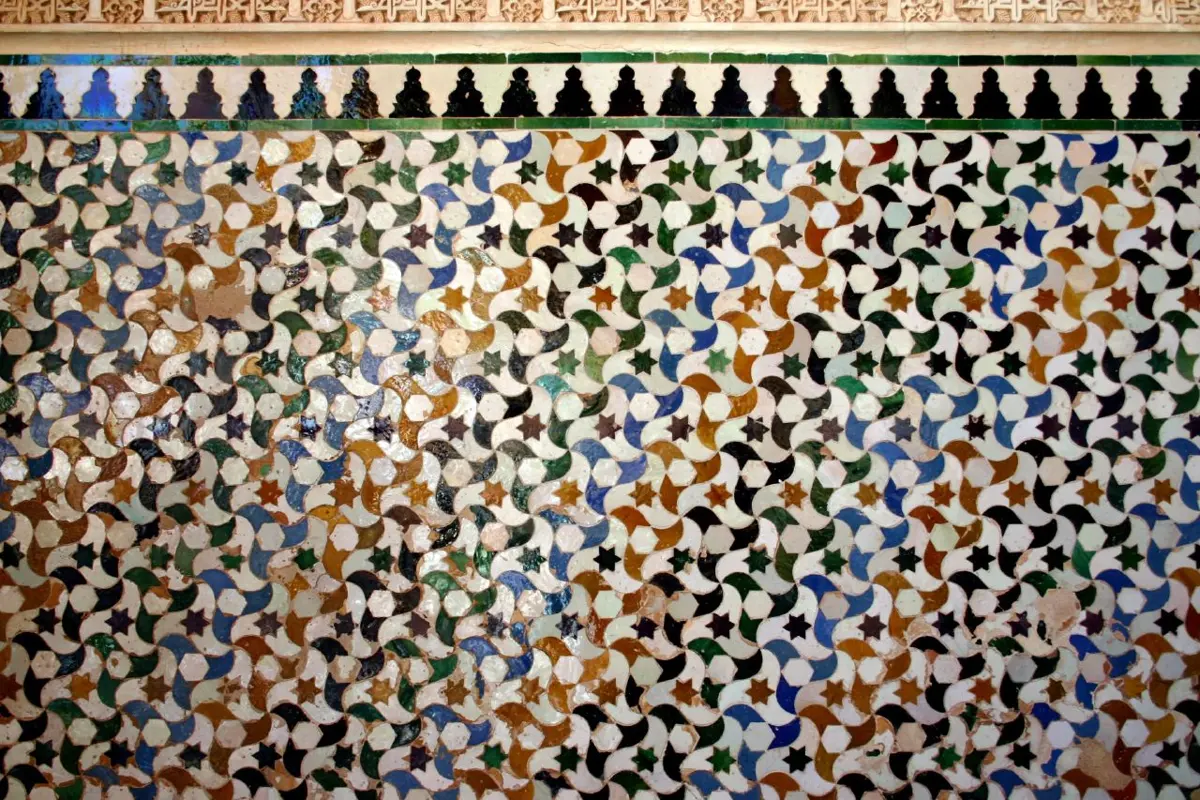
You can also start from a square and change it. Cut a piece from one side, and stick it on the opposite side. The area doesn’t change, and the bump on one tile fits the dent in the next.
Back to the tile shop
Anju’s father can now answer his customer in one line: yes, with small squares between the octagons, as a 4.8.8 floor.
And the whole list? Exactly eleven floors of regular tiles, with whole sides meeting whole sides, have every corner alike: three regular and eight semi-regular.
| Name | Tiles | Angles at a corner |
|---|---|---|
| 3.3.3.3.3.3 | triangles | 60° six times |
| 4.4.4.4 | squares | 90° four times |
| 6.6.6 | hexagons | 120° three times |
| 3.3.3.3.6 | triangles, hexagons | 60° four times, 120° |
| 3.3.3.4.4 | triangles, squares | 60° three times, 90° twice |
| 3.3.4.3.4 | triangles, squares | 60° three times, 90° twice |
| 3.4.6.4 | triangles, squares, hexagons | 60°, 90° twice, 120° |
| 3.6.3.6 | triangles, hexagons | 60° twice, 120° twice |
| 3.12.12 | triangles, 12-gons | 60°, 150° twice |
| 4.6.12 | squares, hexagons, 12-gons | 90°, 120°, 150° |
| 4.8.8 | squares, octagons | 90°, 135° twice |
Twenty-one arrangements of regular polygons close round a point, and these are the eleven that spread. Of the other ten, four (3.3.4.12, 3.3.6.6, 3.4.3.12 and 3.4.4.6) can appear only on floors that also have other kinds of corner, and six (3.7.42, 3.8.24, 3.9.18, 3.10.15, 4.5.20 and 5.5.10) can never be used at all.
What does the answer mean for a tile shop? A shop that stocks triangles, squares, hexagons, octagons and 12-gons with equal sides can lay all eleven. Pentagons, however good they look in a box, have no floor of their own.
Where this is used
- Floors, walls and paving. Bricks and paving blocks are laid in repeating patterns. Of the block-paving patterns, herringbone interlocks the most, which makes it a good choice for driveways and roads.
- A telescope’s mirror. The James Webb Space Telescope’s main mirror, 6.5 m across, was too large to launch in one piece. It is made of 18 hexagons, and it folded up to fit inside the rocket. NASA chose hexagons because they fit together closely into a nearly round mirror.
- Materials. In graphene, carbon atoms form a sheet one atom thick, joined in a 6.6.6 pattern of hexagons.

How the exam asks it
The grid’s Grade 8 model paper has one tessellation part (question 11 a). This question is ours, in the style of its questions: short parts at different levels. Cover the answer and try it.
Where marks are lost
- Not knowing what a regular polygon is: all sides equal and all angles equal.
- Forgetting that the angles round each corner must make 360°.
- Writing the numbers in size order, as 3.3.6.6 for 3.6.3.6, instead of going round the corner.
- Writing the wrong number of numbers: 4.4.4 for squares.
- Calling any mix of tiles semi-regular without checking that every corner is alike.
Exercise 18.1
Continue each pattern over its paper, so that the shape fills the whole sheet with no gaps. Copy the shapes onto dot paper and squared paper of your own.
Hint
Answer
Add 2 or 3 rounds of tiles to each of these tessellations.
Hint
Answer
Name the tessellations of question 2 by the tessellation numbers.
Answer
The figure is part of a semi-regular tessellation made of squares and another regular polygon. What is the name of the regular polygon? Make a tessellation by using this regular polygon.
Answer
The figure is part of a tessellation made of three kinds of regular polygon. One is an equilateral triangle and the second is a square. All the sides are equal. What is the name of the third regular polygon? Make a tessellation with the help of that polygon.
Answer
Project work
Printable PDFs
- Study notes 2 pages
- Harder practice questions 2 pages Answer key
Practice every question in the book, and keep track of the ones you miss →
Where these facts come from
- The exam (For the exam, How the exam asks it): CDC, विशिष्टीकरण तालिका (कक्षा ६-८) गणित – नमुना प्रश्नहरु (Geometry 15 marks in three questions; the Grade 8 model paper’s question 11 a, 1 mark, knowledge; the Grade 6 model paper’s question 12 b, 2 marks, higher ability; both read on the PDF pages); our question is our own.
- The common mistakes (Where marks are lost), everyday examples such as the nanglo, and the project’s materials: CDC, शिक्षक निर्देशिका कक्षा ८ गणित (२०८१), the lesson on tessellation (not knowing what a regular polygon is; not knowing that a corner must make 360°).
- The word tessellation, any triangle or four-sided shape as a tile: Wikipedia, “Tessellation”, read November 2026.
- The eleven floors, Kepler’s Harmonices Mundi of 1619, the 21 arrangements and which can be used: Wikipedia, “Euclidean tilings by convex regular polygons”, read November 2026; the 21 arrangements recounted here by a computer program, and each floor drawn in this unit built and checked by one: no overlaps, and every corner reads as named.
- Escher: Wikipedia, “M. C. Escher” (his return to the Alhambra in 1936, “Regular Division of the Plane”), read November 2026.
- Paving: Wikipedia, “Paving stone” (herringbone), read November 2026.
- Webb’s mirror: NASA, Webb’s Mirrors (why hexagons: a roughly circular mirror with a high filling factor); Wikipedia, “James Webb Space Telescope” (18 segments, 6.5 m, too large to launch in one piece), read November 2026.
- Graphene: Wikipedia, “Graphene”, read November 2026.
- The football: Wikipedia, “Truncated icosahedron”, read November 2026; one pentagon and two hexagons at a corner follows from its 12 pentagons, 20 hexagons and 60 corners.
- Anju, her father and the customer are made up, as in Plane Figures.
A companion to your textbook, not a replacement for it: study from the book your school uses, and where the two differ, follow your teacher. Found a mistake? Please tell us.