
How tall is the Nyatapola? Nobody needs to climb it to find out. Stand a 1.5 m stick upright in Taumadhi square on a sunny day. Suppose its shadow is 2 m long, and at that same moment the temple’s shadow reaches 40 m from the point right under its top.
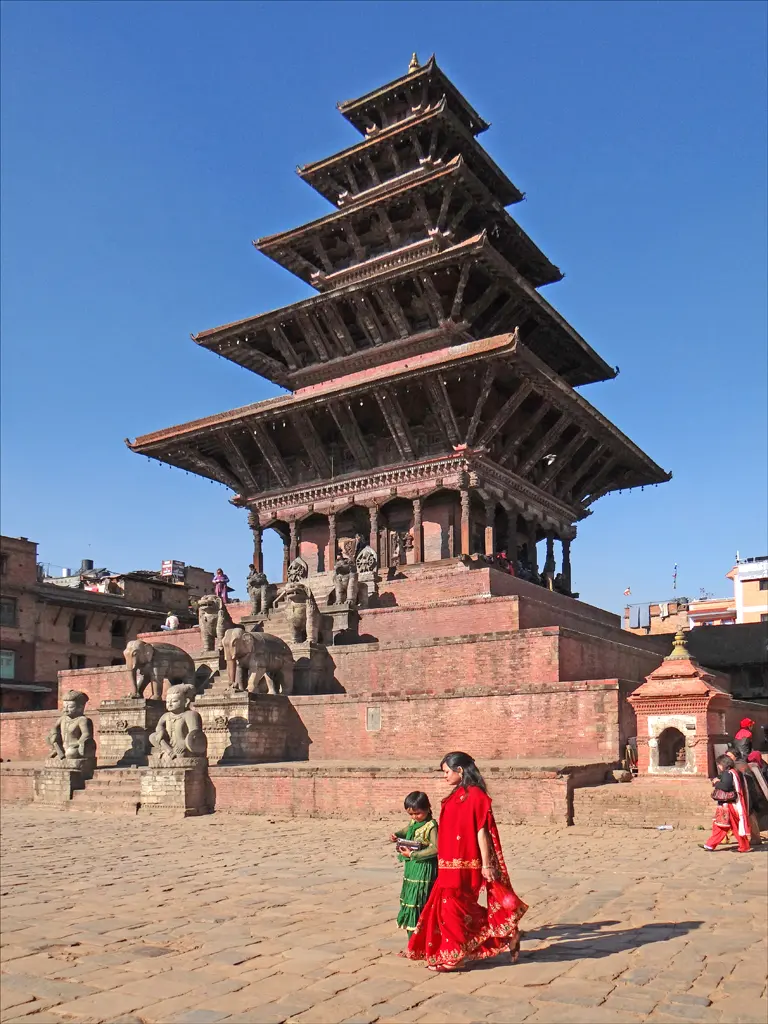
Those numbers are enough, because the stick and the temple make two triangles of the same shape. This unit is about two questions. When are two triangles exactly alike, and how few measurements prove it? And when two shapes are the same but for size, how does one tell you about the other? In Back to the Nyatapola you will work out its height yourself.
15.0 Review
Compare each shape on the right of the line, a. to f., with the first shape in its row. Then discuss your answers in a group.
- Write A if it has the same shape and equal measurements.
- Write B if the shape matches but the measurements differ.
- Write C if both the shape and the measurements differ.
15.1 Congruent triangles
The parts that land on each other are partners. ∠BAC and ∠QPR, ∠ABC and ∠PQR, and ∠BCA and ∠QRP are corresponding angles. AB and PQ, BC and QR, and AC and PR are corresponding sides.
When two triangles have the same shape and size, they are called congruent triangles. In congruent triangles, corresponding sides and corresponding angles are equal. Triangles ABC and PQR are congruent, and we write .
The sign is easy to remember: for the same shape on top of = for the same size.
. Which side is equal to LM?
Pick an answer to see why.
15.2 Test of congruent triangles
To show that two triangles are congruent, must you compare all six parts, three sides and three angles? On what condition can △PQR be constructed congruent with △ABC? Discuss. The next five activities show that three well-chosen parts are enough. In each, you draw a triangle, copy only three of its parts, and measure what you did not copy.
a. Side-Angle-Side (SAS)
SAS: if two sides and the angle between them of one triangle are equal to the corresponding two sides and the angle between them of another triangle, then the triangles are congruent. This is known as the SAS axiom.
An axiom is a fact we accept and build on, because trying it always works, without proving it from anything simpler.
b. Right angle-Hypotenuse-Side (RHS)
RHS: if the hypotenuse and one side of a right-angled triangle are equal to the hypotenuse and one side of another right-angled triangle, then the triangles are congruent.
c. Angle-Side-Angle (ASA)
ASA: if two angles and the side between them of one triangle are equal to two angles and the side between them of another triangle, then the two triangles are congruent.
d. Side-Side-Side (SSS)
SSS: if the three sides of one triangle are individually equal to the three sides of another triangle, then the triangles are congruent.
e. Angle-Angle-Side (AAS)
AAS: if two angles and a side that is not between them in one triangle are equal to the corresponding two angles and side of another triangle, then the triangles are congruent. The side must be the one opposite the same angle in both triangles.
Why does this work? The angles of a triangle add up to 180°, so if two angles match, the third matches too. Then the given side has matching angles at both its ends, and that is ASA again.
Why three parts are enough, and which three
Using the tests
In △ABC and △PQR, AB = PQ, BC = QR and ∠BAC = ∠QPR. What can you say?
Pick an answer to see why.
Construct it: A right-angled triangle (RHS)
Exercise 15.1
Question 1
Write the reason for the congruency of this pair of triangles.
Answer
Write the reason for the congruency of this pair of triangles.
Answer
Write the reason for the congruency of this pair of triangles.
Answer
Write the reason for the congruency of this pair of triangles.
Answer
Question 2
Determine whether these triangles are congruent. Each square of the grid is 1 cm: find the sides and measure the angles. If they are congruent, identify the corresponding angles and corresponding sides.
Answer
Determine whether these triangles are congruent. Each square of the grid is 1 cm: find the sides and measure the angles. If they are congruent, identify the corresponding angles and corresponding sides.
Answer
Question 3
△ABC and △PQR are congruent. What are the corresponding angles and corresponding sides? Write.
Answer
△ABC and △PQR are congruent. What are the corresponding angles and corresponding sides? Write.
Answer
△ABC and △PQR are congruent. What are the corresponding angles and corresponding sides? Write.
Answer
Question 4
To make △ABC and △PQR congruent, which three corresponding sides must be equal? Write.
Answer
Question 5
Write the reason for the congruency of this pair of triangles.
Answer
Write the reason for the congruency of this pair of triangles.
Answer
Write the reason for the congruency of this pair of triangles.
Answer
Write the reason for the congruency of this pair of triangles.
Answer
Question 6
In the figure, D is the midpoint of AB, and CD is perpendicular to AB. Prove that .
Answer
Question 7
In the figure, ∠RPQ = ∠PQS and QS = PR. Prove that .
Answer
Question 8
In △ABC and △PQR, ∠BAC = ∠QPR and ∠ABC = ∠PQR. Which condition should be added to make ?
Answer
Question 9
In △LMN and △XYZ, and MN = XY. Which condition should be added to make the two triangles congruent? State the axiom of congruency.
Answer
15.3 Similar figures
The shape on worksheet b. is similar to the shape on a. but smaller. The shape on worksheet c. is larger. Two plane figures are said to be similar if they have the same shape. They may be smaller, larger or of equal size, but their shapes are identical. Congruent figures are therefore similar too, with a factor of 1.
Two circles are always similar, and so are two squares. Two rectangles need not be: a long thin strip isn’t the same shape as a sheet of paper.
A photo 10 cm wide and 15 cm tall is stretched to fit a frame 20 cm wide and 20 cm tall. Is the new picture similar to the photo?
Pick an answer to see why.
15.4 Similar triangles
Triangles ABC and PQR are similar triangles. Where ∠BAC = ∠QPR, ∠ABC = ∠PQR and ∠ACB = ∠PRQ, we get
Here the corresponding angles are ∠A and ∠P, ∠B and ∠Q, ∠C and ∠R. The sides opposite equal angles are the corresponding sides: BC and QR, AC and PR, AB and PQ.
In similar triangles, equal angles are called corresponding angles, and the sides opposite equal angles are called corresponding sides. When the corresponding angles of two triangles are equal and the corresponding sides are proportional, the two triangles are called similar triangles. We write .
The number that turns one triangle’s sides into the other’s is the scale factor. In Activity 8 it is .
, AB = 6 cm and PQ = 9 cm. If BC = 4 cm, what is QR?
Pick an answer to see why.
Back to the Nyatapola
The temple is 30 m tall, from those numbers. Here is why.
At one moment, the Sun’s rays reach the stick and the temple at the same slant, because the Sun is so far away that its rays arrive parallel. The stick stands upright, and so does the line from the temple’s top down to the point under it. So each makes a right-angled triangle with its shadow, and the two triangles have two equal angles. The third pair must be equal too, so they are similar. That is why the proportion you used for a flagpole’s shadow in Unit 4 works.
The temple’s shadow is 20 times the stick’s, so the temple is 20 times as tall: h = 30 m.
There is one catch, and it is a real one. The top of the temple is above the middle of its base, so you can’t measure the shadow from the edge of the bottom plinth. Measure from the edge to the shadow’s tip, then add half the width of the base. Sources give the Nyatapola’s height as 30 m or as 33 m, so this is a measurement worth making on a sunny day.
Where this is used
Roofs and bridges use SSS. Three sides fix a triangle, so a triangle made of three stiff bars can’t change shape, unless a bar bends or breaks. A square frame can be pushed over with no bar changing length at all. That is why a truss, the frame in a roof or a steel bridge, is built of triangles.
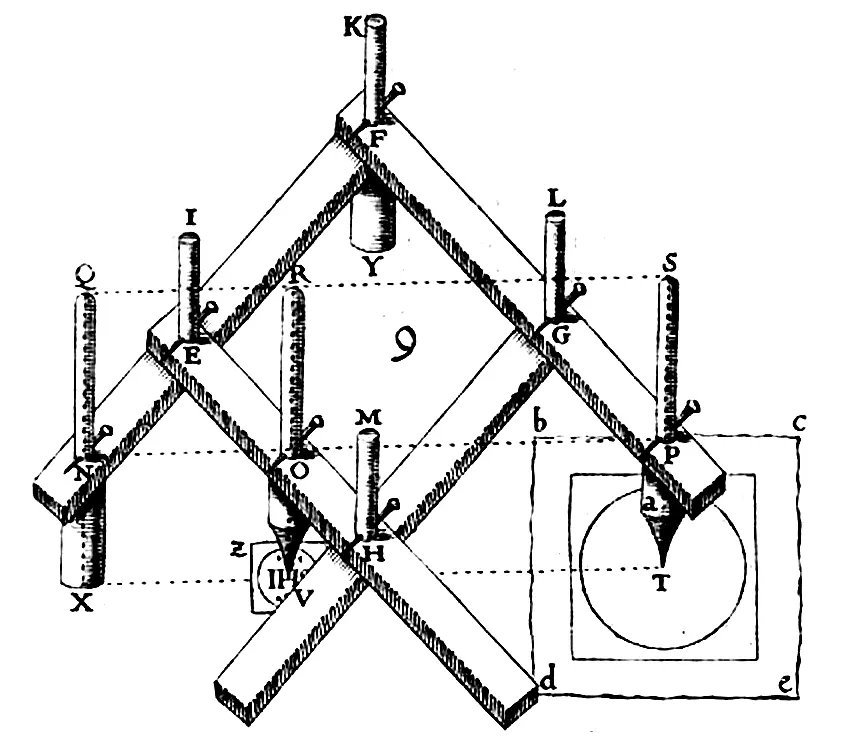
Copying at another size uses similarity. A pantograph is a frame of hinged bars built on a parallelogram: one point traces a drawing while a pen draws an enlarged or reduced copy. Christoph Scheiner used one in 1603 to copy diagrams.
Maps, plans and models are similar to the real thing. When a plan shows 1 cm for each meter, every length is reduced by the same factor and every angle stays the same. So you can measure on the paper and multiply. You will draw your own in Unit 20.
How the exam asks it
The grid’s Grade 8 model paper puts this unit into a question on a parallelogram. The first part, a construction for 3 marks, belongs to the unit on plane figures. Here is a question of our own in the shape of its second part.
Where marks are lost
- Writing the letters in the wrong order. P goes with R here, because PQ = RS.
- Leaving out the reason beside a statement, or forgetting the common side.
- Calling two sides and an angle SAS when the angle isn’t between them.
- Using RHS when no right angle or hypotenuse is known.
- Setting corresponding sides of similar triangles equal instead of in proportion.
Exercise 15.2
Question 1
These triangles are similar. Find their corresponding angles and sides by name.
Answer
These triangles are similar. Find their corresponding angles and sides by name.
Answer
Question 2
If the ratio of corresponding sides of △IJK and △PQR is 1 : 1, what type of triangles are they?
Answer
Question 3
Find the ratio of corresponding sides in the given similar triangles.
Answer
Question 4
These triangles are similar. Find the unknown sides.
Answer
These triangles are similar. Find the unknown sides.
The textbook gives AC = 6 cm and QR = 6 cm, with AB = 2 cm and PQ = 3 cm. These lead to BC = 4 cm, and 2 + 4 = 6, so the three sides would lie flat along one line: the book’s numbers don’t work. With these angles AC is about 1.2 × AB and QR about 1.1 × PQ, so 2.4 cm and 3.3 cm are used here.
Answer
Question 5
in the figure. Answer the following questions.
The textbook gives 75° at R and Y, but with 85° at X, ZY = 16 cm and XY = 8 cm the angle at Y comes out at about 65° when you draw it. So the book’s numbers don’t work; 65° is used here. With 75° the same working gives ∠PQR = 20°.
- a.Find the ratio of corresponding sides.
- b.Find the value of ∠PQR.
- c.Find the length of side PR.
Answer
Question 6
These triangles are similar. Find the values of x and y, and then the unknown angles.
Answer
These triangles are similar. Find the values of x and y, and then the unknown angles.
Answer
These triangles are similar. Find the value of x, and then the unknown sides and angle.
The textbook gives AB = PQ = 3.1 cm, but with angles of 56°, 64° and 60° the side AB must be a little longer than AC, which comes to 4.8 cm. So the book’s numbers don’t work; 5 cm is used here, and x is the same.
Answer
These triangles are similar. Find the value of x, and then the unknown sides and angle.
Answer
Printable PDFs
- Study notes 2 pages
- Harder practice questions 2 pages Answer key
Practice every question in the book, and keep track of the ones you miss →
Where these facts come from
- The exam (For the exam, How the exam asks it): CDC, विशिष्टीकरण तालिका (कक्षा ६-८) गणित – नमुना प्रश्नहरु (Geometry 15 marks in three questions; Grade 8 model question 10, read on the PDF page); our question is our own.
- The common mistakes (careful boxes, Where marks are lost): CDC, शिक्षक निर्देशिका कक्षा ८ गणित (२०८१), the lesson on congruency and similarity (treating corresponding sides as always equal).
- The Nyatapola (the opening, Back to the Nyatapola): Wikipedia, “Nyatapola” (finished in 1702; 33 m, and 30 m in one place), read November 2026. The stick’s and the shadows’ lengths are made up for the sum, not measured; the drawing’s proportions are those of Grade 10 Math’s, from a frontal photo.
- Thales: Wikipedia, “Thales of Miletus” (his shadow equal to his height; Diogenes Laërtius, Pliny and Plutarch, from Hieronymus of Rhodes; Amasis), read November 2026.
- The five tests, SSA and AAA: Wikipedia, “Congruence (geometry)”, read November 2026.
- Why trusses use triangles: Wikipedia, “Truss” (a triangle will not change shape when the lengths of its sides are fixed), read November 2026.
- A sizes: Wikipedia, “ISO 216” (the ratio √2; a half sheet keeps it; a copier reducing A4 to A5), read November 2026.
- The pantograph: Wikipedia, “Pantograph” (based on parallelograms; Scheiner, 1603, written up in 1631), read November 2026.
- Every answer: worked out here and checked by a computer program.
A companion to your textbook, not a replacement for it: study from the book your school uses, and where the two differ, follow your teacher. Found a mistake? Please tell us.