
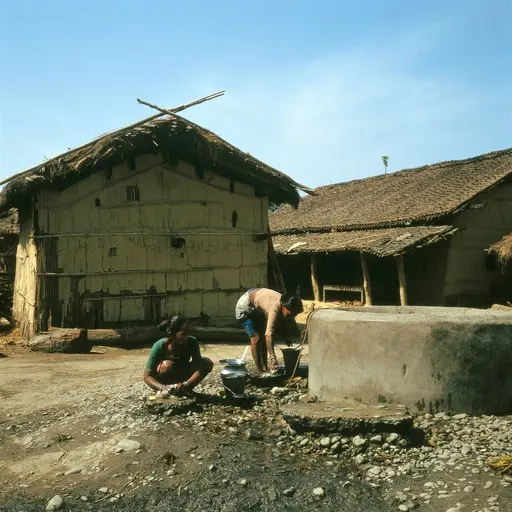
Suraksha has a field with four sides, two of them parallel, and a round well near the middle of it. The land office asks how much land she has. The blacksmith asks how much steel plate a lid for the well will take, and he charges by the square meter. Neither can be counted in squares: the field’s sides slant, and a round lid has no straight sides at all.
This unit answers both. The trick is the same every time: cut a shape and move the pieces until you have a shape you already know. Nothing is added and nothing is lost, so the area stays the same. In Back to Suraksha’s field you will find both answers, and what happens to the lid if the well is twice as wide.
8.0 Review
Area is the amount of flat surface a shape covers. We measure it by asking how many squares of a chosen size would cover it. So a square centimeter, 1 cm², is a square of side 1 cm, and an area of 12 cm² is as much surface as 12 of those squares.
Counting works on squared paper, but nobody can lay squares over a field. A formula counts the squares for you, from two or three lengths. In this unit every formula comes from something you can do with scissors, so you can rebuild it in an exam if you forget it.
8.1 Area of triangles and quadrilaterals
8.1.1 Area of triangles
(i) Area of a right-angled triangle
The two sides that meet at the right angle were the rectangle’s two sides. If they are the base b and the perpendicular p, the area of a right-angled triangle is:
A right-angled isosceles triangle has its base and its perpendicular equal, so its area is , or .
Now try one that leans out past its base.
The height of a triangle is the distance from a corner, or vertex, straight down, at a right angle, to the opposite side. Any of the three sides can be the base, as long as you use the height that goes with it.
A triangle has sides 13 cm, 14 cm and 15 cm. The height onto the 14 cm side is 12 cm. What is its area?
Pick an answer to see why.
(ii) Area of an equilateral triangle
So in triangle ABC with each side a, the height AD makes . The height comes from Pythagoras’ theorem in the right-angled triangle ADC:
(iii) Area of an isosceles triangle
Area of an isosceles triangle , where a is an equal side and b the base. If you forget it, find the height by Pythagoras’ theorem and use : the answer is the same.
8.1.2 Area of different quadrilaterals
(i) Area of a parallelogram
The height is the straight distance between the two parallel sides, not the slanting side. So tilting a parallelogram while keeping its base and height doesn’t change its area, though its sides grow longer.
(ii) Area of a rhombus
This works for every rhombus. The diagonals AC = d₁ and BD = d₂ cross at right angles, so AO is the height of △ABD and CO is the height of △CBD. Add the two triangles:
A kite has the same area formula, , and the proof is the same word for word, because its diagonals also cross at right angles. A rhombus also has base and height, so b × h works for it too, if those are the lengths you are given.
(iii) Area of a trapezium
A trapezium is a quadrilateral with one pair of parallel sides. Those sides can point any way: up the page, across it, or on a slant. What makes a side “parallel” is not that it lies flat.
Here is a second way, which works every time. Sides AB = a and DC = b are parallel. AE = BG = h is the height, and the diagonal AC cuts the trapezium into △ADC and △ABC. Add their areas:
Area of a trapezium height × sum of parallel sides.
(iv) Area of any quadrilateral
A quadrilateral with no special sides can still be cut in two by a diagonal. In ABCD, the diagonal is BD = d. Draw AF and CE perpendicular to it. The height of △ABD is AF = h₁, and the height of △CBD is CE = h₂. Add the two triangles:
Area of a quadrilateral diagonal × sum of the perpendiculars drawn onto it. This is how a surveyor can find the area of a plot with four crooked sides: one long diagonal, and two short lines at right angles to it.
Here are all the shapes together, with the perimeter P and the area A of each.
Triangle
P a + b + c
A ½ × b × h
Equilateral triangle
P 3a
A (√3 / 4) a²
Isosceles triangle
P 2a + b
A (b / 4) √(4a² − b²)
Right-angled triangle
P p + b + h
A ½ × b × p
Right-angled isosceles triangle
P 2p + h
A ½ p²
Rectangle
P 2(l + b)
A l × b
Square
P 4a
A a², or ½ d²
Parallelogram
P 2(a + b)
A base × height
Rhombus
P 4a
A ½ × d₁ × d₂
Kite
P 2(s₁ + s₂)
A ½ × d₁ × d₂
Trapezium
P add the four sides
A ½ × (a + b) × h
Any quadrilateral
P add the four sides
A ½ × d × (h₁ + h₂)
A square has a diagonal of 10 cm. What is its area?
Pick an answer to see why.
Worked examples
When a shape isn’t on the list, cut it into shapes that are.
Exercise 8.1
Question 1
Find the perimeter of each triangle. Add its three sides.
Find the perimeter.
Answer
Find the perimeter.
Answer
Find the perimeter.
Answer
Find the perimeter.
Answer
Find the perimeter.
Answer
Find the perimeter.
Answer
Question 2
Find the area of each triangle.
Find the area.
Answer
Find the area.
Hint
Answer
Find the area.
Answer
Find the area.
Answer
Find the area.
Answer
Find the area.
Answer
Find the area.
Hint
Answer
Find the area.
Answer
Find the area.
Answer
Find the area.
Answer
Find the area.
Answer
Find the area.
Answer
Question 3
Find the area of each quadrilateral.
Find the area.
Answer
Find the area.
Answer
Find the area.
Answer
Find the area.
Answer
Find the area.
Answer
Find the area.
Answer
Find the area.
Answer
Find the area.
Answer
Find the area.
Answer
Find the area.
Answer
Find the area.
Answer
Find the area.
Answer
Question 4
Find the area of each shape. Cut it into shapes you know.
Find the area.
Hint
Answer
Find the area.
Answer
Find the area.
Answer
Find the area.
The textbook gives these four lengths, but its numbers don’t work: MO would be in one triangle and in the other. We kept them, because each triangle’s area needs only its own two sides, and drew MO between the two.
Answer
Find the area.
Answer
Find the area.
Answer
Find the area.
Answer
Find the area.
Hint
Answer
Find the area.
Answer
Question 5
Find the area of the shaded part of each figure.
Find the area of the shaded part.
Answer
Find the area of the shaded part.
Answer
Find the area of the shaded part.
Answer
Find the area of the shaded part.
Answer
Find the area of the shaded part.
Answer
Find the area of the shaded part.
Answer
Find the area of the shaded part.
Answer
Find the area of the shaded part.
Answer
Find the area of the shaded part.
Answer
Find the area of the shaded part.
Answer
Find the area of the shaded part.
Answer
Find the area of the shaded part.
Answer
Question 6
Find the value of x in each figure.
The area of triangle ABC is 56 cm².
Answer
The area of triangle PQR is 40 cm².
Answer
The area of triangle XYZ is 50 cm².
Answer
The area of parallelogram PQRS is 92 cm².
Answer
The area of trapezium ABCD is 75 cm².
Answer
The area of rhombus MNOP is 44 cm². Its diagonals are MO = 8.8 cm and PN = x.
Answer
Question 7
A rectangular park 120 m long and 110 m wide has a volleyball court 18 m long and 9 m wide in it. Find the area of the park without the court.
Answer
A square fish pond of side 50 m is dug in the middle of a rectangular field 125 m long and 100 m wide. Find the area of the field without the pond.
Answer
Question 8
How many boards of area 1 ft² does it take to cover a wall 9 ft long and 7 ft high without overlapping?
Answer
How many sheets of plywood of area 1 m² does it take to cover a wall 25 m long and 3 m high without overlapping?
Answer
Question 9
The perimeter of a square field is 200 ft.
- i.Find the length of its side.
- ii.Find its area.
Answer
The wall around a square ground is 80 m long.
- i.Find the length of the ground.
- ii.Find its area.
Answer
A rectangular room is 15 ft long and its perimeter is 54 ft.
- i.What is its breadth?
- ii.What is its area?
Answer
The length of a rectangular room is twice its breadth, and its perimeter is 60 ft.
- i.What are its length and breadth?
- ii.How many square feet of carpet are needed to cover the floor?
Hint
Answer
Question 10
The map shows some important places of a village. The water tank and the chautari are square. The map is not drawn to scale. Find the area of each.
- a.The public toilets
- b.The pond
- c.The school
- d.The chautari
- e.The water tank
Answer
8.2 Area of circle
Every shape so far had straight sides. A circle has none, so we can’t cut it into a few triangles and be done. We need one new number first.
The circumference of a circle is the whole length of its boundary. The ratio of the circumference to the diameter is the same for every circle. It is called pi, written :
The value of never ends and never repeats. In calculations we use or 3.14, and neither is exact: is about 3.143. Each question tells you which to use. If it doesn’t, say which you took.
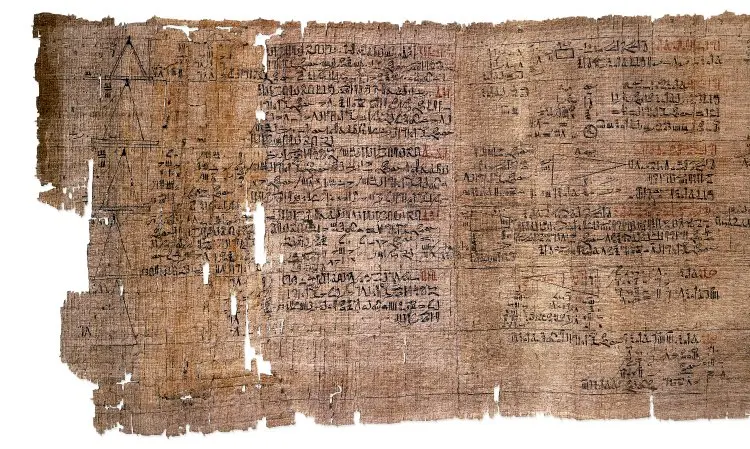
A wheel has a diameter of 70 cm. How far does it roll in one full turn? ()
Pick an answer to see why.
So the area of a circle is
Since , it can also be written with the diameter:
What does the mean? Double the radius, and the area doesn’t double. It becomes , four times as much. That’s why a 12-inch pizza holds four times as much as a 6-inch one, and a well twice as wide needs four times the steel in its lid.
A circle has radius 3 cm. Another has radius 9 cm. How many times as big is its area?
Pick an answer to see why.
Exercise 8.2
Question 1
Find the area of a circle with each of these measures. ()
radius = 3 cm
Answer
radius = 8 ft
Answer
radius = 16 m
Answer
diameter = 5 cm
Answer
diameter = 12 in
Answer
diameter = 18 m
Answer
diameter = 20 km
Answer
diameter = 15 mm
Answer
diameter = 22 cm
Answer
Question 2
Find the area of a circle with each of these circumferences. ()
34.54 cm
Answer
65.94 m
Answer
18.84 in
Answer
113.04 m
Answer
376.80 ft
Answer
157 m
Answer
Question 3
Find the radius of a circle with each of these areas. ()
154 cm²
Answer
346.5 ft²
Answer
616 m²
Answer
1,386 m²
Answer
38.5 km²
Answer
3,850 ft²
Answer
Question 4
Find the area of the shaded part of each figure. ()
Find the area of the shaded part.
Answer
Find the area of the shaded part.
Answer
Find the area of the shaded part.
Answer
Find the area of the shaded part.
Answer
Find the area of the shaded part.
Answer
Find the area of the shaded part.
Answer
Question 5
A round room has a diameter of 14 m. What area does it cover? ()
Answer
A round fun park has a radius of 21 m. What area does it cover? ()
Answer
A cow is tied to a post with a rope 7 ft long. What area can it graze? ()
Hint
Answer
Question 6
The base of a cylindrical bowl has a diameter of 9 cm. Find the area of the base. ()
Answer
The end of a cylindrical pipe has a diameter of 30 cm. Find its area. ()
Answer
Question 7
The base of a cylindrical tank has an area of 154 ft². Find its radius and its circumference. ()
Answer
A round playground of area 153.86 m² is plastered. Find the diameter of the plastered part and its circumference. ()
Answer
Question 8
Sharmila has drawn a circle of radius 5 cm, and Dipesh a circle of radius 7 cm. Whose circle has the greater area, and by how much? ()
Answer
Salman dug a well of radius 14 m, and Prarthana a well of radius 18 m. Whose well takes up more land, and how much more? ()
Answer
Question 9
The area of a round pond is 616 m². ()
- a.What is its radius?
- b.How long a wire does it take to go round the pond once?
- c.If fencing costs Rs 250 per meter, what is the total cost of fencing round the pond?
Answer
Question 10
A runner runs 3,520 m by going 4 times round a circular track. ()
- a.What is the length of the track?
- b.What is its diameter?
- c.What area does the track enclose?
- d.What is the total cost of fencing round the track, if wire costs Rs 600 per meter?
Answer
Back to Suraksha’s field
How much land? Her field is a trapezium with parallel sides 30 m and 60 m, 30 m apart.
A ropani is about 508.72 m², so that is about 2.65 ropani.
How much steel for the lid? The well is 1.4 m across, so r = 0.7 m.
So the lid takes 1.54 m² of plate, and the rim round it is m long.
A well twice as wide? At 2.8 m across, r = 1.4 m and the lid takes m²: four times the plate, though the rim only doubles to 8.8 m. A blacksmith who charged double would lose money.
Where this is used
- Land. A land record is an area. In the hills it is counted in ropani (about 508.72 m²) and in the Terai in bigha (about 6,772.63 m²); a surveyor gets there by cutting a plot into triangles.
- Cost. Paint, tiles, carpet and plate are priced by the square meter, so a bill is area × rate. It’s the sum in Exercise 8.2’s Questions 9 and 10 and the Mixed exercise’s Question 7.
- Round lids. A round cover can’t fall through its own hole, whichever way it is turned, while a square one can if it is slipped in along its diagonal. That is one reason manhole covers in streets are round.
- Paper and cloth. Tailors and printers lay shapes on a sheet to see how much is left over. It is the “shaded part” sum, whole minus pieces.
How the exam asks it
The grid gives this unit one question of 5 marks, in four parts. Here is one of that kind.
Alina has a pasture in the shape of a trapezium ABCD, with AB parallel to DC and a right angle at D: AB = 32 m, DC = 50 m and AD = 24 m. There is a round pond of diameter 2.8 m in it. ()
Write the formula for the area of a circle of radius r. [1]
Answer
Find the area of the pond. [1]
Answer
Find the area of the pasture without the pond. [2]
Answer
Alina has 130 m of wire. Is it enough to go once round the pasture? Give a reason. [1]
Answer
Mixed exercise
Question 1
Find the area of each shape.
A triangle with base 5 cm and height 10 cm.
Answer
A parallelogram with base 12 cm and height 8 cm.
Answer
A square with a diagonal of 6 ft.
Answer
A rhombus with diagonals 5.4 cm and 6.8 cm.
Answer
A kite with diagonals 9 cm and 5 cm.
Answer
A circle with diameter 7 m. ()
Answer
A circle with radius 6 cm. ()
Answer
Question 2
Find the area of the shaded part of each figure. ()
Find the area of the shaded part.
Answer
Find the area of the shaded part.
Answer
Find the area of the shaded part.
Answer
Find the area of the shaded part.
Answer
Find the area of the shaded part.
Answer
Question 3
A circular carpet of diameter 7 ft lies in the middle of the floor of a square room of side 10 ft. ()
- a.What is the area of the room?
- b.What is the area of the carpet?
- c.Find the area of the room not covered by the carpet.
Answer
Question 4
A building 40 m long and 30 m wide stands in a rectangular field 200 m long and 120 m wide.
- a.What is the total area of the land?
- b.What is the area of the building?
- c.What is the area of the land without the building?
Answer
Question 5
The figure shows the main parts of a hotel’s land. Find the area of each. ()
- a.The whole land
- b.The swimming pool
- c.The children’s park
- d.The vehicle parking
- e.The land under the hotel building
- f.The garden, if all the remaining open space is made into one
Answer
Question 6
Find the areas of △ABC, △PQR and △XYZ.
Answer
Question 7
A circular carpet of diameter 3.5 m lies in the middle of the floor of a rectangular room 6 m long and 4 m wide. ()
- a.What is the area of the room?
- b.What is the area of the carpet?
- c.Find the area of the room not covered by the carpet.
- d.What does the carpet cost, at Rs 1,000 per square meter?
Answer
Question 8
In the figure, ABCD is a trapezium and BPC is a right-angled triangle. AB = 20 cm, DC = 25 cm and BC = 13 cm.
- a.Find the length of BP.
- b.Find the area of trapezium ABCD.
- c.How many times the area of triangle BPC is the area of the trapezium?
Hint
Answer
Question 9
The house has a triangle, a parallelogram and a circle in it; the models show their measures. ()
- a.Write the relationship between the diameter and the radius of a circle.
- b.What is the area of the triangular part at the front of the house?
- c.What does it cost to color that triangular part, without the round window, at Rs 50 per square meter?
- d.If 10 tiles cover 1 m², how many tiles does it take to tile the two roofs, each shaped like the parallelogram?
Answer
Question 10
In the figure, ABCD is a trapezium with CD = 6 cm, AE = 10 cm, BC = 5 cm and EC = 4 cm.
The textbook also gives AC = 8 cm, but its numbers don’t work: in the right-angled triangle AEC, cm. No answer needs it, so we left it out.
- a.What is the length of AB?
- b.Find the area of the trapezium.
- c.Which of the triangles BEC and AEC has the greater area, and by how much?
Answer
Question 11
Rabina has drawn a right-angled triangle and a rhombus in her round garden of radius 8 m. ()
- a.Write the formula for the area of a circle of radius r meters.
- b.Find the area of the right-angled triangle AOB.
- c.Find the area of the rhombus OBCD, if its longer diagonal is 13.86 m. Which has the greater area, the rhombus or the triangle, and by how much?
- d.Compare the area of the triangle and the rhombus together with the area of the rest of the garden. Which is greater, and by how much?
The textbook gives a longer diagonal of 12 m, but its numbers don’t work: B, C and D are on the circle, so every side of the rhombus is the radius, 8 m, and its shorter diagonal OC is 8 m too. Diagonals of 12 m and 8 m would make a side of m. Each half of the longer diagonal is m, so 13.86 m is the length that fits.
Hint
Answer
Printable PDFs
- Study notes 2 pages
- Harder practice questions 2 pages Answer key
Practice every question in the book, and keep track of the ones you miss →
Where these facts come from
- The exam (For the exam, How the exam asks it): CDC, Specification Grid and Model Questions, Mathematics, Grades 6–8 (2080) (Mensuration 5 marks; Grade 8 model question 5, read on the PDF page); our question is our own.
- The common mistakes (the two “careful” boxes on the height and the trapezium): CDC, Teachers’ Guide, Mathematics, Grade 8 (2081).
- The value of (the story in 8.2): Wikipedia, “Approximations of π” (the Rhind papyrus, Archimedes, Aryabhata, Zu Chongzhi) and “Rhind Mathematical Papyrus” (Ahmes, about 1550 BC, the British Museum), read November 2026.
- The circle and the thread (the fact after Exercise 8.2): Wikipedia, “Isoperimetric inequality”, read November 2026.
- Land units (Back to Suraksha’s field, Where this is used): Wikipedia, “Ropani”, read November 2026, as in Grade 9’s Area.
- Round lids (Where this is used): Wikipedia, “Manhole cover”, read November 2026.
- A4 paper (project in Exercise 8.1): Wikipedia, “ISO 216” (210 × 297 mm), read November 2026.
- The photos: Wikimedia Commons, credited under each picture.
- Every answer: worked out here and checked by a computer program.
A companion to your textbook, not a replacement for it: study from the book your school uses, and where the two differ, follow your teacher. Found a mistake? Please tell us.