
A plastic water tank on a roof in Nepal is sold as “1000 liters”. One such tank is 42 inches across and 48 inches high. Is the label honest? A plain cylinder that size would hold about 1,090 liters, more than the label. But the tank’s top is not flat: it narrows to a lid, so the tank is really a cylinder with a cone on top, and some of those 1,090 liters are missing.
By the end of this unit you will work out what such a tank really holds, how much cloth a tent needs, how much paint a room takes, and what each job costs. You will also see why a cone holds exactly a third of a cylinder.
Figures: a 1000-liter tank’s size from its seller’s listing (Sources).
5.0 Review: solids you already know
Two ideas carry the whole unit, and you have just used both. A surface area is the area of every face you could paint, laid out flat and added. A volume is how much the solid holds, in cubes: cm³, m³, or liters. Prisms and cylinders keep the same shape all the way up, so their volume is base × height. This unit is about solids that narrow to a point, pyramids and cones, and about solids built from several pieces.
5.1 Pyramids
What a pyramid is
Fold your own net on screen. The slider folds all four triangles at once; the second slider changes how tall the triangles are.
A pyramid is a solid with a polygon for its base and triangles for all its other faces, the lateral faces, which meet at one point, the apex. It is named by its base: triangular, square, pentagonal. In a right pyramid the apex is straight above the center of the base; with a regular base too, all its lateral faces are congruent. The vertical height is the distance from the apex straight down to the base, at right angles to it.
In this unit, as in the SEE, every pyramid is a right square pyramid: a square base with the apex straight above its center.
The parts of a square pyramid
A square pyramid has four lengths that matter:
- a, the base edge, the side of the square ABCD;
- h, the vertical height, PO, straight down from the apex to the center of the base;
- l, the slant height, PM, down the middle of a triangular face to the middle of a base edge: the height of each triangle;
- e, the lateral edge, such as PB, from the apex down to a corner.
They are tied together by two right-angled triangles. O is the center of the square, so OM is half the base edge, a/2. In triangle POM the right angle is at O, and Pythagoras’ theorem gives
M is the middle of BC, so MB = a/2, and the slant line PM meets BC at a right angle (the face is an isosceles triangle). In triangle PMB:
Each formula has its longest side on the left: the edge is longer than the slant height, and the slant height longer than the height. A pyramid’s face slopes, so the path down it is longer than the path straight down.
A square pyramid has base edge 10 cm and vertical height 12 cm. What is its slant height?
Pick an answer to see why.
Surface area of a pyramid
The net is the surface, laid flat: folding changes no face’s size. So the surface area is the area of the net. The slant height l is the height of each triangle, which is why it matters so much.
The lateral surface is the four triangles alone; the total surface adds the base. A tent’s cloth or a roof’s tin is a lateral surface; a box made all round, a total surface.
Volume of a pyramid
A pyramid narrows to a point, so it must hold less than a prism on the same base with the same height. How much less?
Pouring shows it; a cube cut into three shows why. Take a cube and pick one top corner, V. Join V to every corner of the three faces that don’t touch it: the bottom, the right and the back. The cube falls apart into three square pyramids, all with apex V.
Each piece has a base (a face of the cube) and height a (V is a full edge away from that face), and the three pieces are equal. Together they make the cube, , so each is : a third of base × height. The same holds for any pyramid, tall or flat:
Exercise 5.1
Question 1
Study the square pyramid below and answer.
What do GO and GM stand for in the pyramid?
Answer
If XY = a cm, what is the length of OM?
Answer
If the vertical height is h, the slant height l and the base edge a, write the relation between them.
Answer
What do GZ, GY, GX and GW stand for? Are they equal?
Answer
Question 2
Write the total surface area of a square pyramid with base edge m cm and slant height n cm.
Answer
What is the lateral surface area of a square pyramid with base edge p cm and slant height q cm?
Answer
Write the volume of a square pyramid with base edge r cm and vertical height h cm.
Answer
A square pyramid’s base has area z square units and its total surface area is y square units. What is the area of its triangular faces?
Answer
Question 3
Find the volume of a square pyramid whose base has area 64 cm² and whose height is 15 cm.
Answer
A square pyramid’s total surface area is 285 cm² and its triangular faces have area 192 cm² in all. Find the area of its base.
Answer
Find the slant height and the length of a lateral edge of this pyramid, where PO = 8 cm and OM = 12 cm.
Answer
Find the vertical height and the length of a lateral edge of this pyramid, where the slant height SA = 13 cm and the base edge NO = 10 cm.
Answer
Question 4
Find the total surface area and the volume of each square pyramid.
Answer
Answer
Answer
Answer
Answer
Answer
Question 5
Sophiya has a pot shaped like a square pyramid, 25 cm high on a base 30 cm square. How much water does it hold when full?
Answer
Question 6
A square pyramid has total surface area 800 cm² and base edge 16 cm. Find the area of its triangular faces and its volume.
Answer
Question 7
A fish tank shaped like a square pyramid has total surface area 400 square inches and slant height 15 inches. Find its volume.
Answer
Question 8
Tourists in Egypt reach a pyramid. Their guide says its base has area 3,600 m² and its height is 50 m. A mathematics teacher in the group works out its total surface area from this. What does she get?
Answer
Question 9
A hotel plans a tent shaped like a square pyramid for a group of foreign tourists: each side of the base 32 m, height 50 m.
How many square meters of cloth make the tent (its four sloping sides)?
Answer
What does the cloth cost at Rs 500 a square meter?
Answer
Question 10
Nepal Telecom has built a mobile tower in Asharam’s field. The tower is a square pyramid: its slant height is 50 ft and its vertical height 40 ft.
How much of the field does the tower stand on?
Answer
If the rent of the field is Rs 50 a square foot a year, how much rent does Nepal Telecom pay in 20 years?
Answer
Question 11
A chocolate is a square pyramid with total surface area 1,920 cm² and base edge 30 cm. Find its vertical height.
Answer
5.2 Cones
What a cone is
A cone has a circle for its base and one curved surface that narrows to a point, the vertex (or apex). In a right circular cone, the cone of this unit, the vertex is straight above the center of the base.
The slant height is always the longest side of that triangle: longer than the height and longer than the radius. It is the same all the way round the cone.
Surface area of a cone
The curved surface is the sector you get when you cut the cone open, so its area is the sector’s area. But a sector’s area needs its angle, which the cone doesn’t tell you directly. There is a neater way.
So the curved surface of a cone is a rectangle long and l high, in disguise:
The base is a circle, ; add it when the cone is closed underneath (a solid wooden cone), leave it out when it is open (a birthday cap, a tent, an ice-cream cone).
In this unit , unless a question says otherwise (some SEE questions give : use what the question gives); an answer in terms of (like cm²) is exact.
Volume of a cone
It is the pyramid’s rule again, with a circle for a base: any solid that narrows evenly from a base to a point holds a third of base × height.
Exercise 5.2
Question 1
Look at the cone and answer.
What do h, l and r stand for?
Answer
Write the relation between l, h and r.
Answer
Find h if l = 13 cm and r = 5 cm.
Answer
Question 2
Write the curved surface area of a cone with base radius r cm and slant height l cm.
Answer
Write the total surface area of a cone with base radius x cm and slant height y cm.
Answer
What is the volume of a cone whose base is p cm across (diameter) and whose height is q cm?
Answer
Question 3
Find the volume of a cone whose base has area 81 cm² and whose height is 15 cm.
Answer
A cone’s total surface area is 250 cm² and its base has area 118 cm². Find its curved surface area.
Answer
Find the volume of a cone with slant height 5 cm and base radius 4 cm.
Answer
Question 4
Find the curved surface area, total surface area and volume of each cone.
Answer
Answer
Answer
Answer
Answer
Answer
Question 5
A right circular cone has volume cm³ and height 12 cm. Find its slant height.
Answer
Question 6
A cone-shaped tent has volume 1,232 m³ and its floor has area 154 m². Find the radius of its floor and its height.
Answer
Question 7
A cone-shaped tent with slant height 14 m takes 77 m² of plastic. Find the area of its floor and the distance round it.
Answer
Question 8
Find the volume, curved surface area and total surface area of a cone 21 cm high on a base 8 cm across.
Answer
Question 9
A solid cone is three times as high as its base is wide (its diameter). Its volume is cm³. Find its total surface area.
Answer
Question 10
For a project, a Grade 10 student made a wooden cone whose base has area 154 cm² and whose height is 14 cm. What does it cost to paint its curved surface at Rs 1.50 a square centimeter?
Answer
Question 11
A cone-shaped pot, 21 cm high and 14 cm across, is full of water. Two equal solid cones are dropped in, and a third of the water spills out. What is the volume of each solid cone?
Answer
Question 12
Three solid cones of the same height, with base radii 3 cm, 4 cm and 5 cm, are melted and made into one cone of that height. Find the diameter of its base.
Answer
Question 13
A wooden toy cone has a base 10 cm across. Painting its whole surface at Rs 4 a square centimeter costs Rs 880. Find the volume of the toy.
Answer
5.3 Combined solids
Solids built from pieces
To find a combined solid’s volume, add the volumes of its parts: the parts fill different spaces. Its surface needs more care. Where two parts are joined, the circle (or square) between them is inside the solid: nobody can paint it, so it is not part of the surface. Add only the faces you can see.
The five shapes and their formulas
All the parts of one combined solid share the same radius r (or base edge a).
Cylinder and cone (a tent): the cylinder has height h₁; the cone height h₂ and slant height l.
The is the floor; leave it out for a tent with no floor.
Cone and hemisphere (an ice cream): the cone has height h and slant height l.
Cylinder and hemisphere (a grain silo with a dome): the cylinder has height h.
Two cones on one base (a spinning top, a toy rocket’s ends): heights h₁ and h₂, slant heights l₁ and l₂.
Prism and pyramid (a pillar with a pointed top): a square base of edge a; the prism has height h₁, the pyramid height h₂ and slant height l.
Here 4a is the perimeter p of the base, so the prism’s sides are ph₁, as for any prism.
Exercise 5.3
Question 1
Answer from what is given for each combined solid.
The whole solid has volume 1,050 cm³ and its cylindrical part 748 cm³. Find the volume of the conical part.
Answer
The conical part’s curved surface is 252 cm², the cylinder’s curved surface 272 cm², and the circular end 154 cm². Find the total surface area.
Answer
A square prism of height h has a square pyramid on top; the whole solid is 2h high. The base has area 36 cm² and the prism’s volume is 144 cm³. Find the volume of the pyramid.
Answer
A cone with slant height 2r has a hemisphere of radius r on it. The cone’s curved surface is 308 cm². Find the curved surface of the hemisphere.
Answer
Question 2
Find the volume of each solid.
Answer
Answer
Answer
Answer
Question 3
A crystal is two equal square pyramids joined base to base. The square between them (shaded) is 2.5 cm on each side, and the crystal is 4.5 cm from tip to tip. Find its total surface area and volume.
Answer
Question 4
Find the total surface area of each solid.
Answer
Answer
Answer
Answer
Answer
Answer
Question 5
A toy is a cone and a hemisphere, both of radius 14 cm; it is 49 cm high. Find its total surface area.
Answer
Question 6
A pyramid 12 cm high stands on top of a square cuboid whose base has area 100 cm² and which is 10 cm high. Find:
the total volume;
Answer
the total surface area.
Answer
Question 7
A pyramid 8 cm high stands on top of a solid cube with edges of 12 cm. Find the total volume.
Answer
Question 8
A solid is a cylinder with a cone on top. The cylinder’s base has area 100 cm² and it is 3 cm high. The solid’s volume is 600 cm³. Find its total height.
Answer
A solid is a square prism with base edge 8 cm and a square pyramid with slant height 5 cm on top. Its volume is 448 cm³. Find the height of the prism.
Answer
Question 9
A tower is a square prism 6 ft high on a base 1 ft square, with a square pyramid 1 ft high on top.
Find the lateral surface area of the pyramid.
Answer
Find the area of the tower that can be painted (not its base).
Answer
Question 10
For his sixth birthday Ram got a spinning top from his father: a cone below and a hemisphere above, 5 cm high in all, the hemisphere 3.5 cm across. Ram wants to paint it. How much surface is there to paint?
Answer
5.4 Estimating costs
Every job of building, painting, tiling, fencing or filling is priced per unit: so many rupees a square foot of paint, a meter of wire, a liter of water. Its cost is
and the whole skill is finding the right quantity, an area, a length or a volume, in the unit the rate uses.
Why is the walls’ area 2h(l + b)? Unfold them.
The four walls are two l × h and two b × h rectangles. Laid side by side they make one rectangle h high and 2(l + b) long: the room’s perimeter. So
How the SEE asks it
In the SEE’s Compulsory Mathematics paper, Mensuration (area and volume) carries 13 marks in three questions, with knowledge, understanding, application and higher-ability parts spread among them (CDC’s specification grid). CDC’s model paper asks:
| Question | Part | Level | Marks | What it asks |
|---|---|---|---|---|
| a square pyramid | a. | knowledge | 1 | how many triangular faces |
| b. | understanding | 1 | its volume | |
| c. | application | 2 | the cost of covering its triangles | |
| a cone and hemisphere | a. | knowledge | 1 | the slant height formula |
| b. | understanding | 2 | its volume | |
| c. | higher ability | 1 | melted into a cylinder: its height | |
| a water tank | a. | application | 3 | the cost of painting its inner walls |
| b. | higher ability | 2 | the cost of filling it |
Here is a question in the tank’s shape (3 + 2 marks, as the model’s), and one in the pyramid’s to practice with.
Exercise 5.4
Question 1
How much water can each tank hold when full? (1 ft³ = 28.317 liters)
A cube-shaped tank with edges of 6 ft.
Answer
A cuboid tank 2 m long, 1.5 m wide and 2 m high.
Answer
A cylindrical tank 1 m across and 4 m high.
Answer
Question 2
The parking area in front of an insurance company’s office is the shape ABCD below. It is to be paved with bricks; each brick covers 0.222 sq ft and costs Rs 16.
Find the area of the parking area.
Answer
How many bricks are needed to pave it?
Answer
Two workers pave it in 3 days at Rs 1,200 a day each. Find the total cost, bricks included.
Answer
Question 3
A garden beside a new temple has the shape below. The temple committee will fence it with barbed wire, going round it 5 times. Three workers can do it in 2 days at Rs 1,500 a day each; the wire costs Rs 80 a meter.
Find the perimeter of the garden.
Answer
How much wire goes round it 5 times?
Answer
Find the total cost of the fencing, wages included.
Answer
Question 4
A cube-shaped room is 9 ft each way. It has two square windows 2 ft on a side and two doors 5 ft by 3 ft.
Find the area of the floor.
Answer
Find the area of the four walls without the windows and doors.
Answer
Find the cost of painting the four walls, windows and doors included, at Rs 350 a square foot.
Answer
Another room is 1 ft longer, wider and higher than the first, and its four walls (windows and doors included) are painted at Rs 340 a square foot. By how much does the cost rise or fall?
Answer
Question 5
A well needs 60 concrete rings, each 3.5 ft across and 1 ft high. A ring costs Rs 1,200; 2 workers set the rings in 12 days at Rs 1,500 a day each. (1 ft³ = 28.317 liters)
What do the rings alone cost?
Answer
What does it cost to build the well?
Answer
Find the most water the well can hold.
Answer
The water reaches the top of the 35th ring. How much water is in the well, and how much more would fill it?
Answer
Question 6
A house’s gate has two pillars, each a square prism with a base 5 ft square and 10 ft high, with a square pyramid 1 ft high on top.
Draw the pillar.
Answer
Find the slant height of the pyramid.
Answer
What does it cost to paint both pillars with their pyramids at Rs 94 a square foot?
Answer
Question 7
A house’s gate has two pillars, each a square prism with a base 1 ft square and 6 ft high, with a square pyramid 1 ft high on top.
Draw the pillar.
Answer
Write the formula for the lateral surface area of a square pyramid.
Answer
Find the slant height of the pyramid.
Answer
Tiling both pillars with their pyramids costs Rs 2,729 in all. What is the rate a square foot?
Answer
Question 8
A plant nursery builds a round tank 2.80 m across inside to collect rainwater. Its walls are 3 m high, and its top is a cone 0.72 m high.
Write the formula for the volume of a cylinder.
Answer
How much water can the tank hold?
Answer
If water costs Rs 1.85 a liter, what does it cost to fill the tank?
Answer
Question 9
A pyramid tent is sewn from 8 equal triangles of cloth, each with sides 5 m, 6 m and 6 m.
Find the area of one triangle.
Answer
Find the total area of cloth.
Answer
At Rs 600 a square meter, what does the cloth cost?
Answer
Mixed exercise
These questions mix the whole unit, as the SEE’s Mensuration questions do.
Question 1
For a project, a Grade 10 student hands his mathematics teacher three paper square pyramids, each with base edge 12 cm and slant height 10 cm.
Write the formula for the volume of a square pyramid.
Answer
Find the vertical height of a pyramid.
Answer
How much space do the three pyramids take up?
Answer
Coloring each pyramid, without its base, costs Rs 80 a square centimeter. Find the cost for all three.
Answer
Question 2
A square pyramid has base edge 16 cm and volume 1,280 cm³.
Write the formula for the total surface area of a square pyramid.
Answer
Find the perimeter of its base.
Answer
Find its slant height.
Answer
Find its total surface area and the area of its triangular faces. Which is greater, and by how much?
Answer
Question 3
A square pyramid’s lateral surface area is 540 cm² and its slant height 15 cm.
Write the formula for the total surface area of a square pyramid.
Answer
Find its base edge.
Answer
Find its volume.
Answer
Question 4
A toy is a cylinder with a hemisphere on one end.
What is the diameter of its base?
Answer
Find the circumference of its base.
Answer
Find its total surface area.
Answer
Find its volume.
Answer
Question 5
A solid is a square prism with base edge 8 cm, with a square pyramid of slant height 5 cm on top. Its volume is 1,024 cm³.
Draw the solid.
Answer
Find the vertical height of the pyramid.
Answer
Is the pyramid’s height greater than, less than or equal to the prism’s, and by how much?
Answer
Find the total surface area of the solid.
Answer
Question 6
A tent is a cylinder with a hemisphere on top, both of the same radius. It is 6.5 m high in all, and its cylindrical part is 3 m high.
Draw the tent.
Answer
Find the radius of the cylinder.
Answer
Find the tent’s surface area (it has no cloth floor).
Answer
Cloth costs Rs 500 a square meter. What does the cloth for the tent cost?
Answer
Question 7
A solid is a hemisphere and a cone, both of radius 7 cm. Painting it at Rs 6 a square centimeter costs Rs 5,148.
Find its total surface area.
Answer
Find the slant height of the cone.
Answer
Find the vertical height of the cone.
Answer
Find the total height of the solid.
Answer
Question 8
A toy is a cylinder and a cone on the same base, 10 cm across. The cylinder is 14 cm long and the cone 12 cm high.
Find the slant height of the cone.
Answer
A new toy is made with the cylinder’s length and the cone’s height swapped. Painted at the same rate, which toy costs more?
Answer
Question 9
A pyramid 12 cm high stands on a square cuboid whose base has area 100 cm² and which is 9 cm high.
What is the base edge of the cuboid?
Answer
Find the volume of the whole solid.
Answer
Question 10
A cylindrical drum of radius 14 cm and height 40 cm is full of cement. Poured onto the ground, the cement makes a conical heap 30 cm high.
Find the radius of the heap.
Answer
Find the surface area of the heap (not its base).
Answer
If 1 cm³ of cement weighs 2.5 g, find the weight of the cement.
Answer
Question 11
A stadium has two pillars, each with a base 6 ft square and 8 ft high, with a pyramid 4 ft high on top.
Draw a pillar.
Answer
Write the formula for the lateral surface area of a square pyramid.
Answer
Find the slant height of the pyramid.
Answer
Find the area of a pillar to be painted.
Answer
Find the cost of painting the pillars at Rs 110 a square foot.
Answer
Question 12
A house’s gate has two cuboid pillars, each 1 ft long, 1 ft wide and 6 ft high, with a pyramid 1 ft high on top.
Write the formula for the lateral surface area of a prism.
Answer
What is the perimeter of the base?
Answer
Find the slant height of the pyramid.
Answer
Find the area of a pillar to be painted.
Answer
Find the cost of painting the pillars at Rs 52 a square foot.
Answer
Question 13
A well is made of 32 concrete rings, each 3.5 ft across and 1 ft high, costing Rs 1,200 a ring.
Find the cost of the rings.
Answer
Find the volume of water the well holds.
Answer
The water reaches the top of the eighteenth ring. Find the space in the well above the water.
Answer
Question 14
Two square pyramids on the same base are joined base to base. The base edge is 12 cm and the solid is 20 cm from tip to tip.
Write the formula for the lateral surface area of a square pyramid.
Answer
Find the volume of the solid.
Answer
Question 15
Nandakishor came home from work abroad and started a farm of cows and goats in his village. His water tank is a cylinder 1.4 m across and 2.1 m high inside, with a cone 0.36 m high on top.
Write the formula for the total surface area of a cone.
Answer
Find the perimeter of the tank’s base.
Answer
How many liters can the tank hold?
Answer
Question 16
A solid with volume cm³ is a cone with a hemisphere on it. The cone’s slant height and radius are in the ratio 5 : 3.
What shapes make up the solid?
Answer
Write the formula for the curved surface area of a cone.
Answer
Find the total surface area of the solid.
Answer
Is the total surface area the same as the curved surface area? Give a reason.
Answer
Question 17
A solid is a cylinder 24 cm long with a cone on one end, and its total surface area is cm². The cone’s slant height and vertical height are in the ratio 13 : 12.
What shapes make up the solid?
Answer
Write the formula for the perimeter of the base of a cone.
Answer
Find the volume of the solid.
Answer
Is the total surface area the same as the curved surface area? If not, compare them.
Answer
Question 18
Figure 1 shows a cylinder and a cone on the same base, 14 cm across; the cylinder is 39 cm long and the cone 24 cm. Joined, they make the solid in Figure 2.
Write the formula for the total surface area of a cone.
Answer
Find the total surface area of each solid in Figure 1, and their sum.
Answer
Is that sum the total surface area of the solid in Figure 2?
Answer
Is the sum of the volumes in Figure 1 the volume of Figure 2’s solid? Give a reason.
Answer
Compare the cost of painting the solids of Figure 1 and Figure 2 at Rs 150 a square meter.
Answer
Question 19
A toy is a cylinder and a cone on the same base, 10 cm across; the cylinder is 14 cm long and the cone 12 cm high.
Write the formula for the volume of a cone.
Answer
Find the slant height of the cone.
Answer
A new toy is made by swapping the base’s diameter and the cone’s height (base 12 cm across, cone 10 cm high). Which toy costs more to paint at the same rate?
Answer
Question 20
A solid is a cylinder 28 cm long with a cone of slant height 17 cm on one end, both of the same radius. Painting the whole solid at Rs 140 for each 100 cm² costs Rs 2,851.20.
Draw the solid.
Answer
What shape is the base of the cylinder?
Answer
Find the height of the cone.
Answer
Question 21
A water tank is a cylinder with a hemisphere on top. It is 20 m high in all and its base has area 154 m². It is filled with water at 45 paisa a liter.
How many liters does 1 m³ hold?
Answer
What is the radius of its base?
Answer
How high is its cylindrical part?
Answer
What does it cost to fill the tank?
Answer
Practice every question in the book, and keep track of the ones you miss →
Where these facts come from
- The 1000-liter roof tank, 42 inches across and 48 inches high (the opening, Back to the roof tank): Agarwal Plastic Water Tank 1000 L, Blue, L&T SuFin, read October 2026.
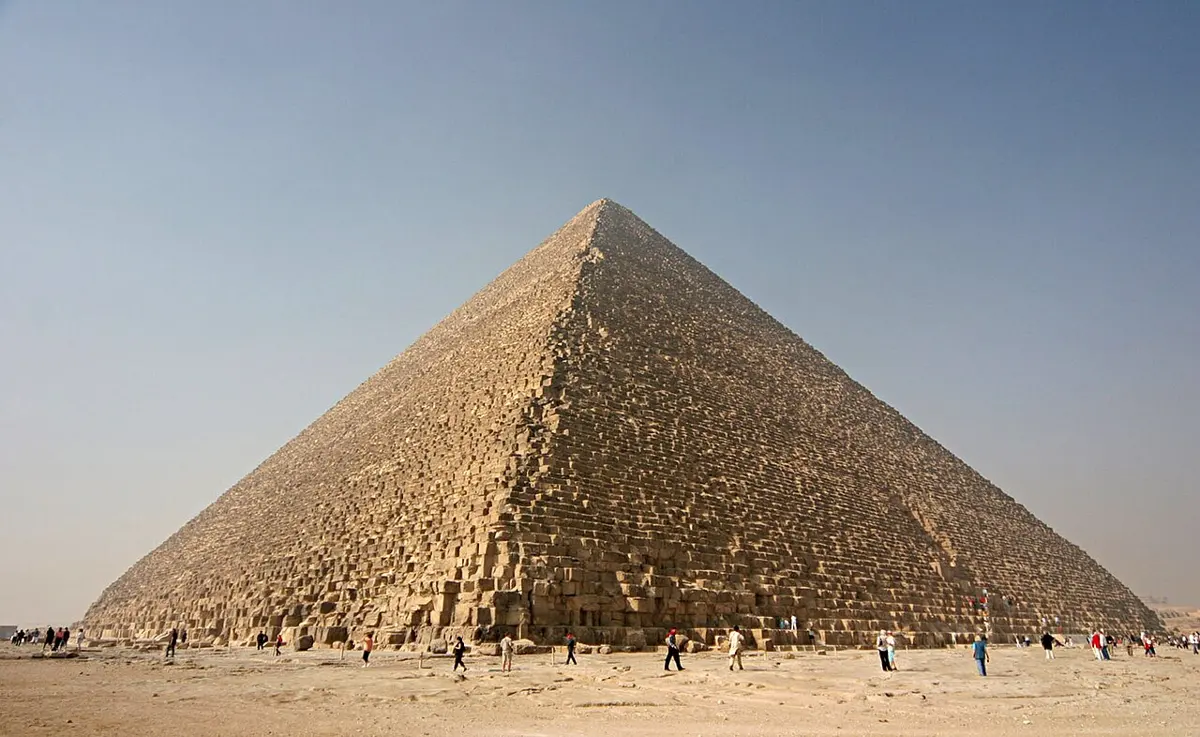
- The Great Pyramid of Giza: built about 2600 BC; base 230.33 m, original height 146.6 m; volume about 2.6 million m³ including a hillock of rock; about 2.3 million blocks: Wikipedia, “Great Pyramid of Giza”, read October 2026.
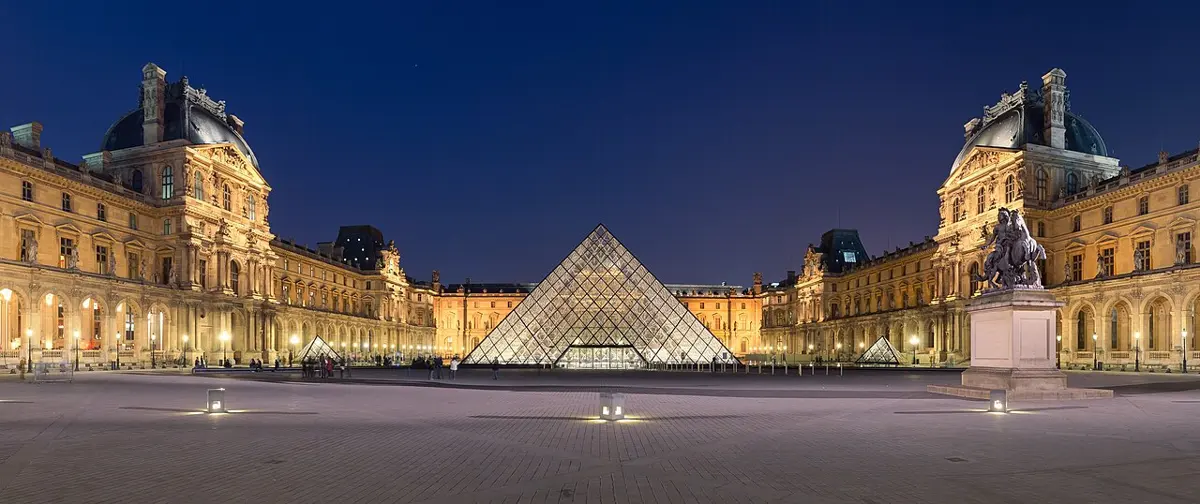
- The Louvre pyramid: 21.6 m high, base 34 m square, 603 rhombus-shaped and 70 triangular panes, completed 1989: Wikipedia, “Louvre Pyramid”, read October 2026.
- Democritus’s statement about the cone and pyramid, and Eudoxus’s proof as Archimedes credits it: Wikipedia, “Democritus” and “Eudoxus of Cnidus”, read October 2026.
- A poured heap forms a cone; angles of repose about 34° for dry sand and 45° for wet sand: Wikipedia, “Angle of repose”, read October 2026.
- The SEE’s Mensuration marks and the model questions: CDC, Specification Grid for Compulsory Mathematics, Grades 9–10 (2078), and its model question paper.
A companion to your textbook, not a replacement for it: study from the book your school uses, and where the two differ, follow your teacher. Found a mistake? Please tell us.