
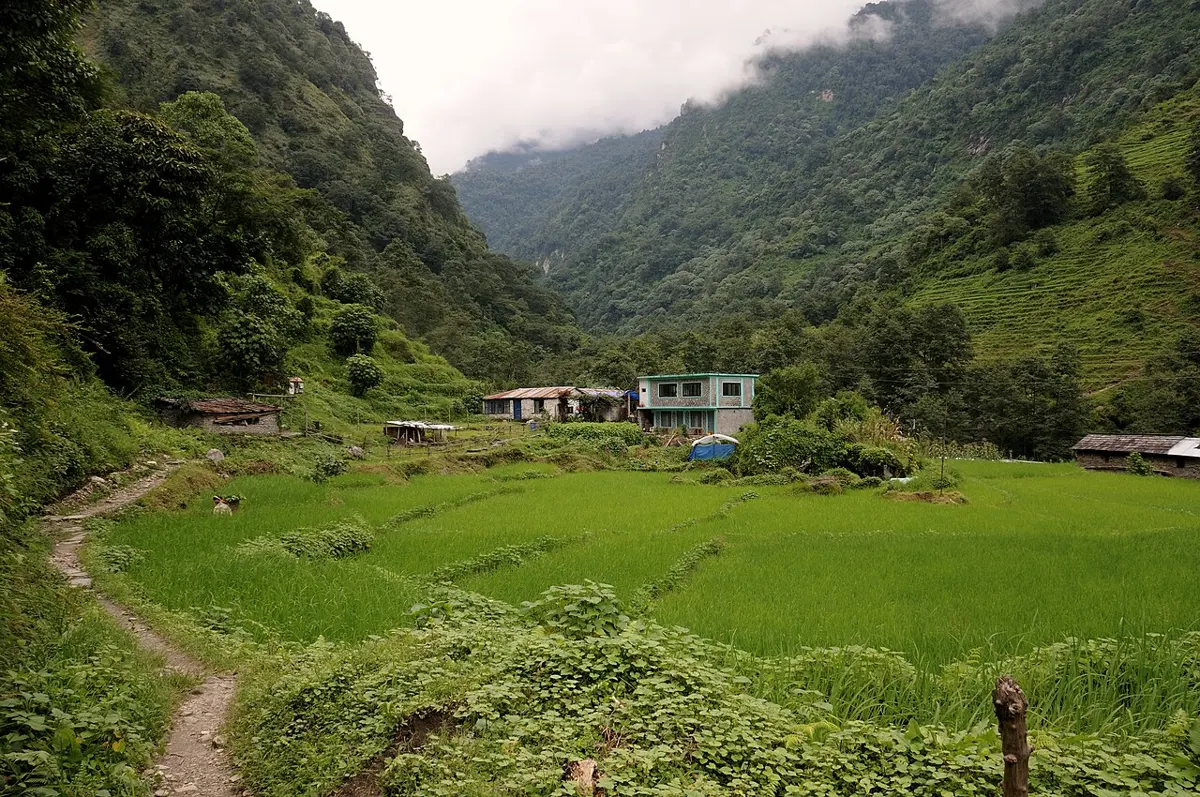
An amin from the Survey Department measures plot no. 559 with a tape. It has three straight sides, 13.5 m, 16 m and 11.5 m, and no square corner anywhere. Its owner wants to know how big it is in aana, the unit written on her land certificate. You know that a triangle’s area is half its base times its height. But the height of a plot is a line from a corner that meets the opposite side at a right angle, somewhere in the middle of a field, and nobody can find that spot with a tape. Can the area be found from the three sides alone?
It can, and in this unit you will learn how: with a formula found in Alexandria two thousand years ago. Then you will use areas to price a room’s paint and carpet, and change square meters into ropani, aana, bigha and kattha. In 5.4 we come back to plot no. 559 and find its area.
Sources: CDC’s Mathematics, Grade 9, and the land units of Nepal’s Survey Department; every area in this unit is worked out here.
5.0 Review
You have met triangles named in two ways.
- By their sides: an equilateral triangle has all three sides equal, an isosceles triangle two sides equal, and a scalene triangle no two sides equal.
- By their angles: acute-angled (every angle less than 90°), right-angled (one angle 90°) and obtuse-angled (one angle more than 90°).
And you know the area of any triangle:
where the height is the perpendicular from the opposite corner to the base.
5.1 Area of scalene triangle
On paper, finding a height is easy: draw a perpendicular with a set square and measure it. On land it is not. A field is too big for a set square, the foot of the height may fall in the middle of a crop, and on a slope it is hard to keep a tape level and straight. The three sides, though, can always be measured: walk along each with a tape. So surveyors want the area from the three sides alone.
Finding the height from the sides
Let ABC be a triangle with BC = a, CA = b and AB = c. Draw the height , and call AD = h and DC = x; then BD = a − x.
The perimeter is a + b + c, and half of it is the semi-perimeter:
The height makes two right-angled triangles, and Pythagoras’ theorem works in each.
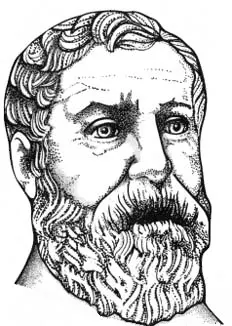
Three lengths make a triangle only when each is shorter than the other two put together; then s − a, s − b and s − c are all positive. If one side equals the other two together, the triangle is flat and Heron’s formula gives 0.
A triangle has sides 7 cm, 8 cm and 9 cm. What is s?
Pick an answer to see why.
Exercise 5.1
Question 1
Answer these questions.
What is a scalene triangle?
Answer
The sides of a triangle are p cm, q cm and r cm. What is its perimeter?
Answer
Write Heron’s formula for the area of a triangle.
Answer
Question 2
Find the area of each triangle.
Answer
Answer
Answer
Answer
Question 3
Find the area of each quadrilateral.
Answer
Answer
Question 4
The sides of a triangular field are in the ratio 3 : 5 : 7, and its perimeter is 300 m. Find its area.
Answer
Question 5
The sides of a triangular field are in the ratio 12 : 17 : 25, and its perimeter is 540 ft. Find its area.
Answer
Question 6
The sides of a triangular garden are in the ratio , and its perimeter is 62 m. Find its area.
Hint
Answer
Question 7
A triangular field has perimeter 20 m and area m², and one side is 9 m. Find the other two sides.
Answer
Question 8
A “school ahead” traffic sign is an equilateral triangle with sides a cm. Its perimeter is 360 cm. Find its area with Heron’s formula.
Answer
Question 9
The scale drawing shows a four-sided piece of land to be divided between two brothers along the diagonal AC: the elder gets △ABC and the younger △ACD. Whose land is bigger, and by how much? What was the area before it was divided?
Hint
Answer
Question 10
A garden ABCD has , AB = 9 m, BC = 12 m, CD = 5 m and AD = 8 m. Find its area.
Answer
Question 11
A triangle and a parallelogram on the same base have equal areas. The triangle’s sides are 26 cm, 28 cm and 30 cm, and the parallelogram’s base is 28 cm. Find the parallelogram’s height.
Answer
5.2 Area of four walls, floor and ceiling
A room is a box: a cuboid. Painters, tilers and carpenters price their work by the area of its flat surfaces, so this is where areas earn money.
The formulas
The four walls are lh + bh + lh + bh = 2lh + 2bh, so
Notice that 2(l + b) is the perimeter of the floor. So the walls’ area is the floor’s perimeter times the height, whatever the room’s length and breadth.
For a cube with edge l (since l = b = h):
and with windows of area a₁ and doors of area a₂, all six without them .
A room is 5 m long, 4 m wide and 3 m high. What is the area of its four walls?
Pick an answer to see why.
Exercise 5.2
Question 1
Answer these questions.
How are the areas of opposite walls of a rectangular room related?
Answer
In a cubical room, how are the four walls related to each other and to the floor?
Answer
Are the floor and ceiling of a rectangular room equal?
Answer
Which surfaces of a rectangular room are equal?
Answer
Question 2
Name the surfaces that are the floor, the four walls and the ceiling in each model.
Answer
Answer
Question 3
A room is 8 m long, 5 m wide and 2.5 m high. Find a. the area of its four walls, b. the area of its floor and ceiling.
Answer
Question 4
A room is 8.5 m long, 6 m wide and 2.4 m high. Find:
the area of the floor.
Answer
the area of the ceiling.
Answer
the area of the two walls along its length.
Answer
the area of the two walls along its breadth.
Answer
the area of the four walls.
Answer
the area of the four walls, floor and ceiling.
Answer
Question 5
The four walls of a meeting hall have an area of 135 m². The hall is 15 m long and 12 m wide. Find its height.
Answer
Question 6
The four walls of a room have an area of 432 ft². The room is 14 ft wide and 9 ft high. Find its length.
Answer
Question 7
The perimeter of Ishan’s bedroom floor is 60 m, and its four walls have an area of 144 m². Find the room’s height.
Answer
Question 8
Sonam’s school has built a hall 30 m long, 25 m wide and 4 m high (inside). It has 5 windows of 2.5 m × 1.5 m and 2 doors of 5 m × 3 m.
Find the area of its floor and ceiling.
Answer
Find the area of its four walls without the doors and windows.
Answer
The ceiling is decorated with 3 patterns in every square meter. How many patterns are there in all?
Answer
Three national flags are painted for every 15 m² of the four walls, measured whole (doors and windows included). How many flags are painted?
Answer
Question 9
A classroom is 8 m long, 6 m wide and 3 m high, with 2 doors of 2 m × 1.5 m and 2 windows of 1.5 m × 1 m.
Find the area of its four walls without the doors and windows.
Answer
The students paste one sheet with a picture on every square meter of that wall. How many sheets do they paste?
Answer
Question 10
Sijan’s father has rented a dark room for photo shoots. It is a cube with sides 2.7 m, and has one door of 2 m × 1 m.
Find the area of its four walls without the door.
Answer
One photo frame is hung for every 4 m² of that wall. How many frames can be hung?
Answer
5.3 Problems related to cost estimation
A painter, a tiler or a carpet shop quotes a rate: so many rupees for each square meter (or square foot). The cost is then
and if the cost and rate are known, the area is .
Tiling a floor costs Rs 36,000 at Rs 1,200 a square meter. The room is 6 m long. How wide is it?
Pick an answer to see why.
Exercise 5.3
Question 1
Find the cost of laying carpet at Rs 130 a square foot in a room 12 ft long and 11 ft wide.
Answer
Question 2
A room is 15 ft long, 12 ft wide and 8 ft high inside. It has two windows of 6 ft × 4 ft 6 in and a door of 3 ft × 6 ft 6 in. Find the cost of painting the four walls (not the windows, the door or the ceiling) at Rs 125 a square foot.
Answer
Question 3
A square room has sides 15 ft and height 8 ft. Find the cost of plastering its floor, four walls and ceiling at Rs 120 a square foot.
Answer
Question 4
An assembly hall is 32 m long, 32 m wide and 4 m high. It has 6 windows of 2.5 m × 1.8 m and 2 doors of 4 m × 3 m.
Find the total area of its floor and ceiling.
Answer
Find the total area of its windows and doors.
Answer
Find the area of its four walls without the windows and doors.
Answer
One chair needs 2 m² of floor. How many such chairs fit in the hall?
Answer
Find the cost of plastering the four walls (without the openings) at Rs 350 a square meter.
Answer
Question 5
The floor of the largest room in Simran’s house is 500 ft². It is 25 ft long and 9 ft high, with three windows of 6 ft × 5 ft and a door of 3 ft × 6.5 ft. Find the cost of coloring its four walls, without the windows and door, at Rs 300 a square foot.
Answer
Question 6
A square room is 8 ft high. Carpeting it costs Rs 39,200 at Rs 200 a square foot. Find the cost of coloring its four walls at Rs 250 a square foot.
Answer
Question 7
A school pays Rs 7,056 to carpet a square room for its teachers and staff at Rs 144 a square meter. Pasting paper on the four walls, without the windows and doors, at Rs 400 a square meter costs Rs 30,000. The windows and doors have a total area of 9 m². Find the room’s height.
Answer
Question 8
A room in Nima’s house is twice as long as it is wide and 2.8 m high. Painting pictures on its four walls, without the windows and door, costs Rs 54,000 at Rs 900 a square meter, and the windows and door have an area of 7.2 m². Find the cost of tiling its floor at Rs 200 a square meter.
Answer
Question 9
A school hall is twice as long as it is wide, and twice as wide as it is high. Coloring its four walls, windows and doors included, costs Rs 43,200 at Rs 225 a square meter. Find the cost of tiling its floor at Rs 250 a square meter.
Answer
Question 10
A park laid out by a municipality is 50 m × 40 m. It is to be covered with square pieces of dubo turf (dubo grass cut with its soil), each 20 cm by 20 cm.
How many pieces of turf are needed?
Answer
Laying one piece costs Rs 225. Find the total cost.
Answer
Some years later the park is made 15 m longer and 10 m wider. How many more pieces are needed for the new part, and what do they cost at the same rate?
Answer
5.4 Area of triangular and quadrilateral shaped land
When land is bought, sold, divided between brothers and sisters, or taxed, its area must be measured and recorded. In Nepal this is the work of the Survey Department, set up in Jestha 2014 BS (1957 AD). Its cadastral survey (kitta napi) measures every plot and gives it a number on a map sheet; it also runs the geodetic survey, which fixes exact points across the country, and the topographic survey, which maps the land’s shape for the country’s maps.
Here are three people and their land. Discuss how land is measured where you live.
- Durga Kumari lives in a hill district. She has 3 ropani of farmland, 1 ropani of dry hillside field (pakho bari), a house on 8 aana 3 paisa of land, and a triangular plot of 4 aana beside the main road.
- Ravilal lives in the Terai. He has 3 bigha of farmland, 1 bigha 3 kattha of bari, a house on 1 kattha 2 dhur, and a four-sided plot of 4 kattha beside the main road.
- Bhim Bahadur is an amin, a land surveyor. He follows the Survey Department’s rules: a four-sided plot is cut into two triangles by a diagonal, each triangle’s area is found from its sides, and the two are added.
Units of land in Nepal
Square feet and square meters are used everywhere in the world. But Nepal also keeps its own units:
- in the hills (and the mountains and Kathmandu Valley): ropani, aana, paisa, daam;
- in the Terai: bigha, kattha, dhur.
Changing between units
To change an area into hill units, divide by one ropani (5,476 ft² or 508.72 m²); the whole number is the ropani. Multiply what is left by 16: the whole number is the aana. Multiply what is left by 4: the paisa. Multiply what is left by 4: the daam, kept with its decimal. The answer is written R-A-P-D, for example 0-4-2-0.93.
For the Terai, divide by one bigha (72,900 ft² or 6,772.63 m²), then multiply what is left by 20 for kattha, and by 20 again for dhur. The answer is written B-K-D.
To go from hill units to Terai units or back, go through square feet: those values are exact.
A land ownership certificate, the Lalpurja, gives each plot’s number, its map sheet, and its area in the local units and in square meters. In the Terai the area has four places, B-K-D and a fourth for the kanwa, a still smaller unit; in the examples here it is 0.
Area of triangular and quadrilateral land
Blueprint maps of land are drawn to a scale, such as 1 : 500 (1 cm on the map is 500 cm, or 5 m, on the ground). But for the area, an amin uses the sides measured on the ground.
A plot is 0-8-0-0 in R-A-P-D. What is that in ropani?
Pick an answer to see why.
Exercise 5.4
Question 1
Answer from the conversion table.
How is land measured in the mountains and hills of Nepal?
Answer
Which units are used where you live?
Answer
How many square feet are in one ropani?
Answer
How many aana are in one ropani, and how many square feet in one aana?
Answer
How many square meters are in one bigha?
Answer
How many kattha are in one bigha, and how many square feet in one kattha?
Answer
Which is bigger, an aana or a kattha?
Answer
A rectangular plot 37 ft wide has an area of one ropani. How long is it?
Answer
A landowner in the Terai has 10 bigha. How many ropani is that?
Answer
Question 2
Change into square feet.
2 kattha
Answer
4 aana
Answer
8 dhur
Answer
5 aana
Answer
6 aana 3 paisa
Answer
4 kattha 10 dhur
Answer
Question 3
Change into square meters.
2 ropani
Answer
1 bigha
Answer
16 dhur
Answer
3 kattha
Answer
5 kattha 10 dhur
Answer
Question 4
Change into aana (through square feet).
16 dhur
Answer
4 kattha
Answer
3 kattha 2 dhur
Answer
6 kattha 10 dhur
Answer
2 ropani
Answer
1 bigha
Answer
Question 5
Change into dhur.
3 aana
Answer
6 aana 3 paisa
Answer
16 kattha 5 dhur
Answer
1 bigha 4 kattha
Answer
2 bigha
Answer
Question 6
Aitaman has a plot of one ropani facing a road 20 ft wide; its side along the road is 148 ft. He divides it into four plots of equal area, each with its own side on the road. What is the area of each plot, and its length and breadth?
Answer
Question 7
Write each area a. in R-A-P-D, b. in B-K-D.
3,056 ft²
Answer
1,426.85 m²
Answer
5,026.80 ft²
Answer
2,167.24 m²
Answer
80,736.75 ft²
Answer
Question 8
A Lalpurja gives a plot’s area as 0-5-3-0 (B-K-D-kanwa) and 1,743.70 m². Check it with the conversion table.
Answer
Question 9
A Lalpurja gives a plot’s area only in square meters: 677.26 m². Write it:
in R-A-P-D.
Answer
in B-K-D.
Answer
in square feet.
Answer
Question 10
A piece of land has been cut into plots, each marked on its map with its area in R-A-P-D. Some of them are:
| Plot no. | 1 | 2 | 4 | 6 | 8 | 9 | 18 | 20 | 22 |
|---|---|---|---|---|---|---|---|---|---|
| R-A-P-D | 0-3-2-3 | 0-4-0-2 | 0-4-2-0 | 0-4-0-0 | 0-3-1-0 | 0-5-1-3 | 0-3-2-2 | 0-4-0-0 | 0-7-0-0 |
Change the areas of plots 1, 2, 6, 8 and 9 into square meters.
Answer
Change the areas of plots 4, 18, 20 and 22 into square feet.
Answer
Change the areas of plots 9 and 22 into B-K-D.
Answer
Question 11
Find the area of each plot a. in R-A-P-D, b. in B-K-D.
Answer
Answer
Answer
Answer
Answer
Question 12
A triangular plot has a perimeter of 160 ft, and its sides are in the ratio 5 : 7 : 8. Find its area in dhur.
Answer
Practice every question in the book, and keep track of the ones you miss →
How the exam asks it
Grade 9’s final exam is set to CDC’s specification grid for Compulsory Mathematics, Grades 9–10. There, Mensuration is 13 marks in three questions; the grid’s model area question for Grade 9 is 5 marks on one room:
| Part | Level | Marks | What it asks |
|---|---|---|---|
| a. | knowledge | 1 | the formula for the four walls |
| b. | understanding | 1 | the height (or a side) from the walls’ area |
| c. | application | 2 | the cost of painting without the door and windows |
| d. | higher ability | 1 | painting against wallpaper: which costs less, by how much |
Here is one in that shape, with how it is marked.
Where these facts come from
- Heron’s formula and its history (5.1, the story): Wikipedia, “Heron’s formula” (Heron’s Metrica, Archimedes, Qin Jiushao’s 1247 formula, Brahmagupta’s formula), and “Hero of Alexandria”, read November 2026.
- Land units (5.4): Wikipedia, “Nepalese units of measurement” (the ropani of 74 × 74 ft, 5,476 ft² = 508.737 m²; aana, paisa, daam; bigha, kattha, dhur), read November 2026; the conversion table from CDC’s Mathematics, Grade 9, checked here against the square feet, with 1 ft = 0.3048 m exactly.
- The Survey Department (5.4): the Nepalese Journal on Geoinformatics, Survey Department, on its founding in Jestha 2014 BS, and its report to the UN-GGIM (2012) on the cadastral, geodetic and topographic surveys.
- NaaPI (5.4, the fact box): its Android app listing (M&S Developers), read November 2026.
- The photos: Wikimedia Commons, credited under each picture.
- The exam’s area question (For the exam, How the exam asks it): CDC, Specification Grid, Compulsory Mathematics, Grades 9–10, and its model questions (the four walls question: K1, U1, A2, HA1); our question is our own.
A companion to your textbook, not a replacement for it: study from the book your school uses, and where the two differ, follow your teacher. Found a mistake? Please tell us.