
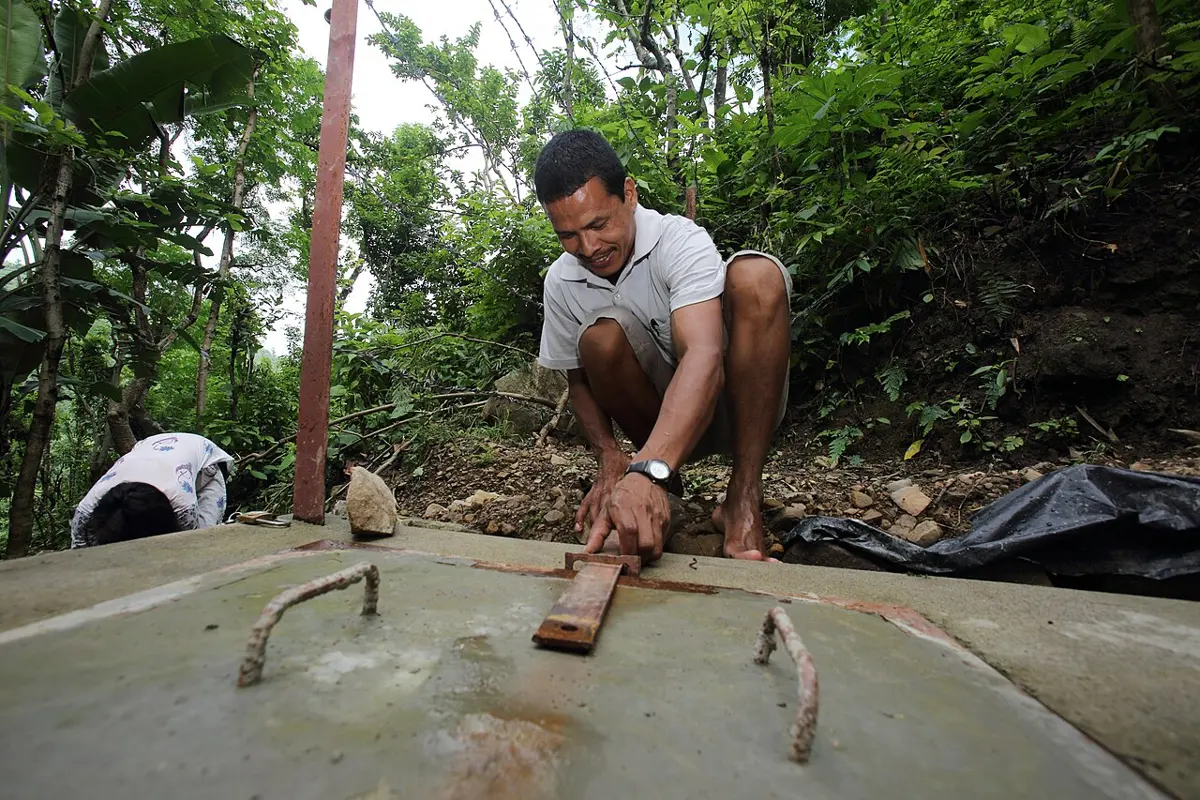
A ward office is building a covered concrete tank to hold 8,000 liters of drinking water, 8 m³. The mason has two plans. One is long and shallow: 4 m long, 2 m wide and 1 m deep. The other is a cube: 2 m every way. Both hold exactly the same water. But the walls, floor and lid have to be built, plastered and paid for, and the two plans don’t need the same amount. Which one needs less, and by how much?
A water tank, a matchbox, a tent and a pencil are all prisms. In this unit you will learn to find a prism’s cross-section, its side faces, its whole surface and the space inside it. Then, in Back to the tank, you will answer the mason’s question, and see why the answer is no accident.
Sources: CDC’s Mathematics, Grade 9; every number in this unit is worked out here.
6.0 Review
Keep the pile in mind. Every idea in this unit comes from it: the same flat shape, piled straight up.
6.1 Introduction to prism
A prism is a solid with two opposite faces that are congruent, parallel polygons, joined by flat side faces. Take any polygon, slide it straight out without turning it, and the space it sweeps through is a prism. The two polygons are its bases (or ends), and a prism is named after them:
- triangle at each end: a triangular prism, like a tent or a box of chocolate bars;
- rectangle: a rectangular prism, a cuboid, like a brick, a matchbox or a room;
- square: a square prism, and if every edge is equal, a cube;
- six sides: a hexagonal prism, like most pencils.
Every side face of a prism is a parallelogram, and in the prisms of this unit, a rectangle.
Which of these is a prism?
Pick an answer to see why.
A prism has a 7-sided polygon at each end. How many vertices does it have?
Pick an answer to see why.
Count the faces F, vertices V and edges E of any prism, and F + V − E = 2 every time: a cuboid has 6 + 8 − 12 = 2, a triangular prism 5 + 6 − 9 = 2. A prism with an n-sided end has n + 2 faces, 2n vertices and 3n edges, and (n + 2) + 2n − 3n = 2. The great Swiss mathematician Leonhard Euler noticed in 1750 that this works for every solid with flat faces and no holes, pyramids too: try it on the table above.
6.2 Cross-section area of prism
A cut through a prism parallel to its ends is a cross-section, and it is always congruent to the ends. That is the whole point of a prism: the same shape, all the way along. So the cross-sectional area of a prism is just the area of one end, its base area A.
Characteristics of a prism
- a.It has two parallel, congruent opposite polygons, its bases. A prism whose base is a triangle is a triangular prism; one whose base is a rectangle is a rectangular prism.
- b.A face cut parallel to the base is a cross-section, and it is congruent to the base.
- c.In a right prism, every side face stands at right angles to the bases. If the far end is pushed sideways, the side faces lean over and the prism is oblique. In this class we work with right prisms only.
- d.The faces other than the two bases are the lateral faces, and together their areas make the lateral surface area.
- e.The perpendicular distance between the two bases is the prism’s height, also called its length when the prism lies on its side.
- f.The volume of a prism is its base area times its height: V = A × h.
A right prism is the kind you meet every day: a box, a brick, a tank. An oblique prism is like a stack of exercise books given a push from one side. The pile leans, but each book is still the same book, so the pile holds the same paper; its volume is still base area × height, if the height is measured straight up between the ends. Its side faces are now parallelograms, though, which is why we keep to right prisms here.
Areas of the bases
To find a prism’s cross-section, find the area of its base polygon. These are the shapes you will meet most often, with the formulas you know from Grade 8 and from Unit 5.
| Base | Area A |
|---|---|
| a.equilateral triangle, side a | |
| b.isosceles triangle, equal sides a, third side b | |
| c.scalene triangle, sides a, b, c | , |
| d.right-angled triangle, perpendicular p, base b | |
| e.right-angled isosceles triangle, equal sides p | |
| f.rectangle, length l, breadth b | l × b |
| g.square, side l |
The first two aren’t new formulas: both are , with the height found by Pythagoras’ theorem.
A triangular prism 20 cm long is cut across, parallel to its ends, 5 cm from one end and again 15 cm from it. How do the two cut faces compare?
Pick an answer to see why.
6.3 Lateral surface area of prism
2(l + b) is the perimeter P of the base ABCD. So the four side faces together are the perimeter of the base times the height. They are the box’s lateral surface, all its faces except the two bases (the walls of a room, in Unit 5).
This isn’t special to boxes. Every lateral face of a right prism is a rectangle: one side of the base for its width, the prism’s height h for its height. Stand them side by side and they make one long rectangle, as wide as all the base’s sides put together, which is the perimeter, and h high.
A prism’s end is a triangle with sides 5 cm, 6 cm and 7 cm, and the prism is 10 cm long. What is its lateral surface area?
Pick an answer to see why.
6.4 Total surface area of prism
The total surface area of a prism is the area of all its faces: the two bases and the lateral surface. That is the cardboard in a box, the metal in a tin, the plaster on a tank.
For a cuboid, A = lb and P = 2(l + b), so
and for a cube with edge l, each face is , so TSA .
Two cuboids: one is 4 cm × 4 cm × 4 cm, the other 8 cm × 4 cm × 2 cm. Both hold 64 cm³. Which has the smaller total surface?
Pick an answer to see why.
6.5 Volume of prism
The layers don’t have to be square-shaped. Any prism is a pile of identical slices, each a copy of the base; a slice 1 cm thick holds A cm³, and h cm of them hold A × h.
Capacity and liters. The capacity of a tank, box or bottle is how much it can hold: the volume of the space inside it. A liquid’s volume, and so a tank’s capacity, is usually given in liters:
A cube 10 cm on each side holds exactly 1 liter, and a cube 1 m on each side holds 1000 liters, the size of the big plastic tanks on Nepal’s roofs.
Back to the tank
The ward’s tank must hold 8 m³, and it has a lid. Both plans hold 8 m³, so the question is only about the surface, 2(lb + bh + hl):
- long and shallow, 4 m × 2 m × 1 m: 2(8 + 2 + 4) = 28 m²;
- the cube, 2 m × 2 m × 2 m: 6 × 4 = 24 m².
The cube needs 4 m² less to build and plaster, about 14% less, for exactly the same water. That is not luck. Play with the tank below, and see if you can beat the cube.
For a closed box that must hold a given volume, the cube has the least surface; the further the box is from a cube, long, flat or tall, the more material it takes. That is why water tanks, grain bins and shipping boxes are often close to cubes, unless something else matters more (a tank on a roof must be low; a box must fit a shelf).
Exercise 6.1
Question 1
What is the volume of a prism whose cross-sectional area is 35 cm² and height 10 cm?
Answer
Question 2
Find the lateral surface area of a prism whose base has a perimeter of 36 cm and whose height is 8 cm.
Answer
Question 3
Find the total surface area of a prism whose cross-sectional area is 40 cm² and lateral surface area 175 cm².
Answer
Question 4
Find the cross-sectional area, lateral surface area, total surface area and volume of each prism.
Answer
Answer
Answer
Answer
Answer
Answer
Question 5
A cuboid is 6 cm long, 5 cm wide and 8 cm high.
Find its cross-sectional area.
Answer
Find its lateral surface area.
Answer
Find its volume.
Answer
Question 6
A rectangular tank is 2 m long, 1.5 m wide and 1 m high. Find its capacity in liters.
Answer
Question 7
A wooden cube with edges 20 cm is cut into 8 equal cubes. Find the edge of each small cube.
Answer
Question 8
Find the cross-sectional area, lateral surface area, total surface area and volume of each prism.
Answer
Answer
Answer
Answer
Question 9
The volume of a prism whose ends are right-angled triangles is 864 cm³. The two sides of the triangle that make the right angle are 8 cm and 9 cm. Find the height of the prism.
Answer
Question 10
A prism 30 cm high has right-angled triangles for its ends, with base 4 cm and perpendicular 3 cm. Find the areas of its rectangular faces.
Answer
Question 11
The total surface area of a triangular prism is 660 cm², and its base is a right-angled triangle with base 12 cm and hypotenuse 13 cm. Find the prism’s length.
Answer
Question 12
The volume of a triangular prism is 480 cm³. It is l cm long, and the sides of its ends are 4 cm, 13 cm and 15 cm.
Find its length l.
Answer
Find the areas of its rectangular faces.
Answer
Find its total surface area.
Answer
Question 13
The lateral surface area of a triangular prism is 2160 cm². The perimeter of its base is 54 cm and its cross-sectional area 126 cm².
Find the height of the prism.
Answer
Find its volume.
Answer
Question 14
Santaman plans to make a bin of corrugated metal sheet to store rice, in one of the two shapes below, each with a lid. Which holds more rice? Which needs less sheet, and how much less?
Answer
Question 15
A school needs a tent of the shape below for its mathematics exhibition hall. It will be carpeted, and one end (across the breadth) will be left fully open as the entrance.
How much cloth is needed to make the tent?
Answer
What area of carpet is needed?
Answer
Each exhibition cabin takes 7 m² of floor. How many cabins fit in the hall?
Answer
Question 16
A village will build a reserve tank for drinking water, to one of the two designs below, each closed with a lid. Which design is better, judged by how much it holds and how much material it needs?
Answer
Practice every question in the book, and keep track of the ones you miss →
How the exam asks it
Grade 9’s final exam is set to CDC’s specification grid for Compulsory Mathematics, Grades 9–10. There, Mensuration is 13 marks in three questions; the grid’s model prism question is 4 marks on a tent:
| Part | Level | Marks | What it asks |
|---|---|---|---|
| a. | understanding | 2 | the area of the tent’s triangular ends |
| b. | higher ability | 2 | the length of a tent made from a given amount of cloth, with the same ends, and how much longer or shorter it is |
Here is one in that shape, with how it is marked.
Where these facts come from
- The Giant’s Causeway (6.1, the fact box): Wikipedia, “Giant’s Causeway” (about 40,000 interlocking basalt columns, from lava about 50–60 million years ago), read November 2026.
- Euler’s formula (6.1): Wikipedia, “Euler characteristic” (Euler’s 1750 letter to Goldbach), read November 2026.
- The liter (6.5, the fact box): Wikipedia, “Litre” (defined as one cubic decimeter since 1964; from 1901 the volume of 1 kg of water, 1.000028 dm³), read November 2026.
- The honeycomb (Back to the tank, the story): Wikipedia, “Honeycomb conjecture” (Varro, about 36 BC; proved by Thomas Hales in 1999), read November 2026.
- The photos: Wikimedia Commons, credited under each picture.
- The exam’s prism question (For the exam, How the exam asks it): CDC, Specification Grid, Compulsory Mathematics, Grades 9–10, and its model questions (the triangular tent question: U2, HA2); our question is our own.
A companion to your textbook, not a replacement for it: study from the book your school uses, and where the two differ, follow your teacher. Found a mistake? Please tell us.