
Lunch is over, and a pot of cooked rice sits on the kitchen shelf. Two hours later it looks exactly the same. Is it the same?
In warm food, bacteria can double in number in as little as 20 minutes. So if a single bacterium lands in the pot, how many can there be after two hours? After ten hours?
You could keep doubling on paper, but the numbers soon get too long. Indices write that growth in two small symbols, and their laws let you work with numbers you could never write out. By Back to the rice pot you will answer both questions in a few lines, and see why food safety rules say “two hours”.
9.0 Review
Many bacteria multiply by splitting in two. Suppose the number of bacteria doubles every twenty minutes, and there is one to begin with. What will the number be after one hundred twenty minutes? Discuss it in your group, then try it here.
Here is the same growth as a table.
| Time | Doublings | Number of bacteria |
|---|---|---|
| At the beginning | 0 | 1 |
| After 20 minutes | 1 | |
| After 40 minutes | 2 | |
| After 60 minutes | 3 | |
| After 80 minutes | 4 | |
| After 100 minutes | 5 | |
| After 120 minutes | 6 |
The product of a number with itself, a given number of times, can be written with an index. In , a is called the base and n is called the index. The whole thing is a power, and is read “2 to the power 6”. Another word for an index is exponent.
What it means: an index is a count. In the table, it counts the doublings. So 6 doublings is written with one small 6, and 60 doublings would need just one more digit.
What does mean?
Pick an answer to see why.
9.1 Laws of Indices
The laws of indices are shortcuts for counting. None of them needs memorizing as a bare rule, because each one comes from writing the powers out in full.
The widget does the same counting with tiles. It writes a where we have written x: the letter doesn’t matter.
a. Multiplying powers of the same base
In general, m of them and then n more make m + n:
When powers of the same base are multiplied, the base stays the same and the indices are added.
What it means: in the review, 2 hours of doubling is and 1 more hour is . Both together make 9 doublings, and . The times add, so the indices add.
What is ?
Pick an answer to see why.
b. Dividing powers of the same base
Each x below cancels one x above, so:
When powers of the same base are divided, the base stays the same, and the index of the denominator is subtracted from the index of the numerator.
What it means: after 3 hours there are bacteria, and after 1 hour . How many times as many is that? times. That is just the 6 doublings in the 2 hours between.
What is ?
Pick an answer to see why.
c. Zero index
What is ? Any number except 0, divided by itself, is 1. The law says . Both answers must be the same thing. In general, for x ≠ 0:
Any number except zero, with the index zero, has the value 1.
What it means: an index counts multiplications. means no doubling has happened yet, so the one bacterium you started with is still one. The number stays as it was, and “stays as it was” is multiplying by 1.
d. Power of a product or a quotient
The order of multiplying doesn’t matter, so the x’s can be gathered together, and the y’s too.
A quotient works the same way:
So:
If the base is a product or a quotient of two numbers, the index goes to each number of the base.
What it means: make the side of a square twice as long, and you get four squares of the old size, not two. The 2 inside the bracket is squared too: . The same is why a map at twice the scale needs four times the paper.
So , and not . A number inside the bracket takes the index as well.
What is ?
Pick an answer to see why.
e. Negative index
For x ≠ 0, we know that . Divide both sides by :
Turning this over, an index in the denominator can move up in the same way:
A negative index in the numerator can be moved to the denominator, where the index becomes positive. A negative index in the denominator can be moved to the numerator in the same way.
You can also see this by going down the powers of 2. Each step down halves the number, and there is no reason to stop at 1.
What it means: an index counts doublings forward, so a negative index counts them backward. If there are 64 bacteria now, then 20 minutes ago there were . You have already used this in scientific notation: .
What is ?
Pick an answer to see why.
f. Power of a power
Another way to see it uses law a. is n copies of , so its index is m added n times:
When a power is raised to another index, the two indices are multiplied on the same base.
What it means: 2 hours of doubling multiplies the number by . Three such stretches in a row multiply it by : 18 doublings in 6 hours.
Using the laws
Back to the rice pot
After 2 hours, one bacterium can have become 64. After 10 hours, it can have become more than 100 crore.
Two hours is 120 minutes, which is 6 doublings of 20 minutes: . Ten hours is 600 minutes, which is 30 doublings, and the power law makes short work of it:
The exact number is 1,07,37,41,824.
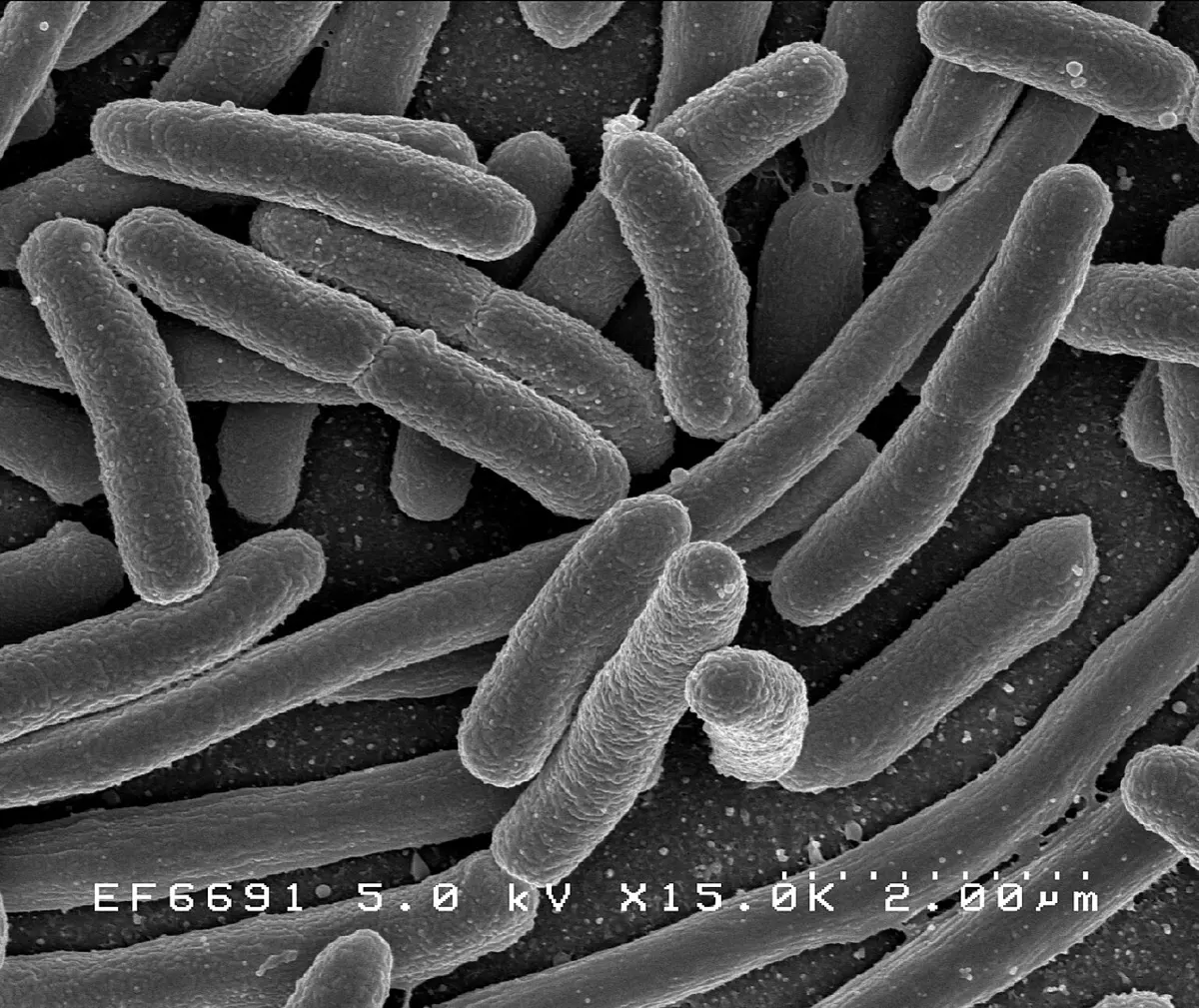
Food rarely starts with just one bacterium. If 1,000 land in the pot, two hours can turn them into 64,000. That is why food safety agencies give a time limit: the US Department of Agriculture says never to leave food out of the refrigerator for over 2 hours, or over 1 hour if the temperature is above 32 °C. Its reason is the number in this unit: bacteria “doubling in number in as little as 20 minutes” in warm food.
Now the nuance. “As little as 20 minutes” is a fast case, not a promise, and bacteria take time to settle in before they start to divide. The growth doesn’t go on for ever either: a real colony runs short of food and fills with its own waste, and then the number stops rising. The sum tells you how fast it can go, and that is what a safety rule has to allow for.
Where this is used
- Food safety: the 2-hour rule above comes from how fast bacteria double.
- Computers: you met binary numbers in Unit 2. A byte is 8 bits, and each bit can be 0 or 1, so one byte has possible values. A typical phone screen mixes red, green and blue with one byte each, which gives colors. There’s the power law at work.
- Earthquakes: each whole number up the magnitude scale means 10 times the measured shaking on a seismograph and about 32 times the energy, according to the US Geological Survey. So two steps up is , or about 1,000 times the energy.
- Science: very large and very small numbers are written as powers of 10, and scientists multiply them by adding the indices, as in Unit 3.
How the exam asks it
Grade 8’s final exam follows CDC’s specification grid for Mathematics, Grades 6–8. There, Algebra is 10 marks in three questions, shared by Indices, Algebraic Expression, Algebraic Fraction and Equation and Graph. The grid’s Grade 8 model paper uses this unit in question 6:
| Part | Level | Marks | What it asks |
|---|---|---|---|
| a. | knowledge | 1 | express as a power of x |
The answer is . The grid also says that a paper’s questions should cover all the topics of each area in proportion, so a real paper may word it differently or ask a little more. Here are some of our own in that shape.
Express as a power of y. [1]
Answer
Simplify: [2]
Answer
Exercise 9
Question 1
Simplify using the laws of indices.
Answer
Answer
Answer
Answer
Answer
Answer
Answer
Question 2
Simplify using the laws of indices.
Answer
Answer
Answer
Answer
Answer
Answer
Question 3
Simplify using the laws of indices.
Answer
Answer
Answer
Answer
Answer
Answer
Answer
Answer
Question 4
Simplify using the laws of indices.
Hint
Answer
Hint
Answer
Hint
Answer
Question 5
Fill the box with the right number.
Answer
Answer
Answer
Question 6
Prove that:
Answer
Answer
The textbook prints the middle bracket’s outer index as b − c, but that doesn’t work: with x = 2, a = 3, b = 2, c = 1 the left side comes to . So the book’s numbers don’t work, and the pattern of the other two brackets gives b + c, which we use here.
Hint
Answer
Question 7
If a = 2, b = 3, c = 1, m = 4 and n = 5, find the value of:
Answer
Answer
Printable PDFs
- Study notes 2 pages
- Harder practice questions 2 pages Answer key
Practice every question in the book, and keep track of the ones you miss →
Where these facts come from
- The exam (For the exam, How the exam asks it): CDC, विशिष्टीकरण तालिका (कक्षा ६-८) गणित – नमुना प्रश्नहरु (Algebra 10 marks in three questions; Grade 8 model question 6a, 1 mark, knowledge, read on the PDF page; the note that a paper covers each area’s topics in proportion); our questions are our own.
- The common mistakes (careful boxes, Where marks are lost) and the question of 0 ÷ 0: CDC, शिक्षक निर्देशिका कक्षा ८ गणित (२०८१), the lesson on indices.
- Bacteria in food (opening, Back to the rice pot): US Department of Agriculture, Food Safety and Inspection Service, “‘Danger Zone’ (40 °F – 140 °F)” (doubling in as little as 20 minutes; never over 2 hours, 1 hour above 90 °F), read in the Internet Archive’s copy, November 2026.
- Growth slowing down (Back to the rice pot): Wikipedia, “Bacterial growth” (lag, exponential and stationary phases), read November 2026.
- The size of E. coli (photo in Back to the rice pot): Wikipedia, “Escherichia coli” (rods about 2.0 μm long), read November 2026.
- Archimedes (story in 9.1): Wikipedia, “The Sand Reckoner” (3rd century BC, the myriad, the law of exponents, grains), read November 2026.
- The chessboard (story in 9.1): Wikipedia, “Wheat and chessboard problem” ( grains, 1256, Ibn Khallikan, over 1,400 times the world’s wheat), read November 2026.
- Computers (Where this is used): Wikipedia, “Byte” (8 bits, ) and “Color depth” (24-bit true color, 16,777,216 colors), read November 2026.
- Earthquakes (Where this is used): US Geological Survey, “Earthquake Magnitude, Energy Release, and Shaking Intensity”, read November 2026.
- WhatsApp (the project): WhatsApp Blog, “More changes to forwarding” (the update limiting forwarding to five chats at once), and Wikipedia, “WhatsApp” (the limits as a response to misinformation), read November 2026.
- Every answer: worked out here and checked by a computer algebra program (SymPy).
A companion to your textbook, not a replacement for it: study from the book your school uses, and where the two differ, follow your teacher. Found a mistake? Please tell us.