
A job that needs filling, a birthday next Sunday, a boy’s Bratabandha, a father starting a farm: each of them begins with a few careful lines that ask someone to come. Some of those lines are stiff and formal, and some are as easy as talking to a friend. Knowing which to use, and how to say no without hurting anyone, is one of the most useful things you can do in English.
This unit is about invitations. You will read a vacancy announcement, which invites people to apply for a job, then a friendly invitation email and a formal invitation card. You will learn how to invite, accept and decline, how -tion and -sion sound, how to place things and times with prepositions, and how to get the harder question tags right (aren’t I? shall we? have they?). You will also find out what those four letters R.S.V.P. really mean.
Getting started: how would you invite them?
The unit opens with four pictures: two men in coats shaking hands; a smiling man pulling out an office chair and holding out his hand towards it; a man in an apron standing outside a restaurant and waving; and a bright card that says Happy Birthday.
Look at the pictures. How would you invite people in these situations?
Model answers
Look at how much the words change. To a business visitor you say I’d like to invite you; to a friend, Come to my party! An invitation has to fit the person and the occasion, and that is what this whole unit is about.
Reading I: Vacancy Announcement
Before you read
What is the given text about?
A model answer
Where do you find it?
A model answer
What kind of text it is
A vacancy is a job that nobody is doing yet, and a vacancy announcement (or job advertisement) tells the public about it. It is an invitation of a very serious kind: it asks suitable people to apply. So it is written in short, formal phrases, it is full of facts, and it doesn’t waste a word. You don’t read it from top to bottom like a story. You scan it for what you need: what the job is, whether you qualify, and how and when to apply.
The text, part by part
Who is hiring. The dark band at the top names the employer, the United Nations Entity for Gender Equality and the Empowerment of Women, or UN Women for short. The first sentence says what it stands for. Its idea of equality is enshrined (written down and protected, like something holy) in the Charter of the United Nations. It works to end discrimination against women and girls, to empower women, and to bring about equality between women and men, as partners and beneficiaries (people who get the good of something) in development, human rights, humanitarian work, and peace and security.
Whom it wants. The sentence in italics says UN Women Nepal wants applications from qualified Nepali citizens with commitment to women, a strong will to get results, honesty, and proven teamwork.
The two jobs. Each job then has the same set of headings, and that makes it easy to put them side by side.
| Job 1 | Job 2 | |
|---|---|---|
| Job title | ICT and Administrative Support | Driver |
| Duty station (where you work) | Kathmandu, Nepal | Kathmandu, Nepal |
| Contract type and level | General Staff (SB-3) | General Staff (SB-2) |
| Duration | 1 year, which may be extended | 1 year, which may be extended |
| Closing date | 21 November 2021, midnight, New York time | 21 November 2021, midnight, New York time |
| Education | secondary education completed | SLC/SEE completed |
| Must have | CCNE and MCSE or MCP certificates; at least 5 years’ experience with networks, hardware and software, and telecommunications; experience with computers and office software; fluency in English and Nepali | a valid driver’s license |
| Is an asset | a bachelor’s degree in Computer Science; experience of ATLAS (a computer system) | at least 3 years driving for an international organization, an embassy or the UN, with a safe record; fluency in English; knowing another UN working language |
| How to apply | online, at the address given | online, at the address given |
How to apply. Every application must come with UN Women’s Personal History Form (P11), which you download from its website. Applications are treated with the strictest confidence: nobody else gets to know who has applied.
Who may apply. The last lines make the job inclusive. UN Women wants a diverse workforce, whatever a person’s gender, nationality or culture, and it asks people from minority groups, Indigenous groups, LGBTIQ people and people with disabilities to apply.
“A bachelor’s degree in Computer Science is an asset.” What does this mean?
Pick an answer to see why.
Words from the text
Words linked here open in English Vocabulary, where you can see an example and practice them in the word game. The meanings below are the ones the words have in this text.
| Word | Meaning here |
|---|---|
| vacancy | a job that is free for someone to take |
| announcement | a formal public statement about something |
| enshrined | written down and protected, as if holy |
| elimination | getting rid of something completely |
| discrimination | treating some people worse than others, unfairly |
| empowerment | the process of becoming stronger and more confident, and of taking control of your life and your rights |
| beneficiaries | the people who get the good of something |
| commitment | a strong promise to work for something |
| integrity | being honest and doing what is right |
| demonstrable | able to be shown |
| competencies | skills needed to do a job well |
| extension | more time added to something |
| asset | a useful or valuable thing or person |
| license | an official paper giving you permission to do something |
| fluency | the skill of speaking a language easily and well |
| requirement | something you must have |
A. Find the words
Find the correct words from the text for the following meanings.
- a.a formal public statement about something ………
- b.the process of becoming stronger and more confident, especially in controlling one’s life and claiming one’s rights ………
- c.able to be shown ………
- d.an official permission to do something ………
- e.a useful or valuable thing or person ………
Answer
B. Complete the sentences
Complete the sentences with correct words from the text. Use one word only.
- a.UN Women works for ……… between male and female.
- b.It is looking for ……… from Nepali citizens.
- c.Both job titles require ……… of secondary education.
- d.If someone wants to submit a/an ……… application, they should visit the given website.
- e.An applicant for the post of a driver should be able to ……… in English.
Answer
C. Answer the questions
What do CCNE, MCSE and MCP stand for?
Answer
Where is the work station for both the jobs?
Answer
Who is UN Women working for?
Answer
Why do you think the working duration is only for a year?
A model answer
How is the job made inclusive?
Answer
D. Other advertisements
What other types of advertisements do you find published in different media?
A model answer
Pronunciation: -tion and -sion
The spelling suggests “tee-on” and “see-on”, but no one says that. These endings are short and quick: shun or zhun, with no real vowel in them at all. In dictionaries they are written /ʃn/ and /ʒn/.
| The spelling | The sound | Words |
|---|---|---|
| -tion | /ʃn/, “shun” | occupation, action, revolution |
| -ssion | /ʃn/, “shun” | mission |
| -sion after a consonant | /ʃn/, “shun” | suspension, comprehension |
| -sion after a vowel | /ʒn/, “zhun” | decision, collision, explosion, infusion |
Here are all ten, with the beat said most strongly in capitals:
| Word | Say it | Dictionary |
|---|---|---|
| mission | MISH-un | /ˈmɪʃn/ |
| occupation | ok-yoo-PAY-shun | /ˌɒkjuˈpeɪʃn/ |
| action | AK-shun | /ˈækʃn/ |
| collision | kuh-LIZH-un | /kəˈlɪʒn/ |
| suspension | suh-SPEN-shun | /səˈspenʃn/ |
| decision | dih-SIZH-un | /dɪˈsɪʒn/ |
| comprehension | kom-prih-HEN-shun | /ˌkɒmprɪˈhenʃn/ |
| explosion | ik-SPLOH-zhun | /ɪkˈspləʊʒn/ |
| infusion | in-FYOO-zhun | /ɪnˈfjuːʒn/ |
| revolution | rev-uh-LOO-shun | /ˌrevəˈluːʃn/ |
Look at the capitals. In all ten words the strong beat falls just before the ending, so they are easy to stress: deCIsion, occuPAtion, compreHENsion.
Which word ends in the sound /ʒn/, “zhun”?
Pick an answer to see why.
Where is the strong beat in revolution?
Pick an answer to see why.
Writing I: a vacancy advertisement
A vacancy advertisement is built from headings, so plan it as a list. A reader should find each of these things in a second.
| Part | What it says | Example |
|---|---|---|
| Heading | what this is | Vacancy Announcement |
| Who is hiring | the name, place, one line about it | Himal Jyoti Secondary School, Jiri |
| The post | the job’s title, how many people | Office Assistant (1) |
| Requirements | education, experience, skills | +2 pass; two years’ office work |
| An asset | what is useful but not a must | Knowledge of English typing |
| What the job offers | hours, pay, length of the contract | Sunday to Friday, 9 a.m. to 4 p.m. |
| How to apply | what to send, where | a letter and a copy of your certificates |
| Closing date | the last day | by 15 Baisakh |
Write it in short phrases, not full sentences, as the UN Women text does. Keep one full sentence for the invitation to apply.
Imagine your school is looking for an office assistant. Prepare a vacancy advertisement for the position.
Hint
A model answer
Grammar I: prepositions of place and time
A. Where is the apple?
A preposition is a small word that shows how one thing stands to another: where it is, or when it happens. It comes before a noun, and that is how it got its name: pre means before. Nepali does the same job with a word after the noun, so the order turns round: बाकसमाथि is on the box, and बाकसभित्र is in the box.
| Preposition | In Nepali | Example |
|---|---|---|
| on | माथि | The cup is on the table. |
| in | भित्र | The pen is in my bag. |
| next to (beside) | छेउमा | Dorje sits next to Yasmin. |
| in front of | अगाडि | The bus stopped in front of the temple. |
| behind | पछाडि | The sun went behind the hill. |
| between | बिचमा | Nepal lies between India and China. |
| under | मुनि | The cat is sleeping under the bed. |
| through | भएर | The Bagmati flows through Kathmandu. |
| around | वरिपरि | We sat around the fire. |
There is a shop on your left and a shop on your right, and you are standing at the tea stall in the middle. The tea stall is ……… the two shops.
Pick an answer to see why.
The train goes ……… a tunnel. Which word shows that it goes in at one end and out at the other?
Pick an answer to see why.
Prepositions of time
The same small words also tell when. Three of them do most of the work, and they go from a small point of time to a large stretch of it.
| Preposition | Used for | Examples |
|---|---|---|
| at | a point: a clock time, a short moment | at 7 o’clock, at noon, at night, at sunset |
| on | a day or a date | on Friday, on 5 Falgun, on New Year’s Day |
| in | a long stretch: a part of the day, a month, a season, a year, a century | in the morning, in Asar, in winter, in 2015, in the 1990s |
| in | a length of time from now: when it ends | The bus leaves in ten minutes. I’ll be there in two days. |
| before | earlier than | Wash your hands before dinner. |
“The Dashain holidays start ……… Wednesday.” Which fits?
Pick an answer to see why.
“My cousin was born ……… the monsoon.” Which fits?
Pick an answer to see why.
B. Complete the sentences
Complete the sentences with the correct prepositions from the box. You may use them more than once. (Not every word has to be used.)
in, at, on, under, before, over, behind, in front of
- a.Call me ……… the lunch break.
- b.Your school starts at 10 a.m. You came sharp at 10 a.m. It means you came ……… time.
- c.Brush your teeth ……… the evening ……… you sleep.
- d.Our school starts ……… Monday.
- e.Alka will come back ……… a week.
- f.It’s cold in there. The baby is ……… the blanket.
- g.Your father is coming. Hide ……… the curtain.
- h.We exchange cards ……… our birthdays.
- i.Palak is busy ……… the moment ……… the phone.
- j.Put the papers ……… the dustbin.
- k.Many children are good at using electronic devices ……… the 21st century.
- l.Rehan parked his bicycle ……… the house, not behind the house.
Hint
Answer
Listening: an invitation by phone
Two young women are talking on the phone. Read the sentences in B first, then listen, as many times as you need. The recording is CDC’s, and it lasts about a minute; the answers are hidden under the questions.
Words to know: wanna (the way many people say want to in casual talk: never write it), gonna (going to, in the same way), empty-handed (without bringing anything, as a gift or to share).
A. Before you listen
Study the picture and answer these questions. (The picture shows two young women, one in pink and one in blue, each smiling and holding a phone to her ear.)
- a.Who do you think the girls are?
- b.What do you think they are talking about?
Model answers
B. Fill in the gaps
Listen to the audio and fill in the gaps with the correct words. Use one word only.
- a.Christina asks her friend if she has any plans this ……… .
- b.Christina wants to invite her friend to her ……… party.
- c.The party is on the 15th ……… .
- d.The friend will definitely ……… to the party.
- e.Christina lives at 104 Supaive ……… .
- f.Christina wants her friend to bring snacks or ……… .
Answer
Notice what happens at the end. Christina first tells her friend to bring nothing, and the friend asks again. That is good manners in English too: a guest offers, and a host says there is no need.
C. What gifts?
If you were Christina, what gifts would you want from your friends? Note them down and discuss with your friends.
A model conversation
Speaking: inviting, accepting and declining
A. Ways to invite
Read aloud the sentences used to make invitations. Which would you say to your head teacher? Which only to a close friend?
- a.Would you like to come to dinner tomorrow?
- b.Would you like some food?
- c.Why don’t you join us?
- d.We would be pleased to have you for lunch.
- e.Come and join us.
- f.Come to the party, please.
- g.You will have to go with us.
What to notice
Let your voice go up and warm on an invitation. Would you like to COME? sounds kind when your voice rises, and cold when it falls flat.
| How formal | Inviting | Saying yes | Saying no |
|---|---|---|---|
| Formal | We would be pleased to have you… | Thank you so much for the invitation. I’ll be there. | Thank you very much for asking, but I’m afraid I can’t. |
| Everyday | Would you like to…? | Sure, I’d love to. | I’d love to, but I have an appointment. |
| With friends | Why don’t you…? Come and… | Yes, that’s a good idea. | I wish I could, but I have other work. |
How to say no kindly
A good refusal has three steps, and the first is the one people forget.
- Thank the person or show you’d like to: Thanks for asking. / I’d love to, but…
- Say no gently: I’m afraid I can’t. / I’m sorry, I can’t.
- Give a short reason: I have an appointment. / I’m away tomorrow.
A fourth step is kind when you really want to go: offer another time. How about next Saturday?
Your teacher invites you to a science talk, but you have a family wedding that day. What do you say?
Pick an answer to see why.
Your friend says, “Why don’t you come over this evening?” You would like to go. What do you say?
Pick an answer to see why.
B. Invite in pairs
Work in pairs. Take turns to make invitations in the following situations. Use the responses from the box.
- a.You want to have tea with your friend.
- b.You want to have lunch with your sister.
- c.You want to watch a horror movie with your brother.
- d.You would like your friend to attend your party.
- e.You want your friend to go shopping with you.
Responses:
- a.Sure, I’d love to.
- b.Yes, that’s a good idea.
- c.Thank you so much for the invitation. I’ll be there.
- d.I’m afraid I don’t have time.
- e.I’d love to, but I have an appointment.
- f.That sounds great, but I’m away tomorrow.
- g.I wish I could, but I have other work.
Model conversations
Reading II: an email and a card
Before you read
How do you invite people to different functions at your home?
A model answer
Have you ever sent or received an invitation card?
A model answer
What kind of text it is
These are two invitations, one informal and one formal. The first is an email from one friend to another. The second is a printed card from a family to its guests. Reading them one after the other shows you how much the same job can change.
| The email | The card | |
|---|---|---|
| From and to | a boy to his friend | a family to all its guests |
| Sounds like | someone talking | a very polite announcement |
| Sentences | full, friendly, with news | short lines; few full sentences |
| Opens with | Hi Pratik, and a question about him | the names of the hosts |
| Asks with | Would you like to join us…? | …cordially request your presence… |
| Closes with | With lots of love, | With Kindest Regards |
The email, paragraph by paragraph
At the top. The email has the friend’s address in the To line, and a subject line saying what it is about: an invitation to an opening ceremony.
Paragraph 1: the friendly opening. Rahim doesn’t begin with the invitation. He begins as a friend does, by asking how Pratik and his family are, and then he says he is well and has enjoyed his school holiday.
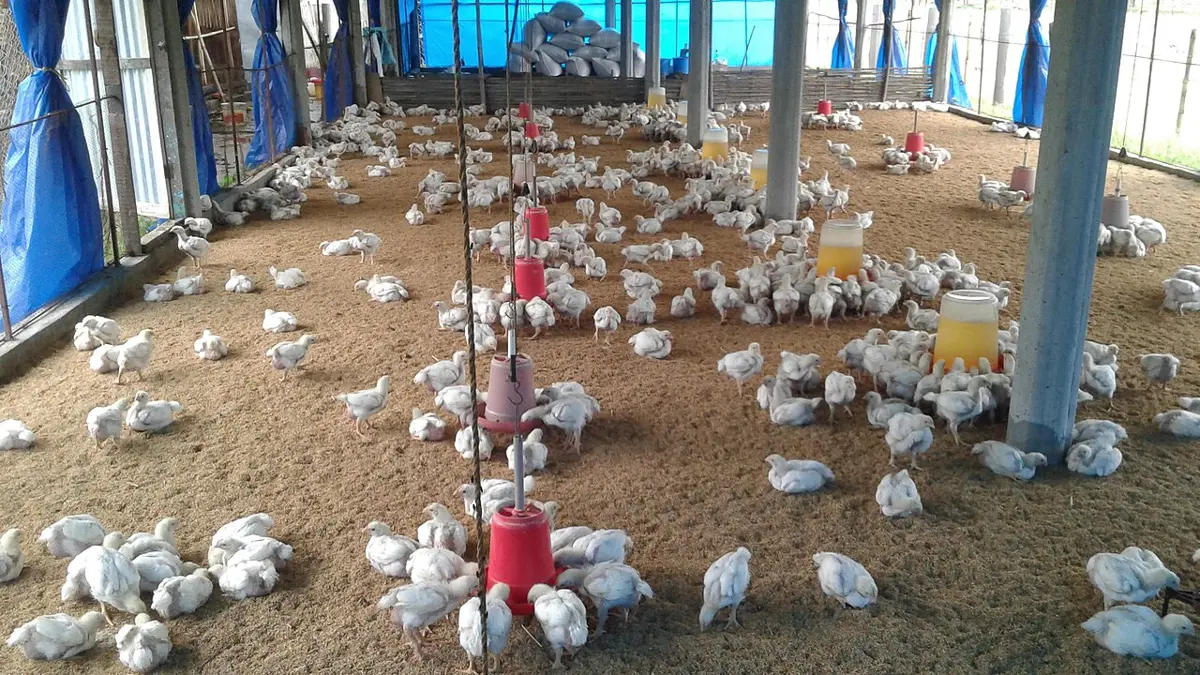
Paragraph 2: the news and the invitation. Now comes the reason for writing. Rahim’s father has come back after three tough years abroad. He has decided to work in his own country and be his own boss. Next week he is starting a farm with poultry and vegetables, and the family is delighted. They have planned an opening ceremony, so Rahim asks if Pratik is free and invites him to their home. Notice how gentle the asking is: I wonder if you are free… Would you like to join us…?
Paragraph 3: the details. Rahim gives the date, 24th May 2023, says how pleased they would be to see Pratik, and asks for a reply.
The closing. With lots of love and his first name: this is how you end a letter to a close friend, never one to an office.
Why does Rahim begin with “How have you been?” and not with the invitation?
Pick an answer to see why.
The card, line by line
The card has hardly a full sentence in it, but every line has a job.
| Part of the card | What it says | Its job |
|---|---|---|
| The hosts | Mr. Bikas Prasad Joshi and Mrs. Honey Joshi | who is inviting |
| The request | cordially request your presence | a very polite way of saying please come |
| The occasion | the Bratabandha ceremony, called auspicious (lucky and full of good promise) | why they are asking |
| Whose it is | their grandson, Mr. Sangam Joshi, son of Manjit and Salina Joshi | who the day is for |
| The venue | Yak Palace, Kali Marg, New Baneshwor | where |
| The date and time | 14th February 2023, 5 p.m. onwards (from then on) | when |
| R.S.V.P. | a phone number | how to answer |
| The closing | With Kindest Regards, from all the Joshi family | a polite end |
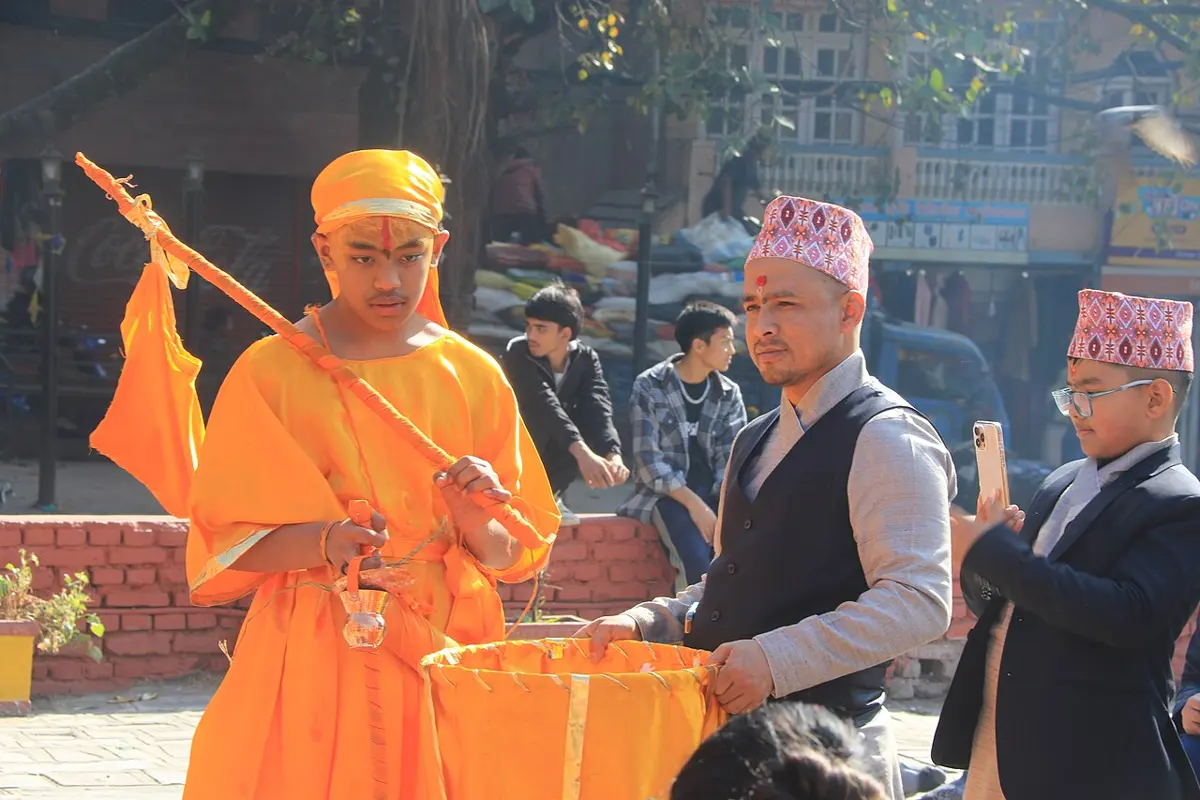
Bratabandha is the Hindu ceremony in Nepal that starts a boy on his life as a learner. His head is shaved, and he receives the sacred thread, which he wears over his left shoulder and under his right arm. Families hold it while the boy is still young, and the age varies. The whole family takes part, so it is one of the occasions when a family prints cards.
A card says “R.S.V.P.: 9800000000”. What should a guest do?
Pick an answer to see why.
Words from the texts
| Word | Meaning here |
|---|---|
| abroad | in or to a foreign country |
| tough | difficult |
| poultry | birds kept for eggs or meat, such as hens and ducks |
| ceremony | a formal event held for a special occasion |
| delighted | very happy |
| cordially | in a warm and friendly way |
| presence | being in a place; a polite word for coming |
| auspicious | lucky; showing that good things will follow |
| occasion | a particular time when something happens |
| venue | the place where an event is held |
| onwards | from that time on |
A. Find the words
Read the following definitions and choose the correct words from the texts.
- a.a particular time when something happens ………
- b.in a warm and friendly way ………
- c.domestic birds such as chicken, ducks, etc. ………
- d.difficult ………
- e.in or to a foreign country or countries ………
- f.very happy ………
Answer
B. Choose the correct answers
Rahim’s family is happy because
- i.his father worked abroad for three years.
- ii.his father had tough three years in a foreign country.
- iii.his father has decided to start his own business in his homeland.
Answer
Rahim sent the email because
- i.he wanted Pratik to know about his father’s progress.
- ii.Pratik was his friend.
- iii.he wanted to invite Pratik to join the event.
Answer
Manjit Joshi is the father of
- i.Mr. Bikas Prasad Joshi
- ii.Mrs. Honey Joshi
- iii.Mr. Sangam Joshi
Answer
The Bratabandha party starts
- i.late morning
- ii.early afternoon
- iii.early evening
Answer
C. Answer the questions
Who wrote the email to whom?
Answer
When is Rahim’s father starting his business?
Answer
Do you like Rahim’s father’s decision? Why?
A model answer
What is the card for?
Answer
Where is the Bratabandha party taking place?
Answer
What does R.S.V.P. mean?
Answer
D. Why and how?
Discuss with your friends why and how Rahim invited Pratik.
A model discussion
Grammar II: question tags
You met question tags in Grade 7. A question tag is the short question at the end of a statement: You’re coming, aren’t you? We use it to check something, or to ask someone to agree, and this makes it useful when you invite: You will come, won’t you?
Here is the rule again, in three steps:
- Take the helping verb of the statement. If there is none, use do, does or did.
- Give it the opposite sign: a positive statement takes a negative tag, a negative statement a positive tag.
- Put a pronoun for the subject, never the noun again.
A. Study the tags
Study the following statements and their question tags.
- a.IOM promotes humane and orderly migration, doesn’t it?
- b.They are supposed to work for one year, aren’t they?
- c.The applicants should maintain a diary of events, shouldn’t they?
- d.They are appointed for the post in several branches, aren’t they?
- e.Qualified candidates can write an email or send a handwritten application, can’t they?
What to notice
The harder cases
Most tags follow the three steps. Here are the ones that catch people out.
| The statement | The tag | Why |
|---|---|---|
| I am late, | aren’t I? | English has no amn’t in the standard language. |
| Let’s eat, | shall we? | A suggestion takes shall we. |
| Wait for me, | will you? | An order or a request takes will you. |
| Everyone is here, | aren’t they? | Everyone, someone, nobody become they, and they needs are. |
| Nothing broke, | did it? | Nothing, everything become it. |
| She never sings, | does she? | Never makes it negative. |
| He seldom calls, | does he? | So do hardly, seldom, rarely, nobody, nothing, no one: they take a positive tag. |
| We have two cows, | don’t we? | Have is the main verb here, so it needs do. |
How you say it changes what it means. If your voice falls on the tag, you are sure, and you only want the other person to agree: It’s a lovely day, ↘isn’t it? If it rises, you really are asking: You’ve got the card, ↗haven’t you?
“Nobody came to the meeting, ………?” Which tag is right?
Pick an answer to see why.
“Let’s start the program, ………?” Which tag is right?
Pick an answer to see why.
“I am next in the line, ………?” Which tag is right?
Pick an answer to see why.
B. Correct the tags
Read the following sentences and correct the mistakes in question tags.
Example: Darpan invited his friends, doesn’t he? → Darpan invited his friends, didn’t he?
- a.Kunal has gone to market, haven’t he?
- b.Ram and Laxman are twins, are not they?
- c.Abdul will buy a new car, won’t Abdul?
- d.Dolma has a car, hasn’t she?
- e.Sanam had written a letter, didn’t they?
- f.Someone is whispering, isn’t he?
- g.I never go out in the evening, don’t I?
- h.Let’s have a party, will you?
- i.I am doing great at school, amn’t I?
Answer
C. Supply the tags
Supply the correct question tags to the following statements.
- a.Seema enjoyed the event a lot, ………?
- b.My father has recently returned home from abroad, ………?
- c.Rajkumar cannot write with his left hand, ………?
- d.Nabina has decided not to go to a university, ………?
- e.My mother believes in honesty, ………?
- f.My neighbor is starting his new business, ………?
- g.I am good at drawing, ………?
- h.My brother and sister are happy, ………?
- i.We have arranged a meeting at 6:00 p.m., ………?
- j.Nishu won’t buy a new notebook, ………?
- k.Nobody has solved the puzzle, ………?
- l.They hardly attend social functions, ………?
Hint
Answer
Writing II: a message of invitation
Whatever its style, an invitation must answer five questions. If one is missing, your friend has to phone you to ask.
| The question | Example |
|---|---|
| Why? What is it for? | a party for my uncle’s new job |
| When? The day, the date, the time | Saturday, 12 Mangsir, at 4 p.m. |
| Where? A place that can be found | our home, near the Ward Office |
| Who? Who is inviting | me, and my family |
| How do I answer? | call or message me by Thursday |
To a friend, write as you speak: open warmly, give the news, invite, and give the details. Use Would you like to…? or I’d be so happy if you could…
Imagine your uncle has recently got a new job. Your family is organizing a party to celebrate the achievement. Now, write a message of invitation to your friend to attend the party.
Hint
A model message
The same party, on a card
Project work
Extra bit: inviting, accepting and declining
Here are more ways to do all three, to keep and use. The rows don’t go together: any reply can answer any invitation.
| Inviting | Accepting | Declining |
|---|---|---|
| Would you like to join me for a coffee? | Thank you. I’d love to. | Thank you very much, but I’m a bit busy at the moment. |
| Shall we meet for a coffee tonight? | That would be very nice. | Thank you very much for asking me, but I can’t make it. |
| What about dinner together? | It would be very nice to be there. | I’m very sorry, I don’t think I can. |
| Come and have tea with us. | That sounds great. | I wish I could, but I have an appointment with my doctor. |
| Why don’t you come and stay with us for a few days? | I’d like nothing better. | I’m afraid I have already promised to meet Nina today. |
| Would you like some fruit? | With pleasure. | I’m sorry. I can’t attend the party. |
| We would be pleased if you could come and stay with us. | Great! | Thanks for the invitation, but I can’t attend it. |
| Would you care to attend the party? | I’m in. | It’s a shame I can’t be there. |
| Do you fancy coming along? | That’s very kind of you. | Sorry. We will be away on vacation next week. |
Would you care to…? and We would be pleased… are formal. Do you fancy…? and I’m in are very casual, and fancy is mostly British.
Which reply says no?
Pick an answer to see why.
Which is the most formal?
Pick an answer to see why.
Exercise
Practice on this unit in the style of the final exam. Try each one as in the exam, then open the answer.
Read the “Vacancy Announcement” again and write whether the following statements are True or False.
- a.UN Women Nepal wants applications from qualified Nepali citizens.
- b.Both jobs are in Kathmandu.
- c.A driver must have worked for the UN before.
- d.Applicants have to send a form along with the application.
- e.People with disabilities are asked not to apply.
Answer
Read the email and the card again and complete the sentences with the correct words.
- a.Rahim’s father lived abroad for ……… years.
- b.He is going to keep poultry and grow ……… .
- c.Rahim is writing to his friend ……… .
- d.Sangam Joshi is the ……… of Bikas Prasad and Honey Joshi.
- e.To answer the card, guests should use the ……… number.
Answer
Read the notice and answer the questions.
Tree Planting Day
The Eco Club of Saraswati School, Lamjung, invites all students and parents to help plant 100 saplings along the river bank on Saturday, 6 Asar, from 8 a.m. to 11 a.m. Please bring a hat and a bottle of water. Tools will be provided. Students of Grades 6 to 10 should meet in front of the school gate at 7:30 a.m. Lunch will be served at the school at noon. To take part, give your name to Mrs. Gurung by Thursday.
- a.Who is holding the event?
- b.How long will the planting last?
- c.Where should students meet?
- d.What don’t you need to bring?
- e.Why do you think the notice gives a last day for names?
Answer
Supply the correct tags.
- a.Let’s invite Tenzing, ………?
- b.Nobody told Riya about the party, ………?
- c.I am on the list, ………?
- d.She has hardly eaten anything, ………?
- e.Your cousins live in Biratnagar, ………?
Answer
Choose and copy the best answer for the numbered blanks.
The wedding is (a) ……… (in/on/at) Friday, and it starts (b) ……… (on/at/in) 5 p.m. The hall is (c) ……… (between/through/around) the bank and the post office. Park your car (d) ……… (over/behind/through) the hall, and come (e) ……… (in/on/at) the evening if you can.
Answer
Identify ten errors in the given paragraph. Rewrite the paragraph by correcting the errors.
Dear manisha im having a party on sunday can you come it starts at three
Answer
Your school’s library needs a part-time helper. Write a short vacancy announcement. Use the clues: the school’s name; the post; requirements; working hours; how to apply; closing date.
A plan
Write a letter to your friend in another town, inviting him or her to spend the Tihar holidays at your home.
Hint
A plan
Printable PDFs
- Study notes 2 pages
- Harder practice questions 3 pages Answer key
Practice every question in the book, and keep track of the ones you miss →
A companion to your textbook, not a replacement for it: study from the book your school uses, and where the two differ, follow your teacher. Found a mistake? Please tell us.