
Two children ask a farmer for a holiday job and are told to pick the caterpillars off his cabbages, every one. A hundred years earlier, a poet in Bengal tells a worshipper to leave the dark temple and look for God out in the fields, where a farmer is ploughing and a road-builder is breaking stones. Both are about work: what it is worth, and what happens when you look for a short cut.
This unit reads both, and then turns to the language of work and rest: how to ask for permission politely, how modal verbs (must, might, can’t) show how sure you are, how imperatives give orders, advice and directions, and two pieces of writing the SEE asks for, a job application and a notice of rules and regulations.
Getting started
The unit opens with four pictures of how people spend their time. Two show work, two show leisure, time free from work, to rest or enjoy yourself.
| Picture | What it shows | Why it matters |
|---|---|---|
| Farmers in a terraced field: a man ploughing with a pair of oxen, women bent over planting rice seedlings | farm work, the work that feeds the country | Farming is still the work of millions of Nepali families; without it there is no dal bhat on anyone’s plate. |
| A teacher talking to her class at their desks | teaching, work that passes on knowledge | Every other job, the doctor’s, the engineer’s, the farmer’s new methods, starts in a classroom. |
| A large indoor pool full of swimmers, with slides and balloons | recreation, play and exercise in free time | Swimming and play rest the mind and keep the body fit; people come back to work fresher. |
| Two hikers with rucksacks looking out over high mountains | travel and adventure in leisure time | Walking in nature lowers stress, and trekking brings visitors and jobs to Nepal’s hills. |
Reading I: Cabbage White
Before you read
What kind of text it is
Cabbage White is a short story, adapted from a collection of stories by Jake Allsop, a British writer of stories for learners of English. It is a comic story: it is told straight, but the joke builds up until a surprise at the end. Most of it is dialogue, people talking, so it is easy to act out (task E).
The story, part by part
1. Two children ask for work
Sarah, aged twelve, and her brother Jamie, eleven, stand on their toes to hand a card from their school to a tall man behind the counter of a farm. He frowns and makes a face: they look too small to be of any use. When he asks if they shouldn’t be at school, they explain that it is the holidays and they want to earn some money and help their parents. He says that farm work is tough, and he needs someone big and strong.
Sarah pleads: there must be some job for them on such a big farm.
2. The job
The man tests them. Do they know what a Cabbage White is? Sarah does: a pretty white butterfly that lays its eggs on cabbages, and the eggs hatch into caterpillars. Jamie shouts out what the caterpillars do: they eat the cabbage leaves. Are they afraid of caterpillars? Not at all, Sarah answers sharply.
So the man gives them the job: check every single cabbage and get rid of every caterpillar, by picking them off and collecting them. They ask politely whether they may use his pails, and what he will pay. He won’t say: he wants to see how they get on first, and promises that if he is happy with their work, they won’t be disappointed. Then he goes off to his greenhouse.
Why does the man agree to give the children work?
Pick an answer to see why.
3. An impossible task
The cabbage patch is enormous. Jamie guesses there must be a million cabbages. Sarah says at least, and that with ten caterpillars on each, that makes a billion caterpillars. Jamie doubts her arithmetic but is wise enough not to argue.
They start on the first row. It is a hideous (horrible) job: the caterpillars wriggle as they are picked up, and the first row takes ages. Their pails are already so full that they can’t see the bottom. And all around them fly Cabbage White butterflies, which seem to mock them, as if saying: kill our caterpillars if you like; we can lay millions more eggs. The children become desperate: they feel the job can never be finished.
4. Sarah’s “brilliant” idea
Sarah swipes at a butterfly, misses, and watches it fly happily away. Then she has an idea, which the writer jokingly compares to Einstein discovering E = mc²: caterpillars come from eggs; eggs come from butterflies; so if they get rid of the butterflies, there will be no more eggs and no more caterpillars.
She pulls two bamboo poles out of the bean plants (two bean plants die), hands one to Jamie, and runs into the cabbages swinging hers at the butterflies. Jamie thinks it is a fine game and joins in. Butterflies in the air are hard to hit, but butterflies resting on cabbages are easy.
5. The battlefield
They fight on until they are completely worn out. The ground is covered with dead butterflies, and hardly any butterflies are left. But hardly any cabbages are left either: you can’t hit a butterfly on a cabbage without hitting the cabbage. The patch looks like a battlefield; not one cabbage is standing.
Without a word, they put down the poles and tiptoe out of the garden. The story ends with a joke in three lines: Jamie worries that the man knows their names; Sarah points out that he doesn’t know where they live; and together they say “Thank goodness.”

Words from the story
| Word | Meaning here |
|---|---|
| tiptoe | to walk on the front of your feet, heels off the ground (here, to make themselves taller; at the end, to go out quietly) |
| frown | to pull your eyebrows together because you disapprove, or are thinking hard |
| make a face | to twist your face to show you don’t like something |
| plead | to ask for something seriously and with feeling |
| retort | to answer quickly and sharply |
| eliminate | to get rid of completely |
| pail | a bucket |
| open-mouthed | very surprised or shocked |
| dispute | to argue that something is wrong |
| hideous | very ugly or unpleasant |
| wriggle | to twist and turn the body with quick, small movements |
| mock | to laugh at someone in an unkind way |
| desperate | without hope, ready to try anything |
| gaily | in a cheerful, carefree way |
| exhausted | very tired |
A. Match the words with their meanings
Match the meanings with the words: frown, plead, open-mouthed, dispute, hideous, gaily, mock, wriggle.
- a.to laugh at somebody in an unkind way
- b.very unpleasant
- c.to twist and turn the body or part of it with quick, short movements
- d.in a cheerful way
- e.very surprised or shocked
- f.to ask for something in a serious and emotional way
- g.to make a facial expression showing disapproval
- h.to argue or disagree strongly with somebody
Answer
B. Words for ways of walking
Tiptoe is one of many verbs that say how someone walks. A good writer chooses the exact one instead of “walked”.
| Word | How you walk | Example |
|---|---|---|
| sneak | quietly and secretly, so as not to be seen | The boys sneaked out of class while the teacher was writing on the board. |
| stroll | slowly and in a relaxed way, for pleasure | On Saturday evening we strolled round Bhaktapur’s Durbar Square. |
| lurch | with a sudden, jerky, uncontrolled movement, forward or to the side | The bus lurched as it hit the pothole. |
| stagger | unsteadily, almost falling, as if weak, hurt or carrying something heavy | The porter staggered up the last steps under his heavy load. |
| stride | with long, firm steps, sure of where you’re going | The captain strode onto the field. |
| stumble | catching your foot on something so that you almost fall | I stumbled on a loose stone in the dark. |
The tired trekker ……… the last few meters to the lodge, almost falling with every step.
Pick an answer to see why.
Sarah and Jamie ……… out of the garden so that the farmer would not hear them.
Pick an answer to see why.
C. Answer the questions
Why do you think the man frowned when Sarah and Jamie gave him their school card?
Answer
Why were Sarah and Jamie looking for a job instead of going to school?
Answer
Why was the man ready to give them work on his farm?
Answer
What work were they supposed to do at the man’s farm?
Answer
Were there really a million cabbages or a billion caterpillars in the cabbage field? If not, what do Sarah and Jamie mean by them?
Answer
What were Sarah and Jamie desperate about?
Answer
What was Sarah’s “brilliant” idea?
Answer
Were the children happy with their work? Give reasons for your answer.
Answer
Why did they run away from the farm secretly?
Answer
D. True, False or Not Given
A statement is True if the story says the same, False if it says the opposite, and Not Given if it doesn’t say either way.
Sarah and Jamie’s parents were unable to work to support the family.
Pick an answer to see why.
Sarah and Jamie have never been to school.
Pick an answer to see why.
The man decides to pay them when they have finished the work.
Pick an answer to see why.
Sarah and Jamie had not expected to find so many caterpillars in the cabbage field.
Pick an answer to see why.
Sarah’s idea finally helped them finish the job.
Pick an answer to see why.
They were caught by the farm owner while running away.
Pick an answer to see why.
E. Act out the story
Pronunciation: short vowels, long vowels and vowel combinations
English has short vowel sounds, long vowel sounds, and vowel combinations (also called diphthongs), where the sound glides from one vowel to another inside one syllable, as in my /maɪ/ or now /naʊ/. The spelling doesn’t tell you which: stood and bamboo are both spelled oo, but one is short and one is long. (All the sounds are in the chart at the end of the unit, under Vowel sounds.)
Put the words in the right column by the sound of the letters shown in brackets: stood (oo), their (ei), support (u), plead (ea), beautiful (the last u), afraid (ai), hideous (eou), seemed (ee), lay (ay), gaily (ai), ground (ou), exhausted (au), tiptoe (oe), bamboo (oo), pail (ai).
Answer
Speaking: asking for permission
A. Four conversations
The task gives four short conversations in which someone asks to do something. Here are the four ways of asking, and what each answer means.
| Asking | How polite | The answer given |
|---|---|---|
| Would you mind if I sat near the window? | very polite, to a stranger or a superior | Oh, well, alright. (yes, a little unwillingly) |
| Do you mind if I smoke here? | polite | I’m sorry, but this is a “No Smoking Zone”. (no) |
| Is it alright if I go out with my friends, mum? | friendly, to family and friends | OK, but don’t make it late. (yes, with a condition) |
| I wonder if I could possibly sit next to you. | very polite and careful | I am sorry, this seat has been booked for my friend. (no) |
Others you know: Can I…? (friendly), Could I…? (more polite), May I…? (formal and polite).
Ways to grant permission: Sure. / Of course. / Go ahead. / Yes, please feel free. / Not at all (to Do you mind?). Ways to refuse it politely: I’m sorry, but… / I’d rather you didn’t, if you don’t mind. / I’m afraid not, because… Always give a reason when you refuse.
“Do you mind if I borrow your pen?” Which answer means yes, you may?
Pick an answer to see why.
Which is correct?
Pick an answer to see why.
B. Ask and answer
Match each request with a suitable response, then make the conversation: a. close the window b. use the computer c. ask a question d. use the phone e. come late to work tomorrow f. use the car.
Responses: i. I’m sorry, but the battery has gone down. ii. I’d rather you didn’t, if you don’t mind. iii. Yes, please. It’s a little cold here. iv. No, please don’t. It’s time to go to bed. v. Yes, please feel free. vi. Yes, sure. Here is the key.
Answer
C. Ask, answer and report
Student C’s job is to report what A asked and what B answered. Two patterns:
- Saloni asked for Nurgen’s permission to use his computer, and he granted it (or refused it).
- Saloni asked Nurgen if she could use his computer, and he said she could (or couldn’t).
These are reported questions, from Unit 2: if + statement order, and the tense one step back (can → could).
Make a conversation and a report for each: a. go out b. use the pen c. close the door d. borrow a book e. go to the park with friends f. take the car.
Model conversations
Grammar I: Modal verbs
What modals do
Modal verbs (can, could, may, might, must, shall, should, will, would, and ought to) go before a main verb and add a meaning to it: ability, permission, possibility, advice, duty. You met their rules in earlier grades: the base verb after them (must go, not must to go or must goes), no -s (she can), and questions by turning them round (Can you…?).
| Modal | Common uses | Example |
|---|---|---|
| can / could | ability; permission; a request | She can swim. Could you open the door, please? |
| may / might | possibility; may also for polite permission | It might rain. May I come in? |
| must | strong duty or need; being sure (deduction) | You must wear a helmet. He must be tired. |
| should | advice; what is expected or right | You should see a doctor. |
| would | polite requests and offers; refusing in the past (wouldn’t) | Would you like some tea? |
| had to | duty in the past (must has no past form) | We had to walk home. |
How sure are you? must, might, can’t
When you don’t know something for certain but work it out from clues, you are making a deduction. Three modals show how sure you are:
| How sure | About now | About the past |
|---|---|---|
| certain it is true | He must be tired. | He must have been tired. |
| possible | He may / might / could be tired. | He may / might / could have been tired. |
| certain it is not true | He can’t be tired. | He can’t have been tired. |
About the past: modal + have + past participle (must have left, can’t have seen, might have forgotten). The opposite of must be is can’t be, not mustn’t be: mustn’t means something is not allowed.
“Rita’s lights are off and her scooter isn’t outside. She ……… at home.”
Pick an answer to see why.
“The road is wet, but the sky is clear now. It ……… in the night.”
Pick an answer to see why.
A. The heron’s modals
The textbook tells an old fable in seven sentences, with seven verbs underlined. In it, a heron walks slowly and proudly along a riverbank. All he could see in the clear water was a little fish, which, he thought, might be a good breakfast. Then he noticed a much bigger fish swimming past, and told himself that a fine heron like him should not be satisfied with a tiny fish: he wouldn’t even open his beak for it while he may have a lovely dinner instead; he must catch the big one by a trick before it escapes. But both fish were smarter than the heron and swam off into the deep water, and in the end he had to make do with a tiny snail for breakfast. (The fable is very old: the French poet La Fontaine told it in the 1600s. Its lesson: if you are too choosy, you can end up with less.)
What is each underlined word used for? could, might, should, wouldn’t, may, must, had to.
Answer
B. Choose the modal
Complete the sentences with could, can’t, must, may, should, might, would, using each once.
- a.This ……… be Safal’s coat. It is too small for him.
- b.……… you please tell me the way to the airport?
- c.……… you like to stay with us at the weekend?
- d.Do you know where Jack is? He ……… be in his office.
- e.The sky is overcast. It ……… rain in the afternoon.
- f.Sanam has been working in the field all day. She ……… be tired.
- g.The film is really wonderful. You ……… see it at least once.
Answer
C. must or can’t
Complete with must or can’t.
- a.The man is looking around. He ……… be lost.
- b.He ……… be a doctor. He has not studied medicine.
- c.Sushmita failed the test although she is a smart student. She ……… have prepared well this time.
- d.The restaurant always serves really good food. They ……… have employed excellent chefs.
- e.There ……… be something wrong with the fan. It is making an unusual sound.
- f.This ……… be Sumana’s book. There is a library stamp on it.
- g.He ……… have had hard times. He has lost his job and has to support his elderly parents.
Answer
Writing I: A job application
A. Put Pabitra’s letter in order
Pabitra Nepali, of Bhanu-10, Tanahun, is applying to the headteacher of Shree Janajagriti Secondary School for the job of school accountant. The address, date, subject and greeting are in place, but the twelve sentences of the body are jumbled:
- a.I am a young girl of 20.
- b.After my SEE I worked as a finance staff for a year at Himalayan Investment Company Limited.
- c.I am writing to apply for the position of school accountant that was recently advertised in The Tanahun Post.
- d.Moreover, I possess good skills in handling a wide range of finance-related tasks.
- e.As an experienced finance staff, I have a proven record of successfully coordinating administrative and financial duties.
- f.I have enclosed copies of my relevant credentials required for the position.
- g.I also possess sound skills in spoken and written English besides the Nepali language.
- h.I look forward to working with your team.
- i.If I am appointed as the school accountant in your school, I will provide excellent service.
- j.I have a keen interest in working in an academic institution.
- k.I possess all the skills and qualifications that you are looking for.
- l.I am confident that I can be a valuable asset to your school.
Put the sentences in order and write out the letter.
Hint
Answer
How to write a job application
A job application letter (or cover letter) asks for a job and shows, in a short space, why you are the right person. It is a formal letter, laid out like the one in Unit 1:
- Your address and the date.
- The employer’s title and address: The Human Resources Manager, …
- Subject: Application for the post of …
- Dear Sir/Madam,
- Opening paragraph: the post you are applying for and where you saw it advertised.
- Middle paragraph(s): your qualifications (education), experience (jobs, with how long), and skills that match what the advertisement asks for. Take each requirement in the advertisement and show that you meet it.
- Closing paragraph: what you can offer, the documents you have enclosed (a CV, certificates), that you are available for an interview, and a polite close: I look forward to hearing from you.
- Yours faithfully, your name (and signature).
B. Apply for the advertised job
The advertisement in the task is a vacancy announcement from an electronics and home appliances company in Kathmandu, which needs a Marketing Manager, a Marketing Executive and an Accountant (three vacancies, salary negotiable). It asks for a bachelor’s degree in management, at least two years’ experience in the field (for the accountant: accounting and financial reporting, tax and VAT), computer skills (Word, Excel and accounting software), a good command of English and Nepali, and says that a two-wheeler driving license is an added advantage. Applicants send a CV and a scan of their citizenship certificate by email before the deadline.
Write a letter of application for one of the advertised posts. Imagine that you meet all the requirements.
A model letter
Reading II: Leave this Chanting and Singing
Before you read
The pictures show a farmer ploughing a muddy field behind two buffaloes, and a woman praying, a dark shape against an orange sunset, her hands joined.
a. What are the people in the pictures doing? b. Why are they doing these activities? c. Who, do you think, is better at serving God? Why?
A model answer
The poet and the poem
Rabindranath Tagore (1861–1941) was a poet, writer, musician and painter from Bengal, in British-ruled India. In 1913 he became the first person from outside Europe to win the Nobel Prize in Literature, mainly for Gitanjali (“Song Offerings”), a book of short poems that he translated himself from Bengali into English prose. He wrote the national anthems of both India and Bangladesh.
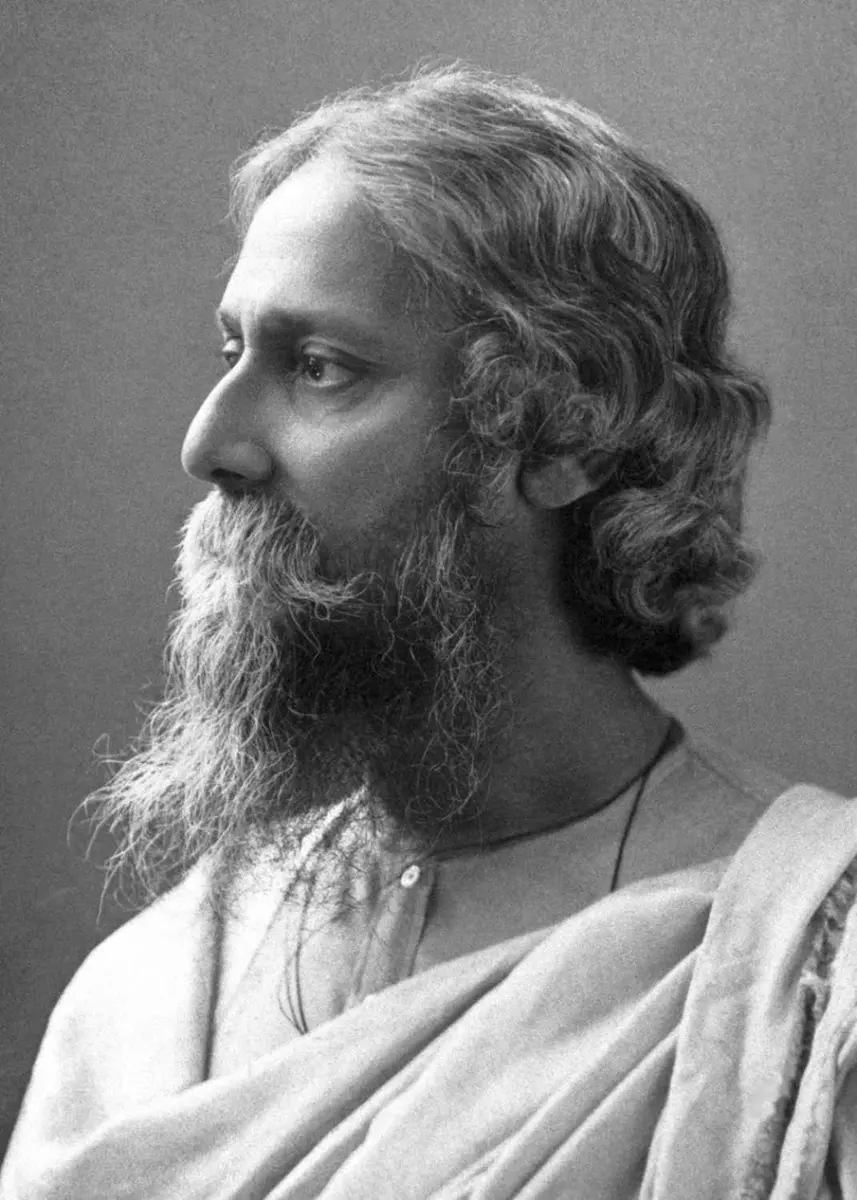
“Leave this chanting and singing” is poem 11 of Gitanjali. Like the whole book, it is written in free verse: long lines with no rhyme or regular rhythm, close to prose. It uses the old English of prayers (thou, thy, dost) to speak to a religious person, and turns their own way of speaking back on them.
The poem, part by part
Stanza 1: Open your eyes
The speaker tells a worshipper to stop chanting, singing hymns and counting prayer beads (telling of beads: tell here is the old meaning, to count). Whom are you worshipping, he asks, alone in a dark corner of a temple with all the doors shut? Open your eyes: your God is not in front of you.
The temple is described as lonely, dark and shut: everything that is cut off from the world and its light.
Stanza 2: Where God really is
God is out where the tiller (the farmer) is breaking up hard ground, and where the pathmaker is breaking stones to build a road. He is with them in sun and rain, and his clothes are covered in dust: he is shown as a labourer. So the speaker tells the worshipper to take off his holy mantle (the cloak of a priest or holy man) and come down, as God has, onto the dusty soil.
Stanza 3: Deliverance?
The worshipper may answer that he is seeking deliverance, to be freed from the world and its troubles. Where will you find that, asks the speaker? Our master himself has joyfully tied himself to creation with the bonds of creation: God is bound up with the world and with all of us forever. If God has not escaped from the world, there is no escape for us to look for.
Stanza 4: Meet him in work
Come out of your meditations, leave your flowers and incense. What harm is there if your clothes get torn and stained? Go and meet God, and stand beside him in toil (hard work) and in the sweat of your brow (forehead).
The poet’s devices:
- Imperatives throughout: Leave… Open… Put off… Come out… Meet him… The poem is a set of commands (see Grammar II).
- Rhetorical questions, which expect no answer: Whom dost thou worship…? Where is this deliverance to be found? What harm is there…?
- Contrast of darkness and closed doors with sun, rain and open fields.
- Personification: God is shown as a worker whose garment is covered with dust.
- Archaic (old) words: see below.
Old words: thou, thee, thy, thine, dost
Old English had two words for you: thou for one close person, and you for many people or to be polite. Thou survives in old prayers and poems.
| Old form | Modern English | Example from the poem |
|---|---|---|
| thou | you (subject) | Whom dost thou worship? = Whom do you worship? |
| thee | you (object) | thy God is not before thee = in front of you |
| thy | your (before a consonant) | thy holy mantle = your holy mantle |
| thine | your (before a vowel); yours | Open thine eyes = Open your eyes |
| dost | do (with thou) | dost thou = do you |
| art | are (with thou) | who art thou? = who are you? (in Unit 5’s poem) |
Words from the poem
| Word | Meaning here |
|---|---|
| bead | a small ball of glass, wood or stone with a hole through it, threaded with others; prayer beads (a mala) are counted while praying |
| tiller, till | a farmer; to prepare and use land for crops |
| garment | a piece of clothing |
| mantle | a loose cloak; also a layer that covers something (a mantle of snow) |
| deliverance | being rescued or set free from danger, evil or pain |
| bond | something that ties or joins |
| incense | a substance that gives a sweet smell when burned (dhoop) |
| tattered | old and torn |
| stained | marked with dirt that is hard to remove |
| toil | hard, tiring work |
| brow | the forehead |
A. Find the words
Find words in the poem with these meanings.
- a.a small piece of glass or stone threaded with others to make a necklace
- b.to prepare and use land for growing crops
- c.a piece of clothing
- d.a layer of something that covers a surface
- e.the state of being rescued from danger, evil or pain
- f.a substance that produces a pleasant smell when you burn it
- g.covered with marks
- h.hard, unpleasant work that makes you very tired
Answer
B. Modern equivalents
Give the modern equivalents of: a. dost b. thou c. thine d. thy
Answer
C. Answer the questions
Who is the poem addressed to?
Answer
What does the speaker advise people?
Answer
Where do people try to find God?
Answer
Where, according to the speaker, does God actually live?
Answer
How can people have a glimpse of God?
Answer
Why can’t God rescue people?
Answer
What does the speaker ask people to do in the last stanza?
Answer
D. Your opinion
Do you believe in the existence of God? What do you do to please him? Share your opinion.
Two model answers
Listening: working hours around the world
The textbook’s listening task is a short talk about how many hours people work, and how much holiday they get, in different countries. CDC’s own recording is below: read the questions in B and C first, then listen, as many times as you need. After the answers, practice with a talk of our own that your browser reads aloud.
A. Before you listen
B and C. The textbook’s audio: answers
a. How long do people work in France in a year?
Pick an answer to see why.
b. Which of the following reasons for working long hours is not mentioned in the audio?
Pick an answer to see why.
c. What do many people think about their vacation?
Pick an answer to see why.
d. How long is the vacation of German employees?
Pick an answer to see why.
e. In which country do people have the shortest vacation?
Pick an answer to see why.
C a. A French employee generally spends more time at work than a Japanese employee.
Pick an answer to see why.
C b. Many companies in Japan do not pay workers for their extra time.
Pick an answer to see why.
C c. Many employees have lost their jobs for not working overtime.
Pick an answer to see why.
C d. English workers have longer vacations than they need.
Pick an answer to see why.
C e. According to the proverb, there are many dull boys in the world.
Pick an answer to see why.
Practice listening alone
Grammar II: Imperatives
An imperative sentence tells someone to do something. It uses the base form of the verb, usually with no subject: Sit down. Open your book. The subject you is understood. Imperatives aren’t only orders: the same form makes a request, gives directions, an invitation, advice or a warning, and the situation and a few words (please, kindly, let’s, don’t) show which.
| Function | Example | Clues |
|---|---|---|
| command | Put your hands up! | short, strong, said by someone in charge |
| order | Get out of here at once. | sharp; often at once, now |
| request | Kindly tell me where the bus park is. | please, kindly; asks a favor |
| direction | Go straight and take the first turn on your right. | how to get somewhere |
| instruction | Cook the rice on medium heat until it is tender. | steps for doing a task |
| invitation | Please join us on the tour. | asks someone to share something pleasant |
| advice | Wear warm clothes. | what is good for the listener |
| warning | Don’t feed the animals in the zoo! | danger or a rule; often negative |
| suggestion | Let’s go for a walk. | let’s: includes the speaker |
Making them negative:
- Put don’t (or do not, more formal) before the verb: Turn left. → Don’t turn left.
- With please: Please open the door. → Please don’t open the door. (or Don’t open the door, please.)
- Let’s + verb → Let’s not + verb: Let’s play. → Let’s not play. (Don’t let’s play is also heard in British English.)
- Let him/her/them + verb → Don’t let him… : Let him tell a story. → Don’t let him tell a story.
- Never makes a strong negative: Never touch a fallen electric wire.
“Let’s watch the match at Rina’s house.” The negative is:
Pick an answer to see why.
“Don’t touch the wires: you could get a shock!” What is it used for?
Pick an answer to see why.
A. Match the sentences with their functions
Match each imperative with its function.
- a.Kindly tell me where the bus park is.
- b.Go straight and take the first turn on your right.
- c.Cook the rice on medium heat until it turns tender.
- d.Please join us on the tour.
- e.Don’t feed the animals in the zoo!
- f.Wear warm clothes.
- g.Put your hands up!
- h.Get out of here at once.
- i.Let’s go for a walk.
Functions: i. giving directions ii. warning iii. command iv. giving advice v. order vi. giving instructions vii. invitation viii. request ix. suggestion
Answer
B. Make them negative
Change into negative.
- a.Turn left at the junction.
- b.Please open the door.
- c.Let him tell a story.
- d.Put out the light.
- e.Let’s play a friendly football match.
- f.Please help the man get out of the well.
- g.Instruct the people about how they should work.
Answer
Writing II: Rules and regulations
A. A notice from Chitwan National Park
The textbook’s model is a notice of rules for visitors to Chitwan National Park, put up by the park office at Kasara under the Department of National Parks and Wildlife Conservation. Its six rules, in short:
- Pay the entry fee at the gate (different for foreigners, visitors from SAARC countries, and Nepalis).
- The park’s plants and animals are fully protected: don’t disturb them.
- Don’t buy illegal animal or plant products: you could be prosecuted.
- Respect the religious and cultural sites in and around the park.
- Put litter in the bins and keep the park clean.
- Don’t walk inside the park between sunset and sunrise.
Notice how it is written: who is giving the rules (the government office, at the top), a clear title, numbered rules, one rule each, and formal phrases that give orders politely but firmly: has to be paid, must not be disturbed, are required to, are strictly prohibited.
How to write rules and regulations
- Heading: who makes the rules (the institution’s name and address), then a title: Rules and Regulations for Library Users.
- Numbered rules, one idea each, short and clear, most important first.
- Formal, impersonal language. Useful phrases:
- Visitors are (not) allowed to …
- … is strictly prohibited / forbidden.
- Users are required / expected to …
- Visitors must / must not …
- Mobile phones should be switched off.
- imperatives: Do not …, Keep …
- A short closing line, if you like: Thank you for your cooperation., and who issued it (Library Management Committee).
B. Write rules for a library and a hospital
Write a set of rules and regulations for visitors to a library.
A model notice
Write a set of rules and regulations for visitors to a hospital.
A model notice
Project work
Vowel sounds
English has 20 vowel sounds: 12 monophthongs (single sounds; 7 short, 5 long) and 8 diphthongs (combinations that glide from one vowel to another). The symbols are those of a British dictionary; the long mark ː means the sound is held.
| Kind | Sound | Common spellings | Examples |
|---|---|---|---|
| short | /ə/ | a, e, o, u | alive, the, today, supply |
| short | /ɪ/ | i | thin, sit, rich |
| short | /ʊ/ | u, oo, ou | put, look, should |
| short | /e/ | e, ea, ie | went, bread, friend |
| short | /ʌ/ | u, o | fun, love, money |
| short | /æ/ | a | cat, hand, fan |
| short | /ɒ/ | o, a | rob, top, watch |
| long | /iː/ | ee, ea | need, beat, team |
| long | /uː/ | ew, oo, o | few, boot, lose |
| long | /ɜː/ | ir, ur, or | third, turn, worse |
| long | /ɔː/ | al, aw, or, our | talk, law, port, four |
| long | /ɑː/ | a, al, ar | glass, half, car |
| diphthong | /eɪ/ | ay, ea, ai | pay, great, maid |
| diphthong | /ɔɪ/ | oi, oy | noise, toy, boy |
| diphthong | /aɪ/ | i, y | fine, like, my |
| diphthong | /əʊ/ | o, oa | no, stone, road |
| diphthong | /aʊ/ | ou, ow | round, how, brown |
| diphthong | /ɪə/ | eer, ear | beer, hear, steer |
| diphthong | /eə/ | are, ere, ea, ai | care, there, bear, air |
| diphthong | /ʊə/ | ur, ou | plural, tourist, sure |
Exercise
SEE-style practice on this unit. Try each one as in the exam, then open the answer.
Put these events from Cabbage White in the order they happen.
- a.Sarah pulls two poles out of the bean plants.
- b.The man asks whether the children know what a Cabbage White is.
- c.The children tiptoe out of the garden.
- d.The pails fill with caterpillars after the first row.
- e.Not a single cabbage is left standing.
Answer
Choose the correct answer for each numbered blank.
Bishnu (a) ……… (must, can’t, should, would) be very tired today: he worked in the paddy field from dawn to dusk yesterday. His sister wanted to help, but she (b) ……… (can’t, mustn’t, couldn’t, may) come because she had an exam. “You (c) ……… (should, can’t, would, might) rest this afternoon,” their mother said. “And Bishnu, (d) ……… (don’t, not, doesn’t, no) carry the heavy sacks alone. (e) ……… (Let’s, Let, Lets, Let us to) ask the neighbors to help.” Bishnu smiled. “I (f) ……… (must, should, can’t, would) believe it: the rice is planted at last!”
Answer
Rewrite as instructed.
- a.Perhaps the farmer is in the greenhouse. (Use might.)
- b.I am sure Jamie was afraid of the farmer. (Use must have.)
- c.It is impossible that Sarah killed every butterfly. (Use can’t have.)
- d.Open the window. (Make it negative.)
- e.Let’s pick the caterpillars by hand. (Make it negative.)
Answer
Read the advertisement and write a job application in about 150 words.
Wanted: a part-time library assistant for the Sunday and Monday mornings at Suryabinayak Public Library. Requirements: SEE passed, good English and Nepali, basic computer skills. Apply with a CV to the Librarian by 20 Mangsir.
A plan
Write a set of rules for students using the school computer lab.
A model notice
Practice every question in the book, and keep track of the ones you miss →
A companion to your textbook, not a replacement for it: study from the book your school uses, and where the two differ, follow your teacher. Found a mistake? Please tell us.