
A boy has been fishing all day on the bank of the Sun Koshi. It is getting dark, he has caught nothing, and then something bright and silent comes down over the river. If a spaceship really landed in front of you, what would you do? And if its crew asked you to carry one message back to the people of the Earth, what would that message be?
This unit reads a science-fiction story, A Message from Another Planet, and a famous poem in questions and answers, Up-Hill, by Christina Rossetti. You will learn the three sounds of -ed (walked, opened, landed), say where places are on a town map (opposite, next to, between, behind), and use in, at and on for places and the prepositions that belong to certain words (eligible for, envious of, familiar with). You will write an account of a meeting with someone from another planet and a set of rules for a park, listen to the story of why Pluto is no longer a planet, and find out about space tourism.
Getting started: pictures of space
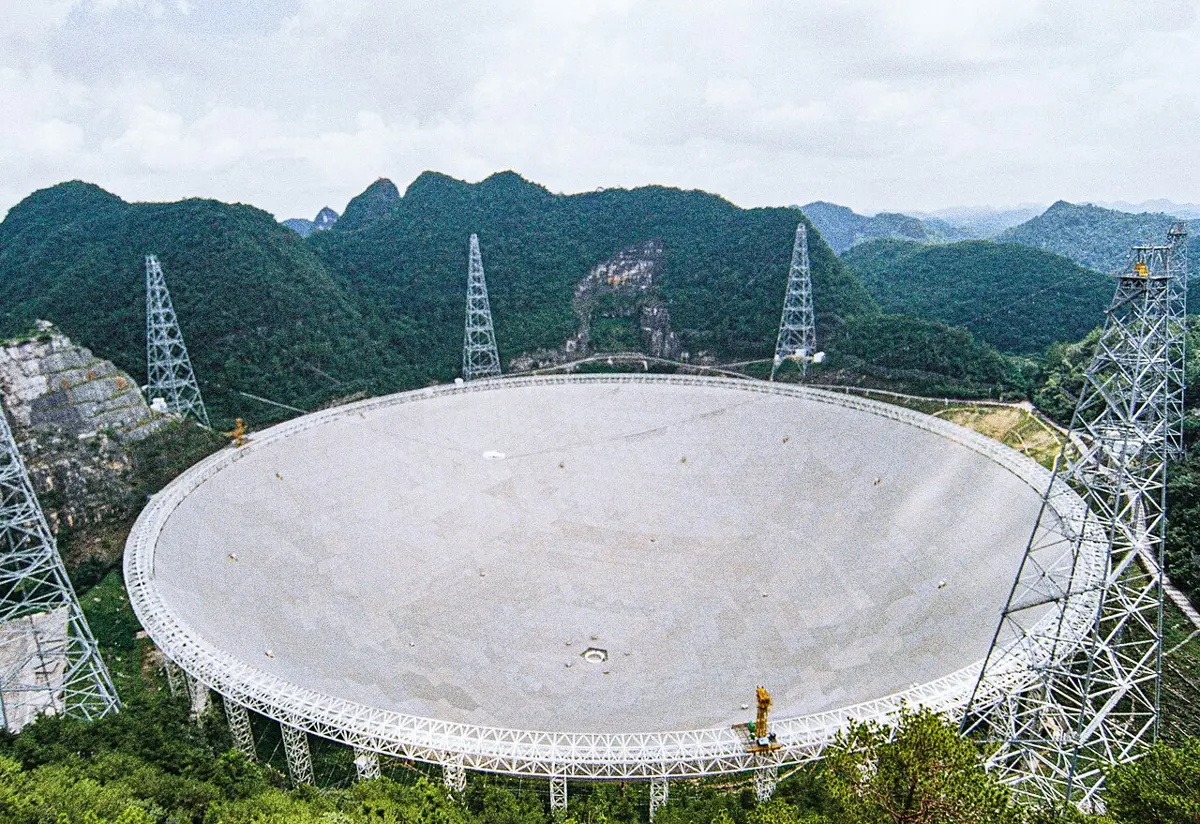
The unit opens with four photos: an astronaut floating in space in a white spacesuit, with the blue Earth behind; the planet Saturn with its wide, flat rings; a rocket climbing through the clouds on a column of fire; and a giant radio telescope, a huge silver dish set in a bowl among green hills.
Look at the pictures and talk to your friends about them.
Model answer
Reading I: A Message from Another Planet
Before you read
The pictures show a boy sitting on a rock by a river with a fishing rod, and a shining, flat, round spacecraft: a flying saucer.
- a.What do you see in the picture?
- b.Do you think life exists on planets other than the Earth?
Model answers
What kind of text it is
The text is a science-fiction story: a made-up story built on science and technology (spaceships, visitors from other planets, machines more advanced than ours). It is told in the third person (“Suren… he…”), and most of it happens in one evening. The book’s version is adapted from a story in an English course published by Longman in 1989; the hero has been given a Nepali name and a Nepali river.
Like many good science-fiction stories, it uses the strange visitors to say something about our own world: here, that we waste the Earth’s resources.
The text, part by part
1. A bright object over the river
Suren Majhi is sitting on the sandy bank of the Sun Koshi (also written Sunkoshi), a big river of eastern Nepal. He has been fishing all day and caught nothing. He is tired, and the twilight (the half-light after the sun has set) is turning into darkness. Suddenly he sees a bright object far away over the river. At first he thinks it might be a helicopter, perhaps on its way to Diktel (the headquarters of Khotang district, in the hills above the Sun Koshi). But it makes no noise. As it comes closer, it takes the shape of a saucer (a small flat dish that a cup stands on), and it lands on the bank about 50 meters away.
2. Drawn into the spaceship
Suren gets up and walks towards it. He once saw a film about a spaceship, and he wonders whether this is one, come from another planet. As he gets closer, a door opens, and he is drawn into the vessel (pulled inside the craft, without walking in himself). He finds himself in a room full of control panels with flashing lights. He is frightened, and almost jumps when a voice welcomes him by name and tells him not to be afraid but to sit down on the couch behind him. Suren asks how they know his name.
3. Why they chose Suren
The voice explains. They come from another planet and have been observing the Earth for several months. Their machines have recorded our radio and television broadcasts, and from them they have learned English, because it is the language most widely used on the Earth. With a long-distance listening device, they learned Suren’s name, and that he is the best student in his school. They have chosen him to carry an important message to the leaders of his country and of the world.
Suren doesn’t believe the leaders will listen to a poor kid like him, and he asks them to open the door: he wants to leave.
4. The message: recycle
He can’t leave now. The voice tells him to look at a screen: the ship is already several thousand kilometers from the Earth, though only a few minutes have passed. Then comes the message. On their planet, all resources are recycled; on the Earth, we are wasting ours, and soon nothing will be left. Suren must tell people to set up recycling collection centers in every town and city on the Earth, where cans, bottles, old household appliances (machines used at home, like fridges and fans), in fact everything no longer in use, can be taken and recycled (made into new things).
Suren worries that if he says he has been in a spaceship, people will think he is joking or out of his mind (mad). The voice has an answer: they give him a tiny computer, far more advanced than any on the Earth. When a computer engineer examines it, they are sure, his story will be believed.
5. Back on the sand
The screen lights up and Suren watches the world grow larger and larger: he sees the Himalayas and the Sun Koshi. The screen goes dark, the door opens, and he steps out onto the sand. The moment he is out, the spaceship ascends (rises) at an enormous speed and disappears. That night, before going to bed, Suren wonders whether he has been dreaming. But when he puts his hand in his pocket, he can feel the tiny computer.
Why did Suren first think the bright object was not a helicopter?
Pick an answer to see why.
How had the visitors learned English?
Pick an answer to see why.
Why did the visitors give Suren a tiny computer?
Pick an answer to see why.
Words from the text
Words linked here open in English Vocabulary, where you can see an example and practice them in the word game. The meanings below are the ones the words have in this text.
| Word | Meaning here |
|---|---|
| twilight | the soft, fading light after sunset (or before sunrise) |
| saucer | a small, shallow round dish that a cup stands on; a flying saucer is a spaceship of that shape |
| spaceship | a vehicle that travels in space, carrying people |
| vessel | a ship or a large boat; here, the spaceship |
| flashing | shining in short, bright bursts, on and off |
| couch | a long, comfortable seat for two or three people |
| broadcast | a program sent out on radio or television; to send one out |
| device | a machine or tool made for a particular job |
| appliance | a machine made to do a particular job in the home: a fridge, a fan, a rice cooker |
| recycle | to treat used things so that they can be made into something new |
| advanced | modern; ahead of others in its development |
| ascend | to go up, to rise (the opposite of descend) |
| enormous | very, very big; huge |
| out of one’s mind | mad, crazy |
A. Opposite or similar
Find the words from the story that are either opposite or similar to the words below.
- a.dawn (opposite)
- b.shining (similar)
- c.took off (opposite)
- d.modern (similar)
- e.descended (opposite)
- f.great (similar)
Answer
B. Match the words
Match the words with their meanings.
- a.saucer b. spaceship c. vessel d. flashing e. couch f. broadcast g. appliance
- i.a ship or large boat ii. a long comfortable seat iii. short bursts of bright light iv. a vehicle that travels in space, carrying people v. a machine that is designed to do a particular thing in the home vi. a small shallow round dish that a cup stands on vii. to send out a program on television or radio
Answer
C. Put the events in order
Put the following events in the correct order.
- a.They gave Suren a tiny computer.
- b.The spaceship landed back on the bank of the Sun Koshi.
- c.A voice welcomed him, and asked him to sit on the couch.
- d.Suren wondered whether he had been dreaming.
- e.Suren had been fishing when he saw a bright object over the Sun Koshi.
- f.They wanted to send a message to the leaders of Nepal and the world.
- g.When Suren went closer to the vessel, he was pulled into it.
Answer
D. Answer the questions
What did Suren think about the bright object at first?
Answer
Where had Suren seen a spaceship before?
Answer
How did Suren feel when he was drawn inside the vessel?
Answer
How had they known about Suren?
Answer
How do they manage resources on their planet?
Answer
Why did Suren express his inability to deliver a message at first?
Answer
What message did they want to pass on?
Answer
Why did they give Suren a tiny computer?
Answer
Do you think people will believe Suren’s story? Give your reasons.
A model answer
E. Advice for a visitor
If you met someone from another planet, what advice would you give about the Earth or Nepal?
A model answer
Pronunciation: the three sounds of -ed
We write the past form of regular verbs with -ed, but we don’t always say “ed”. There are three different sounds, and which one a verb takes depends on the last sound of the base verb (its sound, not its spelling):
| Last sound of the base verb | -ed sounds like | Syllables | Examples from the story |
|---|---|---|---|
| /t/ or /d/ | /ɪd/ (“id”) | one more | landed, ascended, recorded, wanted |
| a voiceless sound: /p/, /k/, /s/, /ʃ/ (sh), /tʃ/ (ch), /f/, /θ/ (th) | /t/ | no more | walked, asked, passed, finished, jumped, stepped |
| a voiced sound: every vowel, and /b/, /g/, /v/, /z/, /m/, /n/, /l/, /r/… | /d/ | no more | opened, frightened, wondered, recycled |
Voiced or voiceless? Put your fingers on your throat and say a long “zzzz”, then a long “ssss”. With /z/ your throat hums: that is a voiced sound. With /s/ there is only air: voiceless. The -ed copies its neighbor: after a voiceless sound it is voiceless too (/t/), and after a voiced sound it is voiced (/d/). Only after /t/ and /d/ do we need a whole new syllable, because “landd” or “wantt” can’t be said clearly.
Listen to your teacher. What sounds do the final ‘ed’ in these words make? Put the words in the correct box: landed, opened, walked, passed, frightened, asked, ascended, finished, jumped, recorded.
Answer
In which word does -ed add an extra syllable?
Pick an answer to see why.
Speaking: where is it?
To tell someone where a place is, we use a preposition of place and a landmark, a place they can find easily: It’s opposite the bus park. These are the seven to practice:
| Preposition | Meaning | Example |
|---|---|---|
| next to | right beside, touching or almost | The hospital is next to the school. |
| opposite | on the other side of a road, facing it | The school is opposite the bus park. |
| between | with one place on each side | The cinema hall is between the supermarket and the stadium. |
| behind | at the back of, seen from where you stand | The bank is behind the fun park. |
| in front of | before it, facing the one who looks | The fun park is in front of the bank. |
| above | higher than, or (on a map) nearer the top | The hotel is above the restaurant on the map. |
| below | lower than, or (on a map) nearer the bottom | The pharmacy is below the fun park on the map. |
Many books print this map sideways on the page. Turned so that the names read the right way, New Road runs along the top, with the supermarket, the cinema hall and the stadium above it, and Old Road runs below it. That is how it is drawn here.
Work in pairs. Study the map and take turns to ask and answer where different places are located. Use the given prepositions (next to, opposite, between, behind, in front of, above, below). Example: You are in Old Road. A: Where is the school? B: It’s opposite the bus park.
- a.You are in New Road. i. supermarket ii. cinema hall
- b.You are in Old Road. i. fun park ii. bank
- c.You are in East Road. i. restaurant ii. pharmacy
- d.You are in West Road. i. post office ii. hospital iii. school
Model conversations
On the map, which place is between the supermarket and the stadium?
Pick an answer to see why.
Grammar I: in, at and on
In, at and on are the three most common prepositions of place. Picture each one:
| Use it for | Examples | |
|---|---|---|
| in | inside an area or space with edges: a room, a building, a box, a field, a town, a country, the air | in the house, in the field, in Bhaktapur, in England, in the air |
| at | a point, a place seen as one spot: a meeting place, an address, an event, a building where something happens | at the corner, at the station, at the airport, at the hotel, at a party, at the top of the page |
| on | a surface, a line, a vehicle you can stand in | on the carpet, on the T-shirt, on the wall, on Old Road, on a bus, on a farm |
The same place can take a different preposition depending on how you see it: We met at the hotel (a meeting point) but There was no water in the hotel (inside the building).
Places without the
Some places we go to for their purpose take no the: at school (as a student), in hospital (as a patient), in prison (as a prisoner), in bed (lying in it to sleep or rest), at university, at work, at home. With the, we mean the building or the thing: at the school (for a meeting), at the hospital (visiting), on the bed (on top of it).
“The children are ……… school until four o’clock.” Which fits best?
Pick an answer to see why.
“The horses are grazing ……… the field.” Which preposition?
Pick an answer to see why.
A. Fill in the blanks
Fill in the blanks with prepositions in, at or on.
- a.We will meet ……… the corner of the street on Sunday at 5:00 p.m.
- b.Phurba is studying English literature ……… Ratna Rajya Campus.
- c.The horses are grazing ……… the field.
- d.Rima and Nakul got married ……… Bhadrakali temple 10 years ago.
- e.What time did you arrive ……… the hotel?
- f.Rachita lives ……… England these days.
- g.The cat is somewhere ……… the house.
- h.There is a picture of a house ……… Sheetal’s T-shirt.
- i.The instruction is ……… the top of the page.
- j.The dog is sleeping ……… the carpet.
Answer
B. Complete the sentences
Choose one of the words or phrases from the box (the air, a farm, school, prison, the airport, Shanti Chalchitra Hall, bed, hospital, the station) and complete the sentences using in, at or on. Example: My train arrives at 4:30. Can you meet me at the station?
- a.I love Saturdays the most. I can stay ……… until eight.
- b.My favorite movie Pashupati Prasad is playing ………
- c.Many people are ……… for the crime they committed.
- d.I like the village, especially the fresh air. I think I should work ……… my village.
- e.Did you make many friends when you were ……… ?
- f.Aryashila had an accident last month. She is still ………
- g.It was not a long flight. We were ……… for only 25 minutes.
- h.When our flight was delayed, we had to wait ……… for about two hours.
Answer
Writing I: an account
An account is a piece of writing that tells what happened at an event or in an experience, in the order it happened, with the writer’s own feelings and reactions. It has a heading, an introduction, a body and a conclusion, and it is signed: the parts are explained in Account writing, at the end of this unit. Write it in the past tense and the first person (I).
Imagine you have recently met someone from another planet and spent about an hour with him or her. Write an account describing your feelings and reactions.
Hint
A model account
Reading II: Up-Hill
Before you read
The picture shows two people with backpacks on a narrow mountain path, seen from behind, walking towards snowy peaks. Each has an empty speech bubble.
- a.Who are the people in the picture?
- b.Where are they traveling to?
- c.What is the lady asking the man?
Model answers
What kind of text it is
Up-Hill is a poem by the English poet Christina Rossetti (1830–1894). She wrote it in 1858, and it was printed in 1861 and in her first book, Goblin Market and Other Poems (1862). It is a dialogue: one speaker, a traveler, asks eight questions, and a second voice, who knows the road, answers each one. In every stanza, the long lines are the traveler’s questions and the short lines are the answers.
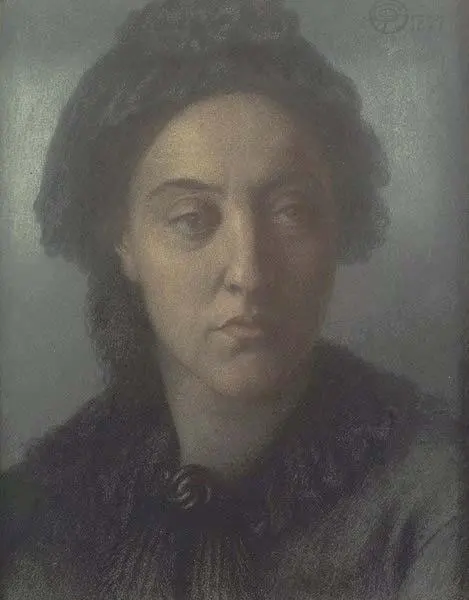
On the surface it is about a long day’s walk to an inn. But it is also an allegory: a story in which each thing stands for something else. The road is life, its up-hill climb life’s hardships, the day a lifetime, the night death, and the inn the rest that comes after death (for Rossetti, a deeply religious Christian, the welcome of heaven).
The poem, stanza by stanza
- The road and the day. The traveler asks whether the road winds (twists and bends) uphill the whole way. Yes, the guide says, to the very end. Will the journey take the whole day? From morn (morning) to night, my friend. Life is hard all the way through, and it takes the whole of our time.
- A place to rest. Is there a resting-place for the night? Yes: a roof for when the slow dark hours begin. Won’t the darkness hide it from her? No: you cannot miss that inn. Everyone reaches it: no one can miss death, and no one will miss the rest it brings.
- Others on the road. Will she meet other wayfarers (travelers on foot) at night? Yes, those who have gone before: the people who walked the road earlier, the dead. Must she knock, or call out when she can see the inn? They will not keep you standing at that door: she will be let in at once.
- Comfort and beds. Will she find comfort, being travel-sore (aching from the journey) and weak? Of labour you shall find the sum: she will find the full result, the reward, of her hard work (and its end). Will there be beds for her and all who seek (look for them)? Yea (yes, an old word), beds for all who come.
How the poem works
| Device | In the poem |
|---|---|
| Dialogue (question and answer) | the anxious long lines ask; the short, calm lines answer, like a patient guide |
| Allegory | the road, the day, the night and the inn stand for life, a lifetime, death and the rest after it |
| Rhyme | every other line rhymes: way / day, end / friend, place / face, begin / inn (abab) |
| Archaic words | morn (morning), wayfarer (traveler on foot), yea (yes): old words that make the poem sound solemn |
| Repetition | Shall I…? Shall I…?, beds… beds: the traveler’s worries pile up, and each is answered |
Who are “those who have gone before”?
Pick an answer to see why.
What does the inn stand for in the poem?
Pick an answer to see why.
Words from the poem
| Word | Meaning |
|---|---|
| wind | (said like find) to have many bends and twists: The road winds up-hill. |
| morn | morning (an old word, used in poems) |
| inn | a small hotel, usually in the country, where travelers eat and sleep |
| wayfarer | a traveler, usually on foot |
| travel-sore | aching and tired from traveling |
| seek | to look for, to try to find |
| yea | yes (an old word) |
A. Match the words
Match the words in column A with their meanings in column B.
- a.wind b. morn c. inn d. wayfarer e. seek
- i.person who usually travels on foot ii. a small hotel, usually in the country iii. to have many bends and twists iv. look for v. morning
Answer
B. Complete the summary
Complete the summary of the poem using suitable words or phrases given below: the road ahead, up-hill, someone, a place, a journey, in the affirmative, on the way, everyone, fellow travelers, an inn.
The speaker is making ……… with her guide. She asks the guide eight different questions about ……… The first question is if the road is all ……… and if the journey will take all day. The guide replies ……… Next, she asks if there is ……… to rest for the night. The guide informs the speaker that there is ……… which she won’t miss. The speaker’s fifth question is whether she will meet the other travelers ……… At the inn, the speaker asks if she should knock or call the ……… The guide replies that ……… will open the door. Lastly, the speaker asks if there will be a bed for her. The guide tells her that there are beds for ………
Answer
C. Answer the questions
How far is the road up-hill, according to the guide?
Answer
What does the speaker doubt about the place to rest?
Answer
Who has traveled the road before?
Answer
What is the speaker’s seventh question?
Answer
Who do you think opens the door?
A model answer
D. An interesting road
Write a short description of an interesting road that you have recently traveled along.
A model description
Listening: the planet that wasn’t
A. Before you listen
The picture shows Pluto, a small, pale, mottled world. The first clear photos of it were taken in 2015, when NASA’s New Horizons spacecraft flew past.
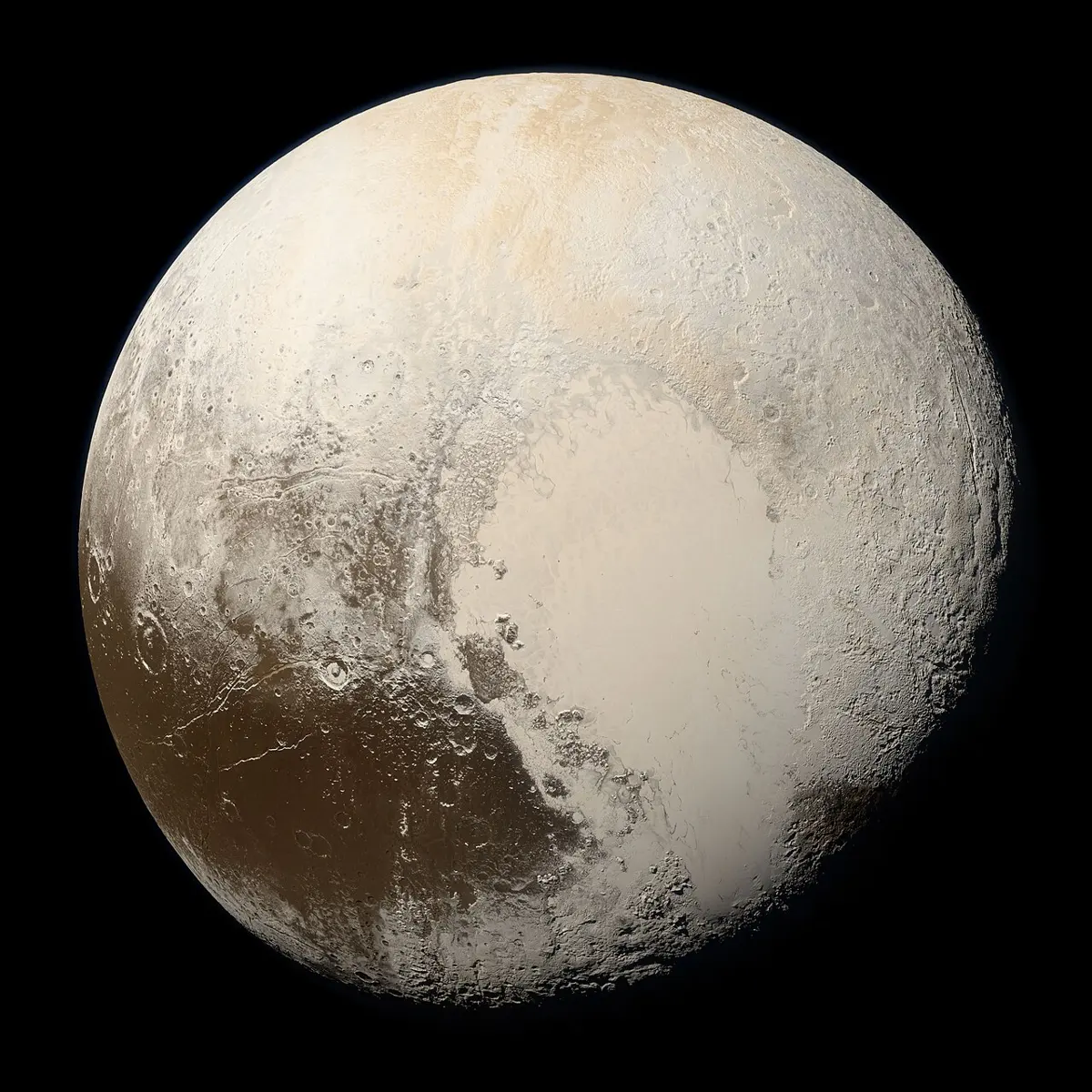
Look at the picture and answer these questions.
- a.How many planets are there in the solar system?
- b.Do you think that Pluto is a planet?
Model answers
The recording
A short talk tells the story of Pluto: found in 1930, counted as a planet for 76 years, and then, after the discovery of Eris, a world of the same size, put into a new group. Read the questions in B and C first, then listen, as many times as you need.
B. Fill in the blanks
Listen to the audio and complete the sentences with the correct words or phrases.
- a.Pluto was kicked out from the group of ……… in 2006.
- b.Pluto is made of ……… and ice.
- c.Pluto takes about 250 ……… years to complete its full orbit around the Sun.
- d.Eris was ……… in 2005.
- e.The scientists created a new category as ……… planet.
Answer
C. True or false
Listen to the audio again and say whether each statement is True or False.
- a.Pluto is smaller than the Moon.
- b.The NASA New Horizons spacecraft took almost 12 years to get very close to Pluto.
- c.Eris is about the same size as Pluto.
- d.The scientists disqualified Eris as a planet.
- e.Pluto is a member of the dwarf planet club.
Answer
D. Why is Pluto not a planet?
In August 2006, the International Astronomical Union (IAU), the world body of astronomers, met in Prague and decided, for the first time, what a planet is. A planet must pass three tests: it goes round the Sun; it is big enough for its own gravity to have pulled it into a round shape; and it has cleared its path (its orbit) of other bodies, so that it is by far the biggest thing there. A body that passes the first two but not the third is a dwarf planet.
Why is Pluto not a planet? Give your reasons.
A model answer
Which test does Pluto fail?
Pick an answer to see why.
Grammar II: prepositions that go with words
Some verbs, adjectives and nouns are always followed by one particular preposition. These are called dependent prepositions: the word decides the preposition, not the meaning of the sentence. There is no rule to work them out; learn them as pairs, like a single word: eligible for, envious of, familiar with.
| After a verb | After an adjective | After a noun |
|---|---|---|
| abide by (obey) | eligible for | an excuse for |
| depend on | envious of (jealous of) | a reason for |
| play with (a person) | estranged from (no longer close to) | a cause of |
| be entrusted with | familiar with | respect for |
| be brought up (raised) | due to (caused by) | an interest in |
| arrive in / at | afraid of, proud of, good at, interested in | an answer to |
“He is envious ……… his rich neighbor.” Which fits?
Pick an answer to see why.
“My grandmother brought me ………” Which word completes it?
Pick an answer to see why.
A. Complete the sentences
Complete the sentences with the correct prepositions from the brackets.
- a.Due ……… a traffic jam, we are late today. (with/to/at)
- b.I’m sorry. You are not eligible ……… admission to this course. (with/for/of)
- c.Look! She is playing ……… her young son. (with/to/in)
- d.The District Administration Office is entrusted ……… maintain law and order in the city. (to/with/of)
- e.He is envious ……… his rich neighbor. (with/of/off)
- f.He became estranged ……… his family after the argument. (with/from/of)
- g.You had no excuse ……… misbehaving with the clerk. (of/for/to)
- h.I’m quite familiar ……… her. (at/with/to)
- i.She was brought ……… by her grandmother. (out/in/up)
- j.Gopal left home because he did not want to abide ……… his father’s wishes. (to/with/by)
Answer
B. Circle the correct prepositions
Choose and circle the correct prepositions (in brackets) in the paragraphs below.
Mr Pandey arrived in Kathmandu (on/in) May 10 (at/on) eight o’clock (in/on) the evening. He decided to call on his uncle who lived (on/in) Bhaktapur. He got on a bus (at/of) the station and paid the fare (to/for) the conductor. The bus was very crowded, so Mr Pandey had to stand up all the way.
When he reached Thimi, Mr Pandey got off the bus and walked a short distance (in/to) the house where his uncle lived. He knocked (at/in) the door (of/on) his uncle’s house. He waited (for/during) a few minutes, but no one came (to/at) the door. He was disappointed to find no one (to/at) home. He saw a bench (at/to) the corner of the porch, and he sat down (on/in) it to wait for his uncle.
Answer
Writing II: rules for a park
Rules tell people what they must, may and must not do. They are short, clear and polite, and each one says one thing. These expressions go from the strongest to the gentlest:
| Kind of rule | Expressions |
|---|---|
| you have to | Visitors must… / are required to… / are expected to… |
| you may | Visitors can… / are allowed to… |
| you may not | Visitors must not… / cannot… / are not allowed to… |
| the strongest “no” | …is strictly prohibited. / …is forbidden. / Visitors are strictly forbidden to… |
Note the grammar: must, can, cannot + base form (must keep); be allowed / required / expected / forbidden + to + base form; is prohibited after a noun or -ing (Smoking is strictly prohibited).
Write a set of rules and regulations for the visitors in a park. Use the expressions: …is/are (not) allowed to…, …strictly prohibited/forbidden to…, …can/cannot…, …is/are required/expected to…, …must/must not…
A model set of rules
Project work: space tourism
Space tourism means traveling to space for pleasure, as a paying passenger, not as a trained astronaut doing a job. There are two kinds of trip:
- Suborbital flights: a rocket or rocket plane climbs to the edge of space and comes straight back down. The edge is usually taken as 100 km up (the Kármán line); the United States counts from 80 km, and the rocket plane flies to about 85 km. Passengers float weightless for a few minutes and see the black sky and the curve of the Earth. The whole flight takes about ten minutes (by rocket) to an hour and a half (by rocket plane).
- Orbital flights: a rocket carries passengers fast enough (about 28,000 km/h) to go round and round the Earth, for days, sometimes to a space station.
Some milestones:
| Year | What happened |
|---|---|
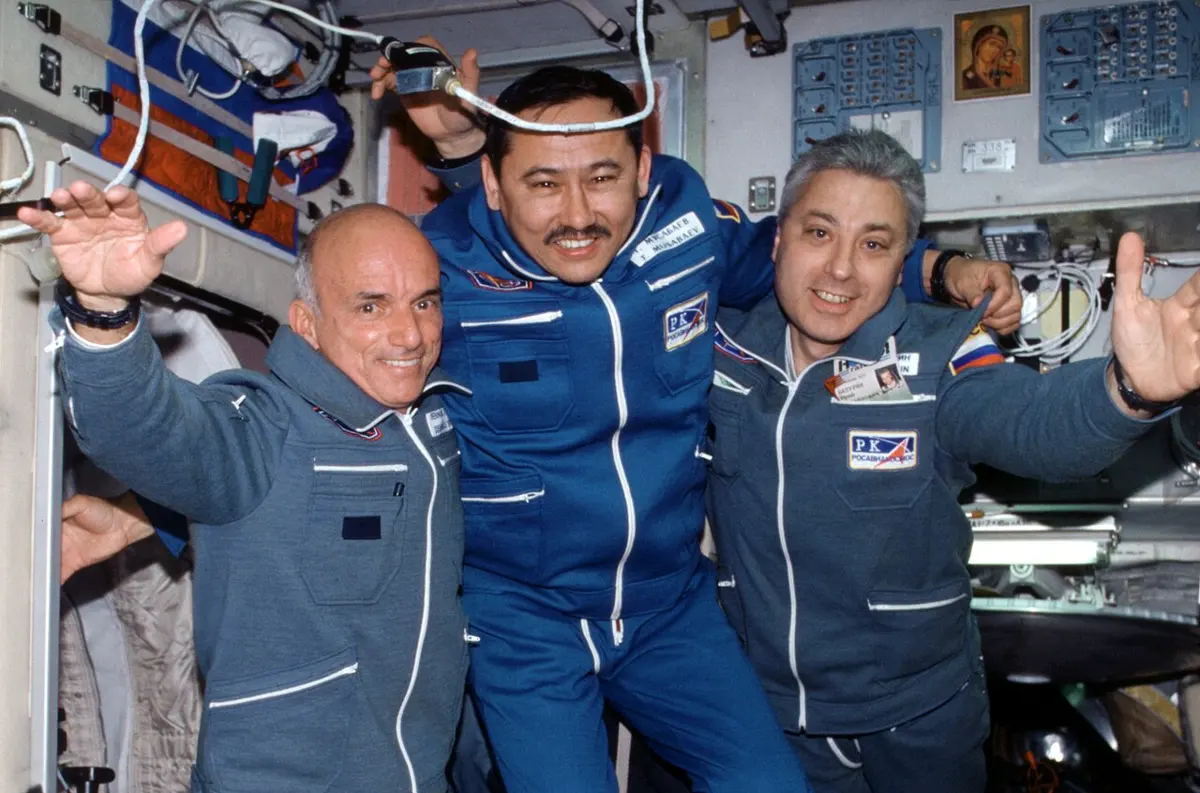
| 2001 | Dennis Tito, an American businessman, became the first paying space tourist, flying on a Russian Soyuz rocket to the International Space Station for about a week, for about US$20 million. |
| 2021 | Space tourism by private companies began: in July, Virgin Galactic’s rocket plane and Blue Origin’s rocket made their first flights with passengers to the edge of space; in September, SpaceX’s Inspiration4 took four people who were not professional astronauts round the Earth for three days. |
| 2021 | The 82-year-old pilot Wally Funk, who had trained for space in the 1960s but was never allowed to go, at last flew on Blue Origin’s rocket. |
Account writing
An account is a piece of writing that reports or describes an event or an experience: a school trip, a sports day, a flood in your village, an unusual meeting. It tells what happened, in order, with enough detail for a reader who wasn’t there, and it is usually written in the past tense. An account written for a teacher or an office is like a report; one written for a magazine or a friend can show more of the writer’s feelings.
| Part | What it does | Example |
|---|---|---|
| Heading (optional, but highly recommended) | names the reader and the purpose | To the head teacher: an account of our recent trip to Pokhara |
| Introduction | says why you are writing, with a little background: what, when, where, who | On 12 Falgun, forty students of Grade 9 went on a two-day trip to Pokhara. This account describes what we did and learned. |
| Body | the main part: the event in detail, in order; one paragraph for each subject (each place, each day, each part of the event); only details that help the reader | On the first morning we… / In the afternoon… / The next day… |
| Conclusion | restates the purpose and gives the message or lesson of the event | The trip taught us more about our country’s geography than any lesson. We thank… |
| Sign-off | Written by, the writer’s full name (or signature), and the date | Written by, Durga Thapa Magar, 20 Falgun 2082 |
Where in an account do you say what you learned from the event?
Pick an answer to see why.
Exercise
Practice on this unit in the style of the final exam. Try each one as in the exam, then open the answer.
Read the text and write True or False after each statement.
Chiring had always wanted to see the stars clearly. So last October he went with his uncle to a village above Jumla, where there are no city lights. They arrived in the evening, and after dal bhat they lay on the roof of the guest house. At first Chiring saw only a few bright stars, but after twenty minutes his eyes got used to the dark, and thousands appeared. A pale band, the Milky Way, stretched from one side of the sky to the other. His uncle pointed out Saturn, high in the south. “It hardly twinkles,” he said. “That’s how you know it’s a planet.”
- a.Chiring went to the village with his uncle.
- b.They watched the sky from the guest house roof.
- c.Chiring saw thousands of stars as soon as he lay down.
- d.The Milky Way looked like a pale band across the sky.
- e.According to his uncle, planets twinkle more than stars.
Answer
Fill in the blanks with in, at or on.
- a.Zeenat’s grandfather is ……… hospital with a broken leg.
- b.Let’s meet ……… the bus stop ……… six o’clock.
- c.There is a map of Nepal ……… the wall ……… our classroom.
- d.My cousin works ……… a tea estate in Ilam.
- e.We were ……… the air for forty minutes before we saw Lukla.
Answer
Complete with the correct prepositions.
- a.Tek is very proud ……… his little sister.
- b.Students who score above 80% are eligible ……… the scholarship.
- c.Everyone must abide ……… the rules of the game.
- d.I’m not familiar ……… this part of the city.
- e.The match was cancelled due ……… the rain.
Answer
Write the -ed endings of these verbs under /t/, /d/ or /ɪd/: watched, needed, called, laughed, started, played.
Answer
Write five rules for visitors to a school library, using must, must not, are (not) allowed to and is strictly prohibited.
A model answer
Write an account of about 120 words of a time you watched the night sky, a sunrise or a storm.
A model account
Practice every question in the book, and keep track of the ones you miss →
A companion to your textbook, not a replacement for it: study from the book your school uses, and where the two differ, follow your teacher. Found a mistake? Please tell us.