
A great scientist once sat down at his dinner table, looked at the empty plates and said, “I see that I have already eaten.” He hadn’t. His guest had. How would you describe a man like that? And how would you describe a green meadow at 3,000 meters, or a village where the guests sleep in the villagers’ own homes?
This unit is about describing places and people. You will read a short life of Sir Isaac Newton and a description of Khaptad National Park. You will race through some tongue twisters, describe a person, a place and an object, join sentences with who, which, where, whose, that and when, write a biography of Pasang Lhamu Sherpa from a page of notes, fold a leaflet about a place near you, write a set of rules, sort out a, an, the and no article at all, and learn why gonna belongs in a chat and not in an exam.
Getting started: places and people
The unit opens with four pictures, two of places and two of people. They are all from Nepal: Bhaktapur Durbar Square, with its old palace and its stone temple under a blue sky; crowds of pilgrims at the mouth of the cave at Halesi Mahadev in Khotang; Dr. Mahabir Pun, smiling in a red shirt; and Bhuwan Chand, in a green sari.
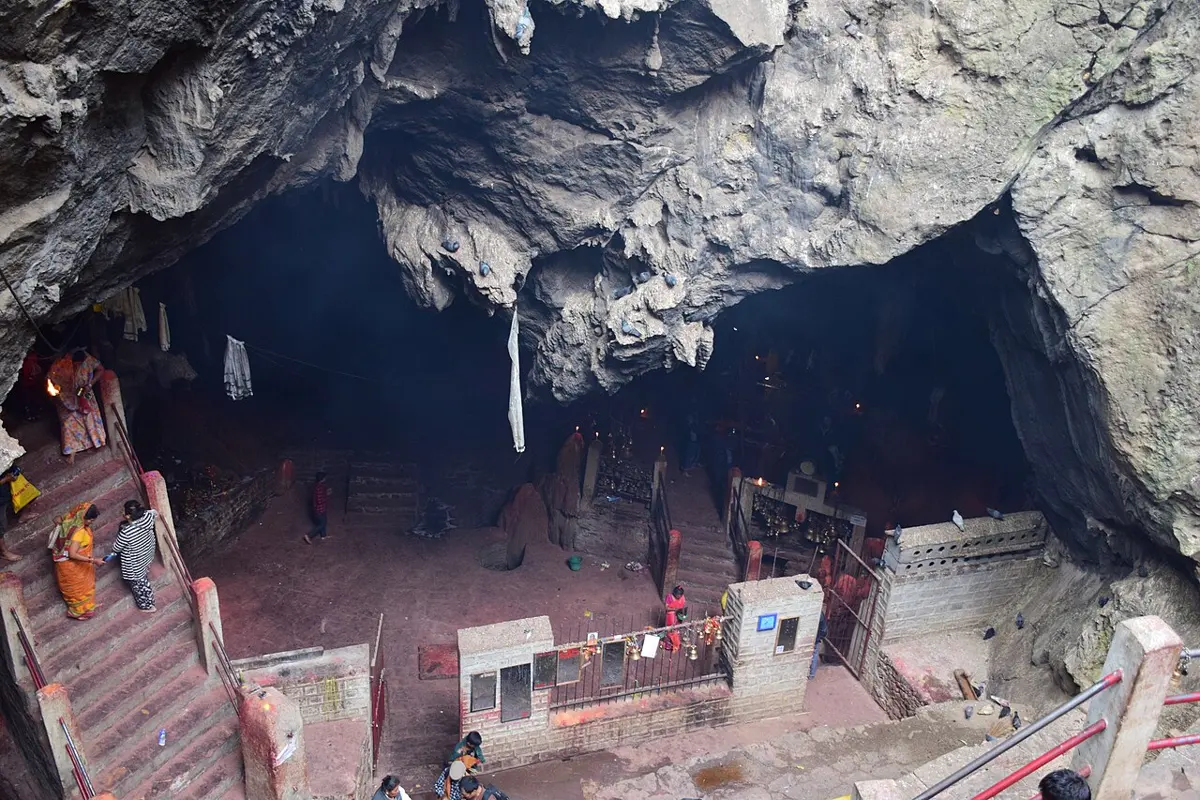
To talk about a place, say what it is, where it is and why people go there. To talk about a person, say who they are, what they look like and what they are known for.
Look at these pictures and talk about the places and the people.
Model answers
Look at the shape of those answers. Each begins with a name, then adds details, and each detail answers a question a listener might ask: Where? What does it look like? Why is it famous? A good description is exactly that.
Reading I: Sir Isaac Newton
Before you read
Who is Sir Isaac Newton?
A model answer
What is he famous for?
A model answer
What kind of text it is
This is a short biography: the story of a real person’s life, written by someone else. A biography usually moves in order of time, from birth onward, and it is written in the past tense. This one does something more. The last two paragraphs stop the timeline and tell two funny stories, because a story shows what a person was like better than a list of dates can. Stories like these are called anecdotes. You will write a biography of your own in Writing I, so notice how this one is built.
The text, paragraph by paragraph
Paragraph 1: a slow start. Newton was born in 1643 at Woolsthorpe in England. His father, a peasant (a farmer who works a small piece of land), died three months before he was born. When his mother remarried (married again), the boy went to live with his maternal grandmother (his mother’s mother). Someone tried to make a farmer of him, which interrupted his schooling, and it didn’t work. At first he seemed dull (slow to learn) and took little interest in his lessons. But his hands were busy. He built small machines, such as windmills, and he even caught mice to run them.
Paragraph 2: Cambridge. In 1661, at eighteen, he went to Cambridge University and studied mathematics and science. He began making discoveries in mathematics while still a student, and he went on after his degree. He became a Professor of mathematics when he was only 26.
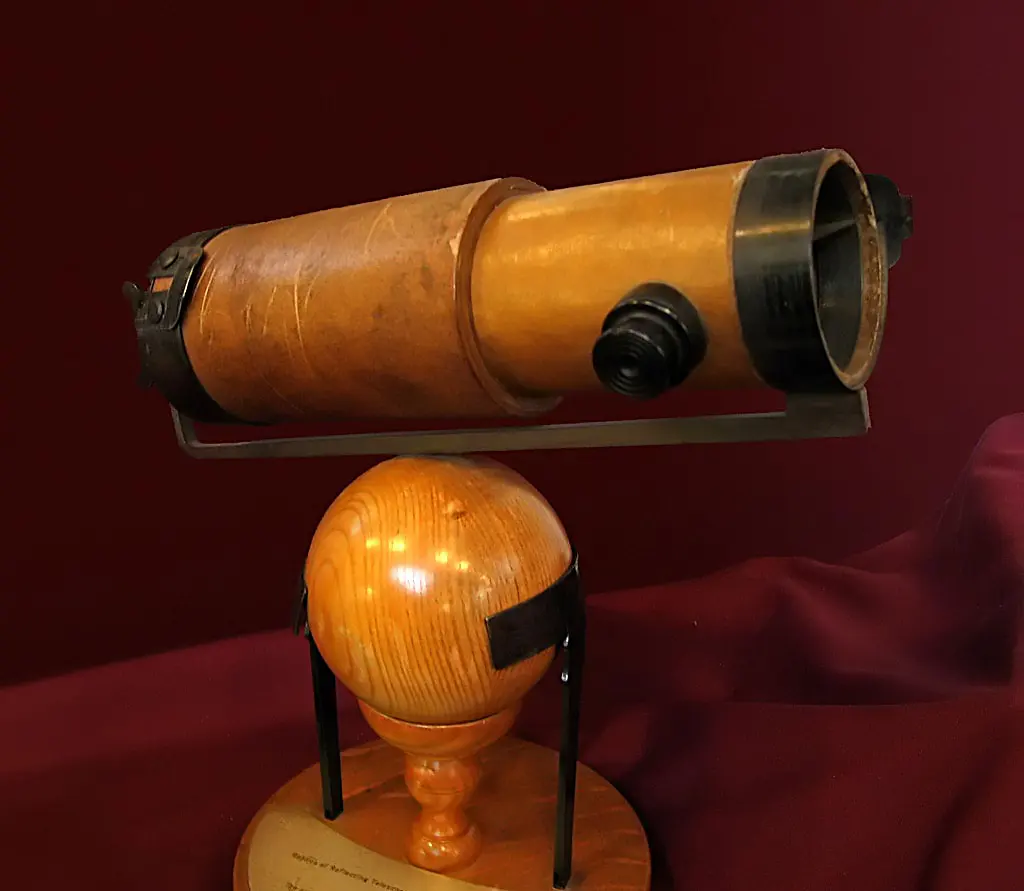
Paragraph 3: light and telescopes. He didn’t stop at mathematics. He became very interested in how light behaves, and that led him to improve the telescope. The lenses of his day weren’t as good as ours. Newton showed that curved mirrors could do the job of lenses, and in some ways do it better. Such telescopes have been used ever since.
Paragraph 4: the apple. The story goes that an apple fell while he was sitting under a tree, and he began to wonder (to ask himself) why it fell down and not up. After long thought he reached his theory of gravitation: every body attracts every other. The Sun and the Earth pull on each other. So do the Moon and the Earth, and that is why the Moon stays near us and doesn’t rush away.
Paragraph 5: the missing host. Newton’s head was so full of problems that he was often lost in thought, and then he forgot his meals and his friends. Stories of his absent-mindedness (forgetting what is around you because you are thinking of something else) are many. Once, while entertaining guests at dinner (giving them food and company at home), he left the room to fetch more food. He didn’t come back. At last they went to look for him, and they found him at his studies, with the guests and the food both forgotten.
Paragraph 6: the eaten dinner. Another time, he invited a friend and wasn’t at home when the friend came. The hungry guest sat on a couch (a sofa), looking at the food on the table, and at last he ate alone. Hours later Newton came home, puzzled (confused) to find a visitor. Then he remembered, and he apologized (said sorry). He turned to the table, saw the used plates, and said he was sorry, because he seemed to have eaten his dinner already.
Why does the writer end with the dinner stories?
Pick an answer to see why.
Why, according to the text, does the Moon stay near us?
Pick an answer to see why.
Words from the text
Words linked here open in English Vocabulary, where you can see an example and practice them in the word game. The meanings below are the ones the words have in this text.
| Word | Meaning here |
|---|---|
| peasant | a farmer with a small piece of land |
| maternal | on your mother’s side of the family |
| interrupted | stopped for a time; made something discontinue |
| dull | slow to learn (it can also mean boring, without interest or excitement) |
| wonder | to ask yourself about something (as a noun: a feeling of amazement and admiration) |
| gravitation | the force that pulls bodies towards one another |
| gravity | the same force, especially the Earth’s pull |
| absent-minded | forgetful, because you are thinking of something else |
| host | a person who receives other people as guests; as a verb, to receive guests or hold an event |
| couch | a sofa |
| puzzled | unable to understand; confused |
| apology | saying sorry; the verb is apologize |
| curved | bent smoothly, not straight |
A. Match the words
Match the words in column A with their meanings in column B.
| Column A | Column B | ||
|---|---|---|---|
| a. | apology | i. | forgetful |
| b. | absent-minded | ii. | unable to understand; confused |
| c. | couch | iii. | made something discontinue |
| d. | curved | iv. | a person who receives other people as guests |
| e. | dull | v. | the force of attraction |
| f. | gravity | vi. | a feeling of amazement and admiration |
| g. | host | vii. | lacking interest or excitement |
| h. | interrupted | viii. | a bent line; not a straight line |
| i. | puzzled | ix. | sofa |
| j. | wonder | x. | saying sorry |
Answer
B. Complete the sentences
Choose the correct words/phrases from the box to complete the following sentences.
gravitation, absent-mindedness, interrupted, couch, telescopes, curved, dull, hosted, tired of
- a.The construction work got ……… because of the heavy rain.
- b.Newton used curved mirrors in ……… instead of lenses.
- c.My grandmother keeps forgetting things. She is suffering from ……… .
- d.Anisha came into my room and sat on the ……… .
- e.Please draw a ……… line on the white board, not a straight one.
- f.Particles are attracted to each other by ……… .
- g.Newton was a ……… boy in his childhood.
- h.My friend ……… a birthday party yesterday.
- i.I got ……… working the whole day. I want to rest for some time.
Answer
C. True or False
Read the text again and write whether the following statements are True or False.
- a.Sir Isaac Newton’s father was a lawyer.
- b.Newton received his father’s affection during his childhood.
- c.In the beginning, Newton was not good at his studies.
- d.The fallen apple helped Newton develop the theory of gravitation.
- e.Newton’s mind always remained full of problems and thoughts.
- f.He lived with his wife and children in his later years.
Answer
D. Answer the questions
How was Newton in his studies in the early life?
Answer
Which subjects did Newton study at Cambridge University?
Answer
What changes did Newton make to telescopes?
Answer
Why do you think Newton forgot his food and friends at times?
A model answer
E. Other discoveries
Find some other discoveries Newton has made.
A model answer
Pronunciation: tongue twisters
A tongue twister is a sentence that is hard to say quickly, because similar sounds are packed close together. People say them for fun, and actors and news readers say them as practice. They train your tongue to move cleanly from one sound to the next.
| Tongue twister | The sounds that fight | |
|---|---|---|
| a. | She sells seashells by the seashore. | s and sh |
| b. | Katie caught the kitten in the kitchen. | k and ch (the tch of kitchen) |
| c. | I scream, you scream, we all scream for ice cream. | where one word stops and the next starts |
| d. | Smelly shoes and socks shock Simon. | s and sh, again |
| e. | Fred fed Ted bread and Ted fed Fred bread. | f, t and br, all with a short e |
Speaking: describing a person, a place, an object
A. Person, place or object?
Three students are each describing something. Each uses different kinds of detail.
Read what the people are saying and identify whether they are describing a person or a place or an object.
- a.“Ratna is a fifteen-year-old girl. She has an oval face. She has curly hair. She looks like her mother.”
- b.“The car is big and green. It looks like a Mercedes car.”
- c.“It’s a beautiful city with many ponds. It has a famous temple called Janaki temple.”
Answer
Here are the words you need, whatever you describe.
| To describe | Say | Useful patterns |
|---|---|---|
| a person | age, face, hair, height, clothes, character, who they look like | She is a … -year-old girl. She has … hair. He looks like … . She is wearing … . |
| a place | what kind of place, where it is, what it has, why it is famous | It’s a … city/village. It lies in … . It has … . It is famous for … . |
| an object | size, color, shape, what it is made of, what it is for | It is big and … . It is made of … . It looks like … . It is used for … . |
Look like is the key phrase. She looks like her mother compares two faces. What does she look like? asks you to describe someone’s appearance. What is she like? is different: it asks about her character.
A friend asks, “What is your new teacher like?” Which is the best answer?
Pick an answer to see why.
B. Describe the pictures
Here are four more pictures to describe: the white Maya Devi Temple at Lumbini, with its reflection in a pond; a busy market street with shops and a city mall; two trekkers with big backpacks; and a smiling student with a school bag.
Describe the following pictures.
Model answers
Grammar I: relative clauses
Short sentences sound like a list. Good describers join them, and English has a set of small words for that job. Study how the second sentence is folded into the first.
Read the following pairs of sentences and study how they are combined into a single sentence.
- a.This is the room. I keep my computer there. → This is the room where I keep my computer.
- b.I am looking for the person. He sent me this mail. → I am looking for the person who sent me this mail.
- c.Eva doesn’t like the presents. Owen has given them. → Eva doesn’t like the presents which Owen has given.
What happened
The part that describes the noun is a relative clause, and the joining words are relative pronouns (where and when are strictly relative adverbs, but they do the same job).
| Word | Use it for | It stands for | Example |
|---|---|---|---|
| who | a person | he, she, they | the guide who met us at the gate |
| whom | a person, as the object | him, her, them | the guide whom we thanked (who is fine in speech) |
| which | a thing or an animal | it, they, them | the bus which goes to Dhulikhel |
| that | a person or a thing, never after a comma | any of these | the bus that goes to Dhulikhel |
| whose | belonging to | his, her, its, their | the boy whose kite got stuck |
| where | a place | there | the shop where I buy my pens |
| when | a time | then | the year when my sister was born |
To join two sentences, take three steps.
- Find the two words that mean the same thing (the shop … there).
- Take the word out of the second sentence, and choose the relative word for it.
- Put the clause straight after the noun it describes.
With commas or without?
This is the new step in Grade 8. Some relative clauses tell you which one we mean. Others add an extra fact about something already clear.
| Tells you which one | Adds an extra fact | |
|---|---|---|
| Example | The boy who sits by the window is my cousin. | Mount Everest, which lies on Nepal’s border, is the highest mountain. |
| Take it away | We no longer know which boy. | We still know the mountain. |
| Commas | no commas | commas on both sides, or one if the clause ends the sentence |
| that? | yes | never |
Names are the easy test. A name already says who or what, so a clause after a name is almost always extra: Sonam, who lives upstairs, plays the guitar.
Two more things to know.
After anything, everything, nothing, all, use that, not which: Everything that she said was true. You can also leave it out: Everything she said was true.
Which can point to a whole sentence, and then it needs a comma: Our team won the cup, which surprised everybody. Here which doesn’t mean the cup. What surprised everybody is that the team won.
“I know a farmer ……… buffaloes won a prize at the fair.” Which fits?
Pick an answer to see why.
“Rara Lake, ……… is in Mugu, is the largest freshwater lake in the Nepal Himalaya.” Which fits?
Pick an answer to see why.
“I’ll never forget the night ……… the lights went out.” Which fits?
Pick an answer to see why.
B. Fill in the relative word
Complete the following sentences with the correct relative pronouns: who, where, whose, which, that, and when. You may use some of them more than once.
- a.The couple ……… live next door have six grandchildren.
- b.The house, ……… is painted red, is mine.
- c.The woman ……… house was broken into called the police.
- d.The car ……… my uncle bought is quite comfortable.
- e.This is the school ……… I study now.
- f.This is the place ……… I was born and brought up.
- g.My uncle, ……… is in the army, came to see us.
- h.We have a friend ……… plays the madal well.
- i.Is there anything ……… I can do to help you?
- j.She remembered the day ……… she met her husband for the first time.
Hint
Answer
C. Join the sentences
Join the following pairs of sentences using suitable relative pronouns.
- a.We know the woman. She donated this money.
- b.We walked past my old school. It is celebrating its 50th anniversary this month.
- c.I met the woman yesterday. I had helped her last month.
- d.A new headteacher is going to be appointed next month. It is good.
- e.Bring me the file. The file is on the table.
- f.This is the player. The committee appointed him captain.
- g.We met a girl. The girl has lost her way.
- h.This is the house. Naresh built it.
- i.Mandy is the girl. I am using her car today.
Answer
Writing I: a biography
A biography doesn’t begin with a blank page. It begins with notes, and your job is to turn them into sentences that flow. Here are the notes on Pasang Lhamu Sherpa, the first Nepali woman to climb Mount Everest.
| When | What |
|---|---|
| Birth | Solukhumbu, on 16 December 1961 |
| Early age | grew up in a mountaineering family; started to climb mountains in her teens |
| At the age of 17 | went to Kathmandu with Lhakpa Sonam Sherpa, the man she loved; together they ran a travel agency |
| 1989 | first climbed Mount Pisang (6,091 m), then Mont Blanc (4,807 m); failed on Mount Everest, reaching only 8,000 m |
| 1991 | made two attempts on Mount Everest, but could reach only 8,750 m and 8,500 m |
| 22 April 1993 | reached the top of Mount Everest |
| Death | 22 April 1993; died in bad weather while climbing down |
| Honors | National Hero; a highway and a mountain named after her |
How to turn notes into a biography:
- Open with who she was and why she matters, in one or two sentences.
- Go in order of time, with the past tense: was born, grew up, went.
- Join the notes. Use who, which, where; use time words such as at the age of 17, in 1989, two years later, at last.
- Choose what to stress. Don’t give each note the same weight. Here, the tries on Everest are the story.
- Close with what she left behind.
| The notes | A sentence |
|---|---|
| Birth: Solukhumbu, 16 December 1961 | She was born in Solukhumbu on 16 December 1961. |
| grew up in a mountaineering family | She grew up in a family of mountaineers, and she began climbing in her teens. |
Study the information above about Pasang Lhamu Sherpa, the first Nepali woman to scale Mt. Everest. Write a short biography of her based on the given information.
A model biography
Reading II: Khaptad National Park
Before you read
What is a national park?
A model answer
Name some national parks of Nepal.
A model answer
What kind of text it is
This is a description of a place, written to inform visitors. Unlike a story, it isn’t in order of time. It is in order of topic, with headings (Background, Features) and a box of rules. You don’t have to read such a text from top to bottom: you can go straight to the part you need. It is mainly in the present tense, because these things are true now.
The text, part by part
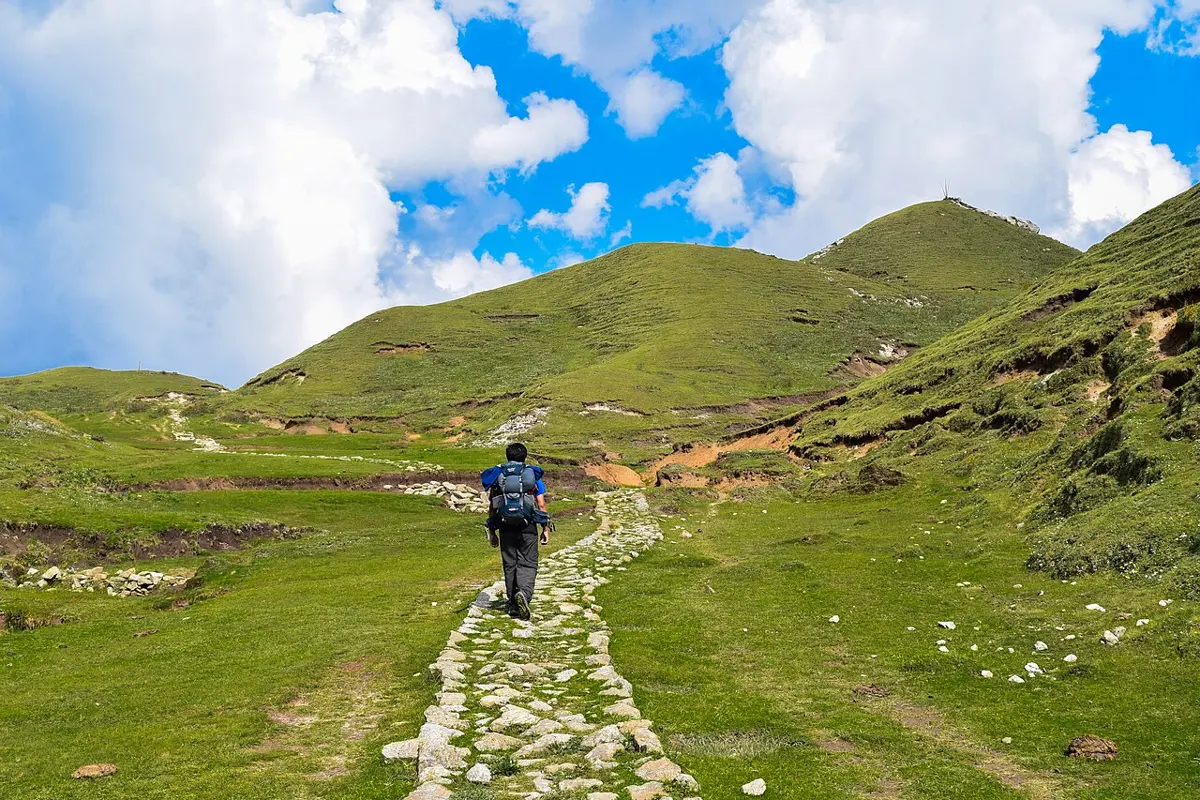
Background. The park was set up in 1984. It lies in the mid mountains of Sudurpaschim Province, covers 225 square kilometers of pastures (grassland for animals) mixed with coniferous forest (trees with cones and needle-like leaves, such as pine and fir), and takes in parts of four districts: Bajura, Bajhang, Achham and Doti. Its average height is about 3,000 meters.
Features: the grasslands. It is spectacular (very beautiful to see) and pristine (still as nature made it), with rich biodiversity (a variety of animals and plants). There are 22 patches of grassland on gentle hills, which local people call patans. In summer they give ample (more than enough) grazing for cattle, so they support local livelihood (how people earn their living). They flower from June to August. A small lake, Khaptad Daha, lies on a patan, and it is the best place for aquatic birds (birds of water) and migratory ones (birds that fly to a different place each season).
Features: the holy places. Thousands of pilgrims come each year. Three places are the most popular: Khaptad Baba Ashram, near the park headquarters and named after the late Khaptad Swami, a renowned (famous) saint; Triveni, a Shiva temple at the confluence of three rivers (the place where they meet), on the way to the headquarters, with a fine view and other old temples; and Sahashra Linga, the highest point of the park, at 3,276 meters. Holy days bring crowds of pilgrims to worship Shiva: Ganga Dashahara is marked at Triveni, and Janai Purnima brings them too. Other holy places are Ganesh temple, Nagdhunga and Kedardhunga. These are places for meditation and tranquility (peace and quiet), so tobacco, alcohol and animal sacrifice are not allowed there.
Features: the living things. The park is rich in flora and fauna (plants and animals).
| What the text names | |
|---|---|
| Main trees | sal, pine, alder; on the plateau, sub-alpine plants (those just below the high mountain zone): fir, oak, birch, rhododendron |
| Grassland flowers | primulas, buttercups, wild berries; the park also harbors (holds, and lets grow) many medicinal herbs |
| Birds | 266 species, counting migratory birds: Dhanphe, flycatcher, bulbul, cuckoo, eagle |
| Small creatures | butterflies, moths, insects |
| Mammals | about 23 species: barking deer, wild boar, ghoral, black bear, yellow-throated marten, rhesus and langur monkeys; also common leopard, wolf, wild dog, jackal, musk deer |
The box: Park Regulations. This part isn’t description: it tells visitors what to do. Look at the language, because you will need it in Writing II.
| Rule | In short |
|---|---|
| Entry fee | Rs. 1,500 for foreigners, Rs. 500 for SAARC nationals, Rs. 100 for Nepalis |
| Permit | Entering without one is illegal |
| Filming | Needs a special permit from the Department of National Parks and Wildlife Conservation (DNPWC) |
| Filming fee | $1,500 for foreigners, Rs. 50,000 for SAARC nationals, Rs. 10,000 for Nepalis, paid at DNPWC; 25% more with drones |
| Plants and animals | Don’t remove or damage them: all are fully protected |
| Rubbish | Carry it out, or bury or dispose of it in designated areas (places chosen for that) |
| Holy places | Respect them |
| Camping | Only in designated areas |
These are the fees in the text. Fees change, so a visitor should check with the park before going.
Why are tobacco and alcohol prohibited at the holy places?
Pick an answer to see why.
“Dhanphe, bulbul and cuckoo” are examples of the park’s ……… .
Pick an answer to see why.
Words from the text
| Word | Meaning here |
|---|---|
| pasture | land covered with grass, for animals to eat |
| coniferous | of trees with cones and needle-like leaves |
| spectacular | very beautiful and impressive |
| pristine | fresh and untouched, as nature made it |
| biodiversity | the existence of a variety of animals and plants |
| ample | more than enough |
| aquatic | growing or living in, on or near water |
| confluence | the place where rivers meet and become one |
| tranquility | the state of being quiet and peaceful |
| flora and fauna | the plants and animals of a place |
| harbor | to contain something and allow it to develop |
| documentary | a film or program giving facts about something |
| designated | chosen for one purpose |
A. Match the words
Match the words in column A with their meanings in column B.
| Column A | Column B | ||
|---|---|---|---|
| a. | pastures | i. | the state of being quiet and peaceful |
| b. | biodiversity | ii. | a film or program giving facts about something |
| c. | aquatic | iii. | the existence of a variety of animals and plants |
| d. | confluence | iv. | land covered with grass |
| e. | tranquility | v. | to contain something and allow it to develop |
| f. | documentary | vi. | growing or living in, on or near water |
| g. | harbor | vii. | the place where rivers meet and become one |
Answer
B. Fill in the gaps
Fill in the gaps with correct information from the text.
- a.Khaptad National Park comprises ……… patches of grassland.
- b.The religious sites in the national park are visited by thousands of ……… every year.
- c.A tourist from Pakistan should have to pay ……… as entry fee.
- d.The highest point of the national park is ……… situated at the height of 3,276 meters.
- e.Many pilgrims make a holy visit to ……… Janai Purnima.
Answer
C. Answer the questions
What type of forest can be found in Khaptad National Park?
Answer
How have the patans supported local people around the national park?
Answer
Where is the Shiva temple?
Answer
After whose name is the national park named as Khaptad National Park?
Answer
If anyone is interested in shooting a film in the national park, how much money s/he has to pay?
Answer
Make a list of the flora and fauna found in the national park.
Answer
D. Your own visit
If you visited Khaptad National Park, which thing would you enjoy the most? Why?
A model answer
Writing II: a leaflet and a set of rules
A. A leaflet
A leaflet is one sheet of paper, often folded, that tells people about a place, an event or a service. Nobody has to read it, so it must catch the eye and get to the point: a bold title, a picture, short headings and short lines. It often speaks to the reader directly: Come early. Bring warm clothes.
A leaflet about a place answers five questions, and these make good headings.
| Guideline | The reader’s question | Example heading |
|---|---|---|
| Introduction and location | What is it, and where? | Welcome to … |
| Major attractions | What will I see and do? | Don’t miss |
| How to get there | How do I reach it? | Getting there |
| Provisions and requirements | What is there, and what must I bring or pay? | Before you come |
| Suitable time to visit | When is it best? | When to come |
You might have a religious/historical/natural place in your district or locality. Make an attractive leaflet about the place based on the guidelines given below.
- Introduction and location of the place
- Major attractions
- How to get there
- Provisions and requirements
- Suitable time to visit the place
A plan
B. A set of rules
A place’s rules are short, clear and firm. The Park Regulations you read are an example. Use a mix of patterns, so that the list doesn’t sound like one sentence said ten times.
| Pattern | Example |
|---|---|
| … is/are strictly prohibited | Plastic bags are strictly prohibited. |
| … is/are not allowed to … | Visitors are not allowed to climb on the walls. |
| … is/are supposed to … | Visitors are supposed to walk on the marked paths. |
| Don’t + verb | Don’t feed the monkeys. |
| Verb-ing … is not entertained | Bargaining at the ticket office is not entertained. |
Write a set of rules to be followed in the place you have selected in exercise A above using the following clues.
……… is/are strictly prohibited … allowed to/supposed to … don’t + infinitive … V-ing … is not entertained …
A model set of rules
Which rule is written correctly?
Pick an answer to see why.
Grammar II: articles
A, an and the are the smallest words in a description, and for a speaker of Nepali the hardest, because Nepali has nothing like them. You met them in Grades 6 and 7. Here they are all together, as three questions to ask.
Question 1. Do we both know which one? Then use the. That covers things already mentioned (I bought a pen. The pen leaks.), the only one of its kind (the Sun, the king of a country), a superlative (the tallest girl), and a noun that the words after it pick out (the shop where I work).
Question 2. If not, is it one countable thing? If not, use no article. This covers plurals in general (Cats sleep a lot.), things you can’t count (Milk is good for you.), meals (have breakfast), sports and games (play volleyball), and most names (Pokhara, Nepal).
Question 3. If it is, what is its first sound? A vowel sound takes an, and a consonant sound takes a. Go by the sound, and not by the letter:
| Written with | Sounds like | So |
|---|---|---|
| h that isn’t said | our | an hour, an honest man |
| u said you | you-niform | a uniform, a university |
| o said wun | wun | a one-rupee coin |
| a letter that starts with a vowel sound | em, es, ex | an MP, an X-ray |
Three fixed habits to learn:
| Habit | Examples |
|---|---|
| the with musical instruments, after play | play the madal, play the flute |
| a or an in once upon a time, a piece of, half an hour, twice a week | a piece of bread |
| a when a meal has an adjective | We had a quick lunch. |
The article goes by the sound of the next word, even when that word is an adjective. So it’s a uniform, but an old uniform; an honest man, but a very honest man.
“My cousin has just joined ……… university in Pokhara.” Which fits?
Pick an answer to see why.
“We go to bed after ……… dinner.” Which fits?
Pick an answer to see why.
A. a, an, the or nothing
Put ‘a’, ‘an’ or ‘the’ to complete the sentences. Put a cross (✗) if an article is not needed.
- a.I’d like to ask you ……… question now.
- b.It is ……… nice day today, isn’t it?
- c.Where is ……… tallest statue of Lord Shiva located?
- d.The boys are playing ……… football in the backyard.
- e.She is ……… intelligent girl.
- f.Do you want to go to ……… restaurant where we first met?
- g.My father bought ……… new TV set yesterday.
- h.I live in ……… old house. ……… house needs to be repaired.
- i.Would you like to have ……… piece of cake?
- j.Sharmila can play ……… guitar well.
- k.We usually have ……… lunch at 12:30.
Answer
B. Complete the paragraphs
Put ‘a’, ‘an’ or ‘the’ to complete the paragraph.
You’ve probably learned ……… rule that ……… comes before ……… vowel, and that ……… comes before ……… consonant. While this is generally true, it is more accurate to say that ……… comes before ……… vowel sound, and ……… comes before ……… consonant sound. The can be used with both singular and plural nouns, with nouns of any gender, and with nouns that start with any letter. The is ……… most commonly used word in ……… English language.
Hint
Answer
Put ‘a’, ‘an’ or ‘the’ to complete the paragraph.
Once upon ……… time, there was ……… old farmer. He was honest and helpful. Once, the whole village was affected by famine. People remembered ……… old farmer. He helped ……… villagers by providing food and shelter. This news reached ……… king. He invited ……… old farmer and gave him ……… golden stick as ……… gift for his honesty and help to ……… villagers during hard times.
Answer
Listening: a village of homestays
A short talk describes Sirubari, a village in Syangja. Read the questions in B and C first. CDC hasn’t put this recording online, so listen to it in class, and use the questions here to get ready.
Words to know: homestay (a visitor’s stay in a family’s own home), community-based (run by the people of a place together), heritage (the customs and buildings handed down from the past), unspoiled (not changed for the worse), accommodation (a place to stay), sightseeing (visiting interesting places), lodging (a room for the night), pioneer (the first to do something new).
A. Before you listen
The picture for this task shows a hill village of low stone houses with slate roofs, with a white snow peak rising behind it.
What do you see in the picture?
A model answer
What do you think the name of the place is?
A model answer
B. Fill in the blanks
Listen to the audio and fill in the blanks with missing words or numbers.
- a.Sirubari village lies in the ……… of Pokhara.
- b.Sirubari introduced the concept of community-based ……… in Nepal.
- c.It takes about ……… hours by bus to reach Sirubari from Pokhara.
- d.The Tourism Management Committee welcomes tourists and manages sightseeing and ……… for them.
- e.Tourists are provided with food and lodging facilities at the villagers’ own ……… .
Answer
C. Choose the correct answers
a. When did Sirubari begin community-based tourism?
Pick an answer to see why.
b. How long does it take for the trekkers to reach Sirubari from Nagdanda?
Pick an answer to see why.
c. Why do you think tourists visit Sirubari village homestay?
Pick an answer to see why.
d. Why was Sirubari village tourism honored with the PATA Gold Award?
Pick an answer to see why.
D. Your own homestay
Share a real or an imaginary experience of visiting a homestay and spending time there with your friends.
A model answer
Project work
A description of a famous place uses all you have learned: facts in a good order, details that a reader can see, and relative clauses to join them.
Extra bit: informal expressions
Spoken English runs words together. Going to turns into gonna, and want to into wanna. People also write these in chats and songs, so you need to recognize them. But they are for friends, and not for exam papers.
| Informal | Standard | Informal | Standard |
|---|---|---|---|
| coz | because | lemme | let me |
| doc | doctor | lotta | a lot of |
| gimme | give me | outta | out of |
| gonna | going to | sorta | sort of |
| gotcha | got you | uni | university |
| gotta | got to | wanna | want to |
| hadda | had to | kinda | kind of |
Which sentence would suit a letter to your head teacher?
Pick an answer to see why.
Exercise
Practice on this unit in the style of the final exam. Try each one as in the exam, then open the answer.
Read “Sir Isaac Newton” again and write True or False.
- a.Newton’s father died before Newton was born.
- b.His grandmother on his father’s side brought him up.
- c.Newton made little machines when he was a boy.
- d.He became a professor at the age of 26.
- e.His friends found him at his studies when he forgot them at dinner.
Answer
Read “Khaptad National Park” again and complete the sentences with the correct words or numbers.
- a.The park was established in ……… .
- b.It covers an area of ……… square kilometers.
- c.The grasslands are locally called ……… .
- d.The park is reported to have ……… bird species.
- e.Camping is allowed only in ……… areas.
Answer
Read the leaflet and answer the questions.
VISIT DEURALI COMMUNITY FOREST! Only 40 minutes’ walk from Ratopul Bazaar, this forest, which local women have looked after since 1998, is home to deer, monkeys and over 80 kinds of birds. Come for the sunrise tower, where you can see the whole valley. Open every day from 6 a.m. to 5 p.m. Entry: Rs. 50, and free for students in uniform. Plastic bags are strictly prohibited. Don’t light fires. The best months are March and April, when the rhododendrons are in flower. — A made-up text, for practice
- a.How far is the forest from Ratopul Bazaar?
- b.Who has looked after the forest?
- c.What can you see from the tower?
- d.How much does a student in uniform pay?
- e.When is the best time to visit, and why?
Answer
Choose and copy the best answer for each numbered blank.
Pushpa is (a) ……… (a, an, the) honest girl (b) ……… (who, whose, which) lives near (c) ……… (a, an, the) river Bagmati. Her school, (d) ……… (that, which, where) is two hours away, has no bus. She walks there with her friend, (e) ……… (who, whose, whom) father drives a tempo.
Answer
Identify ten errors in the given paragraph. Rewrite the paragraph by correcting the errors.
newton who was born in england asked why dont apples fall upward
Answer
Write a short biography of about 100 words of Mahabir Pun, using the notes.
Home: Nangi, a village in Myagdi. School: founded Himanchal High School there, with computers. Idea: to connect far-off villages by wireless internet. Nepal Wireless Networking Project: began in Nangi, and grew to more than 175 villages in 15 districts. 2007: the Magsaysay Award, for community leadership. 2012: led the setting up of the National Innovation Center.
A plan
Write a letter to a friend abroad, describing a place in Nepal that you love and inviting your friend to see it.
Hint
A plan
Printable PDFs
- Study notes 3 pages
- Harder practice questions 3 pages Answer key
Practice every question in the book, and keep track of the ones you miss →
A companion to your textbook, not a replacement for it: study from the book your school uses, and where the two differ, follow your teacher. Found a mistake? Please tell us.