
Squeeze a drop of hand sanitizer onto your palm and it feels cold, then vanishes in seconds. Rub a cut with surgical spirit and it stings. Open the cap of a bottle of raksi and the smell reaches the next room. All three are doing the same thing: a liquid called ethanol is evaporating, and ethanol is the best known of a large family of compounds, the alcohols. Its relatives are just as familiar once you know their names: methanol, a fuel and solvent that blinds and kills when it is passed off as drink; propan-2-ol, the “isopropyl alcohol” in many sanitizers; ethane-1,2-diol, the antifreeze in a car’s radiator; and glycerol, the sweet, sticky liquid in soap, toothpaste and cough syrup.
Nepal makes ethanol by the tank load. The country’s sugar mills crush sugarcane from the Tarai, and the thick brown syrup left over, molasses, goes to distilleries that ferment it with yeast. From 2026 that ethanol has a new use: the government now allows Nepal Oil Corporation to blend up to 10% of it into imported petrol. This unit explains what alcohols are, how they are named and made, why ethanol mixes with water while petrol doesn’t, and the reactions that turn an alcohol into almost any other organic compound. It ends with the tests that tell one alcohol from another, including the one in a police breathalyzer.
10.1 Introduction
Take a hydrocarbon and replace one of its hydrogen atoms by an –OH group, the hydroxyl group. The compound you get is an alcohol:
So an alcohol is a compound in which one or more hydroxyl groups are bonded to a carbon atom of an alkyl group (a saturated, sp³ carbon). Its general formula is R–OH, where R is an alkyl group. In the common system an alcohol is named alkyl alcohol; in the IUPAC system it is an alkanol, from the alkane’s name with its final -e changed to -ol:
| Formula | Common name | IUPAC name |
|---|---|---|
| R–OH | alkyl alcohol | alkanol |
| CH₃–OH | methyl alcohol | methanol |
| CH₃–CH₂–OH | ethyl alcohol | ethanol |
| CH₂(OH)–CH₂(OH) | ethylene glycol | ethane-1,2-diol |
| CH₂(OH)–CH(OH)–CH₂(OH) | glycerol (glycerine) | propane-1,2,3-triol |
The –OH must be on an alkyl (sp³) carbon. When it sits directly on a benzene ring, as in C₆H₅–OH, the compound is a phenol, which behaves quite differently Grade 12: Unit 11; and an –OH on a C=C carbon (an enol) rearranges at once to a carbonyl compound, as you saw in the hydration of ethyne in Grade 11.
The alcohols with one –OH group and an open, saturated chain form a homologous series, CH₃OH, C₂H₅OH, C₃H₇OH…, with the general formula CₙH₂ₙ₊₁OH, which is the same as CₙH₂ₙ₊₂O: the alkane’s formula with one oxygen added.
Which of these is not an alcohol?
Pick an answer to see why.
10.2 Nomenclature, isomerism and classification of monohydric alcohols
10.2.1 Classification
By the number of –OH groups. Alcohols are first sorted by how many hydroxyl groups a molecule has (Figure 10.1):
- a.Monohydric alcohols have one –OH group: CH₃–OH, CH₃–CH₂–OH.
- b.Dihydric alcohols (diols, or glycols) have two –OH groups, on different carbons: ethane-1,2-diol (ethylene glycol), CH₂(OH)–CH₂(OH).
- c.Trihydric alcohols (triols) have three –OH groups, on different carbons: propane-1,2,3-triol (glycerol), CH₂(OH)–CH(OH)–CH₂(OH).
Alcohols with more –OH groups are polyhydric; sorbitol, the sweetener in sugar-free chewing gum, has six.
By the carbon carrying the –OH. A monohydric alcohol is also classified by the kind of carbon the –OH is on, exactly as the carbons of an alkane are (Grade 11, Unit 14), counting the other carbon atoms bonded to that carbon (Figure 10.2):
- a.Primary (1°) alcohol: the –OH is on a carbon bonded to one other carbon (or to none, in methanol): the group –CH₂OH. Examples: methanol CH₃OH, ethanol CH₃CH₂OH, propan-1-ol.
- b.Secondary (2°) alcohol: the –OH is on a carbon bonded to two other carbons: the group >CHOH. Examples: propan-2-ol CH₃CH(OH)CH₃, butan-2-ol CH₃CH₂CH(OH)CH₃.
- c.Tertiary (3°) alcohol: the –OH is on a carbon bonded to three other carbons: the group >C(OH)–, with no hydrogen on it. Example: 2-methylpropan-2-ol, (CH₃)₃C–OH.
The number of hydrogen atoms on the –OH carbon is the other way to see it: two on a primary carbon (three in methanol), one on a secondary, none on a tertiary. Keep this in mind: nearly every test in Section 10.3 and every oxidation in Section 10.8 depends on it.
A polyhydric alcohol can have –OH groups of all three kinds in one molecule (Figure 10.3).
How should 2-methylbutan-2-ol, CH₃CH₂C(OH)(CH₃)₂, be classified?
Pick an answer to see why.
Which alcohol has no hydrogen atom on the carbon that carries its OH group?
Pick an answer to see why.
10.2.2 Nomenclature
Alcohols are named in two systems.
1. The common system. The alkyl group’s name followed by the word alcohol: methyl alcohol, ethyl alcohol. Prefixes show the shape of the chain:
- n- (normal): an unbranched chain with the –OH at its end (n-propyl alcohol, CH₃CH₂CH₂OH);
- iso-: a chain whose second-last carbon carries a methyl branch, (CH₃)₂CH– (isopropyl alcohol, isobutyl alcohol);
- neo-: a chain whose second-last carbon carries two methyl branches, (CH₃)₃C– (neopentyl alcohol);
- sec- and tert-: the –OH on a secondary or tertiary carbon (sec-butyl alcohol, tert-butyl alcohol).
2. The IUPAC system. Alcohols are alkanols:
- a.Choose the longest carbon chain that carries the –OH group: this is the main chain, and it gives the root (meth-, eth-, prop-, but-…).
- b.Number the chain from the end nearer the –OH group, so the carbon carrying it gets the lowest possible number.
- c.Change the alkane’s final -e to -ol, with the –OH carbon’s number before it: propan-2-ol. (Older books write 2-propanol; both mean the same compound.)
- d.Name branches as prefixes with their numbers, in alphabetical order: 2-methylpropan-1-ol.
- e.For two or three –OH groups the -e stays and -diol or -triol is added: ethane-1,2-diol, propane-1,2,3-triol.
For example, in Figure 10.4 the longest chain carrying the OH has five carbons. Numbered from the end nearer the OH, the OH is on C-2 and a methyl branch on C-4: 4-methylpentan-2-ol. Numbered from the other end, the OH would be on C-4, so that numbering is wrong, even though it gives the methyl a lower number: the –OH always comes first.
| Formula | Common name | IUPAC name |
|---|---|---|
| CH₃–OH | methyl alcohol | methanol |
| CH₃CH₂CH₂–OH | n-propyl alcohol | propan-1-ol |
| CH₃CH(OH)CH₃ | isopropyl alcohol | propan-2-ol |
| CH₃CH₂CH₂CH₂–OH | n-butyl alcohol | butan-1-ol |
| CH₃CH₂CH(OH)CH₃ | sec-butyl alcohol | butan-2-ol |
| (CH₃)₂CHCH₂–OH | isobutyl alcohol | 2-methylpropan-1-ol |
| (CH₃)₃C–OH | tert-butyl alcohol | 2-methylpropan-2-ol |
| (CH₃)₃CCH₂–OH | neopentyl alcohol | 2,2-dimethylpropan-1-ol |
| CH₂(OH)–CH₂(OH) | ethylene glycol | ethane-1,2-diol |
| CH₂(OH)–CH(OH)–CH₂(OH) | glycerol | propane-1,2,3-triol |
10.2.3 Isomerism
Alcohols show three kinds of structural isomerism: compounds with the same molecular formula but different structures (Grade 11, Unit 13).
1. Chain isomerism. The isomers differ in their carbon skeleton: a straight chain in one, a branched chain in the other. It needs at least four carbons (Figure 10.5).
2. Position isomerism. The isomers have the same skeleton but the –OH on different carbons. It needs at least three carbons (Figure 10.6).
3. Functional isomerism. The isomers have different functional groups. Alcohols (R–OH) and ethers (R–O–R′, Unit 12) with the same number of carbons are functional isomers: in an ether the oxygen sits between two carbons. It needs at least two carbons (Figure 10.8).
Optical isomerism. Butan-2-ol has a carbon (C-2) bonded to four different groups, H, OH, CH₃ and C₂H₅: a chiral carbon. So it exists as two non-superimposable mirror images, enantiomers, which turn plane-polarized light in opposite directions (Figure 10.10). Propan-2-ol has no such carbon: its C-2 carries two identical CH₃ groups.
10.3 Distinction of primary, secondary and tertiary alcohols by Victor Meyer’s method
How can you tell which of three bottles holds a primary, a secondary and a tertiary alcohol? In the 1870s the German chemist Viktor Meyer, who first made nitroalkanes, found a sequence of reactions that ends in a different color for each. It reads the number of hydrogens on the –OH carbon.
The alcohol is taken through four reagents:
- i.Red phosphorus and iodine (which make PI₃ in the flask) turn the alcohol into an iodoalkane: , then .
- ii.Silver nitrite, AgNO₂, turns the iodoalkane into a nitroalkane: .
- iii.Nitrous acid, HNO₂ (made in the cold from sodium nitrite and hydrochloric acid, ), replaces a hydrogen on the carbon that carries the nitro group, if there is one, by a nitroso group.
- iv.Potassium hydroxide solution is added, and the color is seen.
In general:
| Alcohol | H on the C–NO₂ carbon | With HNO₂ | Color in KOH |
|---|---|---|---|
| primary, RCH₂OH | 2 | nitrolic acid | red |
| secondary, R₂CHOH | 1 | pseudonitrol | blue |
| tertiary, R₃COH | 0 | no reaction | colorless |
So: red, blue, colorless; primary, secondary, tertiary. Methanol, with three hydrogens on its carbon, gives red, like the primary alcohols.
The Lucas test (Section 10.8.1) does the same job far more quickly and is the one used in most school laboratories today; Victor Meyer’s method is worth knowing because each step shows a reaction you meet elsewhere in this book.
10.4 Preparation of monohydric alcohols from haloalkanes, primary amines and esters
a. By hydrolysis of haloalkanes
A haloalkane boiled with an aqueous solution of a strong alkali (NaOH or KOH) gives an alcohol: the hydroxide ion replaces the halogen by nucleophilic substitution (Unit 8 explains how, by SN1 and SN2).
The alkali must be aqueous. In alcoholic KOH the same haloalkane loses HX instead and gives an alkene (elimination, Unit 8). Moist silver oxide, “AgOH”, does the same job as aqueous alkali.
b. By hydrolysis of esters
An ester, RCOOR′, is made from an acid and an alcohol (Section 10.8.6). Boiling it with water and dilute acid, or with an alkali, splits it back into the two:
methyl propanoate gives propanoic acid and methanol. With an alkali the reaction goes to completion, because the acid is taken up as its salt:
This is how soap is made: fats are esters of glycerol, and boiling them with sodium hydroxide gives soap (the sodium salts of the fatty acids) and glycerol (saponification).
c. By reduction of esters
Lithium aluminium hydride, LiAlH₄, in dry ether, or sodium in ethanol, reduces an ester to two alcohols: its acid part becomes a primary alcohol, RCH₂OH, and its alcohol part, R′OH, is set free. Writing the reducing agent’s hydrogen as [H]:
methyl propanoate gives propan-1-ol and methanol; ethyl ethanoate gives two molecules of ethanol. (LiAlH₄ works by handing over hydride ions, H⁻, to the C=O carbon; reduction with sodium in ethanol is the Bouveault–Blanc reduction.)
LiAlH₄ reduces other carbonyl compounds the same way, which you need for the exercise:
Sodium borohydride, NaBH₄, a milder reagent that can be used in water or ethanol, reduces aldehydes and ketones but not esters or acids.
d. From primary amines
A primary amine, RNH₂, treated with nitrous acid in the cold (0–5 °C, sodium nitrite and hydrochloric acid) gives an alcohol, with brisk bubbles of nitrogen:
The fizz of nitrogen makes this a test for primary aliphatic amines rather than a good way to make alcohols: the reaction goes through a carbocation, which also gives alkenes and other products, so the yield of alcohol is poor.
e. By Grignard reagents
A Grignard reagent, R–Mg–X, made from a haloalkane and magnesium in dry ether Grade 12: Unit 8, has a carbon that behaves like a carbanion, R⁻. It adds across the C=O bond of an aldehyde or ketone: R joins the carbon, MgX the oxygen. Water and a little acid then free the alcohol:
A new carbon–carbon bond forms, so the alcohol has more carbons than the carbonyl compound. The kind of alcohol depends on the carbonyl compound:
- methanal (formaldehyde), HCHO, gives a primary alcohol;
- any other aldehyde, R′CHO, gives a secondary alcohol;
- a ketone, R′COR″, gives a tertiary alcohol.
The rule is easy to see: the carbonyl carbon becomes the –OH carbon, and it keeps whatever it had. Methanal’s carbon has two H, so the product has a –CH₂OH; an aldehyde’s has one H; a ketone’s has none.
With carbon dioxide a Grignard reagent gives a carboxylic acid, not an alcohol (the C=O of CO₂ is attacked the same way):
Which pair gives butan-2-ol, CH₃CH₂CH(OH)CH₃, after hydrolysis?
Pick an answer to see why.
10.5 Industrial manufacture of alcohols: the oxo process, hydroboration–oxidation and fermentation
10.5.1 Oxo process
In the oxo process, or hydroformylation, an alkene is heated with carbon monoxide and hydrogen (a mixture called synthesis gas) under pressure, with a cobalt catalyst, dicobalt octacarbonyl, [Co(CO)₄]₂. A hydrogen atom and a formyl group, –CHO, add across the double bond, giving an aldehyde with one carbon more than the alkene. Hydrogen over nickel then reduces the aldehyde to a primary alcohol:
It was discovered by Otto Roelen in Germany in 1938, and it is still one of the largest uses of a catalyst in industry: millions of tonnes of butanal from propene every year, most of it turned into alcohols for plastics, paints and detergents.
10.5.2 Hydroboration–oxidation of ethene
Diborane, B₂H₆, behaves as if it were two molecules of borane, BH₃. Each B–H bond adds across a C=C bond: the boron goes to the less substituted carbon (the one with more hydrogens) and the hydrogen to the other. Three alkene molecules add to each BH₃, giving a trialkylborane, R₃B. Hydrogen peroxide in alkali then replaces each boron–carbon bond by a carbon–oxygen bond, giving the alcohol and boric acid:
For ethene, any route would give ethanol. The method shows its value with an unsymmetrical alkene such as propene. The boron, and so in the end the –OH, goes to the end carbon:
Propene gives propan-1-ol. This is the opposite of what adding water by Markovnikov’s rule gives (below), so hydroboration–oxidation is described as anti-Markovnikov addition of water. It is used mostly in the laboratory and for fine chemicals, where the right position of the –OH matters more than the cost of the borane; Herbert C. Brown shared the 1979 Nobel Prize in Chemistry for discovering it.
Hydration of alkenes
Most of the world’s industrial ethanol that isn’t fermented is made by adding water to ethene: ethene and steam are passed over phosphoric acid on a solid support at about 300 °C and 60–70 atm:
In the laboratory the same addition is done with dilute sulphuric acid, and an unsymmetrical alkene follows Markovnikov’s rule (Grade 11, Unit 14): the H⁺ adds to the carbon that already has more hydrogens, and the –OH ends on the more substituted carbon, the one that carried the more stable carbocation. Propene gives propan-2-ol, and 2-methylpropene gives 2-methylpropan-2-ol:
So from propene, acid gives propan-2-ol and hydroboration–oxidation gives propan-1-ol.
Which reagents turn propene into propan-1-ol?
Pick an answer to see why.
10.5.3 Fermentation
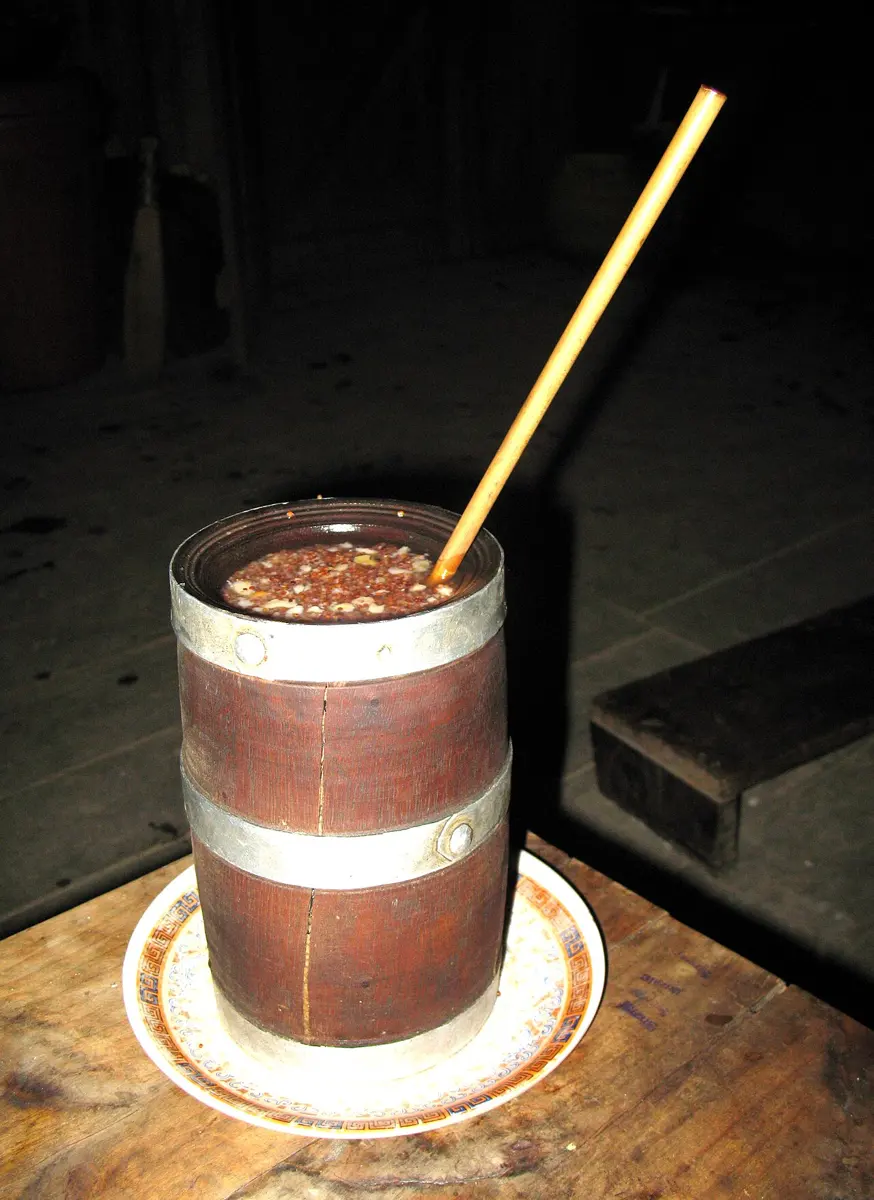
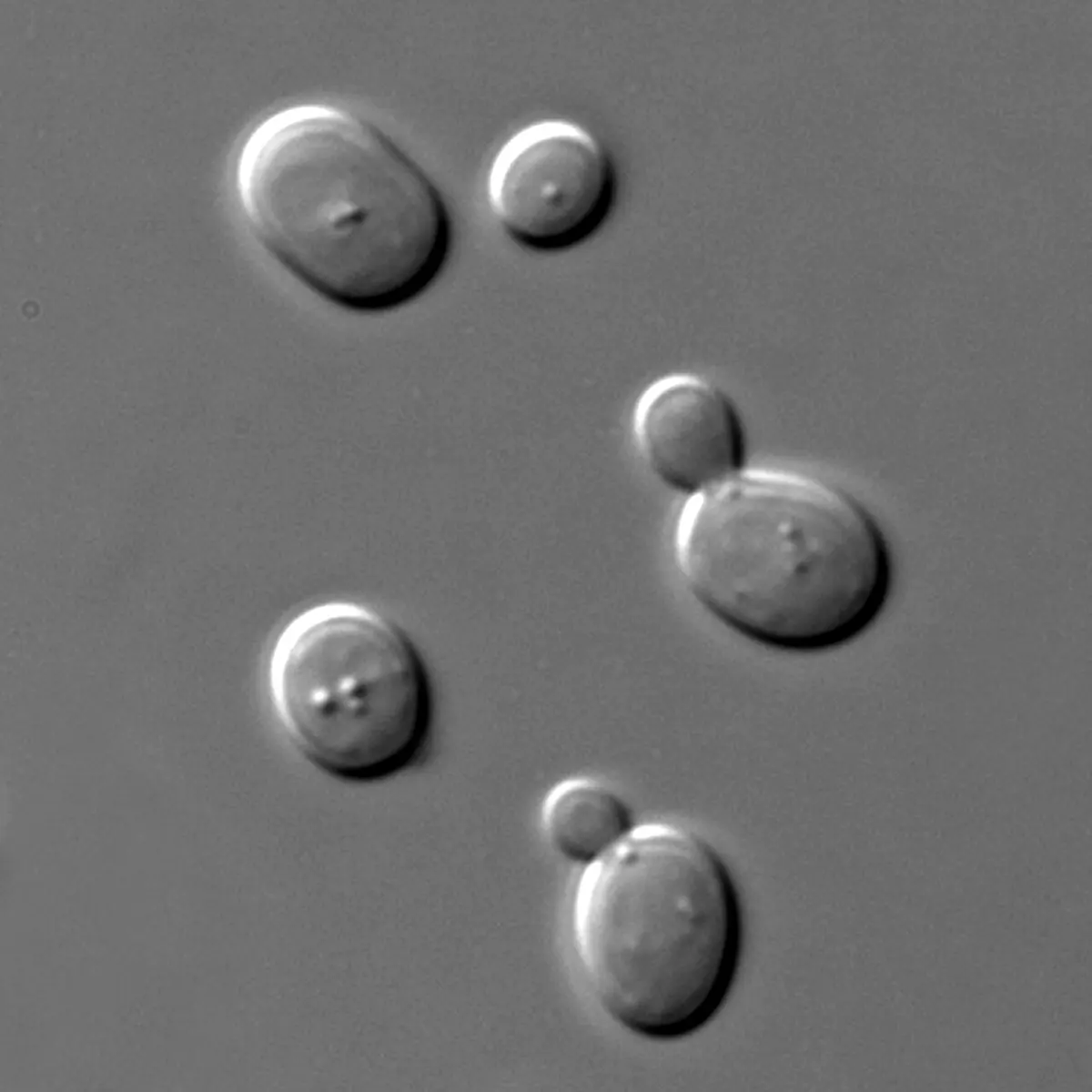
Fermentation is the slow breakdown of large organic molecules, such as starch and sugars, into smaller ones, such as ethanol and carbon dioxide, by enzymes made by living cells (here yeast, Saccharomyces cerevisiae), in the absence of air (it is an anaerobic process). Yeast gets its energy this way when there is no oxygen; the ethanol is its waste product. In Nepal fermentation makes alcohol and many foods (gundruk, kinema, achar, and the dough of sel roti). Two raw materials are used for ethanol:
- i.molasses (from sugarcane);
- ii.starch (from grains and potatoes).
Ethanol from molasses. When sugarcane juice is boiled down and sugar crystallizes out, a thick, dark brown syrup is left that won’t crystallize any further: molasses. It still holds roughly half its weight of sugars, mostly sucrose (table sugar) with glucose and fructose. It is diluted with water, and yeast is added. Two enzymes from the yeast do the work:
- invertase splits sucrose into glucose and fructose;
- zymase (in fact a group of enzymes) turns glucose and fructose into ethanol and carbon dioxide.
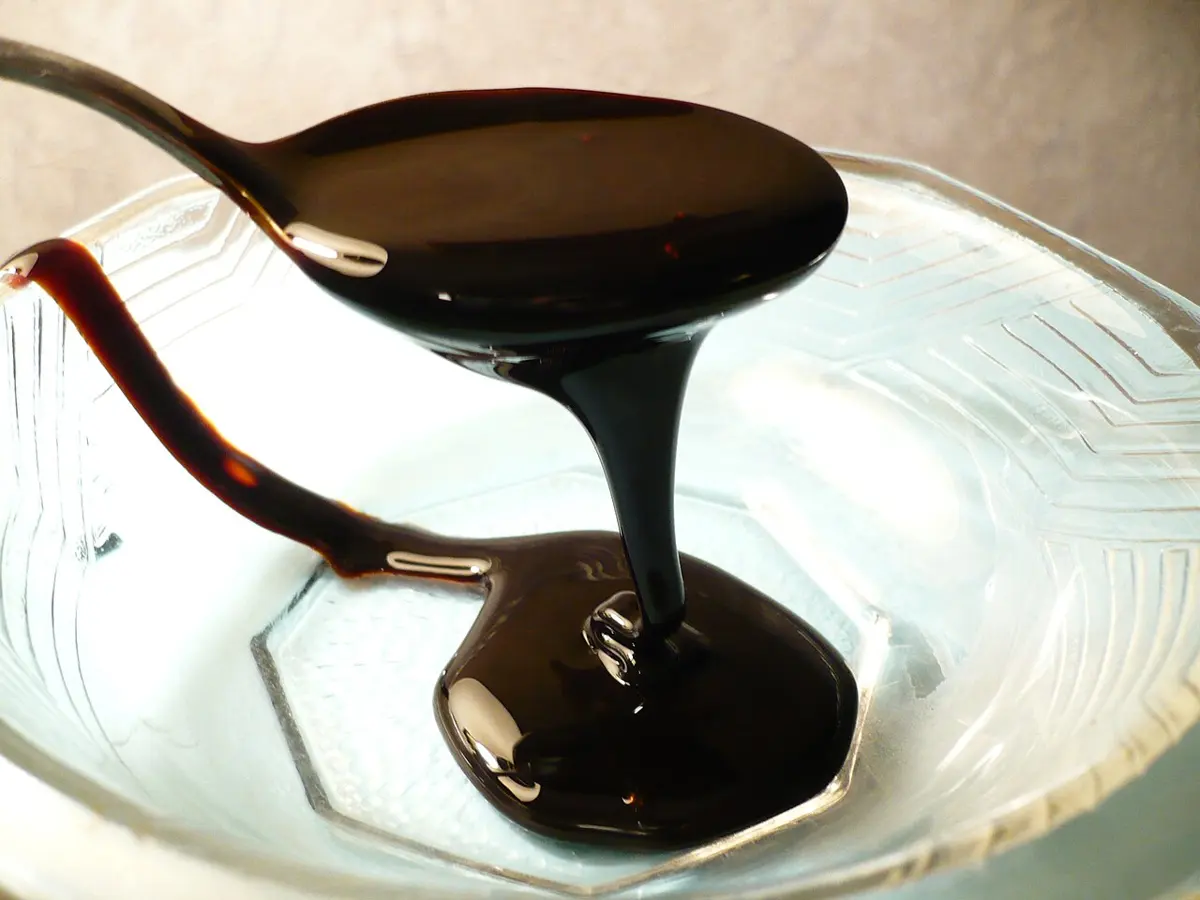
The mixture is kept at about 30–35 °C for two or three days. The froth on top is the carbon dioxide escaping. Fermentation stops by itself at about 10–15% ethanol, because more alcohol than that kills the yeast. The fermented liquid (the wash) is then distilled: ethanol boils at 78 °C and water at 100 °C, so the vapor is richer in ethanol, and repeated distillation in a column gives rectified spirit, about 95.6% ethanol by mass. Distillation can go no further, for a reason given in Section 10.6.1.
Ethanol from starch. Starch, from rice, maize, millet, barley or potatoes, is a polymer of glucose, too big for yeast to ferment. It is first broken down:
- diastase, from germinated barley (malt), splits starch into maltose, a sugar of two glucose units;
- maltase, from yeast, splits maltose into glucose;
- zymase, from yeast, turns glucose into ethanol and carbon dioxide.
In Nepal’s jaand and tongba the starch-splitting enzymes come not from malt but from marcha, a dried starter cake of rice flour and herbs that carries molds (which break the starch down) and yeasts (which ferment the sugar) together.
10.6 Definition of common terms: absolute alcohol, power alcohol, denatured alcohol (methylated spirit), alcoholic beverage
10.6.1 Absolute alcohol
Absolute alcohol is ethanol with almost no water in it: 99.5% ethanol or more. It can’t be made by simple distillation. A mixture of 95.6% ethanol and 4.4% water (by mass) boils at 78.2 °C, a little lower than pure ethanol (78.3 °C), and its vapor has exactly the same composition as the liquid. A mixture like this, which distills without changing, is an azeotrope. So rectified spirit, the 95.6% mixture, is as far as distillation goes. To remove the last water, chemists use:
- azeotropic distillation: a third liquid (benzene in the past, cyclohexane today) is added, which forms a new azeotrope with the water that boils off first;
- drying agents: quicklime (CaO), which reacts with the water, or molecular sieves (porous crystals whose holes catch water molecules but not ethanol).
Absolute alcohol is used as a laboratory solvent and in power alcohol. It is not for drinking (and is often denatured).
10.6.2 Power alcohol (gasohol)
Power alcohol is ethanol mixed with petrol for use as a motor fuel: gasohol. Blends are named by their ethanol content: E10 is 10% ethanol, E20 20%. The ethanol must be absolute: with water in it, ethanol and petrol separate into two layers in the tank. In the early days a little benzene was added to help them mix; it is no longer used, because benzene causes cancer.
Ethanol is a good anti-knock fuel: its octane number is above 100, higher than that of ordinary petrol, so a blend burns smoothly in the engine (octane numbers are in Grade 11, Unit 12). It is made from plants, which took the CO₂ out of the air as they grew, and a country with sugar mills can make it at home instead of importing all its fuel. Its drawback is that it gives less energy per liter than petrol (about two-thirds as much), and large amounts of it compete with food crops for land.
10.6.3 Denatured alcohol (methylated spirit)
Ethanol for industry, cleaning and fuel is taxed far less than drinking alcohol in most countries, so it is denatured: made unfit to drink by adding poisonous or foul-tasting substances that are hard to remove. Common denaturants are methanol, pyridine (which smells and tastes vile), very bitter compounds, and a coloring such as methyl violet (a dye) or copper sulphate to mark it. Ethanol denatured mainly with methanol is methylated spirit, used in spirit lamps and stoves, as a cleaner and as a solvent.
10.6.4 Alcoholic beverage
An alcoholic beverage is a drink that contains ethanol made by the fermentation of sugars by yeast. By how they are made, they fall into two classes:
- i.Undistilled (fermented) beverages are made by fermentation alone. Their ethanol content is low, about 4–15%, because the yeast stops working at about that strength. Examples: jaand, tongba and chhyang (fermented grain); beer, from barley, wheat or maize, usually 3–8% ethanol; wine, from grapes and other fruits, usually 8–15%.
- ii.Distilled beverages (spirits) are fermented and then distilled to concentrate the ethanol, to about 20–50% or more. Examples: raksi (distilled from fermented millet or rice), whisky, vodka, rum, brandy.
The percentage on a bottle is by volume (% ABV, “alcohol by volume”).
Why can’t ordinary distillation turn rectified spirit into absolute alcohol?
Pick an answer to see why.
10.7 Physical properties of monohydric alcohols
1. State and smell. The lower alcohols (up to about C₁₁) are colorless liquids with a characteristic “spirit” smell; the higher ones are waxy solids, with little smell, because they barely evaporate.
2. Solubility in water. Methanol, ethanol and the propanols mix with water in all proportions. The reason is the hydrogen bond: the O–H bond is strongly polar (O^δ−^–H^δ+^), so the hydrogen of an alcohol’s –OH is attracted to a lone pair on a water molecule’s oxygen, and a water molecule’s H to the alcohol’s oxygen (Figure 10.25). The alcohol molecules slot into water’s network of hydrogen bonds.
But an alcohol has two parts: the –OH group, which is hydrophilic (water-loving), and the alkyl chain, which is hydrophobic (water-hating), like a small piece of petrol. As the chain grows, the hydrophobic part pushes water molecules apart without bonding to them, and it wins: butan-1-ol dissolves only about 8 g in 100 g of water, hexan-1-ol less than 1 g, and the long-chain alcohols in waxes not at all.
Among isomers, the more branched, compact one is the more soluble, because its hydrophobic part has less surface for water to touch: 2-methylpropan-2-ol mixes with water in all proportions, while butan-1-ol does not. For the C₄ alcohols: 3° > 2° > 1° in solubility.
3. Boiling and melting points. Alcohols boil much higher than hydrocarbons (and ethers) of about the same molar mass, because their molecules are held together by hydrogen bonds as well as London forces, and these have to be broken for the liquid to boil. They boil lower than water, at least the small ones: water has two O–H hydrogens per molecule and two lone pairs, so it makes more hydrogen bonds per molecule than an alcohol, which has only one O–H.
| Compound | Molar mass (g/mol) | Boiling point (°C) |
|---|---|---|
| propane, CH₃CH₂CH₃ | 44 | −42 |
| methoxymethane, CH₃OCH₃ | 46 | −24 |
| ethanol, CH₃CH₂OH | 46 | 78 |
| water, H₂O | 18 | 100 |
Down the series, boiling points rise with the chain’s length (bigger molecules, stronger London forces): methanol 65 °C, ethanol 78 °C, propan-1-ol 97 °C, butan-1-ol 118 °C. From pentan-1-ol (138 °C) on, the alcohols boil higher than water: the chain’s London forces have taken over. Among isomers, branching lowers the boiling point: a branched molecule is more compact and spherical, touches its neighbors over less surface, and the London forces between them are weaker. The –OH on an inner carbon is also partly hidden by the groups round it, which weakens its hydrogen bonding a little.
Ethanol (46 g/mol) boils at 78 °C, methoxymethane (46 g/mol) at −24 °C. What causes the difference of more than 100 °C?
Pick an answer to see why.
10.8 Chemical properties of monohydric alcohols
An alcohol can react in two places. It can lose the whole –OH group, breaking the C–O bond (substitution by a halogen, dehydration), or it can lose just the hydrogen of the –OH, breaking the O–H bond (with sodium, in esterification). Oxidation takes hydrogen from both the –OH and the carbon next to it.
10.8.1 Reaction with HX, PX₃, PX₅ and SOCl₂
These reactions break the C–OH bond and put a halogen in its place: they are nucleophilic substitutions, and they make haloalkanes. Unit 8 uses them to prepare haloalkanes; here they are reactions of the alcohol.
a. With hydrogen halides, HX. The halide ion, X⁻, replaces the –OH. The –OH can’t leave as OH⁻, a poor leaving group, so the acid first puts a proton on the oxygen, and the group then leaves as a water molecule. With HCl a catalyst is needed: anhydrous zinc chloride, or concentrated sulphuric acid.
The reactivity of the halides is HI > HBr > HCl, and of the alcohols 3° > 2° > 1°: a tertiary alcohol loses water to give a tertiary carbocation, the most stable kind, so it reacts fastest (by SN1).
b. With phosphorus halides, PX₃ and PX₅. Phosphorus trihalides replace three –OH groups each, leaving phosphorous acid; phosphorus pentahalides react in the cold, leaving phosphoryl halide and hydrogen halide:
The white fumes of HCl that PCl₅ gives with any –OH compound make it a test for the –OH group.
c. With thionyl chloride, SOCl₂. Refluxed with thionyl chloride in the presence of pyridine, an alcohol gives a chloroalkane. Both by-products are gases, which escape, so the chloroalkane is left nearly pure. This is Darzens’ method of making chloroalkanes:
The Lucas test: 1°, 2° and 3° alcohols
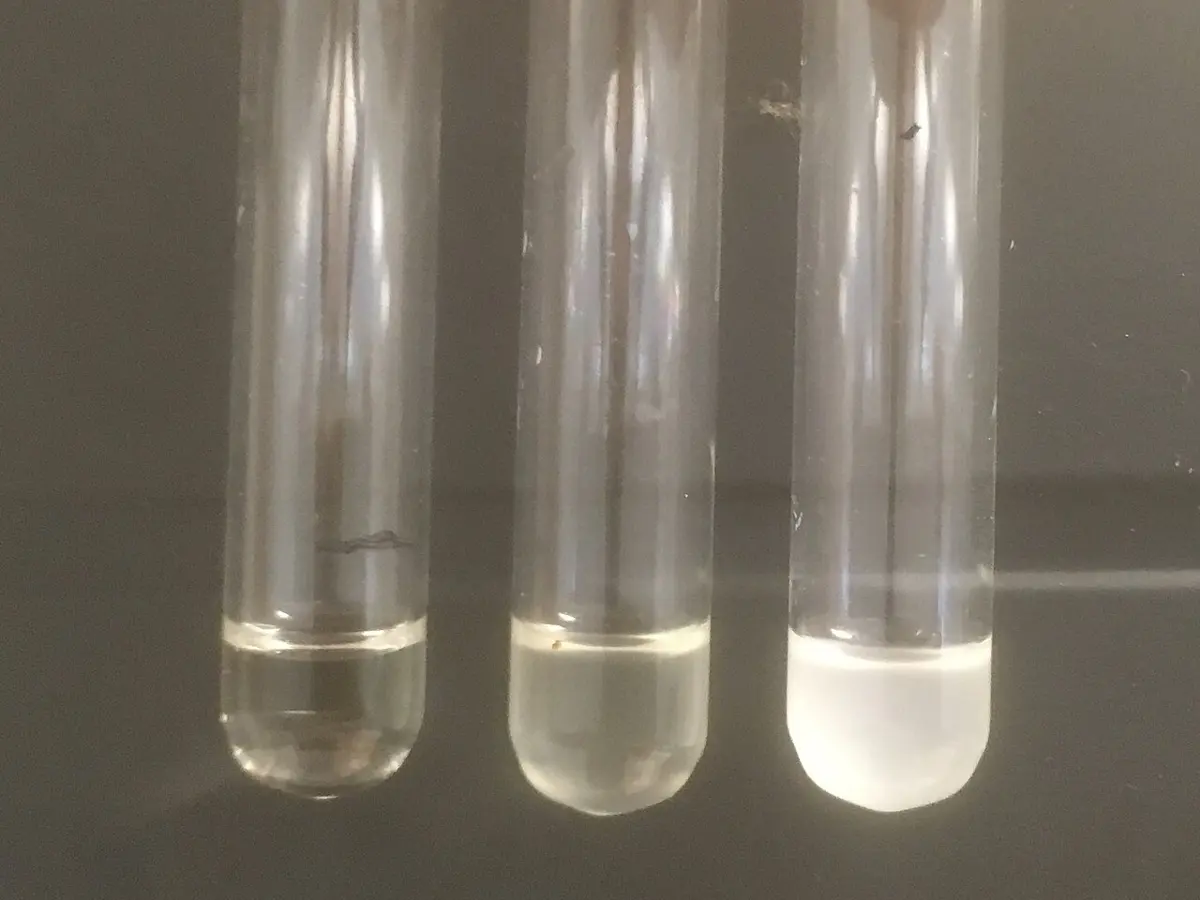
Lucas reagent is a solution of anhydrous zinc chloride in concentrated hydrochloric acid. Shaken with it at room temperature, a small alcohol (up to about six carbons, so that it dissolves in the reagent) turns into a chloroalkane, which doesn’t dissolve and makes the mixture cloudy (turbid). How soon the cloudiness appears tells the class of the alcohol:
| Alcohol | With Lucas reagent at room temperature |
|---|---|
| tertiary | cloudy at once |
| secondary | cloudy within about 5 minutes |
| primary | stays clear; reacts only on heating |
The order is the order of carbocation stability: zinc chloride (a Lewis acid) pulls on the oxygen, the C–O bond breaks, and the more stable the carbocation left behind, the faster this happens (SN1, Unit 8).
An alcohol C₄H₁₀O turns Lucas reagent cloudy the moment it is added. Which is it?
Pick an answer to see why.
10.8.2 Action with reactive metals: the acidic and basic nature of alcohols
Drop a small piece of sodium into ethanol and it fizzes, more gently than in water: hydrogen gas is given off, and a metal alkoxide forms. Potassium and lithium do the same. Only the hydrogen of the O–H bond is replaced:
The product of ethanol is sodium ethoxide, a strong base used in organic synthesis (it is the R′ONa of Williamson’s synthesis of ethers in Unit 8).
Alcohols as acids. Giving up the O–H proton to a metal, as water does, shows that an alcohol is a very weak acid. How weak? Methanol (pKₐ about 15.5) is about as acidic as water (15.7), ethanol (15.9) slightly less, and 2-methylpropan-2-ol (about 18) less still. Alkyl groups push electrons towards the oxygen (their +I effect), which makes the alkoxide ion less stable, so the order of acidity is methanol > 1° > 2° > 3°. Alcohols are much too weak to turn blue litmus red, and they don’t react with NaOH or with carbonates; only reactive metals take their proton. An alkoxide ion is in turn a stronger base than hydroxide: with water, sodium ethoxide gives back ethanol and NaOH.
Alcohols as bases. The oxygen of the –OH carries two lone pairs, so an alcohol can also accept a proton from a strong acid, like water, making an alkyloxonium ion, R–OH₂⁺; it acts as a Lewis base (and a Brønsted base). This is the first step of the reactions with HX and of dehydration below.
Which of these does ethanol react with to give hydrogen gas?
Pick an answer to see why.
10.8.3 Dehydration of alcohols
Removing a molecule of water from an alcohol is dehydration. It can take water from inside one molecule, giving an alkene (intramolecular), or from two molecules, giving an ether (intermolecular). Which happens depends on the temperature.
a. With concentrated sulphuric acid. Concentrated H₂SO₄ is a strong dehydrating agent and an acid catalyst. With ethanol:
Below 100 °C, it forms ethyl hydrogen sulphate (an ester of sulphuric acid); with excess alcohol, some diethyl sulphate:
At 140 °C, with excess ethanol, it gives an ether, ethoxyethane (diethyl ether), from two molecules Grade 12: Unit 12:
At 160–170 °C, with excess acid, it gives an alkene, ethene, from one molecule:
Propan-2-ol gives propene:
b. With alumina, Al₂O₃. Passing alcohol vapor over heated aluminium oxide does the same job, with ether at about 250 °C and alkene at about 350 °C:
Which alcohols lose water most easily? The ease of dehydration is 3° > 2° > 1°. A tertiary alcohol loses water in warm dilute acid; ethanol needs concentrated acid at 170 °C. The reason is the mechanism (Figure 10.28). The acid puts a proton on the –OH; the protonated alcohol loses a water molecule, leaving a carbocation; and a water molecule (or HSO₄⁻) takes a proton from a carbon next to it, forming the C=C bond. The slow step makes the carbocation, and a tertiary carbocation is the most stable (its three alkyl groups feed electrons to the positive carbon), so it forms fastest. This is the E1 mechanism of Unit 8.
When the –OH carbon has neighbors on both sides, the hydrogen can come from either, and two alkenes are possible. The more substituted alkene, the one with more alkyl groups on its C=C, is the major product (Saytzeff’s rule, Unit 8): butan-2-ol gives mainly but-2-ene, with some but-1-ene.
Ethanol and concentrated sulphuric acid at 140 °C with ethanol in excess give mainly
Pick an answer to see why.
10.8.4 Oxidation of primary, secondary and tertiary alcohols
Oxidizing an alcohol takes two hydrogen atoms away: the H of the –OH and an H on the carbon carrying it (the α-hydrogen). The C–O bond becomes a C=O bond. Oxidizing agents for this are acidified potassium dichromate, K₂Cr₂O₇/H⁺ (orange Cr₂O₇²⁻ turns green Cr³⁺), and acidified or alkaline potassium permanganate, KMnO₄ (purple MnO₄⁻ loses its color). Both are strong oxidizing agents. Writing the oxidizing agent’s oxygen as [O], the general steps are:
Primary alcohols have two α-hydrogens. They are oxidized first to an aldehyde Grade 12: Unit 13, then on to a carboxylic acid with the same number of carbons Grade 12: Unit 14:
To stop at the aldehyde, chemists either distill the aldehyde off as it forms (ethanal boils at 20 °C, ethanol at 78 °C, so the aldehyde escapes before it can be oxidized further) or use a mild oxidizing agent such as PCC (pyridinium chlorochromate) in a solvent without water. Methanol goes the same way, to methanal and then methanoic acid, the reactions that make it poisonous in the body (Section 10.6.4).
Secondary alcohols have one α-hydrogen. They are oxidized to a ketone with the same number of carbons, and there the reaction stops under ordinary conditions, because a ketone has no hydrogen left on its C=O carbon:
Only drastic conditions (hot, concentrated permanganate or dichromate for a long time) break the ketone’s carbon chain, giving acids with fewer carbons:
Tertiary alcohols have no α-hydrogen, so they resist oxidation under ordinary conditions: acidified dichromate stays orange, and permanganate keeps its color. Under drastic conditions they react only by breaking C–C bonds (in acid they first lose water to an alkene, which is then cut at its double bond), giving a mixture of ketones and acids with fewer carbons. 2-Methylbutan-2-ol, for example, gives propanone and ethanoic acid, and the propanone is slowly oxidized further:
Breaking a molecule into smaller pieces by oxidation is called oxidative degradation. Because the products show which kind of alcohol was used (an acid with the same carbons, a ketone, or smaller pieces), oxidation can identify an alcohol: an aldehyde, for example, gives a silver mirror with Tollens’ reagent, and a ketone does not.
Which alcohol gives a ketone when oxidized with acidified potassium dichromate?
Pick an answer to see why.
10.8.5 Catalytic dehydrogenation of 1° and 2° alcohols and dehydration of 3° alcohols
Taking hydrogen out of a compound with a catalyst is dehydrogenation. When alcohol vapor is passed over copper heated to about 300 °C, the copper catalyzes the loss of a hydrogen molecule from the –OH and the α-carbon, with no oxidizing agent at all. Each class of alcohol behaves differently:
a. Primary alcohols give aldehydes (Figure 10.31):
b. Secondary alcohols give ketones:
c. Tertiary alcohols have no α-hydrogen, so they can’t be dehydrogenated. Over hot copper they lose water instead, a hydrogen coming from a neighboring carbon (a β-carbon), and give an alkene:
This makes hot copper a test for the class of an alcohol: hydrogen gas and an aldehyde (1°), hydrogen and a ketone (2°), or water and an alkene (3°). It is also how much of the world’s methanal (formaldehyde) is made, from methanol over a silver or copper catalyst.
10.8.6 Esterification
When an alcohol is warmed with a carboxylic acid and a little concentrated sulphuric acid, they combine with the loss of water to form an ester, a compound with a pleasant, fruity smell. This reaction is esterification:
The reaction is reversible: it reaches an equilibrium with about two-thirds of the acid and alcohol turned to ester. The sulphuric acid is a catalyst and also takes up the water, pushing the equilibrium to the right. Experiments with ethanol containing heavy oxygen, ¹⁸O, show that the ¹⁸O ends up in the ester, not the water: the alcohol keeps its oxygen and loses only its O–H hydrogen, while the acid loses its –OH.
Esters give many fruits and flowers their smell: ethyl ethanoate (nail-polish remover, pear drops), 3-methylbutyl ethanoate (banana), octyl ethanoate (orange). Fats and oils are esters of glycerol.
10.8.7 Tests for ethanol
a. Dichromate test. Warmed with acidified sodium or potassium dichromate, ethanol is oxidized to ethanal (and then ethanoic acid), and the orange dichromate ion is reduced to green chromium(III) ion, Cr³⁺ (chromium(III) sulphate in sulphuric acid):
Every primary and secondary alcohol turns dichromate green; a tertiary alcohol leaves it orange.
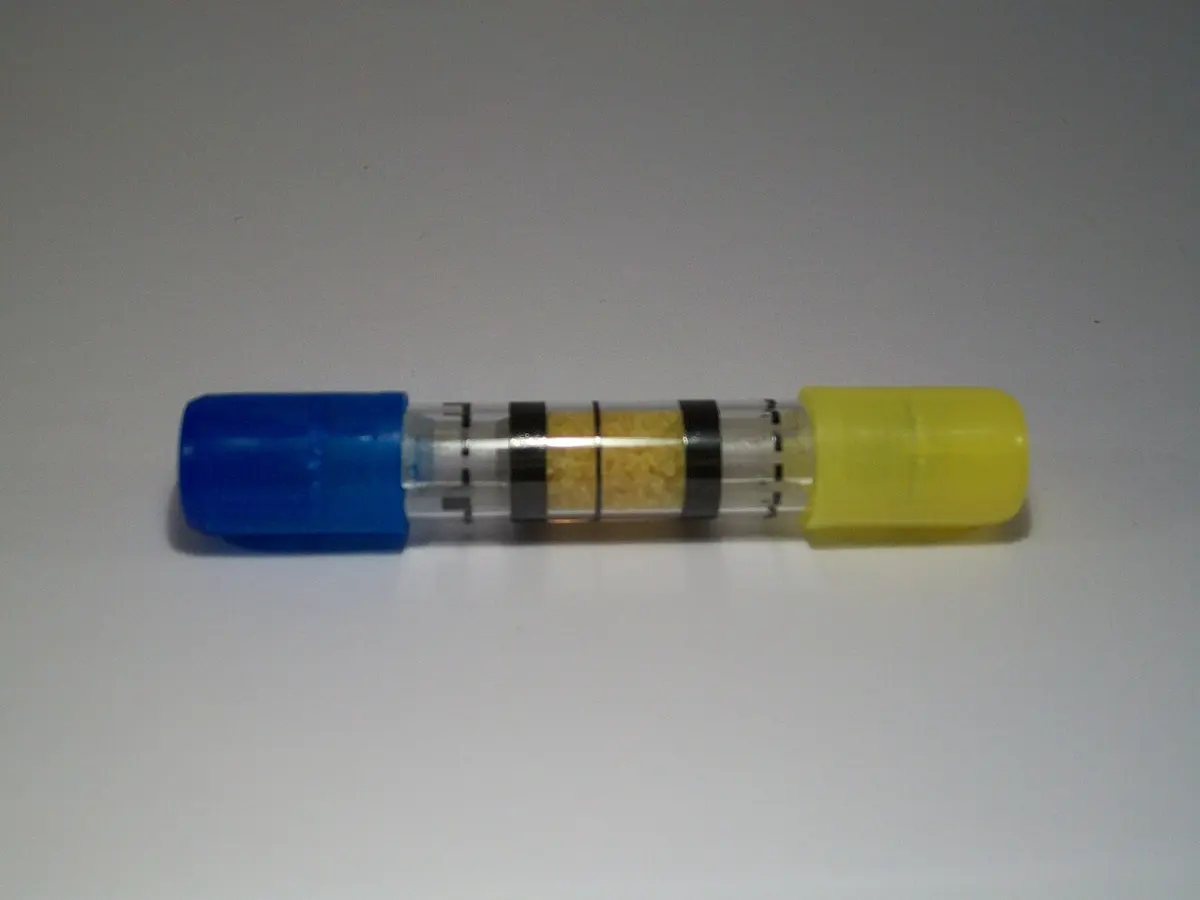
b. Iodoform test. Warmed with iodine and sodium hydroxide solution, ethanol gives a yellow precipitate of iodoform, CHI₃, with a strong “hospital” smell:
The iodine first oxidizes the alcohol to ethanal, CH₃CHO, whose CH₃ group is then iodinated and split off as CHI₃. So the test is given by every alcohol with the group CH₃–CH(OH)–: ethanol, propan-2-ol, butan-2-ol. Methanol, propan-1-ol and tertiary alcohols don’t give it. Propan-2-ol, for example:
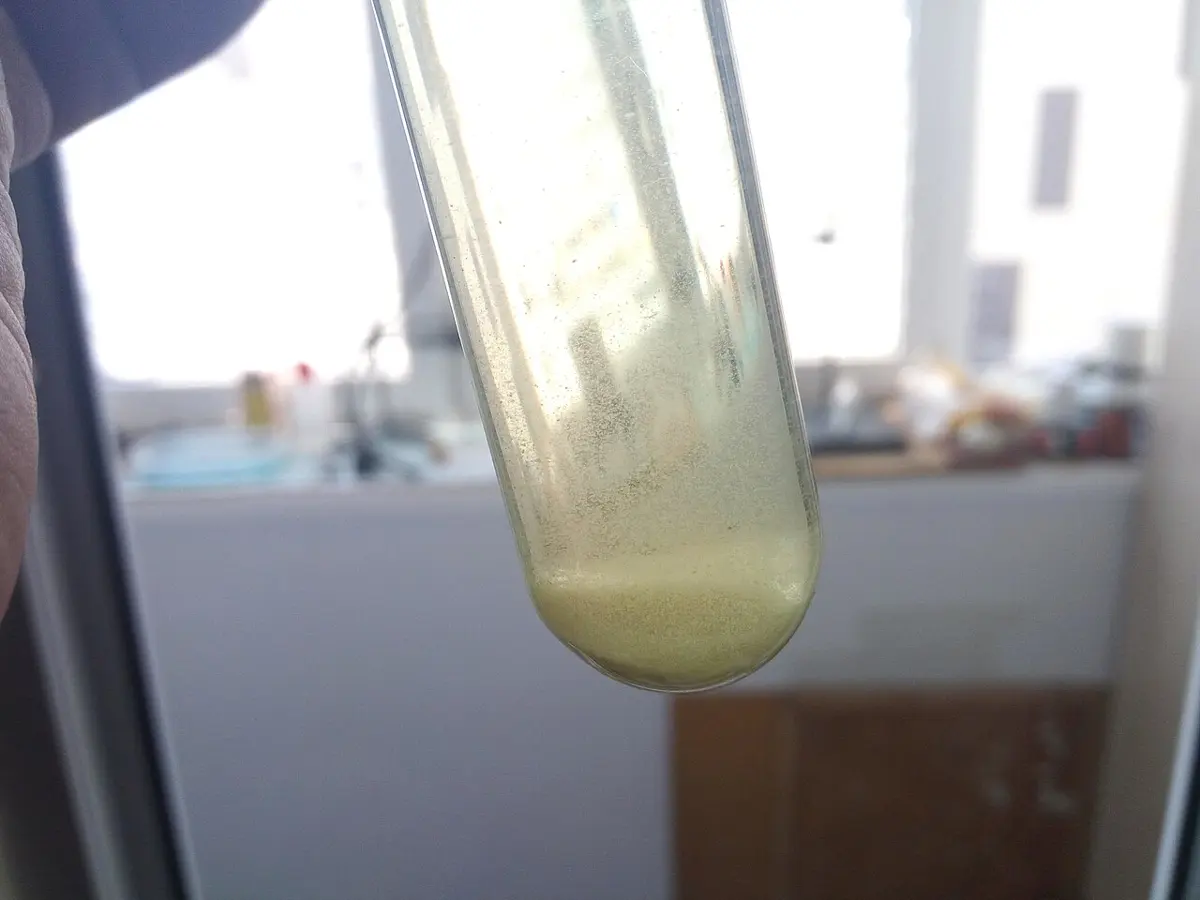
The iodoform test is the usual way to tell ethanol from methanol: ethanol gives the yellow precipitate, methanol doesn’t.
c. Ceric ammonium nitrate test. Ceric ammonium nitrate, (NH₄)₂[Ce(NO₃)₆], is a yellow-orange solution. With any alcohol it gives a red color, because the alcohol replaces a nitrate in the cerium(IV) complex:
This shows that an –OH group is present (in a compound up to about ten carbons), but not what kind of alcohol it is.
d. A test that alcohols don’t give: neutral iron(III) chloride. Phenols turn neutral FeCl₃ solution violet; alcohols don’t. So FeCl₃ tells an alcohol from a phenol.
Exercise
Exercise 10.1: Multiple choice questions
- The general formula of a (saturated, monohydric) alcohol is
Pick an answer to see why.
- The IUPAC name of CH₃CH(CH₃)CH₂OH is
The textbook prints propan-1-ol, butan-1-ol, propan-2-ol and butan-2-ol as the options, but the compound is none of them, so the book’s options don’t work; 2-methylpropan-1-ol is put in place of butan-2-ol here.
Pick an answer to see why.
- Absolute alcohol is
Pick an answer to see why.
- An alcohol has a higher boiling point than an alkene of similar molar mass because
Pick an answer to see why.
- Which of these methods is most suitable for distinguishing primary, secondary and tertiary alcohols?
Pick an answer to see why.
- Alcohols are soluble in water. The property responsible for this is
Pick an answer to see why.
- Which of these reacts with FeCl₃ to give a colored complex?
Pick an answer to see why.
- Which reagent turns ethene into ethanol?
Pick an answer to see why.
- Which of these alcohols gives a positive iodoform test?
The textbook prints 2-butanol and 2-propanol among its options, but both have the CH₃–CH(OH)– group and both give iodoform, so the book’s options don’t work; butan-1-ol is put in place of 2-butanol here.
Pick an answer to see why.
- The enzyme that turns sugar (glucose) into ethanol during fermentation is
Pick an answer to see why.
- The most suitable reagent for dehydrating ethanol to ethene is
Pick an answer to see why.
- Which of these alcohols gives a ketone on oxidation?
Pick an answer to see why.
- To convert a primary alcohol to an aldehyde without further oxidation to a carboxylic acid, the most suitable reagent is
Pick an answer to see why.
- Special additives are added to denatured alcohol
Pick an answer to see why.
- Esterification is the reaction of an alcohol with
Pick an answer to see why.
- Methanol poisoning is dangerous because its metabolism produces
Pick an answer to see why.
- Which statement best explains the decreasing solubility of higher alcohols in water?
Pick an answer to see why.
- Which alcohol shows optical activity?
Pick an answer to see why.
- Under strong oxidation, which alcohol gives a carboxylic acid by way of a ketone, not an aldehyde?
The textbook prints “Which of the following alcohols will undergo oxidation to form a carboxylic acid without passing through the aldehyde stage?” with propan-2-ol and 2-methylpropan-2-ol among the options, but both do (a tertiary alcohol under drastic conditions also gives acids with no aldehyde), so the book’s question doesn’t work as printed; it is asked here about the ketone stage, keeping propan-2-ol as the answer.
Pick an answer to see why.
Exercise 10.2
An alcohol has the molecular formula C₄H₁₀O. It may have different structural formulas.
- i.Write the possible isomers of C₄H₁₀O and their IUPAC names.
- ii.Classify these isomeric alcohols.
Hint
Answer
Lower alcohols are liquids with a characteristic smell, but higher alcohols are solids with no smell.
- i.Explain the cause of the solubility of alcohols in water.
- ii.Boiling points of alcohols are higher than those of their parent hydrocarbons. Explain.
- iii.Compare the solubility of 1°, 2° and 3° alcohols in water.
Answer
Victor Meyer’s method is a well-known method for distinguishing alcohols.
- i.What are the reagents used in Victor Meyer’s method?
- ii.Write the reactions involved in Victor Meyer’s method for distinguishing propan-1-ol, propan-2-ol and 2-methylpropan-2-ol.
- iii.Why doesn’t R₃C–NO₂, formed in the test of a 3° alcohol, react with HNO₂?
- iv.In Victor Meyer’s test, why does a secondary alcohol give a blue solution while a primary alcohol gives a red one?
Answer
In Nepali culture fermentation is common in the preparation of pickles, home-made alcoholic drinks and other foods, using vegetables, fruits, barley, millet and so on.
- i.Define fermentation, with examples.
- ii.Which enzymes are used for the fermentation of molasses (sucrose)? Represent them with relevant reactions.
Answer
Complete the following reactions.
- i.
- ii.
- iii.
- iv., then
- v., then
- vi., then
- vii., then
- viii.
- ix.
- x.
- xi.
Answer
Alkenes may be a source of alcohols. Catalytic hydration and hydroboration–oxidation are the main reactions.
- i.Describe the steps of the hydroboration–oxidation of ethene for the preparation of an alcohol, with relevant reactions.
- ii.Write the reactions of alkenes that give propan-2-ol and 2-methylpropan-2-ol.
Answer
The Lucas test and the KMnO₄ test are tests that identify the kinds of alcohol.
- i.What is Lucas reagent? Write the reactions involved in the Lucas test of 1°, 2° and 3° alcohols.
- ii.Why does a tertiary alcohol not undergo oxidation with acidified KMnO₄?
- iii.Write the reactions involved in the oxidation of ethanol and propan-2-ol with acidified KMnO₄.
Answer
Complete the following reactions.
- i.
- ii.
- iii.
- iv.
- v.
- vi.
- vii.
- viii.
Answer
Dehydration of tertiary alcohols occurs more readily than that of primary and secondary alcohols. Explain.
Answer
Different alcohols give different products when passed over heated copper. Complete the following reactions.
- i.
- ii.
- iii.
Answer
An alcohol A (C₄H₁₀O) reacts with PCl₅ to form compound B. B undergoes dehydrohalogenation with alcoholic KOH to form compound C. C reacts with dilute H₂SO₄ to form compound D, which is a tertiary alcohol. Identify A, B, C and D, with the reactions.
Hint
Answer
An alcohol M (C₃H₈O) reacts with metallic sodium to release hydrogen gas. On oxidation, M gives an aldehyde N. Identify M and N, write their structures and explain their reactions.
Answer
An alcohol X (C₅H₁₂O) turns Lucas reagent cloudy after about 5 minutes. Dehydration of X with concentrated H₂SO₄ gives compound Y. Ozonolysis of Y gives Z (C₃H₆O) and W (C₂H₄O). Identify X, Y, Z and W, and write their structures with the reactions.
Hint
Answer
An alcohol A (C₄H₁₀O) is oxidized to a ketone B. When B reacts with I₂ and NaOH, it gives a yellow precipitate of iodoform. Dehydration of A gives compound C. Identify A, B and C, with structures and reactions.
Answer
A compound A (C₂H₆O) is a liquid, soluble in water, that burns with a blue flame. It reacts with sodium metal to produce a gas, and forms compound B when heated with concentrated H₂SO₄ at 170 °C. A also gives a yellow precipitate with iodine in alkaline medium.
- i.Identify A and write all the reactions.
- ii.What is the role of H₂SO₄ in this reaction?
- iii.How can you distinguish between A and propan-2-ol by a chemical test?
- iv.What change would you see if A were treated with acidified potassium dichromate solution? Write a balanced equation.
Answer
Printable PDFs
- Study notes 2 pages
- Worksheet 4 pages Answer key
Quiz yourself: Materials and Chemicals We Use, Grades 5–12 →
Practice every question in the book, and keep track of the ones you miss →
A companion to your textbook, not a replacement for it: study from the book your school uses, and where the two differ, follow your teacher. Found a mistake? Please tell us.