
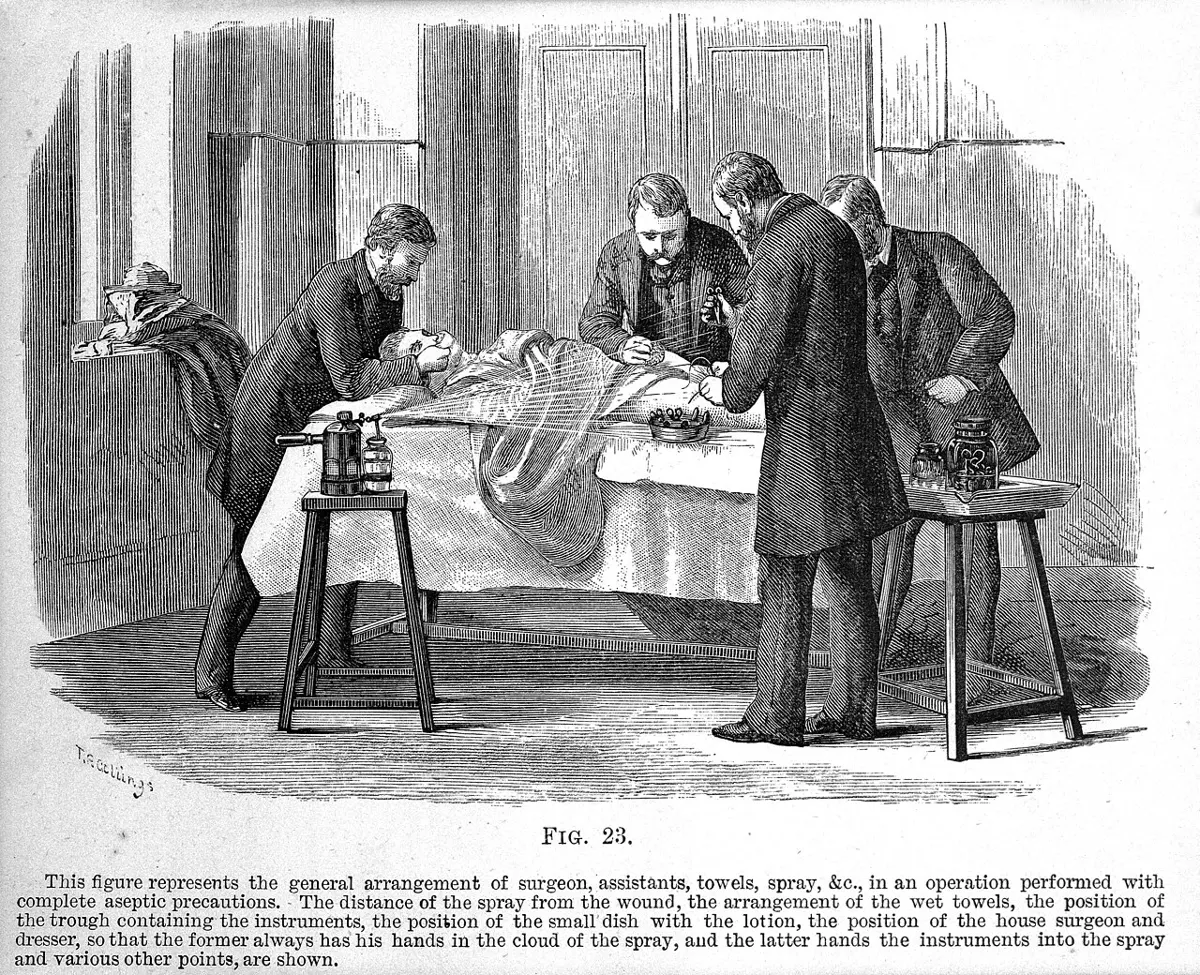
On a shop shelf in Nepal you may see two bottles side by side. One is a bright floor cleaner sold as “phenyl”. The other, from a chemical supplier, says PHENOL in red letters, with “carbolic acid” printed beneath. The cleaner borrows its name from the second bottle. In 1865, a few drops of carbolic acid on a broken leg in Glasgow began the age of germ-free surgery. A century and a half later, most of the phenol made in the world ends up as plastic: CDs, spectacle lenses, the glue in plywood and the handles of pressure cookers.
Phenol is benzene with an –OH group on it, and the two change each other. The ring makes the –OH an acid, something an alcohol’s –OH hardly is. The –OH makes the ring so eager to react that bromine water, which leaves benzene untouched, puts three bromine atoms on it at once. This unit covers both halves of that story, how phenol is made, and the tests that pick it out.
11.1 Introduction and nomenclature
Phenols are compounds in which one or more hydroxyl groups (–OH) are joined directly to a carbon of an aromatic ring. The simplest, C₆H₅OH, is called phenol itself. Its old name, carbolic acid, comes from the German Karbolsäure, “coal-oil acid”, which the chemist Friedlieb Runge gave it when he found it in coal tar in 1834. Many phenols occur in nature: thymol in the seeds of jwano (ajwain), eugenol in cloves (lwang), and the polyphenols that give black tea its color and taste.
A phenol has two parts: an aryl group (Ar–, a benzene ring or another aromatic ring) and a hydroxyl group. So its general formula is Ar–OH. By the number of hydroxyl groups on the ring, phenols are monohydric (one –OH), dihydric (two) or trihydric (three) (Figure 11.2).
Which of these is not a phenol?
Pick an answer to see why.
Naming phenols
The IUPAC name of C₆H₅OH is simply phenol, a name IUPAC keeps as the parent of the whole family; benzenol is the systematic form and is also correct. (Older books call it hydroxybenzene; “monohydroxybenzene” is not an IUPAC name.) For substituted phenols, the carbon carrying the –OH is carbon 1, and the other groups are written as prefixes with their numbers, as low as possible: 2-methylphenol, 4-nitrophenol, 2,4,6-trinitrophenol. The old o-, m-, p- names still turn up everywhere, and are worth knowing.
When a ring carries two or three –OH groups, the IUPAC name counts them with the suffix -diol or -triol on benzene: benzene-1,2-diol, benzene-1,3-diol. Their common names (catechol, resorcinol, quinol) are older than the rules.
| Common name | IUPAC name | Where the groups are |
|---|---|---|
| phenol (carbolic acid) | phenol (benzenol) | –OH on carbon 1 |
| o-cresol | 2-methylphenol | –CH₃ next to –OH |
| m-cresol | 3-methylphenol | one carbon between |
| p-cresol | 4-methylphenol | opposite each other |
| catechol | benzene-1,2-diol | two –OH, next to each other |
| resorcinol | benzene-1,3-diol | two –OH, one carbon between |
| quinol (hydroquinone) | benzene-1,4-diol | two –OH, opposite |
| picric acid | 2,4,6-trinitrophenol | three –NO₂ round the –OH |
11.2 Preparation of phenol
i. From chlorobenzene (Dow’s process)
A chlorine atom on a benzene ring is very hard to replace Grade 12: Unit 9: its C–Cl bond is partly double. But with sodium hydroxide under drastic conditions, about 623 K (350 °C) and 300 atm, it gives way and sodium phenoxide forms. Dilute acid then gives phenol.
ii. From a diazonium salt
Aniline, with sodium nitrite and hydrochloric acid at 0–5 °C, gives benzenediazonium chloride (diazotization; it is kept cold, since it falls apart when warm):
When its solution is warmed with water (made acidic, so that the phenol formed doesn’t couple with the salt that is left), nitrogen bubbles off and phenol forms. This is the best laboratory method:
iii. From benzenesulphonic acid
Benzene and concentrated sulphuric acid give benzenesulphonic acid (electrophilic substitution, Grade 11). Fused with sodium hydroxide, it gives sodium phenoxide, and acid gives phenol. This was the first industrial route, from about 1900.
iv. From anisole
Anisole (methoxybenzene) is an ether. Heated with hydrogen iodide, its O–CH₃ bond breaks and phenol forms with iodomethane. It is the methyl–oxygen bond that breaks, not the ring–oxygen bond, which is partly double like the C–Cl bond of chlorobenzene (more in Unit 12).
v. The cumene process: phenol by the million tonnes
Nearly all the world’s phenol, several million tonnes a year, is made by none of these. In the cumene process, benzene and propene (both from oil) join to give cumene (isopropylbenzene); air oxidizes cumene to cumene hydroperoxide; and dilute acid splits that into phenol and acetone. Both products sell, which is why the process won.
Which of these does not give phenol?
Pick an answer to see why.
11.3 Physical properties of phenol
Pure phenol is a colorless, crystalline solid that smells sweet and tarry. It melts at about 41 °C and boils at 182 °C. It is hygroscopic: it takes up water from the air, and a few percent of water is enough to melt it. Left in air and light, it slowly turns pink, as a little of it is oxidized (11.4.5).
Phenol is moderately soluble in water (about 8 g in 100 mL at room temperature) and very soluble in ethanol, ether and other organic solvents. Its –OH group forms hydrogen bonds with water molecules (Figure 11.13), which is why it dissolves at all; its large non-polar benzene ring cannot, which is why it dissolves less than small alcohols such as ethanol, which mixes with water in any amount. Phenol with about 10% water is a liquid, sold as liquefied phenol; a dilute solution in water is the “carbolic acid” of old hospitals.
Phenol molecules also hydrogen-bond to one another. That is why phenol (182 °C) boils so far above benzene (80 °C) and toluene (111 °C), whose molecules are held only by weaker dispersion forces, though toluene is almost as heavy as phenol.
11.4 Chemical properties
11.4.1 Acidic nature of phenol (comparison with alcohol and water)
An acid is a substance that gives up a proton, H⁺. In water, phenol does so to a small extent, forming the phenoxide ion and the hydronium ion:
The equilibrium lies far to the left: phenol is a weak acid, with Ka about 1.0 × 10⁻¹⁰ (pKa 10.0). A 0.1 M solution has a pH of about 5.5. Yet ethanol, with an –OH group just like phenol’s, is about a million times weaker still. The difference is in the ion that is left behind.
The phenoxide ion is stabilized by resonance. One lone pair of the oxygen can join the ring’s π electrons, so the negative charge is not held on the oxygen alone: it is spread to carbons 2, 4 and 6 of the ring. The five resonance structures in Figure 11.16 show it, and the real ion is their resonance hybrid (Figure 11.17).
In structures II, III and IV the oxygen is joined to the ring by a double bond, so the real C–O bond is partly double. Every structure carries the same single negative charge, only in a different place: no structure separates charges. That is why they all count, and why the ion is so stabilized.
Phenol itself has resonance structures too (Figure 11.32), but in its II, III and IV the oxygen has become positive and a ring carbon negative: they separate charge. Separating charges costs energy, so these structures add little, and phenol gains far less from resonance than its ion does. Losing the proton therefore takes phenol downhill in energy, compared with an alcohol, and the equilibrium lies further to the right.
Ethanol and water have no ring. When ethanol loses a proton, the charge of the ethoxide ion stays on one oxygen (Figure 11.14), and the ethyl group’s +I effect pushes even more electron density onto it. When water loses a proton, the charge of OH⁻ is held on one oxygen too. Neither ion is stabilized by resonance.
The pKa values (at 25 °C) put this into numbers. The lower the pKa, the stronger the acid:
| Compound | Ion it forms | Charge held by | pKa |
|---|---|---|---|
| ethanol | C₂H₅O⁻ | one O, made worse by +I of C₂H₅ | 15.9 |
| water | OH⁻ | one O | 15.7 |
| phenol | C₆H₅O⁻ | O and three ring carbons | 10.0 |
So the order of acidic strength is
that is, phenol > water > alcohol. (Some books take water’s pKa as 14.0; the order is the same.)
Reactions that show phenol is acidic. Phenol reacts with sodium, giving hydrogen, as water and alcohols do; and, unlike alcohols, it dissolves in sodium hydroxide solution, forming sodium phenoxide and water. But it is too weak to react with sodium hydrogencarbonate (NaHCO₃): carbonic acid (pKa 6.35) is a stronger acid than phenol, so no CO₂ fizzes. This gives a quick way to tell the three apart: a carboxylic acid fizzes with NaHCO₃; phenol dissolves in NaOH but doesn’t fizz; an alcohol does neither.
Phenol dissolves in sodium hydroxide solution but ethanol does not react with it in any useful amount. The reason is that:
Pick an answer to see why.
Groups on the ring change the acidity
A group that pulls electrons out of the ring (–NO₂, –Cl, –CN) spreads the negative charge of the phenoxide ion further and makes the phenol a stronger acid. A group that pushes electrons into it (–CH₃, –OCH₃) makes the charge harder to spread and the phenol a weaker acid. A nitro group works best at the ortho or para position, where it can take the ring’s negative charge onto its own oxygens by resonance (−R); at the meta position it can pull only through the σ bonds (−I). Try it in the widget below.
| Phenol | pKa | Effect of the group |
|---|---|---|
| 4-methylphenol | 10.26 | +I: weaker than phenol |
| 4-methoxyphenol | 10.21 | +R outweighs −I: slightly weaker |
| phenol | 9.99 | |
| 4-chlorophenol | 9.41 | −I outweighs +R: stronger |
| 3-nitrophenol | 8.36 | −I only: stronger |
| 4-nitrophenol | 7.15 | −R and −I: much stronger |
| 2,4-dinitrophenol | 4.07 | two −R groups |
| 2,4,6-trinitrophenol | 0.42 | three: nearly as strong as a mineral acid |
11.4.2 Action with NH₃, Zn, Na, benzenediazonium chloride and phthalic anhydride
i. With ammonia
Heated with ammonia and anhydrous zinc chloride at about 673 K (400 °C), phenol gives aniline: the –OH is replaced by –NH₂. It is a nucleophilic substitution, and it needs these drastic conditions because the ring’s C–O bond is partly double.
ii. With zinc dust
Heated with zinc dust, phenol is reduced to benzene; the zinc takes its oxygen and becomes zinc oxide. This is how phenol (and other ring compounds with oxygen) can be traced back to its parent hydrocarbon.
iii. With sodium
Phenol reacts with sodium metal, giving off hydrogen and forming sodium phenoxide. It shows that phenol’s –OH hydrogen is acidic.
iv. With benzenediazonium chloride: coupling
In a cold, slightly alkaline solution, phenol (as its phenoxide ion) couples with benzenediazonium chloride at its para carbon, forming 4-hydroxyazobenzene (p-hydroxyazobenzene), an orange azo dye. The diazonium ion is a weak electrophile, and only a ring as activated as phenoxide’s will react with it. The –N=N– link between two rings is what colors every azo dye, from orange to deep red.
v. With phthalic anhydride: phenolphthalein
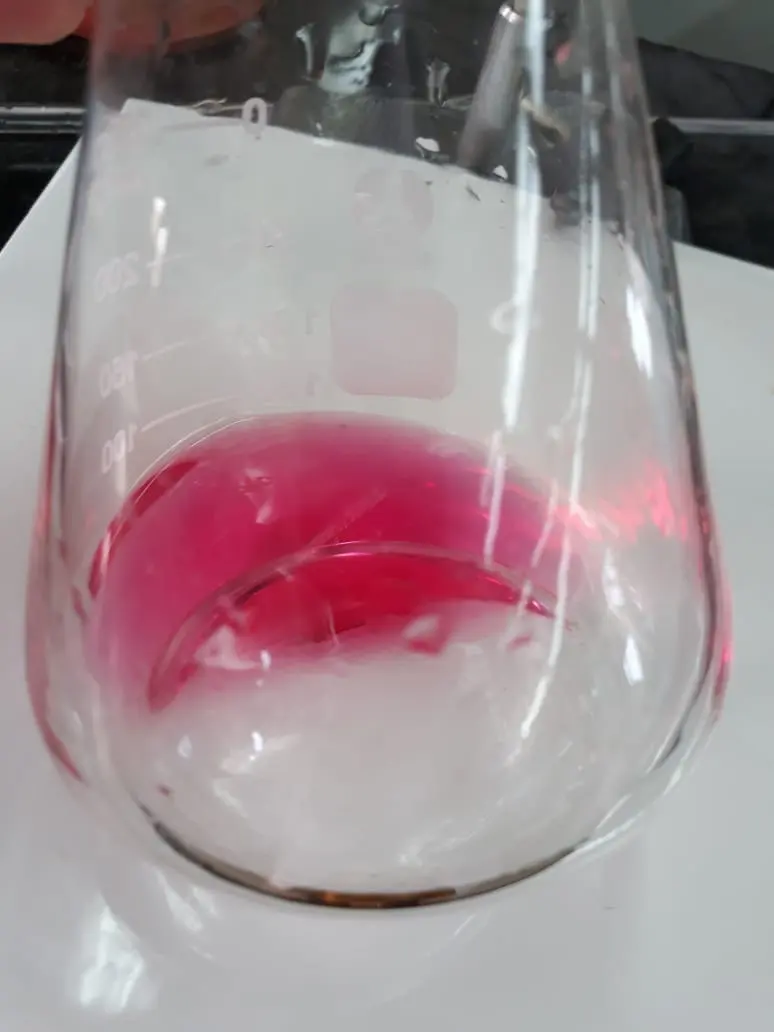
Heated with phthalic anhydride and a little concentrated sulphuric acid, two phenol molecules join it at their para carbons, giving phenolphthalein and one molecule of water. This is a condensation. Phenolphthalein is the indicator you use in titrations: colorless in acid, pink in alkali (it changes between pH 8.2 and 10).
11.4.3 Acylation reaction, Kolbe’s reaction and the Reimer–Tiemann reaction
i. Kolbe’s reaction (carboxylation)
Sodium phenoxide (made from phenol and NaOH) is heated with carbon dioxide at about 400 K (125–135 °C) and 4–7 atm. The phenoxide ring, very rich in electrons, attacks the weak electrophile CO₂ at its ortho carbon, giving sodium salicylate; acid then gives salicylic acid (2-hydroxybenzoic acid). This is Kolbe’s reaction (Hermann Kolbe, 1860; the high-pressure version by Rudolf Schmitt, 1885).
Salicylic acid is the start of aspirin. With ethanoic anhydride, its –OH group is acetylated:
ii. The Reimer–Tiemann reaction
Phenol warmed with chloroform and aqueous sodium hydroxide (or KOH) at about 340 K (70 °C) gets a –CHO group at its ortho position: salicylaldehyde (2-hydroxybenzaldehyde) is the main product, with some of the para isomer. The base makes dichlorocarbene, :CCl₂, from chloroform, and the phenoxide ring attacks it; the two chlorines are then hydrolyzed to the aldehyde. This is the Reimer–Tiemann reaction (Karl Reimer and Ferdinand Tiemann, 1876), a formylation.
iii. Acylation
When phenol is treated with an acid chloride or an acid anhydride, the acylation happens on the oxygen, not the ring. With an acid chloride (in pyridine, which takes up the HCl) or an acid anhydride, phenol’s –OH is acylated, giving an ester: phenyl ethanoate (phenyl acetate). This is O-acylation, and it needs no AlCl₃.
With benzoyl chloride and sodium hydroxide solution (shaken together: the Schotten–Baumann reaction), phenol gives phenyl benzoate, a white solid:
To put an acyl group on the ring, the ester is heated with anhydrous AlCl₃: the acyl group moves from the oxygen to the ortho and para carbons, giving hydroxyacetophenones. This is the Fries rearrangement (Karl Fries, 1908).
11.4.4 Electrophilic substitution: nitration, sulphonation, bromination and Friedel–Crafts alkylation
In electrophilic substitution, an electrophile (an electron-seeking reagent, such as NO₂⁺) replaces a hydrogen atom on a ring carbon. Where it goes, and how fast, depends on the group already on the ring. Phenol’s resonance structures (Figure 11.32) show both.
The –OH group pulls electrons through the σ bond (−I, oxygen being electronegative), but its lone pair pushes far more into the π system (+R). The net effect is to activate the ring: phenol reacts with electrophiles far faster than benzene. And since structures II, III and IV put the extra electrons on carbons 2, 4 and 6, that is where electrophiles attack: –OH is an ortho, para director.
a. Nitration
With dilute nitric acid at room temperature (293 K), no sulphuric acid needed, phenol gives a mixture of 2-nitrophenol (the larger part) and 4-nitrophenol. Benzene needs a mixture of the concentrated acids.
The two are easy to separate by steam distillation: 2-nitrophenol comes over with the steam; 4-nitrophenol stays behind. The reason is a hydrogen bond inside the 2-nitrophenol molecule, between its –OH and its neighboring –NO₂ (Figure 11.35). Its –OH is busy, so its molecules hardly hydrogen-bond to each other or to water: it boils lower (216 °C, against 279 °C for 4-nitrophenol), is less soluble in water, and is volatile in steam. This is called the ortho effect here. 4-nitrophenol’s groups are too far apart, so its –OH bonds to other molecules.
With concentrated nitric acid and concentrated sulphuric acid, all three ortho and para positions are nitrated, giving picric acid, 2,4,6-trinitrophenol, a yellow solid. The yield is poor, because nitric acid is a strong oxidizing agent and oxidizes much of the phenol (which oxidizes easily) to tars. Picric acid is better made by first sulphonating phenol and then nitrating it.
b. Sulphonation
With concentrated sulphuric acid, phenol is sulphonated. At room temperature the main product is 2-hydroxybenzenesulphonic acid; at about 373 K (100 °C) it is 4-hydroxybenzenesulphonic acid. Sulphonation can be reversed, and the ortho acid forms faster, while the para acid is more stable; given heat and time, the ortho acid changes into the para.
c. Halogenation (bromination)
With bromine water, phenol at once gives a white precipitate of 2,4,6-tribromophenol, and the bromine’s color disappears. No catalyst is needed: benzene doesn’t react with bromine water at all.
In water, a polar solvent, some phenol is present as the phenoxide ion, even more activated than phenol; and water helps to polarize the Br–Br bond. All three ortho and para positions are attacked. With bromine in a solvent of low polarity such as CS₂ or CCl₄, at low temperature (273 K), the phenol stays un-ionized and the bromine unpolarized, and only one bromine goes on: a mixture of 4-bromophenol (major) and 2-bromophenol.
d. Friedel–Crafts alkylation
With an alkyl halide and anhydrous aluminium chloride, phenol gives 2- and 4-methylphenol, the para product being the major one. But the yield is poor. AlCl₃ is a Lewis acid, and it accepts a lone pair from phenol’s oxygen; the complex takes up the catalyst and pulls electrons out of the ring, so phenol is difficult to alkylate (and to acylate on the ring) this way. Industry alkylates phenols with alkenes and acid catalysts instead.
Bromine water is added to a solution of phenol. What do you see?
Pick an answer to see why.
11.4.5 Other reactions
i. Catalytic hydrogenation
With hydrogen over nickel at about 423 K (150 °C), the ring takes up three H₂ and phenol becomes cyclohexanol. Oxidizing cyclohexanol to cyclohexanone is the first step to nylon.
ii. Oxidation in air
Phenol oxidizes slowly in air and light. Among the products is 1,4-benzoquinone, which is yellow; it combines with phenol into colored compounds (phenoquinone, which is red), and the crystals turn pink, then red-brown. With a strong oxidizing agent such as chromic acid, phenol gives 1,4-benzoquinone itself.
iii. Condensation with methanal: Bakelite
With methanal (formaldehyde, HCHO) in acid or alkali, phenol’s activated ring takes up –CH₂OH groups at its ortho and para carbons.
These join with more phenol, losing water each time, and the rings link through –CH₂– bridges. In a first stage, linear chains form, a soft resin called novolac:
Heated with more methanal, the chains are joined to each other at their remaining ortho and para carbons, into a hard three-dimensional network: Bakelite. Once set it can’t be melted again: it is a thermosetting plastic. It is a good electrical insulator and resists heat, so it is used for switches, plugs, the handles of pans and pressure cookers, and the glue of plywood.
11.5 Tests for phenol
These tests are best done by your teacher as demonstrations, with a very dilute solution of phenol (phenol burns skin: 11.3).
a. The iron(III) chloride test
To a dilute aqueous solution of phenol, add a few drops of neutral iron(III) chloride solution. A violet color appears. The oxygen of phenol (as phenoxide) gives a lone pair to the Fe³⁺ ion, forming a colored complex (a coordinate bond, Unit 6). It is often written
Other phenols give violet, blue or green colors, and alcohols give none. The color fades in acid, so the solution must be neutral.
b. The bromine water test
Add bromine water to a solution of phenol: the brown color disappears at once and a white precipitate of 2,4,6-tribromophenol forms (Figure 11.38). Alkenes also decolorize bromine water, but give no precipitate.
c. The Liebermann test
A few crystals of phenol are warmed with sodium nitrite and concentrated sulphuric acid: a deep green to blue color forms. Poured into water, it turns red; made alkaline with NaOH, it turns deep blue again. Nitrous acid puts a nitroso group, –N=O, on phenol’s para carbon; the 4-nitrosophenol joins another phenol molecule into indophenol, red in acid, whose sodium salt is deep blue. Note that the two rings are joined through one nitrogen atom (C=N–C), not by an azo (–N=N–) group.
11.6 Uses of phenol
Phenol is made by the million tonnes, and most of it goes into plastics:
- a.Bisphenol A, made from phenol and acetone, is the starting point of polycarbonates (unbreakable bottles, spectacle and car-light lenses, CDs) and epoxy resins (strong glues, coatings, the board of electronic circuits).
- b.Phenol–formaldehyde resins (Bakelite and its relatives): electrical fittings, handles, and the glue in plywood and particle board.
- c.Cyclohexanone for nylon (11.4.5).
- d.Medicines: salicylic acid and aspirin (11.4.3), and paracetamol, made from 4-aminophenol.
- e.Antiseptics and disinfectants: dilute phenol in some sore-throat sprays; its chlorinated relatives in household antiseptics, such as chloroxylenol, the active ingredient of Dettol; cresols in strong disinfectants.
- f.Dyes and indicators: azo dyes (11.4.2) and phenolphthalein.
- g.Antioxidants: phenols are easily oxidized themselves, so they protect other substances. BHT, a phenol, keeps cooking oil and ether from going off, and vitamin E is a natural phenol that does the same inside our cells.
- h.Picric acid, once an explosive and a dye, and many herbicides and pesticides.
Exercise
Exercise 11.1: Multiple choice questions
- Which one of the following represents phenol? (Figure 11.50)
Pick an answer to see why.
- The IUPAC name of phenol is:
Pick an answer to see why.
- Phenol can be prepared from chlorobenzene through:
Pick an answer to see why.
- Which of the following conditions is responsible for the hydrolysis of a diazonium salt to form phenol?
Pick an answer to see why.
- The solubility in water and the boiling point of phenol are greater than those of toluene due to:
Pick an answer to see why.
- Which of the following is the correct order of acidic strength?
The textbook prints option d as water < ethanol < phenol, with ethanol and water the wrong way round, so the question doesn’t work: none of its four orders is right. Option d is put right here.
Pick an answer to see why.
- C₆H₅OH + Na → ? The products of this reaction are:
Pick an answer to see why.
- Phenol reacts with zinc dust to give benzene. The reaction is:
Pick an answer to see why.
- The coupling reaction of phenol with benzenediazonium chloride produces:
Pick an answer to see why.
- The reagent used in Kolbe’s reaction to react with phenol is:
Pick an answer to see why.
- Phenol reacts with chloroform in the presence of aqueous KOH in the Reimer–Tiemann reaction. The product of this reaction is:
Pick an answer to see why.
- When phenol reacts with acetic anhydride to produce phenyl acetate, the reaction is called:
Pick an answer to see why.
- Nitration of phenol (with dilute nitric acid) is an electrophilic substitution reaction. The product of this reaction is:
Pick an answer to see why.
- Bromination of phenol in CS₂ gives:
Pick an answer to see why.
- Friedel–Crafts alkylation is not feasible with phenol because:
Pick an answer to see why.
- When phenol is treated with FeCl₃, it produces a violet color due to:
Pick an answer to see why.
- Liebermann’s test confirms phenol by a deep blue color that turns red on dilution and deep blue again with alkali. The reagent in this test is:
Pick an answer to see why.
- Phenol decolorizes bromine water to form:
Pick an answer to see why.
- Which of the following is a polymer of phenol?
Pick an answer to see why.
Exercise 11.2
Phenol is a hydroxyl derivative of benzene in which the –OH group is attached directly to a carbon of the benzene ring.
- i.What are the IUPAC names of the compounds C₆H₄(OH)CH₃ with the structures in Figure 11.51?
- ii.Compare the polarity of phenol and toluene.
- iii.Draw the structural formulae of C₆H₄(OH)₂ and write their IUPAC names.
Hint
Answer
Phenol, also known as carbolic acid, is a white crystalline aromatic compound.
- i.Compare the solubility of phenol and benzene in water.
- ii.The boiling point of phenol is higher than those of benzene and toluene. Explain.
- iii.Arrange in increasing order of boiling point: benzene, toluene, phenol and cresol.
- iv.Give the reason for the lower boiling point and solubility of o-nitrophenol compared with the m- and p-isomers.
Answer
Phenol is acidic: it releases H⁺ ions to produce the phenoxide ion.
- i.The phenoxide ion is more stable than the ethoxide ion. Explain.
- ii.Compare the acidic strength of phenol, ethanol and water.
- iii.Discuss the effect of substituents on the acidic strength of phenols, and compare the acidic strength of the four phenols in Figure 11.52.
Hint
Answer
The hydroxyl group activates the benzene ring towards electrophilic substitution.
- i.Give the reason for the ortho, para directing nature of the –OH group in phenol.
- ii.Electrophilic substitution in phenol is faster than in benzene. Explain.
- iii.With aqueous Br₂, phenol gives a trisubstituted product, but with Br₂ in CCl₄ or CS₂ it gives a monosubstituted product. Explain.
Answer
Complete the following sequence: phenol → (?) → benzene → (?) → ? → (?) → ?
The textbook prints only the first two compounds, so the sequence doesn’t work as a question with one answer; any correct route counts, and one natural way is shown here.
Hint
Answer
In phenol the –OH group is an electron-releasing group and activates the ring. How does an electron-withdrawing group at the meta position affect the reactivity of phenol towards electrophilic substitution?
Answer
Phenol undergoes bromination easily, whereas benzene needs a Lewis acid catalyst. Explain this in terms of electronic structure.
Answer
Predict the major product when phenol is treated with:
- i.dilute HNO₃
- ii.concentrated HNO₃
- iii.CH₃COCl in the presence of pyridine
Answer
Phenol bingo
Project work
Printable PDFs
- Study notes 3 pages
- Worksheet 4 pages Answer key
Quiz yourself: Materials and Chemicals We Use, Grades 5–12 →
Practice every question in the book, and keep track of the ones you miss →
A companion to your textbook, not a replacement for it: study from the book your school uses, and where the two differ, follow your teacher. Found a mistake? Please tell us.