
The blue flame under a kitchen pressure cooker, the petrol in a motorbike, the wax of a Tihar candle and the plastic bucket by the tap are all made of the same two elements, carbon and hydrogen. Compounds of only these two are called hydrocarbons, and they are the starting point of nearly all organic chemistry: every other family of organic compounds can be thought of as a hydrocarbon with something added.
Nepal has no oil wells, but it runs on hydrocarbons all the same. In 2078/79 (2021/22), Nepal Oil Corporation brought in about 536,000 tonnes of LPG, 736,000 kiloliters of petrol and 1.7 million kiloliters of diesel, all of it carried in by tanker and pipeline from India. Twenty years earlier, in 2059/60, Nepal bought five times more kerosene than petrol, and a tenth as much LPG: kitchens moved from the kerosene stove to the gas cylinder within one generation. This unit explains what these fuels are made of, why some hydrocarbons only burn while others react with almost anything, and how chemists make one from another.
Aliphatic compounds are those with open chains of carbon atoms, and also the rings that behave like open chains (cyclohexane reacts like hexane). Aromatic compounds are benzene and the compounds like it, with a special ring of six carbons. The three families of aliphatic hydrocarbons are the alkanes, with only single bonds between carbon atoms; the alkenes, with a C=C double bond; and the alkynes, with a C≡C triple bond. This unit takes them in that order.
| Family | Bond between carbons | General formula | First member | Old name of the family |
|---|---|---|---|---|
| Alkanes | C–C, single | CₙH₂ₙ₊₂ | methane, CH₄ | paraffins |
| Alkenes | C=C, double | CₙH₂ₙ | ethene, C₂H₄ | olefins |
| Alkynes | C≡C, triple | CₙH₂ₙ₋₂ | ethyne, C₂H₂ | acetylenes |
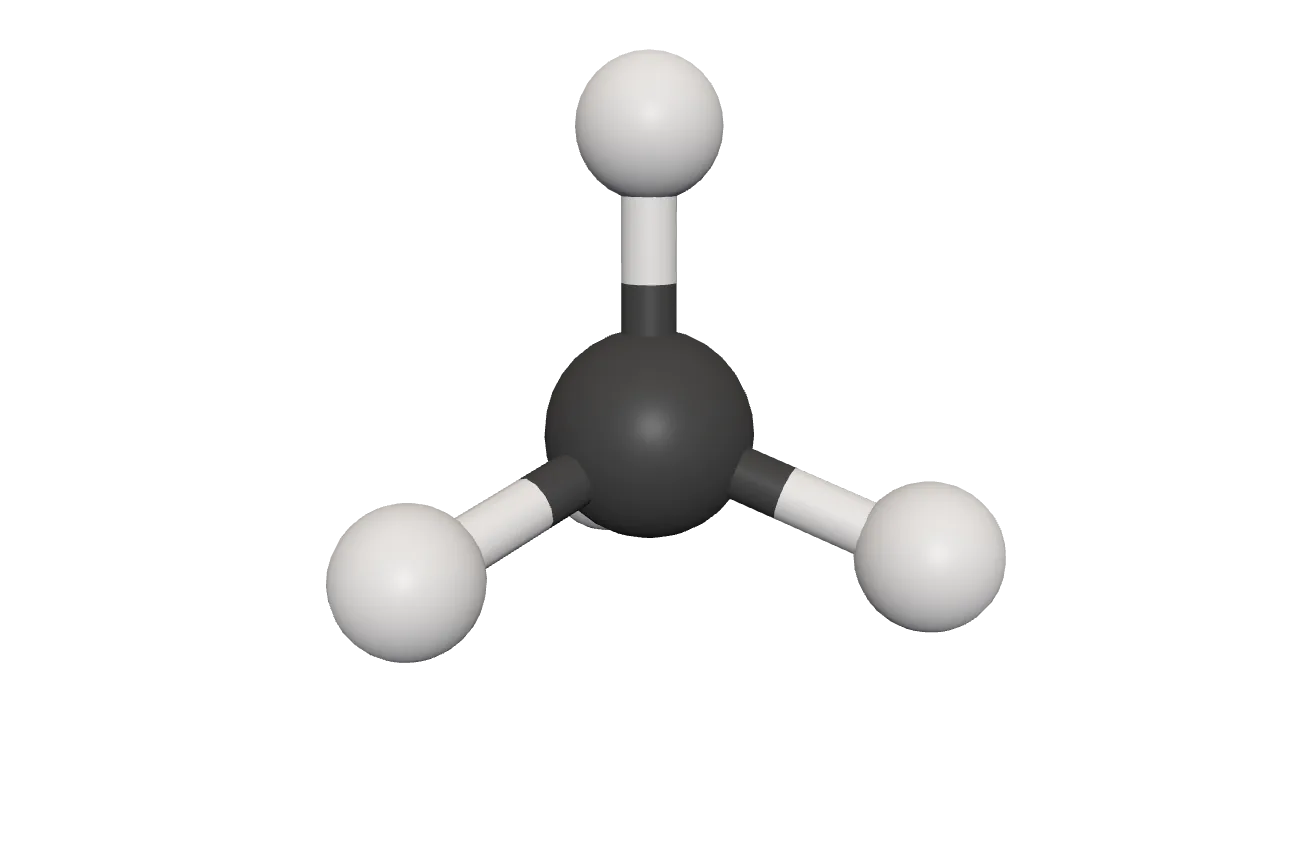
This browser can’t show the 3D model. The picture above is the same model.
A tetrahedron: the four hydrogens are as far apart as they can be, every two bonds 109.5° apart. Stood on three hydrogens, the fourth points straight up.
Carbon atom: four single bonds, one to each hydrogen.
Hydrogen atom: one single bond.
Single bonds only: each carbon’s four bonds point to the corners of a tetrahedron, about 109.5° apart (108.3° and 110.6° in this computed model).
Carbon atom: four single bonds, three to hydrogens and one to the other carbon.
Hydrogen atom: one single bond.
Flat: all six atoms lie in one plane (turn it edge-on), the bonds about 120° apart (118.5° and 120.7° here). The two carbons share a double bond.
Carbon atom: a double bond to the other carbon and a single bond to each of two hydrogens.
Hydrogen atom: one single bond.
Straight: all four atoms lie in a line (180°). The two carbons share a triple bond.
Carbon atom: a triple bond to the other carbon and a single bond to a hydrogen.
Hydrogen atom: one single bond.
Drag to turn it. Tap an atom to see what it is.
Molecules: computed 3D conformers from PubChem, National Library of Medicine (public domain): pubchem.ncbi.nlm.nih.gov, CID 297, 6324, 6325, 6326
14.1 Saturated hydrocarbons: the alkanes
Saturated hydrocarbons
Look at butane, the gas in a lighter. Each carbon atom has four bonds, the most a carbon atom can make, and every one of them is a single bond to a carbon or a hydrogen. There is no room to add another atom without first breaking a bond. A hydrocarbon like this, with only single bonds, is called saturated: it holds as much hydrogen as its carbon skeleton can carry. Saturated open-chain hydrocarbons are the alkanes:
- They are also called paraffins, from the Latin parum affinis, “little affinity”: they react with very little.
- All their bonds are single covalent bonds, which are sigma (σ) bonds.
- Their general formula is CₙH₂ₙ₊₂: ethane CH₃–CH₃ (C₂H₆), propane CH₃–CH₂–CH₃ (C₃H₈).
Because they are saturated, alkanes give no addition reactions: an atom can join an alkane only by replacing a hydrogen, in a substitution reaction (Section 14.1.2).
Naming the straight-chain alkanes
An alkane’s IUPAC name is its word root (which gives the number of carbons) followed by -ane (which says all its bonds are single). The first four roots are old names; from five carbons on they are Greek numbers.
| Formula | Common name | IUPAC name | Carbon atoms |
|---|---|---|---|
| CH₄ | methane | methane | 1 |
| C₂H₆ | ethane | ethane | 2 |
| C₃H₈ | propane | propane | 3 |
| C₄H₁₀ | n-butane | butane | 4 |
| C₅H₁₂ | n-pentane | pentane | 5 |
| C₆H₁₄ | n-hexane | hexane | 6 |
The n (for normal) in a common name means the unbranched chain; it is needed only from butane on, where branched isomers exist (methane, ethane and propane have one structure each, so they need no n). Each member differs from the next by one CH₂ group: together they form a homologous series.
Classification of alkanes
a. Open-chain alkanes have their carbon atoms in chains with two ends. They are of two kinds.
- Straight-chain alkanes have every carbon in one unbranched chain, with no group joined to its side: CH₃–CH₃ (ethane), CH₃–CH₂–CH₃ (propane).
- Branched-chain alkanes have one or more groups (methyl, ethyl…) joined to the side of the main chain.
In a name, the branches are listed in alphabetical order, ethyl before methyl, so these are 3-ethyl-2-methylpentane and 3-ethyl-2-methylhexane. The naming rules are in Unit 13.
b. Closed-chain alkanes (cycloalkanes) have their two end carbons bonded to each other, making a ring. A molecule with one ring is monocyclic, with two bicyclic (decalin, two six-membered rings sharing a side), with three tricyclic, and so on. A ring has two hydrogen atoms fewer than the open chain, so the cycloalkanes are CₙH₂ₙ, the same formula as the alkenes, though they have only single bonds.
Which of these is a saturated hydrocarbon with the formula C₆H₁₂?
Pick an answer to see why.
Structure of alkanes: sp³ carbon
In an alkane every carbon is sp³ hybridized (hybridization is explained in Unit 5). Carbon’s electron configuration is 1s² 2s² 2p² in its ground state; with only two unpaired electrons it could form only two bonds. To form four, one 2s electron is promoted into the empty 2p orbital, giving 1s² 2s¹ 2pₓ¹ 2p_y¹ 2p_z¹, four half-filled orbitals. These four (one s and three p) mix into four equal sp³ hybrid orbitals, each with one electron:
The four sp³ orbitals point to the corners of a regular tetrahedron, 109.5° apart. In methane, each overlaps head-on with a hydrogen 1s orbital, giving four C–H σ bonds (Figure 14.7). In ethane, one sp³ orbital of each carbon overlaps with one of the other carbon, making the C–C σ bond, and the other three on each carbon bond to hydrogens (Figure 14.8). Propane is the same again with one more carbon: three tetrahedral carbons, two C–C σ bonds and eight C–H σ bonds, the chain bent at 109.5° at the middle carbon. However long the chain, every carbon of an alkane is a tetrahedron, which is why a long alkane chain zigzags.
Classification of carbon atoms
These counts are the basis for classifying carbon atoms:
a. A primary carbon (1°) is bonded to only one other carbon atom: C-1, C-6, C-7, C-8 and C-9 above. The hydrogen atoms on a primary carbon are primary (1°) hydrogens.
b. A secondary carbon (2°) is bonded to two other carbon atoms: C-2 and C-3.
c. A tertiary carbon (3°) is bonded to three other carbon atoms: C-4.
d. A quaternary carbon (4°) is bonded to four other carbon atoms: C-5. A quaternary carbon has no hydrogen left.
In the same way, hydrogens are called 1°, 2° or 3° by the carbon they are on. The classification matters because the type of carbon decides how easily its hydrogen is replaced and which product of a reaction is the major one (Saytzeff’s rule and Markovnikov’s rule, below, both come down to it).
In 2-methylbutane, CH₃–CH(CH₃)–CH₂–CH₃, how many primary carbon atoms are there?
Pick an answer to see why.
Isomerism in alkanes
Compounds with the same molecular formula but different structures are isomers. The alkanes differ in how their carbon chain is arranged, so this is chain isomerism (all the kinds of isomerism are in Unit 13). Methane, ethane and propane have no isomers: there is only one way to join one, two or three carbon atoms. From butane on, the number of isomers rises steeply.
| Alkane | Formula | Chain isomers |
|---|---|---|
| butane | C₄H₁₀ | 2 |
| pentane | C₅H₁₂ | 3 |
| hexane | C₆H₁₄ | 5 |
| heptane | C₇H₁₆ | 9 |
| octane | C₈H₁₈ | 18 |
| nonane | C₉H₂₀ | 35 |
| decane | C₁₀H₂₂ | 75 |
| icosane | C₂₀H₄₂ | 366,319 |
A short-cut formula is often given, number of isomers = 2ⁿ⁻⁴ + 1, for n carbon atoms. It works for butane to heptane:
- butane, n = 4: 2⁰ + 1 = 1 + 1 = 2
- pentane, n = 5: 2¹ + 1 = 2 + 1 = 3
- heptane, n = 7: 2³ + 1 = 8 + 1 = 9
The three isomers of pentane:
The nine isomers of heptane, as skeletal formulas (each corner and end is a carbon):
How many chain isomers does C₅H₁₂ have?
Pick an answer to see why.
14.1.1 Preparation of alkanes
a. By reduction of haloalkanes. Zinc and hydrochloric acid produce nascent hydrogen (hydrogen atoms just formed, written [H]), which reduces an alkyl halide, R–X, to the alkane with the same number of carbon atoms:
For example:
iodomethane gives methane, chloroethane gives ethane, and 1-chloropropane gives propane. The halogen is replaced by hydrogen. Lithium aluminium hydride, LiAlH₄, or hydrogen over nickel or palladium does the same job.
b. By Wurtz’s reaction. When an alkyl halide is heated with sodium metal in dry ether, two alkyl groups join, giving a symmetrical alkane with twice as many carbon atoms:
chloromethane gives ethane, chloroethane gives butane. The ether must be dry because sodium reacts with water.
c. By decarboxylation. Look at these three reactions:
In each, the alkane has one carbon fewer than the salt: the –COONa group has left as sodium carbonate. Removing the carboxyl group, as CO₂ (here trapped as Na₂CO₃), is decarboxylation. The sodium salt of a carboxylic acid is heated with soda lime, a mixture of sodium hydroxide and quicklime (CaO); the quicklime keeps the mixture dry and stops the NaOH attacking the glass. Sodium ethanoate gives methane, sodium propanoate gives ethane.
d. By catalytic hydrogenation of alkenes and alkynes. Catalytic hydrogenation means adding hydrogen with a catalyst. When an alkene or alkyne is heated with hydrogen over nickel, palladium or platinum, it gives the alkane. Nickel needs heating (about 200–300 °C; the reaction with finely divided nickel is Sabatier’s), while palladium and platinum work at room temperature.
propene gives propane. An alkyne adds two molecules of hydrogen, through the alkene:
propyne, CH₃–C≡CH, gives propene and then propane.
Lindlar’s catalyst stops the reaction halfway. It is palladium on calcium carbonate “poisoned” with lead acetate and quinoline, which make it too weak to hydrogenate an alkene: an alkyne takes up one molecule of hydrogen and stops at the alkene. Both hydrogens add from the same side, so the alkene formed is the cis isomer:
Which method can give methane?
Pick an answer to see why.
Which product forms when 1-bromopropane is heated with sodium in dry ether?
Pick an answer to see why.
14.1.2 Chemical properties of alkanes
Every bond in an alkane is a strong σ bond, and C–H bonds are hardly polar, so alkanes ignore acids, bases, and most oxidizing agents at room temperature (which is why paraffin wax was used to line bottles of hydrofluoric acid). With no π bond, they give no addition reactions. They do react with strong reagents when given a lot of energy, by heat or by light, and then by substitution: a hydrogen atom is replaced by another atom or group.
1. Substitution reactions
a. Halogenation. A mixture of methane and chlorine does nothing in the dark at room temperature. In ultraviolet light (or sunlight), or at about 400 °C, the chlorine reacts, and hydrogen atoms of methane are replaced one at a time:
The products are chloromethane (methyl chloride), dichloromethane, trichloromethane (chloroform) and tetrachloromethane (carbon tetrachloride). All the chlorines are on the one carbon, so no position numbers are needed. Which product you get depends on the amounts: with a large excess of methane, a chlorine atom nearly always meets a methane molecule, so chloromethane is the main product; with excess chlorine, the substitution runs on to carbon tetrachloride.
The reaction goes by a free-radical chain mechanism (free radicals are in Unit 13). A half-headed arrow shows one electron moving.
Initiation: light splits a chlorine molecule evenly, one electron to each atom, giving two chlorine atoms (free radicals):
Propagation: a chlorine atom pulls a hydrogen atom off methane. Its own unpaired electron pairs with one electron of the C–H bond to make the H–Cl bond, and the other electron stays on the carbon, leaving a methyl radical. The methyl radical then takes a chlorine atom from a Cl₂ molecule in the same way, and the new chlorine atom starts the cycle again (the arrows show the electrons of the bond that breaks):
Termination: the chain stops when two radicals meet: Cl• + Cl• → Cl₂, CH₃• + Cl• → CH₃Cl, or CH₃• + CH₃• → CH₃–CH₃ (a little ethane is always found in the product). One photon can start a chain that converts thousands of methane molecules.
Other alkanes react in the same way:
ethane gives chloroethane. Propane has two kinds of hydrogen, six on the two primary carbons and two on the secondary carbon, so chlorination in light gives a mixture of 1-chloropropane and 2-chloropropane (about 45 : 55 at room temperature, although there are three times as many primary hydrogens, because a secondary C–H bond is easier to break):
The condition is light, not a metal catalyst. Bromine reacts more slowly and more selectively; iodine hardly reacts at all (Long answer 5a explains why).
b. Nitration. Replacing a hydrogen by a nitro group, –NO₂, is nitration. Alkanes are nitrated by nitric acid vapor at about 400–500 °C (vapor-phase nitration), giving nitroalkanes:
methane gives nitromethane and ethane gives nitroethane. At that temperature the C–C bond breaks too, so ethane gives some nitromethane as well. Concentrated nitric acid in a test tube at room temperature does nothing to an alkane.
c. Sulphonation. Replacing a hydrogen by a sulphonic acid group, –SO₃H, is sulphonation:
The alkane is heated with fuming sulphuric acid (oleum, concentrated H₂SO₄ with SO₃ dissolved in it; the SO₃ is the attacking reagent), and gives an alkanesulphonic acid. It works for the higher alkanes, from hexane up, and best at a tertiary hydrogen; methane, ethane and propane hardly react. Ethane to ethanesulphonic acid, , shows the pattern, but it isn’t a practical way to make it. Alkanesulphonates of long chains are detergents.
Methane and chlorine are mixed in the dark. What happens?
Pick an answer to see why.
2. Oxidation of alkanes
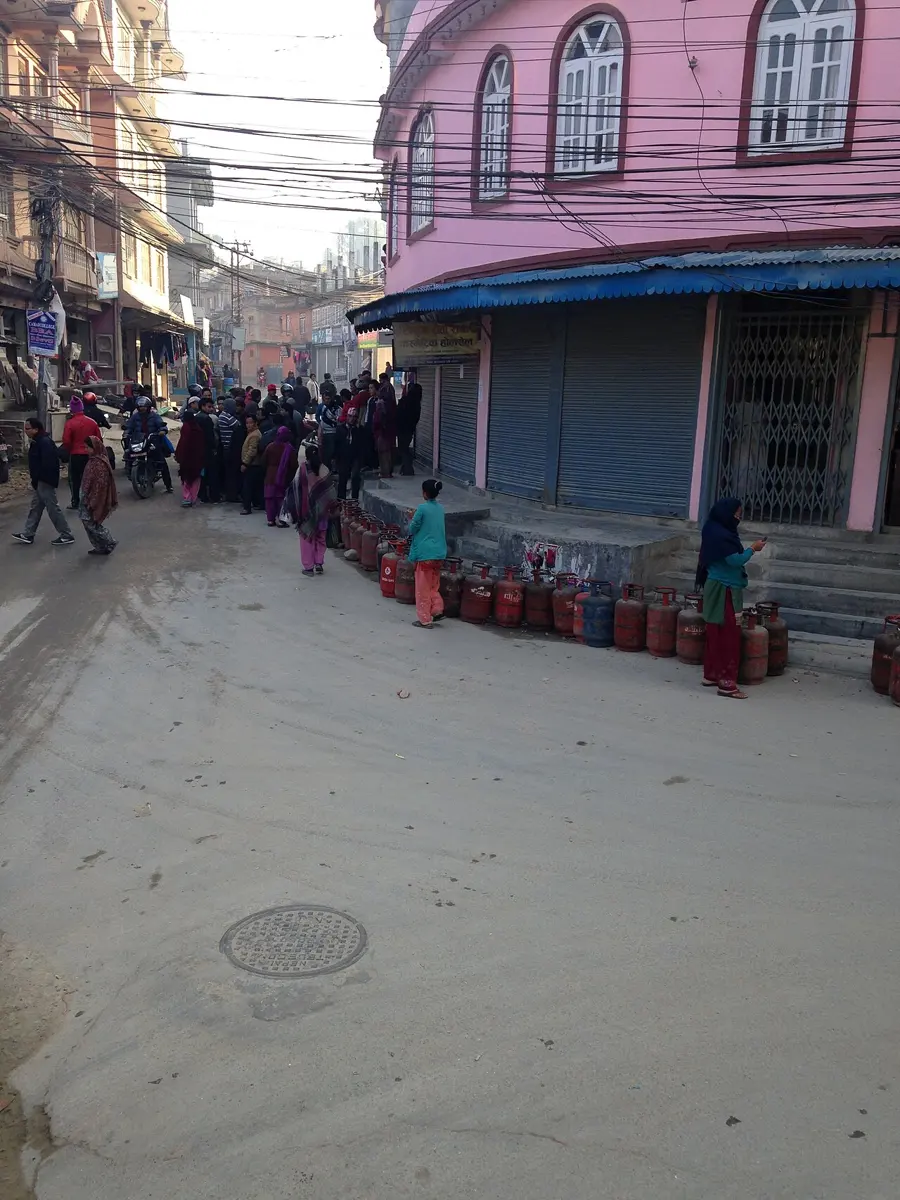
a. Combustion. Alkanes burn readily in plenty of oxygen to carbon dioxide and water, giving out a lot of heat: combustion is strongly exothermic. That is why alkanes are the world’s main fuels: natural gas (mostly methane), LPG (propane and butane), petrol (C₅–C₁₀), kerosene and jet fuel (about C₁₀–C₁₆) and diesel (about C₁₂–C₂₀).
In general,
When there isn’t enough oxygen, as in a badly adjusted stove, a smoky lamp or a car engine running rich, the alkane burns incompletely to carbon monoxide and soot (carbon): . A yellow, sooty gas flame is a sign of too little air, and a reason never to run a gas heater or charcoal stove in a closed room: carbon monoxide has no smell and kills.
b. Catalytic oxidation. Burned with a limited amount of oxygen over a catalyst, under pressure, an alkane is oxidized only partly, to an alcohol or an aldehyde:
methane gives methanol, or methanal (formaldehyde). The second catalyst is molybdenum(III) oxide. Industry today makes methanol from methane by a different route, through a mixture of CO and H₂, but these equations show that partial oxidation of an alkane gives alcohols and aldehydes.
14.2 Unsaturated hydrocarbons: the alkenes
Alkenes are hydrocarbons with one C=C double bond. They are unsaturated: each has two hydrogens fewer than the alkane, and their general formula is CₙH₂ₙ. Their old name, olefins, means “oil-makers”: ethene and chlorine give an oily liquid, 1,2-dichloroethane. An alkene’s name ends in -ene, and a number gives the position of the double bond: ethene CH₂=CH₂, propene CH₃–CH=CH₂, but-1-ene CH₂=CH–CH₂–CH₃, but-2-ene CH₃–CH=CH–CH₃ (old names: ethylene, propylene).
Structure of alkenes: sp² carbon
Each carbon of a C=C bond is sp² hybridized: its 2s and two of its 2p orbitals mix into three sp² orbitals, which lie in one plane at 120°, and one 2p orbital is left unhybridized, standing at right angles to that plane.
In ethene, one sp² orbital of each carbon overlaps head-on with one of the other, forming the C–C σ bond; the other two sp² orbitals of each carbon form σ bonds with hydrogen. The two leftover p orbitals, parallel to each other, overlap sideways above and below the line of the nuclei, forming a π (pi) bond. So the double bond is one σ bond and one π bond, and ethene has five σ bonds (one C–C, four C–H) and one π bond. All six atoms lie in one plane, with angles of about 120°.
The π bond is the alkene’s weak point. Sideways overlap is smaller than head-on overlap, so a π bond is weaker than a σ bond (the C=C bond, 614 kJ/mol, is less than twice C–C, 348 kJ/mol), and its electrons sit above and below the molecule, open to attack. That is why alkenes give addition reactions so easily.
How many σ and π bonds are there in propene, CH₃–CH=CH₂?
Pick an answer to see why.
14.2.1 Preparation of alkenes
a. By dehydration of alcohols. When an alcohol vapor is passed over hot aluminium oxide at about 350 °C, the –OH group and a hydrogen from the next carbon leave together as water:
Concentrated sulphuric acid does the same. With excess acid at about 100–110 °C ethanol first forms ethyl hydrogen sulphate, which at 170 °C breaks up into ethene and gives the acid back:
Overall, water has been removed from the alcohol, so this is a dehydration; the acid is both a catalyst and a drying agent. Propan-2-ol gives propene:
Saytzeff’s rule. When a secondary or tertiary alcohol has hydrogens on two different neighboring carbons, it can lose water two ways, giving two alkenes. The major product is the more substituted alkene, the one with more alkyl groups on the carbons of its double bond (and so fewer hydrogens on them). This is Saytzeff’s rule (also spelled Zaitsev, after the Russian chemist Alexander Zaitsev, 1875). Butan-2-ol gives mostly but-2-ene:
and pentan-2-ol gives mostly pent-2-ene, with some pent-1-ene:
The more alkyl groups round a double bond, the more stable it is.
b. By dehydrohalogenation of alkyl halides. When an alkyl halide is heated with alcoholic potassium hydroxide (KOH dissolved in ethanol), a hydrogen and the halogen are removed from neighboring carbons as HX (taken up by the KOH as KX and water). The halogen leaves from the α-carbon (the one it was on) and the hydrogen from the next one, the β-carbon, so this is a β-elimination:
Tertiary halides eliminate most easily: the ease is 3° > 2° > 1°. 2-Chloro-2-methylpropane gives 2-methylpropene:
c. By partial hydrogenation of alkynes. Over Lindlar’s catalyst (Section 14.1.1) an alkyne takes up just one molecule of hydrogen and stops at the alkene:
ethyne gives ethene and propyne gives propene. Lindlar’s catalyst is palladium on calcium carbonate, poisoned with lead acetate and quinoline; palladium on barium sulphate with quinoline works the same way.
d. From vicinal dihalides. A vicinal dihalide has its two halogen atoms on neighboring carbons (Latin vicinus, neighbor). Heated with zinc dust in alcohol, it loses both halogens as zinc halide and the double bond forms:
Which is the major product when butan-2-ol is heated with concentrated sulphuric acid at 170 °C?
Pick an answer to see why.
14.2.2 Chemical properties of alkenes
The π electrons of the double bond attract reagents that are short of electrons (electrophiles). The typical reaction of an alkene is addition: the π bond breaks, and a new atom or group joins each carbon. The alkene becomes saturated.
a. Addition of hydrogen halides, HX: Markovnikov’s rule
A symmetrical alkene such as ethene gives only one product with HBr: . But propene is unsymmetrical, and HBr could add two ways: H to the end carbon and Br to the middle one, giving 2-bromopropane, or the other way round, giving 1-bromopropane. In practice 2-bromopropane is the major product:
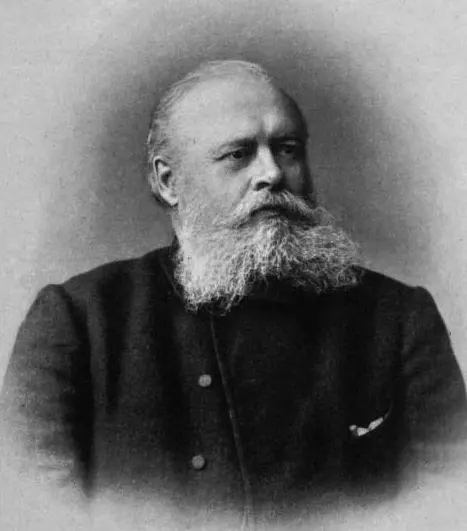
The Russian chemist Vladimir Markovnikov studied many additions to unsymmetrical alkenes and in 1869 stated the rule now named after him. Markovnikov’s rule: when a polar reagent HX adds to an unsymmetrical alkene (or alkyne), the positive part of the reagent (H) goes to the carbon of the double bond that already has more hydrogen atoms, and the negative part (X) to the carbon with fewer.
The reason is the mechanism, an electrophilic addition in two steps. The π electrons first take H⁺ from HBr. The H⁺ can join either carbon, and it joins the CH₂ end, because that leaves the positive charge on the middle carbon, a secondary carbocation, which is more stable than the primary one the other way would give (alkyl groups push electron density towards a positive carbon and spread its charge: the inductive effect, Unit 13). The bromide ion then joins the positive carbon:
So the rule really says: the reaction goes through the more stable carbocation (3° > 2° > 1°). 2-Methylpropene (isobutylene) adds HBr to give 2-bromo-2-methylpropane, through a tertiary carbocation:
The peroxide effect (Kharasch effect), anti-Markovnikov addition. In 1933 Morris Kharasch and Frank Mayo, at the University of Chicago, found that the result changed when the propene contained a little organic peroxide (R–O–O–R, formed when alkenes stand in air): HBr then added the other way, giving 1-bromopropane:
This is the peroxide effect, or Kharasch effect: in the presence of peroxide, HBr adds to an unsymmetrical alkene against Markovnikov’s rule, the Br going to the carbon with more hydrogens. Only HBr does this, not HCl or HI.
The peroxide changes the mechanism to a free-radical chain. The peroxide splits into RO• radicals, which take an H from HBr, making bromine atoms, Br•. It is a bromine atom, not H⁺, that adds first; it joins the CH₂ end, leaving the more stable secondary radical on the middle carbon, which then takes an H atom from another HBr and makes a new Br•. Br ends up on the end carbon.
b. Addition of water (hydration)
In the presence of an acid (dilute H₂SO₄ or phosphoric acid), water adds across the double bond, giving an alcohol:
ethene gives ethanol (this is how most industrial ethanol is made, over phosphoric acid at about 300 °C and 60–70 atm). Water’s two parts, H⁺ and OH⁻, add by Markovnikov’s rule, the OH going where Br went with HBr:
propene gives propan-2-ol. 2-Methylpropene gives 2-methylpropan-2-ol:
c. Addition of ozone: ozonolysis
Ozone, O₃, attacks a double bond in an inert solvent such as carbon tetrachloride or an ether, at low temperature, and adds across it, first as an unstable molozonide that rearranges into a five-membered ring, the ozonide. Ozonides are explosive and aren’t isolated: the solution is warmed with zinc dust and water, which splits the ozonide into two carbonyl compounds (aldehydes or ketones). The zinc takes up the hydrogen peroxide formed, which would otherwise oxidize an aldehyde to an acid. The whole process, the C=C bond cut in two and each end turned into C=O, is ozonolysis:
ethene gives two molecules of methanal (formaldehyde); propene gives ethanal (acetaldehyde) and methanal. A carbon of the double bond that carried a hydrogen becomes an aldehyde, –CHO; one with two carbon groups becomes a ketone.
Ozonolysis is used to find where the double bond is in an unknown alkene: identify the two carbonyl compounds, join their C=O carbons with a double bond, and you have the alkene. But-1-ene gives propanal and methanal; but-2-ene gives two ethanal: so the products tell the two isomers apart.
An alkene C₄H₈ gives only ethanal on ozonolysis. It is
Pick an answer to see why.
d. Addition of sulphuric acid
Cold concentrated sulphuric acid adds as H⁺ and ⁻OSO₃H, giving an alkyl hydrogen sulphate:
With an unsymmetrical alkene the addition follows Markovnikov’s rule: propene gives propan-2-yl (isopropyl) hydrogen sulphate.
Boiled with water, an alkyl hydrogen sulphate gives the alcohol, so this is another way of hydrating an alkene. Alkanes don’t react with cold concentrated sulphuric acid, so shaking a mixture with it removes alkenes from alkanes.
14.3 Unsaturated hydrocarbons: the alkynes
Alkynes are hydrocarbons with a C≡C triple bond, general formula CₙH₂ₙ₋₂, names ending in -yne: ethyne HC≡CH (acetylene), propyne CH₃–C≡CH, but-1-yne CH≡C–CH₂–CH₃, but-2-yne CH₃–C≡C–CH₃.
Structure of alkynes: sp carbon
Each carbon of a triple bond is sp hybridized: its 2s and one 2p orbital mix into two sp orbitals pointing in opposite directions, 180° apart, and two 2p orbitals are left over, at right angles to each other and to the line of the sp orbitals.
In ethyne, one sp orbital of each carbon overlaps head-on with the other’s, forming the C–C σ bond, and the other sp orbital of each forms a σ bond with hydrogen. The two pairs of leftover p orbitals overlap sideways, making two π bonds, one above and below the axis and one in front and behind. So a triple bond is one σ and two π bonds, and the molecule is a straight line, H–C≡C–H, with 180° angles. The two π clouds merge into a cylinder of electron density round the C–C axis.
| Alkane C–C | Alkene C=C | Alkyne C≡C | |
|---|---|---|---|
| Hybridization | sp³ | sp² | sp |
| Bonds | 1 σ | 1 σ + 1 π | 1 σ + 2 π |
| Shape round the carbon | tetrahedral, 109.5° | planar, 120° | linear, 180° |
| Bond length (pm) | 154 | 134 | 120 |
| Bond energy (kJ/mol) | 348 | 614 | 839 |
The more bonds, the shorter and stronger the bond as a whole; but each extra π bond adds less than a σ bond, which is why alkynes, like alkenes, give addition reactions.
14.3.1 Preparation of alkynes
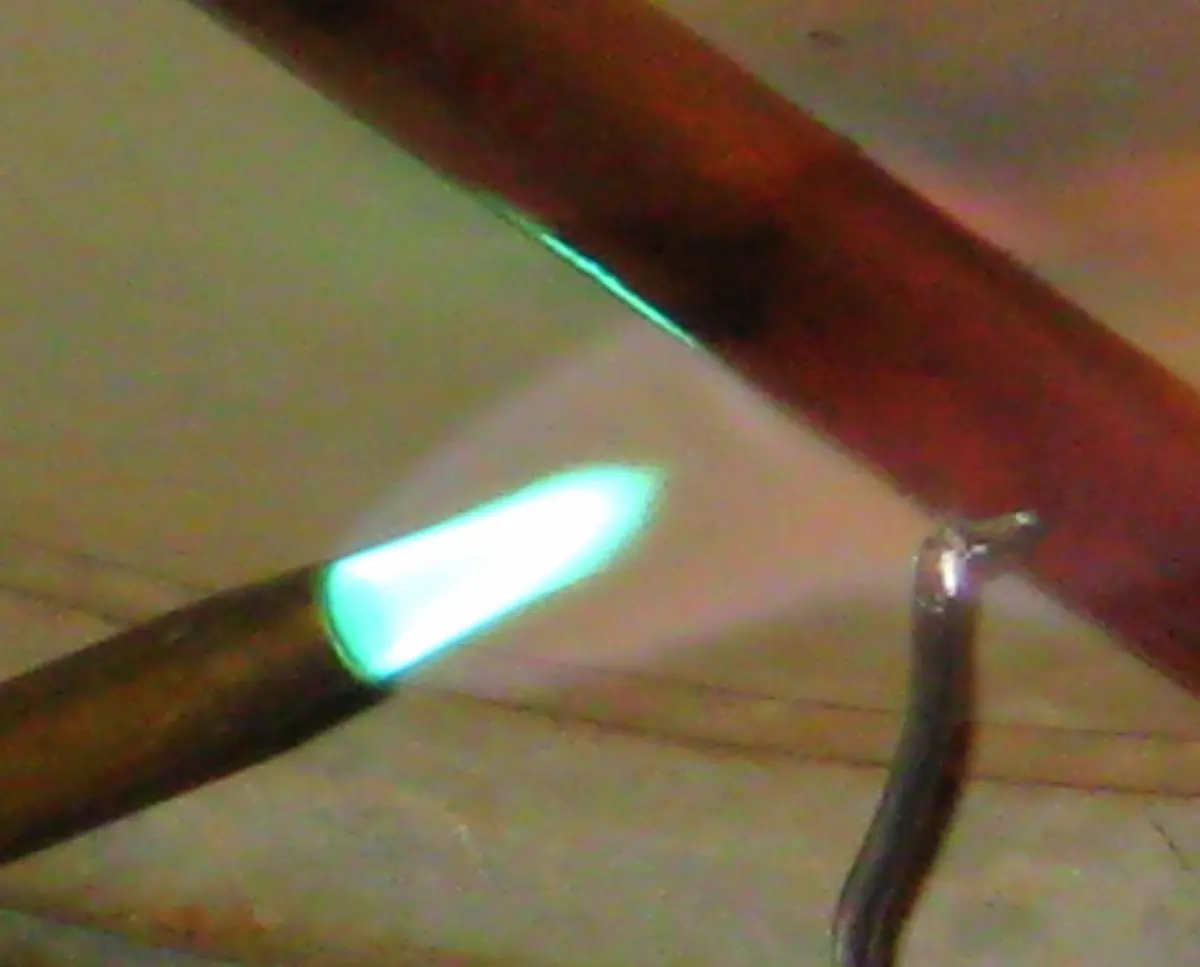
a. From carbon and hydrogen: Berthelot’s synthesis. In 1862 the French chemist Marcellin Berthelot passed hydrogen through an electric arc struck between carbon electrodes, and got ethyne:
It was one of the first organic compounds made directly from its elements, and part of the evidence that organic compounds need no “vital force” Grade 11: Unit 12.
b. By dehydrohalogenation of vicinal dihalides. A vicinal dihalide treated with alcoholic KOH loses one molecule of HX, giving a haloalkene; a stronger base, sodamide, NaNH₂, removes the second:
The second HBr is harder to remove, because a halogen on a double-bonded carbon is held more firmly; hot alcoholic KOH can do it slowly, but sodamide is used in practice. Since 1,2-dibromoethane is made from ethene and bromine, this is a way to turn an alkene into an alkyne: add Br₂, then remove 2HBr. A geminal dihalide, with both halogens on one carbon (such as 1,1-dichloroethane), loses 2HX in the same way. 1,2-Dibromopropane gives propyne through 2-bromopropene:
c. From chloroform or iodoform. When chloroform (trichloromethane) or iodoform (triiodomethane) is heated with silver powder, the silver takes all the halogen atoms, and the two carbons join by a triple bond:
14.3.2 Chemical properties of alkynes
The two π bonds make alkynes unsaturated and reactive: like alkenes they give addition reactions, each π bond taking up one molecule of reagent, so an alkyne can add two molecules. Unlike alkenes, a terminal alkyne is also a weak acid.
a. Addition of hydrogen. Over nickel with heat (or platinum, palladium), an alkyne adds hydrogen in two steps, to the alkene and then the alkane:
ethyne → ethene → ethane; but-2-yne → but-2-ene → butane; propyne → propene → propane. With Lindlar’s catalyst (or Pd/BaSO₄ and quinoline) the reaction stops at the alkene, the cis alkene from an internal alkyne:
b. Addition of hydrogen halides, HX. HX adds in two steps. The first gives a haloalkene, and the second adds to it by Markovnikov’s rule: the second halogen joins the carbon that already carries the first, giving a geminal dihalide (both halogens on one carbon; Latin geminus, twin):
But-1-yne with HCl gives 2-chlorobut-1-ene and then 2,2-dichlorobutane; but-2-yne with HBr gives 2,2-dibromobutane. Ethyne with HCl gives chloroethene, CH₂=CHCl (vinyl chloride), and then 1,1-dichloroethane; vinyl chloride is the starting material of PVC, the plastic of water pipes.
c. Addition of water: hydration. Alkynes add water in the presence of about 1% mercury(II) sulphate and dilute sulphuric acid, at about 60 °C (333 K). The first product is an enol, a compound with an OH on a carbon of a C=C bond (ene + ol). Enols are unstable: a hydrogen moves at once from the oxygen to the other carbon and the C=C becomes C=O, giving a carbonyl compound. This shift of a hydrogen between two forms is keto–enol tautomerism Grade 11: Unit 13.
Ethyne gives ethanal (acetaldehyde):
Every other alkyne gives a ketone: water adds by Markovnikov’s rule, so the OH goes to the inner carbon, and the C=O ends up there. Propyne gives propanone (acetone), and in general a terminal alkyne R–C≡CH gives a methyl ketone, R–CO–CH₃:
So ethyne is the only alkyne that gives an aldehyde. (For ethyne the keto form happens to be an aldehyde, but the shift is the same keto–enol tautomerism.)
What is formed when propyne is passed into dilute H₂SO₄ containing HgSO₄?
Pick an answer to see why.
d. Acidic nature of alkynes. A hydrogen on a triple-bonded carbon, ≡C–H, can be removed by a strong base. The reason is the carbon’s hybridization: the more s character an orbital has, the closer its electrons are held to the nucleus.
| Compound | Hybridization of C | s character | Approximate pKa |
|---|---|---|---|
| ethane, CH₃–CH₃ | sp³ | 25% | 50 |
| ethene, CH₂=CH₂ | sp² | 33% | 44 |
| ethyne, HC≡CH | sp | 50% | 25 |
An sp carbon, with 50% s character, holds its electrons closest and is the most electronegative of the three. It pulls the electrons of the C–H bond towards itself, the hydrogen leaves as H⁺ more easily, and the anion left behind (HC≡C⁻, acetylide) is the most stable, its lone pair held close to the nucleus. So ethyne is the most acidic of the three, although it is still a far weaker acid than water (pKa 15.7): it doesn’t turn litmus red, and it needs sodium or a very strong base to lose its hydrogen. Ethane and ethene are not acidic at all in practice. Only terminal alkynes, R–C≡C–H, are acidic; an internal alkyne such as but-2-yne has no H on its triple-bonded carbons.
i. With sodium. Ethyne passed over sodium in liquid ammonia gives sodium acetylide and hydrogen:
and with more sodium, heated, disodium acetylide:
Sodium here is a reactive metal that replaces the acidic hydrogen, as it does in water or alcohol, not a base.
ii. With ammoniacal silver nitrate (Tollens’ reagent). Tollens’ reagent is made by adding sodium hydroxide to silver nitrate, which gives a brown precipitate of silver oxide, and then ammonia solution until it dissolves:
Ethyne passed into it gives a white precipitate of silver acetylide:
iii. With ammoniacal copper(I) chloride. Ethyne gives a red precipitate of copper(I) acetylide:
These two precipitates are a test for a terminal alkyne, and they tell an alkyne from an alkene, which gives neither: ethene and but-2-yne give no precipitate.
14.4 Tests for unsaturation
An alkene or alkyne can be told from an alkane by two quick tests, both shown by a teacher in the laboratory. Bromine is toxic and burns the skin, and its vapor attacks the lungs, so it is handled only in a fume cupboard with gloves; potassium permanganate stains and is an oxidizer. Neither test is for home.
a. Bromine water (or bromine in CCl₄) test. Bromine water is reddish brown. Shaken with an alkene or alkyne, it loses its color, because the bromine adds across the multiple bond, giving a colorless dibromide (or tetrabromide). An alkane leaves the color, in the dark, unchanged.
Ethyne first gives 1,2-dibromoethene, still unsaturated, and then 1,1,2,2-tetrabromoethane, so it takes up twice as much bromine as ethene does. The addition is electrophilic, like HBr’s: as the Br₂ molecule nears the π electrons it becomes polarized, the near bromine δ+, and is attacked:
(Experiments show that the first step actually gives a three-membered ring with the bromine bridging both carbons, a bromonium ion, so the two bromines end up on opposite sides; the open carbocation above is the simpler picture used at this level.)
b. Baeyer’s test. Baeyer’s reagent is cold, dilute, alkaline potassium permanganate, purple-pink. An alkene or alkyne shaken with it turns it colorless, and a brown precipitate of manganese dioxide appears. The alkene is oxidized to a diol, two OH groups added on the same side of the former double bond; ethene gives ethane-1,2-diol (ethylene glycol, the antifreeze):
An alkane leaves the purple color unchanged: that is what you saw in pictures A and B at the start of the unit.
A colorless gas turns bromine water colorless and gives a white precipitate with ammoniacal silver nitrate. It is
Pick an answer to see why.
14.5 Physical properties of alkanes, alkenes and alkynes compared
a. State at room temperature. All three families are gases when small and solids when large, because the forces between molecules (London dispersion forces) grow with the size of the molecule.
| Gases | Liquids | Solids | |
|---|---|---|---|
| Alkanes | C₁–C₄ | C₅–C₁₇ | C₁₈ and up |
| Alkenes | C₂–C₄ | C₅ to about C₁₇–C₁₈ | the higher ones |
| Alkynes | ethyne, propyne, but-1-yne | but-2-yne, then C₅ to about C₁₇–C₁₈ | the higher ones |
b. Solubility. All are non-polar or nearly so: insoluble in water and in polar solvents, soluble in non-polar solvents such as petrol, ether, benzene and carbon tetrachloride (“like dissolves like”). Ethyne is a little soluble in water (about 1 volume in 1) and very soluble in acetone, which is how it is stored safely: dissolved in acetone, soaked into a porous filling, inside a welding cylinder.
c. Acidic nature. Alkanes and alkenes are not acidic; terminal alkynes are weakly acidic (Section 14.3.2).
d. Hybridization. Alkanes sp³, alkenes sp², alkynes sp.
e. Density, melting and boiling points. All are less dense than water (alkanes about 0.6–0.8 g/cm³), so petrol floats, and an oil fire can’t be put out with water. In each series density, melting point and boiling point rise with molecular mass. Branching lowers the boiling point: a branched molecule is more compact, touches its neighbors less, and is held less firmly (pentane boils at 36 °C, 2,2-dimethylpropane at 9.5 °C).
f. Polarity. Alkanes are non-polar. Ethene and ethyne are non-polar too (symmetrical, so the bonds’ small dipoles cancel), but an unsymmetrical alkene or alkyne has a small dipole moment, because an sp² or sp carbon pulls electrons more than an sp³ one: propene 0.37 D, propyne 0.78 D.
Which has the highest boiling point?
Pick an answer to see why.
14.6 Kolbe’s electrolysis
In 1849 the German chemist Hermann Kolbe passed a current through a concentrated solution of a sodium or potassium salt of a carboxylic acid and found a hydrocarbon at the anode. Kolbe’s electrolysis can make an alkane, an alkene or an alkyne, depending on the salt.
a. Alkanes. In solution, sodium ethanoate is in ions:
At the anode, each carboxylate ion loses an electron, giving a radical that falls apart into an alkyl radical and carbon dioxide; two alkyl radicals then join:
At the cathode, water is reduced, not the sodium ion (sodium is far too reactive to be set free in water):
Some books write this in two steps, and then . The result, hydrogen and sodium hydroxide at the cathode, is the same; but no sodium metal actually forms in the water.
Overall:
So ethane and carbon dioxide come off at the anode, hydrogen at the cathode. Like Wurtz’s reaction, Kolbe’s method joins two alkyl groups, so it gives symmetrical alkanes with an even number of carbon atoms: R–COONa gives R–R; sodium propanoate gives butane.
b. Alkenes. The potassium or sodium salt of succinic acid (butanedioic acid), potassium succinate, gives ethene: the two carboxylate groups of one ion lose two electrons and two CO₂, and the two carbons left join with a double bond.
At the anode:
c. Alkynes. The salt of maleic acid (cis-butenedioic acid), sodium maleate, gives ethyne in the same way:
At the anode:
What is formed at the anode when a concentrated solution of sodium propanoate, CH₃CH₂COONa, is electrolyzed?
Pick an answer to see why.
Exercise
A. Multiple choice questions
- Which type of hybridization do the carbon atoms of a saturated hydrocarbon have?
Pick an answer to see why.
- A bar diagram, “Mass of alkanes”, shows the molar masses of three alkanes: A about 16, B about 30 and C about 44 (g/mol). Which is correct?
Pick an answer to see why.
- Which is the general formula of the alkanes?
Pick an answer to see why.
- What is B in this reaction?
Pick an answer to see why.
- Which equation is a correct example of Wurtz’s reaction?
Pick an answer to see why.
- What type of hybridization do the carbons of the double bond in an alkene have?
Pick an answer to see why.
- What is Y in this reaction?
Pick an answer to see why.
- Match the two columns. A. Markovnikov’s rule; B. Wurtz’s reaction; C. ozonolysis; D. Baeyer’s test. 1. KMnO₄/KOH; 2. ethanal and methanal; 3. butane; 4. 2-chloropropane.
Pick an answer to see why.
- Which is correct for the table?
| Reactant | Condition | Product |
|---|---|---|
| P | alc. KOH | ethene |
| but-2-ene | Q | ethanal |
| sodium ethanoate | NaOH + CaO, heat | R |
| ethyne | S | ethanal |
Pick an answer to see why.
- Which is another name for the alkanes?
Pick an answer to see why.
B. Short answer questions
How many isomers does the hydrocarbon C₄H₁₀ have? Write all of them and their IUPAC names.
Answer
Suggest a reason why the peroxide effect is seen with HBr but not with HCl or HI. Why is Wurtz’s reaction not a good method for preparing alkanes with an odd number of carbon atoms? Explain with examples.
Answer
Give an example of each: a. Wurtz’s reaction; b. Kolbe’s electrolysis; c. decarboxylation; d. Markovnikov’s rule; e. dehydrohalogenation.
Answer
Identify P, Q, R, S and T. The reactant, condition and product of each reaction are in one row.
| Reactant | Condition | Product |
|---|---|---|
| P | alc. KOH | propene |
| but-1-ene | Q | propanal and methanal |
| sodium propanoate | NaOH + CaO, heat | R |
| propyne | S | propanone |
| T | peroxide | 1-bromopropane |
The textbook prints 1-chloropropane as T’s product, but the peroxide effect works only with HBr: propene and HCl give 2-chloropropane even with a peroxide, so the book’s row doesn’t work. It is answered here with 1-bromopropane.
Answer
Convert methane into ethyne.
Answer
Two containers hold but-2-ene and octane. How can you tell them apart by a chemical test? Write the equation.
Answer
Distinguish between, with an example of each: a. Wurtz’s reaction and the decarboxylation reaction; b. Markovnikov’s rule and the anti-Markovnikov rule; c. olefins and paraffins.
Answer
What products are obtained by ozonolysis of: a. ethene; b. propene; c. but-2-ene; d. 2-methylbut-2-ene; e. 2,3-dimethylbut-2-ene?
Answer
Addition reactions are impossible for alkanes but possible for alkenes and alkynes, while substitution reactions are possible for alkanes. Explain with an example of each.
Answer
Among CH₃CH₃, CH₂=CH₂ and CH≡CH, which is the most acidic? Explain with examples.
Answer
Draw the orbital structures of methane, ethene and ethyne. Give the number and nature of the bonds between the carbon atoms in each.
Answer
C. Long answer questions
Alkanes are saturated hydrocarbons. How do we confirm this? Explain with examples. Alkanes are less acidic than alkynes: explain this statement. What products would you obtain when ethane undergoes nitration and sulphonation? Explain with suitable examples.
Answer
Compare any three physical and any five chemical properties of alkanes, alkenes and alkynes.
Answer
Study the table, in which the reactant, condition and product of each reaction are given. Write the structure and name of P, Q, R, S, T, U, V and W.
| Reactant | Condition | Product |
|---|---|---|
| P | Na, dry ether, heat | CH₃CH₂CH₂CH₃ |
| CH₂=CH₂ | Q | CH₃–CH₃ |
| CH₃–CH₂Cl | alc. KOH | R |
| S | HgSO₄/H⁺ | CH₃CHO |
| CH₃CH₂OH | T | CH₂=CH₂ |
| CH≡CH | Na, liquid NH₃ | U |
| V | HCl | CH₃CHClCH₃ |
| W | NaOH/CaO | CH₄ |
The textbook prints U’s condition as “Na/NH₄OH”, but in ammonia solution sodium reacts with the water, and any acetylide ion formed takes H⁺ back from water at once (ethyne, pKa 25, is a far weaker acid than water, 15.7), so the book’s condition doesn’t work. It is answered here with sodium in liquid ammonia, with no water present.
Answer
Convert methane into ethene.
Answer
What happens when:
- a.ethane is treated with iodine?
- b.ethane is treated with concentrated nitric acid?
- c.ethane is treated with concentrated sulphuric acid?
- d.chloroethane is heated with sodium in dry ether?
- e.ethylene is heated with hydrogen in the presence of nickel?
- f.ethane is burned in air?
- g.sodium acetate is heated with soda lime?
- h.chloroethane is heated with zinc and HCl?
Answer
Printable PDFs
- Study notes 3 pages
- Worksheet 4 pages Answer key
Quiz yourself: Materials and Chemicals We Use, Grades 5–12 →
Practice every question in the book, and keep track of the ones you miss →
A companion to your textbook, not a replacement for it: study from the book your school uses, and where the two differ, follow your teacher. Found a mistake? Please tell us.