
In 1958 Nepal began its first national public health campaign: teams walked from village to village in the Terai and the inner valleys, spraying the inside walls of every house with a white powder. Mosquitoes that rested on the walls after biting died, malaria fell away, and millions of people could farm land that had been feared for centuries. The powder was DDT, made from chlorobenzene, a benzene ring with one chlorine atom on it.
Chlorobenzene and its relatives, the haloarenes, are odd molecules. A chlorine atom on a chain of carbons is easy to knock off, as you will see in the haloalkanes; the same chlorine on a benzene ring holds on so tightly that hot sodium hydroxide at 300 atmospheres is needed to move it. This unit is about why, how haloarenes are made, what they do, and why the most famous of them, DDT, went from a Nobel Prize to a ban.
9.1 Introduction
Haloarenes, or aryl halides, are compounds in which one or more halogen atoms (F, Cl, Br or I) are joined directly to an sp² carbon of an aromatic ring. They can be pictured as an arene with one of its ring hydrogens replaced by a halogen:
Their general formula is Ar–X, where Ar (aryl) is a phenyl group, C₆H₅–, a substituted phenyl group, or another aromatic ring, and X is the halogen.
The test is always where the halogen is. On a ring carbon: a haloarene. On a carbon outside the ring, even one next to a ring (benzyl chloride): a haloalkane.
Which of these is not a haloarene?
Pick an answer to see why.
9.2 Nomenclature and isomerism of haloarenes
In IUPAC names, a haloarene is named by putting the halogen as a prefix (fluoro-, chloro-, bromo-, iodo-) before the name of the aromatic hydrocarbon: chlorobenzene, bromobenzene. The common names say the same thing the old way, as phenyl halides: phenyl chloride, phenyl bromide.
With two groups on the ring, there are three places the second can be, named from the first: ortho (o-, positions 1 and 2, next to each other), meta (m-, 1 and 3, one carbon between them) and para (p-, 1 and 4, opposite). The IUPAC name gives the numbers instead, as low as possible; the o-, m-, p- names are still used everywhere and asked in exams. So C₆H₄Cl₂ has three position isomers (Figure 9.4):
When the ring carries another group that has a name of its own, such as –CH₃ in toluene, the compound is named from that parent and the halogen gets the number: 2-chlorotoluene (o-chlorotoluene), 3-chlorotoluene (m-) and 4-chlorotoluene (p-). The fully systematic names number the ring in alphabetical order of the prefixes, giving 1-chloro-2-methylbenzene and so on, and 2-bromotoluene in Figure 9.2 is 1-bromo-2-methylbenzene. With a nitro group, both are prefixes, numbered in alphabetical order: 1-chloro-3-nitrobenzene (m-chloronitrobenzene).
What is the IUPAC name of a benzene ring with Br on carbon 1 and Cl on carbon 4?
Pick an answer to see why.
9.3 Preparation of chlorobenzene
There are two main ways to put a chlorine atom on a benzene ring: put it on directly, or swap it in for a group that leaves easily.
1. By direct chlorination of benzene
Dry chlorine passed into benzene in the dark, with anhydrous iron(III) chloride (FeCl₃) or aluminium chloride as a halogen carrier, gives chlorobenzene and hydrogen chloride. It is an electrophilic substitution: FeCl₃ pulls Cl⁻ off Cl₂ and leaves the electrophile, Cl⁺, to attack the ring, as in Grade 11, Unit 15.
Bromobenzene is made the same way with bromine and FeBr₃. Iodine is too unreactive to substitute this way without an oxidizing agent, and fluorine far too violent.
2. From benzenediazonium chloride
Chlorobenzene can also be made from aniline, C₆H₅NH₂, in two steps. First, aniline dissolved in cold hydrochloric acid is treated with sodium nitrite at 0–5 °C. Nitrous acid forms in the solution and turns the –NH₂ group into a diazonium group, –N₂⁺. This is diazotization (more on it in Unit 16), and the product is benzenediazonium chloride, C₆H₅N₂⁺Cl⁻:
The solution is used at once, still cold: above about 5 °C the diazonium salt starts to break down (into phenol and nitrogen), and dry diazonium salts can explode. The –N₂⁺ group is a superb leaving group, because it leaves as a molecule of nitrogen gas, N₂, one of the most stable molecules there is, which bubbles away and can’t come back.
a. The Sandmeyer reaction. The cold diazonium solution is added to copper(I) chloride (cuprous chloride, CuCl) dissolved in hydrochloric acid and warmed: nitrogen bubbles off and chlorobenzene separates as an oil. With copper(I) bromide in hydrobromic acid, bromobenzene forms instead.
The copper(I) salt is not just a source of chloride (there is plenty of Cl⁻ in the acid already): it is a catalyst that passes one electron to the diazonium ion, which loses N₂ and becomes a phenyl radical; the radical then takes a chlorine atom from the copper. Older books write the reagent as Cu₂Cl₂, the same thing.
b. The Gattermann reaction. A simpler version: the diazonium salt is warmed with copper powder and hydrochloric acid (or hydrobromic acid for bromobenzene). It is a modification of the Sandmeyer reaction, easier to set up, though the yield is usually lower.
The diazonium route is the laboratory method: it puts the halogen exactly where the –NH₂ group was, with no o- and p- mixture, and it makes iodobenzene and fluorobenzene, which direct halogenation can’t. Iodobenzene needs no copper at all: the diazonium solution is simply warmed with potassium iodide solution.
Why must the diazonium salt be made and kept at 0–5 °C?
Pick an answer to see why.
9.4 Physical properties
Here are chlorobenzene’s physical properties, with the reasons behind them.
- A colorless liquid that evaporates easily, boiling at 132 °C. Its boiling point is well above benzene’s (80 °C), because its molecule is heavier (112.6 g/mol against 78) with more electrons, so the London (dispersion) forces between molecules are stronger, and it is polar (C–Cl has a dipole), adding dipole–dipole attraction. Down the group the boiling point rises with the molar mass (Figure 9.11): iodobenzene > bromobenzene > chlorobenzene > fluorobenzene.
- Among the dichlorobenzenes, the para isomer has by far the highest melting point: it is a solid at room temperature, the others are liquids. The p- molecule is symmetrical, so it packs neatly into a crystal, and more energy is needed to break that crystal up. The boiling points, which depend on the forces in the liquid, are close together; o-dichlorobenzene boils highest because it is the most polar (its two C–Cl dipoles point partly the same way; in the p- isomer they point exactly opposite and cancel).
- It has a faint, almond-like smell.
- It is insoluble in water but soluble in organic solvents such as ethanol, ether and benzene. It can’t form hydrogen bonds with water, and the energy needed to break water’s hydrogen bonds isn’t paid back.
- It is denser than water (1.11 g/cm³), so it sinks below water instead of floating, as benzene (0.88 g/cm³) does.
| Dichlorobenzene | Melting point | Boiling point | Dipole moment |
|---|---|---|---|
| o- (1,2-) | −17 °C | 180 °C | 2.50 D |
| m- (1,3-) | −25 °C | 173 °C | 1.72 D |
| p- (1,4-) | 53 °C | 174 °C | 0 |
Values from the CRC Handbook of Chemistry and Physics.

Why does p-dichlorobenzene melt at 53 °C, while o-dichlorobenzene melts at −17 °C?
Pick an answer to see why.
9.5 Chemical properties
A haloarene has two parts that can react: the C–X bond, where a nucleophile might replace the halogen, and the ring, where an electrophile might replace a hydrogen. In a haloalkane only the first exists, and it reacts easily. In a haloarene the C–X bond is very reluctant, and the ring reacts as benzene does, a little more slowly.
9.5.1 Nucleophilic substitution in haloarenes
A nucleophilic substitution is the replacement of one group by a nucleophile, an electron-rich species with a lone pair to give, such as OH⁻, NH₃, CN⁻. In a haloalkane, OH⁻ replaces the halogen in warm aqueous alkali: . Boil chlorobenzene with sodium hydroxide solution, though, and nothing happens. Why?
a. Resonance: the C–Cl bond is partly double
A chlorine atom has three lone pairs. In chlorobenzene one of them lies next to the ring’s π electrons and can spread into the ring by resonance (Figure 9.13). In three of the resonance structures (II, III and IV), chlorine is joined to the ring by a double bond, C=Cl⁺, and the negative charge sits on the ortho and para carbons.
The real molecule is the resonance hybrid of all five (Figure 9.14). Its C–Cl bond is partly double: shorter and stronger than a C–Cl single bond. Chlorine carries a small positive charge (δ+) from giving up some of its lone pair, and the ortho and para carbons carry small negative charges (δ−).
The measurements agree:
| Chloromethane, CH₃–Cl | Chlorobenzene, C₆H₅–Cl | |
|---|---|---|
| carbon holding Cl | sp³ | sp² |
| C–Cl bond length | 177 pm | 169 pm |
| energy to break the C–Cl bond | about 350 kJ/mol | about 400 kJ/mol |
| dipole moment | 1.89 D | 1.69 D |
| hot aqueous NaOH | substitution (methanol) | no reaction |
A shorter, stronger bond is harder to break, so it is very hard to replace chlorine in chlorobenzene by another nucleophile. The dipole moment is smaller too, because the lone pair pushed into the ring works against the pull of chlorine’s electronegativity.
b. The carbon is sp² hybridized
The carbon holding the halogen in a haloarene is sp², with 33 % s character; in a haloalkane it is sp³, with 25 %. The more s character an orbital has, the closer its electrons are held to the nucleus: an sp² carbon is more electronegative than an sp³ one. It holds the shared pair of the C–X bond more tightly, so the bond is shorter and stronger, and less polar too (the electronegativity difference between C and Cl is smaller), so there is less δ+ on carbon to attract a nucleophile.
c. The ring repels the nucleophile
A nucleophile is electron-rich. To attack the carbon holding Cl it must approach a ring wrapped in a cloud of six π electrons, and it is repelled.
d. Neither of the haloalkanes’ routes is open
Haloalkanes are substituted by two mechanisms Grade 12: Unit 8. Neither works here:
- In the nucleophile attacks from the back, opposite the halogen. In a haloarene the back of the C–Cl bond is inside the benzene ring: there is no way in.
- In the halogen leaves first, as X⁻, leaving a carbocation. A phenyl cation, C₆H₅⁺, would have its positive charge in an sp² orbital in the plane of the ring, where the ring’s π electrons can’t reach it to help. It is very unstable and almost never forms.
So, for all these reasons, haloarenes are far less reactive than haloalkanes towards nucleophilic substitution.
Which is the main reason chlorobenzene does not react with boiling aqueous NaOH, while chloroethane does?
Pick an answer to see why.
Nucleophilic substitution under special conditions
Hard is not impossible. At high temperature and pressure, or with a catalyst, the halogen can be replaced.
a. With sodium hydroxide: Dow’s process. Chlorobenzene heated with aqueous sodium hydroxide at 623 K (350 °C) and about 300 atm gives sodium phenoxide; dilute hydrochloric acid then frees phenol.
Two moles of NaOH are used: one replaces the chlorine, and the second turns the phenol formed into sodium phenoxide (phenol is an acid). The Dow Chemical Company in the United States made phenol this way from the 1920s; today almost all phenol is made from cumene instead.
b. With ammonia. Chlorobenzene heated with concentrated aqueous ammonia at about 200 °C and 60 atm, with copper(I) oxide (Cu₂O) as a catalyst, gives aniline:
Some books write the copper(I) oxide into the equation:
Both are balanced; the oxide is changed to copper(I) chloride if it is counted as a reactant.
c. With copper(I) cyanide. Chlorobenzene heated with copper(I) cyanide (cuprous cyanide) at about 200 °C in pyridine gives benzonitrile (phenyl cyanide, benzenecarbonitrile), C₆H₅CN. Bromobenzene and iodobenzene react more readily; the reaction is named after Rosenmund and von Braun.
Benzonitrile is useful because the –CN group can be hydrolyzed to –COOH (benzoic acid) or reduced to –CH₂NH₂.
What helps: electron-withdrawing groups at ortho and para
A nitro group (–NO₂) ortho or para to the chlorine makes the substitution far easier, and each extra one makes it easier still. The nitro groups pull electrons out of the ring, so the carbon holding Cl is short of electrons and the nucleophile is attracted to it, not repelled; and when OH⁻ adds to that carbon, the negative charge of the ion that forms spreads onto the nitro groups’ oxygens, which hold it well. A nitro group meta to the chlorine can’t take the charge in any resonance structure, and helps much less.
Compared with haloalkanes
In a haloalkane, such as chloroethane, there is no ring to share the lone pairs with: the C–Cl bond is a plain single bond on an sp³ carbon, polar, with a δ+ carbon open to attack from behind. So haloalkanes react with OH⁻, NH₃, CN⁻ and other nucleophiles under mild conditions, while haloarenes need a catalyst, high temperature and high pressure, or nitro groups on the ring.
9.5.2 Reduction of chlorobenzene
Nascent hydrogen (hydrogen at the moment it is made, written [H]), from a nickel–aluminium alloy in sodium hydroxide solution, reduces chlorobenzene to benzene: the C–Cl bond is replaced by C–H.
The aluminium of the alloy dissolves in the alkali, giving hydrogen right on the surface of the nickel, where it is very active. (In the alkali, the HCl formed is at once neutralized.) Sodium in ethanol, another source of nascent hydrogen, does the same. This is one of the ways benzene was made in Grade 11.
9.5.3 Electrophilic substitution reactions
The ring of a haloarene reacts as benzene’s does, by electrophilic substitution: halogenation, nitration, sulphonation and the Friedel–Crafts reactions, with the same reagents and the same electrophiles (Cl⁺, NO₂⁺, SO₃, CH₃⁺, CH₃CO⁺) as in Grade 11, Unit 15. Two things are new: where the new group goes, and how fast.
Where: ortho and para. A halogen pushes its lone pair into the ring by resonance (its +M, or +R, mesomeric effect). As Figure 9.13 shows, this puts extra electron density on the ortho and para carbons, not on the meta ones, so an electrophile attacks there. The same is seen in the ion formed on the way: when the electrophile attacks para (or ortho) to the chlorine, one of the resonance structures puts the positive charge on the carbon holding Cl, and then chlorine’s lone pair can share it, giving a fourth structure in which every atom has an octet (Figure 9.20). Attack at meta has no such structure. So the ortho and para routes are easier.
How fast: slower than benzene. Chlorine is very electronegative, and it pulls electrons out of the ring through the σ bond (its −I, inductive effect). This pull is stronger than the push of its lone pair, so the ring as a whole holds fewer electrons than benzene’s, and it attracts electrophiles less: chlorobenzene is nitrated about 30 times more slowly than benzene. The halogen is a deactivating group.
So the halogens are the exception in the directing table: ortho–para directing, yet deactivating. The −I effect decides how fast; the +M effect decides where.
In each reaction below the para product is the major one. Ortho is next to the chlorine, which crowds the incoming group, and there is only one para position against two ortho, so the para product still wins. Meta products form only in traces.
a. Halogenation. Chlorobenzene and chlorine, with anhydrous FeCl₃, give 1,2-dichlorobenzene (minor) and 1,4-dichlorobenzene (major), and HCl.
b. Nitration. Chlorobenzene with concentrated nitric acid and concentrated sulphuric acid gives 1-chloro-2-nitrobenzene (o-chloronitrobenzene, minor) and 1-chloro-4-nitrobenzene (p-chloronitrobenzene, major): roughly 30 % ortho and 70 % para, with about 1 % meta.
c. Bromination. With bromine and FeBr₃, the products are 1-bromo-2-chlorobenzene (minor) and 1-bromo-4-chlorobenzene (major).
d. Sulphonation. Heated with concentrated sulphuric acid, chlorobenzene gives 2-chlorobenzenesulphonic acid (minor) and 4-chlorobenzenesulphonic acid (major). The bulky –SO₃H group goes almost entirely para.
e. Friedel–Crafts alkylation. With chloromethane and anhydrous AlCl₃, chlorobenzene gives 2-chlorotoluene (o-chlorotoluene, minor) and 4-chlorotoluene (p-chlorotoluene, major).
f. Friedel–Crafts acylation. With ethanoyl chloride (acetyl chloride) and anhydrous AlCl₃, the products are 2-chloroacetophenone (minor) and 4-chloroacetophenone (major).
The Friedel–Crafts reactions of chlorobenzene go slowly and give poor yields, because the ring is deactivated.
Chlorobenzene is nitrated. Which statement is right?
Pick an answer to see why.
9.5.4 Action with sodium: the Fittig and Wurtz–Fittig reactions
In the Wurtz reaction Grade 12: Unit 8, two alkyl halides heated with sodium in dry ether join into one alkane. Aryl halides do the same.
Fittig reaction. An aryl halide heated with sodium in dry ether joins two aryl groups together. From chlorobenzene the product is biphenyl (diphenyl, phenylbenzene):
Wurtz–Fittig reaction. A mixture of an alkyl halide and an aryl halide, heated with sodium in dry ether, gives an alkylbenzene (an alkylarene). Chlorobenzene and chloromethane give toluene:
Because both halides can react with sodium, two side products form as well: biphenyl (two aryl groups joined) and ethane (two methyl groups joined). They are separated by distillation, since their boiling points are far apart.
Why dry ether? Sodium reacts violently with water, giving sodium hydroxide and hydrogen (which can catch fire), so even a little water would use up the sodium and spoil the reaction. Ether dissolves the halides without reacting with sodium.
9.5.5 Action with chloral: making DDT
Chlorobenzene heated with chloral (trichloroethanal, CCl₃CHO) and concentrated sulphuric acid gives DDT. The aldehyde’s carbon joins two chlorobenzene molecules, each at its para position (the electrophilic substitution of Section 9.5.3), and the oxygen of the aldehyde and the two ring hydrogens leave as water:
DDT stands for p,p′-dichlorodiphenyltrichloroethane. Its IUPAC name, read off its structure, is 1,1,1-trichloro-2,2-bis(4-chlorophenyl)ethane: an ethane whose carbon 1 has three chlorines and whose carbon 2 has two 4-chlorophenyl groups (“bis” means two of the same, in brackets).
The concentrated sulphuric acid does two jobs: it makes the electrophile (it protonates chloral’s C=O, leaving a positive carbon that attacks the ring) and it takes up the water formed.
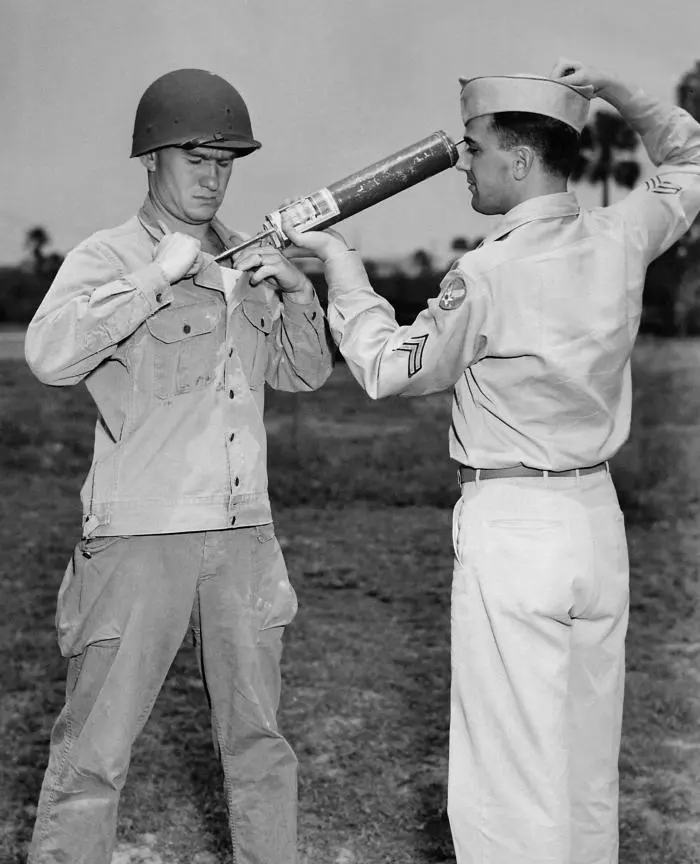
Why does DDT kill insects? It is a nerve poison for insects: it keeps open the sodium channels in their nerve cells, so the nerves fire again and again, and the insect twitches and dies. It works on contact: an insect that only walks over a sprayed wall takes it in through its body. It is not soluble in water but dissolves in fats, and it is very stable: the C–Cl bonds on the rings, as this unit has shown, are hard to break. So one spraying of a wall keeps killing mosquitoes for months. Those same two properties, staying for years and building up in fat, are why it was banned.
DDT is prepared in the laboratory from:
Pick an answer to see why.
9.6 Uses of haloarenes
- a.Chlorobenzene is the starting material for the nitrochlorobenzenes (Section 9.5.3), from which dyes, rubber chemicals and medicines such as paracetamol are made; and it was the starting material for phenol (Dow’s process) and for DDT.
- b.Chlorobenzene and o-dichlorobenzene are solvents: for paints, resins, greases and waxes, and for removing grease from metal.
- c.p-Dichlorobenzene (1,4-dichlorobenzene) is a moth repellent and the white blocks hung in toilets to cover smells. It turns straight from solid to vapor at room temperature. It is now classed as possibly causing cancer, so it is being replaced.
- d.Insecticides: DDT, as above, and other chlorinated aromatic compounds. Most are banned or limited now because they persist.
- e.Bromobenzene and other aryl bromides are used to make Grignard reagents (C₆H₅MgBr), and in the reactions that join rings in making medicines and the light-giving materials of phone screens.
- f.Medicines: many drugs carry a halogen on a ring, which makes them last longer in the body. The painkiller diclofenac has two chlorines on a ring, the antimalarial chloroquine one, and the antibiotic ciprofloxacin a fluorine.
- g.Polychlorinated biphenyls (PCBs), biphenyl with several chlorines on it, were used from the 1930s as insulating oils in transformers and capacitors, because they don’t burn or conduct and last for ever. That is exactly why they were banned (Exercise 9.2, Question 10).
Exercise
Exercise 9.1: Multiple choice questions
- Chlorobenzene has a higher boiling point than benzene. The reason is:
Pick an answer to see why.
- The boiling points of the three isomers of dichlorobenzene are in the order:
The textbook prints four orders, none of which matches the measured boiling points (ortho 180 °C, para 174 °C, meta 173 °C), so the book’s options don’t work; one of them is put right here.
Pick an answer to see why.
- To prepare chlorobenzene in the laboratory from benzenediazonium chloride, the reagent used is:
Pick an answer to see why.
- A chemist finds that a halogen compound shows no nucleophilic substitution even with a strong nucleophile. The compound may be:
Pick an answer to see why.
- Why are haloarenes less reactive than haloalkanes towards nucleophilic substitution?
Pick an answer to see why.
- Through resonance (its +M effect), a halogen on a benzene ring:
Pick an answer to see why.
- A halogen is an electron-withdrawing group, yet an ortho–para director, because of its:
Pick an answer to see why.
- DDT is an insecticide. To prepare it in the laboratory, the two compounds required are:
Pick an answer to see why.
- Why does Friedel–Crafts alkylation of chlorobenzene give a poor yield?
Pick an answer to see why.
- Which of the following is used to prepare a haloarene?
Pick an answer to see why.
- In the Fittig reaction, chlorobenzene reacts with sodium in dry ether to form:
Pick an answer to see why.
- The major product when chlorobenzene is nitrated with concentrated HNO₃ and concentrated H₂SO₄ is:
Pick an answer to see why.
- Which of the following will not undergo nucleophilic substitution easily?
Pick an answer to see why.
- Which of the following reactions involves both an electrophilic and a nucleophilic substitution step?
Pick an answer to see why.
- Which best explains why the Fittig reaction needs dry ether as the solvent?
Pick an answer to see why.
Exercise 9.2
Write the possible isomers of C₆H₄Cl₂. Draw their structures and name them.
Hint
Answer
There are different methods for the preparation of chlorobenzene.
- i.What happens when benzene is treated with chlorine?
- ii.How will you prepare chlorobenzene from benzenediazonium chloride? Name the reaction.
- iii.What is the use of CuCl in the preparation of chlorobenzene from the diazonium chloride?
Answer
Chlorobenzene is an aromatic compound in which chlorine is bonded to a carbon of the ring.
- i.Compare the solubility of chlorobenzene in water and in organic solvents.
- ii.Arrange chlorobenzene, bromobenzene and iodobenzene in increasing order of boiling point.
- iii.Why is the boiling point of chlorobenzene higher than that of benzene?
Answer
A nucleophilic substitution reaction is the replacement of one group by a nucleophile to give a new compound.
- i.Explain why haloarenes are less reactive towards nucleophilic substitution.
- ii.Compare the strength of the C–Cl bond, and the reactivity towards nucleophilic substitution, of a haloarene and a haloalkane.
Answer
In chlorobenzene, an electronegative chlorine atom is attached to a carbon of the ring.
- i.How could you show that –Cl is an ortho and para director in chlorobenzene?
- ii.In spite of being an ortho–para director, –Cl deactivates the aromatic ring. Explain.
Answer
Complete the following reactions and identify the major product.
i.
ii.
iii.
iv.
v.
Answer
Complete the following reactions.
- i.
- ii.
- iii.
iv.
v.
Hint
Answer
There are several name reactions in which halogen compounds are treated with sodium in dry ether.
- i.What happens when chlorobenzene is treated with chloroethane and sodium in dry ether? Name the reaction.
- ii.Compare the Fittig and Wurtz–Fittig reactions with suitable examples.
Answer
Chlorobenzene is used to make insecticides.
- i.What is the full form of DDT? Write its structure and IUPAC name.
- ii.What happens when chlorobenzene is treated with chloral in the presence of H₂SO₄?
- iii.Why is the product of this reaction used as an insecticide?
Answer
Polychlorinated biphenyls were widely used in the past but are banned now. Explain the reason.
Answer
Complete the following reactions.
- i.benzenediazonium chloride, with Cu/HBr →
- ii.benzenediazonium chloride, with CuCl/HCl →
Answer
Why does the reaction of chlorobenzene with aqueous NaOH happen only at high temperature and pressure, while benzyl chloride reacts readily under mild conditions? Explain from the mechanisms.
Answer
Explain why chlorobenzene behaves differently from trichloromethane (CHCl₃) with reducing agents such as Zn/HCl.
Answer
Carry out the following conversions.
- i.Nitrobenzene to chlorobenzene
- ii.Chlorobenzene to aniline
- iii.Chlorobenzene to benzoic acid
- iv.Chlorobenzene to phenol
Answer
Haloarene bingo
Project work
Printable PDFs
- Study notes 2 pages
- Worksheet 4 pages Answer key
Quiz yourself: Materials and Chemicals We Use, Grades 5–12 →
Practice every question in the book, and keep track of the ones you miss →
A companion to your textbook, not a replacement for it: study from the book your school uses, and where the two differ, follow your teacher. Found a mistake? Please tell us.