
A porter climbs from Lukla towards Namche with a 30 kg load on his back. A pump lifts water to a tank on a roof in Lalitpur. Water from the Kulekhani reservoir rushes down a pipe and spins a turbine. A cricket ball hits the bat and flies off faster than it came. In each, something is pushed through a distance, and something called energy moves from one place to another.
In Unit 4 you learned how forces change motion. This unit follows the energy that forces carry: how much work a force does, how fast it does it (power), the energy of motion and of position, the great law that energy is never made or lost, and what happens to energy when bodies collide.
5.1 Introduction
Our everyday words work, energy and power became exact ideas of physics only about two hundred years ago.
- The word energy comes from the Greek ἐνέργεια (energeia), “activity”, first used by Aristotle in the 4th century BCE.
- In the 1680s Gottfried Leibniz argued that a moving body carries a “living force”, vis viva, which he measured by its mass times the square of its speed, . It was the first step towards kinetic energy.
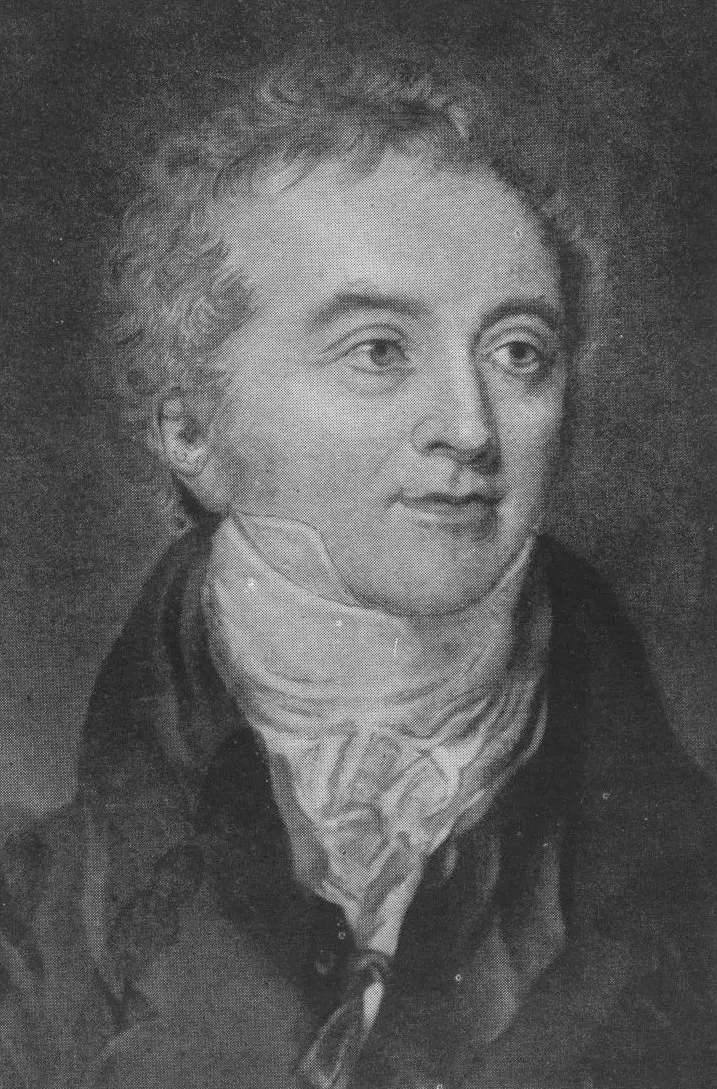
- In his lectures at the Royal Institution in London, published in 1807, Thomas Young used the word energy in its modern sense, in place of vis viva.
- In 1826–1829 the French engineer Gaspard-Gustave Coriolis gave work (French travail) its exact meaning, the force times the distance moved along it, “weight lifted through a height” as in the steam engines that pumped water out of flooded mines. He also put the factor ½ into Leibniz’s “living force”, making it , so that it equals the work done to produce it. About twenty years later William Thomson (Lord Kelvin) gave it the name we use, kinetic energy.
- In 1853 the Scottish engineer William Rankine introduced the term potential energy.
5.2 Work
Work is done when a force acts on a body and the body moves in the direction of the force. It is measured by the force times the displacement in the direction of the force. If a constant force moves a body through a displacement along it,
If the force makes an angle θ with the displacement (Figure 5.2), only its part along the displacement, , does work; the part , at right angles to the motion, does none:
Work is the scalar (dot) product of two vectors, force and displacement (Unit 2), so work itself is a scalar: it has a size and a sign, but no direction.
- θ = 0°: force and displacement in the same direction, , the most work this force can do. (Pushing a car whose engine won’t start.)
- 0° < θ < 90°: positive work, less than . (Pulling a desk across the classroom by its edge, at an angle.)
- θ = 90°: , so . A force at right angles to the motion does no work.
- 90° < θ ≤ 180°: is negative, so the work is negative: the force acts against the motion. Friction on a sliding box (θ = 180°) does negative work, .
When is no work done?
For work to be done, there must be a displacement, and the force must have a part along it. So no work is done:
- If there is no displacement (). A guard standing all day at a gate, or a man standing still with a load, does no work on the load, however tired he gets. Static friction on a box that stays at rest does no work, because the box doesn’t move.
- If the force is at right angles to the displacement (θ = 90°).
- A man walking along a level road with a bucket of water does no work on the bucket: his upward force holds it up, but it moves sideways.
- A porter with a load on his head walking along a level platform does no work on the load, for the same reason.
- The centripetal force on a body moving in a circle, or the tension in a string whirling a stone round, does no work: it always points to the center, at right angles to the motion (Unit 6).
- If there is no force along the motion. A puck gliding over smooth ice at a steady speed needs no force, and none does any work on it.
But a porter climbing stairs with a suitcase on his head does work on it: he pushes it upward, and it moves upward, in the direction of his push.
Units and dimensions of work
The SI unit of work is the joule (J), named after the English physicist James Prescott Joule. One joule is the work done when a force of 1 N moves its point of application through 1 m in the direction of the force:
Older units are still met:
- the gravitational unit, the kilogram-force meter (kgf m), the work done in lifting 1 kg through 1 m: ;
- the CGS unit, the erg (1 dyne × 1 cm): .
Dimensions:
A girl pulls a sledge 20 m across level snow with a rope at 60° to the ground, with a force of 50 N. How much work does her pull do?
Pick an answer to see why.
5.3 Work done by a variable force
So far the force has been constant. Often it isn’t: its size, its direction, or both change as the body moves. The force needed to stretch a spring grows with the stretch; the pull of gravity, and the electric and magnetic forces, change with distance. How do we find the work then?
The analytical method
Split the path into tiny steps , so small that over each step the force is practically constant. The work done in one step is
and the total work from to is the sum of all these small bits, an integral:
Pushing a wheelbarrow along a curving path, both your push and the angle between your push and the path keep changing; the work is found by adding up step by step along the path.
The graphical method
Let a force act along the x-axis, and plot it against from to (Figure 5.3). Divide the displacement into narrow strips of width , so narrow that is nearly constant across each. The work done over one strip is : the area of that strip. Adding all the strips,
and as the strips become infinitely narrow () the sum becomes exact:
The work done by a force is the area under its force–displacement graph. (Compare: in Unit 3 the displacement was the area under the velocity–time graph.)
Work done on a body and by a body
- Work done on a body by a force from outside is positive when the force acts along the body’s motion. The body gains energy. Lifting a bucket, you do positive work on it, and it gains potential energy.
- Work done by a body on its surroundings means the body pushes something through a distance. It loses energy doing it. A moving hammer does work on a nail and slows down; the surroundings do negative work on it.
Every push has a pair (Newton’s third law): if A does +50 J of work on B, B does −50 J on A. So the sign of work tells us which way energy flows: positive work on a body carries energy into it, negative work carries energy out.
5.4 Power
Two porters carry the same 30 kg load up the same 300 m of trail. Both do the same work, about 88 kJ. But the one who does it in one hour is more powerful than the one who takes two. Power is the rate of doing work, or of transferring energy:
This is the average power over the time . For the same work, the shorter the time, the greater the power; a very long time means a very small power.
If a constant force moves a body at a velocity , in a short time it moves and does work , so the power at that instant (the instantaneous power) is
Power is a scalar. Its SI unit is the watt (W), named after the Scottish engineer James Watt, whose improved steam engine powered the Industrial Revolution:
Larger units are the kilowatt (1 kW = 1000 W) and the megawatt (1 MW = 10⁶ W). Watt himself compared his engines with horses: the horsepower is still used for vehicles and pumps,
In electricity, the power taken by a device is the voltage times the current, (Unit 23).
Dimensions: .
5.5 Energy
Energy is the capacity to do work. A body that has energy can do work, and when it does work it loses that much energy; when work is done on a body, it gains that much. So energy is measured in the same units as work, joules.
Energy comes in many forms. Mechanical energy, the energy of motion and of position, is the subject of this unit; there are also heat (thermal) energy, light, sound, chemical, electrical and nuclear energy. Mechanical energy has two kinds: kinetic energy and potential energy.
5.5.1 Mechanical energy: kinetic energy
A child is about to run into a busy road, and you sprint to catch her. In a race on sports day you run as fast as you can. Walking and chatting with friends, you move slowly. In each case your body has energy because it is moving, more the faster you go.
Kinetic energy (KE) is the energy a body has because of its motion. A body of mass moving with speed has kinetic energy
Proof. A body of mass , at rest, is pushed by a constant force along a smooth level surface (Figure 5.4). After a displacement its velocity is .
- Its acceleration is constant, so (from Unit 3) with :
- The work done on it by the force is
- This work has all gone into the body’s motion, so its kinetic energy is
Kinetic energy is a scalar. It depends on the square of the speed: double the speed and the kinetic energy is four times as large. That is why a car crash at 80 km/h is far more destructive than one at 40 km/h. And since and can never be negative, kinetic energy is never negative: it is zero for a body at rest and positive for any moving body.
A motorcycle’s speed rises from 10 m/s to 20 m/s. Its kinetic energy:
Pick an answer to see why.
The work–energy theorem
After a long day digging in the field you are tired and hungry: you have spent energy, and the work you did is where it went. Work and energy are linked, and the link is exact.
A body of mass moving on a smooth surface with velocity is pushed by a constant resultant force along its motion, and after a displacement its velocity is .
- The work done on it is .
- From :
- So
The work–energy theorem: the work done by the resultant force on a body equals the change in its kinetic energy.
The final kinetic energy is the initial kinetic energy plus the work done. If the net work is positive, the body speeds up; if negative (friction, braking), it slows down. The theorem holds for a varying force too, with .
Kinetic energy and momentum
Kinetic energy and momentum both depend on mass and velocity. With ,
An explosion. A body of mass , at rest, explodes into two parts of masses and , which fly apart with velocities and . Its momentum was zero, and momentum is conserved (Unit 4), so
The two parts have momenta of equal size, so
The lighter part gets the larger share of the kinetic energy, in inverse proportion to the masses. If the total kinetic energy released is , then
This is why a fired bullet carries almost all the energy of the explosion, while the heavy gun recoils with very little (and why a gun can be held at the shoulder).
5.5.2 Potential energy
Potential energy (PE) is energy stored in a body because of its position (relative to other bodies) or its configuration (its shape). It is stored, ready to be turned into kinetic energy or other forms.
- A stretched rubber band or a compressed spring has elastic potential energy.
- A bent bow, or a catapult pulled back, stores energy that sends the arrow or the stone flying.
- A compressed gas, as in a pumped-up tire, stores energy.
- Water in a dam and a ball held up high have gravitational potential energy, the kind this unit is most concerned with.
Gravitational potential energy. To raise a body of mass through a height at a steady speed, you must pull it up with a force equal to its weight, . The work you do is
This work is stored in the body as potential energy:
The height is measured from a level we choose as zero (the ground, the floor, a table top). Only changes in potential energy matter, and they are the same whatever zero we choose: lifting a 2 kg bag 1 m always adds 19.6 J.
Kinetic and potential energy together
A body can have both kinds at once. Their sum is its total mechanical energy:
- A stone resting on the ground has no kinetic energy; its potential energy depends on the level we call zero.
- Water in a reservoir high in the hills has potential energy. As it is piped down to a town, or through a turbine, its potential energy turns into kinetic energy.
- The energy stored in a stretched catapult’s band becomes the kinetic energy of the stone; a bent bow’s energy becomes the arrow’s.
- When a tire bursts, the energy stored in the compressed air turns into the kinetic energy of the rushing air, and into sound and heat.
- A body can have potential energy and no momentum (a book on a shelf), since momentum depends only on motion; and a body with no kinetic energy has no momentum.
When something swings or bounces back and forth, its energy changes from one kind to the other. For a mass on a spring (Figure 5.6), at the ends of its swing () it stops: all its energy is potential, stored in the spring. As it passes the middle () it moves fastest: all its energy is kinetic. In between it has some of each, and the sum stays the same, as long as nothing (friction, air) takes energy away.
Change in potential energy and work
When a body is raised through , gravity pulls it down while it moves up, so gravity does negative work, , and the potential energy increases by . When the body falls, gravity does positive work and the potential energy decreases. In general:
The change in potential energy is the work done against the force (or minus the work done by it).

5.6 Principle of conservation of energy
You know many forms of energy: mechanical, heat, sound, light, chemical, electrical, nuclear. Energy keeps changing from one form to another, and whenever one form disappears, another appears in exactly the same amount.
- A radio turns the chemical energy of its battery (or the electrical energy from the mains) into sound, and some heat.
- A fan turns electrical energy into the kinetic energy of its blades and of the air, and some heat and sound.
In every case the energy lost in one form equals the energy gained in the others. This is the principle of conservation of energy:
Energy can neither be created nor destroyed; it can only be changed from one form to another. The total energy of an isolated system stays constant.
- It is an experimental law. It can’t be proved by mathematics alone; it comes from countless measurements, starting with Joule’s, who showed in the 1840s that a fixed amount of work always makes the same amount of heat.
- It is believed to hold everywhere: no experiment or observation has ever found it broken.
- It links mechanics with heat, light, electricity and every other part of physics, which is why energy is one of the great unifying ideas of science.
- Mechanical energy alone stays constant only when the forces at work are conservative (Section 5.7), like gravity. Friction turns mechanical energy into heat, which is no longer available to do useful work. The total energy is still conserved; the mechanical energy is not.
A swinging pendulum shows the exchange well (Figure 5.8). At the end of its swing the bob stops for an instant, at its highest: all its energy is potential. At the bottom it moves fastest: all its energy is kinetic. Without air resistance it would swing up to the same height on the other side for ever.
5.6.1 Conservation of mechanical energy in a falling body
A body falling freely, with air resistance too small to matter, feels only gravity, and its mechanical energy is conserved: the total mechanical energy of an isolated system, acted on only by conservative forces, stays constant.
Proof. A body of mass is let go from rest at A, a height above the ground (Figure 5.9). It passes B, a distance below A, with velocity , and reaches the ground at C () with velocity .
At A (, height ):
At B (fallen , height ): from ,
At C (fallen , height 0): from ,
At A, B and C, and in fact at every point, the total mechanical energy is . As the body falls, potential energy changes into kinetic energy, and the total doesn’t change.
5.7 Conservative and non-conservative forces
5.7.1 Conservative forces
A force is conservative if the total mechanical energy stays constant when only it does work. Gravity, the force of a spring (elastic force) and the electrostatic force are conservative. A conservative force:
- does work that depends only on the start and end points, not on the path. Lifting a box onto a shelf 2 m high, gravity does −mg × 2 m of work, whether you lift it straight up, carry it up a ramp, or take it the long way round by the stairs (Figure 5.12).
- does zero work round any closed path. Carry the box up and back down to where it started: gravity does −mgh on the way up and +mgh on the way down, zero in all.
- gives back all the work done against it. The work you do lifting the box is stored as potential energy, and all of it comes back as the box falls. This is what lets us define a potential energy for it.
- keeps mechanical energy conserved:
5.7.2 Non-conservative forces
A force is non-conservative if the mechanical energy is not conserved when it acts: part of the energy is turned into heat, sound or other forms. Friction, air resistance and the drag of liquids (viscous forces) are non-conservative; so are the pushes and pulls of people, engines and muscles, which add energy from fuel or food. A non-conservative force:
- does work that depends on the path. The longer the path, the more work friction does: walking from home to college by a long road, you do more work against friction than by a short one.
- does work that isn’t zero round a closed path. Friction opposes you both ways, so on the way there and back it does negative work each time; the total is not zero.
- does work that can’t be recovered. The energy friction turns into heat doesn’t come back as motion.
- breaks the conservation of mechanical energy: with friction, .
We can still use energy, by counting the work of the non-conservative forces:
where is the work done by friction, which is negative. The mechanical energy lost is the heat made by friction.
A sledge slides down a snowy slope from the same height by two routes: a short steep one and a long gentle one. Friction is the same on both. It reaches the bottom:
Pick an answer to see why.
5.8 Collisions: elastic and inelastic
In physics, a collision is an interaction in which two or more bodies exert strong forces on each other for a short time, so that their motion changes suddenly. Usually they touch: two billiard balls, a bat and a cricket ball, two cars. But they needn’t: an alpha particle fired at a gold nucleus is turned back by electric repulsion without touching it, and a spacecraft swinging past a planet “collides” with it through gravity.
In every collision of bodies on their own (no outside force), momentum is conserved (Unit 4), and the total energy is conserved. What may change is the kinetic energy.
Coefficient of restitution
How bouncy is a collision? For two bodies colliding head-on, the coefficient of restitution is the ratio of their relative velocity of separation after the collision to their relative velocity of approach before it:
where are the velocities before and after. Its value lies between 0 and 1, :
- : perfectly elastic collision; the bodies separate as fast as they approached;
- : perfectly inelastic collision; they don’t separate at all, but move on together;
- : an ordinary inelastic collision.
5.8.1 Types of collision
Elastic collision
In an elastic collision both momentum and kinetic energy are conserved:
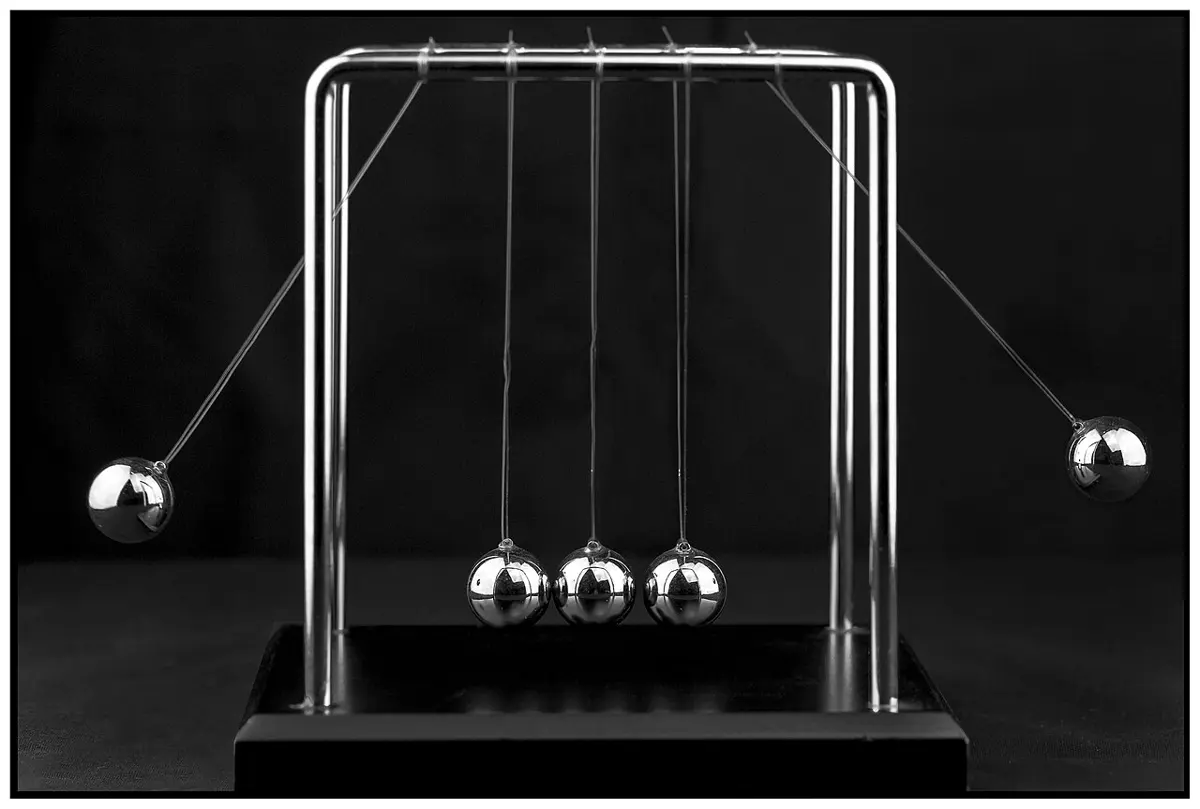
No kinetic energy is turned into heat, sound or other forms; the forces between the bodies during the collision are conservative. Collisions between atoms, molecules of a gas, and nuclear particles are often perfectly elastic. Collisions of billiard balls, or the steel balls of a Newton’s cradle, are nearly elastic: a little energy goes into the click you hear and a little warming.
In an elastic collision:
- momentum is conserved;
- kinetic energy is conserved;
- total energy is conserved;
- no mechanical energy is changed into other forms; the forces involved are conservative.
Inelastic collision
In an inelastic collision momentum is conserved but kinetic energy is not:
Some kinetic energy is lost, turned into heat, sound and the work of bending and denting:
The forces involved are non-conservative. Cars that crash and crumple, a lump of clay dropped on the floor, a tackle in football in which two players fall together: all are inelastic. Almost every collision of everyday objects is inelastic to some degree.
In an inelastic collision:
- momentum is conserved;
- kinetic energy is not conserved;
- total energy is conserved;
- part of the mechanical energy is changed into other forms; the forces involved are non-conservative.
Perfectly inelastic collision. When the bodies stick together and move on with a common velocity , the loss of kinetic energy is as large as it can be. Momentum gives
One-dimensional elastic collision
Two bodies of masses and move along one line with velocities and , with , so the first catches up with the second (Figure 5.14). They collide elastically for a short time and then move on along the same line with velocities and , with .
- Momentum is conserved:
- Kinetic energy is conserved:
- Divide (5.2) by (5.1). Since , and the same on the right:
In a one-dimensional elastic collision, the relative velocity of approach before the collision equals the relative velocity of separation after it (that is, ).
- Find . From (5.3), . Put this into (5.1): , which rearranges to :
- Find in the same way (or by swapping the labels 1 and 2):
Equations (5.4) and (5.5) give both velocities after the collision from the masses and the velocities before.
Special cases
a. Equal masses (). Then (5.4) and (5.5) give and : the two bodies simply exchange velocities. If the second was at rest (), the first stops dead and the second moves off with the first one’s velocity, as in a Newton’s cradle or a straight snooker shot. A neutron hitting a proton (nearly the same mass) head-on stops and sends the proton on, which is why water and paraffin wax, rich in hydrogen, slow down neutrons so well.
b. A light body hits a very heavy one at rest (, ). Putting gives and : the light body bounces straight back with the same speed, and the heavy body hardly moves. A ball bouncing off a wall.
c. A very heavy body hits a light one at rest (, ). Putting gives and : the heavy body carries on almost unchanged, and the light body shoots off at twice its speed. A fast alpha particle passes through a cloud of electrons in an atom almost undisturbed, and a cricket bat swung hard sends a light ball off faster than the bat.
A ball of mass 2 kg moving at 3 m/s hits a ball of mass 2 kg at rest, head-on and elastically. Afterwards:
Pick an answer to see why.
Exercise
Choose the correct option
- A ball of mass m hits a wall normally at speed u and rebounds with the same speed. What is the change in its momentum?
Pick an answer to see why.
- A man holds a bucket of water of mass 5 kg in his hand and walks 50 m along a level road. How much work does he do on the bucket?
Pick an answer to see why.
- A water pump has a power of 2 kW. How much water can it raise through 10 m in 1 minute (g = 10 m/s²)?
Pick an answer to see why.
- A body starts from rest and moves in a straight line with constant acceleration. The power delivered to it at time t is proportional to:
Pick an answer to see why.
- A force proportional to the distance moved, s, acts on a body (F = ks). The work done by the force is proportional to:
Pick an answer to see why.
- Water from a dam high in the hills is piped down to a town. Which energy change best describes this?
Pick an answer to see why.
- A meter rule of mass 800 g, pivoted at one end, is turned through 60° from hanging straight down. By how much does its potential energy increase?
Pick an answer to see why.
- Two balls, each of mass 0.06 kg, move in opposite directions at 4 m/s, collide, and rebound at 4 m/s. What impulse does each ball receive?
Pick an answer to see why.
- The work done by the resultant force on a body changes its:
Pick an answer to see why.
- Which graph in Figure 5.15 best shows how a body’s kinetic energy depends on its velocity?
Pick an answer to see why.
- A body of weight W₁ hangs from the ceiling of a room by a chain of weight W₂. What force does the ceiling exert on the chain?
Pick an answer to see why.
- Two bodies of masses 3 kg and 4 kg are acted on by the same force. If the lighter body’s acceleration is 2 m/s², what is the heavier body’s?
Pick an answer to see why.
Answer these questions
- a.Explain what is meant by work.
- b.Obtain an expression for the work done by a constant force.
- c.A man carrying a load of 200 N on his head climbs up a hill through a height of 500 m. Is he doing work? Justify your answer.
Answer
- a.Explain what is meant by the work–energy theorem.
- b.Explain how the principle of conservation of energy applies to a man sliding from rest down a vertical pole, if there is a constant force of friction on him.
Answer
- a.How can the law of conservation of mechanical energy be used in real situations where there is friction?
- b.An 850 kg roller coaster is released from rest at point A of the track shown in the picture. Assume there is no friction or air resistance. How fast is it moving at point B?
Answer
- a.Can the kinetic energy of a body ever be negative?
- b.The momentum of a body is increased by 100 %. What is the percentage increase in its kinetic energy?
Answer
- a.Explain how the mechanical energy of a freely falling body stays constant until it reaches the ground.
- b.When a constant force acts on a body that is speeding up, is the power of the force constant? If not, how would the force have to change with speed for the power to stay constant?
Answer
- a.Define the coefficient of friction.
- b.A 68.5 kg skater moving at 2.40 m/s on rough horizontal ice slows down uniformly and stops in 3.52 s, because of friction from the ice. What force does friction exert on the skater?
Answer
- a.Show that mechanical energy is conserved for a body falling freely.
- b.State the principle of conservation of mechanical energy.
- c.A block of weight 150 N is pulled 20 m along a horizontal surface at constant velocity. The coefficient of kinetic friction is 0.20, and the pull makes an angle of 60° with the vertical. Find the work done by the pull.
Hint
Answer
- a.Distinguish between an elastic and an inelastic collision.
- b.Explain an elastic collision in one dimension.
- c.A vehicle of mass 1.5 × 10⁵ kg with an engine of power 650 kW climbs a slope that rises 1 in 100, at a constant speed of 60 km/h. Find the friction force between its wheels and the slope.
Answer
- a.State the work–energy theorem.
- b.A mass at rest explodes into two parts of 4 units and 40 units. The larger part has 100 J of kinetic energy. Find the kinetic energy of the smaller part.
- c.Comment on why the smaller part gets so much more energy.
Answer
Numerical problems
A ball of mass 0.1 kg is thrown vertically upward at 20 m/s. What is its potential energy at its highest point? What is its potential energy when it is three-quarters of the way up, on its way up?
Answer
A block of mass 20 kg slides from the rim to the bottom of a smooth bowl of diameter 0.5 m. Find its speed at the bottom.
Answer
An object moves from point A, position vector , to point B, , under a force (in N and m). Find the work done by the force.
Answer
A particle moves along the x-axis from x = 0 to x = 5 m under a force (F in N, x in m). Find the work done by the force.
Answer
A car of mass 1000 kg moves at a constant 20 m/s along a level road against a friction force of 200 N. Find the power developed by its engine. The car then climbs a slope at the same constant speed, with the same friction force; . Find the new power.
Answer
In a football match, player A collides with player B, running towards him from the other side, and they become entangled. Player A’s mass is 40 kg and his velocity 4 m/s; player B’s mass is 60 kg and his velocity 3 m/s. Find their velocity just after the collision, assuming other forces are negligible.
Answer
A train of mass 2.0 × 10⁵ kg moves at a constant 72 km/h up a straight incline against a friction force of 1.28 × 10⁴ N. The track rises 1.0 m for every 100 m along it. Find a. the rate at which the train’s potential energy increases, and b. the power the train must develop.
Answer
A radioactive nucleus of mass 210 units, at rest, decays into an alpha particle of mass 4 units and a residual nucleus of mass 206 units. If the alpha particle’s kinetic energy is E, find the kinetic energy of the residual nucleus.
Answer
A railway truck of mass 4 × 10⁴ kg moving at 3 m/s collides with another truck of mass 2 × 10⁴ kg at rest. They couple together and move off. What fraction of the first truck’s initial kinetic energy remains as kinetic energy of the two trucks?
Answer
A bullet of mass 0.010 kg is fired vertically upward at 100 m/s into a wooden block of mass 0.190 kg hanging by a long string above the gun. The bullet stays embedded in the block. Through what height does the block rise?
Answer
A vehicle of mass 2000 kg traveling at 10 m/s on a level road is stopped in 12.5 m by its brakes. Find the average retarding force. What power must its engine develop to take it up a slope of 1 in 10 at a constant 10 m/s, if the frictional resistance is 200 N?
Answer
Anisha pushes her physics book 1.50 m along a horizontal table top with a horizontal force of 2.40 N. The opposing force of friction is 0.600 N. Find a. the work done by her 2.40 N force, b. the work done by friction, c. the total work done on the book.
Answer
How many joules of energy does a 100 W light bulb use in one hour? How fast would a 70 kg person have to run to have that much kinetic energy?
Answer
A ball of mass 0.420 kg is moving at 2.00 m/s. Rojina kicks it with a constant force of 40.0 N in the direction of its motion. Over what distance must her foot stay in contact with the ball to raise its speed to 6.00 m/s?
Answer
A worker pushes a block of ice with a constant horizontal force of 80 N on a smooth level floor (friction negligible). The block starts from rest and moves 11 m in 5 s. a. What is the mass of the block? b. If the worker stops pushing after 5 s, how far does the block move in the next 5 s?
Answer
A 6.0 kg box moving at 3.0 m/s on a smooth horizontal surface runs into a light spring of force constant 75 N/cm. Use the work–energy theorem to find the greatest compression of the spring.
Answer
A tandem (two-person) bicycle team must overcome a force of 165 N to keep a speed of 9.00 m/s. Find the power each rider must give, if they share equally, in watts and in horsepower.
Answer
Printable PDFs
- The unit as a book (A5) 22 pages Answers as an A4 booklet, 6 sheets
- Study notes 2 pages
- Worksheet 4 pages Answer key
- Harder practice questions 2 pages Answer key
Quiz yourself: Force, Motion and Machines, Grades 5–12 →
Practice every question in the book, and keep track of the ones you miss →
A companion to your textbook, not a replacement for it: study from the book your school uses, and where the two differ, follow your teacher. Found a mistake? Please tell us.