
Look down into a clear pond at the stones on its bottom: they seem close enough to touch, yet the water reaches your waist when you step in. Dip a pencil in a glass of water and it seems to break at the surface. Both come from one fact: light changes speed when it goes from one material into another, and so changes direction.
This unit makes that exact. You will meet Snell’s law and the refractive index, see why light coming out of a glass slab runs parallel to the way it went in, work out how shallow a pool looks, and find the angle beyond which light can’t get out of glass or water at all. That last idea, total internal reflection, carries the internet to Nepal through glass fibers thinner than a hair, and makes a diamond sparkle.

15.1 Introduction
Refraction is the bending of light as it passes from one medium into another. It makes stars twinkle, a straw look bent in a glass of water and the road shimmer like water on a hot day. It is also the principle of every lens, from your eye’s to a camera’s, and of prisms and optical fibers. This unit studies refraction at flat (plane) surfaces; Units 16 and 17 take it on to prisms and lenses.
15.2 Refraction of light
When light passes from one medium into another, its speed changes. Light travels at m/s in a vacuum (and almost as fast in air), about m/s in water and about m/s in glass. If the light meets the boundary between the two media (the interface) at a slant, the change of speed turns it: one side of a beam reaches the boundary and slows down first, while the other side is still traveling fast, so the beam swings round, the way a column of marching students turns when its first row steps into mud. This change of direction is refraction. Light that meets the boundary straight on, along the normal, changes speed but not direction.
In Figure 15.2 a., the incident ray meets the surface between air and glass at the point of incidence O and goes on into the glass as the refracted ray. The dashed line through O, at right angles to the surface, is the normal. The angle between the incident ray and the normal is the angle of incidence ; the angle between the refracted ray and the normal is the angle of refraction .
A medium in which light travels more slowly is optically denser; one in which it travels faster is optically rarer. Optical density is not the same as ordinary density (mass per volume). Kerosene is less dense than water, and floats on it, but light travels more slowly in kerosene (refractive index 1.44 against 1.33), so kerosene is optically denser.
A ray of light passes from air into water at an angle of incidence of 40°. The angle of refraction is:
Pick an answer to see why.
15.3 Laws of refraction of light
- The incident ray, the refracted ray and the normal at the point of incidence all lie in the same plane.
- For a given pair of media and light of a given color, the ratio of the sine of the angle of incidence to the sine of the angle of refraction is a constant.
The constant is the refractive index of the second medium with respect to the first. This second law is Snell’s law.
Snell’s law decides which way the light bends. Going from a rarer into a denser medium, , so and : the light bends towards the normal. Going from a denser into a rarer medium, : it bends away from the normal.
The Optics demo Refraction lets you turn a beam and change the two materials, and see Snell’s law at work.
15.4 Refractive index
The refractive index of a medium tells how much light slows down in it. The absolute refractive index of a medium is the ratio of the speed of light in a vacuum, , to its speed in the medium, :
Being a ratio of two speeds, it has no unit. Water’s refractive index is about 1.33, so light travels in water at , about 75%, of its speed in a vacuum. Air’s is 1.0003, so close to 1 that we treat air as a vacuum.
| Medium | Refractive index (yellow light) |
|---|---|
| air | 1.0003 |
| water | 1.33 |
| kerosene | 1.44 |
| crown glass | 1.52 |
| flint glass | 1.62 |
| diamond | 2.42 |
The relative refractive index of medium b with respect to medium a is the ratio of the speeds of light in them, and from Snell’s law the ratio of the sines:
So Snell’s law can be written in a form with no relative index in it at all, easy to remember:
The refractive index of a medium depends on:
- the material and how its particles are arranged;
- the color (wavelength) of the light: in glass it is larger for violet than for red, which is why a prism spreads white light into colors (Units 16 and 18);
- temperature: a hotter liquid or gas is less dense and usually has a smaller refractive index (the mirage, section 15.8.1);
- pressure, for a gas, and, for materials such as semiconductors, the impurities added to them.
Refractive index has meaning only for transparent media, through which light can pass.
Reversibility of light
The principle of reversibility says that if the path of a ray of light is reversed, after any number of reflections and refractions, it travels back along the same path in the opposite direction.
Suppose light goes from medium a into medium b with angle of incidence and angle of refraction . By Snell’s law,
Reverse the ray: it now goes from b into a, meeting the boundary at angle , and leaves at angle . So
Multiplying (15.1) and (15.2), , that is
The refractive index of b with respect to a is the reciprocal of that of a with respect to b. Glass with respect to air is 1.5, so air with respect to glass is .
Light travels at m/s in a glass. The refractive index of the glass is:
Pick an answer to see why.
The refractive index of glass with respect to water is 1.13. The refractive index of water with respect to glass is:
Pick an answer to see why.
15.5 Relation between relative refractive indices
Let light pass through layers of air, water and glass with parallel faces, and out into air again (Figure 15.3). At each boundary the angle of refraction becomes the angle of incidence at the next, because the normals are parallel. Let the angles with the normal be in air, in water and in glass. Then, at the three boundaries,
where is the angle of the emergent ray CD in the air below. It is found by experiment, and follows from Snell’s law in the form , that : the emergent ray is parallel to the incident ray. So, multiplying the three equations,
Since , equation (15.4) gives
The refractive index of glass with respect to water is the ratio of their refractive indices with respect to air: .
The refractive indices of glass and water are 1.5 and 1.33. Light goes from water into glass at an angle of incidence of 60°. The angle of refraction is:
Pick an answer to see why.
15.6 Lateral shift through a glass slab
When light passes through a parallel-sided glass slab, it bends towards the normal going in and away from it coming out, by equal amounts, so it leaves parallel to the way it came, but shifted to one side. The perpendicular distance between the incident ray (produced) and the emergent ray is the lateral shift.
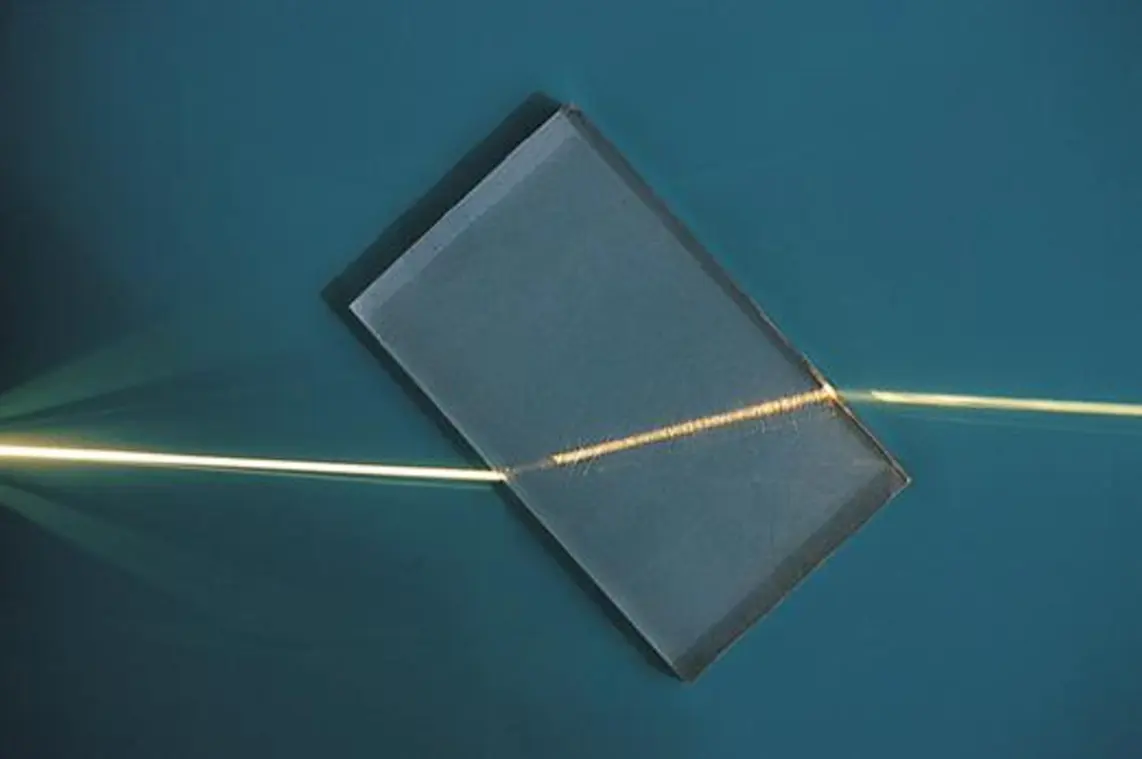
A ray AO meets the face PQ of a slab of thickness and refractive index at angle of incidence , is refracted along OB at angle , and leaves along BC (Figure 15.5). Produce AO beyond O, and draw BM perpendicular to it from B. Then BM is the lateral shift .
At O the ray turns from the direction OM to the direction OB, through the angle . In the right-angled triangle OMB,
In the right-angled triangle ON₂B, the angle at O is and ON₂ = , so
Putting (15.6) into (15.5):
The lateral shift depends on the thickness of the slab , the angle of incidence and the refractive index (through ).
At grazing incidence, as approaches 90°, approaches , and
The shift grows towards the thickness of the slab, its largest possible value, though it reaches it only in the limit: at exactly 90° the light skims along the surface and almost none enters.
For small angles of incidence, , and (angles in radians), and Snell’s law gives . Then
For small angles, the shift is in proportion to the angle of incidence.
15.7 Real depth and apparent depth
An object under water, or under a glass block, looks nearer the surface than it is. Its actual depth is the real depth; the depth at which it appears to be is the apparent depth. The apparent depth is a virtual image formed by refraction.
An object O lies at a real depth below the surface of water (Figure 15.6). The ray OA, along the normal, leaves without bending. Another ray OB meets the surface at B at angle of incidence and leaves at angle of refraction , bending away from the normal. To an eye above, the two rays seem to come from I, where they meet when produced backwards: I is the image of O, at the apparent depth .
The angle AOB = and the angle AIB = (each equals the angle its ray makes with the normal at B). Light goes from water into air, so
In the right-angled triangles OAB and IAB,
When we look straight down, B is very close to A, so and :
So, with (15.8), , and since ,
Equation (15.9) holds when the object is in the denser medium and you look from the rarer one, straight down (or nearly so). Seen from a slant, the image rises higher still and moves towards you, so a pool looks shallower the farther away you look across it; the ratio is then more than .
When the object is in the rarer medium and the observer is in the denser one (a fish looking up at a bird), the same reasoning gives
and the object looks farther away than it is.
Apparent shift
The distance the object seems to be raised, OI = , is the apparent shift (or normal shift). Since real depth = apparent depth + apparent shift,
For a mark under a glass slab of thickness , and the shift is : about a third of the thickness for glass.
Several layers. If transparent layers of thicknesses and refractive indices lie one on another, each layer raises the image by its own shift, so the total apparent depth and total apparent shift are
Some everyday results of refraction:
- A clear pool of water always looks shallower than it is, which is how people misjudge a river’s depth and drown. Before stepping into clear water, test its depth with a stick.
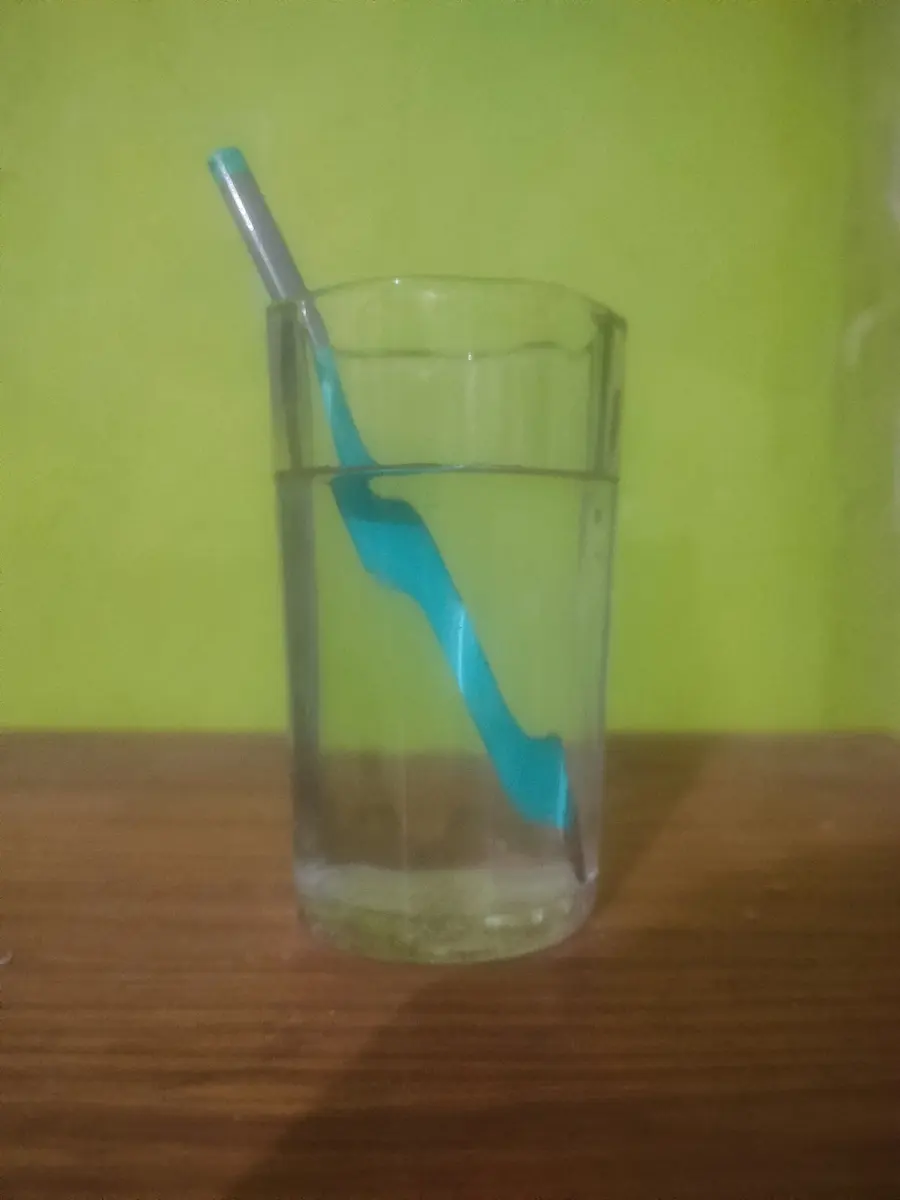
- A stick or pencil dipped at a slant in water seems bent at the surface: each point of the part under water is seen raised, the deeper points more.
- A person under water looking at a tree on the bank sees the tree taller than it is.
A coin lies at the bottom of a tank of water 40 cm deep (). Looking straight down, the coin seems to be at a depth of:
Pick an answer to see why.
15.8 Critical angle and total internal reflection
When light goes from a denser medium into a rarer one, such as from water into air, it bends away from the normal: the angle of refraction is larger than the angle of incidence. As the angle of incidence increases, the angle of refraction increases faster, and at one particular angle of incidence it reaches 90°: the refracted ray skims along the surface. That angle of incidence in the denser medium is the critical angle, .
For light going from water into air at the critical angle, and . By Snell’s law in the form , with :
where is the refractive index of the denser medium with respect to the rarer one. The critical angle is fixed for a given pair of media and a given color of light: about 49° for water and air, 42° for glass and air, and only 24.4° for diamond and air.
If the angle of incidence is less than , the light is refracted out (with a little reflected). If it is more than , there is no angle of refraction that satisfies Snell’s law ( would have to be more than 1), and all the light is reflected back into the denser medium. This is total internal reflection: “total” because all of the light is reflected (an ordinary mirror reflects only about 90%), and “internal” because it happens inside the denser medium.
The conditions for total internal reflection:
- The light must travel from an optically denser medium towards an optically rarer one.
- The angle of incidence in the denser medium must be greater than the critical angle.
The critical angle for a material in air is 30°. Its refractive index is:
Pick an answer to see why.
Light inside water meets the water–air surface at 55°. The critical angle is 48.8°. What happens?
Pick an answer to see why.
15.8.1 Mirage
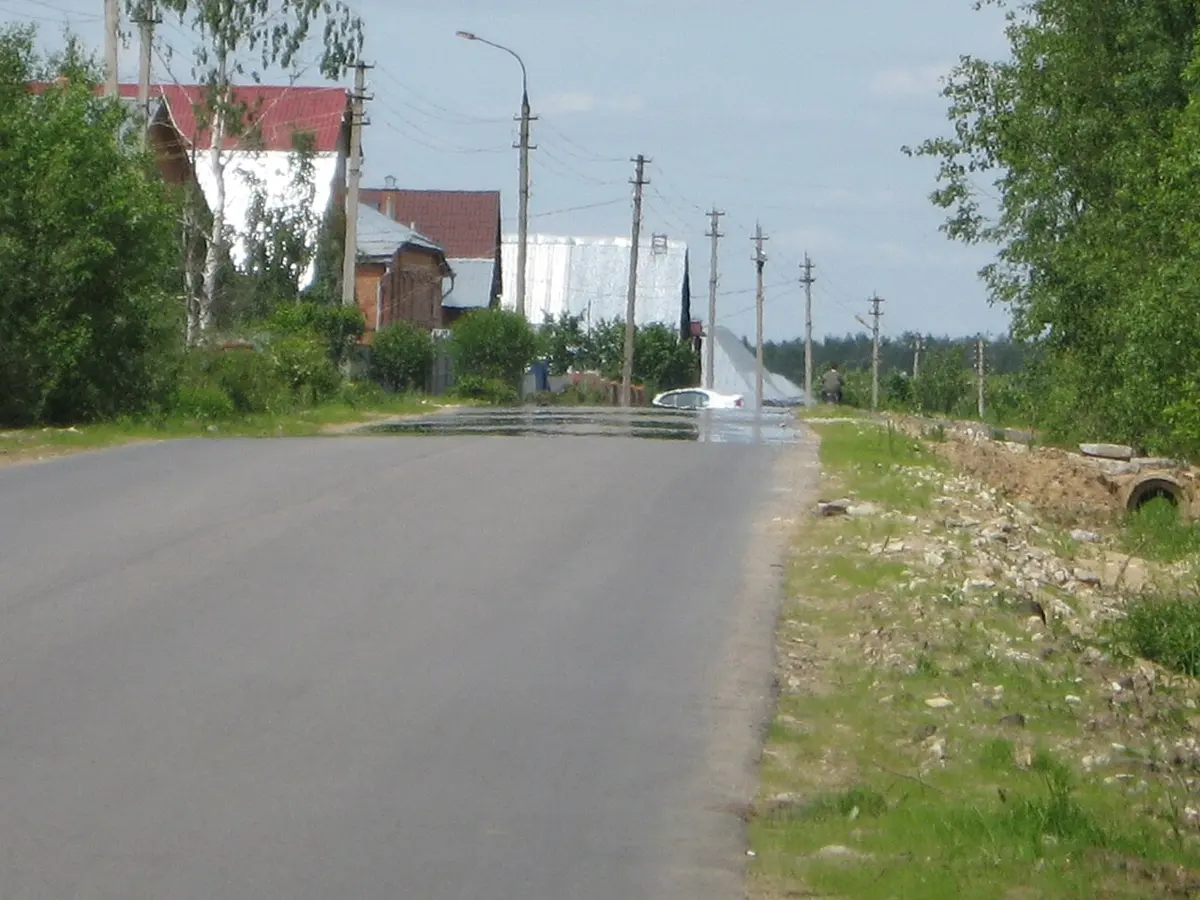
A mirage is an image of the sky, or of a distant object, seen below the object, as if reflected in water. You can see one on a black-topped road on a hot, sunny day: far ahead the road seems covered with water, and cars seem reflected in it.
On a hot day the road heats the air just above it, so the air is hottest, and least dense, near the ground, and cooler and denser higher up. The refractive index of air therefore falls slowly from the higher layers to the lower ones. Light from a distant object heading slantingly down passes from denser into rarer and rarer air: it bends away from the normal at every layer, more and more nearly level, until near the ground it is turned upwards (in effect, it is totally reflected once its angle with the vertical exceeds the critical angle for the layers it meets), and rises along a curve into the eye. The eye traces the light straight back and sees it coming from below the road: an upside-down image of the object, together with a patch of bright sky that looks like water.
In deserts, a mirage may show a distant palm tree upside down below itself, as if reflected in a pool. Over cold seas the opposite happens: the air is coldest, and densest, near the water, light is bent downwards, and ships beyond the horizon can appear hanging in the sky (a superior mirage).
15.9 Applications of total internal reflection
a. Optical fiber
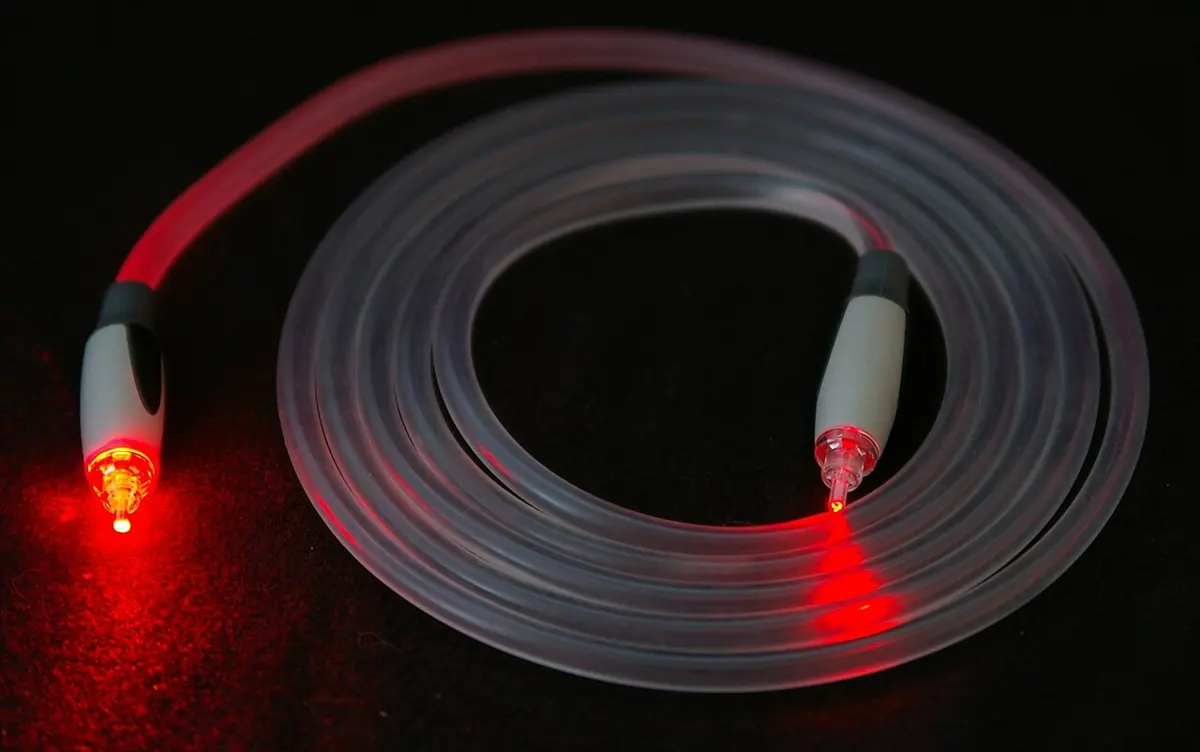
An optical fiber is a very thin, flexible strand of extremely pure glass that guides light along its length by total internal reflection. Its middle, the core, is surrounded by a layer of glass with a slightly lower refractive index, the cladding, and a protective plastic coating. Light sent into one end at a small angle meets the core’s edge at more than the critical angle, so it is totally reflected, again and again, and follows the fiber round bends. At the far end it meets the end face at less than the critical angle and comes out.
A typical fiber is about a tenth of a millimeter ( m) thick, coating aside, and the core of a telephone or internet fiber is only 9 micrometers across. Many fibers are bundled together into a light pipe or a cable. Because total internal reflection loses no light, and the glass is so clear, a light signal can travel 50 km or more before it needs boosting. Optical fibers are used:
- in telecommunications: almost all long-distance telephone calls, internet data and television travel as flashes of infrared light in fibers. One fiber carries far more than a copper wire, and is not disturbed by electrical interference or lightning.
- in medicine: an endoscope carries light into the body through one bundle of fibers and brings back an image through another, so a doctor can look inside the stomach or a knee, and do keyhole surgery, through a tiny cut.
- in data centers, to connect thousands of computers and their storage at high speed.
b. Totally reflecting prism
A totally reflecting prism is a glass prism whose cross-section is a right-angled isosceles triangle (angles 90°, 45° and 45°), usually of crown glass, whose critical angle is about 42°. Light entering one short face along the normal goes straight in and meets the long face at 45°, more than the critical angle, so it is totally reflected and turned through 90°. Entering the long face, it is reflected at both short faces and turned through 180°, the picture also turned upside down.
Totally reflecting prisms are used in binoculars (to fold the long light path into a short case and turn the image the right way up), in periscopes and in some cameras. They are better than plane mirrors for this: they reflect all the light, where a silvered mirror absorbs some; they give a single image, where a glass mirror gives a faint extra image from its front surface; and they have no silvering to tarnish or peel.
c. The sparkle of a diamond
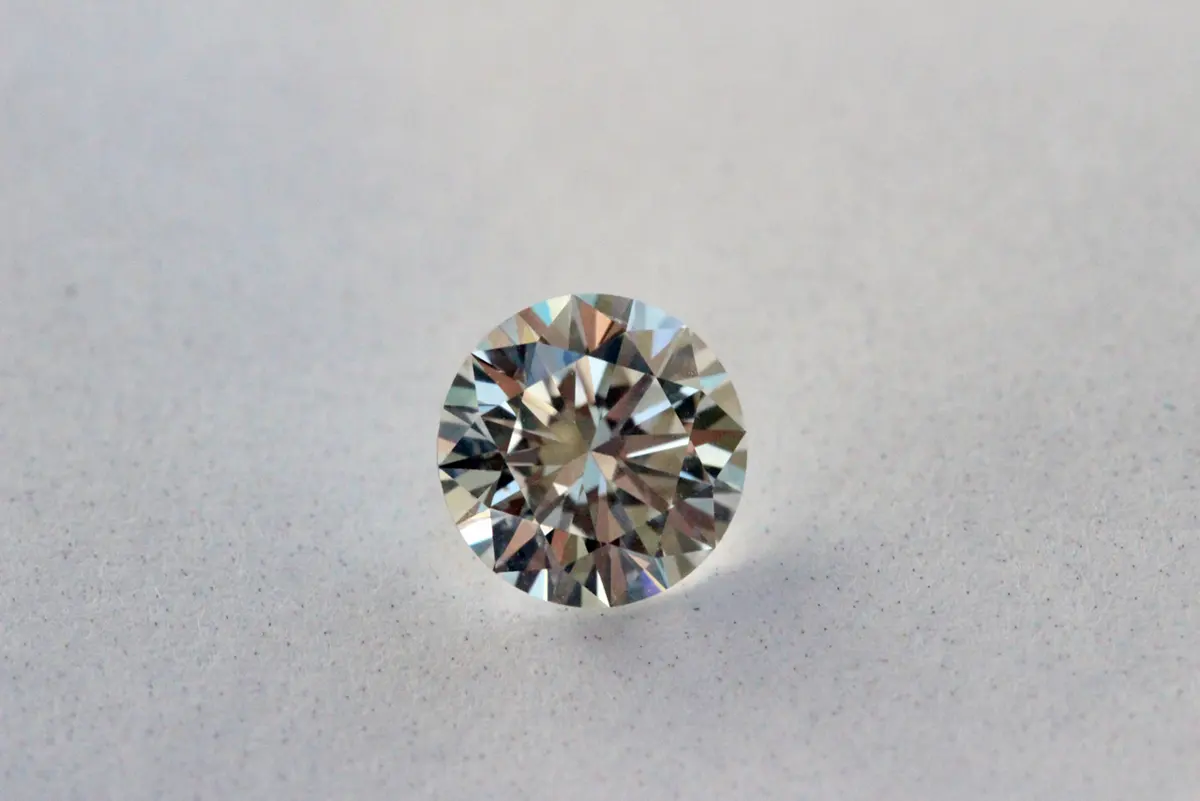
Diamond has a very large refractive index, 2.42, so its critical angle is only 24.4°. A diamond cutter shapes the stone with many faces (58 in the usual “brilliant” cut) at angles chosen so that light entering the top meets the faces at the back at more than 24.4°, is totally reflected several times inside, and comes out through the top. Light entering from all directions leaves in only a few directions, so the diamond looks brilliantly bright from those directions, and flashes as it moves. Diamond’s large dispersion, which spreads the colors (Unit 18), adds the flashes of color, its “fire”.
Exercise
Choose the correct option
- What stays the same for light when it is refracted from one medium into another?
Pick an answer to see why.
- What happens when light of one color travels from air into glass?
Pick an answer to see why.
- The refractive index of glass with respect to air is 1.5. The speed of light in glass is:
Pick an answer to see why.
- A glass slab is 6 mm thick and its refractive index is 1.5. How long, in nanoseconds, does light take to pass straight through it?
Pick an answer to see why.
- An air bubble inside a glass slab () appears 6 cm deep when viewed from one side and 4 cm deep from the opposite side. The thickness of the slab is:
Pick an answer to see why.
- The refractive index of water is 4/3, and that of a glass slab under water is 5/3. The critical angle for light going from the glass into the water is:
Pick an answer to see why.
- The critical angle for light going from a medium into a vacuum is 30°. The speed of light in the medium is:
Pick an answer to see why.
- Optical fibers work on the principle of:
Pick an answer to see why.
- For a given pair of media, for which color of light is the critical angle smallest?
Pick an answer to see why.
- When a ray of light passes from one medium into another, its speed doubles. Up to what angle of incidence can it go without total internal reflection?
Pick an answer to see why.
Answer these questions
- a.Why is light refracted when it passes from one medium into another?
- b.What is lateral shift? How does it change as the angle of incidence increases?
- c.Which color of light travels fastest in glass?
Answer
- a.Can the refractive index be found from Snell’s law for light falling along the normal? Explain.
- b.Why does a clear pool of water always look shallower than it is?
- c.A glass slab is placed over letters printed in different colors. Why do the violet letters seem raised the most?
- d.How long does light take to travel 500 m in water? The refractive index of water is 1.33, and the speed of light in a vacuum is m/s.
Answer
- a.On what does the refractive index of a medium depend?
- b.Write the critical angle of a medium in terms of its refractive index.
- c.Describe a natural phenomenon in which total internal reflection plays a part.
- d.A microscope is focused on a scratch on the bottom of a beaker. Turpentine is poured into the beaker to a depth of 4 cm, and the microscope must be raised by 1.25 cm to bring the scratch into focus again. Find the refractive index of turpentine.
Answer
- a.Why do objects seem to shake at midday in summer?
- b.Why does the Sun look a little oval when it is at the horizon?
- c.An optical fiber () is surrounded by a glass coating (). Find the critical angle for total internal reflection at the boundary between the fiber and the coating.
Answer
- a.A ray of light in air strikes a glass surface. Is there a range of angles for which total internal reflection takes place?
- b.What is a totally reflecting prism?
- c.Why does a crack in glass shine when seen from a suitable direction?
Answer
- a.Why does a black-topped road often seem to be covered with water when seen from a distance in summer?
- b.Why does a diamond sparkle so brilliantly?
- c.Can total internal reflection happen if the light starts in the rarer medium? Explain with a diagram.
- d.A ray of light in water falls at an angle of 70° on a water–glass boundary. Calculate the angle of refraction in the glass. (, )
Answer
Numerical problems
The refractive index of water is 1.33 and that of glass is 1.5. A ray of light in water falls at an angle of 30° on a water–glass boundary. Calculate the angle of refraction in the glass.
Answer
What is the critical angle for light going from glass into water? The refractive indices of glass and water are 1.62 and 1.32.
Answer
What is the apparent position of an object below a rectangular block of glass 6 cm thick, if a layer of water 4 cm thick lies on top of the glass? (, )
Answer
A glass slab is placed in water. Find the critical angle at the glass–water boundary. (, )
Answer
Printable PDFs
- The unit as a book (A5) 29 pages Answers as an A4 booklet, 8 sheets
- Study notes 3 pages
- Worksheet 5 pages Answer key
- Harder practice questions 2 pages Answer key
Quiz yourself: Energy, Heat, Light and Sound, Grades 5–12 →
Practice every question in the book, and keep track of the ones you miss →
A companion to your textbook, not a replacement for it: study from the book your school uses, and where the two differ, follow your teacher. Found a mistake? Please tell us.