
Look into the bowl of a steel spoon: you are upside down. Turn it over and you are the right way up, but tiny. The same piece of polished steel gives two quite different pictures of you, and a single formula, , tells you exactly where each one is and how big.
This unit is about curved mirrors: the shaving mirror that enlarges your chin, the convex mirror on a hairpin bend of a hill road that shows the bus coming round it, and the great mirrors of telescopes that gather starlight. You will see why a mirror’s focus is halfway to its center of curvature, derive the mirror formula, learn a sign convention that turns every case into the same formula, and use magnification to tell how big, and which way up, an image will be.
14.1 Introduction
When light traveling in one medium meets the surface of another, part of it is reflected, part is absorbed and the rest is transmitted. Reflection is the turning back of light into the medium it came from when it strikes a surface. It obeys two laws, which you met in earlier grades:
- The incident ray, the reflected ray and the normal at the point of incidence all lie in the same plane.
- The angle of reflection equals the angle of incidence.
A smooth, polished surface reflects light in an orderly way and forms images: a plane mirror, a curved mirror, still water, a polished steel plate. Mirrors are inside telescopes, cameras, car headlamps, projectors and the instruments a doctor uses to look into your eyes, and reflection also explains how we see most of the world around us: by light bounced off it.
14.2 Image
When the rays of light from a point of an object, after reflection (or refraction), meet at a point, or seem to come from a point, that point is the image of the object point. There are two kinds.
A real image is formed where the rays really meet after reflection or refraction. The light actually passes through it, so a real image can be caught on a screen: the picture on a cinema screen, on the retina of your eye, on a camera’s sensor.
A virtual image is formed where the rays do not meet but only appear to meet when they are produced backwards. No light reaches it, so it cannot be caught on a screen. Your face in a plane mirror is virtual: the light never goes behind the glass.
The same two kinds appear with a concave mirror. An object beyond the focus gives a real image in front of the mirror (Figure 14.3); an object between the focus and the mirror gives a virtual one behind it (Figure 14.4). A convex mirror gives a virtual image behind it wherever a real object stands (Figure 14.5).
Real and virtual images compared
| Real image | Virtual image | |
|---|---|---|
| How it forms | the rays really meet (converge) at it | the rays only seem to meet, when produced backwards |
| On a screen | can be caught on a screen | cannot be caught on a screen |
| Which way up (for a real object) | inverted | upright (erect) |
| Examples | a camera’s picture, the image on the retina, a cinema picture | the image in a plane mirror, in a convex mirror, in a magnifying glass |
The “inverted” and “upright” row holds for a real object, the usual case. With a virtual object the rule turns round: in Worked example 3 below, a convex mirror gives a real image that is upright.
You can catch the image formed by a mirror on a sheet of paper. The image must be:
Pick an answer to see why.
Which of these images is virtual?
Pick an answer to see why.
14.3 Spherical mirrors
A spherical mirror is a mirror whose reflecting surface is part of a sphere. Cut a cap off a hollow glass sphere and silver one of its surfaces, and you have one.
- Silver the outside of the cap, and light reflects from the inner, hollowed face: a concave mirror (it caves in, like the bowl of a spoon).
- Silver the inside, and light reflects from the outer, bulging face: a convex mirror (like the back of the spoon).
The words used with spherical mirrors:
- Pole (P): the middle point of the mirror’s surface.
- Center of curvature (C): the center of the sphere the mirror is part of. In front of a concave mirror, behind a convex one.
- Radius of curvature (R): the radius of that sphere, the distance CP.
- Principal axis: the straight line through P and C.
- Aperture: the width of the mirror’s surface, the diameter of its rim (AB).
- Principal focus (F): the point on the axis where rays parallel to the axis, close to it, meet after reflection from a concave mirror (a real focus, in front), or from which they seem to come after reflection from a convex mirror (a virtual focus, behind).
- Focal length (f): the distance PF from the pole to the principal focus.
The normal to a spherical mirror at any point is the radius through that point: a line from C. That single fact is the key to everything in this unit.
14.4 Relation between f and R
For a spherical mirror of small aperture, the focal length is half the radius of curvature:
For a concave mirror
A ray OA, parallel to the principal axis, meets the mirror at A (Figure 14.7) and is reflected through F.
- CA is a radius, so it is the normal at A. The angle of incidence is , and by the law of reflection the angle of reflection is .
- OA is parallel to the axis CP, and CA cuts both, so (alternate angles).
- So in triangle FAC, the angles at A and at C are both : the triangle is isosceles, and .
- For a mirror of small aperture, A is very close to P, so . Then : F is halfway between P and C.
- and , so .
For a convex mirror
- The normal at A is the radius CA, produced outwards to N (Figure 14.8). The angle of incidence is , and the reflected ray AQ makes .
- Produced back, QA passes through F behind the mirror. (vertically opposite angles).
- OA is parallel to the axis, so (corresponding angles).
- Triangle FAC has equal angles at A and C, so . For a small aperture , so , that is .
Step 4 in each proof is where “small aperture” matters. A ray far from the axis crosses it nearer the mirror than F (the angle at A is large and FA is clearly longer than FP). So a wide spherical mirror has no single sharp focus, a blur called spherical aberration. That is why a car’s headlamp or a satellite dish is shaped as a paraboloid, not a piece of a sphere: a parabola sends every ray parallel to its axis, near or far, through one point.
A concave mirror has a radius of curvature of 40 cm. Its focal length is:
Pick an answer to see why.
14.5 Mirror formula
The mirror formula relates the object distance , the image distance and the focal length of a mirror:
It holds for concave and convex mirrors, and for a plane mirror too, as long as each distance is given its proper sign.
Assumptions
- The aperture of the mirror is small.
- The rays make very small angles with the principal axis (they are paraxial rays).
- The object is a small object (or a point) on the principal axis.
Sign convention: real is positive
- All distances are measured from the pole of the mirror.
- Distances of real objects and real images are positive; distances of virtual objects and virtual images are negative.
- The focal length and radius of curvature of a concave mirror are positive (its focus is real); those of a convex mirror are negative (its focus is virtual).
Deriving the mirror formula
Take a concave mirror and an object AB beyond C, so that the image A′B′ is real (Figure 14.9). Two rays from B fix the image:
- BL, parallel to the axis, is reflected through F to B′;
- BP, to the pole, is reflected at the same angle on the other side of the axis, to B′.
Similar triangles at the pole. The angles at A and A′ are right angles, and (the angle of incidence at P equals the angle of reflection, both measured from the axis, which is the normal at P). So triangles ABP and A′B′P are similar, and
Similar triangles at the focus. In triangles LNF and B′A′F, the angles at N and A′ are right angles, and (vertically opposite). So
The small-aperture step. LN = AB (BL is parallel to the axis), and for a small aperture N is very close to P, so :
Put the two together. The left sides of (14.1) and (14.2) are equal, so
Insert the distances. The object and the image are real, so with the sign convention , , , all positive:
Dividing every term by :
The same steps for a virtual image, or for a convex mirror, give the same formula once the virtual distances are put in as negative numbers. That is the whole point of the sign convention: one formula for every case.
An object is 30 cm in front of a concave mirror of focal length 20 cm. The image is:
Pick an answer to see why.
14.6 Magnification
The magnification of a mirror is the ratio of the size of the image to the size of the object:
Equation (14.1) in the derivation showed that the image and the object are in the same ratio as their distances from the pole, so
With the sign convention, carries a sign as well as a size:
- positive: a real image, which (for a real object) is inverted;
- negative: a virtual image, which (for a real object) is upright;
- the size of : equal to 1, the image is the same size as the object; less than 1, smaller (diminished); more than 1, larger (enlarged).
Magnification has no unit. It is what makes curved mirrors useful: a make-up or shaving mirror and a dentist’s mirror give enlarged images of small things close by; a telescope’s concave mirror forms a large, bright image of something very far away; and convex mirrors give diminished images, fitting a wide view into a small mirror, for vehicles, for road bends and for security in shops. An enlarged image also helps you take exact readings in an experiment.
A mirror forms an image with . The image is:
Pick an answer to see why.
Worked examples
14.7 Applications of spherical mirrors
Concave mirrors
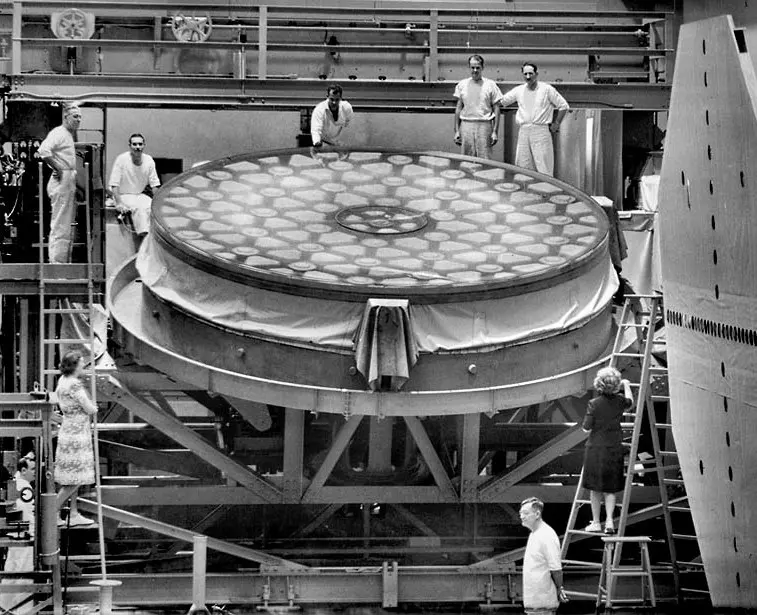
- Reflecting telescopes. The large telescopes of astronomy collect light with a concave mirror, not a lens. A lens meters across can’t be made free of defects (its glass would sag under its own weight, and it would split colors), but a mirror can be supported all over its back, and reflection bends every color equally. The largest single mirrors are over 8 m across.
- Shaving and make-up mirrors. With your face between the pole and the focus of a concave mirror, you see an upright, enlarged, virtual image, which shows the fine detail for a close shave or careful make-up.
- Ophthalmoscopes. A doctor looks into a patient’s eye through a small hole in the center of a concave mirror, which throws light into the eye, lighting up the retina.
- Reflectors. A concave mirror behind a lamp sends the light out as a beam: in torches, car headlamps, projectors and searchlights. With the lamp at the focus of a parabolic mirror, the beam comes out parallel. Run backwards, the same shape gathers sunlight onto one spot in a solar cooker, or radio waves onto the receiver of a satellite dish.
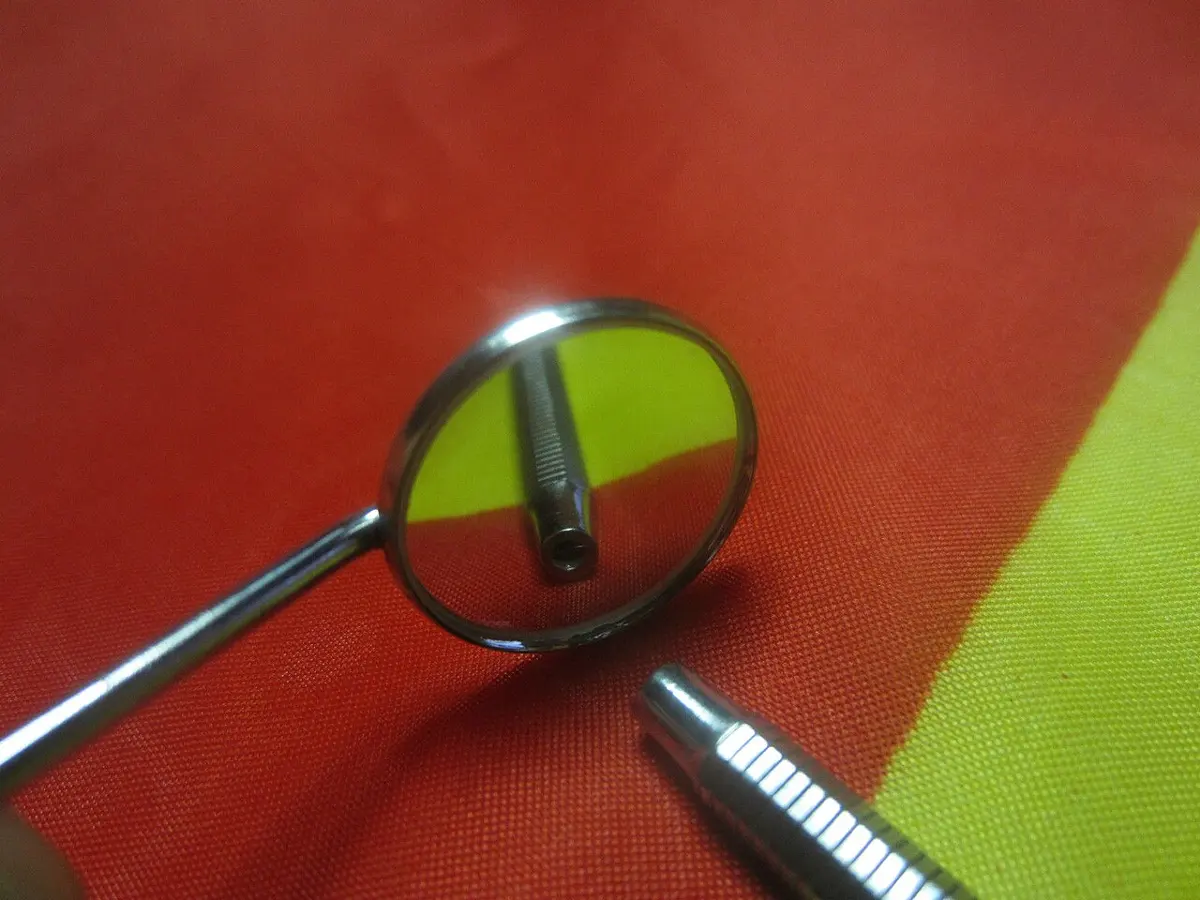
- Dentists’ mirrors. A dentist’s small mouth mirror is usually plane, but some are slightly concave, giving an enlarged view of the back of your teeth.
- Microscopes. The small mirror under the stage of a school microscope has a concave side, which gathers the light of a window or a lamp onto the specimen.
Convex mirrors
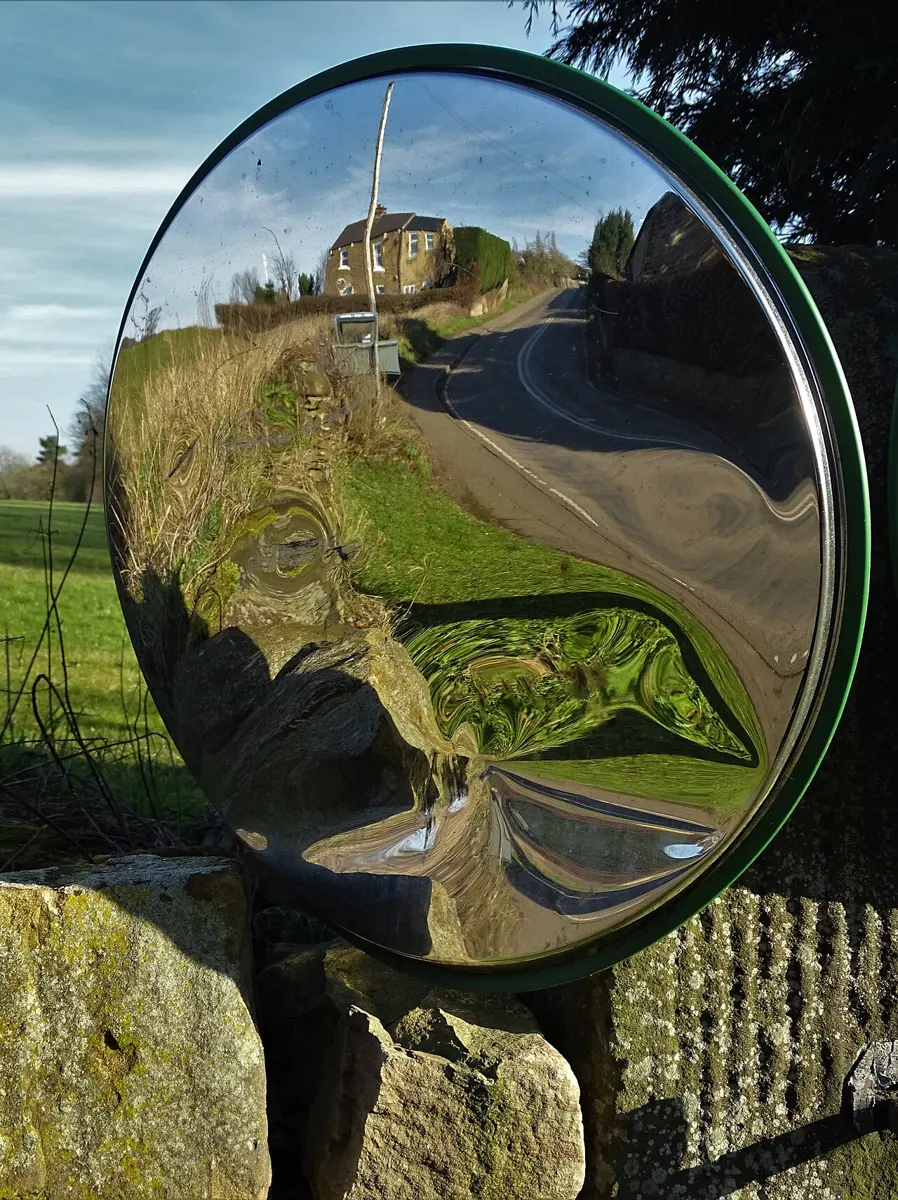
A convex mirror is used as a rear-view mirror on vehicles. Vehicles behind are real objects in front of the mirror, and their images are always virtual, upright and diminished, between the pole and the focus. So a small convex mirror shows a much wider stretch of the road than a plane mirror of the same size: it has a wider field of view. Its drawback is that everything looks smaller, and so farther away, than it is, so a driver can’t judge the distance and speed of a vehicle coming up behind from it alone.
Convex mirrors are also used on blind bends of roads, at the exits of car parks, and in shops for security, wherever one mirror must show a wide area.
Which mirror gives the widest field of view?
Pick an answer to see why.
Exercise
Choose the correct option
- Which of these mirrors has the widest field of view?
Pick an answer to see why.
- What is the nature of the image formed in the figure above?
Pick an answer to see why.
- What can you conclude from the ray diagram above?
Pick an answer to see why.
- What can you conclude from these figures?
Pick an answer to see why.
- A convex mirror receives light converging towards a point between its pole and its focus (a virtual object between P and F). The image is:
Pick an answer to see why.
- Which mirror is used for shaving?
Pick an answer to see why.
- The image formed by a convex mirror (of a real object) is:
Pick an answer to see why.
- A concave mirror of focal length in air is put under water (refractive index 4/3). Its focal length becomes:
Pick an answer to see why.
- The focal length of a concave mirror is:
Pick an answer to see why.
- An object is 20 cm from a convex mirror of focal length 10 cm. The image is:
Pick an answer to see why.
- An upright object 1 m tall is placed very far (at infinity) in front of a concave mirror. The image is:
Pick an answer to see why.
- A concave mirror of focal length forms a real image with magnification . The object distance is:
Pick an answer to see why.
- A converging beam of light is heading for a point 12 cm behind a convex mirror. The mirror forms an inverted image of the same size at that same point. The focal length of the mirror is:
Pick an answer to see why.
- A spherical mirror forms a real image of a point object. The object and the image are 20 cm and 30 cm from the mirror. The focal length and the type of the mirror are:
Pick an answer to see why.
Answer these questions
- a.Distinguish between real and virtual images.
- b.Can a plane mirror ever form a real image?
- c.Explain with a figure how a plane mirror can form a real image.
- d.You move a plane mirror towards your face, keeping it square to your line of sight, at 10 m/s. How fast does your image approach you?
Hint
Answer
- a.Which type of mirror would you suggest for shaving or for make-up, and why?
- b.Write the mirror formula.
- c.An object 2 cm tall stands upright on the axis of a convex mirror of focal length 25 cm, 100 cm from it. Where is the image formed, and what are its size and nature?
Answer
- a.Explain how a spherical mirror can behave as a plane mirror, as a special case.
- b.A convex mirror is put under water. Will its focal length change?
- c.A concave mirror of focal length in air is put under water. What is its new focal length? Explain.
Answer
- a.A convex mirror and a concave mirror are fixed on a wall. How can you tell which is which without touching them?
- b.Why does a ray of light falling normally on a mirror retrace its path?
Answer
Numerical problems
How far from a lamp must a concave mirror of focal length 3 m be placed to throw an image of the lamp on a screen 8 m from the lamp?
Hint
Answer
An object is placed in front of a convex mirror of radius of curvature 20 cm. Its image is formed 8 cm behind the mirror. Find the distance of the object from the mirror.
Answer
An object is 10 cm from a mirror, and its image is 30 cm from the mirror on the same side as the object. Is the mirror concave or convex? What is its focal length?
Answer
An object 1 cm high is 1.5 m from a screen. Where must a concave mirror be placed so that it forms an image 2 cm high on the screen? Find the focal length of the mirror.
Answer
A concave mirror gives a magnification of 0.5 when an object is 60 cm from it. Where should the object be placed to get a virtual image twice the size of the object?
Answer
A pole 4 m long lies along the principal axis of a convex mirror of focal length 1 m, as in the figure. The end of the pole nearer the mirror is 2 m from it. Find the length of the image of the pole.
Answer
An object is 40 cm from a convex mirror. A plane mirror is put between them, 32 cm from the object, facing the object, and the images in the two mirrors coincide. What is the focal length of the convex mirror?
Hint
Answer
Printable PDFs
- The unit as a book (A5) 18 pages Answers as an A4 booklet, 5 sheets
- Study notes 3 pages
- Worksheet 5 pages Answer key
- Harder practice questions 2 pages Answer key
Quiz yourself: Energy, Heat, Light and Sound, Grades 5–12 →
Practice every question in the book, and keep track of the ones you miss →
A companion to your textbook, not a replacement for it: study from the book your school uses, and where the two differ, follow your teacher. Found a mistake? Please tell us.