
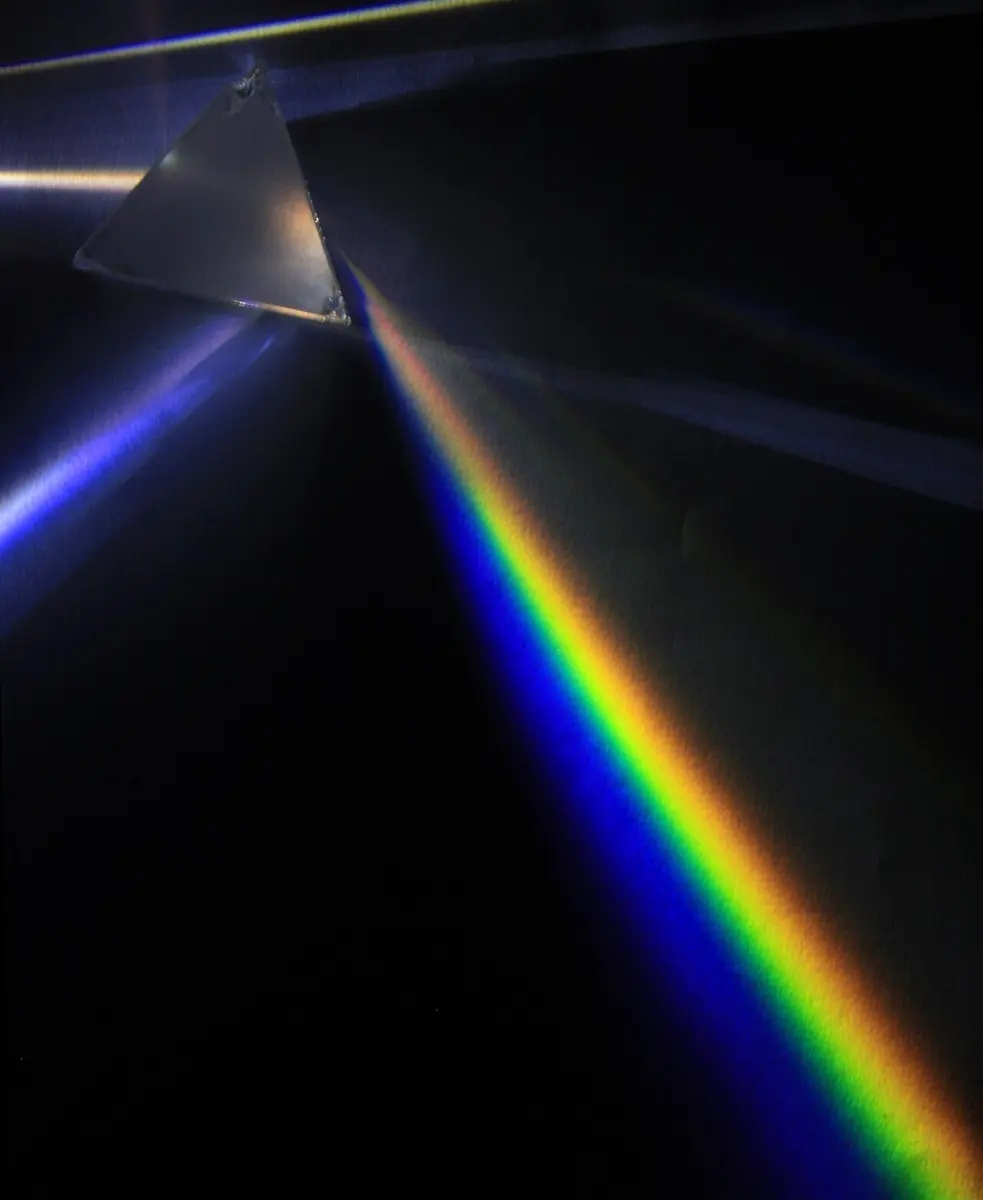
Hold a glass prism to a window and the room beyond it jumps sideways, and its edges grow fringes of color. A prism is only a wedge of glass, yet with it Newton split sunlight into a rainbow, and with it laboratories today measure refractive indices to six decimal places.
This unit follows one ray through a prism, face by face, using nothing but Snell’s law from Unit 15. You will find how much the prism turns the ray, why there is one angle at which it turns the ray least, and how that least turning gives the refractive index of the glass. Then you will see why a thin prism turns every ray by the same amount, the idea behind the prism glasses an eye doctor prescribes.
16.1 Introduction
A prism is a block of transparent material, usually glass, with two plane faces inclined to each other. A prism looks simple, but it opened the way to many discoveries about light: Newton’s splitting of white light into colors, the spectra that tell us what stars are made of, and many of the instruments of optics, from binoculars to spectrometers. In this unit we study, in detail, how light is refracted through a prism.
A prism is a homogeneous, transparent medium enclosed by two plane surfaces that meet along a straight edge. The two surfaces through which light passes are the refracting faces; the line where they meet is the refracting edge; and the angle between them is the angle of the prism or refracting angle, . The face opposite the edge is the base. A plane cut through the prism at right angles to its refracting edge gives a triangle, the principal section of the prism; in this unit all rays travel in such a plane.
16.2 Refraction through a prism
Take a prism XYZ with refracting angle at X, and a ray of light of one color, PQ, falling on face XY at Q (Figure 16.4). It is refracted into the glass along QR, towards the normal, meets the second face XZ at R, and is refracted again, away from the normal, leaving along RS. MN and ON are the normals at Q and R; they meet at N.
- is the angle of incidence at the first face, between PQ and the normal.
- is the angle of refraction at the first face.
- is the angle of incidence inside the glass at the second face.
- is the angle of emergence, between the emergent ray RS and the normal at R.
- is the angle of deviation, the angle between the direction of the incident ray and that of the emergent ray. Produce PQ forwards and SR backwards; they meet at T, and is the angle between them there.
The angle of the prism. In the four-sided figure XQNR, the angles at Q and R are right angles (the normals are perpendicular to the faces), and the four angles add up to 360°. So
In the triangle QNR, the angles at Q and R are and , so
Comparing the two:
The deviation. At Q the ray is turned through ; at R it is turned again, the same way, through . The total turning is
(In the triangle QTR the exterior angle at T is the sum of the interior angles at Q and R, which are and : the same result.) Together with Snell’s law at each face, and , these two equations let us follow any ray through any prism.
A prism of glass in air always turns light, overall, towards its base; for most rays, as in Figure 16.4, both faces turn it that way. The faces of a glass slab are parallel, so the turning at the second face undoes the first, and the light only shifts sideways (Unit 15); the faces of a prism lean towards each other, so the second turning never undoes the first.
A ray passes through a prism of angle 60°. Its angle of refraction at the first face is 35°. What is its angle of incidence at the second face?
Pick an answer to see why.
A ray falls on a 60° prism at 50° and leaves at 40°. What is its deviation?
Pick an answer to see why.
16.3 Angle of minimum deviation and refractive index
Turn the prism slowly while you watch a ray through it, and something surprising happens. As the angle of incidence grows, the deviation falls, reaches a smallest value, and then rises again. The graph of against has a single lowest point; that least deviation is the angle of minimum deviation, .
At minimum deviation the ray passes through the prism symmetrically:
- the angle of incidence equals the angle of emergence, ;
- the angles inside the glass are equal, ;
- in a prism with equal sides about the edge, the ray inside runs parallel to the base.
Why it must be symmetrical. Light can retrace its path (Unit 15). Suppose the least deviation happened for a ray that went in at and came out at , with . Send light backwards along that path: it goes in at , comes out at , and is turned through the same angle. So the deviation would be least at two different angles of incidence, and . But the graph has only one lowest point. The two must be the same: , and then by Snell’s law .
The refractive index of the prism. At minimum deviation , so from ,
and with and , from ,
Snell’s law at the first face, , then gives
This is how the refractive index of glass is measured most accurately. and are both angles, which a spectrometer measures to a fraction of a minute of arc, and finding the minimum is easy, because there the deviation hardly changes as the prism turns: you rock the prism until the image stops and turns back.
With calculus. The same result follows from . At the lowest point , so . Differentiating Snell’s law at both faces, with (since ), gives
This equals when and , which is the symmetrical path.
At the minimum deviation of a prism, which of these is true?
Pick an answer to see why.
16.4 Deviation produced by a small-angled prism
Take a thin prism, of small refracting angle (a few degrees), and light falling on it nearly along the normal, so that is small too (Figure 16.8). Then all the angles, , , and , are small.
For a small angle in radians, . Snell’s law at the first face, , becomes
and at the second face, in the same way,
Putting these into :
A thin prism deviates every ray that falls on it nearly normally by the same angle, whatever its exact angle of incidence. The deviation depends only on the refractive index and the angle of the prism. For glass () a thin prism turns light through half its own angle. This is what makes a thin prism useful: like a lens of no thickness, it acts on the whole beam alike.
What small-angled prisms are used for
- Prism glasses. An eye that turns slightly inwards or outwards sends a double image. A thin prism in the spectacle lens turns the light so that both eyes see the object in the same place. Eye doctors measure such prisms in prism diopters: one prism diopter turns light by 1 cm at a distance of 1 m (an angle of about 0.57°). From , a glass prism of about 1.15° gives 1 prism diopter.
- Steering a beam. Two thin prisms one behind the other, each turned about the beam’s line (a Risley pair), can point a laser beam in any direction within a small cone, with no moving mirrors. They are used to aim laser beams in scanners, laser cutting and some satellite links.
- Shaping a beam. The light from a laser diode spreads out more in one direction than the other, giving an oval spot. Two prisms in a row widen the beam in one direction only and make the spot round (an anamorphic prism pair).
- Alignment. A thin wedge shifts an image by a small, fixed, known angle, so it is used to line up the parts of an optical system and to adjust the path of a beam a little.
- Turning light without colors. A thin prism of crown glass and a thinner, opposite one of flint glass can be chosen so that their color spreads cancel while a deviation remains: an achromatic prism, the same idea as the achromatic lens (Unit 18).
A thin prism of angle 6° deviates a ray by 3.6°. What is its refractive index?
Pick an answer to see why.
Exercise
Choose the correct option
- Which of these must equal the angle of emergence when light passes through a prism at minimum deviation?
Pick an answer to see why.
- Which of these is false for a prism placed at minimum deviation?
Pick an answer to see why.
- The critical angle for the material of a prism is , and the angle of the prism is . In which case is there no emergent ray, whatever the angle of incidence?
Pick an answer to see why.
- What should the refracting angle of a prism of refractive index 1.5 be, for a ray falling on a face at 50° to pass at minimum deviation?
Pick an answer to see why.
- An equilateral prism has a refractive index of . At what angle of incidence does minimum deviation happen?
Pick an answer to see why.
- The angle of a prism is and its angle of minimum deviation is . What is the refractive index of the prism?
Pick an answer to see why.
- The refracting angle of a prism is and its refractive index is . What is its angle of minimum deviation?
Pick an answer to see why.
Answer these questions
- a.Can a ray of light ever pass through a prism without being deviated? Explain.
- b.One face of a prism of refractive index and refracting angle 30° is silvered. At what angle must a ray fall on the other face so that, after refraction there and reflection at the silvered face, it goes back along its own path?
Answer
- a.What are the factors on which the deviation produced by a prism depends?
- b.Light falls at 45° on one face of an equilateral glass prism (). Find the angle of emergence and the angle of deviation.
Answer
- a.Why don’t we speak of a lateral shift for a prism?
- b.Light falls normally on one face of a prism and leaves the second face grazing it (at 90° to the normal). What is the relation between the angle of the prism and the critical angle?
- c.A ray of light makes an angle of 50° with one face of a prism. The angle of the prism is 60° and the ray is deviated through 42°. Find the angle which the emergent ray makes with the second face.
Answer
- a.State the factors on which the deviation produced by a prism depends.
- b.A ray of light falls at an angle of incidence of 60° on one face of a prism whose refracting angle is 30°. The angle between the emergent ray and the incident ray is 30°. What is the angle between the emergent ray and the face from which it emerges?
Answer
- a.A glass prism is put in water. What happens to its angle of minimum deviation?
- b.Light falls normally on one of the shorter faces of a right-angled isosceles prism and is totally reflected at the long face. What is the least refractive index the prism can have?
Answer
- a.Does the angle of deviation depend on the angle of the prism? Explain.
- b.In an equilateral prism the angle of incidence equals the angle of emergence, and each is three-quarters of the angle of the prism. Find the angle of deviation.
Answer
- a.Does the angle of deviation depend on the angle of the prism?
- b.List the conditions for minimum deviation through a prism.
- c.Light falls on one face of a 60° prism of refractive index 1.5 at an angle of incidence of 90° (Figure 16.5). Find the angle of emergence and the angle of deviation.
Answer
Numerical problems
Calculate the angle of minimum deviation for light passing through a prism of angle 60° and refractive index 1.5. What is the angle of incidence for it?
Answer
A ray of light is refracted through a prism at minimum deviation. The angle of the prism is 60° and the deviation is 34°. Find the angle of incidence and the refractive index.
Answer
A ray of light falls normally on one face of a glass prism of refractive index 1.5. Find the angle of the prism if the ray just fails to come out of the second face.
Answer
What should the refracting angle of a prism of refractive index 1.5 be, so that a ray falling on a face at 50° passes at minimum deviation?
Answer
Printable PDFs
- The unit as a book (A5) 14 pages Answers as an A4 booklet, 4 sheets
- Study notes 2 pages
- Worksheet 5 pages Answer key
- Harder practice questions 2 pages Answer key
Quiz yourself: Energy, Heat, Light and Sound, Grades 5–12 →
Practice every question in the book, and keep track of the ones you miss →
A companion to your textbook, not a replacement for it: study from the book your school uses, and where the two differ, follow your teacher. Found a mistake? Please tell us.