
On a dry winter morning in the Kathmandu Valley, you walk across a carpet, reach for a metal door handle, and a small spark jumps to your finger with a sharp little sting. Brush your freshly washed hair hard and the hairs fly apart. A plastic comb run through your hair picks up bits of paper, but a metal comb doesn’t. In every case two things were rubbed together. Why should rubbing make forces and sparks? What kind of force is it? And why do metals behave differently from plastics?
Those are the questions this unit begins with. Their answers lead to one of the great laws of physics, Coulomb’s law, which tells you exactly how hard two charges push or pull on each other. The same law holds an atom together, sticks a balloon to a wall and makes lightning possible. The next two units build on it: Unit 20 describes the space round a charge as an electric field, and Unit 21 the energy stored in it.
19.1 Introduction
Everything round you is made of atoms, and every atom is made of charged particles: protons (positive) in the tiny nucleus at its center, and electrons (negative) round it, with neutrons (no charge) in the nucleus too. An everyday object contains an enormous number of them, but usually exactly as many protons as electrons. The positive and negative charges then cancel: the object has no overall charge, and is said to be neutral.
The protons are locked in the nuclei and can’t be moved about in ordinary processes. But the outermost electrons of an atom are held less tightly, and some of them can be moved from one object to another. That is the whole secret of charging:
- An object given extra electrons becomes negatively charged.
- An object that loses electrons becomes positively charged (it now has more protons than electrons).
So “charging” never creates charge. It only moves electrons from one place to another: whatever charge one object gains, another loses. This is the law of conservation of charge: the total charge of an isolated system never changes.
Charge comes in lumps
Charge is measured in coulombs (C). The charge of one electron is −e and of one proton +e, where
is the elementary charge. Since charge moves only as whole electrons (or whole ions), every charge you can find on an object is a whole number of these lumps:
Charge is said to be quantized. One coulomb is a lot: it is the charge of electrons. The charge on a rubbed comb is only a few nanocoulombs (1 nC = 10⁻⁹ C), and on a charged sphere in the laboratory a few microcoulombs (1 µC = 10⁻⁶ C) at most.
Charge carriers
The charged particles that are free to move and carry charge from place to place are called charge carriers. What they are depends on the material:
- in metals, free electrons, which wander between the atoms;
- in solutions such as salt water and in molten salts, ions, positive and negative, moving in opposite directions;
- in gases, ions and electrons, made when a spark or flame knocks electrons off molecules;
- in semiconductors such as silicon, electrons and holes (places where an electron is missing, which behave like positive carriers).
A material with many charge carriers is a conductor; one with very few is an insulator (more about these in 19.3).
A plastic rod is given a charge of −4.8 × 10⁻⁹ C by rubbing. How many electrons has it gained?
Pick an answer to see why.
19.2 Charging by friction
When two different materials rub together, their surfaces come into very close contact at many tiny points, and electrons cross from one to the other. Which way they go depends on how tightly each material holds its electrons.
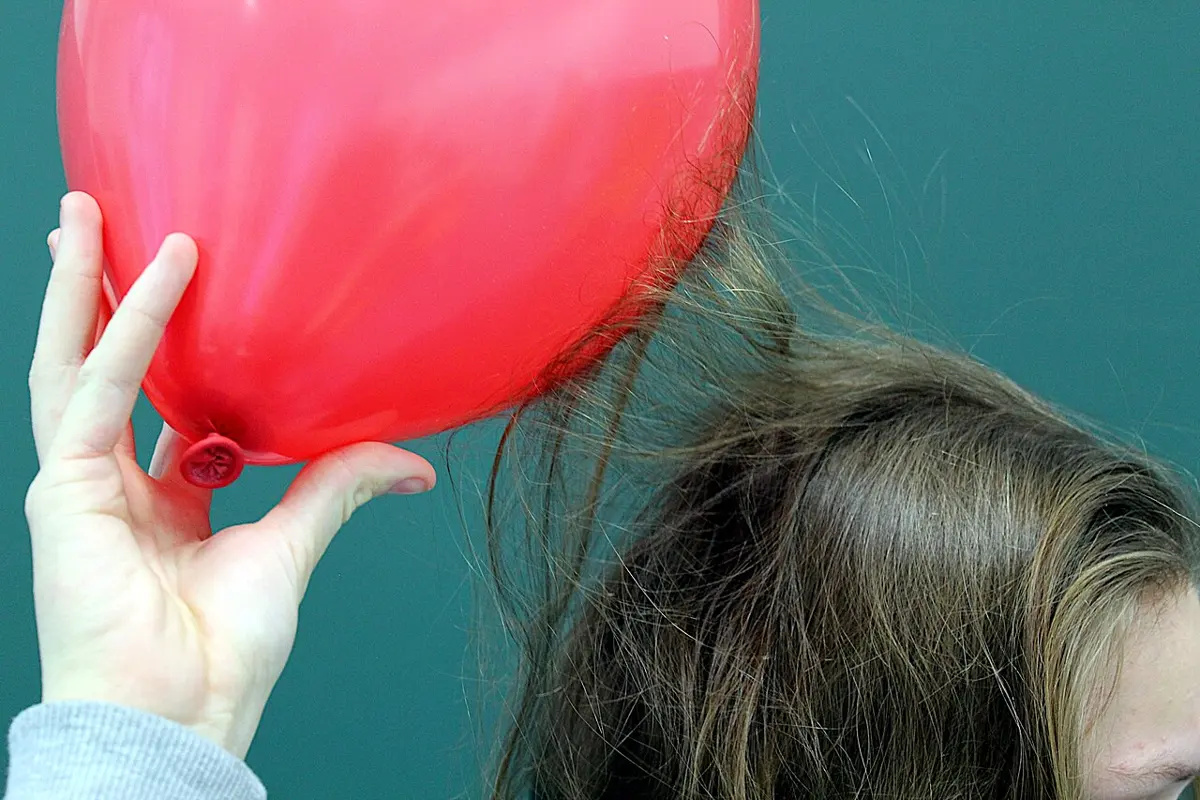
Brush dry hair with a plastic brush, for example, and electrons move from the hair to the brush. The brush gains electrons and becomes negatively charged; the hair loses electrons and is left positively charged. Now two things happen that you can see:
- the brush and the hair, with opposite charges, attract: the hair is pulled towards the brush;
- the hairs, all with the same (positive) charge, repel each other, and stand apart.
In school experiments, insulating rods are rubbed with cloth: one of the two becomes positive and the other negative, as electrons cross between them. A plastic (polythene) rod rubbed with wool takes electrons from the wool and becomes negative; a glass rod rubbed with silk gives electrons to the silk and becomes positive. Insulators are used because they have very few free charge carriers: the charge stays where the rubbing put it. A metal rod held in the hand can be charged by rubbing too, but the charge doesn’t stay: it flows away at once through the metal and through your body.
So: when two materials are rubbed together, electrons are transferred between their surfaces, and the two are left with equal and opposite charges.
A glass rod rubbed with silk becomes positively charged. This is because:
Pick an answer to see why.
19.3 Charging by induction
A charged object can also cause charge to move in a conductor without touching it. Bring a charged rod near a metal object, and the free electrons in the metal are pushed away or pulled closer, even though nothing passes between the rod and the metal.
Follow Figure 19.3, two metal spheres A and B on insulating stands:
- (a) The spheres touch, so together they form a single conductor, uncharged.
- (b) A negatively charged rod is brought near A. The free electrons in the metal are repelled by the rod and move as far from it as they can, to the far side of B. They stop when their own repulsion on each other balances the rod’s push. A’s side near the rod is left with too few electrons: positive. The charge has been redistributed, but the two spheres together are still neutral.
- (c) B is moved away from A while the rod is still in place, so the electrons can’t flow back.
- (d) The rod is taken away. A is left positively charged and B negatively charged, by equal amounts; each sphere’s charge now spreads evenly over its surface.
This is charging by induction. The rod never touched the spheres and it keeps all of its own charge, so it can charge any number of pairs of spheres, again and again.
You can do the same with one sphere. With the charged rod near it, touch the far side of the sphere with your finger: electrons pushed away by the rod flow out through you to the ground. Take your finger away first, then the rod, and the sphere is left positive, opposite to the rod. Connecting a conductor to the Earth like this is called earthing (or grounding).
These experiments show that charge can be passed from one object to another only when they touch (or when a spark jumps between them): contact is needed for charge to be transferred. Induction doesn’t contradict this: in induction the rod’s charge stays on the rod, and it only pushes the charges already in the conductor about. The two spheres of Figure 19.3 were charged by touching each other, not by touching the rod.
And they show there are two kinds of material with very different electric properties:
- Conductors, such as metals, salt water, the human body and the Earth, contain many charge carriers. Charge moves through them freely, so charge put on one place spreads over the whole object at once.
- Insulators, such as plastic, glass, rubber, dry wood and dry air, contain very few. Charge put on them stays where it was put.
A positively charged rod is held near (but not touching) an uncharged metal sphere on an insulating stand. The sphere is touched with a finger, the finger is removed, and then the rod is taken away. The sphere is now:
Pick an answer to see why.
19.4 Coulomb’s law for the electric force
A charged object pushes or pulls on other charged objects across empty space, without touching them. The region round a charged object in which another charge feels this force is its electric field (or electrostatic field): Unit 20 is about fields. First, how big is the force?
In 1785, using his torsion balance, Coulomb measured the force between two small charged spheres and found that the force between two point charges:
- is directly proportional to the product of the two charges, ;
- is inversely proportional to the square of the distance between them, ;
- acts along the line joining them: repulsive between charges of the same sign, attractive between charges of opposite sign.
Combining the two proportions,
so for two point charges and a distance apart in a vacuum,
where is a constant, Coulomb’s constant. It is usually written as , so Coulomb’s law is
The constant is called the permittivity of free space (of a vacuum):
(The 4π is there because a charge’s influence spreads out over a sphere, whose area is ; Unit 20’s Gauss’s law shows why this way of writing it is the natural one.)
The force on each charge is directed along the line joining the two charges. If the charges have the same sign, the force on each points away from the other; if opposite signs, towards the other (Figure 19.6). The force that exerts on is equal and opposite to the force exerts on , as Newton’s third law requires: a small charge pulls a big one exactly as hard as the big one pulls it.
The sign of the force
If you put the charges into the formula with their signs, the sign of tells you which way the force acts:
- positive ( and both positive or both negative): repulsion;
- negative (one positive, one negative): attraction.
The direction of the force is always along the line joining the charges; the sign only says whether it points towards the other charge or away from it.
Charges in a material
The law above is for charges in a vacuum. If the charges are in another medium, such as water or oil, the force between them is smaller, and the permittivity of the medium, , takes the place of :
(the “0” is kept for the vacuum only). The ratio is the medium’s relative permittivity (or dielectric constant): it says how many times weaker the force is in the medium.
| Medium | Relative permittivity | Permittivity (C²/(N m²)) |
|---|---|---|
| vacuum | 1 (exactly) | 8.85 × 10⁻¹² |
| air | 1.0006 | 8.86 × 10⁻¹² |
| paper | about 3 | about 3 × 10⁻¹¹ |
| glass | 5 to 10 | about 4 × 10⁻¹¹ to 9 × 10⁻¹¹ |
| water (room temperature) | about 80 | about 7.1 × 10⁻¹⁰ |
Air is so close to a vacuum that is used for both. Water is the striking one: two charges in water attract only about an eightieth as strongly as in air. That is why salt dissolves in water: the sodium and chloride ions of a salt crystal, held together by Coulomb’s attraction, are pulled apart far more easily once water surrounds them.
Charged spheres act as point charges
Coulomb’s law is for point charges, charges so small compared with the distance between them that their size doesn’t matter: protons, electrons, ions, or small charged balls far apart. But it also works exactly for uniformly charged spheres, however close they are, as long as is measured from center to center: outside it, a uniformly charged sphere acts as if all its charge were concentrated at its center. (Unit 20 proves this with Gauss’s law; it is the same result as for a planet’s gravity in Unit 7.)
Two point charges repel each other with a force F. If the distance between them is made three times as large, the force becomes:
Pick an answer to see why.
The force from several charges
When several charges act on one charge, each pushes or pulls on it exactly as if the others weren’t there, by Coulomb’s law. The total (net) force is the vector sum of these separate forces:
This is the principle of superposition. It sounds obvious, but it is a fact of nature, found by experiment: one charge doesn’t change the force another exerts. Since the forces are vectors, they are added as vectors (Unit 2): along one line, with signs for their directions; at an angle, by the parallelogram law or by components.
A first look at the electric field
The two worked examples below use an idea that Unit 20 develops fully. Instead of asking about the force between two charges, ask: what does a charge do to the space round it? Place a small positive test charge at a point. The electric field strength there is the force on each coulomb of test charge:
in newtons per coulomb (N/C). Its direction is the direction of the force on a positive test charge. For a point charge , Coulomb’s law gives , so
pointing away from a positive and towards a negative one. The field is there whether or not a test charge is placed to feel it. Once you know at a point, the force on any charge put there is .
Exercise
Choose the correct option
- Two charged particles, −2Q and +Q, a distance d apart, attract each other with a force F. The charge of each particle is changed by +Q, and the distance between them is increased to 2d. What is the force between them now?
Pick an answer to see why.
Numerical problems
Two point charges, µC and µC, are 12 cm apart. The electric field at the point P shown is zero. How far is P from ?
Hint
Answer
You are given two unknown point charges, and . At a point on the line joining them, one third of the way from to , the electric field is zero. What is the ratio ?
Hint
Answer
Two point charges of +30 nC and −30 nC form an electric dipole of length 0.25 m.
- a.Calculate the force between the charges.
- b.Calculate the electric field strength at the midpoint between the charges.
- c.Sketch the shape of the electric field in the region of the dipole.
Hint
Answer
Two light polystyrene spheres, coated in a conducting metallic paint, have each been given a positive charge by a high-voltage supply. They hang from one point on cotton threads 15 cm long, and their repulsion pushes them apart until each is 3.0 cm from the vertical, as shown. The mass of each sphere is 0.08 g. Calculate the charge on each sphere (g = 9.8 m/s²), assuming the two charges are equal.
Hint
Answer
Printable PDFs
- The unit as a book (A5) 19 pages Answers as an A4 booklet, 5 sheets
- Study notes 3 pages
- Worksheet 5 pages Answer key
- Harder practice questions 2 pages Answer key
Quiz yourself: Electricity and Magnetism, Grades 5–12 →
Practice every question in the book, and keep track of the ones you miss →
A companion to your textbook, not a replacement for it: study from the book your school uses, and where the two differ, follow your teacher. Found a mistake? Please tell us.