
Walk from your house to the nearest pond and count the kinds of living things you pass: grass, a peepal tree, moss on a wall, ants, a crow, a dog, the green scum on the water, a snail, mosquitoes, and in the water itself millions of things too small to see. Scientists have named about 2.2 million kinds of living things so far (as of 2025), and they think there are several million more still waiting to be found.
How do you make sense of so many? The same way a library makes sense of a million books, or a shop of a thousand things on its shelves: you sort them into groups. This unit is about how living things are sorted, why a fern and a mango tree end up in the same group but a mushroom doesn’t, why a whale is not a fish, and what the groups tell us about where all living things came from.
Why sort living things?
Imagine a shop where the rice, the soap, the pencils and the biscuits are all thrown on one heap. To find anything you would have to search the whole heap. Put them on shelves (food here, stationery there, and in the food shelf, grains together) and you can find anything quickly, and even guess what a new thing is like from the shelf it sits on.
Sorting living things into groups by their similarities and differences is called classification. It helps us to:
- study millions of organisms by learning about a few groups instead of every single one;
- identify a new organism: once you know its group, you already know a lot about it;
- name organisms so that scientists everywhere know exactly which one is meant;
- see how organisms are related to each other, and how they evolved (the last section of this unit).
Groups inside groups
Living things are sorted into groups inside groups, like a home address: country, province, district, municipality, ward, house. The biggest group is the kingdom. Each kingdom is divided into phyla (singular: phylum; for plants, the word division is used), each phylum into classes, then orders, families, genera (singular: genus) and finally the species, one kind of organism.
Every species has a scientific name of two words: its genus and its species, such as Panthera tigris (tiger), Homo sapiens (human) or Ficus religiosa (peepal). It is written in italics, with a capital letter only for the genus. A tiger is bagh in Nepali, tiger in English and tigre in Spanish, but Panthera tigris to scientists everywhere.
In the scientific name Ficus religiosa (peepal), what does Ficus tell you?
Pick an answer to see why.
The five kingdoms
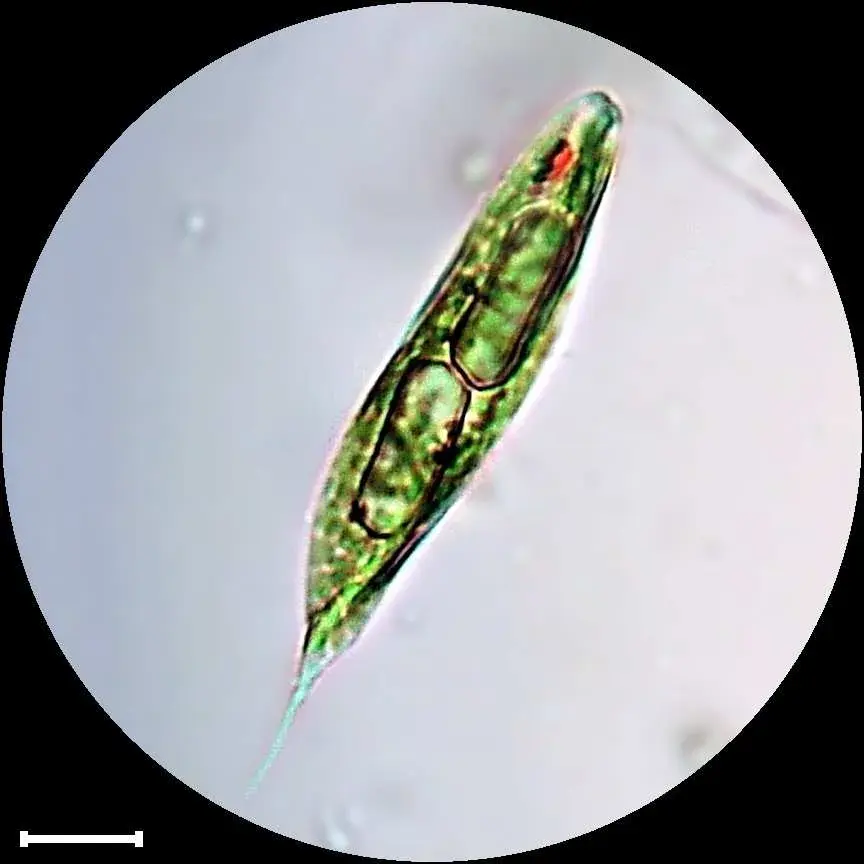
Look at a bacterium and a Euglena.
- A bacterium is a single cell with no nucleus: its DNA lies loose inside the cell. A cell like this is called prokaryotic (pro = before, karyon = nucleus).
- Euglena is also a single cell, but it has a proper nucleus with a membrane around it. A cell like this is eukaryotic (eu = true). Euglena is also strange: it has green chloroplasts and makes its own food in light, like a plant, but it swims with a whip-like flagellum and can take in food in the dark, like an animal.
In 1969, the American ecologist Robert H. Whittaker sorted all living things into five kingdoms. He asked a few simple questions about each organism:
- Are its cells prokaryotic or eukaryotic?
- Is it one cell (unicellular) or many cells (multicellular)?
- Do its cells have a cell wall?
- How does it get its food (its mode of nutrition)? Autotrophs make their own food from sunlight (with chlorophyll); heterotrophs eat or absorb food made by others; saprotrophs are heterotrophs that feed on dead and rotting things.
You met the first three kingdoms in Grade 9. In short:
| Kingdom | Main features | Examples |
|---|---|---|
| Monera | prokaryotic: one cell with no nucleus | bacteria, blue-green algae (cyanobacteria) |
| Protista | eukaryotic, mostly one cell with a nucleus | Amoeba, Paramecium, Euglena, the malaria parasite |
| Fungi | eukaryotic, mostly many cells; cell wall but no chlorophyll; saprotrophs | mushroom, yeast, bread mold |
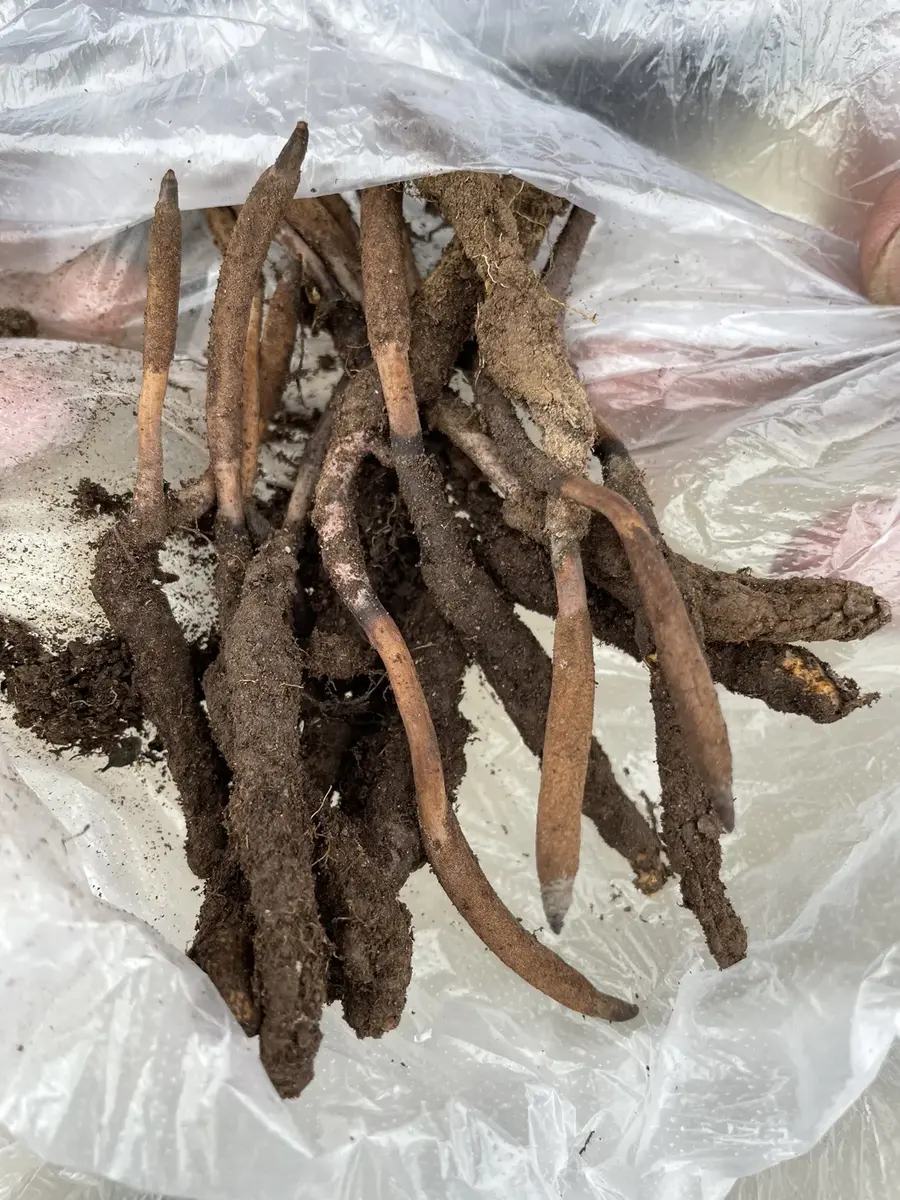
| Plantae | eukaryotic, many cells (a few single); cell wall of cellulose; chlorophyll; autotrophs | moss, fern, pine, maize |
| Animalia | eukaryotic, many cells; no cell wall, no chlorophyll; heterotrophs | sponge, earthworm, fish, human |
With these questions we can place any organism. A bacterium is in Monera (prokaryotic); Euglena in Protista (unicellular, eukaryotic). A mushroom and a fern are both multicellular with cell walls, but the mushroom has no chlorophyll and feeds on dead and decaying plants, while the fern makes its own food. A fern is a plant because it has chlorophyll and is an autotroph; a frog is an animal because it has no cell wall and no chlorophyll, and must eat.
2.1 Kingdom Plantae
Chlamydomonas (a single green cell that swims in ponds), moss, fern, pine, pea and maize look nothing alike. Yet they share what matters:
- they have the green pigment chlorophyll, so they make their own food: they are autotrophs;
- their cells have a cell wall made of cellulose;
- most are multicellular, though a few, like Chlamydomonas, are a single cell.
All of them belong to kingdom Plantae. Some bear flowers and some don’t. By their structure, plants are sorted into three divisions: Algae, Bryophyta and Tracheophyta.
1. Algae
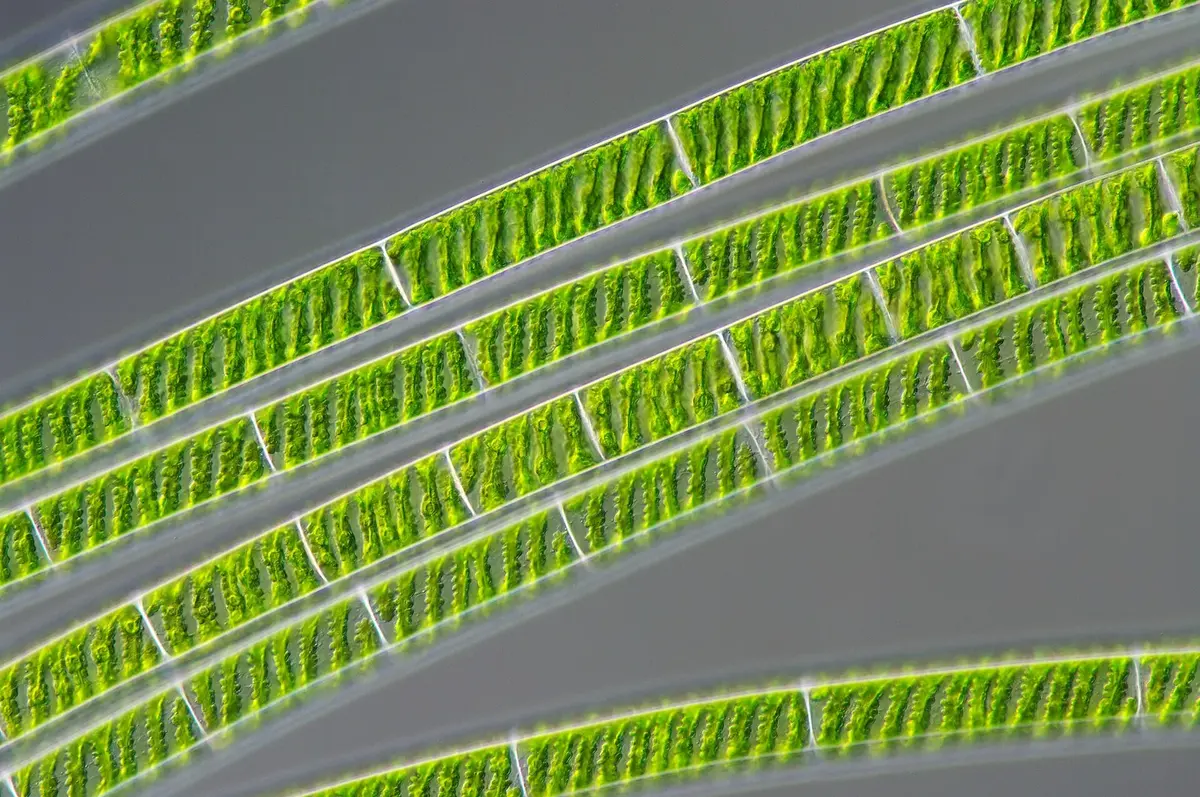
Spirogyra, Volvox and Fucus (a brown seaweed of the sea) have no root, stem or leaf. A plant body that is not divided into root, stem and leaf is called a thallus. Their cells have a cell wall and chlorophyll. These plants belong to the division Algae.
Characteristics of algae
- a.They are unicellular or multicellular.
- b.They are autotrophs, because they have chlorophyll. They make food and store it as starch.
- c.Their cell wall is made of cellulose.
- d.They reproduce both sexually and asexually.
- e.They live in water or very wet places: ponds, rivers, the sea and marshes.
- f.Their body is a thallus: not divided into root, stem and leaf.
Examples: Chlamydomonas, Volvox, Spirogyra, Ulothrix, Fucus.
A green, slimy thread from a pond has no root, stem or leaf, but its cells contain chlorophyll and have cellulose walls. It belongs to:
Pick an answer to see why.
2. Bryophyta
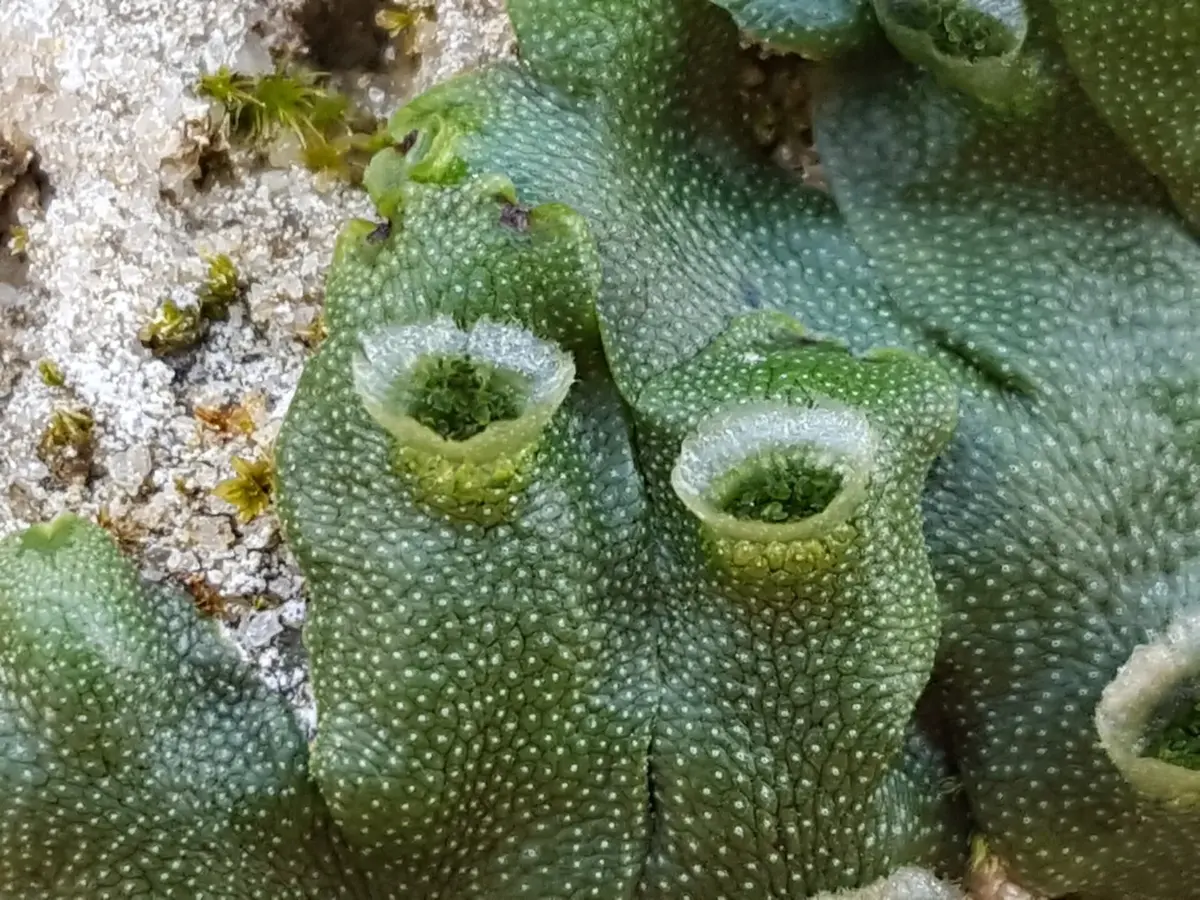
Marchantia, Riccia and the mosses are more developed than algae. They are green plants that live on land, in moist and shady places. The body of Marchantia and Riccia is still a flat green thallus lying on the ground, but the body of a moss is divided into rhizoids, a stem and simple leaves.
They have no roots: the rhizoids are thin hairs that hold the plant down and take in some water. They are not true roots, and their stems and leaves are not true stems and leaves, because they have no vascular tissue (no xylem to carry water, no phloem to carry food).
Moss: Jan Kops, Flora Batava vol. 8 (1846), public domain
Characteristics of bryophytes
- a.They are multicellular plants.
- b.They are autotrophs.
- c.Their body is either a thallus (Marchantia, Riccia) or divided into rhizoids, stem and simple leaves (moss).
- d.They live in moist and shady places.
- e.The green plant body is the gametophyte. Many, like Marchantia, are dioecious: there are separate male and female plants. A male plant makes male gametes in antheridia; a female plant makes the egg (ovum) in an archegonium.
- f.They have no vascular tissue, so they stay only a few centimeters high, or spread flat over the ground, rocks or bark (the substratum).
- g.They need water for fertilization: the male gametes swim to the egg through a film of water. So bryophytes are called the amphibians of the plant kingdom: they live on land, but need water to reproduce.
- h.Their life cycle shows alternation of generations, and the gametophyte (the green plant you see) is dominant and independent.
Examples: Marchantia, Riccia, Funaria and other mosses.
Alternation of generations
This is the part students find hardest, so take it slowly. A bryophyte’s life has two stages, two “generations”, that take turns:
- The gametophyte (the plant that makes gametes). This is the green moss plant you see. In many bryophytes (such as Marchantia), some plants are male and some female. A male plant makes male gametes in organs called antheridia (singular: antheridium); a female plant makes an egg (ovum) in an organ shaped like a tiny flask, an archegonium.
- Fertilization. After rain, the male gametes swim out through the film of water on the plant and reach the archegonium, where one fuses with the egg. The fused cell is the zygote.
- The sporophyte (the plant that makes spores). The zygote does not fall off; it grows right there, on top of the female plant, into the sporophyte: a stalk with a capsule. The sporophyte stays attached to the gametophyte and takes food and water from it. Inside the capsule, the spore mother cells divide by meiosis to make spores, each with half the number of chromosomes (haploid).
- Back to the start. The capsule opens and the wind carries the spores away. A spore that lands somewhere damp grows into a new green gametophyte.
So the life cycle goes gametophyte → gametes → zygote → sporophyte → spores → gametophyte, round and round. When the gametophyte generation and the sporophyte generation follow one after another to complete the life cycle of a plant, it is called alternation of generations.
Why do mosses never grow tall like trees?
Pick an answer to see why.
3. Tracheophyta
A fern, a Cycas, a banana and a peepal look very different, but their bodies are all divided into a true root, stem and leaf, and they all have vascular tissue:
- xylem carries water and minerals up from the roots;
- phloem carries the food made in the leaves to every part of the plant.
Plants with vascular tissue belong to the division Tracheophyta. It holds non-flowering ferns, small herbs and shrubs, and the biggest trees on Earth. Because xylem can carry water high up, these plants can grow tall and live in drier places.
By their structure, tracheophytes are sorted into three subdivisions: Pteridophyta, Gymnosperms and Angiosperms.
A. Pteridophyta
Ferns, clubmosses (Lycopodium, Selaginella) and horsetails (Equisetum) have a clear root, stem and leaf, but they do not bear flowers or seeds. They belong to the subdivision Pteridophyta (pteris = fern).
Fern: H. A. Köhler, Medizinal-Pflanzen (1887), public domain
Prothallus: Strasburger, in the Encyclopaedia Britannica (1911), public domain
Characteristics of pteridophytes
- a.They live in moist and shady places.
- b.They have no seeds, but their body is divided into true root, stem and leaf. In most ferns the leaf is large and feather-like (a frond), the stem is an underground rhizome that grows sideways under the soil, and the roots grow from the rhizome.
- c.They have vascular tissue: xylem and phloem.
- d.On the lower surface of some leaves are many brown spots, the sori (singular: sorus). Each sorus holds many sporangia (singular: sporangium), and the sporangia make spores. A leaf with sori is a sporophyll (phyll = leaf); a leaf without sori, which only makes food, is a trophophyll (troph = food).
- e.The fern plant you see is the sporophyte, because it makes spores. Spore mother cells divide by meiosis, so the spores are haploid.
- f.When a sporangium bursts, the spores fall to the ground. Where it is damp, a spore grows into a tiny, flat, heart-shaped gametophyte, the prothallus (plural: prothalli), less than a centimeter across. It makes both male and female gametes; a male gamete swims through a film of water to the egg, and the zygote grows into a new fern.
- g.Their life cycle shows alternation of generations, but now the sporophyte is dominant and lives longer, while the gametophyte is small and short-lived: the opposite of a moss.
Examples: ferns such as Pteris and Dryopteris, the fiddlehead fern (niuro), pani amala (Nephrolepis), clubmosses (Lycopodium, Selaginella) and horsetails (Equisetum).
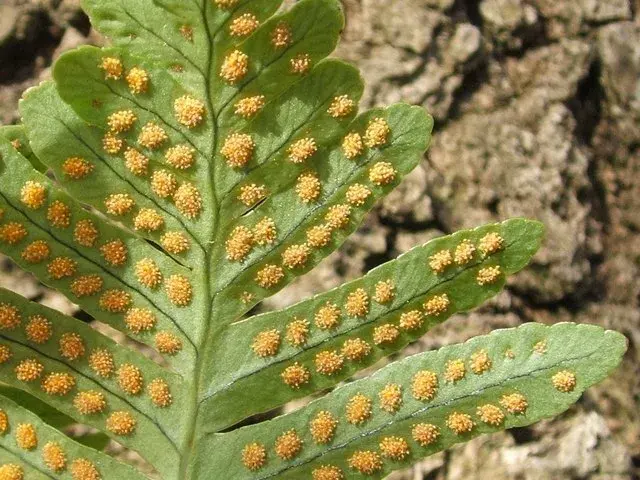
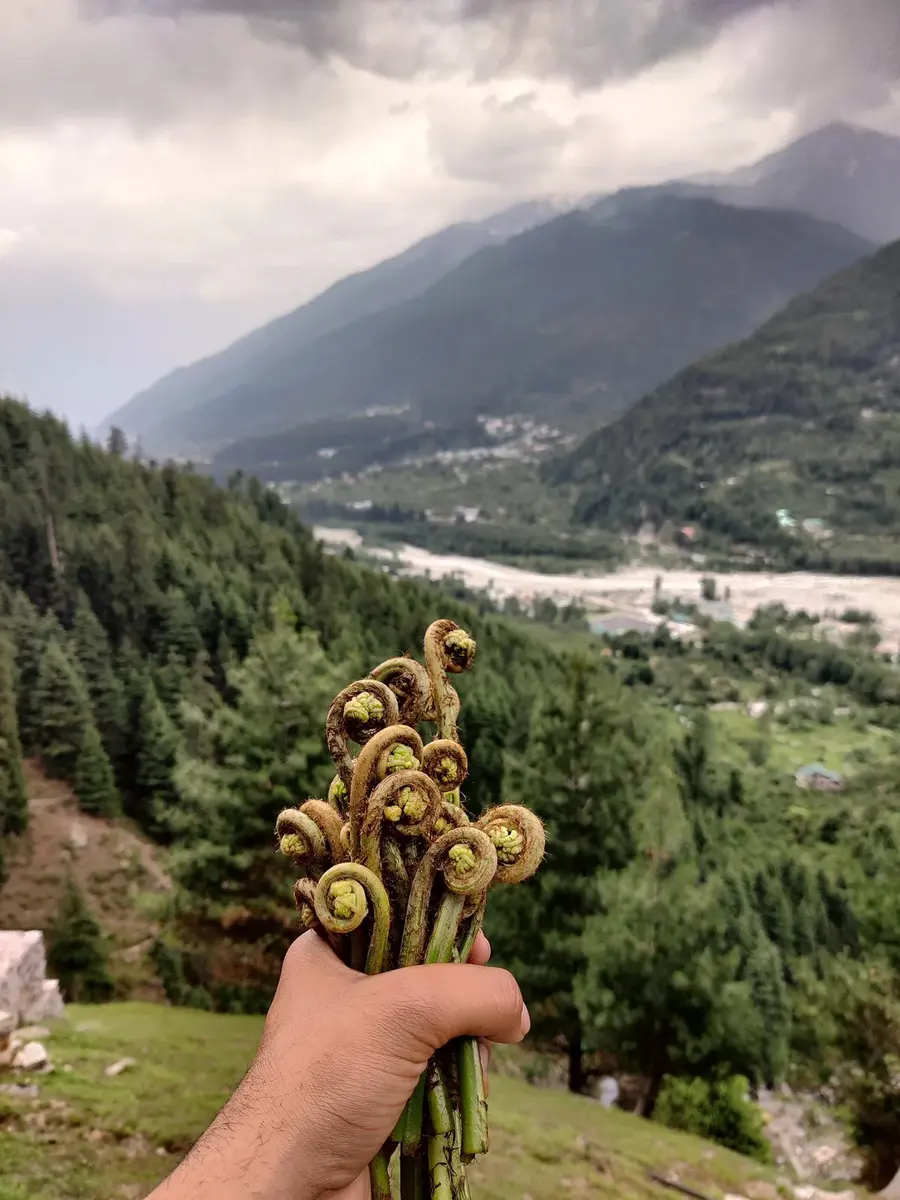
Clubmoss is a pteridophyte, but moss is a bryophyte. Which feature makes the clubmoss more advanced?
Pick an answer to see why.
Draw it: Spirogyra, A moss plant (Funaria), A fern plant
Seed plants: gymnosperms and angiosperms
Mosses and ferns spread by spores: single cells, so tiny and so unprotected that most die. The next two subdivisions of Tracheophyta make seeds. A seed is far better: inside it is a baby plant (the embryo), a store of food for it, and a tough coat to protect it, so it can wait months or years in dry soil until rain comes. Seed plants also don’t need a film of water for their gametes to swim through: pollen carries the male gametes by wind or by animals. That is why seed plants took over the dry land.
B. Gymnosperms
Look at a pine, a juniper (dhupi) and a Cycas. None of them has a flower. Instead, they bear cones. Their seeds lie open on the scales of the female cone, not shut inside a fruit. Gymnosperm means naked seed (Greek gymnos = naked, sperma = seed).
Pine cone: O. W. Thomé, Flora von Deutschland (1885), public domain
Cone scale: Pennsylvania Department of Forestry, Bulletin 11 (1901), public domain
Pea pod: Lukas Budimaier, CC0, via Wikimedia Commons
Characteristics of gymnosperms
- a.In the evolution of plants, gymnosperms were the first plants to produce seeds (they appeared more than 300 million years ago).
- b.They bear cones instead of flowers. Male and female cones are separate (and in some, like Cycas and juniper, on separate plants), so the cones are unisexual. Pollen is carried from male cones to female cones by wind.
- c.A cone has no ovary, so there is no fruit. The seeds are naked.
- d.Most have long, narrow, needle-like leaves (pine, deodar), or small scale-like ones (juniper, cypress). Cycas is the exception, with big, stiff leaves divided like a feather.
- e.The stem is covered by thick bark.
- f.The trees that carry cones are the conifers: the word conifer means cone-bearing (Latin conus = cone, ferre = to bear). They include the pines, deodar, fir and juniper. Many are cone-shaped trees, broad at the bottom and pointed at the top, which lets snow slide off, but some, like old chir pines, are not.
- g.Their roots spread far into the ground.
Examples: Cycas, pine (Pinus), juniper, Himalayan yew (Taxus), deodar (Himalayan cedar, Cedrus deodara), fir.
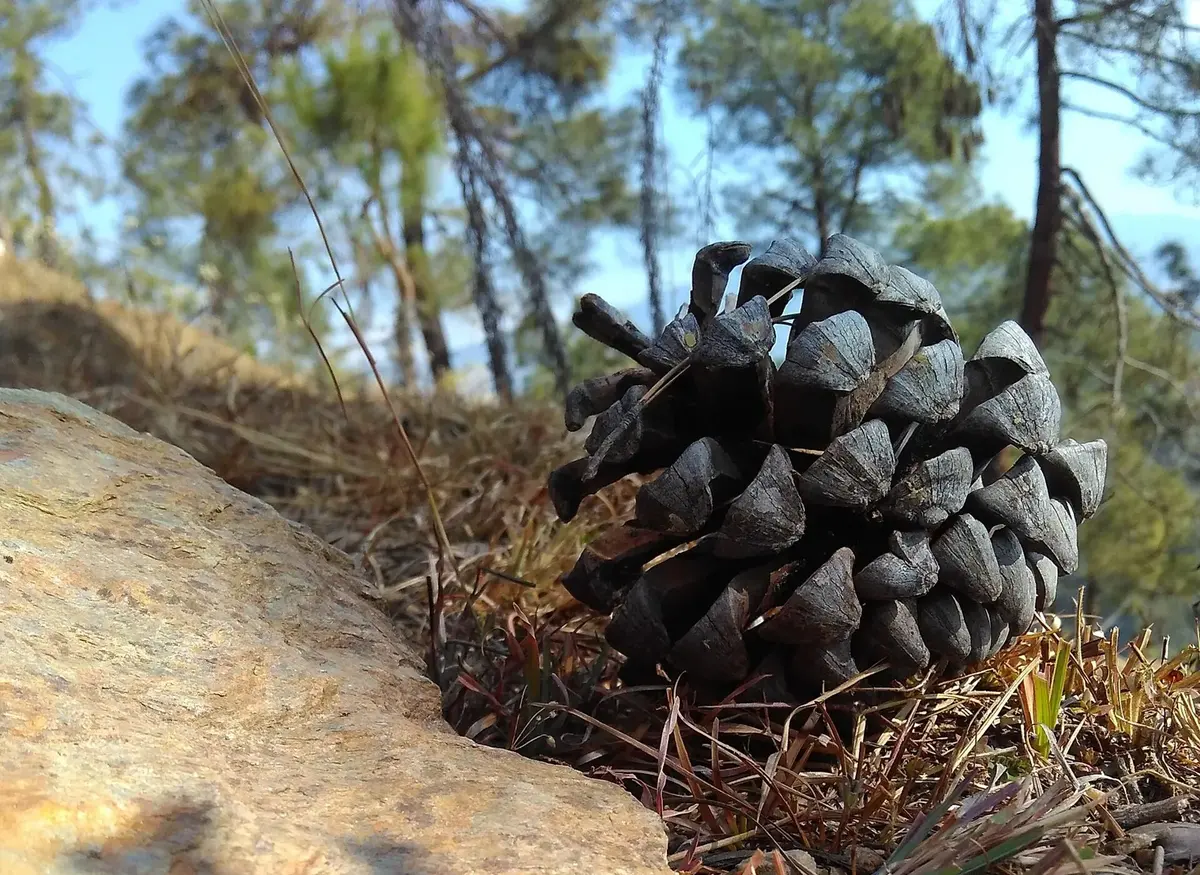
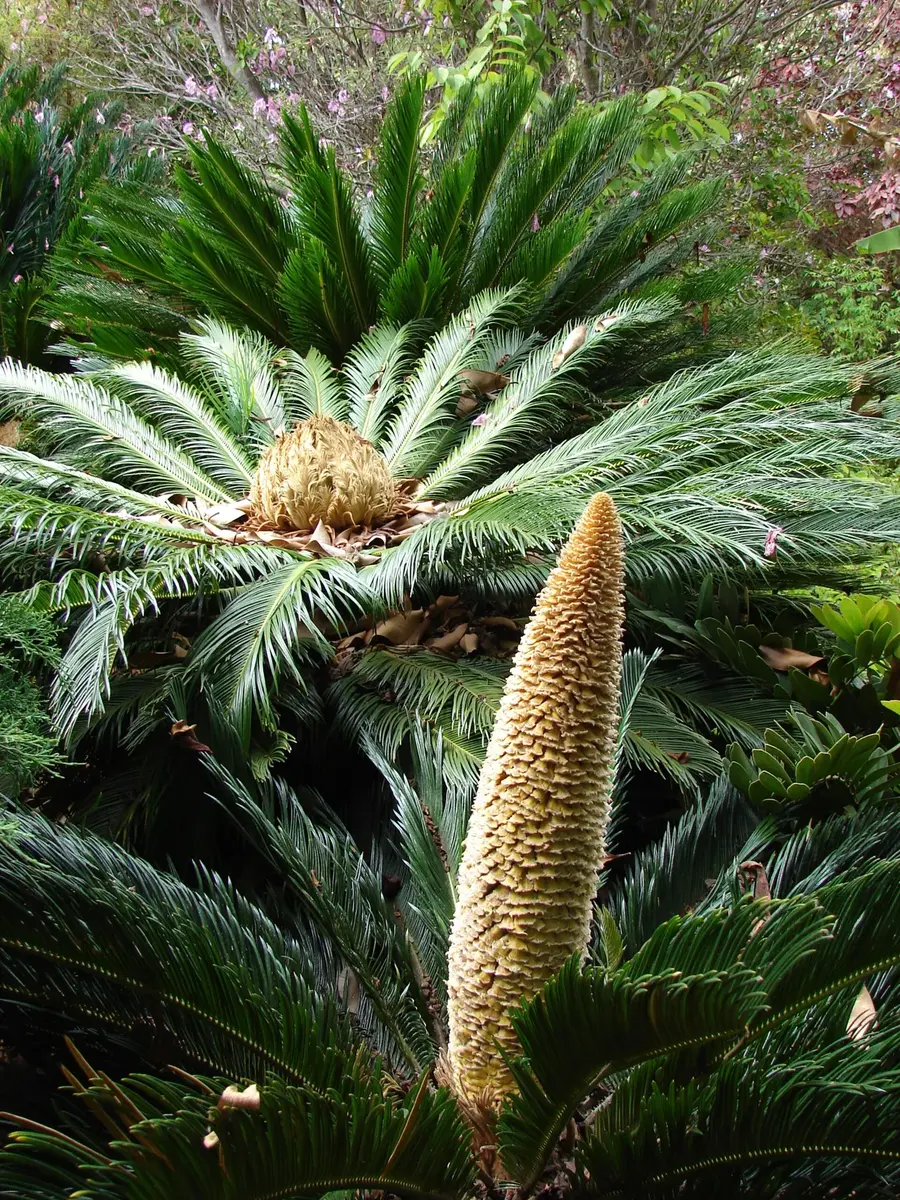
Why is Cycas placed among the gymnosperms?
Pick an answer to see why.
C. Angiosperms
Soybean, bamboo, mustard and mango are true flowering plants. Their seeds develop inside the ovary of the flower, and the ovary ripens into a fruit with the seeds shut inside. Angiosperm means seed in a container (Greek angeion = vessel).
Characteristics of angiosperms
- a.They are the most advanced plants of kingdom Plantae.
- b.They are found everywhere, on land and in water.
- c.They have a well-developed root, stem, leaf, flower and fruit.
- d.They bear true flowers, and the flower has an ovary with ovules inside it. (Each ovule becomes a seed; the ovary becomes the fruit.)
- e.Some have bisexual flowers, with male and female parts in the same flower (mustard, pea); some are unisexual, with separate male and female flowers (maize, pumpkin).
- f.Pollination happens through many carriers: wind, water, insects and other animals.
- g.Their seeds are enclosed inside the fruit.
Examples: orange, maize, banana, paddy, soybean, and water plants such as water hyacinth, Lemna (duckweed) and Pistia (water lettuce).
Angiosperms are divided into two classes by the number of cotyledons (seed leaves, the first leaves of the baby plant, which often hold its food store) in their seeds: monocotyledons (one) and dicotyledons (two).
a. Monocotyledons
Paddy, barley, banana and maize have long, narrow leaves whose veins run parallel. Their roots are all alike and grow from the same place, the base of the stem. These plants are monocotyledons (monocots).
Characteristics of monocotyledons
- a.Their leaves have parallel venation.
- b.They have fibrous roots.
- c.The nodes (joints) of the stem are clear and at regular distances; branches and leaves grow from the nodes. The leaf base widens into a sheath that wraps round the stem. The stems of bamboo, wheat, paddy and most grasses are hollow between the nodes; maize and sugarcane have solid stems, and the banana’s “stem” is rolled leaf sheaths.
- d.The vascular bundles (xylem and phloem) are scattered all through the stem.
- e.The parts of the flower are in threes or multiples of three (3 or 6 petals, 3 or 6 stamens).
- f.The seeds are enclosed in a fruit and have only one cotyledon.
- g.They are found on land and in water.
Examples: wheat, maize, paddy, sugarcane, banana, barley, bamboo, onion, orchids.
b. Dicotyledons
Mustard, pea, orange, soybean and bean have broad, flat leaves with a midrib from which veins and smaller veinlets branch into a network over the whole leaf. They have a strong main root with small branch roots. Their seeds have two cotyledons. They are dicotyledons (dicots).
Characteristics of dicotyledons
- a.They range from small herbs (gram, mustard) and shrubs to very large trees (mango, peepal).
- b.They have a taproot system.
- c.The stem is solid, strong and, in trees and shrubs, woody. The nodes are at unequal distances.
- d.The vascular bundles are arranged in a ring in the stem.
- e.The leaves have reticulate (net) venation. A leaf usually has a stalk (a petiole), and is either simple (one blade) or compound (divided into leaflets).
- f.The parts of the flower are in fours or fives, or multiples of these.
- g.The seeds are enclosed in a fruit and have two cotyledons.
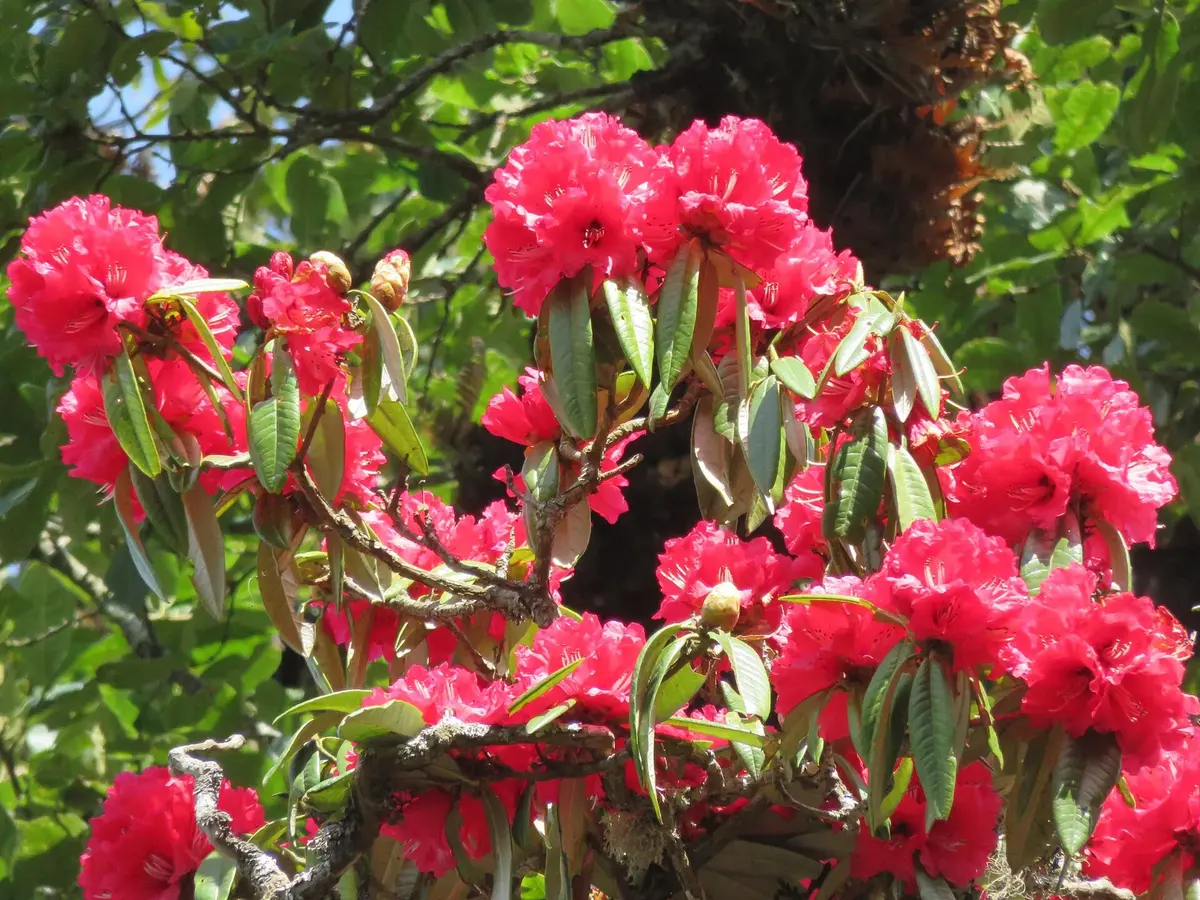
Examples: soybean, mustard, pea, orange, mango, gram, beans, pumpkin, rhododendron, peepal.
Maize grain: traced from Sarah Greenwood, CC BY-SA 4.0 (this drawing CC BY-SA 4.0 too)
Chickpea seed: after P. Taubert (1894) and Pearson Scott Foresman, public domain
Bamboo leaf: traced from W. H. Fitch's plate of Dendrocalamus strictus (public domain)
Peepal leaf: traced from a nature print of 1858 (public domain)
Onion: O. W. Thomé, Flora von Deutschland (1885), public domain
Mustard root: C. A. M. Lindman, Billeder af Nordens Flora (1901), public domain
Trillium: traced from a photo by Cbaile19 (CC0)
Wild rose: petal and sepal traced from O. W. Thomé, Flora von Deutschland, 1885 (public domain)
| Monocot | Dicot | |
|---|---|---|
| cotyledons | one | two |
| leaf veins | parallel | a net (reticulate) |
| root | fibrous | taproot |
| bundles in stem | scattered | in a ring |
| flower parts | in threes | in fours or fives |
| examples | maize, rice, wheat, banana | gram, pea, mustard, mango |
You find a plant with long leaves and parallel veins, and a bunch of thin roots all alike. Which class is it most likely in?
Pick an answer to see why.
Draw it: A maize plant, A gram (chickpea) plant
2.2 Kingdom Animalia
A sponge, an earthworm, a cockroach, a starfish, a fish, a pigeon and a cow: what do they have in common?
- Their bodies are made of many eukaryotic cells, and the cells have no cell wall.
- They have no chlorophyll: they are heterotrophs, which must eat other living things.
So all of them belong to kingdom Animalia. Inside it, they are wildly different. A sponge, an earthworm, a cockroach and a starfish have no backbone: they are invertebrates. A fish, a pigeon and a cow have a backbone (vertebral column): they are vertebrates. Some animals have a skeleton inside (an endoskeleton, like ours); some are covered by a hard exoskeleton outside (a cockroach, a crab). Some have very simple bodies, and some have every organ system.
In the five-kingdom system, the invertebrates are sorted into eight phyla: Porifera, Coelenterata, Platyhelminthes, Nemathelminthes, Annelida, Arthropoda, Mollusca and Echinodermata. Animals that have a notochord (and, in most, a backbone) form the ninth phylum, Chordata. So kingdom Animalia has nine phyla in all.
Words to know before we start
The phyla are told apart by a few features of the body plan. You will meet these words again and again.
Symmetry. Can the body be cut into two matching halves?
- Radial symmetry: like a cake or a wheel, the body can be cut into equal halves along many lines through the middle (jellyfish, adult starfish). These animals usually drift or stay fixed, and meet the world from every side.
- Bilateral symmetry: only one cut, down the middle from head to tail, gives two mirror halves, left and right (a butterfly, a worm, you). These animals move head first.
- Asymmetry: no cut gives equal halves (most sponges, a snail with its coiled shell).
Starfish and sponge: Pearson Scott Foresman, public domain, via Wikimedia Commons
Germ layers. Very early, an animal embryo forms layers of cells, and every organ grows from one of these layers. Diploblastic animals have two layers (an outer ectoderm and an inner endoderm). Triploblastic animals have a third layer between them, the mesoderm, from which muscles, blood and many organs grow. A third layer is what makes complex organs possible.
A few more words:
- Hermaphrodite (bisexual): one animal has both male and female organs. Unisexual: each animal is either male or female.
- Regeneration: growing back a lost part, or a whole new body from a piece.
- Parasite: lives on or in another living thing (the host) and feeds on it. Free-living: not a parasite. An ectoparasite lives on the outside of the host (a leech), an endoparasite inside (a tapeworm).
A starfish can be cut into equal halves along five different lines through its center. Its symmetry is:
Pick an answer to see why.
Porifera
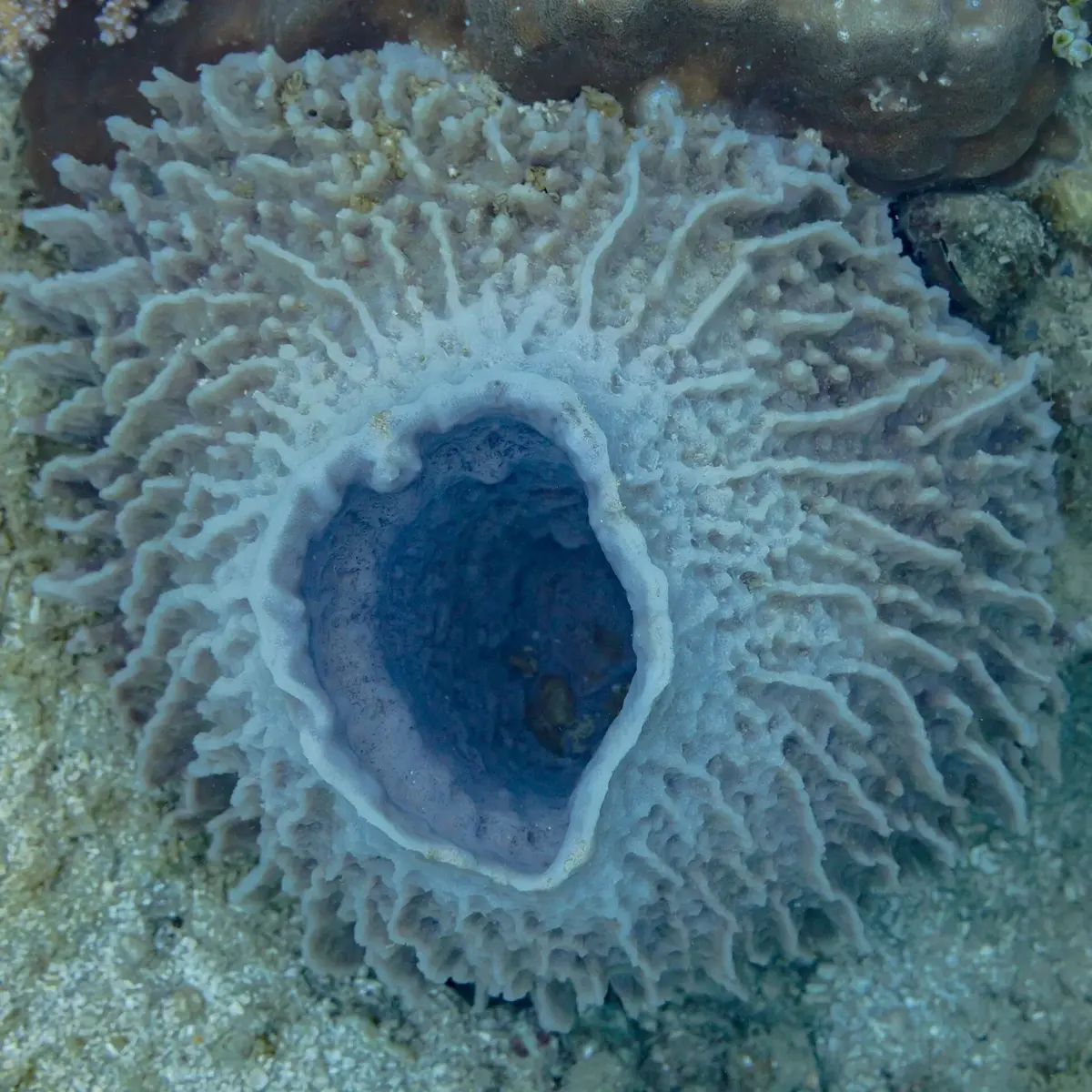
Spongilla, Sycon and Euspongia are many-celled animals that spend their adult lives fixed to a rock or a stick (the substratum), and whose bodies are full of pores. Water flows in through the pores and out of a big opening at the top. These animals are the poriferans (porus = pore, ferre = to bear), or sponges. Most live in the sea; a few, like Spongilla, live in fresh water.
Characteristics of Porifera
- a.They are the simplest multicellular animals.
- b.Their cells don’t form true tissues: each cell works more or less on its own.
- c.Their body is built from two layers of cells, so they are called diploblastic.
- d.Their body has many pores. The large opening is the osculum; the small pores are the ostia (singular: ostium). Water enters through the ostia and leaves through the osculum. This system of water channels is the canal system, and it brings them food and oxygen and carries away waste.
- e.They respire through the general body surface: every cell takes oxygen from the water flowing past.
- f.The adults are fixed to the substratum and cannot move.
- g.They have a high power of regeneration: if the body breaks into pieces, each piece can grow into a new sponge.
- h.They reproduce asexually (by budding and regeneration) and sexually (by gametes).
- i.Most are asymmetrical; a few are radially symmetrical.
Examples: Sycon, Spongilla (a freshwater sponge), bath sponge (Euspongia), Leucosolenia, Hyalonema, Cliona.
Sponge: Encyclopaedia Britannica (1911), after Haeckel, public domain, via Wikimedia Commons
Coelenterata
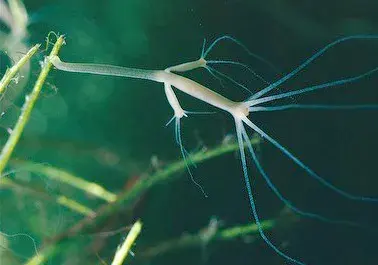
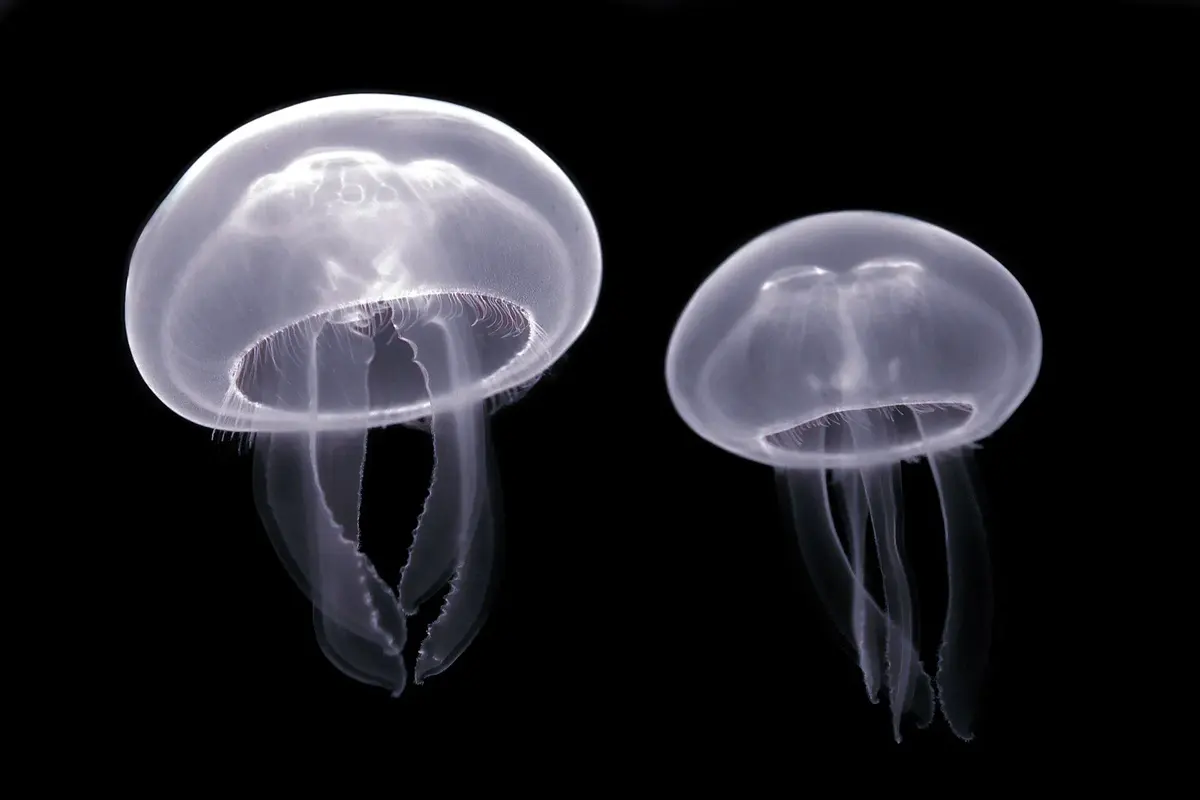
Hydra, jellyfish and coral have long, thin tentacles around the mouth that catch food and help them move. Inside, the body is a hollow sac, the coelenteron (koilos = hollow, enteron = gut). These animals belong to the phylum Coelenterata (also called Cnidaria, from the Greek for “nettle”, because they sting).
Characteristics of Coelenterata
- a.They are multicellular and diploblastic.
- b.They are the first animals with tissues. Inside the body is a hollow cavity, the coelenteron. It is also called the gastrovascular cavity, because it does two jobs: it digests food (gastro) and carries it around the body (vascular).
- c.The gut has a single opening, the mouth, which is surrounded by tentacles. Food goes in and waste comes out through the same opening. The tentacles catch food and help the animal move. They carry stinging cells, the nematocysts (or cnidocytes), which shoot out tiny poisoned threads to stun or kill prey.
- d.They respire through the general body surface.
- e.They reproduce sexually and asexually (by budding and regeneration).
- f.They live in ponds and lakes (Hydra) and, most of them, in the sea.
- g.Their bodies show radial symmetry.
Examples: Hydra, jellyfish (Aurelia), coral, sea anemone, Portuguese man-of-war.
Tetsuo Kon, CC0, via PhyloPic
Stinging cells: after A. N. and D. McAlpine, Biological Atlas, Plate X, public domain, via Wikimedia Commons
Why is the cavity inside a Hydra called a gastrovascular cavity?
Pick an answer to see why.
Platyhelminthes
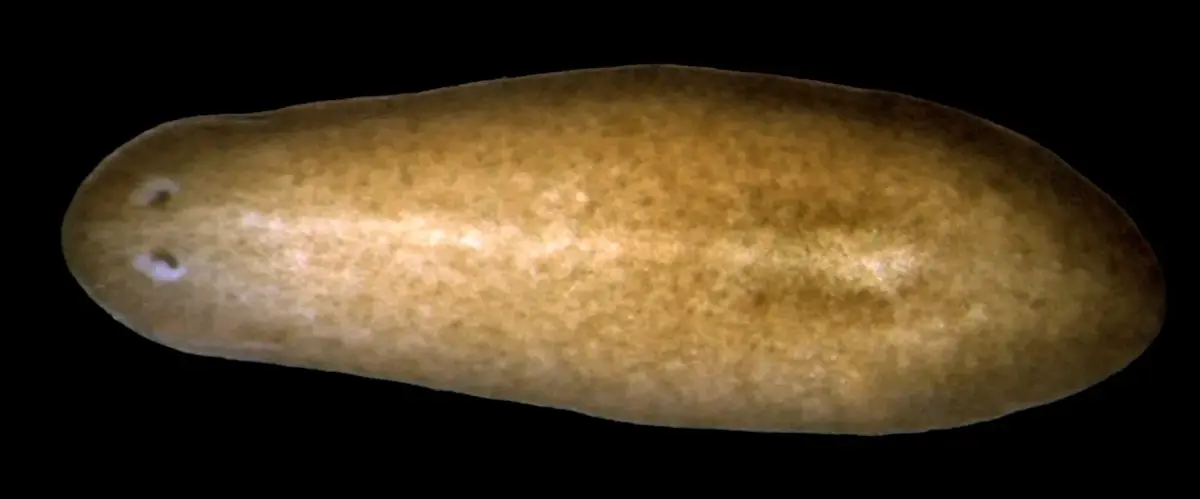
Tapeworms, liver flukes and blood flukes have bodies flat like a ribbon or a leaf. Most of them are parasites that live inside other animals. They belong to the phylum Platyhelminthes (platy = flat, helminthes = worms): the flatworms.
Characteristics of Platyhelminthes
- a.Their body is flat, shaped like a leaf or a long ribbon: they are flatworms.
- b.They develop from three germ layers: they are triploblastic. (They are also bilaterally symmetrical, with a head end.)
- c.A liver fluke’s mouth is at the front, on the underside, and there is no anus: undigested food goes out through the mouth.
- d.Suckers (and, in tapeworms, hooks) on the head attach them to the host, and a fluke’s sucker around its mouth helps it suck in blood and food.
- e.Their organ systems are not well developed: they have simple organs, and no circulatory, respiratory or skeletal system (only their reproductive organs are large and complex).
- f.The space between the body wall and the organs is filled with a soft tissue, the parenchyma, which helps carry substances around.
- g.There is no circulatory system.
- h.They respire through the body surface.
- i.They are hermaphrodite (bisexual): each has male and female organs. Fertilization is internal.
- j.They reproduce sexually and asexually (by fragmentation and regeneration).
- k.Most are parasites; a few, like Planaria, are free-living.
Examples: liver fluke (Fasciola), tapeworm (Taenia), blood fluke (Schistosoma), Diplozoon, Otoplana, Planaria.
Nemathelminthes
Have you ever been given a tablet at school “for worms”? It is for worms like these. Ascaris (the roundworm), hookworms and pinworms have long, round, worm-like bodies pointed at both ends. Most are parasites of humans and other animals. They belong to the phylum Nemathelminthes (nema = thread), the roundworms. (Their modern name is Nematoda.)
Characteristics of Nemathelminthes
- a.Their body is long and cylindrical, with tapering (pointed) ends, and is not segmented.
- b.They are bilaterally symmetrical.
- c.They are triploblastic.
- d.They have a complete digestive system, a tube with a mouth at one end and an anus at the other.
- e.They have no respiratory or circulatory system.
- f.They respire through the general body surface.
- g.They are unisexual: separate males and females.
- h.They reproduce sexually only; fertilization is internal.
- i.Most are parasites, which cause disease in their hosts; a few are free-living in soil and water.
Examples: Ascaris (roundworm), hookworm, pinworm, filarial worm.
What makes a roundworm more advanced than a flatworm?
Pick an answer to see why.
Annelida
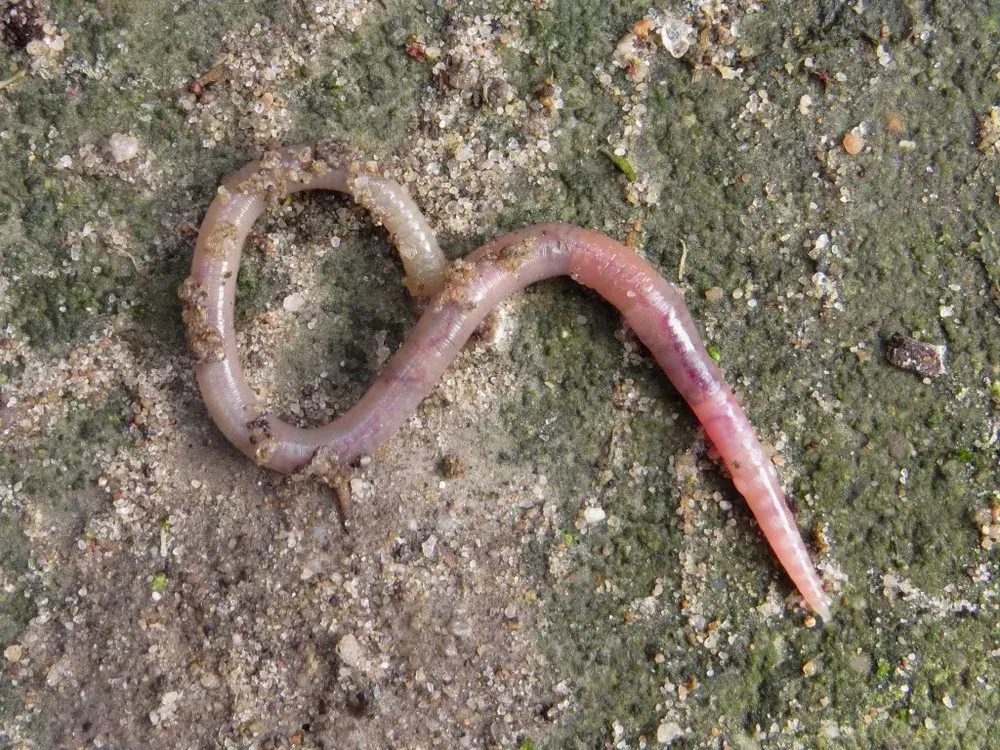
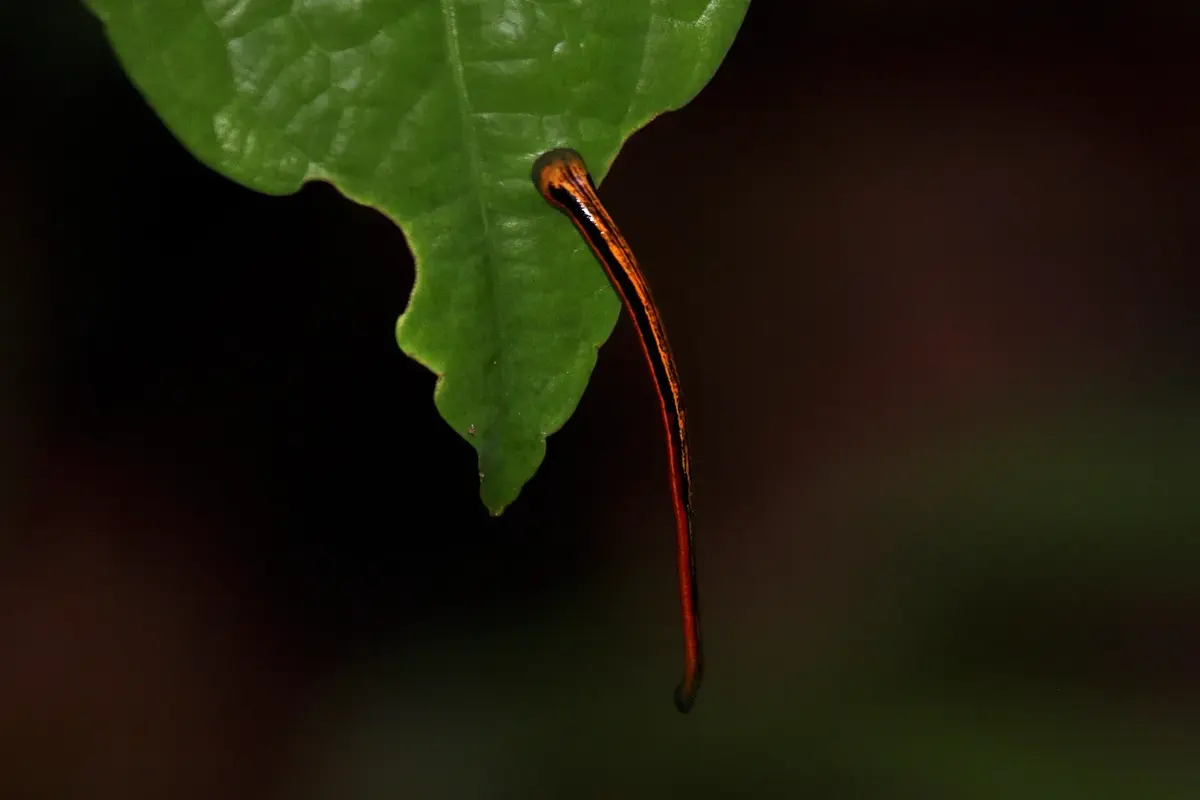
Earthworms, leeches and Nereis live in moist soil, swamps and the sea. Their bodies are long, round and divided into ring-like segments, one after another, both outside and inside (this is called metameric segmentation). The earthworm is free-living in moist soil. Leeches live in swamps and wet forests and are ectoparasites that suck the blood of vertebrates. They all belong to the phylum Annelida (annulus = little ring).
Characteristics of Annelida
- a.The body is long, cylindrical and segmented, outside and inside.
- b.They are bilaterally symmetrical and triploblastic.
- c.They have a moist skin.
- d.They respire through the skin (the outer body surface): oxygen dissolves in the moisture on the skin and passes into the blood.
- e.Excretion is by tiny coiled tubes called nephridia, found in almost every segment.
- f.The circulatory system is well developed, and closed. Their blood has hemoglobin, so it is red like ours.
- g.The nervous system is a nerve ring round the gut near the head and a nerve cord along the underside, with nerves branching from it.
- h.The digestive system is well developed, from mouth to anus.
- i.Some are hermaphrodite (earthworm, leech); some are unisexual (Nereis).
- j.They have a high power of regeneration.
- k.They live in moist soil and fresh water, and in the sea; some are ectoparasites.
Examples: earthworm (Pheretima), leech (Hirudinaria), Nereis (a sea worm).
Planarian and roundworm: PhyloPic (CC0); earthworm: Pearson Scott Foresman, public domain
Earthworm section: traced from the British Museum (public domain)
Roundworm section: traced from FishtailBob, CC BY 4.0, via Wikimedia Commons
How does an earthworm breathe?
Pick an answer to see why.
Arthropoda
Butterflies fly from flower to flower on their wings, a centipede runs on dozens of legs, prawns and crabs live in water. Different as they are, they all have jointed legs, and so they all belong to the phylum Arthropoda (arthron = joint, pous = foot). This is the largest phylum of the animal kingdom: more than a million species have been named, more than 3 out of every 4 known kinds of animals.
Characteristics of Arthropoda
- a.The body is covered by a hard outer skeleton, the exoskeleton, made of chitin.
- b.The body is bilaterally symmetrical, triploblastic and segmented.
- c.In insects, the body is divided into head, thorax and abdomen. In some, like spiders, crabs and prawns, the head and thorax are joined into a cephalothorax. The head carries a pair of compound eyes, a pair (or two) of antennae, and mouthparts.
- d.The legs are jointed. In insects, three pairs of legs grow from the thorax.
- e.Most insects have two pairs of wings on the thorax; some (houseflies, mosquitoes) have one pair, and some (ants, lice) have none.
- f.Males and females are separate, and they reproduce sexually.
- g.They breathe through the body surface, through gills (crabs, prawns), or through tracheae, air tubes that open through holes along the sides of the body (insects, centipedes).
- h.They live in every kind of habitat: air, water and land.
Examples: butterfly, honey bee, housefly, mosquito, cockroach, centipede, millipede, crab, spider, prawn, scorpion.
Bee and spider: Pearson Scott Foresman, public domain, via Wikimedia Commons
Mollusca
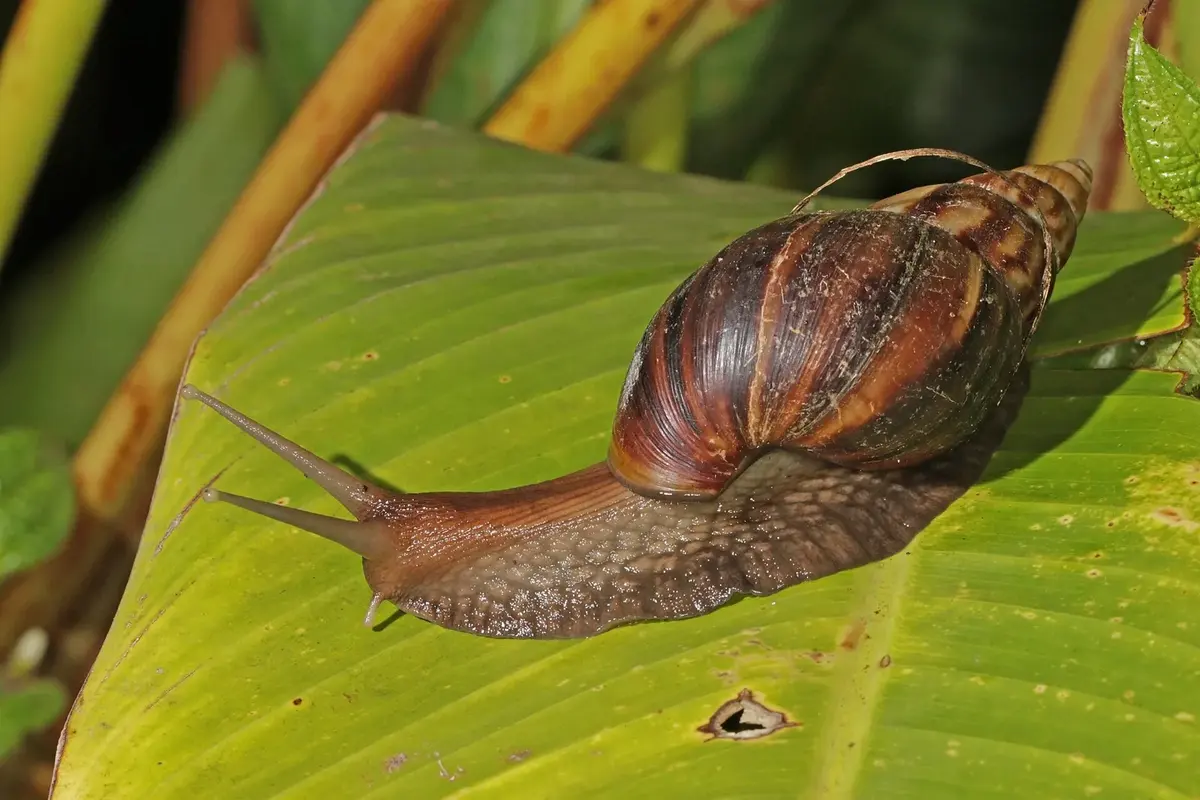
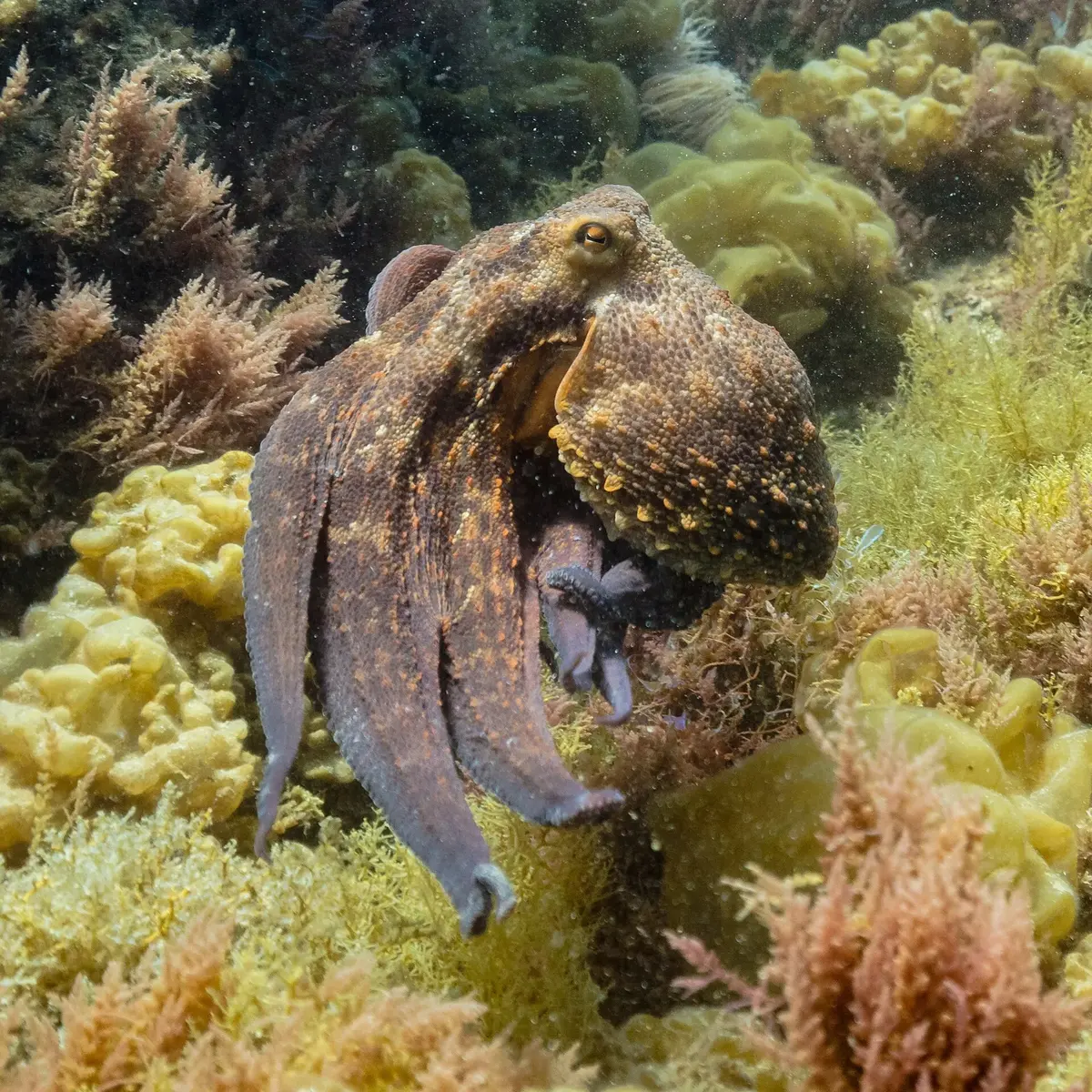
Slugs and snails glide over damp soil; octopuses and cuttlefish swim in the sea. They have soft bodies, tentacles on the head that sense touch, smell and light, and a big muscular foot for moving. They belong to the phylum Mollusca (mollis = soft). With about 85,000 species, it is the second-largest phylum.
Characteristics of Mollusca
- a.They are soft-bodied animals.
- b.The body has four parts: a head, a visceral mass (the hump holding the organs), a muscular foot, and a fold of skin over the visceral mass, the mantle.
- c.In most, the mantle makes a hard shell of calcium carbonate that covers the body. When a snail is touched, it pulls its body inside the shell.
- d.The head carries tentacles and eyes.
- e.Many, like the snail, are asymmetrical: the body is coiled with its shell, and cannot be cut into equal halves.
- f.The muscular foot is used for gliding (snails, slugs) or swimming (octopus, cuttlefish, whose foot has become arms).
- g.They respire through the body surface, gills, or a lung-like pulmonary sac (land snails).
- h.Their digestive, circulatory and nervous systems are well developed.
- i.Most are unisexual; a few (land snails, slugs) are hermaphrodite.
- j.They live on land and in water.
Examples: slug, snail (Pila), octopus, cuttlefish (Sepia), squid, freshwater mussel (Unio), oyster.
Snail: Pearson Scott Foresman, Public domain, via Wikimedia Commons
Echinodermata
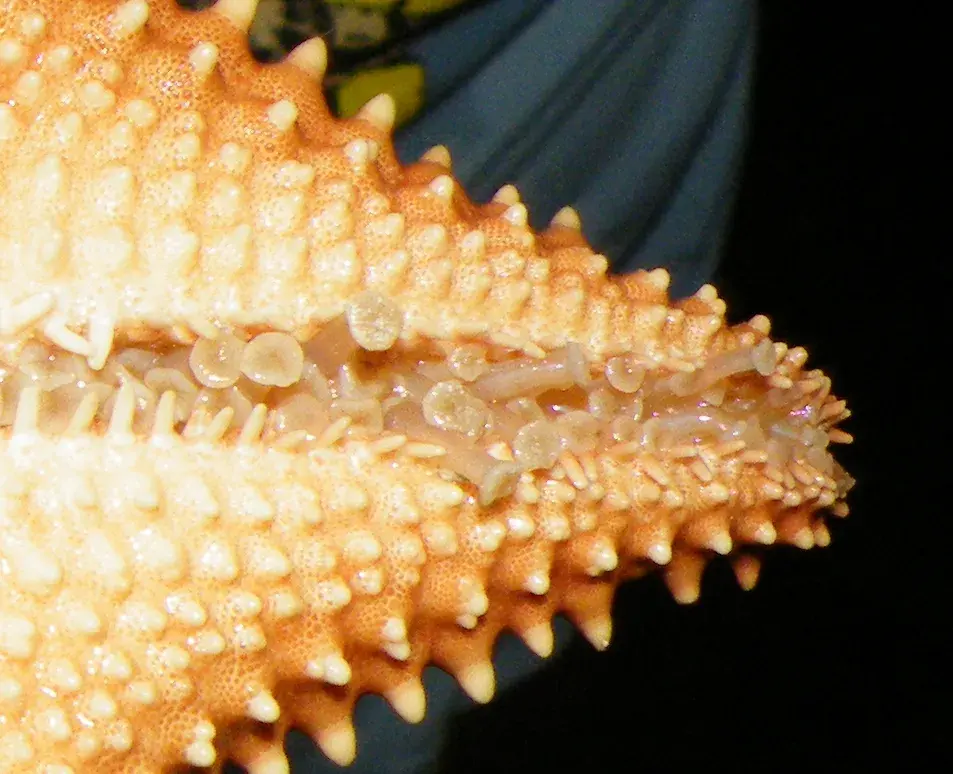
Starfish, sea cucumbers and sea urchins live only in the sea. Their skin is spiny, and they belong to the phylum Echinodermata (echinos = hedgehog, derma = skin).
Characteristics of Echinodermata
- a.The body is covered by hard, calcareous (made of calcium carbonate) plates and spines.
- b.They come in many shapes: star-like, globular (round), long like a cucumber.
- c.They have no distinct head.
- d.They are triploblastic, and the adults are radially symmetrical (usually in five parts).
- e.They move with tube feet: hundreds of tiny tubes filled with water, each with a sucker at the tip, worked by a system of water canals inside the body.
- f.The digestive system is well developed.
- g.They respire through gills: tiny skin gills between the spines, and their tube feet.
- h.They are unisexual, and reproduce sexually.
- i.Regeneration is common: a starfish can regrow a lost arm.
- j.All of them live in the sea. None live in fresh water or on land.
Examples: starfish, sea urchin, sea cucumber, brittle star, sea lily.
A starfish and a fish both live in the sea. Which is the most important difference that puts them in different phyla?
Pick an answer to see why.
Draw it: An earthworm
Phylum Chordata
This phylum has the most advanced animals in the kingdom, including you. All animals that have a notochord belong to the phylum Chordata. A notochord is a flexible, rod-like support that runs along the back, between the nerve cord and the gut. In vertebrates, it is there only in the embryo, and is replaced by the backbone as the embryo grows.
Characteristics of Chordata
- a.They have a flexible, elastic, rod-like notochord between the nerve cord and the alimentary canal, at some stage of life.
- b.Pairs of gill slits open on both sides of the pharynx (the throat), at least in the embryo.
- c.They have a hollow, tube-like nerve cord along the back (in vertebrates, it is the spinal cord, inside the backbone).
- d.The skeleton is inside the body (an endoskeleton) and is covered by muscles.
- e.They have a closed circulatory system: the blood stays inside vessels.
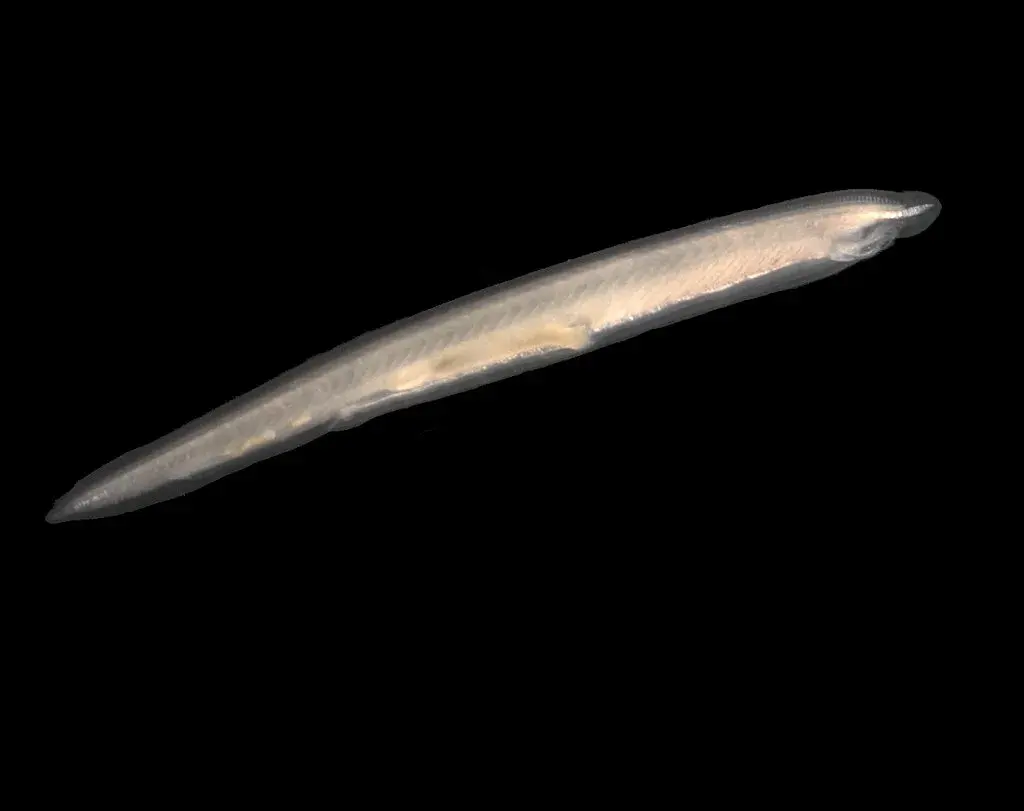
Lancelet: Gervais and Boulart, public domain, via Wikimedia Commons
Phylum Chordata has four subphyla: Hemichordata, Urochordata, Cephalochordata and Vertebrata. The first three together are called Protochordata (proto = first), because their animals are simpler and more primitive than the vertebrates: they have no backbone, no head with a skull, and they all live in the sea. Acorn worms (Hemichordata), sea squirts (Urochordata) and the lancelet (Cephalochordata) are protochordates. In this unit we study only the vertebrates.
Subphylum Vertebrata
A fish, a snake, a pigeon and a tiger all have a backbone (vertebral column): a column of small bones, the vertebrae, that protects the spinal cord. Animals with a backbone are vertebrates. The notochord of the embryo is replaced by the vertebral column. Fish, frogs, snakes, pigeons, whales and bats are all vertebrates.
Characteristics of Vertebrata
- a.The body is bilaterally symmetrical.
- b.They breathe through gills, moist skin or lungs.
- c.In some animals the body temperature changes with the surroundings: on a cold morning the animal is cold and slow, in the sun it warms up. These are poikilothermic or cold-blooded animals (fish, frogs, reptiles).
- d.In other animals the body temperature stays the same whatever the surroundings: about 37 °C in humans, about 40 °C in many birds, in the snow or in the Tarai’s summer. These are homeothermic or warm-blooded animals (birds and mammals). They make heat from food and lose it when needed (by sweating, panting); fur, fat and feathers keep the heat in.
- e.They have a well-developed circulatory system with a heart of two to four chambers.
- f.Some lay eggs, from which the young hatch: they are oviparous (ovum = egg). Others give birth to live young: they are viviparous (vivus = alive).
By their body structure and development, vertebrates are divided into five classes: Pisces, Amphibia, Reptilia, Aves and Mammalia.
Pisces (fish)
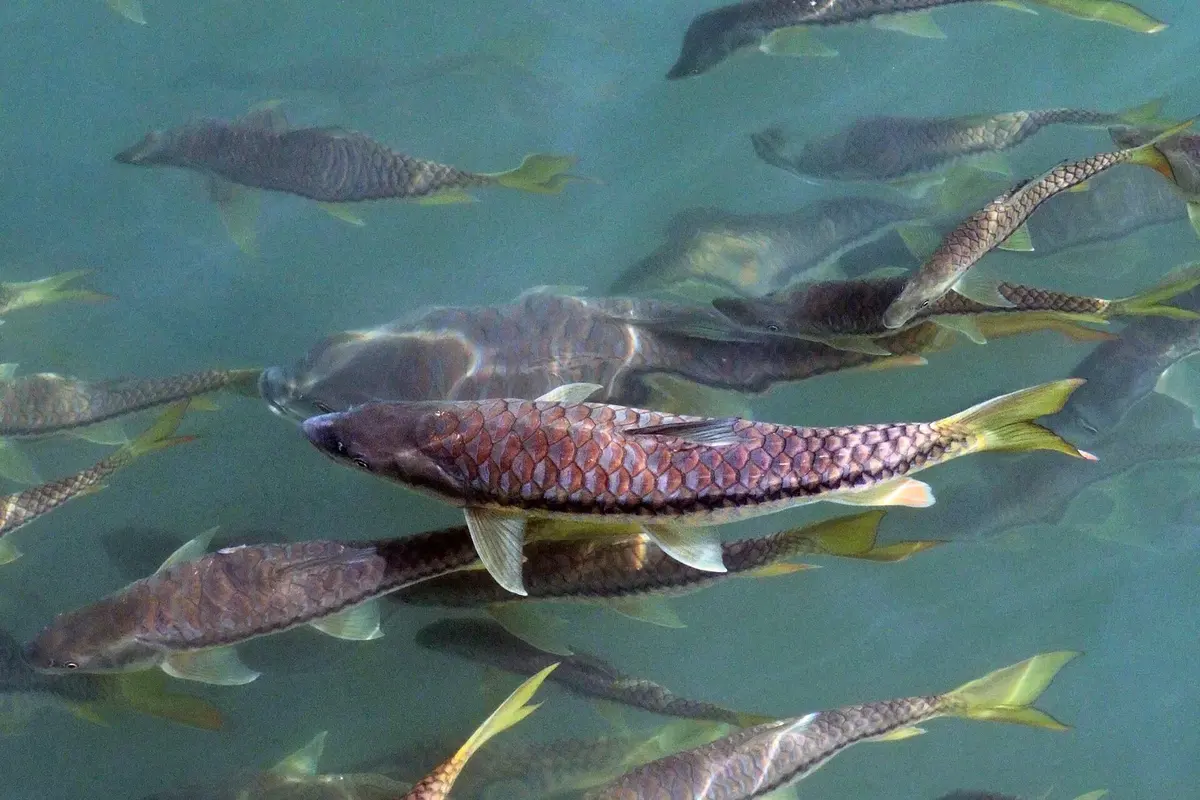
Carp: DBCLS (CC BY 4.0)
The seahorse, the shark and the ordinary fish belong to the class Pisces. Their characteristics:
- a.The body is long, often flattened from side to side, and streamlined for moving through water. It is covered by scales.
- b.The body is divided into head, trunk and tail. There is no neck.
- c.Gills on the sides of the head take oxygen from the water.
- d.They swim with paired and unpaired fins.
- e.Most have an air sac (the swim bladder), a balloon of gas that lets them float at any depth without effort.
- f.The heart has two chambers.
- g.They are poikilothermic.
- h.They are unisexual.
- i.Most are oviparous; a few, like some sharks, are viviparous.
- j.Most have external fertilization: the female releases eggs and the male his sperm into the water. A few, like sharks, have internal fertilization.
- k.They live in water.
Examples: rohu, mahseer, catfish, eel, seahorse, shark.
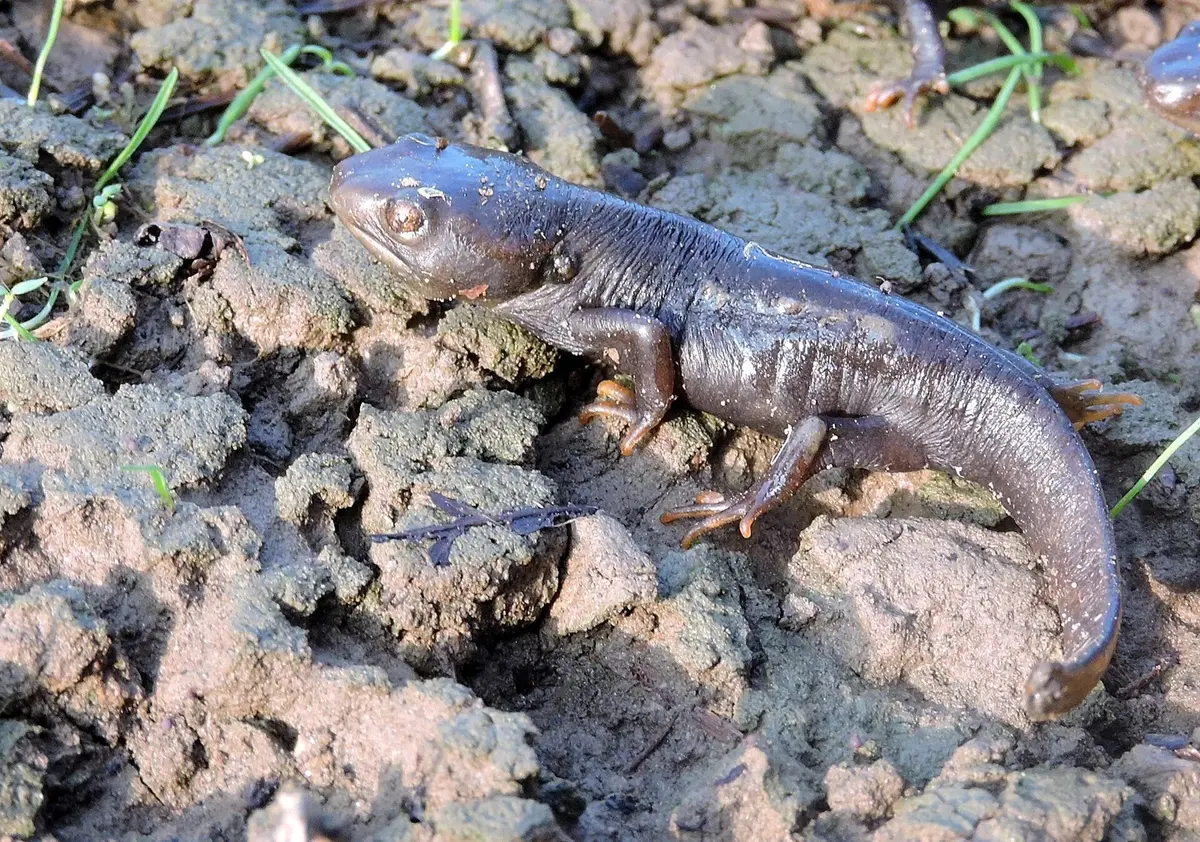
Amphibia
Toads, salamanders and frogs live both on land and in water. They belong to the class Amphibia (amphi = both, bios = life: “a double life”).
- a.The body is covered by a moist skin, without scales.
- b.The body is divided into head and trunk; some (salamanders, newts) also have a tail.
- c.They have two pairs of limbs.
- d.They are poikilothermic.
- e.The young are tadpoles, which live in water and breathe with gills. The adults breathe with lungs and their moist skin.
- f.The heart has three chambers: two atria and one ventricle.
- g.They are unisexual.
- h.They are oviparous and lay their eggs in water. In frogs and toads, fertilization is external. (Most salamanders fertilize the eggs inside the female.)
- i.They need water to reproduce.
Examples: frog, toad, salamander, Himalayan newt.
Frog stages: LadyofHats (CC0)
Reptilia
Snakes, lizards, crocodiles and tortoises crawl on the ground (Latin reptare = to creep). They belong to the class Reptilia.
- a.The body is covered with dry, horny scales.
- b.The body is divided into head, neck, trunk and tail.
- c.They have two pairs of limbs for crawling (snakes have lost theirs).
- d.They are poikilothermic.
- e.They breathe with lungs, at every age.
- f.The heart has three chambers, but the ventricle is partly divided; crocodiles have a four-chambered heart.
- g.They are unisexual. Fertilization is internal, and most are oviparous: they lay eggs with a tough, leathery or hard shell, on land.
- h.Most live on land; some live both on land and in water, and the water-dwelling ones come up to the surface to breathe.
Examples: snake, garden lizard, wall lizard (house gecko), crocodile, gharial, tortoise, turtle.
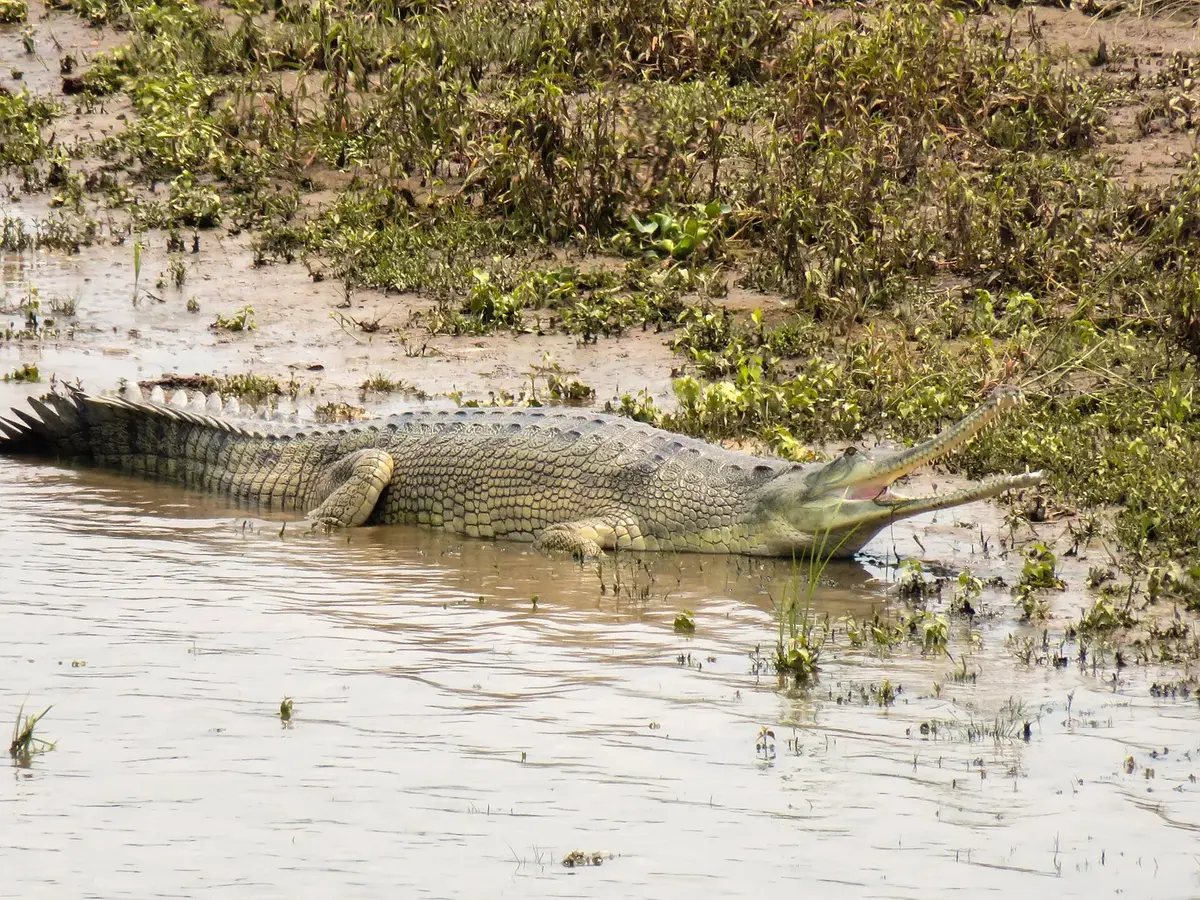
A crocodile has a four-chambered heart, like a bird or a mammal. Why is it still a reptile?
Pick an answer to see why.
Aves (birds)
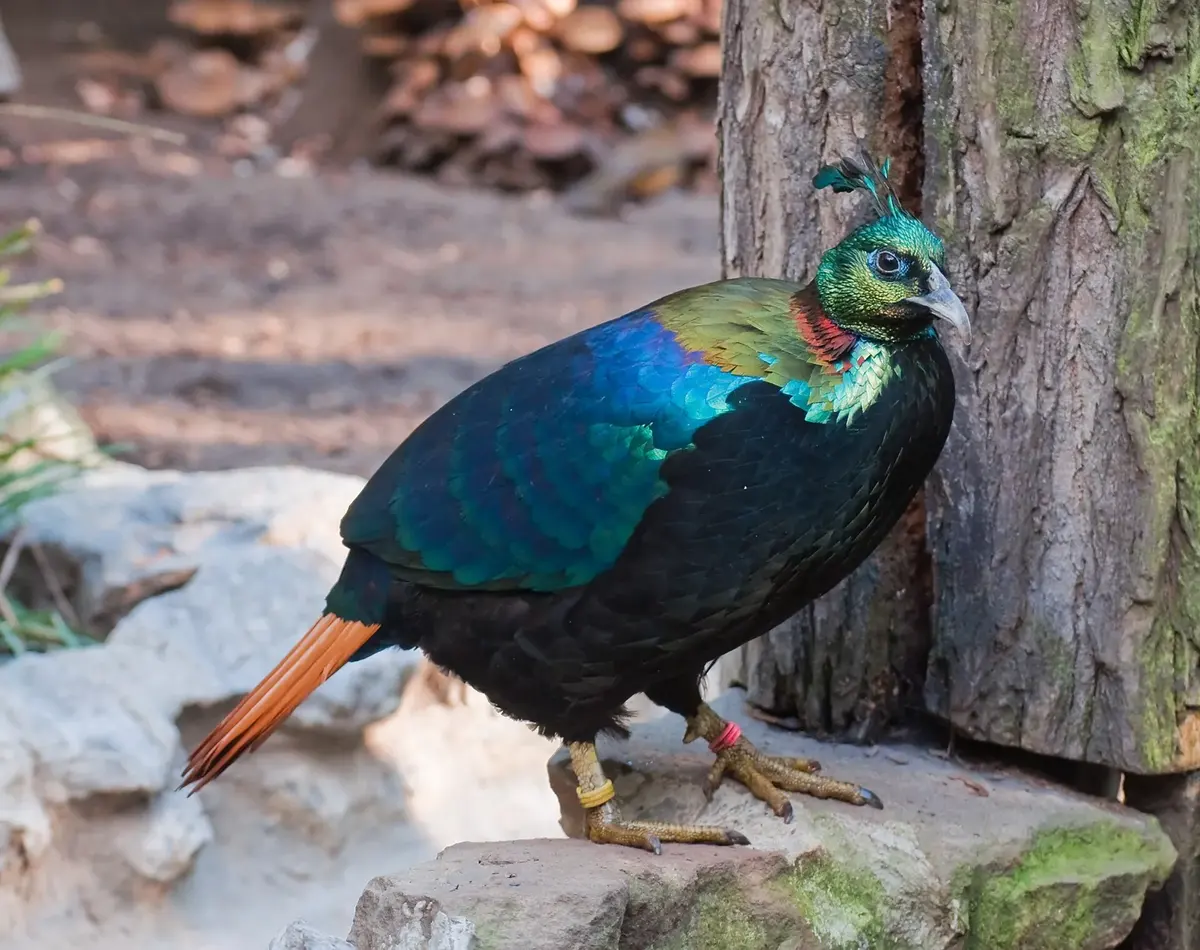
In the parrot, the Himalayan monal (danphe), the peacock, the duck and the hen, the front limbs have become wings. They have a beak, and the body is covered in feathers. They belong to the class Aves (Latin avis = bird).
- a.The body is covered with feathers.
- b.The body is divided into head, neck, trunk and tail.
- c.They have two pairs of limbs: the forelimbs are wings, and the hind limbs are for walking, perching or swimming.
- d.Their bones are hollow and filled with air (pneumatic bones), which makes the body light for flying.
- e.They are homeothermic.
- f.They breathe with lungs.
- g.The heart has four chambers.
- h.They are unisexual. Fertilization is internal, and they are oviparous.
- i.They have air sacs in the body, connected to the lungs, that keep fresh air flowing through the lungs, even while breathing out.
- j.They live on land, and most can fly.
Examples: parrot, Himalayan monal (danphe), peacock, duck, hen, sparrow, ostrich, penguin.
Mammalia
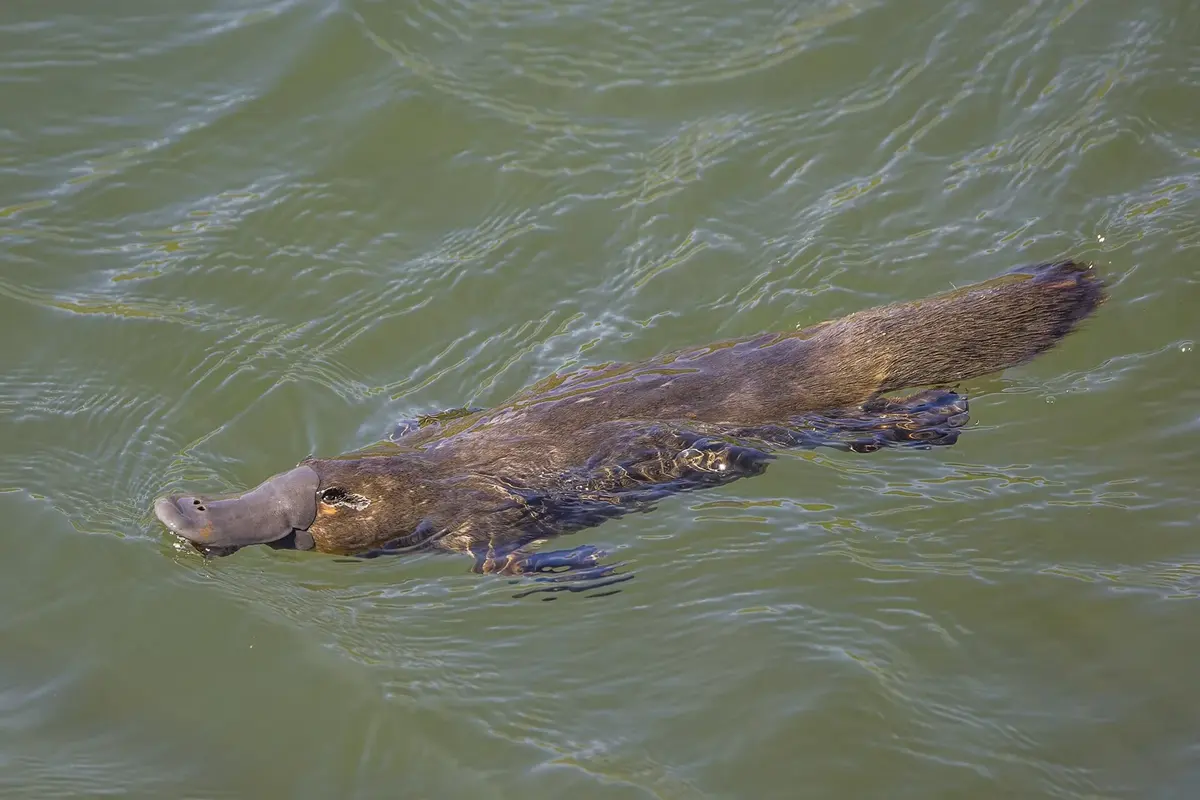
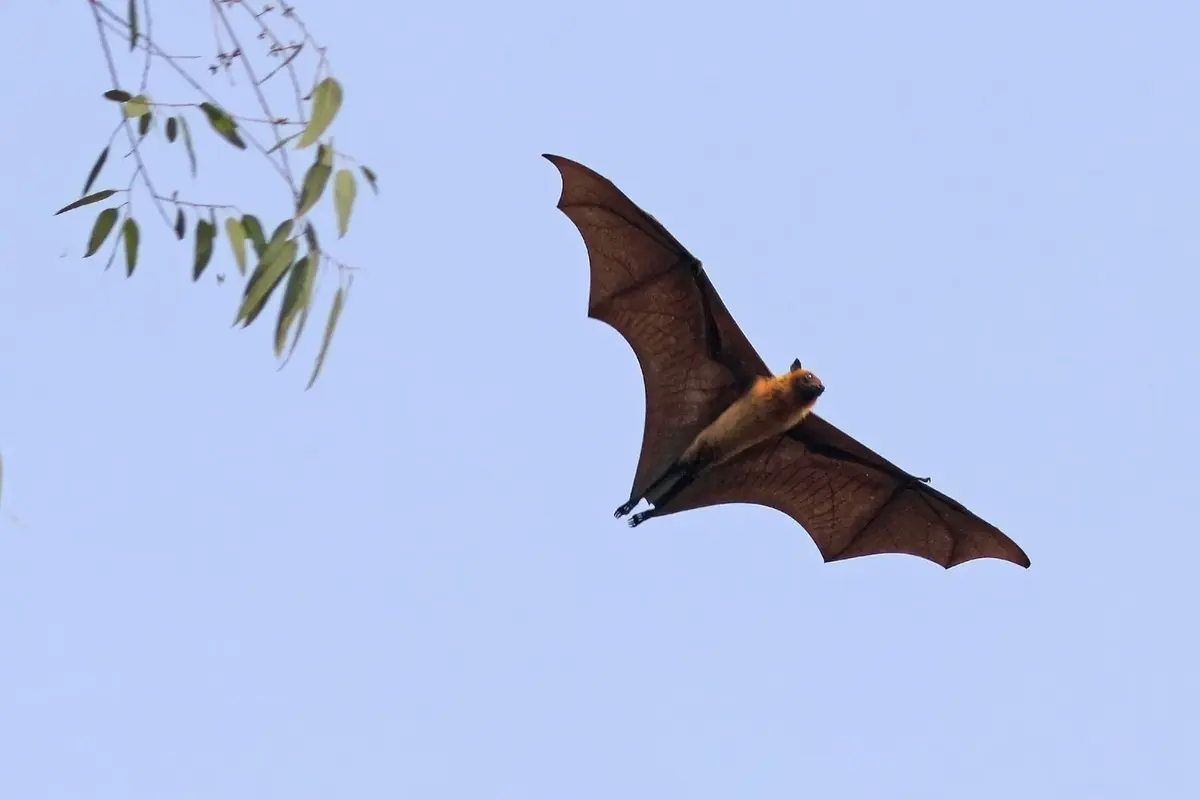
Rats, bats and lions have hair on the body, give birth to their young, and feed them milk. They belong to the class Mammalia (Latin mamma = breast).
- a.The body is covered with hair (or fur).
- b.The body is generally divided into head, neck, trunk and tail.
- c.They have mammary glands, which make milk to feed the young.
- d.They breathe with lungs.
- e.They are homeothermic.
- f.The heart has four chambers.
- g.They are unisexual. Fertilization is internal. They are viviparous.
- h.They have external ears (pinnae) and teeth of different kinds (cutting, tearing, grinding), and a muscle sheet, the diaphragm, between the chest and belly.
Examples: human, horse, cow, buffalo, tiger, one-horned rhinoceros, red panda, whale, bat, rat.
Classification and evolution
Look at the five kingdoms again and ask: which came first?
When we compare the kingdoms, some share many features and some share few. Yet every living thing shares at least one thing: its body is built from living cells, and all cells come from other cells. This tells us that all living things share a common ancestry: they are distant relatives, like the branches of one huge family tree.
The classification also tells us the order in which life appeared:
- Prokaryotes (now kingdom Monera) appeared first, at least 3.5 billion years ago. For more than a billion years they were the only life on Earth.
- Then single eukaryotic cells evolved, slowly (now kingdom Protista), roughly 2 billion years ago.
- Then, over a long time, the multicellular kingdoms: fungi, plants and animals. The first animals appeared roughly 600 million years ago.
Two subjects, one story
Classification and evolution are separate subjects of biology:
- Classification sorts living things into groups by their similarities and differences.
- Evolution is the slow change of living things over many generations, from simpler to more complex forms.
They fit together like this: animals with many features in common are placed in the same group, and they have many features in common because they evolved from a shared ancestor fairly recently. The more two groups share, the more recently their ancestors split.
Compare mammals and birds: they share quite a few features (warm blood, a four-chambered heart, lungs, internal fertilization). Compare mammals and fish: they share very few (a backbone, a heart, a skeleton inside). So mammals and birds are closer relatives, and their lines split later; the line to fish split off much earlier.
Look at the heart, too. Fish have two chambers, amphibians and most reptiles three, and birds and mammals four. This step-by-step series suggests that the more advanced animals evolved from less developed ones. It is such differences, and such series, that make classification possible.
The common features of fish, birds and mammals tell us that all three evolved from one distant ancestor, long ago; along the way, each line gained new features, and in this way new kinds of organisms were formed. Among them, birds are closer to mammals than fish are: birds and mammals split from their shared ancestor later than the fish line split off. Evolution is slow: the line leading to land animals split from the fish about 420 million years ago, and the line leading to mammals split from the line leading to reptiles and birds about 320 million years ago, a hundred million years later. In the same way, if we compare the phyla of the animal kingdom, we find similarities among all of them, which shows that all the animals have a common ancestry and developed into new forms over the course of evolution.
Based on evolution, which group of animal phyla is most closely related?
Pick an answer to see why.
Exercise
1. Choose the correct option
a. What are the main features of organisms in kingdom Plantae?
Pick an answer to see why.
b. Why is Cycas kept in the gymnosperms?
Pick an answer to see why.
c. A worm and a frog belong to the same kingdom. What is the main reason for grouping them in the same kingdom?
Pick an answer to see why.
d. Based on evolution, which of these groups of organisms are closely related?
Pick an answer to see why.
e. What is the main reason for classifying whales in the class Mammalia?
Pick an answer to see why.
f. Why are clubmosses more advanced than mosses?
Pick an answer to see why.
g. Organisms with cell walls belong to which kingdoms?
Pick an answer to see why.
h. Egg-laying animals with a four-chambered heart and a body covered with feathers belong to which class?
Pick an answer to see why.
i. Which group of plants belongs to the angiosperms?
Pick an answer to see why.
j. Plants with vascular tissue belong to which division?
Pick an answer to see why.
2. Differentiate between
Plant kingdom and animal kingdom
Answer
Fish and starfish
Answer
Jellyfish and cuttlefish
Answer
Moss and clubmoss
Answer
Pinus and peepal
Answer
Fish and whale
Answer
Dove and bat
Answer
3. Give reasons
Living beings need to be classified.
Answer
Fucus and Marchantia look alike, but Fucus is classified as an alga while Marchantia is a bryophyte.
Answer
Gymnosperms do not bear fruit.
Answer
Although a crocodile has a four-chambered heart, it belongs to the class Reptilia.
Answer
Although bats and whales are very different, they belong to the same class.
Answer
Riccia is an amphibian plant.
Answer
A fern is not a flowering plant; Cycas bears flower-like cones but no fruit; a banana bears flowers and fruit. Yet all three are kept in the same division.
Answer
4. Answer these questions
Into how many divisions are the organisms of the plant kingdom divided?
Answer
Write the main features of kingdom Plantae.
Answer
Write the similarities of plants that belong to the gymnosperms and the angiosperms.
Answer
If you were given only the leaves of some tracheophytes and asked to sort them into their subdivisions, could you do it? Give your arguments.
Answer
What are the main characteristics of the pteridophytes?
Answer
Roshni saw only the flowers of a new plant in her garden, and decided that it was a monocotyledon. Is looking only at the flowers the right way to identify a monocot? Give reasons.
Answer
Look at two plants: an orange tree with fruits, and a Cycas.
- i.Compare them, and write their similarities and differences.
- ii.Name their subdivisions, with the reason for placing them there.
- iii.Which is more advanced? Explain why.
Answer
This chart sorts animals into four groups. In which group is the fish?
| terrestrial (land) | aquatic (water) | |
|---|---|---|
| invertebrates | A | B |
| vertebrates | C | D |
Answer
Sponges (phylum Porifera) have no digestive system. How do they digest food?
Answer
Rakesh saw an animal while he was playing in the ground. How can he find its phylum using what he knows about the classification of kingdom Animalia? Explain.
Answer
A shark and a whale both live in water. Which is the more developed animal? Explain.
Answer
Think of a bat and an eagle.
- i.To which phylum and class does each belong?
- ii.Write two similarities and two differences between them.
- iii.How does studying these animals make the idea of evolution clearer?
Answer
Explain the relation between classification of living beings and evolution.
Answer
Draw a chart to show the classification of kingdom Plantae according to the five-kingdom system.
Answer
Draw a chart to show the classification of kingdom Animalia according to the five-kingdom system.
Answer
Think of a fish, a pigeon, a snake, a tiger and a frog.
- i.Which animal has a two-chambered heart?
- ii.Which animal feeds its young with milk?
- iii.Write two similarities between frogs and snakes.
- iv.Which of these animals have air sacs in their bodies?
Answer
Worksheet: Classification of Living Beings: plants (PDF, 4 pages)
Worksheet: Classification of Living Beings: animals (PDF, 4 pages)
Quiz yourself: Classification of Living Beings, Grades 5–10 →
Practice every question in the book, and keep track of the ones you miss →
A companion to your textbook, not a replacement for it: study from the book your school uses, and where the two differ, follow your teacher. Found a mistake? Please tell us.