
Sanumaya was watering the flowers in her garden when she heard a buzzing. Honey bees! They landed on one flower, then another, sipping from each, and flew away. She followed them to a hive in a nearby tree, and even from a distance she could see that the bees there were not all the same.
A hive like that one holds up to tens of thousands of bees, and almost all of them are sisters. They never vote and nobody gives orders, yet they build perfect six-sided rooms out of wax they make in their own bodies, keep the nursery at the temperature of your body, and tell each other where the best flowers are by dancing. In this unit you will find out who lives in a hive, how a tiny egg becomes a bee, how the work is shared, and why a farmer who keeps bees makes the whole village richer.
What a honey bee is
A honey bee is an insect. Like every insect, it has jointed legs and a hard outer skeleton, so it belongs to the phylum Arthropoda (class Insecta). In the wild, bees build their own nests of wax, called hives or combs, in hollow trees, on branches, in caves or on cliffs. When people keep bees, they give them artificial hives: wooden boxes, logs or pots.
Honey bees are social insects: they live together in a large family called a colony, and no bee can survive for long on its own. A colony has three kinds of bees, called castes:
- the queen, the mother of the colony;
- the workers, her daughters, who do all the work;
- the drones, her sons, whose only job is to mate.
The members of a colony behave with remarkable order. Each has its own tasks (division of labor), and all of them work for the colony as a whole, busy all the time. Together they collect nectar and pollen from flowers, and make honey from the nectar.
People have kept bees in traditional ways since ancient times. Since the 20th century, bees have been kept not only for honey but also for pollination of crops and for wax. Today, modern hives (wooden boxes with movable frames) make beekeeping a farming business that produces much more honey. Keeping bees for profit is called apiculture (from Latin apis, a bee). The science that studies bees is called melittology (from Greek melitta, a bee) or apiology; it is a branch of entomology, the science of insects.
Why is the honey bee called a social insect?
Pick an answer to see why.
The body of a bee
Honey bees are about 9 mm to 20 mm long, depending on the kind of bee and the species. Like every insect, the body has three parts: the head, the thorax and the abdomen.
Honey bee: Mouagip, CC BY-SA 3.0, via Wikimedia Commons; our tracing is CC BY-SA 3.0 too
The head has:
- a pair of large compound eyes, each made of thousands of tiny lenses, so a bee sees all around without turning its head; and three small simple eyes (ocelli) on top, which sense light;
- a pair of antennae, which feel, smell and taste: this is how a bee senses its surroundings;
- the mouthparts: a pair of jaws (mandibles) for chewing wax and pollen, and a long tongue (proboscis) for lapping up nectar.
The thorax is made of three segments. Each segment has one pair of jointed legs, six legs in all; it is these jointed legs that put bees in the phylum Arthropoda (arthron = joint, pous = foot). The second and third segments each carry a pair of wings, so a bee has four wings. In flight the front and back wings hook together with a row of tiny hooks and beat as one, about 230 times a second: that is the buzz you hear.
The abdomen has 9 segments, but only some can be seen from outside: 6 in adult females (queen and workers) and 7 in adult males (drones). It holds the honey stomach, the wax glands (in workers) and the sting (in females).
Draw it: A worker honey bee
Queen, drone and worker
A hive has three kinds of bees. Each kind has its own body and its own work.
Queen, drone and worker: Brett's Colonists' Guide (1883), public domain, via Wikimedia Commons
The queen bee
- She is the largest and longest bee in the hive. Her head is smaller and rounder for her size, and her proboscis is short and hairy, as she is fed by the workers.
- She has a sting at the end of her abdomen. It is smooth, not barbed, and she uses it mostly to fight rival queens.
- There is usually only one queen in a hive. Her main work is to lay eggs: she is the mother of every bee in the colony.
- Her body makes special scented chemicals called pheromones. With them she attracts drones for mating, keeps the workers calm and working, stops them raising new queens, and helps the colony recognize its own hive. In this way she controls the activities of the hive without giving a single order.
- She lives the longest, about 2–5 years.
- A queen is not born a queen: workers make one by feeding a young larva only on royal jelly.
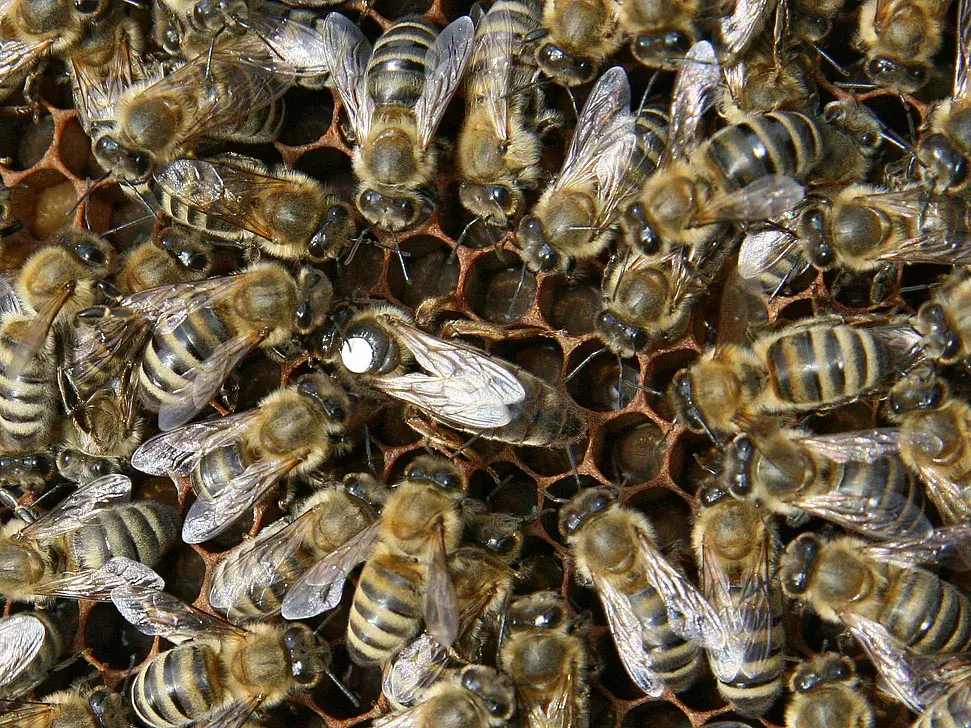
The drone bee
- He is smaller than the queen but larger than a worker, darker, hairier and stouter, with very big eyes (for spotting a queen in flight).
- He has no sting, no pollen baskets and no wax glands, so he can’t defend the hive, collect food or build. He even depends on the workers to feed him; he is often called the laziest bee in the hive.
- His only function is to mate with (fertilize) a queen. In the hive, drones also help keep the brood warm.
- Drones are haploid: they have only 16 chromosomes, one set. Queens and workers are diploid, with 32 chromosomes, two sets (you’ll learn what haploid and diploid mean in Unit 4).
- Drones grow from unfertilized eggs. An egg developing into a new animal without being fertilized is called parthenogenesis (Greek: “virgin birth”).
- A drone lives only about two months. When food runs short in autumn, the workers stop feeding the drones and push them out of the hive.
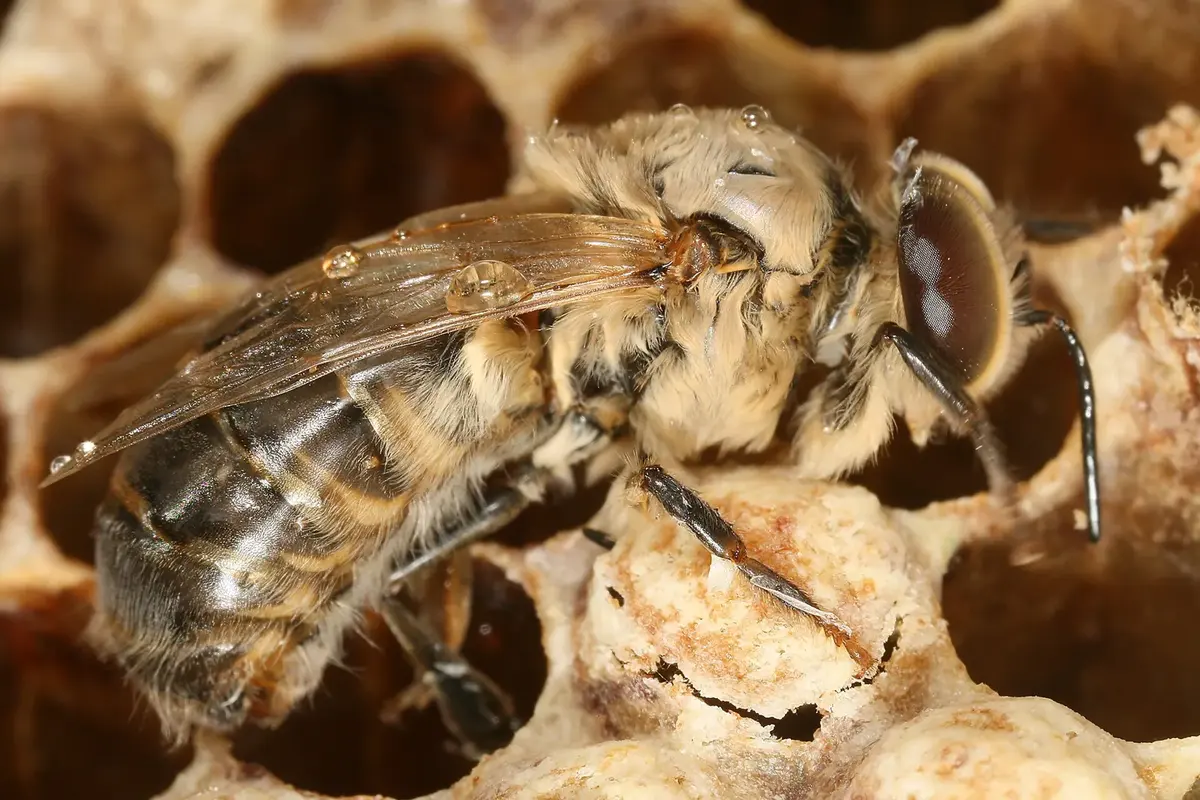
The worker bee
- Workers are the smallest bees in the hive, and by far the most numerous: about 20,000–80,000 in a strong hive.
- They are all females, but they normally don’t lay eggs: their ovaries stay undeveloped (they are sterile).
- Their mouthparts are for chewing and lapping: mandibles to shape wax, and a long proboscis to suck nectar.
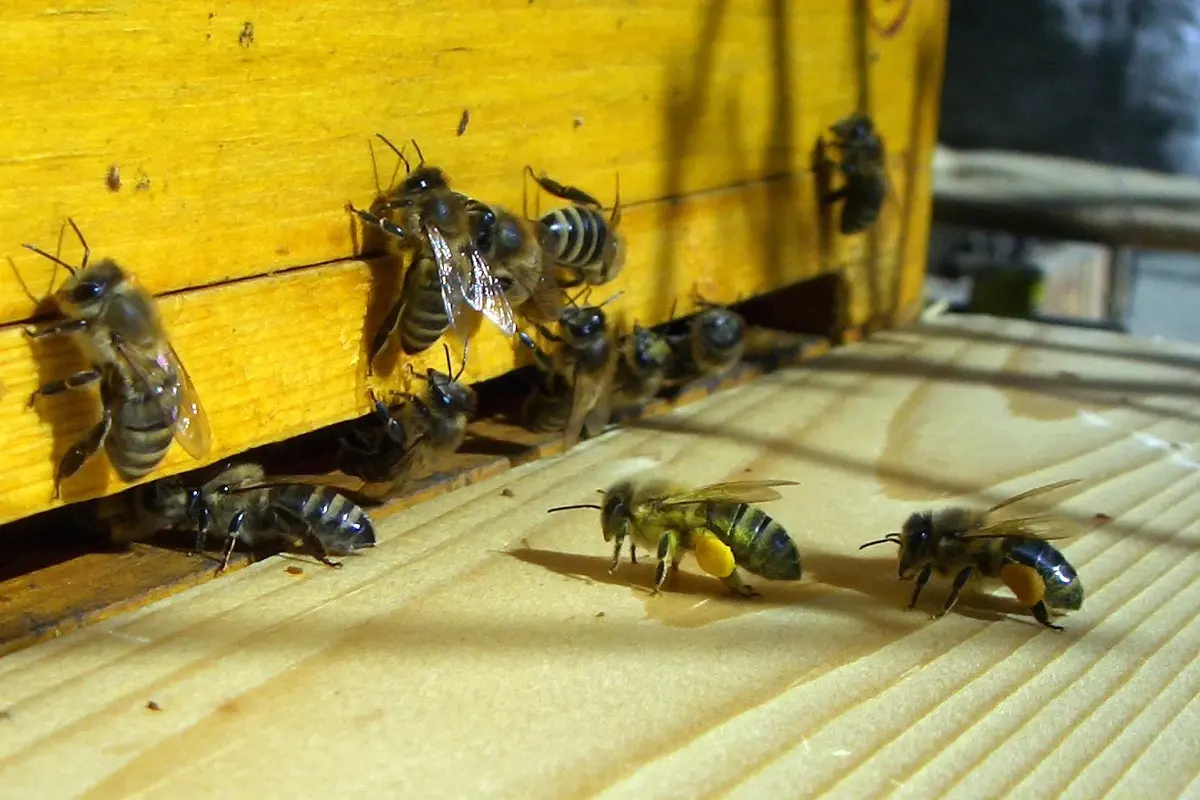
- Their legs are covered in hairs that catch pollen, and each hind leg has a pollen basket (a hollow ringed with stiff hairs) in which they carry pollen home.
- They have wax glands under the abdomen and a barbed sting.
- They do all the work of the colony: collecting nectar, pollen and water, building the comb, nursing the young, cleaning, cooling and guarding the hive.
- A worker lives about 6 weeks in the busy season, and up to 6 months if she is born in autumn and lives through the winter.
| Queen | Drone | Worker | |
|---|---|---|---|
| Sex | female, fertile | male, fertile | female, sterile |
| Grows from | fertilized egg | unfertilized egg | fertilized egg |
| Chromosomes | 32 (diploid) | 16 (haploid) | 32 (diploid) |
| Size | largest, longest | medium, stout | smallest |
| Number in a hive | usually 1 | a few hundred (in season) | 20,000–80,000 |
| Sting | smooth, used on rival queens | none | barbed |
| Pollen baskets, wax glands | none | none | present |
| Lifespan | 2–5 years | about 2 months | 6 weeks to 6 months |
| Work | lays eggs, controls the hive by pheromones | mates with the queen | everything else |
A larva hatches from a fertilized egg. What can it become?
Pick an answer to see why.
Life cycle of the honey bee
Every honey bee goes through four stages: egg → larva → pupa → adult. How long each stage lasts depends on the kind of bee.
A larva looks nothing like a bee: it is a white, legless grub. To turn into an adult, its body is almost completely rebuilt. Inside the larva and the pupa, old tissues are broken down (histolysis) and new ones are built (histogenesis). Because of these two processes, the egg changes into a larva, the larva into a pupa, and the pupa into an adult. A change of body form through all four stages like this is called complete metamorphosis. (Butterflies, flies and beetles do it too; grasshoppers and cockroaches don’t: their young look like small adults.)
Egg, larva, pupa and bee: DataBase Center for Life Science (DBCLS), CC BY 4.0, via Wikimedia Commons
How a new colony starts
When a hive gets too crowded with workers, the colony splits. The old queen leaves with a large group of workers (a swarm) to start a new colony, and the workers build a new hive. In the old hive, the workers left behind raise a new queen by feeding a larva from a fertilized egg only on royal jelly.
When the new queen is adult, she flies out on her nuptial (mating) flight, on a warm, sunny afternoon, followed by drones from many colonies. She mates with many drones (often 10–20) high in the air. A drone dies straight after mating, because his reproductive organ is torn out of his body as he separates from the queen.
The queen stores the sperm in a small sac in her abdomen called the spermatheca. She will use this store for the rest of her life, to fertilize millions of eggs, and never mates again. 2–3 days after mating, she starts laying eggs in the brood cells.
Egg
- Bee eggs are white and long, like tiny grains of rice, 1–1.5 mm long.
- An egg stands upright in its cell on the first day, leans on the second, and lies flat on the third.
- The queen chooses the cell: she lays in queen cells to make queens, worker cells to make workers and the larger drone cells to make drones.
- In the busy season she lays about 1,500–2,000 eggs a day, about her own body weight in eggs, and the very best queens up to about 3,000 in good conditions. Fewer in winter, and the number varies with the kind of bee.
- The egg stage lasts 3 days for every kind of bee.
- There are two kinds of eggs. A fertilized egg becomes a queen or a worker (a female). An unfertilized egg becomes a drone (a male). The queen decides which: as each egg passes, she can release sperm from her spermatheca, or not.
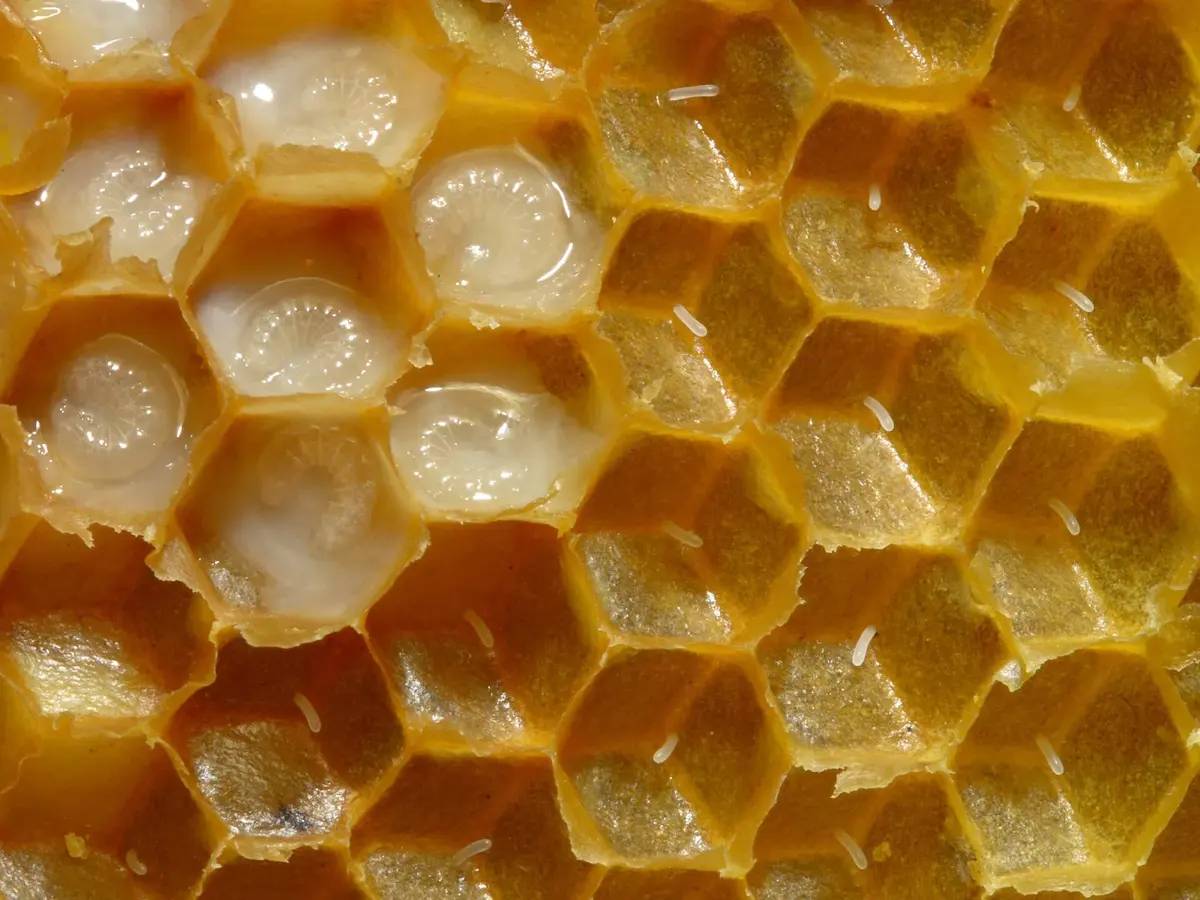
Larva
- After 3 days the egg hatches into a larva: a white, legless grub.
- The larva eats all the time, and grows about 1,500 times heavier in less than a week. It molts (sheds its skin) five times as it grows.
- All larvae are fed royal jelly for the first three days. Then the food changes:
- a future queen keeps getting rich royal jelly, as much as she can eat;
- future workers and drones get bee bread (also called honey bread): a mixture of pollen and honey.
- So whether a female larva becomes a queen or a worker depends only on its food. The larvae of future queens and drones are larger than those of future workers.
- The larval stage lasts about 5.5 days for a queen, 6 days for a worker and 7 days for a drone. Because the larvae are fed differently, they develop at different speeds.
- When the larva is fully grown, the workers seal its cell with a wax cap.
Pupa
- The pupa is a resting stage: it does not eat or move. But inside, great changes go on: the three pairs of legs, the wings, the mouthparts, the eyes and the adult organs are formed.
- The pupal stage lasts about 7.5 days for a queen, 12 days for a worker and 14 days for a drone.
Adult
- When the change is complete, the new adult bee chews through the wax cap of its cell with its mandibles and comes out.
- A new worker starts working straight away: cleaning cells, caring for the brood, feeding larvae, and later guarding the hive.
| Bee | Egg | Larva | Pupa | Total |
|---|---|---|---|---|
| Queen | 3 days | 5.5 days | 7.5 days | 16 days |
| Worker | 3 days | 6 days | 12 days | 21 days |
| Drone | 3 days | 7 days | 14 days | 24 days |
Draw it: Life cycle of the honey bee
Division of labor
Every bee in the hive has its work, and a worker’s job changes as she gets older. Newly born workers work inside the hive for about three weeks; only then do they go outside to forage. Here is how the work is divided by type and age:
| Type | Age | Work |
|---|---|---|
| Drone | all its life | mates with (fertilizes) the queen; helps keep the hive warm |
| Queen | all her life | lays eggs; controls the activities of the hive with her pheromones |
| Worker | days 1–3 | cleans the cells; clings to the comb to keep the eggs, larvae and pupae warm |
| days 4–6 | feeds bee bread (honey bread) to the older larvae | |
| days 7–11 | royal jelly glands (the hypopharyngeal glands) develop in her head; she feeds royal jelly to young larvae and to the queen | |
| days 12–17 | four pairs of wax glands develop under her abdomen; she builds comb and seals the cells of larvae and honey | |
| days 18–20 | her sting (venom) glands are fully developed; she guards the hive entrance | |
| after day 21 | flies out to collect nectar, pollen, water and plant resin |
The ages are not fixed rules. If the colony suddenly lacks foragers, young bees start foraging early; if it lacks nurses, old bees can grow their royal jelly glands again. The colony adjusts the work to what it needs.
A worker bee is 10 days old. What is she most likely doing?
Pick an answer to see why.
How bees talk: the dance language
A forager finds a field of mustard in flower, 1 km from the hive. Within an hour, hundreds of her sisters are working the same field. How did they know where to go? Bees can’t speak, and it is dark inside a hive. She told them by dancing.
Back on the comb, the forager runs straight ahead while waggling her abdomen from side to side, then circles back to the start, first to the right, then to the left, tracing a figure of eight, again and again. Other bees crowd round, touching her with their antennae and tasting the nectar she brings. This is the waggle dance, and it carries two pieces of information:
- Direction. The comb hangs vertically. The direction of the straight waggle run, measured from straight up, is the angle between the sun and the food. Running straight up means “fly towards the sun”; straight down means “fly away from the sun”; 60° to the right of up means “fly 60° to the right of the sun”.
- Distance. The longer the waggle run lasts, the farther the food: roughly one second of waggling for each kilometer (the exact number differs between colonies and species). For food very close to the hive, the runs are so short that the bee seems just to circle, sometimes called the round dance.
Honey
Royal jelly comes from glands (in the heads of young workers), but honey does not. Honey is not made by any particular gland in a bee’s body. It is a mixture of simple sugars (monosaccharides, mainly fructose and glucose), made by evaporating as much water as possible from the nectar of many flowers, with the help of the wind and the draught from the bees’ beating wings.
Honey is made up of roughly:
| Part | Share |
|---|---|
| carbohydrates (sugars, mainly fructose and glucose) | 80–85% |
| water | 15–17% |
| protein | 0.3% |
| amino acids | 0.2% |
| vitamins, minerals, enzymes and other substances | the rest |
The color, smell, taste and quality of honey depend on the flowers the nectar came from: mustard honey is pale and sets solid quickly, chiuri honey is light, and honey from forests is darker and stronger.
Uses of honey bees
Honey bees are among the most useful insects for the whole ecosystem, people included:
- A model for people. Their hard work, division of labor and discipline set an example for how people can work together.
- Honey. Bees make highly nutritious honey, used as food and in Ayurvedic medicine, and in sweets, cakes, bread and more.
- Pollination. As they suck nectar, bees carry pollen from flower to flower and pollinate the plants. That is how many crops set seed and fruit, so bees help farmers grow more food.
- Wax. Beeswax is used in cosmetics (creams, lipstick), candles, polish and in the traditional lost-wax casting of Nepal’s metal statues.
- Royal jelly. Beekeepers who learn to harvest royal jelly can earn a good income from it.
- Income for the nation. Farmers earn well from apiculture, and honey and other bee products help the economy of the country.
Bees also give propolis (bee glue, the resin they collect from tree buds to seal cracks, used in some medicines) and pollen, sold as a food supplement. And the venom itself is studied for medicines.
A farmer keeps bees next to a mustard field. Why do his neighbors’ mustard harvests go up too?
Pick an answer to see why.
Honey bees of Nepal
Nepal has five species of honey bee, four of them its own and one brought in, from the hot Terai to cliffs high in the Himalaya:
| Bee | Nepali name | Where and how it lives |
|---|---|---|
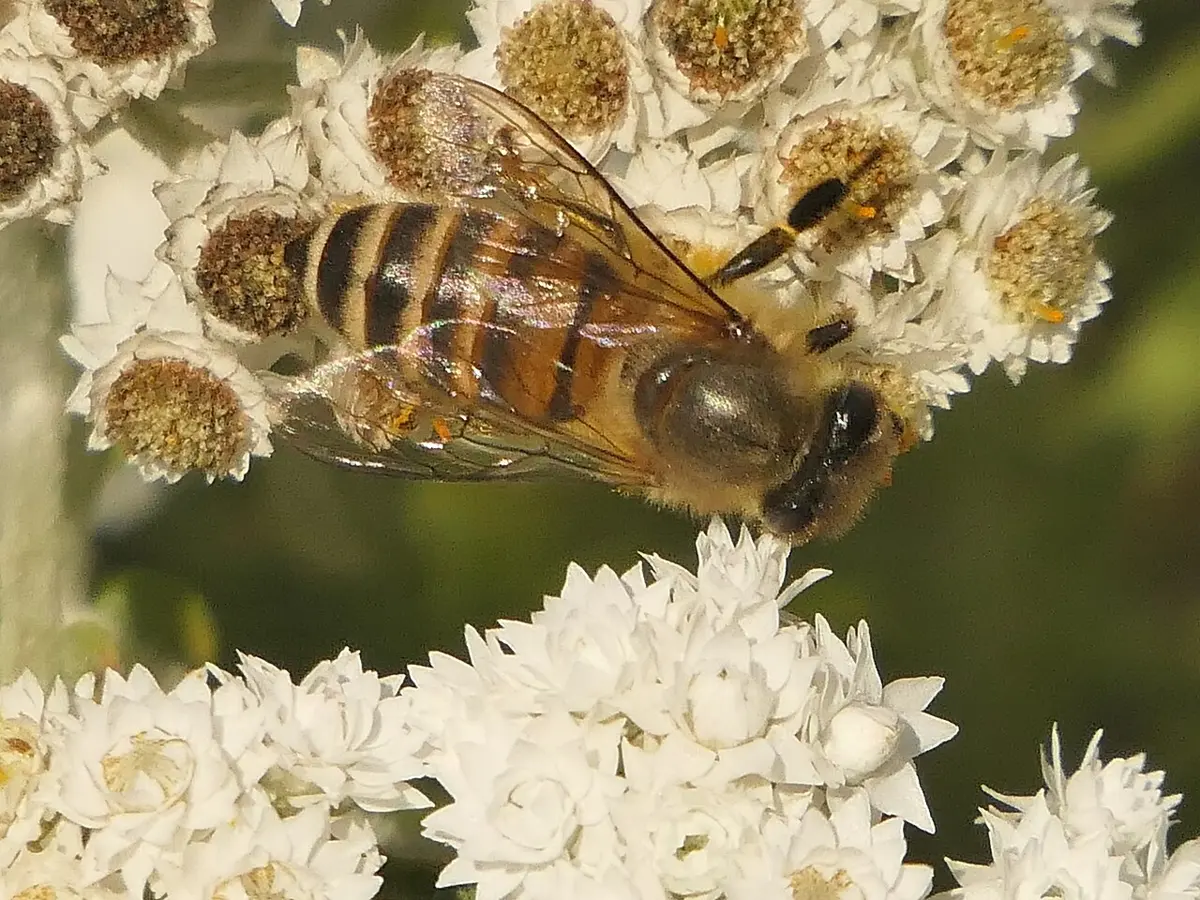
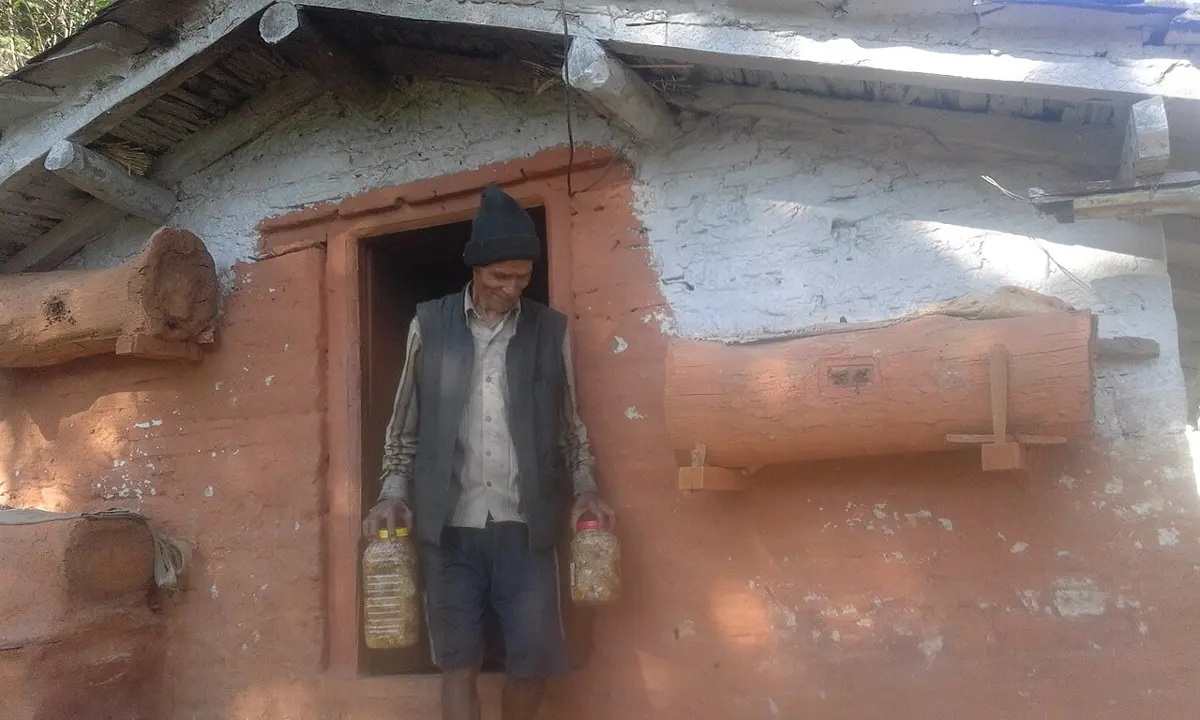
| Asian hive bee (Apis cerana) | घरमौरी (ghar mauri) | Nepal’s own kept bee: lives in hollows, kept in traditional log and wall hives and in modern boxes from the Terai to the hills. Gentle, and good at defending itself against mites and hornets. |
| European honey bee (Apis mellifera) | brought to Nepal for beekeeping (from the 1990s); kept in modern box hives, mostly in the Terai and inner Terai (e.g. Chitwan), where it makes much more honey than A. cerana. | |
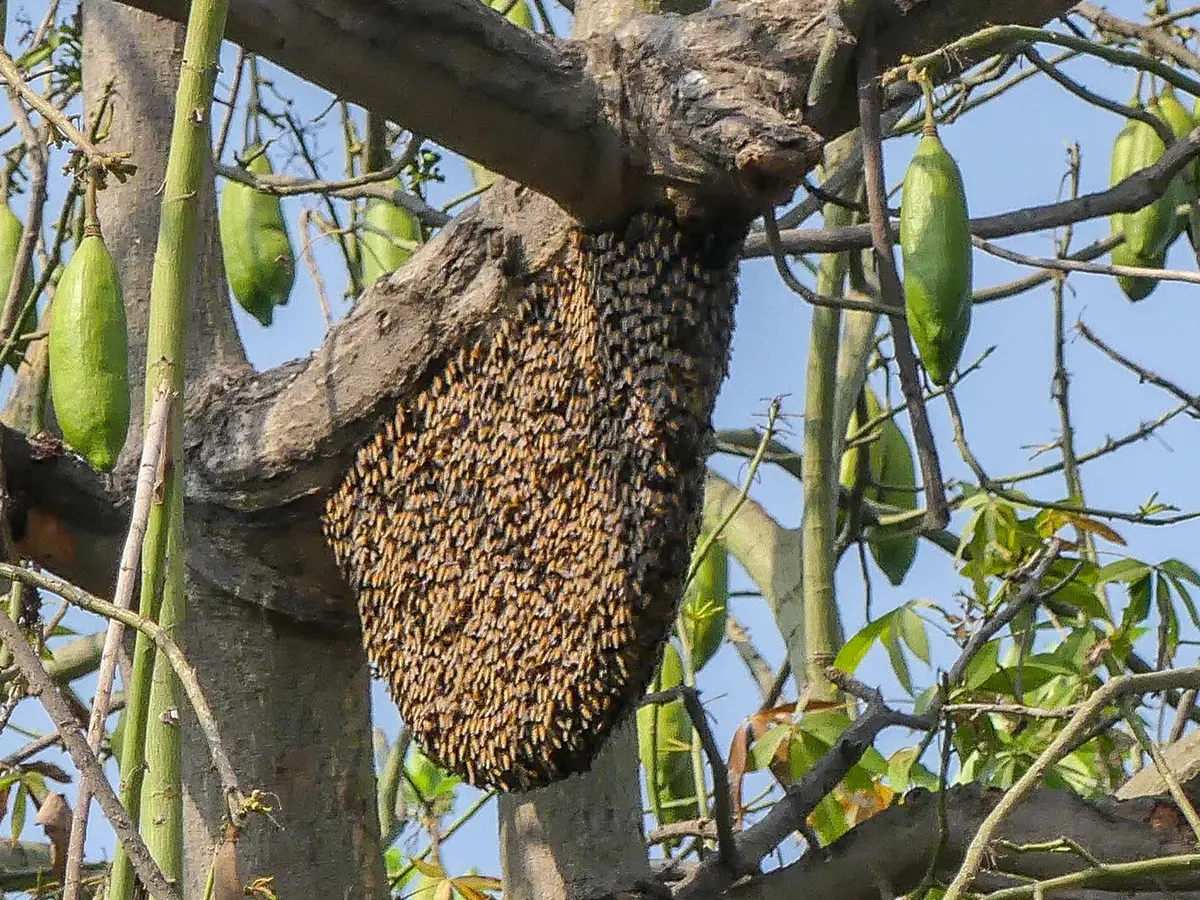
| Giant honey bee (Apis dorsata) | builds one huge open comb, up to about 1.5 m across, under tree branches, buildings and water tanks in the lowlands. | |
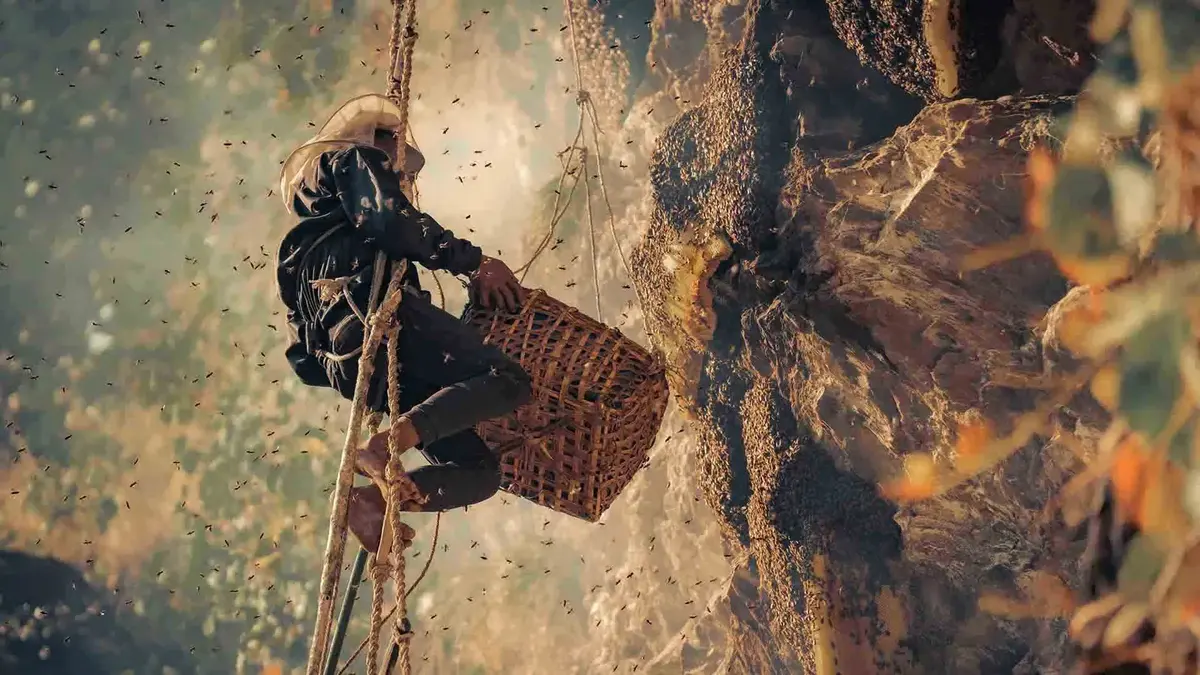
| Himalayan cliff bee (Apis laboriosa) | भिर मौरी (bhir mauri) | the largest honey bee in the world, up to about 3 cm long. Builds big open combs under overhanging cliffs, mostly about 1,200–3,600 m high, and forages up to about 4,000 m. |
| Dwarf honey bee (Apis florea) | the smallest; a single palm-sized comb on a bush or twig in the hot lowlands. |

Project work
Exercise
1. Choose the correct option
a. Which bee has only 16 chromosomes?
Pick an answer to see why.
b. Where is royal jelly made?
Pick an answer to see why.
c. Which bee develops when a larva is fed royal jelly all the time?
Pick an answer to see why.
d. A pale bee lies still in a sealed cell, its legs and wings folded against its body. Which stage is it?
Pick an answer to see why.
e. Why is the honey bee called a social insect?
Pick an answer to see why.
f. If a worker’s pollen baskets are damaged, which job can she no longer do?
Pick an answer to see why.
g. Which describes a drone?
Pick an answer to see why.
h. Where does the queen store the sperm she receives from drones on her nuptial flight?
Pick an answer to see why.
2. Differentiate between
Drone and worker bee
Answer
Queen bee and worker bee
Answer
Queen bee and drone
Answer
3. Give reasons
The honey bee is called a social insect.
Answer
Pasture land is needed for bee farming.
Answer
A drone dies after mating.
Answer
Bees are multipurpose insects.
Answer
4. Answer these questions
Name the kinds of bee found in a hive.
Answer
What is the function of the drone bee?
Answer
If the queen dies for some reason, who will control the hive?
Answer
How does the queen bee control the other members of the hive?
Answer
Write the uses of honey.
Answer
Describe the structure of the queen bee.
Answer
Mention the functions of the worker bee.
Answer
Explain how the division of labor takes place in bees.
Answer
Explain the life cycle of the honey bee with a diagram.
Answer
What is the process called in which a drone develops from an unfertilized egg?
Answer
When one farmer starts keeping bees, the income of other farmers in the area also goes up. Give the reason.
Answer
Because there was not enough pasture (flowering plants) around their apiary, beekeepers moved their bees away. After that, the mustard yield of nearby farmers fell. Explain the link between beekeeping and agricultural production.
Answer
Complete the concept map: from “bee”, one arrow leads to parthenogenesis, which leads to an empty box; another leads to fertilization, which leads to two boxes, one marked “fertile” and one with no label.
Answer
Quiz yourself: Classification of Living Beings, Grades 5–10 →
Practice every question in the book, and keep track of the ones you miss →
A companion to your textbook, not a replacement for it: study from the book your school uses, and where the two differ, follow your teacher. Found a mistake? Please tell us.