
On 15 November 2022 the United Nations marked the day the world’s population passed eight billion. When your grandparents were born, there were only about three billion. Nepal alone has grown from about 5.6 million people in its first census, in 1911, to 29.2 million in 2021.
Every one of those people needs food, water, wood or gas to cook with, a home, and clothes. All of it comes, in the end, from the land and the sea, which are shared with millions of other species. So the question is an old one, and it matters more each year: how many people can the Earth support? Is there a number, like the number of tigers a park can hold? This topic shows why the honest answer is “it depends”, what it depends on, and how to build a small computer model, a spreadsheet you can make yourself, that shows how people, resources and wildlife pull on each other.
Eight billion and counting
For almost all of human history there were few people. Around 1800, after hundreds of thousands of years, the world reached its first billion. Then things sped up. Better farming, clean water, vaccines and medicines meant that far fewer babies and children died, while families stayed large for a generation or two. So the population grew faster and faster.
You can measure how fast a population grows by its growth rate: how much it grows in a year, as a percentage of its size. The world’s growth rate was highest in the 1960s, at over 2 % a year. It has fallen since, to under 1 % a year (as of 2026), because families almost everywhere have become smaller. A woman in the world today has on average about 2.2 children; in the 1960s it was about 5. In Nepal the change has been even faster: about 6 children per woman in the 1970s, about 2.1 in 2022, which is just enough for each generation to replace the one before.
So the world is still growing, but more slowly each year. The UN expects the world to reach about 10.3 billion in the mid-2080s and then to shrink a little. That is a projection, not a fact: it depends on what millions of families decide.
A population growing by a fixed percentage each year doubles in a fixed time. A quick rule, the rule of 70, gives that doubling time: divide 70 by the growth rate in % a year.
The world’s population is still growing, but its growth rate has fallen from over 2 % to under 1 % a year. What does this mean?
Pick an answer to see why.
Why there is no single number
In Grade 8 you met the Earth’s carrying capacity, how much it can bear Grade 8: Principles of sustainable development: for any species, the most a place can support, year after year, without using up its resources. In How Many Tigers Can Chitwan Hold? how ecologists estimate it for tigers: count the deer, and work out how many tigers they can feed. Why not do the same for people?
Because people are not tigers. A tiger needs about 50 deer-sized animals a year, and always will. People change what they eat, how they cook, how they farm and how much they own. A person in Nepal and a person in the USA use very different amounts of the Earth. And people invent: a new crop variety, a better stove or a solar panel can change in a few years what the same land can give.
Scientists sum up what a population takes from the Earth in a simple equation, written by the ecologists Paul Ehrlich and John Holdren in the early 1970s:
where I is the impact (the land used, the wood burned, the carbon dioxide given out), P the number of people (population), A how much each person uses (affluence, or consumption per person), and T how much impact each unit of use causes (technology). A better stove lowers T: the same cooked meal, less wood. A smaller family lowers P. A simpler life lowers A. The impact is the product of the three, so halving any one of them halves it.
The ecological footprint
One way to measure I is the ecological footprint: the area of land and sea needed to grow everything a person uses (food, wood, fibers such as cotton) and to soak up the carbon dioxide they give out. It is measured in global hectares (gha), hectares of land with the world’s average productivity. Against it is set the biocapacity: the area that is really there, able to grow back each year.
| Footprint per person (gha) | |
|---|---|
| Nepal | 0.9 |
| India | 1.1 |
| world average | 2.5 |
| China | 3.8 |
| USA | 7.1 |
The Earth’s biocapacity is about 12.2 billion global hectares: about 1.5 gha for each person alive (as of the 2025 accounts by Global Footprint Network and York University). The world average footprint, 2.5 gha, is about 1.7 times that. Humanity uses as much each year as about 1.7 Earths could grow back. It can do that only by using up stocks that took a long time to build: cutting forests faster than they grow, catching fish faster than they breed, letting soil wash away, and, above all, putting carbon dioxide into the air faster than plants and the sea take it back (about 60 % of the world’s footprint is carbon). Using more than the Earth regrows is called overshoot.
In I = P × A × T, a village replaces its open fires with improved stoves that cook the same food with a third less wood. Which factor has changed?
Pick an answer to see why.
A model you can build: a village and its forest
To see how the pieces fit together, scientists build a model: a set of rules, written as numbers, that stands in for the real thing. A model that a computer runs step by step, year by year, is a computational simulation. It can’t tell the future exactly, but it can show what follows from what: if people do this, then that happens.
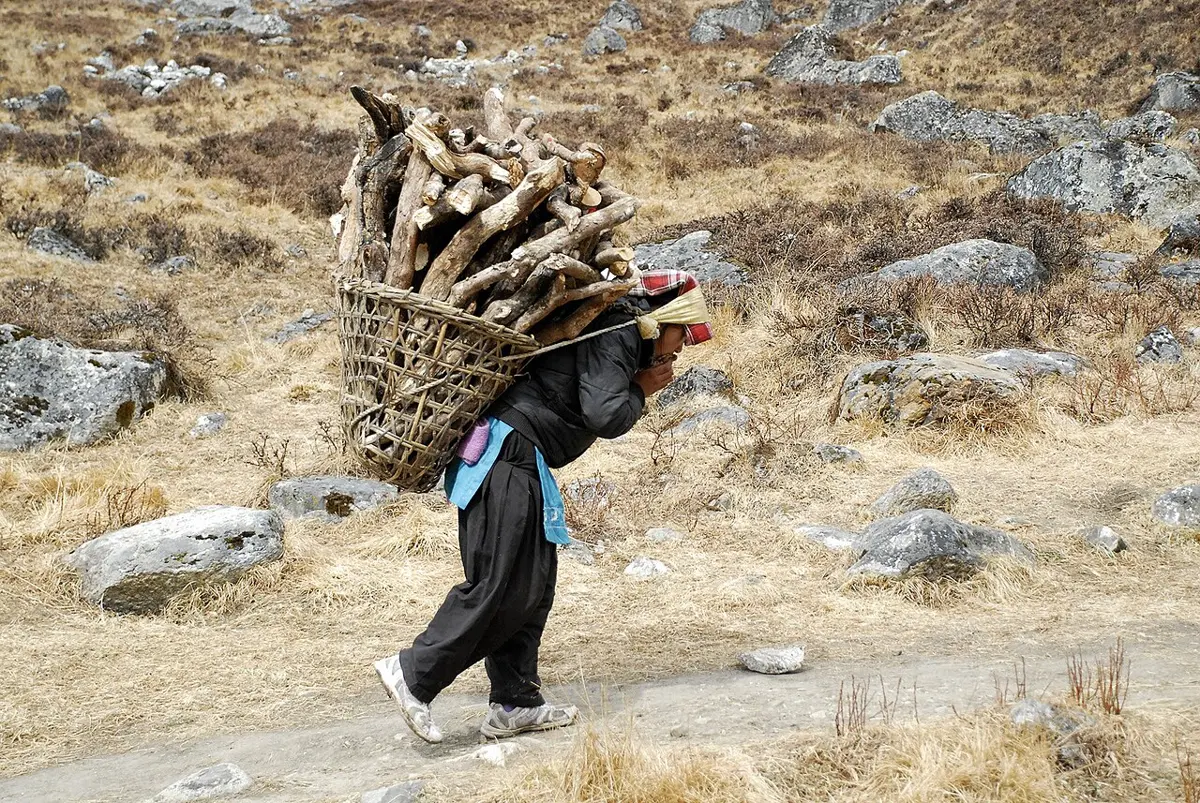
Here is one small enough to build yourself, about something Nepal knows well: a hill village and its community forest. In many hill villages most families still cook on wood. Surveys in Nepal’s hills find that each person burns several hundred kilograms of firewood a year; our model takes 600 kg on an open fire, about 3 tonnes for a family of five. The forest gives that wood, and also shelter for birds, deer, leopards and orchids.
The model has two stocks, things that build up or run down, and flows that change them each year:
The forest. Its stock is the wood standing in it, in tonnes. Our forest is 100 hectares, and full-grown it would hold about 150 tonnes of wood on each hectare, 15,000 tonnes in all. Every year the trees put on new wood, its regrowth. A forest grows back like the tigers in How Many Tigers Can Chitwan Hold? (the logistic model): a nearly bare forest has few trees to grow, and a full forest has no room for more, so it grows fastest when it is about half full:
where is the wood in the forest now, the most it can hold, and r its growth rate when it has plenty of room; we take r = 0.08, 8 % a year.
The village. It starts with 600 people. The wood it needs each year is people × wood per person. Each year the number of people grows by a set percentage.
The link. Each year the village cuts the wood it needs, if the forest has it. The forest’s new stock is
If the wood cut is less than the regrowth, the forest grows; if more, it shrinks. The most that can be cut, year after year, without shrinking the forest, is its sustainable yield: here at most 300 tonnes a year, when the forest is half full.
Doing this by hand for 75 years would take all day. A computer does it in a blink. Play with the model below: it is the same model, run from 2026 to 2100.
Things to find out:
- a.With open fires and 1 % growth a year, when does the village start to run short? What changes the outcome most: a better stove, slower growth, or both?
- b.With the better stove, find the fastest growth at which the village still has enough wood every year to 2100. Is that growth sustainable after 2100?
- c.Protect 30 % of the forest with open fires. What happens to the species, and to the people?
In the model, why does a forest that is cut a little faster than it regrows lose wood faster and faster?
Pick an answer to see why.
People, resources and wildlife
The forest is not only wood. It is home to the birds, insects, orchids, deer and leopards of the hills. In Grade 8 you met the causes of biodiversity loss and the ways of conserving it Grade 8: Conservation of biodiversity. Here we put numbers on it: what happens to the species as the forest shrinks?
Ecologists have measured this on islands and in forests all over the world. A bigger area holds more species, but not in proportion: it follows the species–area relationship. A good rule is that the number of species is in proportion to the area raised to the power of about 0.25 (somewhere between 0.15 and 0.35, depending on the place and the group of living things):
Our village model uses the same rule, treating a thinned forest roughly like a smaller one (in a real forest, it depends on which trees are left). It shows two ways people and wildlife are linked. When the village overuses the forest, people and species lose together. But when the village protects part of the forest and still needs as much wood, the species are kept and the people go short. Protecting nature works best, for both, when it goes with ways for people to need less from it.
The world’s wildlife has been squeezed the same way. Monitored populations of wild mammals, birds, fish, reptiles and amphibians have fallen by 73 % on average since 1970 (WWF’s Living Planet Index, 2024), mostly because their habitat has been turned into farms, and about a million species are at risk of extinction (IPBES, 2019).
Two plans for the village, which grows by 1 % a year: Plan 1 protects 30 % of its forest but keeps the open fires. Plan 2 gives every family a better stove but protects nothing. What does the model show by 2100?
Pick an answer to see why.
What changes the outcome
Every factor in the model is something people can change. These are the levers that decide how many people the Earth, or a village, can support, and how well:
- How many people. Families become smaller when children survive, girls go to school, and women can choose. Nepal’s fall from about 6 children per woman to about 2.1 happened in two generations.
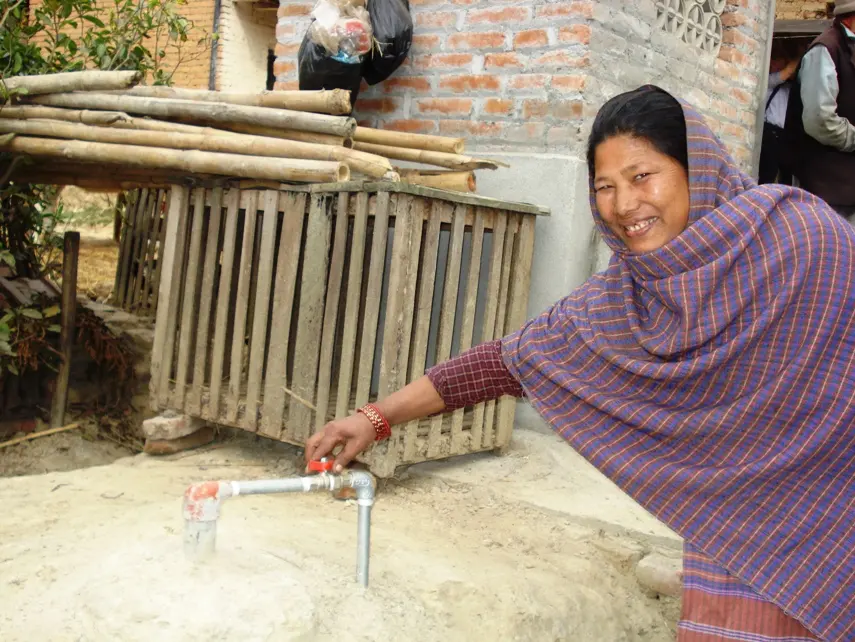
- How much each person uses. A family that cooks with biogas, eats more grains and pulses and less meat, or keeps a phone for years, uses less land and energy. Meat is the big one: most of the world’s farmland is used to feed animals, which give back only a small share of the food energy they eat (see Where Does a Fallen Leaf Go?).
- Efficiency and new technology. World cereal harvests per hectare have roughly tripled since 1961, thanks to new crop varieties, fertilizers and irrigation; without that, feeding today’s people would need far more forest cleared for fields. A better stove, a biogas plant, and electricity from rivers and the Sun do the same for energy.
- The cost of getting resources. As a nearby resource runs low, getting it costs more: a longer walk for firewood, a deeper well, a farther mine. That cost is a signal, but often it comes late.
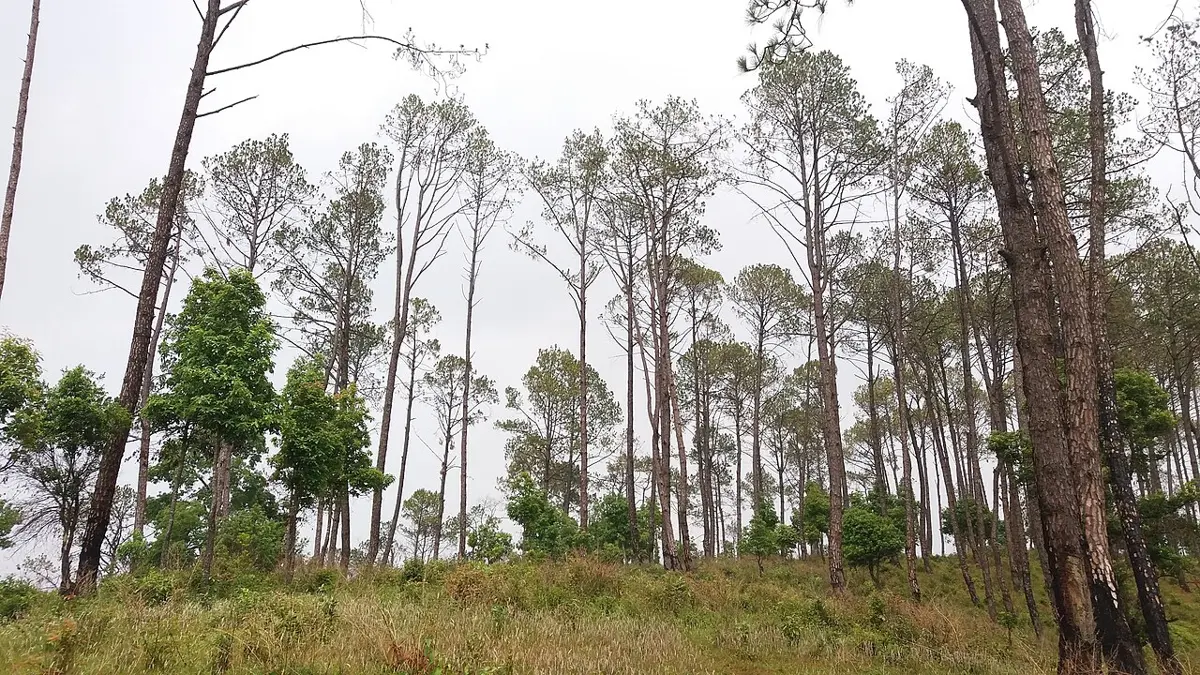
- Conservation. Protected areas, now about a quarter of Nepal’s land, and community forests keep habitat for wildlife. Rules about when and how much to cut keep the harvest within the sustainable yield.
- Planning towns and dealing with waste. A compact town with good buses uses less land and fuel per person than one that sprawls over farmland; waste that is sorted, composted or turned into biogas costs less land and pollutes less.
Questions
A population grows by 1.4 % a year. About how long does it take to double?
Pick an answer to see why.
A country’s population stays the same, but each person’s footprint doubles, and new technology halves the impact of each unit of use. By I = P × A × T, its impact
Pick an answer to see why.
Why can ecologists estimate a carrying capacity for tigers in Chitwan, but not give a single carrying capacity of the Earth for people?
Answer
A tiger’s needs are fixed: it needs about the same amount of prey each year, and the prey a park can support depends on its area and plants. People’s needs are not fixed: how much each person uses (food, wood, energy, goods) varies more than seven times between countries, and technology changes what the same land can give (crop yields have tripled since 1961). People can also trade, bringing in resources from elsewhere. So the number of people the Earth can support depends on how they choose to live, what technology they have, and how much they leave for other species: different choices give very different numbers.
In 2026 a community forest holds 6,000 tonnes of wood; full-grown it would hold 12,000 tonnes, and its growth rate r is 0.08 a year. The village has 400 people, each burning 600 kg of wood a year.
- a.Calculate the forest’s regrowth this year.
- b.Calculate the wood the village needs.
- c.Is the village’s use sustainable? Explain with numbers.
- d.Suggest two changes that would make it sustainable, and show that one of them works.
Answer
- a.Regrowth = 0.08 × 6000 × (1 − 6000 ÷ 12,000) = 0.08 × 6000 × 0.5 = 240 t.
- b.Wood needed = 400 × 0.6 t = 240 t.
- c.Just about: the village cuts exactly what grows back, and the forest is half full, where regrowth is the largest it can be (240 t is the sustainable yield). So the forest stays the same, but there is no margin: if the village grows, or a dry year slows the trees, the forest starts to shrink, and then grows back less each year.
- d.Any two of: improved stoves (about a third less wood: 400 × 0.4 t = 160 t, well under 240 t, so the forest would grow); biogas or LPG for some cooking; planting more trees on spare land; slower population growth. With stoves, the forest gains 80 t in the first year.
Use the species–area rule (power 0.25) to estimate the share of a forest’s species that survive if 75 % of the forest is cleared. Why do conservationists say the last patches of habitat matter most?
Answer
25 % of the forest is left: 0.25^0.25 = 0.71, so about 71 % of the species survive (in the long run). The curve is steep near zero: the first half of a habitat lost costs about 16 % of the species, but the last 10 % holds more than half of them (0.1^0.25 = 0.56). So each hectare of the last patches protects far more species than a hectare of a large, intact habitat.
Explain what “humanity uses 1.7 Earths” means, and how it is possible to use more than one Earth.
Answer
The ecological footprint of all the world’s people, the land and sea needed to grow what they use and to soak up their carbon dioxide, is about 1.7 times the Earth’s biocapacity, the area that can grow these things back each year. It is possible for a time by using up stocks: cutting forests faster than they regrow, catching fish faster than they breed, losing soil, and letting carbon dioxide pile up in the air and the sea instead of being taken back. Like spending a bank account’s savings as well as its interest, it can go on for a while, but the stocks shrink, and so does what they can give in future.
A student runs the village model. With 1 % growth a year and open fires, the village runs short of wood from 2063. She finds three settings with which it never runs short before 2100: open fires with the village shrinking by 1 % a year (in 2100 it needs 171 t a year); better stoves with no growth (240 t); stoves and biogas with 2 % growth (520 t). The forest can regrow at most 300 t a year. What can she conclude about the relationship between population, consumption per person and the sustainability of the village’s resources? Are all three settings sustainable? What are two limitations of her model?
Answer
She can conclude that sustainability depends on the product of the number of people and the wood each one uses, compared with the forest’s sustainable yield: halving the wood per person allows about twice as many people, and faster growth needs a bigger cut in use per person to keep within the forest’s means. No single factor decides the outcome; several combinations work.
Not all three are sustainable, though. The first two need less than the 300 t the forest can regrow, so they could go on for ever. The third needs 520 t in 2100, far more than the forest can regrow: it reaches 2100 only by using up the forest’s stock, and it would run short soon after. Getting through a set number of years is not the same as being sustainable.
Limitations (any two): the numbers are rounded and assumed (a real forest’s growth rate, size and starting stock must be measured); people in the model can’t move away, buy gas or bring wood from elsewhere; the forest is treated as one block (in reality some parts are nearer and are overcut first); the species rule treats a thinned forest like a smaller one; nothing is random (no dry years, fires or landslides).
Design a plan for a hill village whose forest is shrinking, using what you learned. Say which levers your plan moves, how you would know whether it is working, and what trade-offs it involves.
Answer
A good plan uses several levers together, for example: improved stoves for every family and help with biogas plants (lowers wood per person); a community forest user group with rules on when and how much to cut, and a protected core where no one cuts (keeps cutting under the sustainable yield and keeps habitat for species); planting fodder and firewood trees on terrace edges and bare land (raises the forest’s stock and regrowth); support for girls’ schooling and health posts (in the long run, smaller families).
To know whether it is working: measure the forest each year (sample plots: count and measure trees), record how much wood is cut, count birds or other species along a fixed path, and run the numbers in a spreadsheet model to see whether cutting is under regrowth.
Trade-offs: stoves and biogas plants cost money; a protected core means families lose some wood and grazing at first; rules must be fair, or poorer families who depend most on the forest are hurt; it takes years before the forest recovers.
Where to go next
- How Many Tigers Can Chitwan Hold? The carrying capacity of a park for its tigers, and the logistic model that the forest in this topic uses.
- Which Energy Should Nepal Use? Hydropower, solar or imported petrol, river sand or quarries: weighing the costs and benefits of each, for the land, the rivers and the air.
- Why Do People Live Where They Do? How water, soil, hazards and climate shaped where Nepal’s people settle, from the Kathmandu Valley’s old lake bed to the Terai.