
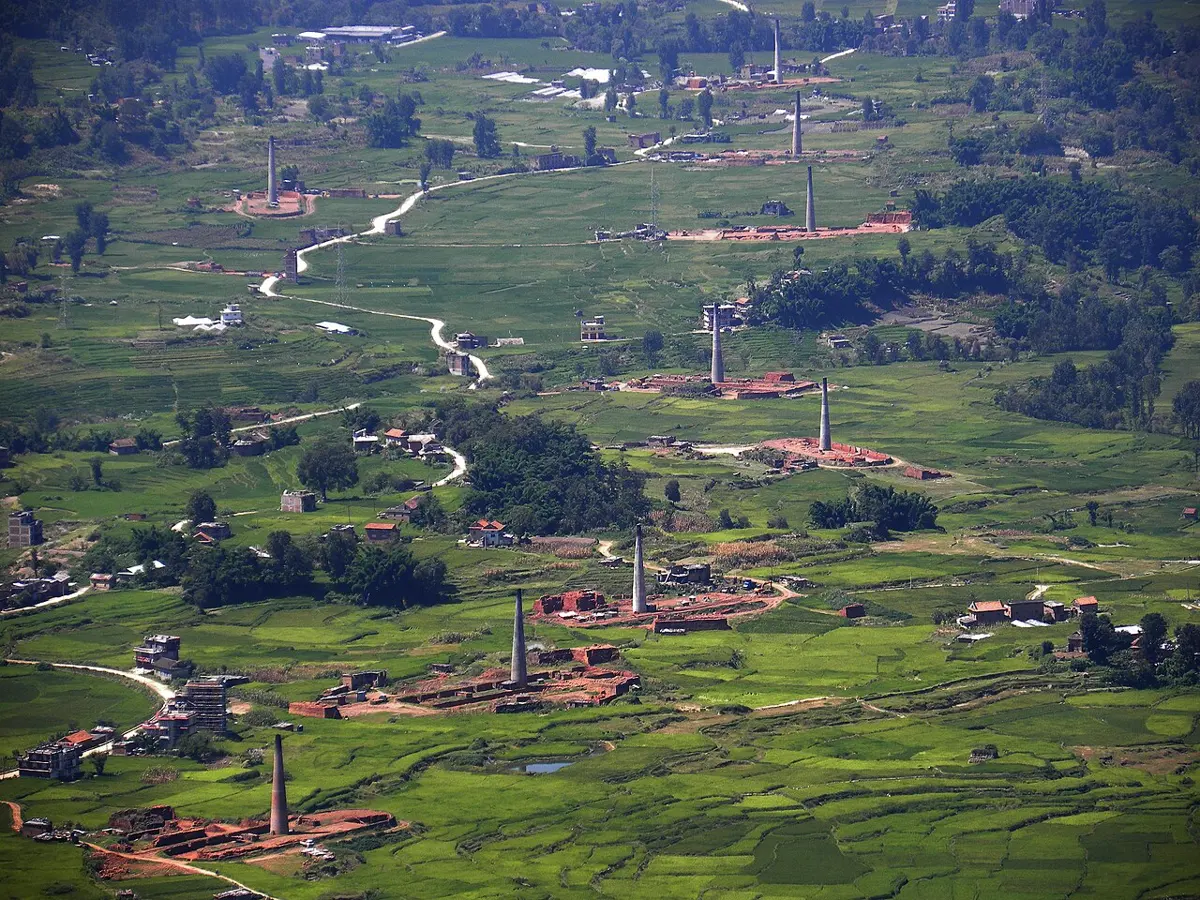
Look out over the fields of Bhaktapur or Lalitpur in winter and you see them: tall chimneys standing in the rice fields, about 110 across the Kathmandu Valley (as of 2017), each beside a long, low kiln of brick. From about November to May they fire more than 600 million bricks a year for the valley’s new houses, and for years many of them gave out thick black smoke.
On 25 April 2015 the Gorkha earthquake damaged almost all of them. When the owners rebuilt, most of the kilns were rebuilt to a new design, the zigzag kiln, with its bricks stacked so that the air winds back and forth through them. It was said to burn less coal and give out much less smoke. Newspapers and reports gave the savings as anything from a fifth to a half less coal, and from 40% to 70% less smoke.
So which is it? Does the fix actually work? Every list of “measures to control pollution” you have learned in school leads to the same question, and this topic shows how to answer it: with measurements, with fair comparisons, and by asking what the fix costs and what else it changes.
What does “it works” mean?
You met the measures in Grade 10: use energy efficiently, switch to renewable energy, plant and protect forests Grade 10: Grade 10: Measures to control climate change; burn low-sulphur fuels, fit factories with scrubbers and cars with catalytic converters Grade 10: Grade 10: Ways to prevent acid rain. Each of these is a technological solution: something designed and built to reduce the harm people do to the air, water, land or living things. A list tells you that the fixes exist. It doesn’t tell you how well each one works, or whether it is worth doing.
Engineers judge a fix against its criteria, the things it must do to count as a success, and its constraints, the limits it must work within (money, materials, space, the law, what people will accept). For any fix that reduces our impact, a good set of questions is:
- a.How much does it cut the harm? Which pollutant, by how much, measured how, and per what (per kilogram of fuel, per brick, per year)?
- b.Compared with what? With the old way, measured in the same way, under the same conditions.
- c.What does it cost, and who pays? To build, and to run.
- d.What are its side effects? Does it make a new problem, or move the old one somewhere else?
- e.Does it work in real life, in the hands of the people who use it, not only in a test?
- f.How big a share of the problem does it touch? A perfect fix used by a few does less than a fair fix used by everyone.
Almost every fix wins on some of these and loses on others. A gain on one criterion that costs you something on another is a trade-off. Deciding which fix is best means weighing the trade-offs, and different people may weigh them differently.
A company says its new cooking stove “burns 50% less wood”. Which question would you ask first to judge the claim?
Pick an answer to see why.
How a brick kiln works
Most of South Asia’s bricks are fired in a kind of kiln invented in India in the 1870s, the Bull’s trench kiln. The valley’s kilns had a fixed chimney in the middle, so they are called fixed-chimney Bull’s trench kilns (FCBTK for short). Seen from above, the kiln is a long rectangle with rounded corners, about 60 m long and 25 m wide: a wide trench running all the way round a central wall, with the chimney standing in the middle of the wall.
The trench is filled with stacks of dried, unfired clay bricks (green bricks), and the fire moves slowly round the trench, about 6 to 10 m a day. Workers on the top drop powdered coal through small holes into the hottest part. The chimney’s draught pulls air in through the open end of the trench, where the fired bricks are being taken out. On its way to the fire the air passes through the bricks that were fired days before, cooling them and warming itself. After the fire, the hot gases pass through the green bricks ahead, heating them up ready for firing, and then leave through a flue in the central wall to the chimney. Nothing is wasted: the same air cools the old bricks, burns the coal and heats the new bricks.
In the old kilns the bricks were stacked in long rows, so the air rushed straight along the trench. That gave two problems. The air passed the fire quickly and didn’t mix well with the coal, so some coal didn’t burn completely: its carbon left the chimney as black carbon (soot, the black kalo moso on a cooking pot) and as carbon monoxide. You saw in Grade 9 that a fuel burned with too little air, or badly mixed with it, makes soot and carbon monoxide Grade 9: Grade 9: Combustion. And the heat spread unevenly, so only about 55–60% of the bricks came out first-class.
In a zigzag kiln, the bricks are stacked in chambers about 2 m long, separated by walls of tightly packed bricks, each with a gap at one end, the gaps at alternate ends. The air has to swing from side to side across the trench, chamber after chamber (see Figure 44.2). Its path is about three times as long, and it moves faster and more turbulently. So it mixes better with the coal, the coal burns more completely, more of its heat goes into the bricks, and the bricks are heated more evenly: about 80–90% come out first-class. Coal is fed in small amounts, often, rather than in big shovelfuls. Some zigzag kilns have a fan to pull the air through (induced draught); others rely on a tall chimney (natural draught).
Why does a zigzag kiln give out less soot than a straight-line kiln burning the same coal?
Pick an answer to see why.
Measuring the fix
To find out how much a kiln gives out, scientists climb the chimney (or a platform built beside it), push a sampling probe into the flue gas through a port, and measure for hours or days. They measure how fast the gas flows, and how much of each pollutant it carries. They also weigh the coal fed in and count the bricks fired. Then they work out each pollutant’s emission factor: the mass of the pollutant given out per kilogram of fuel burned, or per kilogram of brick fired.
The emission factor is the fair way to compare. A big kiln that fires twice as many bricks will give out more smoke in total than a small one, even if it is twice as clean per brick. And because what we want from a kiln is bricks, the most useful factor is per brick.
In 2011 a team from India and the USA measured kilns of different designs in India. Here are their averages for the two designs in this topic.
| Given out per kg of brick fired | Straight-line kiln (3 kilns) | Zigzag kiln (2 kilns) | Change |
|---|---|---|---|
| carbon dioxide, CO₂ | 115 g | 103 g | −10% |
| carbon monoxide, CO | 2.25 g | 1.47 g | −35% |
| black carbon (soot) | 0.13 g | 0.04 g | −69% |
| fine particles (PM2.5) | 0.18 g | 0.13 g | −28% |
| all dust and particles | 0.86 g | 0.26 g | −70% |
| sulphur dioxide, SO₂ | 0.66 g | 0.32 g | −52% |
PM2.5 means particles smaller than 2.5 micrometers across, about a thirtieth of the width of a hair: small enough to be breathed deep into the lungs, which is why they matter most for health.
The percentage change compares the new value with the old:
A minus sign means a cut.
Look at the pattern. The zigzag kiln cuts what comes from burning badly, soot, carbon monoxide and dust, by a third to two-thirds. It cuts carbon dioxide only a little, because carbon dioxide comes from burning the coal at all: every kilogram of carbon burned makes 3.7 kg of carbon dioxide, however well it burns. The only way to cut it is to burn less coal.
How sure can we be?
The table above came from measuring just five kilns. Could the difference be luck? Real kilns differ a lot from one another: in the coal they burn, the clay, the weather, and above all the people who fire them. Here is how much energy each of the five kilns used for every kilogram of brick it fired.
The averages say the zigzag kilns used about 9% less energy. But one straight-line kiln (C) did better than one zigzag kiln (D), and the worst straight-line kiln (A) used over 40% more than the best zigzag kiln (E). Kilns A and D were both in their first firing round of the season, when the kiln is still cold and wet and uses more fuel. Compare only A and E and you would say the zigzag saves 29%; compare only C and D and you would say it uses 10% more. Neither is the truth.
That is why a fair test of a fix needs:
- many examples, not one or two, so that one unusual kiln doesn’t decide the answer;
- the same conditions for both, or conditions you can allow for (the same time in the season, similar coal);
- the same method of measuring;
- an honest statement of how much the results spread. With only five kilns, the best you can say is that zigzag kilns probably save some energy, somewhere between a few per cent and a quarter, and clearly cut soot.
After the valley’s kilns were rebuilt, a newspaper compares the air in Kathmandu in January (kilns firing) with the air in July (kilns idle), and says the kilns cause most of the winter pollution. What is wrong with this comparison?
Pick an answer to see why.
Does it pay?
A fix that costs too much won’t be built, however well it works. Here the zigzag kiln has a big advantage: it pays for itself.
A fix that pays for itself is the easiest kind to spread: the owners want it for their own reasons. When the 2015 earthquake knocked the valley’s kilns down, the owners had to rebuild anyway, and ICIMOD, the Federation of Nepal Brick Industries and engineers from the company MinErgy showed them the zigzag design and trained their firemen. By 2017 most of the valley’s 110 kilns had been rebuilt as zigzag kilns.
From one kiln to the whole valley
A fix’s real effect is how much it cuts per kiln × how many kilns use it × how well they are run.
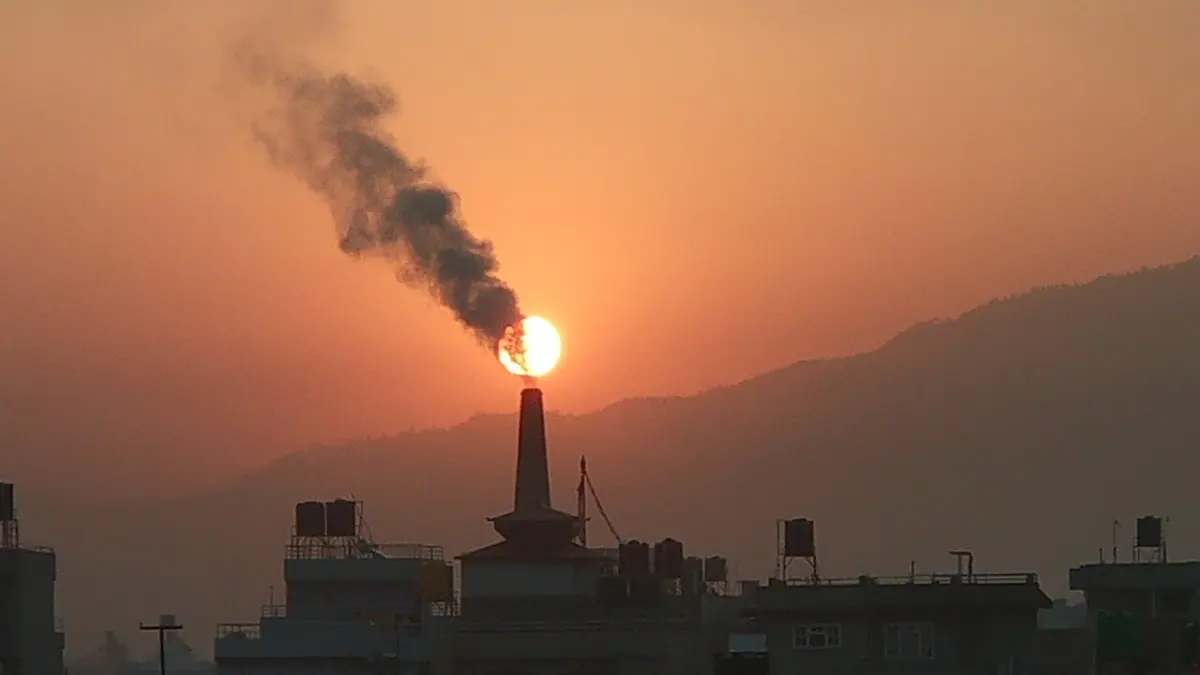
But a design works only as well as it is run. A zigzag kiln stacked carelessly, so that the air finds a short cut, or fed with big shovelfuls of coal, or lit from cold with wood and old tyres, smokes like the old kilns. In 2017 Nepal’s Department of Environment inspected 30 of the valley’s kilns. On average they were within Nepal’s limits on dust, but black smoke could still be seen from some chimneys during firing.
Refining the fix
To refine a solution is to improve it after seeing how it performs. The zigzag kiln was itself a refinement of the straight-line kiln, and it is still being refined. Since the earthquake, the Clean Brick initiative in Nepal (ICIMOD, the brick makers’ federation and MinErgy) has tested:
- starting the fire with LPG instead of wood and tyres, because lighting a cold kiln is one of the smokiest times;
- training firemen to stack and feed properly, because operation matters as much as design;
- hollow bricks, which use less clay and need less fuel to fire, and are strong enough for most walls;
- internal fuel: mixing a little powdered coal or waste into the clay, so the brick helps to fire itself and burns more evenly;
- biomass pellets in place of some of the coal.
There are also other designs. A vertical shaft brick kiln (VSBK) fires bricks as they move slowly down a shaft, the hot gases rising through them: in the Indian tests it used 15–50% less energy than the zigzag kilns and gave out almost no soot, but it fires fewer bricks a day, and some clays make poor bricks in it. A tunnel kiln, a long tunnel through which cars of bricks roll past a fixed fire, is clean and makes the best bricks, but costs 10 to 20 times as much to build (though it also fires several times as many bricks). And bricks needn’t be fired at all: compressed stabilized earth blocks, soil with a little cement pressed hard, need no kiln.
| Kiln | CO₂ per kg of brick | Soot per kg of brick | Cost to build, per million bricks a year | First-class bricks |
|---|---|---|---|---|
| straight-line (FCBTK) | 115 g | 0.13 g | about US$8,000 | 55–60% |
| zigzag | 103 g | 0.04 g | about US$10,000–14,000 | 80–90% |
| vertical shaft (VSBK) | 70 g | 0.002 g | about US$48,000 | depends on the clay |
| tunnel | 166 g | too little to measure | about US$86,000 | the best |
(Measured in India in 2011, one to three kilns of each. The tunnel kiln’s figure includes the fuel for drying its bricks. The vertical shaft kiln’s cost is for the Indian two-shaft design; a bigger Vietnamese one cost about twice as much per brick.)
Which is best? It depends on what matters most to you.
A fix with side effects
Sometimes a fix for one problem makes another, smaller one. Coal-burning power stations and factories cut acid rain by fitting scrubbers (flue-gas desulphurisation units): the smoke rises through a tower while a fine spray of powdered limestone in water falls through it. The limestone reacts with the sulphur dioxide, and with oxygen from air blown into the tank below, and turns into gypsum:
A scrubber removes 90–98% of the sulphur dioxide. It works, and it has made much of the world’s rain far less acid. But look at the equation: for every molecule of sulphur dioxide it takes out, it releases one molecule of carbon dioxide from the limestone. It also needs limestone, quarried and carried to the station, and electricity to run its pumps and fans, about 1–2% of what the station produces.
The United States made power stations cut their sulphur dioxide from 1990, letting each company choose how (scrubbers, low-sulphur coal or closing old stations) and letting them buy and sell permits to emit. By 2018 the power stations in the program gave out about 92% less sulphur dioxide than in 1990, and rain in the eastern USA became much less acid. The lakes have been slower: many are still recovering, decades later, as their soils slowly lose the acid they soaked up. Cutting a pollutant can work fast; the damage it did can take much longer to heal.
Fixes for the whole planet
Some people have proposed fixes for climate change on the scale of the whole Earth, called geoengineering. Here too the same questions apply.
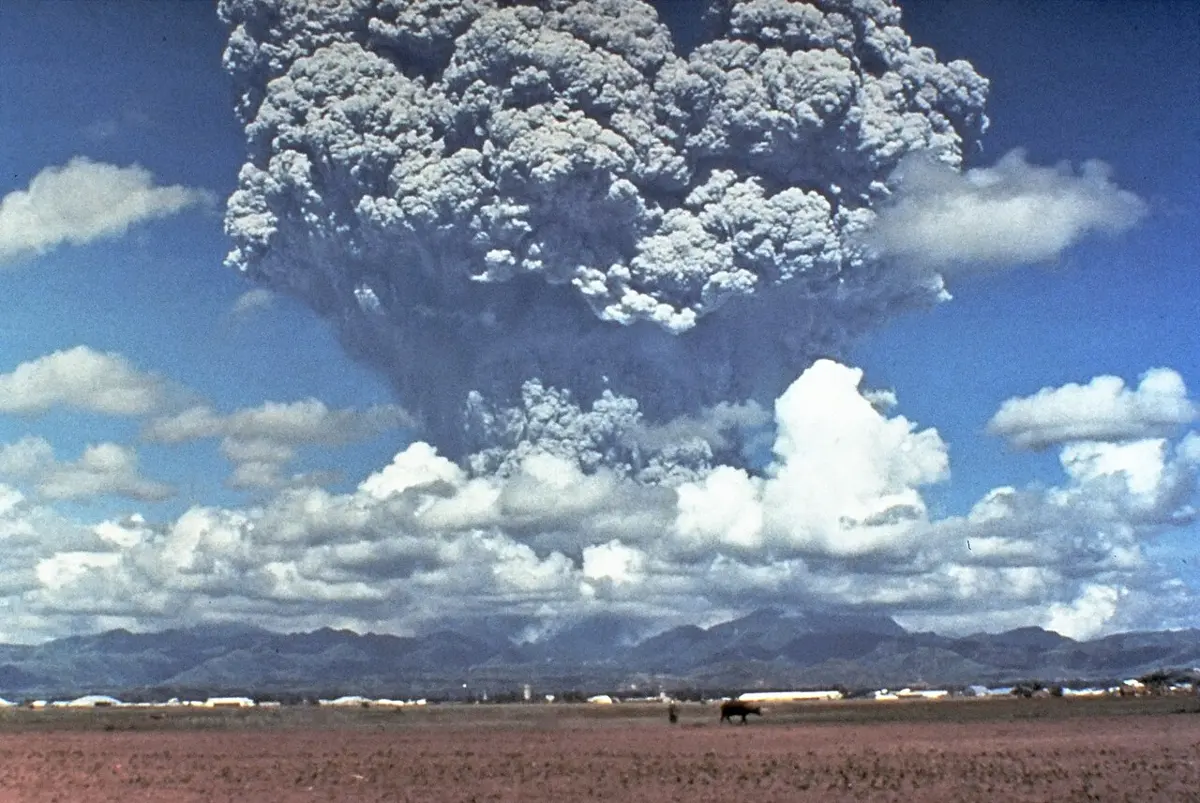
One idea is to cool the Earth by putting a haze of tiny sulphate droplets into the stratosphere, to reflect some sunlight back to space. Nobody has tried it on purpose, but a volcano did it once by accident. In June 1991 Mount Pinatubo in the Philippines blew about 15 million tonnes of sulphur dioxide into the stratosphere. Over the next year, the Earth’s average temperature fell by about half a degree. So the idea would cool the Earth. But the measurements also showed side effects: in the year after the eruption, rain over land around the world fell sharply, and the water flowing from the world’s rivers into the sea dropped to the lowest in the record. For Nepal, which depends on the monsoon for its water, food and electricity, that is not a small side effect. And the haze would do nothing for the carbon dioxide still building up, which also makes the sea more acidic; and if it were ever stopped suddenly, the warming it had hidden would come back within a few years.
Another idea is to suck carbon dioxide straight out of the air with machines, direct air capture, and store it underground as rock.
Test a fix yourself
Questions
A zigzag kiln burns coal containing 1% sulphur. Compared with a straight-line kiln burning the same coal to fire the same bricks, what happens to its sulphur dioxide?
Pick an answer to see why.
Which result would best show that a new kiln design cuts soot?
Pick an answer to see why.
Explain why a zigzag kiln cuts black carbon (soot) by much more than it cuts carbon dioxide.
Answer
Black carbon is unburnt carbon: it comes from coal that burns incompletely, because the air passes too fast or mixes poorly with the fuel. In a zigzag kiln the air follows a path about three times as long, faster and more turbulent, so it mixes well with the coal and the carbon burns completely; much less soot is made. Carbon dioxide comes from burning carbon at all: each kilogram of carbon that burns completely makes 3.7 kg of carbon dioxide. Burning more completely doesn’t reduce it; only burning less coal does. The zigzag kiln needs only about 10–25% less coal per brick, so carbon dioxide falls by about that much, while soot falls by about half or more.
A straight-line kiln gives out 0.86 g of dust per kilogram of brick and a zigzag kiln 0.26 g. a. Calculate the percentage change. b. A house needs 30,000 bricks of 3 kg each. How much less dust is given out in firing its bricks in a zigzag kiln?
Answer
- a.Percentage change = (0.26 − 0.86) ÷ 0.86 × 100% = −0.60 ÷ 0.86 × 100% = −70%: a cut of 70%.
- b.Mass of bricks = 30,000 × 3 kg = 90,000 kg. Dust saved = 90,000 kg × (0.86 − 0.26) g/kg = 90,000 × 0.60 g = 54,000 g = 54 kg less dust.
Two reports on a new kiln design say it cuts soot by “30%” and by “55%”. Both used the same measurements. Explain how both can be right.
Answer
They divided by different things. Soot per kilogram of coal fell by about 30%, because the coal burns more completely. But the new design also needs less coal to fire each brick. Soot per brick = soot per kilogram of coal × coal per brick, and both of these fell, so soot per brick fell by more, about 55%. To compare claims, always ask what the emission is measured per. Per brick is the more useful, because bricks are what the kiln is for.
A town wants to cut smoke from cooking. A laboratory test shows that a new stove gives out 60% less smoke than an open fire. Design a fair test of whether the stoves will really cut the smoke that families breathe. Say what you would measure, how you would make the comparison fair, and for how long.
Answer
- Compare: many households (hundreds), split at random into a group offered the new stove and a group that isn’t, so that the two groups are alike in everything else (choosing them at random stops, say, richer or more careful families all ending up in one group).
- Measure: the smoke the cooks actually breathe (carbon monoxide in their breath, or a small monitor worn while cooking), how often the new stove is used, the wood used, and health (coughs, breathing).
- Fair: measure both groups the same way, at the same seasons; record whether the stoves are still working.
- How long: for several years, not just the first weeks, because stoves break and habits change. The Odisha study found a real cut in the first year that disappeared after that.
Use the table of four kilns in this topic to evaluate the choice between a zigzag kiln and a vertical shaft kiln (VSBK) for a brick maker in the valley. Give at least two criteria on which each is better, and say which you would recommend, and why.
Answer
- VSBK is better on carbon dioxide (70 g against 103 g per kg of brick, about a third less) and on soot (0.002 g against 0.04 g, almost none).
- Zigzag is better on cost (about US$10,000 against US$48,000 per million bricks a year), on output (a zigzag kiln fires millions of bricks a season, a VSBK far fewer), on brick quality (80–90% first-class; a VSBK makes poor bricks with some clays), and it can be built on an existing kiln’s site with the same skills.
- Recommendation: either can be justified if the reasons are given. For example: a zigzag kiln now, because it is affordable, pays for itself quickly and already cuts soot by about two-thirds, with refinements (LPG start-up, trained firemen, hollow bricks) to cut more; or a VSBK where the clay suits it and money can be found, if climate and health are given the most weight. A good answer names the trade-off: the cleaner kiln costs more and makes fewer bricks.
A coal power station removes 190 t of sulphur dioxide a day with a limestone scrubber. How much limestone does it use, and how much carbon dioxide does the scrubber give out, each day? (64 g of SO₂ react with 100 g of CaCO₃ and give 44 g of CO₂.) Is the scrubber worth fitting? Give a reason.
Answer
Limestone = 190 t × 100/64 = 297 t a day (about 300 t). Carbon dioxide = 190 t × 44/64 = 131 t a day.
Yes, in most cases: the extra carbon dioxide is a tiny fraction of what the station already gives out from burning coal (thousands of tonnes a day), while removing 190 t of sulphur dioxide a day greatly reduces acid rain and the lung disease that sulphur dioxide and the particles made from it cause. The side effects (limestone quarrying, a little extra CO₂, some electricity) are small beside the benefit, and the gypsum can be sold. (A full answer weighs the side effect against the benefit, with numbers.)
In 1991 the eruption of Mount Pinatubo cooled the Earth by about 0.5 °C for a year or two. Some people suggest copying it on purpose to fight global warming. Using what was measured after Pinatubo, give two reasons why this fix should be treated with great caution, especially by a country like Nepal.
Answer
Any two, explained:
- Rainfall: after Pinatubo, rain over land worldwide fell sharply, and the flow of the world’s rivers to the sea dropped to the lowest in the record. Nepal depends on the monsoon for drinking water, crops and hydroelectricity, so a weaker monsoon could do great harm.
- It doesn’t remove carbon dioxide: the CO₂ would go on building up, and the sea would go on becoming more acidic.
- Stopping it suddenly: the haze falls out within a year or two, so it would have to be renewed constantly; if it stopped, the hidden warming would return within a few years, much faster than living things or people could adapt.
- It could make people cut emissions less, if they think the problem has been solved.
- Who decides: it would change the weather of every country, but could be done by one.
Where to go next
- Which Energy Should Nepal Use? Hydropower, solar, wind and imported fuels, compared by cost, reliability and their effect on land, rivers and the air.
- What Will the Climate Be Like When You Are Grown Up? How climate models work, what they predict for Nepal, and what the choices made now would change.
- Can One Change Set Off Many More? How soot on snow, cleared forests and dams set off chains of changes, and why a fix can have effects far from where it is made.